You’ve heard the warning a hundred times. Don’t cook with extra virgin olive oil. Save it for salads. Use something “neutral” for heat.
That advice has misled home cooks for years.
The question isn’t just, can i use extra virgin oil for cooking. You can. The better question is whether you understand what makes a cooking oil perform well in a hot pan. Many were taught to obsess over smoke point and ignore the thing that matters more in real kitchens: oxidative stability.
That single mistake has sent generations of cooks toward bland, highly refined oils while keeping one of the most useful fats in the kitchen trapped in a drizzle bottle.
Extra virgin olive oil is not fragile decoration. It’s a working oil. It can sauté, roast, bake, and handle the everyday heat most cooks use. If you start with a good bottle, store it properly, and use it with some judgment, it will reward you with better flavor and a smarter fat profile than many oils marketed for “high heat.”
The Question Every Cook Asks About Olive Oil
A good bottle of extra virgin olive oil creates a strange hesitation in people. They’ll spend money on it, admire the label, sniff the grass and pepper in the glass, then treat it like a museum piece. A finishing oil only. A dipping oil only. A special-occasion oil.
That hesitation comes from a myth repeated so often it hardened into kitchen law: never heat extra virgin olive oil.
It’s bad advice.
Professional cooks have used olive oil over heat for generations because they care about what happens in the pan, not what gets repeated on food packaging. They know flavor matters. They know performance matters. And they know the right oil doesn’t stop being useful the moment flame enters the room.
If you’re still fuzzy on what makes an oil “extra virgin” in the first place, it helps to start with a clear definition. This guide on what extra virgin olive oil is lays out the basics without the usual marketing fog.
Why the confusion stuck
A lot of food advice gets simplified until it becomes wrong. People heard that extra virgin olive oil has a lower smoke point than some refined oils. Then they jumped to a lazy conclusion: lower smoke point means bad for cooking.
That leap ignores how cooking works.
Most home cooking doesn’t happen at violent, restaurant-deep-fryer extremes. It happens in a skillet, in an oven, over moderate heat, with food in the pan and moisture affecting the temperature. In that world, extra virgin olive oil is not only usable. It’s often a smart choice.
You don’t need to save the good oil for the final drizzle. You need to know when the pan, the food, and the oil are working together.
The practical answer
Yes, you can cook with extra virgin olive oil. Not just barely. Confidently.
Use it when you want:
- Better flavor in vegetables, fish, beans, eggs, and roasted dishes
- A less processed fat than many refined alternatives
- An oil that contributes something instead of merely lubricating the pan
The mistake isn’t cooking with EVOO. The mistake is buying tired oil, storing it badly, and judging it by the wrong standard.
The Great Smoke Point Misunderstanding
Smoke point became the celebrity metric because it’s easy to talk about. One number. One chart. One shortcut. But it’s a poor way to judge whether an oil belongs in your kitchen.
A better analogy is the redline on a car. It tells you the upper limit, but it doesn’t tell you how the engine behaves on the road. Most cooks don’t live at the redline. They sauté, roast, warm, sear lightly, and bake. They operate in the normal range.
High-quality extra virgin olive oil sits comfortably in that range. It has a smoke point ranging from 320°F to 410°F (160°C to 210°C), and it contains 73% monounsaturated fats, 11% polyunsaturated fats, and 14% saturated fats. More important, its stable fat profile and natural antioxidants support strong performance under heat, which is why the smoke point argument by itself falls apart when you look closer at the evidence from Healthline’s review of EVOO and heat.

What smoke point tells you, and what it doesn’t
Smoke point tells you when visible smoke begins. That matters, but it doesn’t answer the bigger question: how well does the oil resist breaking down while heated?
That’s oxidative stability.
An oil can have an impressive smoke point on a label and still perform poorly if its fatty acids oxidize easily. That’s the trap with many oils sold as “high heat” solutions. Their numbers look reassuring. Their chemistry is less so.
Why EVOO holds up
Extra virgin olive oil has two big advantages in the pan:
- Its fat structure is stable. Monounsaturated fats are less vulnerable to damage under cooking conditions than more fragile oils rich in polyunsaturated fats.
- It brings protective compounds with it. Natural antioxidants help guard the oil during heating.
That’s why the conversation should move away from fear and toward quality. Fresh, well-made EVOO is not a delicate flower. It’s a resilient cooking fat with character.
Practical rule: Don’t choose a cooking oil by the loudest number on the label. Choose it by how well it stays intact under the heat you actually use.
If you want a broader comparison to help choose oils for home cooking, smoke point charts can still be useful, as long as you treat them as one piece of the puzzle, not the whole verdict.
For a deeper look at where EVOO fits on that spectrum, this page on the smoke point of EVOO is a helpful companion.
What the industry got wrong
The industry loves refined oils because they’re neutral, predictable, and easy to position as technical solutions. “Higher smoke point” sounds scientific. It sounds safe. It sounds modern.
But cooking isn’t won by sterile numbers alone.
A good cooking oil should survive the heat you use, complement the food, and avoid becoming the weak link in the meal. Extra virgin olive oil checks those boxes far more often than it’s given credit for.
A Practical Guide to Cooking With EVOO
Kitchen confidence comes from knowing what the oil should look like, smell like, and do in the pan. The average stovetop cooking temperature is around 350°F, which sits within the safe working range of good-quality extra virgin olive oil, as noted in the earlier evidence on EVOO and heat performance.

A lot of cooks wait for a pan to look angry before adding food. That’s where they get into trouble. EVOO works best when you heat it with intention, not bravado.
Sautéing and everyday skillet cooking
Here, EVOO earns its keep.
For onions, garlic, greens, mushrooms, chickpeas, eggs, fish fillets, and chicken cutlets, extra virgin olive oil is one of the most useful fats you can pour. You want the oil to shimmer, not smoke. Once it loosens and glides across the surface, add the food.
Watch for these cues:
- Shimmering surface means the oil is ready.
- Quiet, steady sizzle means the heat is in the right zone.
- Harsh smoke or burnt aroma means the pan’s too hot. Pull it back.
Roasting and baking
Roasting vegetables with EVOO is one of the easiest ways to prove the myth wrong. Potatoes, carrots, cauliflower, squash, fennel, and onions take beautifully to it. The oil helps with browning, carries flavor into the food, and creates a richer finish than many neutral oils.
Use enough to coat, not drown. Toss well. Salt after coating so the seasoning adheres evenly.
For baking savory dishes, EVOO brings a fuller taste. It’s especially useful in focaccia, rustic cakes, sheet-pan dinners, and baked fish.
Stir-frying and moderate pan-frying
You don’t need to ban EVOO from faster, hotter methods. You need control.
If you’re stir-frying, prep every ingredient before the oil hits the pan. The mistake isn’t the oil. The mistake is heating an empty pan too long while you hunt for the ginger. Add the food promptly and keep it moving.
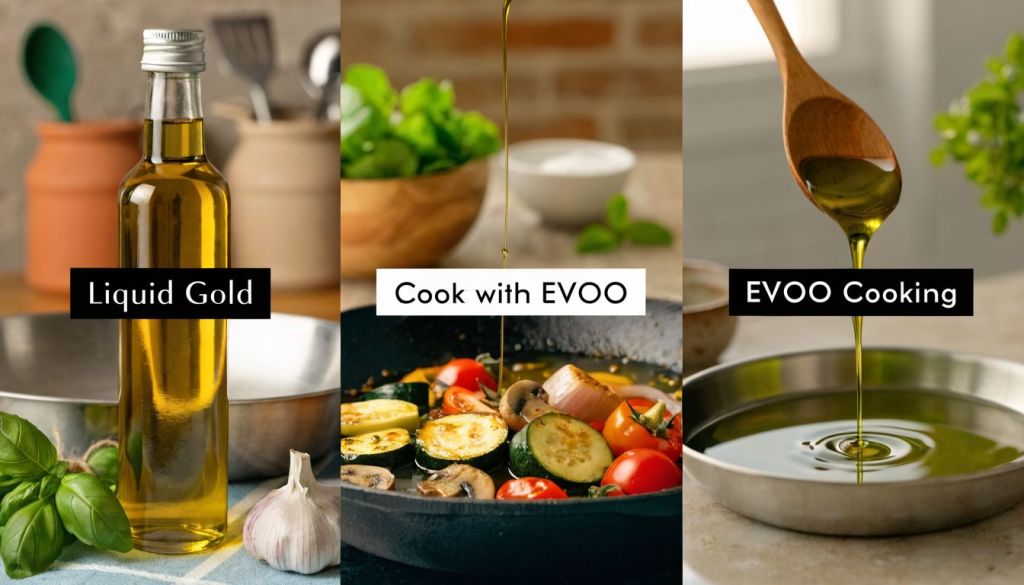
A useful visual reference helps here:
What works and what doesn’t
Here’s the plain kitchen version.
| Cooking method | EVOO works well when | It works poorly when |
|---|---|---|
| Sautéing | the pan is preheated moderately and food goes in on time | the pan is left empty until the oil smokes |
| Roasting | vegetables or proteins are evenly coated | the oven does all the work but the food is crowded and steams |
| Stir-frying | ingredients are ready and the cook stays attentive | the cook wants a long, unattended blast of heat |
| Pan-frying | heat is moderate and the oil is refreshed as needed | heat is pushed too high for too long |
For more detailed kitchen applications, this guide on how to cook with olive oil is worth keeping nearby.
If your technique is sloppy, no oil will save you. If your technique is sound, EVOO is one of the most versatile fats in the kitchen.
How Heat Unlocks Health and Flavor
The narrow version of this conversation asks whether EVOO can survive cooking. The more interesting version asks what it contributes once heat enters the picture.
The answer is a lot.
Research discussed in this analysis of cooking vegetables with EVOO shows that cooking foods like broccoli in extra virgin olive oil can preserve nutrients like vitamin C better than seed oils and can raise the dish’s antioxidant levels compared with the raw or boiled versions because beneficial phenols from the oil move into the food through cooking, as explained in this video discussion of EVOO and cooked vegetables.

What happens in the pan
Good olive oil doesn’t just sit around the food. It participates.
When you cook vegetables in EVOO, the oil helps carry fat-soluble flavor compounds and coats the surface in a way that changes both taste and texture. Bitter greens soften. Sweet vegetables deepen. Aromatics bloom. The whole dish rounds out.
That’s why roasted carrots in a richly flavored olive oil taste more complete than the same carrots cooked in a flat, neutral oil. The difference isn’t imaginary. It’s on the plate.
When premium oil makes sense
Not every dish deserves your most peppery, assertive bottle. Some do.
Use stronger, greener oils when you want the oil to speak clearly:
- Roasted vegetables that benefit from grassy or peppery notes
- Beans and lentils that need structure and richness
- Tomato-based dishes where olive oil and acidity sharpen each other
Use milder oils when the food is more delicate:
- white fish
- simple cakes
- soft scrambled eggs
If you want ideas that naturally suit this style of cooking, you can discover Mediterranean diet recipes that put olive oil where it belongs: at the center of the meal, not at the sidelines.
For a more focused explanation of why heat and olive oil can work together so well, see cooking with olive oil benefits.
The smartest use of EVOO isn’t treating it as too precious to cook. It’s matching the oil’s personality to the dish.
Choosing and Storing the Right EVOO for Your Flame
A tired bottle will make a liar out of every good argument for cooking with EVOO.
Freshness matters because oxidative stability declines over time and with exposure to heat and light. For cooking performance, choose a bottle with a recent harvest date, ideally within 18 months, and store it in a cool, dark place away from the stove, based on guidance from the Olive Wellness Institute on cooking with extra virgin olive oil.

What to look for on the bottle
Many shoppers fixate on “best by” dates because they’re easy to find. That’s not the sharpest tool.
Look for:
- Harvest date instead of relying only on the back-end shelf date
- Dark glass or protective packaging that helps shield the oil from light
- A producer willing to tell you origin and style, not just sell a vague “Mediterranean blend”
If you’re comparing options, best extra virgin olive oil for cooking offers a useful framework for sorting bottles by use case rather than label drama. Learn Olive Oil is one resource among many that organizes this information around cooking needs, flavor style, and buying cues.
Where people ruin a good bottle
The worst storage spot in most kitchens is the one people use most often: right beside the stove.
That spot exposes the oil to heat spikes and light. Over time, that chips away at the very qualities you paid for. Keep the bottle in a cupboard or pantry that stays relatively cool and dark. Pour a small amount into a day-use cruet only if you refill it often and protect it from light.
A few warning signs matter:
- Flat aroma instead of fresh olive, grass, or fruit notes
- Stale or tired taste that makes food feel dull
- Neglect disguised as thrift, where a bottle lingers so long that it stops performing
Cooking oil and finishing oil don’t have to be enemies
You don’t need one oil for worship and another for labor. You need the right bottle for the way you cook.
Some households do well with two EVOOs. One bold bottle for roasting, sautéing, and pan work. One more delicate bottle for dressing, dipping, and finishing. That’s not extravagance. It’s practical flavor management.
Embrace the Flame and Enjoy the Flavor
The old warning against cooking with extra virgin olive oil survives because it’s simple. Simple advice spreads fast, even when it leaves out the truth.
The truth is better. EVOO belongs in a working kitchen.
It handles everyday cooking. It brings flavor instead of blankness. It offers a stable fat profile for everyday use. And when you buy a fresh bottle and store it with some care, it rewards heat rather than fearing it.
This changes how you shop and how you cook. You stop chasing oils because a label promised “high heat.” You start paying attention to freshness, flavor, and stability. You stop saving olive oil for the final flourish and start building meals with it from the first sizzle in the pan.
That’s where olive oil shows its full value. Not in ceremony. In practice.
Use it for the onions that begin a soup. For the vegetables that roast until sweet at the edges. For the fish that needs a gentle, savory cushion in the skillet. For the weeknight meal that should taste better than it has any right to.
The bottle on your counter is not too good to cook with.
It’s good because you should.
If you want to cook with more confidence, buy smarter bottles, and understand what separates fresh, flavorful EVOO from forgettable oil, visit Learn Olive Oil. It’s a practical resource for choosing, tasting, and using premium olive oil in real kitchens.
 Learn Olive Oil
Leave a comment