For years, a single, stubborn myth has kept your best bottle of extra virgin olive oil trapped in the pantry, reserved only for salads and bread dipping. You’ve heard the story a hundred times: EVOO is simply too precious, too delicate for real cooking. Its smoke point is dangerously low, and heating it is a cardinal sin of the kitchen.
This, my friends, is one of the most pervasive—and costly—misunderstandings in the entire culinary world. And it’s robbing your food of incredible flavor.
The Great Misconception About Cooking With EVOO
The fear campaign against cooking with extra virgin olive oil has been wildly successful. It has paralyzed home cooks, forcing them to reach for lesser, blander oils the moment the stove clicks on. But here’s the unvarnished truth: this fear is built on a foundation of incomplete science. It obsesses over a single number—the smoke point—while ignoring the one factor that truly matters: an oil’s oxidative stability.
This misguided belief is just one of many culinary tall tales that need correcting. We break down even more in our guide to common olive oil myths.
Today, we will finally set the record straight and reveal just how tough, resilient, and utterly magnificent a high-quality EVOO is when the heat is on.
Think of an oil's smoke point like a car's top speed—it's an impressive number, but not something you're likely to hit during your daily commute. An oil's stability, on the other hand, is like its engine's reliability on a long road trip. That's what really matters.
Understanding The Numbers
So, what is the actual smoke point of extra virgin olive oil? The answer isn't one number, but a range: most quality EVOOs fall somewhere between 350°F and 410°F (177°C to 210°C). This range exists because the smoke point is a direct reflection of an oil’s quality and freshness.
Let's put that into perspective. A quick glance at this chart reveals that EVOO is more than equipped for the vast majority of your daily cooking needs.
Smoke Point Quick Guide for Common Cooking Oils
| Cooking Oil | Typical Smoke Point Range (°F) | Typical Smoke Point Range (°C) | Best For |
|---|---|---|---|
| Extra Virgin Olive Oil | 350-410°F | 177-210°C | Sautéing, roasting, light frying |
| Refined Olive Oil | 390-470°F | 199-243°C | High-heat frying, searing |
| Canola Oil | 400°F | 204°C | General-purpose cooking |
| Avocado Oil | 520°F | 271°C | High-heat searing and frying |
| Coconut Oil | 350°F | 177°C | Sautéing, baking |
| Butter | 302°F | 150°C | Low-heat baking, sautéing |
As you can see, EVOO is far from the fragile flower its reputation suggests. It holds its own against many kitchen staples.
Now, let's look at a visual comparison. This infographic breaks it down nicely, comparing EVOO to refined olive oil and butter.
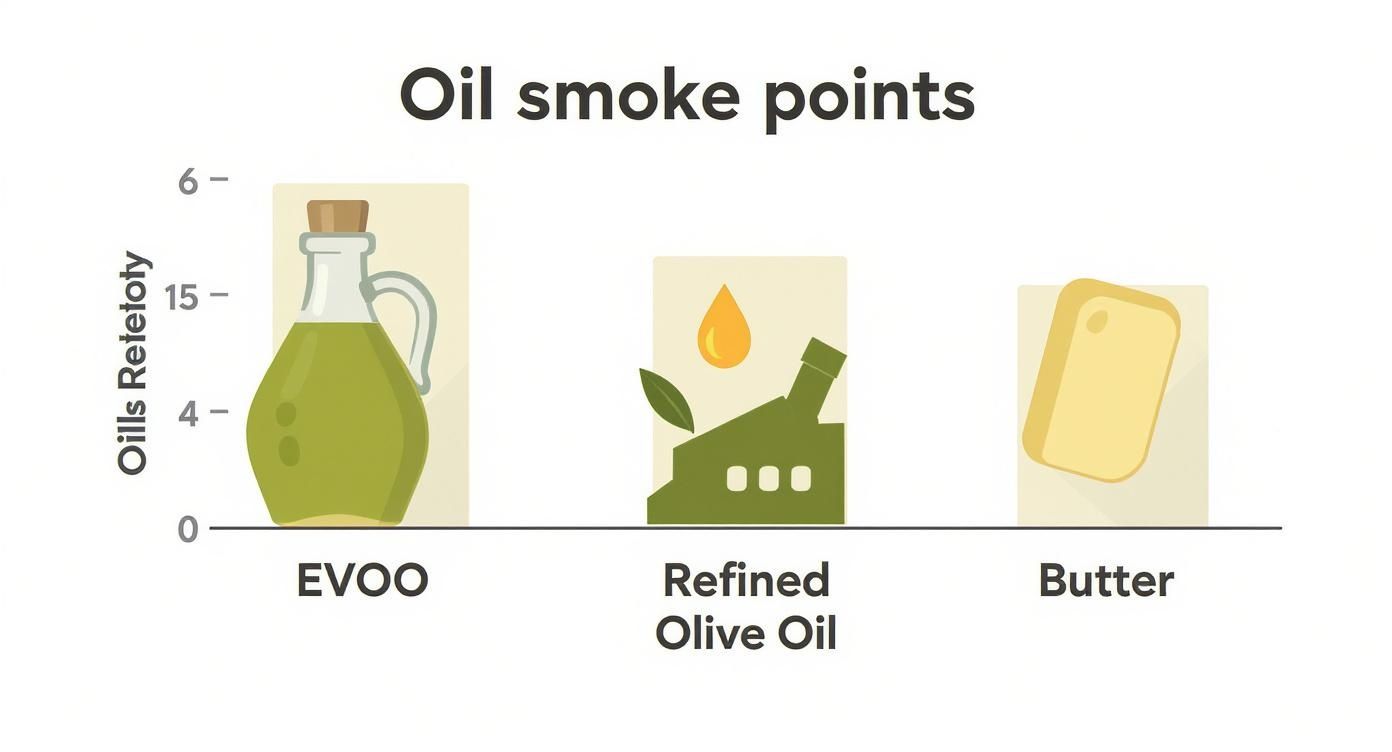
While it's true that refined oils can hit higher temperatures, that "benefit" comes at a steep price. The refining process strips away not just flavor, but the very antioxidants that make EVOO so remarkably stable. A good EVOO’s smoke point is perfectly suited for nearly everything you do, from sautéing greens to pan-searing fish.
Once you truly accept this, you’ll unlock a new level of confidence, finally letting your best olive oil do what it was born to do: make your food unforgettable.
What Really Determines an Olive Oil's Smoke Point
Have you ever wondered why one bottle of extra virgin olive oil stands up to a hot pan like a champion, while another sputters and smokes almost instantly? This isn't random chance. The secret lies not in a generic number, but in the quality, freshness, and craftsmanship sealed within that bottle.
To truly understand the smoke point of EVOO, you must look beyond the label and appreciate the hidden variables that separate a magnificent, versatile cooking oil from a mediocre one. These are the factors that dictate performance when the fire is lit.
Free Fatty Acids: The Ultimate Quality Marker
The single most critical factor is the Free Fatty Acid (FFA) level. Think of FFA as a brutally honest report card on the oil's purity and integrity. A low FFA is the signature of a superior oil, proof that the olives were harvested with precision, handled with care, and milled with speed. It is a mark of excellence.
When FFA levels rise, the oil’s stability plummets, dragging the smoke point down with it. This is precisely why a premium EVOO, with an FFA often below 0.3%, will run circles around a generic, mass-market oil. A lower FFA directly translates to a higher, more reliable smoke point.
Why Filtration is a Cook’s Best Friend
Next, consider filtration. Unfiltered oils contain microscopic particles of olive fruit suspended in the liquid. While some may find the cloudy, rustic look appealing, these solids are trouble in a hot pan.
They burn and scorch long before the oil itself hits its limit, creating smoke and giving you the false impression that your oil has failed. A properly filtered oil, by contrast, is pristine. With those solids removed, the oil heats cleanly, reaching a much higher temperature before smoking. This is a crucial detail for anyone curious about what olive oil is actually made of.
The smoke point for olive oils is not one-size-fits-all. It's a dynamic range influenced by quality, filtration, and age. This is why you see such a broad spectrum of temperatures reported.
Finally, time and poor storage are the mortal enemies of good olive oil. Exposure to its three foes—heat, light, and air—triggers a process of decay. This degradation raises the FFA level and, inevitably, lowers the smoke point. That old bottle sitting on your sunny countertop is a mere ghost of its former self.
These variables explain why you see such a massive reported range for olive oil's smoke point—anywhere from 347°F (175°C) to as high as 464°F (240°C). It all comes down to the quality you start with. You can find more great info on how processing affects heating olive oil on oliveoilsource.com.
Why Stability Is the Unsung Hero of Cooking Oils
While smoke point grabs all the headlines, it’s a distraction from the real story. The true test of a cooking oil’s greatness is its oxidative stability—its ability to resist breaking down under heat. This is what separates a safe, healthy cooking partner from one that creates harmful compounds when the temperature rises.
Think of it as an oil’s inner fortitude. This is where high-quality extra virgin olive oil doesn’t just compete; it dominates.
EVOO’s Natural Defense System
What gives EVOO this incredible resilience? It comes armed with a natural defense system: a powerful army of antioxidants and polyphenols. These compounds are the oil’s personal bodyguards, shielding its delicate fatty acids from the onslaught of heat and oxygen.
This is precisely why a world-class EVOO is a profoundly safer choice for cooking than a highly refined seed oil, even if the seed oil claims a higher smoke point. The brutal refining process strips those other oils of their natural protectors, leaving them naked and vulnerable to rapid degradation under heat.
It’s like picking a well-built brick house to ride out a storm instead of a flimsy tent. The tent might have a taller pole, but you know which one you’d rather be in when the wind really picks up.
This isn't just a charming theory; it's proven science. Studies have shown that even after hours of continuous frying, EVOO’s smoke point remains remarkably stable, holding strong around 375°F (190°C), thanks entirely to its antioxidant shield. You can read more about EVOO's impressive performance under heat on papavince.com.
The more of these protective compounds an oil possesses, the better it will perform. To learn what makes these oils so special, explore our guide on high polyphenol olive oil.
Cooking Confidently With Extra Virgin Olive Oil
Let’s bring this revelation out of the lab and into your kitchen, where it belongs. Now that you know the truth about the smoke point of EVOO, you can finally cook with it fearlessly. This is your new license to create dishes that are not just healthier, but bursting with a depth of flavor you’ve been missing.
It’s time to banish the old myths. A high-quality extra virgin olive oil is one of the most versatile and valuable tools in your culinary arsenal. From sautéing crisp asparagus to pan-searing a steak, its smoke point is more than capable of handling the task with grace.
Your Guide To Everyday Cooking Temperatures
The simple fact is, most of your home cooking takes place at temperatures comfortably below the smoke point of a good EVOO. Here’s how your favorite methods really stack up:
- Sautéing and Stir-Frying: Typically done between 320-350°F (160-177°C), this is the absolute sweet spot for EVOO to shine.
- Roasting Vegetables and Potatoes: Most recipes call for an oven between 375-400°F (190-204°C), a range where a stable EVOO performs beautifully.
- Pan-Searing and Shallow Frying: This method requires heat around 350-375°F (177-190°C), well within the safe zone for a quality oil.
The secret is to learn to listen to your oil. Long before smoke ever appears, your oil will tell you it's ready. Watch for a gentle, elegant shimmer across its surface—that’s your cue to add the food. You can find more great tips in our complete guide on how to cook with olive oil.
The idea that cooking with good EVOO is a 'waste' is one of the most unfortunate kitchen lies. Using a robust, flavorful oil isn't just for finishing; it builds a deep, foundational flavor that neutral oils simply cannot replicate.
This isn’t about waste; it’s about flavor architecture. When you cook with a quality EVOO, its complex, peppery notes don't simply evaporate. They infuse your ingredients, transforming a simple piece of chicken or a handful of mushrooms into something truly extraordinary.
You aren't destroying the health benefits—you're weaving them into the very fabric of your meal. This is how you start creating delicious, healthier dishes using the golden oil you already love.
How to Choose the Right EVOO for High-Heat Cooking
Not all extra virgin olive oils are created equal, especially when the heat is on. Choosing a true workhorse for your stovetop isn’t about grabbing the prettiest bottle; it’s about decoding the clues that signal exceptional quality and radical freshness.
Consider this your field guide to finding an EVOO that won't just survive the heat, but will thrive in it. Once you know what to look for, you can select an oil with a higher, more stable smoke point every single time.
Decoding the Label for Quality
The single most important piece of information on any bottle is the harvest date. Freshness is king. An old oil is a weak oil, having lost the very compounds that grant it stability. Always, without exception, choose the most recent harvest available.
Next, hunt for the Free Fatty Acid (FFA) level. While not always printed, a low FFA is a direct indicator of quality. An FFA below 0.5% is a clear sign that the olives were handled with exemplary care, resulting in a more durable and superior oil.
That peppery kick or slightly bitter finish you taste in top-tier EVOO? That’s not a defect. It's the calling card of polyphenols, powerful antioxidants that act like bodyguards for the oil, protecting it from breaking down under heat.
Early Harvest vs. Late Harvest
The timing of the harvest dramatically alters the oil's character and its performance in the pan.
- Early Harvest EVOO: Pressed from green, unripe olives, this oil is typically more robust, peppery, and grassy. Most importantly, it is brimming with polyphenols, making it the undisputed champion for cooking.
- Late Harvest EVOO: Made from olives that have fully ripened, this oil is often milder, smoother, and more buttery. While fantastic for finishing, its lower polyphenol count means it is less resilient against high heat.
If you're looking for a reliable option, a high-quality product like this Smooth Organic Extra Virgin Olive Oil is a great place to start.
By prioritizing freshness and a robust profile, you’re not just getting an oil that tastes better—you’re getting one that performs better. To dive deeper, check out our guide on finding the best high smoke point olive oil.
Frequently Asked Questions About Cooking With EVOO
Even after debunking the biggest myths, a few practical questions often remain. Let's answer those final "what ifs" so you can step up to the stove with total confidence.
Can I Deep Fry With Extra Virgin Olive Oil?
The short answer is an emphatic yes. While it may feel indulgent, using a high-quality, low-acidity EVOO is a superb and surprisingly stable choice for deep frying.
Most deep frying occurs between 350-375°F (175-190°C), a temperature range a good EVOO handles with ease. Its powerful stability means it resists breakdown better than many refined seed oils. The key is to use a deep-fry thermometer to maintain a steady temperature, ensuring perfectly crispy results without ever challenging the smoke point of EVOO.
Does Heating EVOO Destroy Its Health Benefits?
This is a valid concern, but EVOO is far tougher than it gets credit for. While some of the most delicate polyphenols may diminish with very high, prolonged heat, the oil's core health benefits remain remarkably intact.
The oil's fundamental structure—its heart-healthy monounsaturated fat—is incredibly stable. Better still, research shows that the potent antioxidants in EVOO not only protect the oil itself during cooking but can also be absorbed by your food, making your final dish even more nutritious.
When your oil starts to smoke, it’s a clear signal that it's beginning to break down. This process can create unpleasant flavors and harmful compounds. Acting quickly is the key to saving your dish.
What Should I Do If My Olive Oil Starts Smoking?
If you see the first faint wisp of smoke, you’ve hit the smoke point. The first move is to reduce the heat immediately. Adding your ingredients to the pan will also help bring the temperature down instantly.
However, if the oil is smoking heavily and consistently, it has gone too far. The only correct action is to turn off the heat, allow the oil to cool completely, and discard it. Wipe the pan clean and start over with fresh oil and slightly less heat. Your taste buds will thank you.
At Learn Olive Oil, we believe understanding is the first step to appreciation. We provide the expert insights and tasting guides you need to explore the rich world of premium olive oil. Discover the World of Premium Olive Oil

 Learn Olive Oil
Leave a comment