Pour another drop, and you might be pouring a lie. What really is extra virgin olive oil? I’ll tell you this: it's far more than a fancy label. It’s a promise—a covenant between the producer and you—of breathtaking flavor, unrivaled purity, and a torrent of health benefits locked inside.
To put it plainly, it is the highest grade of olive oil money can buy. Forget what you think you know. Start thinking of it as what it truly is: fresh, unadulterated juice, squeezed directly from olives.
The Undisputed Truth About Extra Virgin Olive Oil
Here’s a secret that will change how you see that bottle forever: stop thinking of olive oil as a common cooking fat and start seeing it as a fruit juice. This one mental shift is the key that unlocks everything. Unlike hyper-processed imposters like canola, vegetable, or even lesser grades of olive oil, real EVOO is never defiled by chemicals or scorched by high heat. It’s a raw, living, natural product.
That single distinction is what makes it "extra virgin." And let me be clear: this isn’t some slick marketing phrase. It's a legally defined, brutally enforced standard of quality. It’s the bright, shining line that separates the genuine article from the legions of fakes cluttering your grocery store shelves.
To earn this coveted title, an oil must pass a grueling, three-part trial:
- Mechanical Purity: It must be born from the simple, physical act of crushing olives. No chemical solvents. No destructive heat. You’ll see honest terms like "cold-pressed" or "cold-extracted," a nod to this ancient, gentle process.
- Chemical Innocence: It must survive a battery of laboratory tests that prove its freshness and certify that it hasn’t begun its inevitable march toward decay.
- Sensory Perfection: This is the final judgment. It must be sniffed and sipped by a trained sensory panel and be found utterly free of flaws, while proudly displaying the vibrant, fruity notes of its noble birth.
The Gold Standard Of Quality
This is where the law gets serious. For an oil to wear the "extra virgin" crown, it must meet ironclad international standards. The International Olive Council and other regulatory bodies decree that EVOO must have a free acidity level of no more than 0.8 grams per 100 grams (≤0.8%). But even more critically, it must be judged to have zero sensory defects by an official tasting panel.
Mark my words: if an oil tastes rancid, musty, or winey, it cannot legally be called extra virgin—I don't care what its lab report says. Both the chemistry and the flavor must be flawless.
This table reveals the stark reality of how EVOO stands apart from its lesser cousins.
Extra Virgin Olive Oil Vs Other Olive Oils At A Glance
| Attribute | Extra Virgin Olive Oil (EVOO) | Virgin Olive Oil | Regular Olive Oil (Pure/Light) |
|---|---|---|---|
| Production Method | Mechanically cold-pressed, no heat or chemicals. | Mechanically pressed, no chemicals. | A blend of refined and virgin oils. Refined using heat and solvents. |
| Acidity Level | ≤ 0.8% (The hallmark of high quality). | Between 0.8% and 2.0%. | Typically below 1.0% after refining. |
| Flavor & Aroma | Fruity, peppery, bitter. Complex and vibrant aroma. | Milder flavor, but may have minor taste defects. | Very mild, neutral, or bland. Lacks distinct olive aroma. |
| Culinary Use | Ideal for dressings, dipping, finishing dishes, and gentle cooking. | Good for general cooking, but lacks the robust flavor of EVOO. | All-purpose cooking where a neutral flavor is desired. |
| Health Benefits | Highest in antioxidants (polyphenols) and healthy fats. | Fewer antioxidants than EVOO. | Most beneficial compounds are stripped away during refining. |
The differences, as you can see, are not subtle. Choosing EVOO means you are demanding an unadulterated product, a pure expression of the olive itself.
Why The Details Matter
This rigid definition is the fortress that protects EVOO from oils deceptively labeled "pure," "light," or just "olive oil." Those products are almost always born in a factory, refined with industrial processes that strip away not only the magnificent flavors and aromas but also the potent, health-giving polyphenols.
The difference is like comparing a glass of just-squeezed orange juice to an orange-flavored drink made from concentrate and water. One is a vibrant, life-giving food. The other is a hollow echo. To truly grasp this, understanding the pivotal role of low acidity in olive oil is your first step toward becoming an insider.
When you choose real EVOO, you are choosing the unblemished soul of the olive, complete with its symphony of flavors and profound health benefits.
From Olive Grove To Your Bottle: The Journey Of True EVOO
Picture yourself standing in an ancient olive grove. The sun warms your skin as it ripens the fruit on gnarled, silver-leafed trees. This is where the story of true extra virgin olive oil begins. Its creation is not an industrial process; it is a craft—a desperate race against time to capture the fruit’s soul from the moment it leaves the branch.
The journey starts with the harvest, and timing, my friend, is everything. Artisans and fiercely dedicated producers don’t just pick olives; they wait for that fleeting, perfect moment of invaiatura, when the fruit blushes from green to violet. Pick too early, and the oil is scarce. Wait too long, and the fruit rots from within, sacrificing the very polyphenols that give EVOO its signature peppery fire and life-extending power.
The Race To The Mill
Once the olive is plucked from the tree, a clock starts ticking—loudly. Every minute an olive waits, it begins to oxidize and ferment, threatening the final oil with foul flavors and rising acidity. This is precisely why the world's greatest producers crush their olives within hours of harvest, not days. Their singular goal: to bottle the fruit’s fleeting perfection.
This urgency leads them straight to the mill, where the miracle of extraction occurs. But banish any images of industrial refining. Making authentic EVOO is a purely mechanical ritual, a method honed over centuries but still true to its brutally simple origins.
A sacred principle of producing extra virgin olive oil is the complete absence of heat and chemicals. The oil is simply pressed or spun from the olive paste, preserving its raw, untamed character. It is, quite literally, fresh fruit juice.
The process itself is a masterclass in elegant simplicity:
- Cleaning and Crushing: The olives are washed and then crushed—pits and all—into a thick, intoxicatingly fragrant paste.
- Malaxation: This paste is then slowly, almost lovingly, stirred. This critical step, called malaxation, coaxes the microscopic oil droplets to join forces, making them eager to separate from the pulp.
- Extraction: Finally, the golden-green oil is liberated. Modern mills use a centrifuge that spins the paste at astonishing speed, pulling the heavier water and solids away from the lighter, pure oil. This is the heart of "cold extraction," a term that promises no heat ever compromised the oil’s integrity.
For a deeper look into the craft and machinery, you can learn more about the astonishing process of making high-quality olive oil and witness how modern technology honors ancient wisdom.
Purity Proven By Process
This flowchart reveals the three pillars of quality control that elevate simple olive juice to the certified glory of Extra Virgin Olive Oil.

As you can see, an oil must triumph in mechanical, chemical, and sensory trials. If it fails even one, it is banished from the kingdom of EVOO.
This entirely mechanical journey—unsullied by solvents or thermal treatments—is what separates true EVOO from every other pretender on the shelf. The final product isn't manufactured; it's released. It’s a testament to the belief that the greatest flavors and most powerful nutrients are not added in a factory but are painstakingly preserved from the grove itself. The result is a vibrant, living oil that carries the soul of its origin directly to your kitchen.
Decoding The Label: A Buyer's Guide To Authenticity
Let’s be honest. The olive oil aisle is designed to overwhelm you. The shelves are a fortress of bottles, each whispering seductive lies of sun-drenched Tuscan hills and ancient family groves. But behind the beautiful glass and poetic nonsense, the reality is often a cheap imitation. Many labels are engineered to confuse, not to clarify.
Right now, you can stop being a victim and start thinking like an insider. The secrets to finding real extra virgin olive oil are hiding in plain sight—if you know the code. It's time to ignore the marketing fluff and laser-focus on the few details that separate the genuine article from the imposters.
The single most powerful weapon in your arsenal is the harvest date. Think of olive oil as what it is: fresh-squeezed fruit juice. And like any juice, it begins to die the moment it's made. Olive oil is at its peak right after pressing; it never, ever improves with age.
A "Best By" date is worse than useless. It is a marketing deception, often stamped for two years after the oil was bottled, which tells you absolutely nothing about when the olives were picked from the tree. You must demand a specific harvest date. For explosive flavor and maximum health benefits, you should only buy oil from the most recent harvest available.
If you cannot find a harvest date, put the bottle down and walk away. Any producer who bleeds for their craft wants you to know precisely how fresh their oil is. This one small detail is your iron shield against stale, dead oil.
Reading Between The Lines
Once you’ve found the harvest date, your next mission is to unmask the oil's true origin. This is where giant brands play a shell game with geography. You’ll see romantic phrases like "Bottled in Italy" or "Packed in Spain" in bold letters, tricking your mind into seeing Italian olives on Italian trees.
This is a deliberate, calculated misdirection. A corporation can legally buy old oil from Tunisia, ship it to Italy for bottling, and then slap "Bottled in Italy" on the label. This shameful but common practice allows them to blend anonymous oils from different countries and harvest years, creating a cheap, soulless product.
To cut through the smoke and mirrors, hunt for these tell-tale signs of authenticity:
- Specific Estate or Region: Does the label name a single farm, a specific mill, or a small, protected growing region? Traceability is the calling card of a proud producer.
- Country of Origin: The label must state "Product of Greece" or "Grown and Milled in Spain," not just the criminally vague "Packed in."
- Olive Cultivar: Just as a winemaker boasts of the grape, serious olive oil producers proudly name the olive variety, like Koroneiki, Picual, or Arbequina.
These details forge an unbroken chain of custody from the tree to your table. To go deeper, our guide to understanding olive oil labeling will transform you into a master detective.
The Power Of Official Seals
Beyond the producer's claims, look for official seals of quality. These are not marketing fluff; they are legally binding, third-party guarantees of authenticity. They are your ultimate defense against fraud.
Two of the most powerful certifications from the European Union will become your best friends in the olive oil aisle:
- PDO (Protected Designation of Origin): This is the holy grail. A PDO seal guarantees the olives were grown, milled, and bottled in a specific, named geographical area using regulated, traditional methods. Every single step is ruthlessly controlled and verified.
- PGI (Protected Geographical Indication): This seal is another potent weapon. It ensures that at least one critical stage of production—growing, milling, or bottling—happened in the named region.
When you see a PDO or PGI seal, you can trust the oil's origin is exactly what it claims to be. It chains that bottle to the land, climate, and traditions of a unique place. Armed with this knowledge, you can stride down that aisle with the confidence of an expert and bring home a bottle of liquid gold every single time.
How To Taste Olive Oil Like An Expert
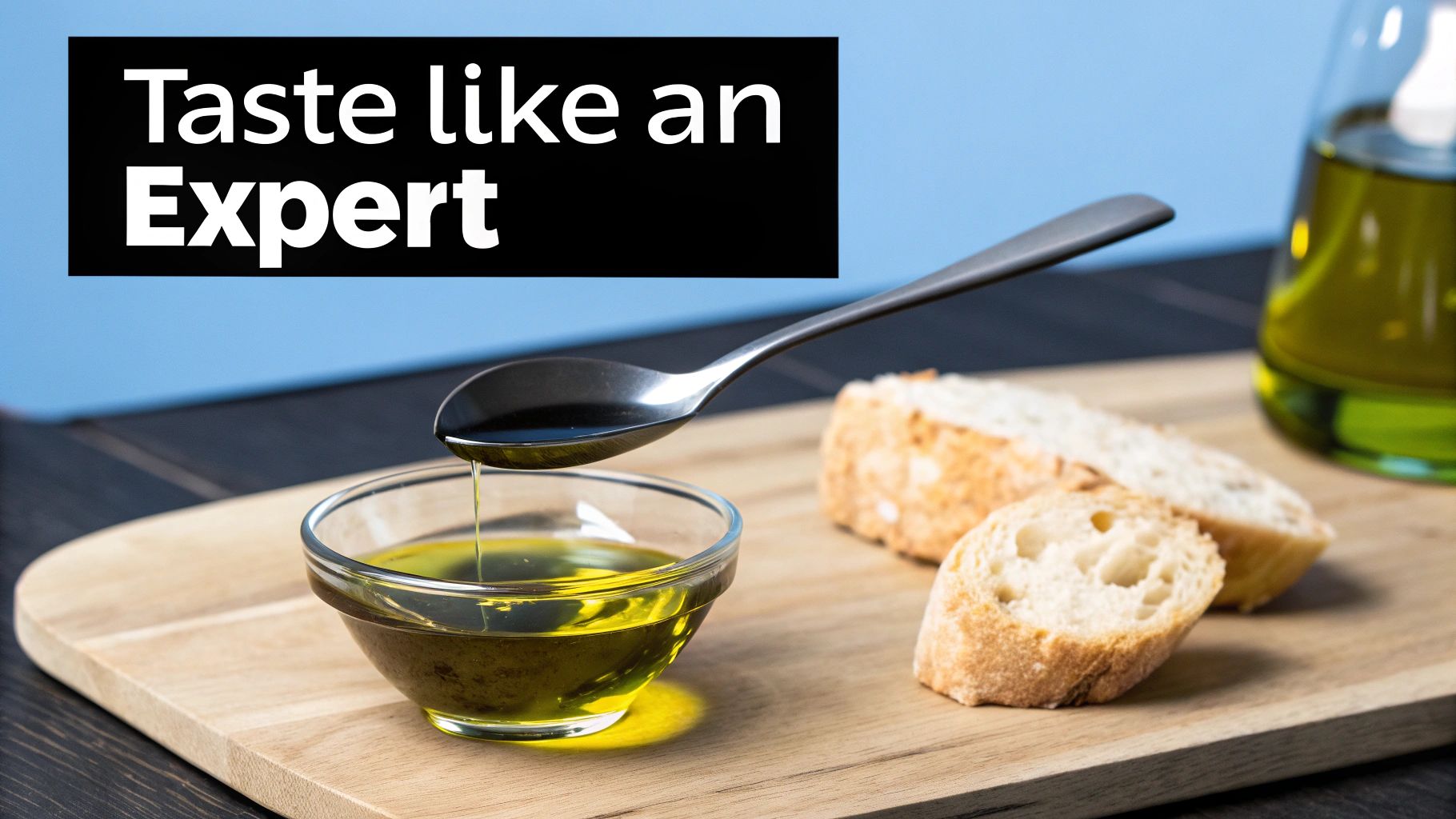
The label on the bottle can tell you a story. But your own senses? They tell you the unvarnished truth.
To truly know what’s in your bottle, you must taste the oil alone, unadorned. Forget dipping bread in a restaurant—that’s a pleasant distraction, not a serious evaluation. Learning to taste properly isn’t a parlor trick; it’s an act of empowerment.
Once you master this simple ritual, no deceptive label or clever marketing will ever fool you again. You will be able to spot freshness, complexity, and the unmistakable signs of a world-class oil in less than sixty seconds.
The Art of the Four S's
Professional tasters follow a disarmingly simple method, often called the "four S's." It is designed to awaken your palate and force the oil to give up every last one of its secrets.
First, pour a small amount of oil—about a tablespoon—into a small, curved glass. A wine glass works beautifully, as the shape concentrates the delicate aromas.
-
Swirl: Cup the glass in one hand to gently warm the oil; this releases its volatile aromatic compounds. Place your other hand over the top to trap them inside, and swirl the glass for about 30 seconds.
-
Sniff: Now, lift the glass to your nose, uncover it, and inhale deeply. What do you smell? Don't just search for "olives." A truly great EVOO will explode with fresh, "green" aromas.
You might discover notes of freshly cut grass, green apple, tomato leaf, even artichoke. These are the positive, fruity characteristics that scream of a well-made oil from healthy, fresh olives. If it smells waxy, musty, or like nothing at all, that is your first glaring red flag.
Unlocking the Flavor Profile
The next two steps are where the truth is revealed. This is where you will experience the two other non-negotiable markers of a world-class extra virgin olive oil: bitterness and pungency.
-
Slurp: Take a small sip of the oil, but do not swallow. Instead, make a sharp "slurping" sound, pulling air across your tongue and through the oil. This action, called stripaggio by Italian masters, atomizes the oil and coats your entire palate, allowing you to perceive its full spectrum of flavors. As you do this, notice its texture. Is it delicate and buttery, or bold and aggressive?
-
Swallow: Finally, swallow the oil. Pay ruthless attention to the sensation at the back of your throat. A high-quality EVOO must deliver a peppery, spicy, or even stinging sensation that might make you cough.
This peppery kick is not a defect—it is the signature of excellence. That sensation is caused by oleocanthal, a powerful anti-inflammatory polyphenol. The stronger the kick, the higher the concentration of this incredibly healthy compound.
A clean bitterness on your tongue is another glorious sign, signaling the presence of other vital antioxidants. A truly great EVOO achieves a perfect harmony between its three key attributes: fruitiness, bitterness, and pungency. If an oil is missing these, it is likely old, refined, or simply an imposter.
If you’re ready to take your skills to the next level, our in-depth guide on professional olive oil tasting techniques will help you refine your palate into a precision instrument.
By practicing these four simple steps, you will transform yourself from a passive buyer into a confident connoisseur, ready to identify true quality with a single taste.
The Powerful Health Benefits Of Authentic EVOO
For millennia, the people of the Mediterranean seemed to hold a secret to long, vigorous life. Now, modern science is finally catching up to their ancient wisdom, confirming that a generous daily dose of authentic extra virgin olive oil is a cornerstone of their remarkable health.
This isn’t about just adding any fat to your diet. The true, explosive power of EVOO comes from a unique synergy of natural compounds that work together to shield and nourish your body from the inside out. While it’s famous for heart-healthy monounsaturated fats, the true superstars are the unseen defenders hiding within the oil.
I’m talking about polyphenols. These are potent antioxidants that are directly responsible for the sensory clues you now know how to look for: that pleasant bitterness on the tongue and the peppery sting in the back of your throat. These aren't just flavor notes; they are the audible proof that an oil is saturated with life-giving compounds.
More Than Just A Healthy Fat
The dominant fat in extra virgin olive oil is oleic acid, a monounsaturated marvel studied for decades for its profound effect on heart health. It plays a critical role in managing cholesterol, helping to suppress the "bad" LDL cholesterol while bolstering the "good" HDL cholesterol.
But that’s only half the story. The real magic begins when you look at the specific polyphenols found only in high-quality, fresh EVOO. These are the very compounds that are utterly annihilated when oil is refined to make "light" or regular olive oil.
That peppery sensation you feel at the back of your throat when you taste a robust EVOO? That's the work of a unique polyphenol called oleocanthal. It possesses natural anti-inflammatory properties that work in a way strikingly similar to ibuprofen, helping to extinguish the chronic, low-grade inflammation that smolders at the root of so many modern diseases.
This is a very big deal. It means a daily drizzle of the right kind of olive oil isn't just a culinary choice—it's an active measure to cool the internal fires that lead to disease.
A Symphony Of Protective Compounds
Beyond just oleocanthal, genuine EVOO is armed with a whole team of antioxidants, each with a specific mission to protect your health.
Another key player is oleuropein, the antioxidant that delivers the oil's bitter taste. It also helps shield blood lipids from oxidative damage—a critical defense against the buildup of plaque in your arteries.
This powerhouse combination of healthy fats and unique antioxidants delivers a cascade of tangible, science-backed benefits:
- Supports Brain Health: New research suggests the compounds in EVOO can help protect brain cells and may play a role in defending cognitive function as we age.
- Fights Oxidative Stress: The army of antioxidants in EVOO neutralizes destructive free radicals, shielding your cells from the damage that leads to premature aging and disease.
- Improves Heart Health Markers: Regular consumption is directly linked to lower blood pressure and improved function of the endothelium, the delicate lining of your blood vessels.
Knowing this makes it brutally clear why choosing authentic EVOO is so vital. These powerful health benefits are incredibly fragile. They vanish when olives are old, processed incorrectly, or chemically refined. To dive deeper into finding oils bursting with these compounds, you can explore the remarkable world of polyphenol-rich olive oil and its benefits.
In the end, the health benefits and the quality of the oil are one and the same. When you choose an EVOO that delivers those vibrant, peppery, and even bitter flavors, you are choosing an oil that is actively fighting to protect your well-being.
The Global World of Olive Oil
When most of us picture extra virgin olive oil, our minds drift to the sun-scorched hills of Italy or the ancient groves of Greece. While these countries are the historic soul of olive oil, the bottle in your kitchen tells a much larger, more complicated story. The world of EVOO is not a collection of quaint villages; it's a massive, interconnected, and often ruthless global market.
Grasping this global picture is the first step to becoming a truly savvy buyer. It explains why a phenomenal oil might come from a country you’d never suspect and why quality can vary so wildly from one bottle to the next. The story of what extra virgin olive oil is today is a story of worldwide production struggling to satisfy an insatiable global appetite.
The industry's heart still beats strongest in the Mediterranean—no question. This region remains the undisputed champion of production, but one country stands like a titan above all others: Spain. Spain isn't just another producer; it is the world's olive oil superpower, single-handedly responsible for more than a third of the entire global supply.
The Mediterranean Powerhouses
This immense concentration of production in just a few countries shapes the entire market. For the 2024/25 season, total world production is forecast at around 3.39 million metric tons, and nearly 60% of that will pour out of EU member states. Spain alone is projected to produce over 1.2 million tons that season, cementing its role as the market's driving force. You can find more data on global olive oil production here.
The journey of your olive oil is rarely simple. It often begins in one country, gets blended in another, and is finally bottled in a third. This global supply chain is precisely why demanding to know the true country of origin—not just where it was packed—is so critical for ensuring traceability and quality.
The New World of Olive Oil
While the Old World dominates production, it's the "New World" that’s driving consumption. Countries like the United States have become enormous importers, fueling a surging demand for authentic, high-quality EVOO. This, in turn, has ignited a craft olive oil revolution in some very surprising places.
You can now find exceptional, award-winning extra virgin olive oils from:
- Portugal: Producing oils with unique, vibrant flavor profiles.
- Tunisia: A historic producer re-emerging on the world stage.
- California: Leading a quality rebellion in the United States.
- Australia: Creating fresh, bold oils in the Southern Hemisphere.
This global reality means the fate of a Spanish harvest directly impacts the choices you face in your local supermarket. The journey of that bottle is often far longer and more complex than its rustic label suggests, making your knowledge of its true origin more important than ever.
Frequently Asked Questions About EVOO
Even after a deep dive into the world of extra virgin olive oil, a few key questions always surface. And for good reason—this industry is riddled with myths and deliberate misinformation. Let's tackle the most common ones head-on and set the record straight, once and for all.
One of the most destructive myths I hear is about cooking with EVOO. The claim that you can't cook with it is a stubborn falsehood, but it is simply not true.
The reality is that a high-quality extra virgin olive oil has a smoke point of around 400°F (204°C). That is more than high enough for nearly any cooking you'd do at home, from sautéing vegetables to pan-searing fish. The secret is to use good EVOO. Low-quality, old, or degraded oils will smoke and break down at much lower temperatures.
Can I Substitute EVOO For Other Oils?
Absolutely. In fact, for many dishes, it's a monumental upgrade. You can easily swap extra virgin olive oil for butter or other oils in most baking recipes; it adds a subtle complexity and keeps baked goods remarkably moist.
And when it comes to dressings, marinades, or finishing a dish with a final flourish of flavor? There is simply no substitute. The right EVOO can elevate a simple salad or a grilled steak from merely good to unforgettable.
Why Is Good Olive Oil So Expensive?
This is a vital question because that price tag tells a story. The cost of a genuine extra virgin olive oil reflects the immense amount of skilled labor, painstaking harvesting, and the agricultural realities of growing and milling premium olives.
Prices are also directly chained to harvest yields, which can swing wildly from year to year. This makes EVOO both a premium culinary ingredient and a commodity vulnerable to climate change and supply chain shocks. That’s why you'll see prices ranging from €4.50 to €15 per liter, depending on the oil's origin and quality. When you pay that premium, you're not just buying superior flavor; you're supporting a product that is often at the mercy of nature itself. You can read more about the factors influencing olive oil prices to get the full picture.
How Long Does EVOO Last?
Remember: olive oil is a fresh juice. It does not get better with age. Once a bottle is opened, you must try to use it within three to six months for peak flavor and health benefits. Olive oil's greatest enemies are heat, light, and air.
To protect your oil, store it in a cool, dark place like a pantry—never next to the stove or on a sunny countertop. Always seal the bottle tightly after each use to shield it from life-stealing oxygen.
Over time, a fresh, vibrant oil will lose its peppery fire and fruity aromas. When that happens, it's a guarantee that its magnificent, health-promoting compounds are vanishing right along with them.
Ready to explore the authentic taste and benefits of world-class olive oil? At Learn Olive Oil, we provide the expert insights and guides you need to choose, taste, and cook with confidence.
Discover the World of Premium Olive Oil at https://learnoliveoil.com


Leave a Reply