Let's settle this once and for all: cooking with good olive oil isn't just possible—it's a revelation. That exquisite bottle of Extra Virgin Olive Oil isn't just for drizzling over a finished dish. It is a robust, flavorful, and shockingly stable choice for everything from a gentle sauté to roasting vegetables at a blistering 400°F. This simple fact shatters the old, tired myth that you can't heat it.
The Secret To Cooking Brilliantly With Olive Oil

It’s time to forget everything you’ve been told about saving your "good" olive oil for salads. The single biggest mistake holding home cooks back is the fear of heating Extra Virgin Olive Oil (EVOO). We're here to arm you with a simple, powerful truth: that bottle of liquid gold is one of the most versatile tools in your entire kitchen.
This is about so much more than just keeping food from sticking to a pan. It's about building layers of breathtaking flavor into your dishes and taking advantage of the unique chemistry that makes premium olive oil a superior cooking fat. From searing a steak to baking a cake, the right olive oil will elevate your food from perfectly fine to truly unforgettable.
Why Your Skillet Loves Good Olive Oil
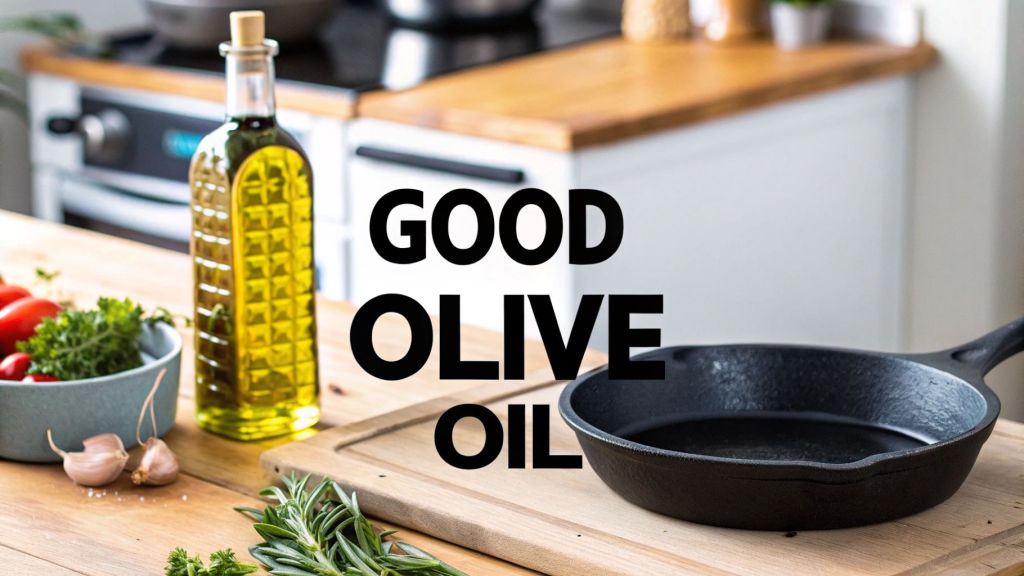
Have you ever worried that you're "wasting" the good stuff by pouring it into a hot pan? The answer is a resounding, definitive no. Here’s exactly why a quality EVOO belongs on your stove:
- Flavor Infusion: Unlike neutral oils that merely bring the heat, EVOO adds its own subtle, complex notes—think peppery, fruity, or grassy—that create a deep flavor foundation for whatever you're cooking.
- Heat Stability: A well-made EVOO is packed with antioxidants and stable monounsaturated fats. This structure makes it far more resistant to breaking down under heat than most people believe. You can dive deeper into the science of how to cook with olive oil in our detailed guide.
- Healthier Cooking: When you cook with EVOO, its powerful polyphenols don't just vanish; they help protect the oil from oxidation and even transfer some of those benefits into your food.
For a quick reference, here’s a simple guide to matching the right oil to the right task.
Quick Guide To Cooking With Olive Oil
This table breaks down which olive oil to grab for common cooking methods, making it easy to get the best results every time.
| Cooking Method | Best Olive Oil Type | Why It Works |
|---|---|---|
| Sautéing & Pan-Frying | Extra Virgin Olive Oil | Its smoke point is well above typical sauté temperatures, and it adds incredible flavor. |
| Roasting | Extra Virgin or Olive Oil | Provides great flavor and holds up well to the prolonged heat of an oven. |
| Deep Frying | "Light" or Refined Olive Oil | A higher smoke point and neutral flavor make it a stable and cost-effective choice. |
| Dressings & Drizzling | Extra Virgin Olive Oil | The bold, fresh flavors are the star of the show here—no heat required. |
| Baking | "Light" or Olive Oil | Offers moisture without overpowering the other ingredients in your cakes and muffins. |
Ultimately, choosing the right olive oil is all about understanding its strengths and using them to your advantage.
More Than Just A Drizzle
The real magic of good olive oil is just how versatile it is. Imagine the rich flavor of a robust EVOO sizzling with your morning eggs or the beautiful aroma it creates while sautéing garlic and onions. With global olive oil production hitting a staggering 3.507 million tons recently, high-quality EVOO—the gold standard for cooking—is more accessible than ever before.
As you start to embrace olive oil in more of your cooking, you might find yourself thinking about the quality of other tools in your kitchen. Choosing effective, high-quality items, including the best sustainable kitchen products, helps create a more conscious and enjoyable cooking experience all around.
Decoding The Labels On The Olive Oil Shelf

Walking down the cooking oil aisle can feel like a pop quiz you didn't study for. Labels shout terms like “Extra Virgin,” “Pure,” and “Light,” but what do they really mean for the meal you're planning tonight? It’s a bit of a maze, and it’s dangerously easy to just grab what you know instead of what’s best.
Let's clear this up with a simple analogy. Think of Extra Virgin Olive Oil (EVOO) as fresh-squeezed, cold-pressed juice. It's the very first oil from the olives, extracted purely by mechanical means—no heat, no chemicals. This process keeps all the vibrant flavor and health-boosting antioxidants right where they belong.
Now, consider oils labeled simply "Olive Oil," "Pure," or "Light." These are more like juice from concentrate. They’ve been heavily processed with heat and solvents, stripping away most of the original color, flavor, and all those good-for-you compounds.
Extra Virgin: The Gold Standard
When you're on the hunt for a good olive oil to cook with, EVOO is almost always the right place to start. It’s the highest grade you can get, defined by an incredibly low free fatty acid level—it has to be under 0.8%—and a perfect, defect-free flavor. Put simply, it’s pure, unadulterated olive juice.
This lack of refinement is exactly what makes it such a powerhouse in the kitchen. Those same antioxidants that give EVOO its characteristic peppery bite and health benefits also make it surprisingly stable under heat. They act as natural bodyguards, protecting the oil from breaking down when you turn up the stove.
The term "first cold press" is more than just marketing jargon; it's a promise of quality. It tells you the oil was squeezed from the olives using only pressure, not heat, which is crucial for preserving the delicate flavors and powerful polyphenols that make EVOO a superior fat.
Understanding Refined Olive Oils
So, what about those other bottles? The names can be a bit sneaky, especially "Light," which has nothing to do with calories and everything to do with a lighter color and flavor. These refined oils have their place, but they are a totally different product from EVOO.
- "Olive Oil" or "Pure Olive Oil": This is a blend. It’s mostly refined olive oil with just a small amount of virgin or extra virgin olive oil mixed back in for a hint of flavor. It’s a compromise that gives you a higher smoke point and a neutral taste, but you lose out on the robust flavor and health perks of EVOO.
- "Light" Olive Oil: This is the most heavily processed of the bunch. The refining is so intense that it produces an oil with a very neutral taste, pale color, and a high smoke point. It’s really only useful for high-heat cooking or baking where you want absolutely no olive flavor to come through.
Choosing the right bottle starts with understanding these basic differences. If you want to go even deeper, you can learn more about the complexities of olive oil labeling to become a true expert in the aisle. At the end of the day, knowing how the oil got from the olive to the bottle is the key to picking the perfect one for your pan.
Why Smoke Point Isn't the Whole Story
Let's talk about smoke point. This single concept has probably caused more confusion and needless worry in the kitchen than anything else. For years, we've been told it's the ultimate rule for cooking with oil, scaring us away from using beautiful extra virgin olive oil for anything other than a salad dressing.
This obsession with a single temperature has led to a colossal misunderstanding. It's why so many people reach for bland, highly refined oils for searing or roasting, thinking they need something with industrial-level heat tolerance. The truth? Smoke point is a terribly incomplete way to judge how an oil will perform when you cook with it.
It's not the whole story. It’s barely even the first chapter.
The Real Hero: Oxidative Stability
Imagine two fighters. One can take a lot of verbal jabs before getting angry (a high smoke point), but has no real defense once a punch is thrown. The other fighter might get annoyed a bit sooner but is equipped with heavy-duty armor that actively deflects blows (high oxidative stability). Who would you want in a real fight?
This is the perfect analogy for cooking oils. Smoke point is just the temperature where an oil starts to break down and produce visible smoke. Oxidative stability, on the other hand, is the oil's innate ability to resist chemical breakdown under the stress of heat and oxygen, which prevents the formation of harmful compounds.
A high-quality Extra Virgin Olive Oil is like that second fighter. Its "armor" is a rich supply of polyphenols—powerful antioxidants that vigorously protect the oil's molecules from heat damage. This is what really makes an oil great for cooking.
Why EVOO Punches Above Its Weight
Many refined seed oils might boast a sky-high smoke point, but they’re nutritional ghosts. The intense refining process that jacks up their smoke point also strips away all their natural defenses—their antioxidants, vitamins, and minerals. They are all sizzle and no substance, breaking down quickly when the heat is on.
A fresh, well-made EVOO, however, is a chemical fortress. Its foundation is stable monounsaturated fat, and its polyphenol content gives it incredible endurance. Time and time again, studies have shown that high-quality EVOO produces far fewer harmful compounds when heated compared to refined oils, even those with technically higher smoke points.
So, what does this mean for your everyday cooking? It means you can confidently use a good EVOO for almost everything, including:
- Sautéing and pan-frying: Most sautéing happens around 320°F (160°C), which is comfortably below the smoke point of a quality EVOO.
- Roasting vegetables: Roasting is typically done between 375°F and 425°F (190°C – 220°C), a range where a stable EVOO thrives and adds incredible flavor.
- Light searing: It's fantastic for creating a delicious crust on meats and fish.
Let's put this into a clearer perspective.
Olive Oil Stability: What Really Matters
This table cuts through the noise, showing why an oil's antioxidant content is a much better indicator of its cooking performance than smoke point alone.
| Oil Type | Typical Smoke Point | Oxidative Stability (Antioxidant Level) | Best For |
|---|---|---|---|
| High-Polyphenol EVOO | 380°F – 410°F | Very High | Sautéing, roasting, light frying, finishing |
| Standard EVOO | 350°F – 380°F | Moderate to High | Sautéing, medium-heat roasting, dressings |
| Refined ("Light") Olive Oil | 465°F | Very Low | High-heat applications where flavor is not desired |
| Refined Canola Oil | 400°F | Very Low | High-heat applications where flavor is not desired |
As you can see, the refined oils look impressive on paper with their high smoke points, but their low stability means they degrade much faster. A robust EVOO protects itself and your food.
The idea that smoke point is the only thing that matters is one of the most persistent myths out there. For a deep dive into the science, you can find a thorough explanation of the true smoke point of EVOO and see why it’s safer than you've been led to believe. When you start choosing an oil based on its stability and quality, you’re not just picking a cooking fat—you're choosing an active ingredient that adds flavor and protects your food from the heat.
Matching The Right Oil To Your Cooking Method
This is where the rubber meets the road—where all the theory about olive oil gets put to the test in your kitchen. Think of this as your practical guide, moving from simply knowing about olive oil to truly doing something with it. Using olive oil well means treating it like an intentional ingredient, not just a slick surface to keep food from sticking.
It all comes down to matching intensity. A delicate piece of flounder needs a soft, buttery EVOO that won't bulldoze its subtle flavor. But if you're searing a big, beefy steak, you need an oil with a peppery, assertive backbone that can hold its own and add character to the crust. This isn't just about heat; it's about creating harmony on the plate.
The Right Tool For The Job
Choosing the right olive oil is about more than just taste; it's about performance. Different cooking methods push an oil in different ways, and understanding this is the secret to getting fantastic results every single time.
This is where you have to decide what matters more in the moment: the oil's stability under heat or its unique flavor profile.

As you can see, the path splits based on one simple factor: heat. When the heat is high, you need to focus on oxidative stability. For everything else—low-heat cooking or no-heat finishing—the oil's flavor gets to be the star of the show.
For Sautéing And Roasting
For your daily sautéing and oven roasting, a high-quality Extra Virgin Olive Oil should be your go-to. The temperatures involved here are well within EVOO's stable range, and the flavor it adds is a world away from boring, neutral oils.
A good EVOO isn't just a cooking fat; it's a seasoning in itself. When you toss vegetables in it before they hit the oven, you're not just preventing sticking. You're wrapping them in a layer of flavor that concentrates and deepens in the dry heat.
The global olive oil market has exploded to USD 20.3 billion, and a big reason is that people are discovering how versatile a good EVOO really is. It’s packed with monounsaturated fats (around 73% of its makeup) and vitamin E, which makes it remarkably stable for cooking. It often holds up better than seed oils, both in flavor and health benefits. Look for bottles with certified origins, as these tend to have the low free fatty acid levels that give you a smoke point between 375-410°F—ideal for most pan-searing and baking.
For Frying And Finishing
So, what about deep frying? You can use EVOO, but a more wallet-friendly choice is a refined "Light" olive oil. Its higher smoke point and much milder flavor make it a practical workhorse for the occasional deep fry.
The real magic, however, is in finishing. A final drizzle of a truly spectacular, pungent EVOO over a finished soup, a rustic bowl of pasta and beans, or even just a slice of grilled bread can be a game-changer. This is where you pull out the boldest, most flavorful oil in your pantry, because its raw, vibrant taste is the whole point.
Ultimately, this kind of kitchen intuition is built through experience. Start noticing how different oils behave and taste with your food. To get a head start, you can explore our detailed guide on the best olive oil for cooking specific dishes. Before you know it, you'll be making pairings that create pure magic.
How To Read An Olive Oil Label Like A Pro
The secrets to finding a truly great olive oil aren't locked away in some Tuscan villa. They're printed right on the bottle in front of you, waiting like clues in a mystery. You just need to learn the language.
Once you can speak "label," you'll stop wasting money on rancid or flavorless imposters. The power to choose a brilliant bottle is already in your hands. It's just a matter of looking past the fancy fonts and romantic farm scenes to focus on what really matters.
The Single Most Important Clue To Freshness
Forget everything else for a moment and hunt for one thing: a Harvest Date. This is, without a doubt, the most critical piece of information on any bottle of olive oil, yet it's often tucked away in tiny print. Remember, olive oil is a fresh fruit juice, and its flavor and health benefits start fading the moment it's made.
A "Best By" date is almost useless. It's typically set two years from the bottling date, not the harvest. That oil could have been sitting in a massive tank for a year or more before it ever saw the inside of a bottle.
Always look for a harvest date. A producer who displays this proudly is telling you they have nothing to hide. For the Northern Hemisphere (Italy, Spain, Greece, California), you want a harvest date from the most recent autumn. For example, look for "Fall 2024" if you're shopping in early 2025.
Decoding Location And Quality Seals
Next, let's play detective with the origin. Vague terms like “Product of Italy” are a major red flag. This often just means the oil was bottled there, using a mix of olives from who-knows-where. You're looking for specificity.
Keep an eye out for seals that guarantee the oil’s origin and quality. These aren't just fancy stickers; they are legally binding promises.
- PDO (Protected Designation of Origin): This is the gold standard. It guarantees the olives were grown, harvested, and pressed into oil all within a specific geographical region, following strict local traditions.
- PGI (Protected Geographical Indication): This is another strong indicator of quality. It means at least one part of the production process happened in a specific region.
These certifications tell you that the producer is accountable and proud of their oil's heritage.
Judging The Bottle Itself
Before you even read a word, the container itself tells a story. Light is one of olive oil's mortal enemies, causing it to oxidize and go rancid incredibly fast. A producer who cares about their product would never sell it in a clear glass bottle.
Always choose oil packaged in dark green or black glass. Better yet, look for an opaque tin or a bag-in-box. A dark, protective container is a non-negotiable sign that the maker understands how to preserve the quality of what’s inside. By mastering these few label secrets, you can walk into any store and confidently pick out a fresh, high-quality olive oil that will make your cooking shine.
Storing Olive Oil To Preserve Peak Flavor
So you've brought home a fantastic bottle of olive oil. Great choice. But now comes the most important part: protecting that investment. The fastest way to ruin a beautiful, high-quality oil is to leave it sitting in a clear bottle right next to your stove.
It might sound dramatic, but your olive oil has three mortal enemies lurking in your kitchen: heat, light, and air. Let any of them get to your oil, and you kickstart the process of oxidation. This is the chemical reaction that turns fresh, vibrant liquid gold into something bland, stale, and frankly, disgusting.
The Three Golden Rules of Storage
Keeping your oil fresh is actually quite simple, but these rules are non-negotiable if you want to enjoy its peak flavor and health benefits from the first pour to the last.
-
Rule 1: Find a Cool, Dark Place. Your olive oil's ideal home is in a pantry or cupboard. The key is to keep it away from the heat of your oven and out of direct sunlight from a window. Heat rapidly speeds up degradation, and light is just as damaging.
-
Rule 2: Keep It Sealed. Oxygen is the enemy of freshness. Every single time you use your oil, make sure you screw that cap on tightly. This simple habit minimizes its contact with the air and slows down the clock.
-
Rule 3: Buy What You'll Use. That giant, economy-sized tin might look like a great deal, but once you open it, the countdown begins. For the best flavor, plan to use up an opened bottle within one to two months.
Your own senses are the best tool you have. Fresh olive oil should smell vibrant—think fruity, grassy, or peppery. If it smells waxy like crayons, like old putty, or stale nuts, it’s gone rancid. When in doubt, trust your nose and toss it out. A bad oil will ruin an entire dish.
For a deeper dive, you can learn more about the best practices for long-term olive oil storage and make sure every bottle stays its best.
Common Questions About Cooking With Olive Oil
As we wrap things up, let's tackle a few of the most frequent questions I hear about cooking with olive oil. This is our chance to clear up any final confusion so you can feel totally confident next time you're in the kitchen.
Is It Really Safe To Cook With Extra Virgin Olive Oil?
Absolutely. Not only is it safe, but a high-quality EVOO is one of the healthiest and most stable fats you can cook with. Its secret weapon is a high concentration of monounsaturated fats, which are very stable, and a boatload of antioxidants that protect the oil from breaking down under heat.
The trick is to start with fresh, low-acidity EVOO and keep your cooking temperatures below its smoke point. For a good quality EVOO, that's usually somewhere between 375-410°F. This range easily covers almost everything you’d do in a home kitchen, from a gentle sauté to roasting vegetables.
What Is The Difference Between Light Olive Oil And EVOO For Cooking?
This one trips a lot of people up. When you see "light" on a label, it's only talking about the flavor and color—it has nothing to do with calories or fat content. "Light" olive oil is a highly refined oil, processed to have a neutral taste and a higher smoke point.
So while that "light" oil might work for high-heat cooking where you don't want any olive flavor, it's been stripped of the amazing antioxidants and health benefits found in EVOO. Stick with Extra Virgin Olive Oil when you want to add both incredible flavor and a nutritional punch to your meal.
How Do I Know If My Olive Oil Has Gone Bad?
Trust your nose and your taste buds—they're your best tools here. Olive oil that has gone rancid has a very distinct, off-putting smell. People often say it smells waxy, like crayons, or like stale nuts that have been sitting in a cupboard too long. The taste will be just as unpleasant: greasy, flat, and just plain bad.
A fresh, vibrant olive oil should smell green and alive—think freshly cut grass, fruity notes, or even a little peppery kick. If that bright aroma is gone or the oil tastes off, it’s past its best. Using it will just ruin your dish with those stale flavors.
Beyond just olive oil, sharpening your general kitchen know-how can make a huge difference. You can read more about common cooking mistakes to avoid to really boost your confidence at the stove.
At Learn Olive Oil, we’re firm believers that understanding the "why" behind your ingredients is the key to unlocking amazing flavor. We are passionate about guiding you through the incredible world of premium olive oil, all the way from the grove to your kitchen. Let's find your next favorite bottle together. https://learnoliveoil.com
 Learn Olive Oil
Leave a comment