Navigating the olive oil aisle can feel like you need a translator. With so many bottles, brands, and fancy terms, how do you pick a good one? It’s simpler than you think. The secret isn't in the marketing hype on the front, but in a few key details that tell the real story of what’s inside.
Think of it this way: when you buy fresh produce, you instinctively look for signs of freshness and quality. You should do the same with olive oil. Focus on its grade, the harvest date, and its origin—these three things will tell you almost everything you need to know.
How to Read an Olive Oil Label in 60 Seconds
You're in the store, faced with a wall of olive oil. It's decision time. Forget the confusing jargon for a moment. You can get a solid read on a bottle's quality in less than a minute by looking for a few specific things.
This is your cheat sheet. We'll cut through the noise and show you exactly what to look for to make a confident choice, fast.
Your 3-Point Checklist
To quickly size up a bottle of olive oil, zero in on these three pieces of information. They are the most reliable indicators of quality you'll find on any label.
-
The Grade: The first thing to check for is the phrase "Extra Virgin Olive Oil." This isn't just a marketing term; it’s the highest grade, signifying the oil was extracted without chemicals and meets strict standards for flavor and aroma.
-
The Harvest Date: This is your best friend when it comes to freshness. Look for a specific date, like "Harvested: November 2023." It tells you exactly when the olives were picked. This is far more reliable than a generic "Best By" date, which can be two years after bottling.
-
The Country of Origin: Does the label name a specific country, or even a single region or estate? An oil that says "Product of Italy" or "Grown in Crete, Greece" is generally a better bet than a vague blend from "multiple countries." Traceability often correlates with quality.
Pro Tip: Always think of olive oil as fresh-pressed fruit juice, not wine. It doesn't get better with age. A recent harvest date is a powerful sign that the producer cares about quality and delivering the best possible flavor and health benefits.
Fortunately, you’re not on your own here. In places like the European Union, labeling laws have been strengthened to help consumers. Regulations mandate that labels for extra virgin and virgin oils clearly state the grade, origin, and proper storage conditions. You can find more details on these consumer protection laws and their specific requirements.
To make it even easier, here's a quick reference table you can use next time you're shopping.
Olive Oil Label Quick Check Guide
This table breaks down the most important things to check on an olive oil label for a quick, informed decision.
| Label Element | What to Look For | Why It Matters |
|---|---|---|
| Grade | The words "Extra Virgin Olive Oil" | This is the top grade, promising superior taste and the highest level of healthy compounds. |
| Harvest Date | A specific month and year (e.g., "October 2023") | This is the truest indicator of freshness. The more recent, the better. |
| Origin | A specific country, region, or estate | Indicates traceability and often higher quality control compared to generic, multi-country blends. |
| "Best By" Date | A date 18-24 months from the harvest | Use this as a secondary check. A close "Best By" date means the oil is old. |
Keep these points in mind, and you'll be able to spot the good stuff and leave the questionable bottles on the shelf.
What Olive Oil Grades Actually Mean
When you see terms like "Extra Virgin" or "Virgin" on a bottle of olive oil, they aren't just fancy marketing words. These grades are part of a legal quality hierarchy, telling you a story about how the oil was made, what it tastes like, and where it stands in terms of quality. Honestly, if you learn just one thing about reading an olive oil label, this is it. It’s the key to making sure you’re getting what you pay for.
It helps to think about it like buying coffee beans. At the top, you have your single-origin, artisanal beans, celebrated for their unique and delicate flavors. Below that, you find the mass-market blends designed for consistency, not character. Olive oil grades follow that same kind of logic.
Extra Virgin: The Gold Standard
Extra Virgin Olive Oil (EVOO) is the absolute best of the best. To earn this top-tier classification, the oil has to be extracted from fresh olives using only mechanical methods, like crushing and pressing. No heat or chemical solvents are allowed. This is what people mean when they talk about "cold-extracted" or "first cold press"—it’s all about preserving the natural, delicate flavors, aromas, and those healthy antioxidants called polyphenols.
But the process is only half the battle. The oil must then pass two make-or-break tests:
- Chemical Analysis: It has to show a free fatty acid (FFA) level of no more than 0.8%. A low acidity level is a direct sign of healthy, carefully handled olives and a clean milling process.
- Sensory Panel: A panel of trained tasters must certify that the oil has zero flavor defects and has some noticeable fruity qualities. It has to taste and smell perfect.
When you see "EVOO" on a label, it's a promise of quality. You're getting an oil with a vibrant, complex flavor that's perfect for drizzling over a finished dish, dressing a salad, or just dipping a good piece of bread into.
Virgin and Refined Oils
Once you move down from the peak of extra virgin, you find other grades that are useful for different things in the kitchen.
Virgin Olive Oil is made the same way as EVOO—mechanically and without chemicals—but it’s not quite perfect. It’s allowed to have some minor sensory flaws and a higher acidity, up to 2.0%. It’s still a good, unrefined oil, but it just doesn’t have that pristine taste and smell of its extra virgin cousin. It's a solid choice for general cooking where you don't need the oil's flavor to be the main event.
A shocking study found that nearly 70% of imported oils labeled as "extra virgin" didn't actually meet the official standards. This is exactly why knowing what these grades really mean is so important for steering clear of subpar products.
Refined Olive Oil is a completely different animal. This oil usually starts its life as virgin olive oil that had too many defects in its taste, smell, or chemical makeup. To make it usable, it goes through an industrial refining process that involves deodorizing and neutralizing treatments, which strip out nearly all of its color, aroma, and flavor.
What you're left with is a very neutral, bland oil with a higher smoke point, making it suitable for high-heat cooking like frying. If you see a bottle just labeled "Olive Oil" or "Light Olive Oil," you're almost certainly looking at a blend of refined olive oil with a little bit of virgin or extra virgin mixed back in to give it a whisper of flavor. Think of these as workhorse oils, not finishing oils.
Why Origin and Certifications Matter
Have you ever wondered why one olive oil tastes peppery and bold while another is buttery and smooth? It's not just random. Where your olive oil comes from is a huge piece of the puzzle. The specific climate, soil, and even the type of olive tree—a concept the French beautifully call terroir—all leave their fingerprint on the final oil.
This is why an oil from the hills of Tuscany can have that classic, spicy artichoke kick, while one from the Greek island of Crete might be milder, with gentle notes of grass and almond. It's a story of place.
A vague label like "Product of the Mediterranean" tells you almost nothing. It's like saying a wine is from "Europe." But a bottle that proudly names a specific country, region, or even a single estate? Now that’s a real sign of traceability and character.
Decoding Origin and Certification Seals
The best way to think about these seals is to compare them to the system used for fine wines. We all know that true Champagne can only come from the Champagne region of France. It’s the same idea. Certain olive oil certifications legally protect the oil’s deep connection to a specific place and the traditional way it’s made. These seals are your best friend in the grocery aisle, helping you cut through the marketing noise.
This image below gives a great overview of the main grades you'll see on a bottle, which are the first clues to quality.
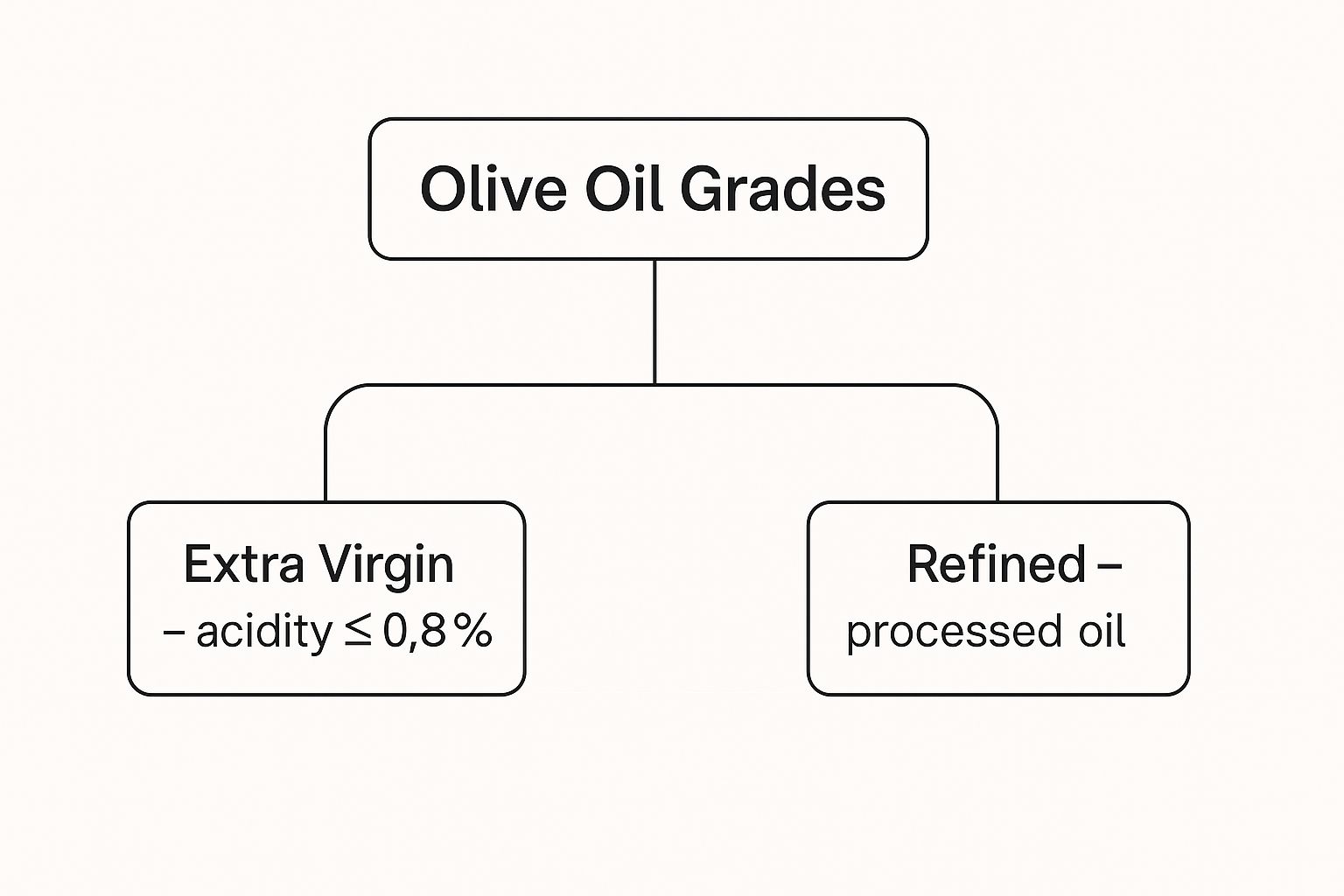
As you can see, Extra Virgin Olive Oil sits at the top with the most demanding chemical standards, especially for acidity—a key sign of how carefully the olives were handled and pressed.
When you're looking at European oils, two seals stand out as powerful guarantees of authenticity. These are your gold standards for origin.
Decoding Origin and Certification Seals
The table below breaks down the most common terms you'll find on a label, from simple origin statements to the most rigorous European certifications. Think of it as your cheat sheet for understanding exactly what a producer is promising you.
| Certification/Term | What It Guarantees | Example |
|---|---|---|
| Product of a Single Country | A basic statement that all olives were grown and the oil was produced in that one country (e.g., "Product of Spain"). It’s a start, but doesn’t guarantee a specific region or quality. | A bottle labeled "100% Italian Product." |
| PGI (Protected Geographical Indication) | A strong indicator of regional character. It guarantees that at least one part of the production process (like pressing or bottling) took place in the named region, and the oil has qualities tied to that place. | "Tuscan PGI" olive oil. The olives might be from Tuscany, or simply pressed there. |
| PDO (Protected Designation of Origin) | The highest level of assurance. This seal guarantees that every single step—from growing and harvesting to milling and bottling—happened within a specific, protected geographical area. It’s a promise of 100% regional authenticity. | "Kalamata PDO" olive oil means everything happened in the Kalamata region of Greece. |
At the end of the day, these seals aren't just clever branding. They are legally binding symbols of authenticity, created to protect both the producer's heritage and your right to know exactly what you're buying.
The world of olive oil labeling can feel complex, and for good reason. As demand has grown, so has the need for regulation. There are over 529 country-specific regulations across the globe, and each market emphasizes different things. European countries, for instance, are famously strict about geographical indicators to protect their cultural food identity. If you're curious, you can explore the depth of these global regulatory requirements and see just how much the standards can vary.
Outside of Europe, other seals provide important quality checks. Here in the United States, keep an eye out for the USDA Organic seal, which tells you the olives were grown without synthetic pesticides or fertilizers. Even better for California oils is the California Olive Oil Council (COOC) seal. It actually sets a stricter standard for "Extra Virgin" than international rules, demanding an acidity of 0.5% or less.
Learning to spot these seals is what transforms you from a casual buyer into someone who truly knows their oil.
Finding the Freshest Oil by Date

When it comes to olive oil, there's one word that matters more than any other: freshness. Unlike a fine wine that gets better with age, olive oil is a fresh fruit juice. Its peak flavor and powerful health benefits are most potent right after the olives are crushed and begin to fade from that moment on.
This means you need to put on your detective hat when you're at the grocery store. The single most important clue on any bottle is the harvest date. This tells you exactly when the olives came off the tree, giving you the clearest picture of the oil's true age.
The Harvest Date Is King
You'll notice a lot of bottles only list a "Best By" or "Use By" date. While that seems helpful, it can actually be a bit deceptive. That date is typically set for 18 to 24 months after the oil was bottled, not when it was made. An oil could have been sitting in a storage tank for a year before it even made it into the bottle, so that "Best By" date isn't a reliable guide to freshness.
It's like buying bread. A "Best By" date tells you when it might go stale, but a "Baked On" date tells you how fresh it really is today. For olive oil, the harvest date is the "Baked On" date. It’s your direct connection to the moment that oil came into existence.
A bottle with a clearly printed harvest date is a sign of a transparent producer. It shows they're proud of their product's freshness and have nothing to hide. To get the most flavor and nutritional bang for your buck, always look for the most recent harvest date.
So, if you're shopping in December 2024, an oil harvested back in November 2023 is already more than a year old. But an oil harvested in November 2024? That’s incredibly fresh and will give you a completely different—and far better—tasting experience.
Look for Protective Packaging
Once you’ve found a fresh oil, you need to make sure it’s been well-protected on its journey to you. The two biggest enemies of olive oil are light and oxygen. Exposure to either one will cause the oil to degrade quickly, lose its delicate flavors, and eventually turn rancid.
This is where the packaging comes in. It’s not just about looks; it’s about preservation. Here’s what you want to see:
- Dark Glass Bottles: Serious producers almost always use dark green or amber glass. Think of these bottles as sunglasses for the oil, blocking out the damaging UV rays that can ruin it.
- Tins or Ceramic Containers: Opaque tins and ceramic vessels are also fantastic choices because they block out 100% of the light.
A word of caution: avoid buying any olive oil sold in a clear glass bottle. It may look beautiful on the shelf, but constant exposure to bright grocery store lights is a death sentence for its quality. The oil is already breaking down before you even bring it home.
By focusing on a recent harvest date and looking for protective, dark packaging, you can feel confident you're picking a bottle that will deliver the peppery, vibrant, and healthy experience that truly great olive oil is all about. To dig deeper, check us out at Learn Olive Oil.
Navigating the olive oil aisle can feel like a pop quiz you didn't study for. The shelves are lined with bottles covered in fancy-sounding terms, but many are just clever marketing designed to confuse you. It’s an unfortunate reality of the industry, where words that sound premium can actually signal a low-quality product.
The good news is that once you learn to see past the marketing fluff, you can easily spot the real deal. Let's pull back the curtain on some of the most common labeling traps out there.
Common Misleading Label Terms
Think of these terms as red flags. When you see one, it doesn’t automatically mean the oil is bad, but it’s your cue to pause and look much closer at things that really matter, like the harvest date and any official certifications.
-
"Light" Olive Oil: This is probably the most deceptive term on the shelf. Your brain might jump to "low-calorie" or "low-fat," but it has nothing to do with either. "Light" only refers to the oil's pale color and mild flavor. What you're actually getting is a highly refined olive oil with just a drop of virgin oil mixed in for a hint of character. It's bland on purpose.
-
"Pure" Olive Oil: "Pure" sounds great, doesn't it? It sounds clean and high-quality. But in the world of olive oil, it’s a classic bait-and-switch. "Pure" doesn't mean it's purely extra virgin. It’s just another blend of mostly refined oil with a small amount of virgin oil, very similar to its "light" counterpart. It’ll work for high-heat cooking, but it's missing the robust flavor and health benefits you get from true EVOO.
-
"First Cold Press": This phrase is mostly a marketing ghost from a bygone era. Decades ago, hydraulic presses were used to squeeze oil from olive paste, and the first pressing without heat produced the best oil. Today, that's not how it works. Modern, high-quality olive oil is made using a centrifuge in one single, continuous, "cold extraction" process. Seeing "first cold press" isn't necessarily bad, but it's more of a romantic marketing term than a real indicator of superior quality.
A label might proudly announce it was "Made in Italy," but this is one of the biggest traps. This phrase often just means the oil was bottled and shipped from Italy. The olives themselves could have come from all over—Spain, Greece, Tunisia—and were simply blended and packaged there. If you want genuine Italian olive oil, look for the words "Product of Italy" or a specific PDO seal.
The Power of Regulation
Thankfully, you're not entirely on your own in this fight. Consumer protection laws, especially in the European Union, are cracking down on misleading labels. EU regulations are quite strict, requiring member countries to perform yearly checks to make sure olive oils, particularly extra virgin oils, live up to their claims.
These conformity checks look at everything from origin to quality. If a producer is caught with non-compliant or fraudulent labeling, they can face hefty fines or have their products pulled from the market. It’s a system designed to add a layer of trust. You can read more about these EU olive oil regulations to see how they work.
By learning to spot these tricky phrases, you’re better equipped to cut through the noise and make a choice based on facts, not marketing jargon. You'll be able to confidently pick a bottle that's actually worth your money.
Alright, you've got the basics of reading an olive oil label down. But let's be honest, that's when the real questions start popping up in the kitchen. Let's get practical and talk about what all this label-reading means for your cooking and your wallet.
Does a Higher Price Always Mean Better Quality?
Not always, but I'll tell you this: there's a very real connection between what you pay and what you get. Crafting genuine extra virgin olive oil is a labor-intensive, expensive process. It involves hand-picking olives at the perfect moment, rushing them to the mill, using sophisticated cold-extraction methods, and then paying for rigorous chemical and sensory testing. None of that comes cheap.
If you see a giant bottle of "EVOO" for a suspiciously low price, that’s your first red flag. It’s a pretty safe bet that it’s either a blend with lower-grade oils, made from old or damaged olives, or just plain fraudulent. While a hefty price tag doesn't automatically guarantee a world-class oil, a rock-bottom price almost certainly guarantees you're getting something subpar. Think of it less as a splurge and more as an investment in authentic flavor and health benefits.
What Is the Best Way to Store Olive Oil?
So you've invested in a great bottle! Now you need to protect it. Olive oil has three mortal enemies: heat, light, and air. Exposing your oil to any of these will kickstart oxidation, which quickly destroys its vibrant flavor and powerful antioxidants.
Your best bet is to store it in a cool, dark place like a pantry or a cupboard—and definitely keep it away from the stove. Always make sure the cap is on tight to keep oxygen out. Here's a pro tip: if you buy a large tin, pour a smaller amount into a dark glass bottle for daily use. That way, you’re not exposing the entire batch to air every time you reach for it.
For the best possible taste and health benefits, try to use an open bottle of extra virgin olive oil within 60 to 90 days. This ensures you’re enjoying it at its absolute peak, just like the producer intended.
Can I Really Cook with Extra Virgin Olive Oil?
Yes, you absolutely can! This is probably the most stubborn myth in the culinary world, and it’s time to put it to rest. A good quality extra virgin olive oil has a smoke point somewhere between 350°F and 410°F (177°C to 210°C). That’s more than high enough for most home cooking, from sautéing vegetables to pan-searing fish.
In fact, cooking with EVOO is a fantastic choice. The same antioxidants that are good for you also help protect the oil from breaking down when heated, making it more stable than many other common cooking oils. So go ahead, use that delicious, fruity oil for more than just dressing a salad. It’s far more versatile than you’ve been led to believe.
Ready to explore the world of premium, authentic olive oil? Learn Olive Oil is your ultimate guide to finding the best bottles, understanding flavor profiles, and using this liquid gold to elevate your cooking. Discover your next favorite oil with us.

 Learn Olive Oil
Leave a comment