Let me tell you a secret that most olive oil marketers hope you never discover.
It's about a single, invisible number that separates a truly magnificent oil—one brimming with flavor and life-giving nutrients—from the tired, bland liquid so often found on supermarket shelves.
This secret has nothing to do with a tart, lemony taste. When we speak of 'acidity' in olive oil, we are not talking about flavor at all.
Instead, we are unveiling a critical chemical measure called Free Fatty Acidity (FFA). Think of it not as a taste, but as an honest report card. It is perhaps the single most powerful indicator of an olive oil's true quality, freshness, and the care with which it was made.
The Hidden Marker of Olive Oil Quality
If the word "acid" conjures up the sharp tang of vinegar, you are not alone. But in the world of fine olive oil, this word means something entirely different. It is a silent, invisible marker of the oil's health and integrity.
Picture a perfect, plump olive, glistening on the branch. Its fats are neatly bound in stable molecules called triglycerides. But what happens if that olive is bruised, left to sit for days after harvest, or milled with clumsy, outdated equipment? Those triglycerides begin to shatter, releasing "free" fatty acids.
This is the genesis of acidity. A low FFA percentage is the quiet signature of a flawless journey from the grove to your bottle. It is proof that:
- The olives were healthy, whole, and undamaged.
- They were rushed to the mill and crushed into oil within mere hours of being picked.
- The entire process was guided with an artisan's care.
A low acidity level is not just a number on a lab report; it is the quiet promise of freshness, a symphony of vibrant flavor, and a treasure trove of potent health benefits.
Grasping this one concept is your key to seeing past clever marketing and finding a genuinely superior product. It’s about understanding the story of an oil’s creation, because that story is written into its very chemistry. Knowing how the olive oil's origin shapes these qualities allows you to appreciate the profound craftsmanship behind every bottle.
The Real Chemistry Behind Olive Oil Acidity
So, what exactly is acidity in olive oil? Forget everything you think you know about sour or tart tastes. Instead, imagine it as a direct chemical measure of the oil's purity—an internal report card that reveals the health of the olives and the skill of the oil maker.
Let's look deep inside a drop of perfect olive oil. At a microscopic level, it's a beautiful structure of molecules called triglycerides. Each one is a neat, stable package: three fatty acids securely bound to a glycerol backbone. This robust structure is the very foundation of a high-quality oil's goodness.
Acidity, or Free Fatty Acidity (FFA), is simply the measure of how many of those fatty acids have been broken away from their glycerol home. When they break free, they begin to float alone, a tell-tale sign that the oil is beginning its inevitable march toward decay.
From A Perfect Olive To A Broken Bond
The story begins with the olive itself. Imagine a fresh, perfect olive on the tree—a tiny, self-contained vessel of natural goodness. But the moment that olive is damaged—bruised by a rake, bitten by a pest, or left to languish in a pile—a destructive process is unleashed.
Damage releases enzymes within the olive. These enzymes act like microscopic scissors, snipping the chemical bonds holding the fatty acids to their glycerol base.
Each time a bond is snipped, a "free" fatty acid is born. The more this happens, the higher the oil's acidity climbs. This breakdown is measured as a percentage of free oleic acid, simply because oleic acid is the most abundant fatty acid in olive oil. If you're curious about all the components, you can learn more about what olive oil is made of.
This simple infographic helps visualize how the olive's journey directly impacts the oil's acidity and, ultimately, its quality.

As you can see, it is a clear chain of consequence: pristine olives lead to low acidity and superior quality.
How A Simple Number Defines Quality
This single chemical measurement is so unerringly accurate that it has become the international standard for grading olive oil. For an oil to legally bear the name "Extra Virgin," its free fatty acidity must be no higher than 0.8%.
But for true artisans and the world's finest producers, that is not an achievement; it is merely the starting line.
A truly exceptional Extra Virgin Olive Oil often boasts an acidity level below 0.3%. This isn't just a number; it is a testament to pristine fruit and a fanatical dedication to speed and precision, from tree to bottle.
The best oils come from olives handled like precious jewels and milled within hours—not days—of harvest. Many elite producers press their olives in less than 24 hours.
This low acidity has profound health implications. Studies show that high-quality EVOOs with low acidity retain vastly more polyphenols—the powerful antioxidants celebrated for their health-giving properties.
While our focus is on oleic acid, it’s just one member of a larger family of dietary fats. For a deeper dive into the broader chemistry, including the ongoing debate about saturated fats, a wealth of information awaits. But when it comes to the bottle in your hand, the acidity level remains the most honest messenger, connecting the life of the olive directly to the quality of the oil in your kitchen.
How Acidity Influences Flavor and Freshness
Here is the question that unlocks everything: if you cannot actually taste the free fatty acids in olive oil, why is it such an ironclad measure of quality?
The answer is elegantly simple. While Free Fatty Acidity (FFA) itself is tasteless, it acts as an infallible fingerprint, revealing everything that happened to the oil on its journey.
A high acidity level is the calling card of compromise. It tells a story of bruised fruit, costly delays between harvest and mill, or the first whispers of oxidation. And those problems create defects you can taste—unpleasant flavors often described as fusty, musty, or rancid. The correlation is direct, powerful, and undeniable.
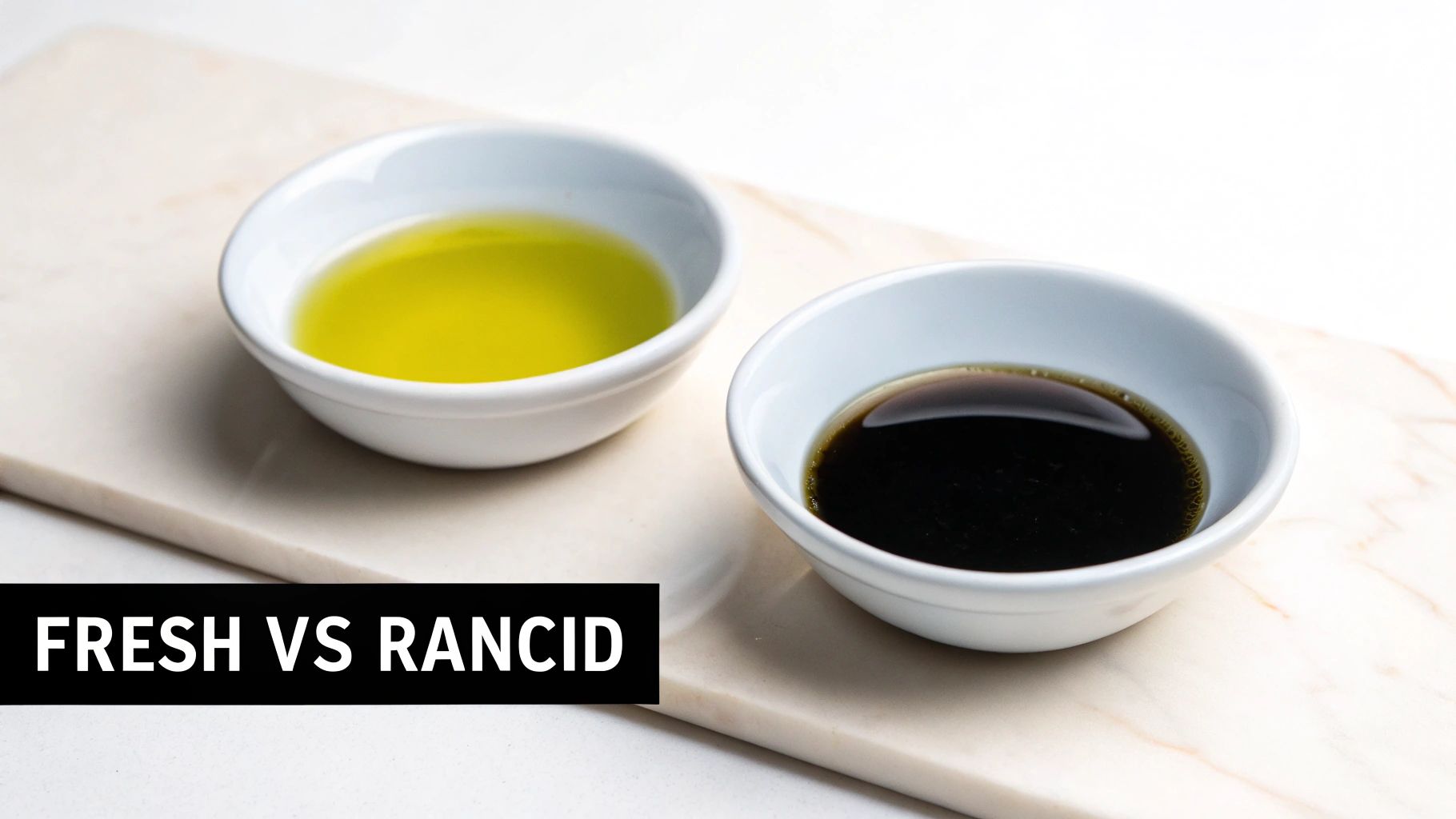
The Flavor Connection
Think of low acidity as a green light for magnificent flavor. An oil with a very low FFA—say, below 0.3%—is almost certain to deliver the fresh, vibrant, and complex notes that define a world-class product. These are the desirable sensations we seek:
- Fruity: Notes of green apple, almond, or fresh tomato leaf.
- Grassy: The clean perfume of a freshly cut lawn or wild herbs.
- Peppery: That delightful, pungent kick in the back of your throat, a sign of potent antioxidants.
Conversely, an oil with high acidity is waving a giant red flag. It signals a product that is flat and lifeless at best, and at worst, actively unpleasant. The link between the oil’s hidden chemistry and your sensory experience is absolute.
This principle is not unique to olive oil. Understanding the role of acidity in beverage flavor, for instance, reveals how chemical composition shapes taste across the board. Just as with a masterfully roasted coffee, controlling acidity in olive oil is the hallmark of true craftsmanship.
Acidity and the Ticking Clock of Freshness
This vital chemical marker does more than predict flavor; it dictates the oil’s lifespan from the moment of its creation. An olive oil’s journey to rancidity is a race against time, and a high acidity level means it began that race with a crippling handicap.
Imagine two runners at the start of a marathon. One is healthy, rested, and primed for the distance. That is your low-acidity oil, built with a stable chemical structure that will shield its flavor and nutrients for months.
The other runner is already fatigued, already showing signs of breakdown. That is the high-acidity oil. It is already in a state of decay, meaning its path to becoming utterly rancid will be tragically swift.
High acidity means the oil is inherently unstable. The destructive process of oxidation already has a foothold, and it is only a matter of time before the oil's flavor and nutritional value are lost forever.
This is why an oil’s initial acidity is so critical. It’s not just about passing a test to earn an "Extra Virgin" label; it’s about ensuring the product has the structural integrity to remain fresh and delicious until you pour it. You can learn more about how to evaluate and maintain olive oil freshness to protect your investment.
Ultimately, low acidity doesn’t just mean the oil was good when it was made—it means it has a fighting chance to still be great when it reaches your kitchen. It is the most honest number on the bottle, telling you everything about its immediate quality and its future stability.
The Two Faces of Acid in Your Olive Oil
To truly master the art of choosing an exceptional olive oil, we must clarify one final, crucial point. It’s a tale of a hero and a villain, both residing in the same bottle, both going by the name "acid." Discerning the difference is the last piece of the puzzle—the secret that separates a casual shopper from a true connoisseur.
First, meet the hero of our story: bound oleic acid. This is the monounsaturated powerhouse that forms the very structure of olive oil. Locked securely into its triglyceride form, this is the "good fat" celebrated for its extraordinary health benefits. This is the oil as nature intended: strong, stable, and life-enhancing.
Then, we have the villain: free fatty acid. This is the troublemaker we have been discussing, the one that signals decay. It is the very same oleic acid, but it has broken free from its molecular home. Its presence is a clear sign that the oil's quality is slipping. One is the essence of olive oil's goodness; the other is the measure of its decline.
The Supporting Role of Linoleic Acid
While oleic acid commands the spotlight, another fatty acid plays a vital supporting role: linoleic acid. This is an essential omega-6 fatty acid, present in much smaller quantities. Its presence is not a flaw; it is part of what gives olive oil its complete nutritional profile.
The secret lies in balance. The fact that olive oil is naturally low in linoleic acid is one of its greatest strengths. This lower concentration gives it superior chemical stability and a healthier fatty acid profile compared to most common seed oils.
Think of it this way: Oleic acid is the strong brick foundation of a house, built to last. Linoleic acid is like a window—essential for light, but you wouldn't build the entire house from glass. Too much would make the whole structure fragile and prone to shattering.
Why Less Is More
Oils rich in linoleic acid, like sunflower or soybean oil, are far more susceptible to oxidation—the chemical reaction that causes rancidity. Their molecular structure is simply not as robust. Olive oil's composition, dominated by stable oleic acid, is what protects its fresh flavor and potent health compounds. This is a critical point when we talk about the acid in olive oil.
Linoleic acid typically accounts for 3.5% to 21% of olive oil, with most quality oils hovering around 10%. This amount provides necessary essential fatty acids without contributing to the inflammatory excess often linked to diets high in omega-6. For true aficionados, oils with under 10% linoleic acid are prized for their exceptional stability and longer shelf life. You can find more detail on how fatty acid composition impacts oil quality on torresyribelles.com.
By separating these two concepts, the picture becomes crystal clear. The oil’s fundamental composition (the heroic bound fatty acids) is entirely different from the metric of its decay (the villainous free fatty acids). One defines the oil’s inherent quality, while the other measures its flaws. This is key to appreciating not just the taste, but the oil's antioxidant power as well. You may want to explore our deep dive into the powerful world of olive oil polyphenol content to see how it all connects.
With this final piece of knowledge, you are empowered. You can now celebrate the healthy, stable structure of a great olive oil while knowing precisely which warning sign—the free acidity level—to watch out for. It's the kind of understanding that will change how you look at every bottle on the shelf.
A Practical Guide to Finding Low-Acidity Olive Oil
Knowledge is one thing, but action is another. All the chemistry in the world is useless if it doesn't help you walk into a store and bring home a bottle of truly exceptional olive oil. Consider this your field guide for turning what you've learned about acidity into a winning shopping strategy.
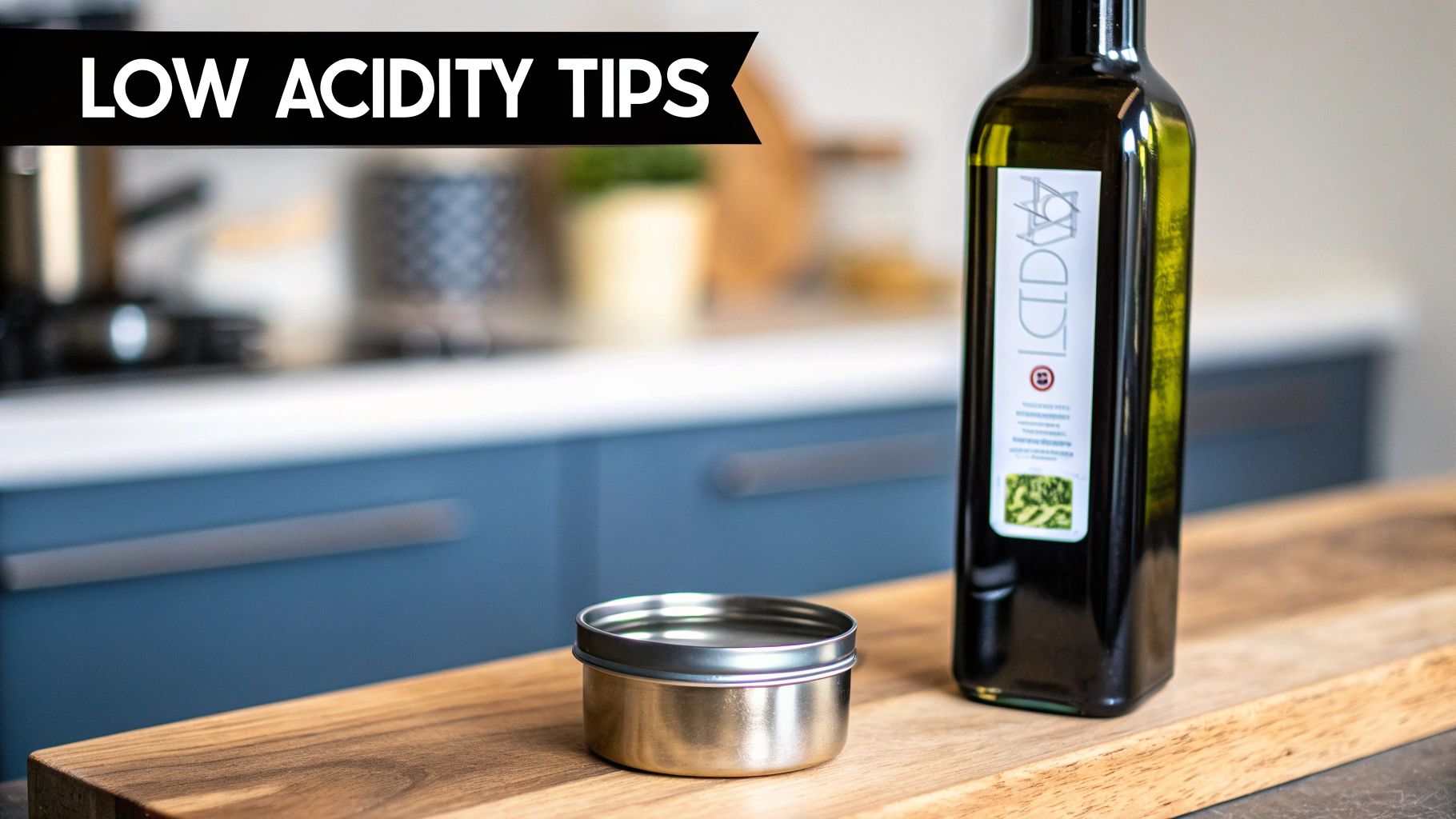
If you remember only one thing from this guide, let it be this: you are buying a fresh fruit juice. Like any juice, its greatest enemy is time. Your mission is to find the freshest oil possible, and the label holds all the clues you need.
Decode the Label Like an Expert
Most shoppers glance at the "best by" date. Frankly, that’s a rookie mistake. This date is often set a full two years after the oil was bottled, which tells you absolutely nothing about when the olives were actually picked from the tree and pressed into oil.
The date you must hunt for is the harvest date.
A specific harvest date, such as "Fall 2023," is the single most trustworthy sign of freshness you will find. It demonstrates a producer's pride and transparency. If a bottle lacks a harvest date, you should be deeply suspicious.
When a producer proudly displays the harvest date and—even better—the specific free acidity level (look for 0.3% or lower), they are making you a promise. They are inviting you to hold them to a higher standard. That is a bottle worth your money.
Beyond dates, familiarizing yourself with olive oil labeling helps you spot other marks of quality. Terms like "single estate" or the naming of specific olive varietals (like Picual or Koroneiki) often accompany lower acidity and more meticulous production.
Judge the Bottle by Its Cover
Once you have vetted the label, your next clue is the packaging. Light is another fierce enemy of olive oil, triggering an oxidative process that demolishes quality and can increase acidity over time.
This means you should never, ever buy olive oil in a clear glass bottle. It may look pretty on the shelf, but it is a death sentence for the precious oil inside.
Here is your checklist for proper packaging:
- Dark Glass: Seek out deep green or brown bottles that serve as a natural shield against light.
- Tins or Ceramics: Opaque containers like these offer the absolute best protection available.
- Check for Dust: A layer of dust is a dead giveaway that a bottle has been languishing on that shelf for a very long time. Always reach for one from the back.
Bring It Home and Keep It Safe
Your job isn't done when you leave the store. How you store your oil at home is just as critical for preserving its low acidity and fresh flavor. The golden rule is simple: protect it from its three enemies—heat, light, and air.
Always store your olive oil in a cool, dark cabinet. Never keep it next to the stove or on a sunny windowsill, as the constant warmth will rapidly accelerate its decline.
Once you open the bottle, air becomes the next threat. This is why you must not "save" a great olive oil for a special occasion. Its peak flavor and health benefits are fleeting. Use it generously, and plan to finish the bottle within a few months of opening.
Olive Oil Acidity: Your Questions Answered
We have covered the science and the secrets. Now, let’s tackle the most common questions head-on to dissolve any lingering confusion. Think of this as your final cheat sheet to becoming a smarter, more confident olive oil buyer.
Can I Actually Taste High Acidity in Olive Oil?
No, not directly. Free fatty acids are tasteless, so you cannot sip an oil and say, "this tastes like 0.7% acidity." Acidity is not a flavor like sour or bitter; it is a chemical measure of decay.
However, you can absolutely taste the consequences of whatever caused that high acidity. The defects that send acidity soaring—fermentation, mold, oxidation—create unmistakable off-flavors. If you taste something musty, fusty, or a wine-like vinegar note, you are tasting the damage that walks hand-in-hand with high acid in olive oil.
Does Lower Acidity Mean Healthier Olive Oil?
Yes, absolutely. A low acidity level is one of the most reliable indicators of a healthier, higher-quality oil.
An exceptionally low number, like 0.3% or less, is proof that the olives were healthy, harvested gently, and milled immediately. This flawless process is precisely what is required to protect the oil's polyphenols—the powerful antioxidants famous for their anti-inflammatory and heart-health benefits. High acidity, conversely, is a red flag for degradation, a process that destroys these delicate, health-giving compounds.
Think of it this way: an oil's free acidity is the best single predictor of its antioxidant potential. Low acidity signals high polyphenols, while high acidity means those precious health benefits are likely long gone.
Why Isn't the Acidity Level Printed on Every Bottle?
This is often a case of "if you don't have anything good to say, don't say anything at all." The legal limit for Extra Virgin is <0.8%, and many mass-market oils barely slide in under that wire. They have no incentive to advertise a number that is, frankly, mediocre.
On the other hand, producers of truly high-quality olive oil are immensely proud of their low acidity. They wear it as a badge of honor and will often print their stellar numbers—like 0.2% or even lower—right on the front label. It is a simple, powerful way to prove their oil is a cut above the rest.
At Learn Olive Oil, we believe that understanding the story behind your food is the first step to a better culinary experience. We're dedicated to helping you discover the world of premium olive oil, from the grove to your table. Discover the World of Premium Olive Oil.

 Learn Olive Oil
Leave a comment