Would you buy wine just because it’s red, without knowing if it's from the sun-drenched hills of Bordeaux or the cool valleys of Napa? Of course not. You know the place is the promise.
Yet, this is exactly how most people shop for olive oil. They reach for a bottle, completely overlooking its single most critical detail: the olive oil origin. This isn't just a tiny piece of information on the label; it's the master key that unlocks an oil's true flavor, its hidden quality, and its honest-to-goodness authenticity.
Why Origin Is Your Most Important Guide to Great Olive Oil
It’s dangerously easy to be seduced by a beautiful bottle or a tempting price tag in the supermarket aisle. We’ve all been there. But this simple mistake can be a costly one for your kitchen and your taste buds. Many of those shelves are lined with bottles that use clever marketing to hide a bland secret: the oil inside is an anonymous blend from all over the world, stripped of its character and robbed of its health benefits.
Learning to read and understand the origin is your best defense. It elevates you from a shopper guessing at quality to a connoisseur who knows exactly what they're getting. When you know where an oil comes from, you get a glimpse into its entire life story—the climate, the soil, and the generations of tradition that brought it to life.
The Power of Place
Think of an oil's origin as its birth certificate. It’s so much more than a country name. A true origin story connects you to a specific grove, a particular hillside, and a real producer who proudly stands by their work. That connection is the ultimate mark of quality.
So why does this 'where' matter so profoundly? Because it dictates just about everything else.
- Flavor Profile: An oil from the sun-baked fields of Andalusia, Spain, will taste bold and peppery—a world away from the delicate, grassy oil produced in the rolling hills of Tuscany.
- Authenticity: Vague labels like "Product of the Mediterranean" should ring alarm bells. Specific origins, especially from a single estate or a protected region (PDO), are a sign of a producer who takes immense pride in their oil.
- Quality and Freshness: Producers who clearly state their origin have a reputation to uphold. They are invested in every step, from the olive grove to the bottle you hold, and they have absolutely nothing to hide.
Knowing your source is the master key. It unlocks a world of taste, quality, and authenticity, turning olive oil from a simple commodity into a true culinary experience.
Beyond the Country Name
Once you start prioritizing origin, you'll see this kitchen staple in a whole new light. It’s the first—and most important—step toward understanding what separates a truly great olive oil from the oceans of mediocrity. As you learn to see origin not as a small detail but as the very foundation of quality, you'll start spotting the liquid gold among the imposters.
This guide will show you exactly how to do that, making you a more confident and informed buyer. If you're ready to start making better choices at the shelf, you can get a head start with our expert tips on how to buy olive oil and what to look for on the label.
The Ancient Roots of Today's Liquid Gold
To truly appreciate what's in that bottle of olive oil sitting in your kitchen, you must understand its incredible backstory. This isn’t just a dry history lesson; it's the story of how a simple fruit became the lifeblood of ancient civilizations, a form of currency for empires, and a non-negotiable staple in the modern pantry. The story of olive oil origin starts in the warm cradle of the Mediterranean, weaving a tale of trade, conquest, and culinary genius.
It all began more than 6,000 years ago. Picture the island of Crete around 4000 BCE, where archaeologists have unearthed evidence of our ancestors first crushing olives. This wasn't just about creating a new food; it was the dawn of one of humanity's first great agricultural movements. From those humble beginnings, a liquid gold emerged that would quite literally shape history.
How a Precious Commodity Spread
The secret of this amazing oil couldn't be kept quiet for long. By 3000 BCE, the practice of cultivating olive trees had spread like wildfire across the eastern Mediterranean. The enterprising Phoenician traders, true masters of the sea, were instrumental. Their ships carried not just jugs of oil but the precious olive trees themselves, planting the seeds of a new industry in places like Syria, Palestine, and beyond. You could say they were the original olive oil evangelists.
This laid the groundwork for the Romans, who turned olive oil production into a massive, brilliantly organized enterprise. For them, olive oil was essential to daily life: fuel for their lamps, ointment for their skin, and a cornerstone of their diet. They engineered vast groves and highly efficient presses, turning a regional specialty into an industrial-scale commodity that reached every corner of their sprawling empire. Olive oil became a true symbol of Roman prosperity and power.
From a simple Cretan stone press to a Roman amphora, olive oil's journey is a powerful testament to its enduring value. It has been a source of light, health, and wealth for thousands of years, connecting ancient tables directly to our own.
From Ancient Staple to Modern Powerhouse
This deep, historical reverence for olive oil hasn't faded. If anything, its importance has only magnified. The traditions that began thousands of years ago in small Mediterranean villages now power a massive global market, with demand hitting all-time highs. The world's hunger for authentic, high-quality olive oil is stronger than ever.
The growth in modern times has been nothing short of explosive. The International Olive Council reports that global olive oil production has tripled over the last 60 years. It jumped from around 1 million tons in the 1960s to an incredible 3,266,500 tons in the 2019/20 crop year. This staggering increase reveals a worldwide awakening to its unparalleled flavor and well-documented health benefits.
Understanding this rich past is key. The traditions born in ancient Greece and the economic forces that drove Roman expansion still echo in the bottles we choose today. This long and fascinating history isn't just trivia—it's the context that gives real meaning to every label, every region, and every single drop of liquid gold.
A Flavor Tour of the World's Great Olive Oil Regions
Ever wonder why one bottle of olive oil tastes grassy and peppery, while another is mild and buttery? The secret is in its origin. Just like with wine, the place where an olive is grown—the soil, the climate, the specific varietal—imprints itself on the final flavor in the bottle.
Getting to know the world's great olive oil regions is the key to moving beyond generic supermarket oils and discovering flavors that can truly transform your cooking.
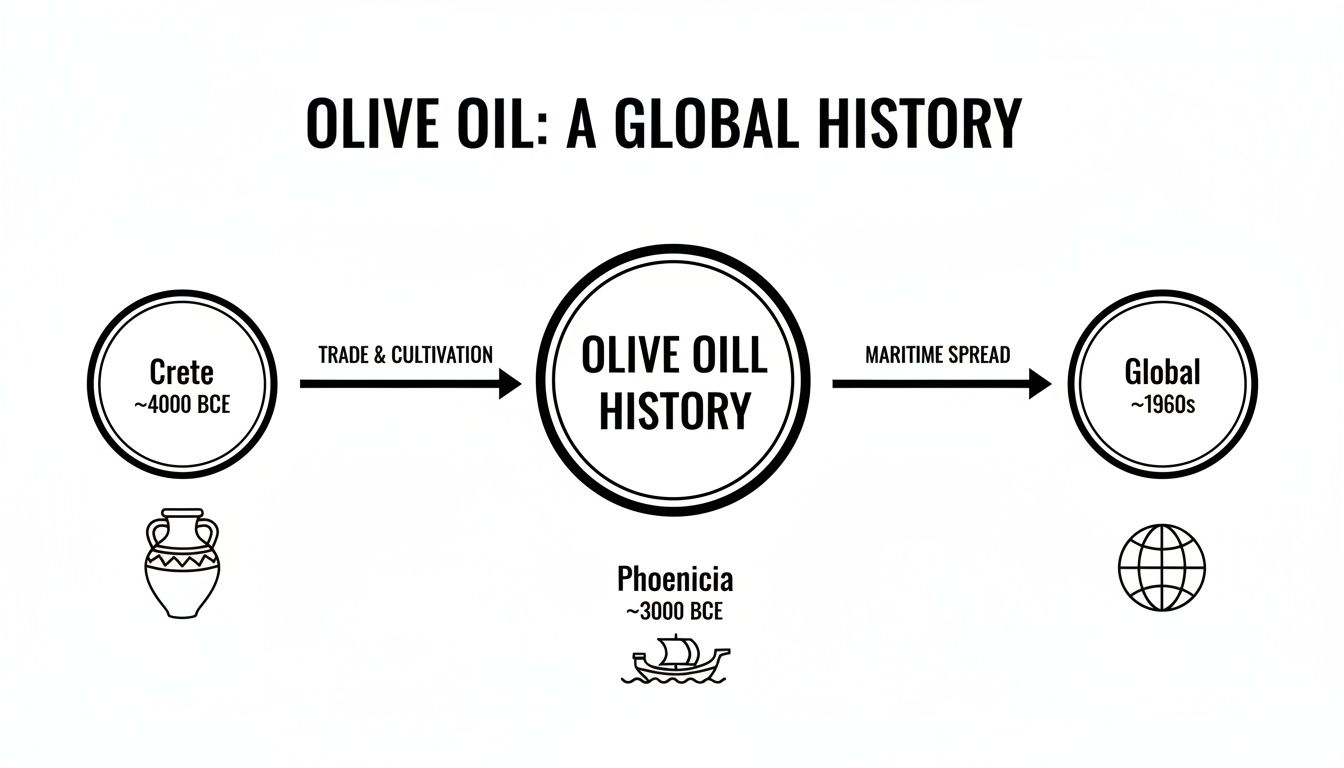
The story of olive oil began on a single Mediterranean island and, over millennia, spread across the sea and eventually to the rest of the world, with each new home adding its own unique chapter to the tale.
The Mediterranean Masters
The heart of the olive oil world has always been, and remains, the Mediterranean basin. This is where ancient traditions meet modern expertise. Three countries in particular stand as giants of the industry, each offering a distinct and unforgettable taste of their land.
-
Spain: When you think of Spanish oil, think bold and robust. As the world's undisputed production champion, Spain's sun-drenched Andalusian groves are famous for the Picual olive. It creates intensely fruity oils with a signature peppery kick at the back of the throat—perfect for when you want a flavor that makes a powerful statement.
-
Italy: Italy is a symphony of diversity. It's a patchwork of microclimates and fierce regional traditions, giving us everything from the delicate, grassy oils of Tuscany to the milder, golden oils of Sicily. Each region passionately protects its own olive varietals, resulting in an incredible spectrum of flavors. You can explore this rich tapestry in our guide to olive oils from Italy.
-
Greece: Home to some of the planet's oldest olive trees, Greece is celebrated for its aromatic and famously fruity oils, especially those from the Koroneiki olive. Greek extra virgin olive oil often has a beautiful green color, a soft herbaceous scent, and a gentle peppery finish that makes it wonderfully versatile in the kitchen.
When you taste an oil from a specific Mediterranean region, you’re tasting more than just fruit. You are experiencing thousands of years of climate, soil, and tradition distilled into a single, perfect drop.
A Global Powerhouse of Production
While tradition runs deep, the modern production numbers are simply staggering. In the 2023/24 season, Spain produced an astounding 766,400 tons of olive oil. That figure absolutely dwarfs the output of its closest competitors, Italy at 288,900 tons and Turkey at 210,000 tons.
Taken together, these top producers account for over 50% of the world's entire olive oil supply. In fact, the European Union as a whole churns out approximately 68% of all the olive oil on the planet. This massive scale shows just how central these regions are to what we find on our shelves.
Olive Oil Flavor Profiles by Major Region
To help you connect a region to a specific taste, here's a quick guide to what you can expect from the world's top producers.
| Region (Country) | Primary Olive Varietal(s) | Dominant Flavor Profile | Best For |
|---|---|---|---|
| Spain | Picual, Arbequina, Hojiblanca | Robust, intensely fruity, peppery, with notes of tomato leaf and green herbs. | Drizzling over hearty stews, grilled meats, and rustic breads. |
| Italy | Coratina, Frantoio, Leccino | Highly diverse; from grassy and sharp (Tuscany) to mild and buttery (Sicily). | Finishing pastas and risottos, salad dressings, and dipping. |
| Greece | Koroneiki, Kalamata | Aromatic, fruity, and herbaceous with a soft, gentle peppery finish. | Greek salads, roasted vegetables, grilled fish, and lemon-based sauces. |
| California (USA) | Mission, Arbequina, Arbosana | Bright, fresh, and often bold, with flavors ranging from artichoke to nutty. | Salad dressings, avocado toast, and finishing grilled chicken or fish. |
| Chile/Argentina | Arbequina, Coratina | Clean, vibrant, and exceptionally fresh with a balanced fruity and spicy character. | Everyday cooking, marinades, and vinaigrettes. |
This table is just a starting point, of course. The real joy comes from exploring the nuances of each region for yourself.
The Innovative New World Producers
But the olive oil tour doesn't end in the Mediterranean. A new wave of producers is making a huge mark on the global stage, bringing fresh ideas and innovative techniques to this ancient craft.
"New World" regions aren't bound by centuries of tradition, which frees them up to experiment. California, for instance, has become a hotbed for high-quality, artisanal oils that blend classic Mediterranean varietals with a uniquely American spirit.
Further south, countries like Chile and Argentina are using their ideal growing climates to produce vibrant, fresh, and incredibly flavorful extra virgin olive oils that are snapping up international awards. Even Australia has joined the party, with producers creating world-class oils that reflect the continent's unique terroir. These regions prove that exceptional olive oil knows no borders.
How to Decode the Language of an Olive Oil Label
Walking down the olive oil aisle can feel like a test. You’re faced with a wall of bottles plastered with foreign terms, fancy crests, and confusing phrases. But that label is the truest story you'll get about what's inside—if you know how to read it.
Think of an olive oil label as a map. It’s designed to guide you to incredible flavor and quality, but first, you have to learn the language. This is your guide to cutting through the marketing noise to find the real liquid gold.
Country of Origin: The First, and Trickiest, Clue
The most obvious detail is usually the country of origin, but this can be the most deceptive. A label screaming "Product of Italy" might have you dreaming of sun-drenched Tuscan groves, but the reality is often far less romantic.
Current regulations allow bottlers to slap this phrase on the label even if the olives were grown in Spain, Greece, or Tunisia and merely bottled in Italy. This results in a generic blend of unknown age and quality, designed for the mass market, not for character.
An authentic olive oil origin statement is precise. Vague terms like "Bottled in" or "Imported by" are red flags. They are often a deliberate attempt to hide the oil's true, and often less glamorous, source.
For a much better bottle, look for more specific wording. A phrase like "Grown and Pressed in Kalamata, Greece" is a huge leap forward. It tells you the olives came from one place and weren't shipped across continents before being turned into oil. For a deeper look at these rules, check out our complete guide to olive oil labeling.
PDO and PGI: Your Guarantee of Authenticity
If you spot a small, colorful seal on a bottle, pay close attention. These certifications are your best friends in the search for authentic olive oil, acting as legally binding promises that protect you from fakes.
The two most important seals come from the European Union:
- PDO (Protected Designation of Origin): This is the gold standard. A PDO seal guarantees that every single step of the process—growing, harvesting, pressing, and bottling—happened in one specific, named geographical area. It’s a promise that the oil is a true expression of its unique home.
- PGI (Protected Geographical Indication): This is another excellent certification. It guarantees that at least one key stage of production happened in the designated region. It’s a bit less strict than PDO, but it still provides a powerful link between the oil and its origin.
Think of these seals as a notarized document for your olive oil. They prove the product is tied to a real place and has passed serious quality checks, making them a reliable shortcut to a fantastic bottle.
The Power of Specificity: Single-Estate vs. Blends
Beyond official seals, the most passionate producers give you an even clearer picture of their oil's journey. This is where you separate the good oil from the truly exceptional stuff.
Look for terms that point to a single, traceable source. A "Single-Estate" or "Single-Origin" oil means every olive was grown on one farm. This is the olive oil equivalent of a single-vineyard wine—it’s a pure, unblended taste of a specific patch of earth and the producer’s unique craft.
Finally, the absence of a harvest date is a major warning sign. Olive oil is fresh-pressed fruit juice; it's always best when it's young. A proud producer will always print the harvest date (e.g., "Harvest Nov 2023") on the label, giving you a clear sign of its freshness and vitality.
Understanding Terroir: The Soul of Olive Oil Flavor
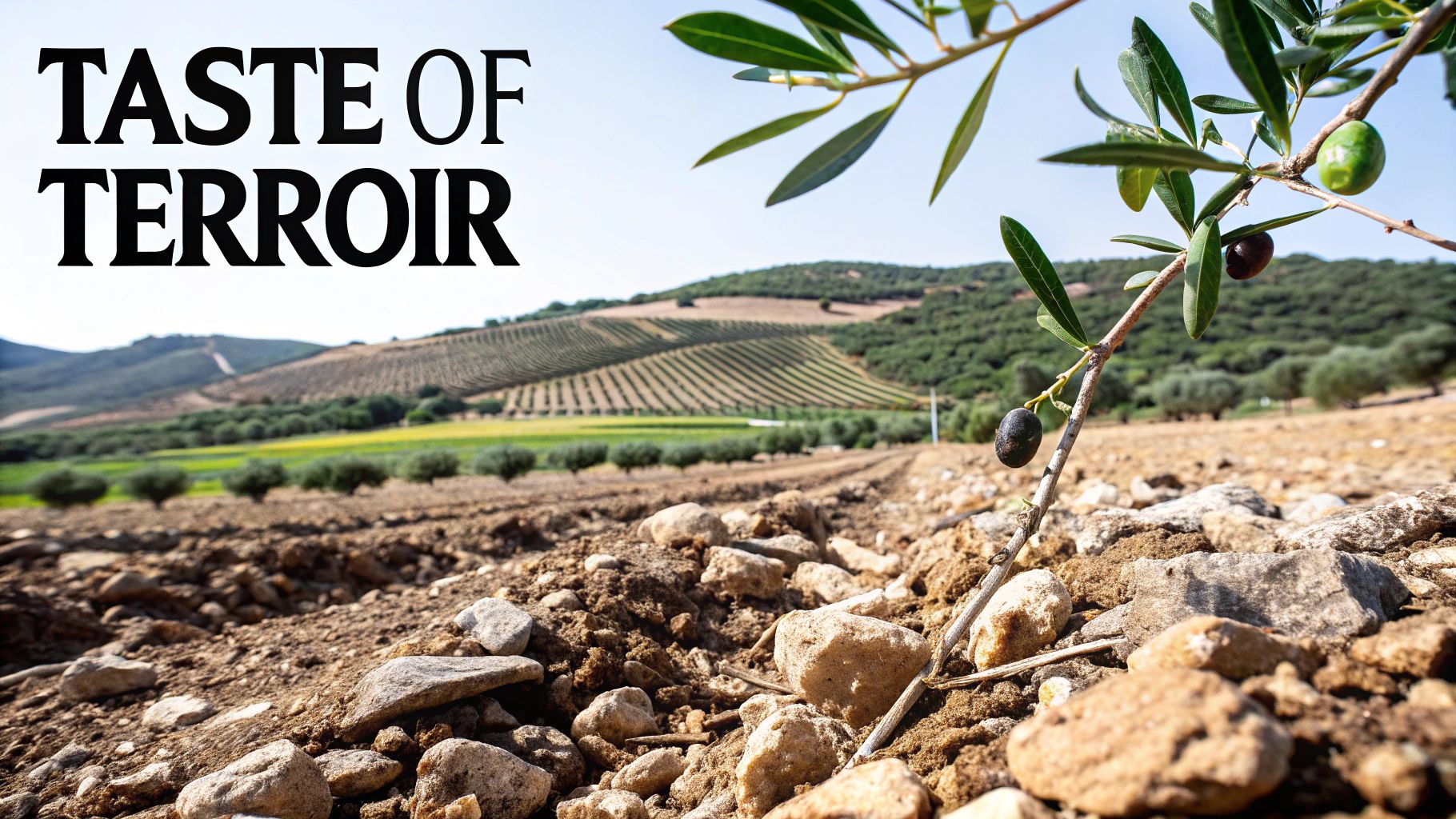
Ever wonder why an olive oil from a sun-drenched Spanish plateau tastes fiery and bold, while one from the cool shores of an Italian lake is delicate and buttery? You might be surprised to learn they could come from the exact same type of olive. The secret isn't in the tree, but in the land itself. It’s a concept the French call terroir.
Borrowed from the world of wine, terroir is the unique fingerprint a place leaves on the food grown there. It's the grand symphony of every element that shaped an olive's life—the soil it grew in, the angle of the sun, the salty sea breeze, and even the generational wisdom of the farmers. This is why olive oil origin is more than just a dot on a map; it's a recipe for flavor.
This isn’t just a romantic idea; you can taste it. An olive that struggled for water in rocky limestone soil will produce a more intensely aromatic and peppery oil. On the other hand, a plump olive that grew happily in rich, dark earth will give you something much softer and rounder.
The Elements That Shape the Flavor
Think of terroir as the combination of natural influences that give an olive grove its unique personality. No two groves are identical, which is why a single olive variety can produce a stunning array of flavors depending on where it’s grown.
The key components are:
- Soil Composition: Is the soil rocky and mineral-rich, or fertile and loamy? Limestone-heavy soil, for example, often yields oils with that sharp, green bitterness that connoisseurs adore.
- Climate and Weather: An olive grove battered by coastal winds produces fruit with a completely different character than one sheltered in a warm inland valley. The amount of sun and rain directly impacts the concentration of oils and healthy polyphenols.
- Topography: The altitude and slope of the land matter immensely. Olives grown on a steep, sun-drenched hillside ripen differently than those in a flat plain, creating vastly different flavors.
Terroir is the land’s signature. It's the reason a Koroneiki olive from the windy island of Crete tastes nothing like a Koroneiki grown in a Californian valley. The DNA is the same, but the soul is completely different.
Of course, human hands play a huge role. Farming practices, such as those for ensuring pure produce, are an integral part of a region's terroir and have a massive impact on the final character of the oil.
A Legacy Written in the Land
The human element of terroir—tradition—is just as crucial. Techniques passed down through generations are woven into a region's identity, creating a deep connection between people and place that can reach back thousands of years.
The story of olive oil origin is an ancient one, starting some 8,000 years ago in the Levant, where wild olive trees were first domesticated. This knowledge spread with traders and conquerors; by 2000 BCE, the Greeks had refined pressing techniques, and later, the Romans scaled production into an empire-wide industry.
This ancient heritage still shapes the oils we taste today. Understanding terroir elevates you from just knowing where an oil is from to understanding why it tastes the way it does. It’s the story of the land, the history, and the people, all captured in the bottle. To truly appreciate these nuances, you have to taste them, and our guide on how to taste olive oil can show you how the pros do it.
Choosing the Right Oil for Your Kitchen
All this information is fascinating, but it's useless if it just stays on the page. The real magic begins when you take what you've learned about olive oil origin and use it to make smarter choices at the store. This is where theory becomes a delicious reality.
Your goal is no longer to just grab any bottle of olive oil; it's to select the right one for the job at hand. A great chef wouldn't rely on a single, all-purpose oil any more than a painter would use only one color for a masterpiece. Think of an oil's origin as your ultimate pairing guide.
From Buyer to Chef: Matching Oil to Dish
The first step to making a brilliant choice is simply thinking about what you plan to cook. An oil’s intensity, its unique flavor profile, and its overall character are all directly tied to where it was grown. Matching that character to your dish is what separates a good meal from an unforgettable one.
Here’s a practical way to approach it:
-
For Bold Flavors: When you're grilling a steak, roasting root vegetables, or simmering a rich tomato sauce, you need an oil that won't get lost. A robust, peppery Spanish Picual or a pleasantly bitter Southern Italian Coratina can cut through heavy flavors and add a complex, spicy kick.
-
For Delicate Dishes: Lighter foods, on the other hand, call for a gentler touch. A delicate, buttery oil from Liguria, Italy, or a mild French Picholine will beautifully enhance the flavor of fresh seafood, a light pesto, or a simple spring salad without overpowering it.
-
For Everyday Versatility: Sometimes you just need a reliable workhorse for general sautéing or making vinaigrettes. A fruity and aromatic Greek Koroneiki offers a fantastic balance that works well across a huge variety of recipes, making it a perfect go-to.
The goal is always harmony. A robust oil complements a bold dish, while a delicate oil elevates a subtle one. When you let your menu guide your choice, olive oil transforms from a simple cooking fat into a dynamic finishing ingredient.
A Simple Origin Pairing Guide
To make things even easier, here’s a little cheat sheet for pairing regional oils with common styles of cooking. This isn't a set of strict rules, but rather a starting point for your own kitchen experiments. It's the simplest way to put your new knowledge of olive oil origin into action.
| Cuisine Style | Recommended Oil Origin Profile | Why It Works |
|---|---|---|
| Hearty Mediterranean | Robust Spanish or Southern Italian | The bold, peppery notes stand up to grilled meats, stews, and tomato-based dishes. |
| Classic French & Italian | Grassy Tuscan or Mild French | The herbaceous and delicate flavors are perfect for finishing pastas, risottos, and fish. |
| Modern American/Californian | Bright and Fruity Californian | The fresh, often artichoke-like notes complement salads, avocado toast, and grilled chicken. |
| Simple Greek Dishes | Aromatic and Fruity Greek | The well-balanced fruitiness is ideal for classic Greek salads, roasted vegetables, and dips. |
This framework is all about cooking with intention. When you choose an oil with purpose, you instantly become a more confident and skilled cook. To keep building on this, dive into our detailed guide on how to choose olive oil for even more pro tips.
Common Questions About Olive Oil Origin
Even with a firm grasp of the basics, the world of olive oil can still feel a little tricky. It's a complex product, and a few common myths can trip up even the most careful shoppers. Let's clear the air and tackle some of the most frequent questions about olive oil origin.
Think of this as your final check-in before you head to the store, armed with the knowledge to pick the perfect bottle.
Does a Higher Price Mean a Better Origin?
Not necessarily. It's easy to assume that the most expensive bottle must be the best, but price alone can be a terribly misleading guide. While a truly exceptional single-estate oil with a protected designation (PDO) will absolutely command a premium, a high price tag can just as easily hide hefty marketing costs or elaborate packaging.
A much better measure of quality is traceability. Look for labels that tell you a specific story—the name of the estate, a PDO or PGI seal, and, crucially, a recent harvest date. You'll often find that a moderately priced oil from a small, passionate Greek producer is far superior to a pricey, mass-market brand from a famous region that offers zero specifics.
What Is the Biggest Mistake People Make with Olive Oil Origin?
Hands down, the single biggest mistake is confusing the "bottled in" country with the "grown in" country. A label that prominently says "Product of Italy" can legally be filled with oil from olives grown in Spain, Tunisia, and Greece. All it means is that the oil was blended and bottled on Italian soil.
This is a massive red flag. This practice often involves mixing older, lower-quality oils to create a generic product completely devoid of the unique character that makes olive oil so special. To sidestep this trap, always look for precise wording like “Grown and Pressed in Tuscany, Italy” or find that trusted PDO or PGI seal. That certification is your guarantee that the olives were grown and processed right there.
The most common pitfall is accepting a vague origin story. True quality has a specific address, not just a country of import.
How Much Does Origin Affect Health Benefits?
The connection is enormous. The powerful health benefits of extra virgin olive oil are directly tied to its polyphenol content—the antioxidants responsible for so much of its goodness. And those polyphenol levels are determined by the olive variety, the terroir, and exactly when the olives were harvested.
For instance, early-harvest oils, which are common in regions known for robust and peppery flavors like parts of Spain and Greece, tend to have much higher polyphenol counts. A fresh, authentic extra virgin olive oil from a specific, reputable origin will always pack more of a nutritional punch than a generic blended oil with an unknown past.
At Learn Olive Oil, we believe understanding origin is the first step toward a richer culinary life. We're dedicated to demystifying this liquid gold, from the groves to your table, so you can choose with confidence. Discover the World of Premium Olive Oil and start your journey to better flavor today.


Leave a Reply