Walk down the olive oil aisle, and you’ll see the word “acidity” on a few bottles. It’s easy to assume this means a sharp, tart flavor, like a splash of lemon or vinegar. But you’d be mistaken.
In the world of fine olive oil, acidity has nothing to do with taste. It’s a silent number. A chemical fingerprint. It’s the single most revealing clue to an oil’s quality, telling a hidden story of the care—or carelessness—taken from the olive grove to your kitchen.
It’s the report card that tells you everything.
What Olive Oil Acidity Really Means
Acidity in olive oil is the measure of its free fatty acids (FFA). Picture a perfect, healthy olive, hanging heavy on the branch. Inside, its fats are locked in a stable, pristine structure called triglycerides. These are the building blocks of exceptional oil.
But what happens if that olive is bruised during harvest? Bitten by a pest? Or left to sit in a pile, slowly baking under the sun?
That’s when the trouble starts. The stable triglycerides begin to shatter, releasing individual fatty acids. These rogue acids now roam “free.” The percentage of these free fatty acids is precisely what a lab measures as the oil’s acidity. It’s a direct, unflinching indicator of how much the olive fruit has degraded before it was even pressed.
The takeaway is simple and powerful: a lower acidity number means a higher quality oil. It’s the single most important chemical score a producer can earn.
The Science Behind the Number
Achieving a rock-bottom acidity level is no happy accident. It’s the hard-won result of obsessive, meticulous care at every single stage. A low number whispers a story. It tells you the olives were:
- Pristine: Harvested with a gentle hand, free from bruises or the tell-tale damage of olive flies.
- Fresh: Rushed from the tree to the mill with a desperate urgency, often within a few short hours.
- Cleanly Processed: Milled using spotless, modern equipment at precisely controlled cool temperatures.
A single misstep—a delay of a few hours, a pile of bruised fruit, a dirty piece of equipment—unleashes the enzymes that break down fats, causing the free fatty acid level to climb. That’s why a low acidity number is worn as a badge of honor. It’s irrefutable proof of purity and masterful handling.
This chart reveals the unbreakable link between healthy olives, low FFA, and world-class olive oil.
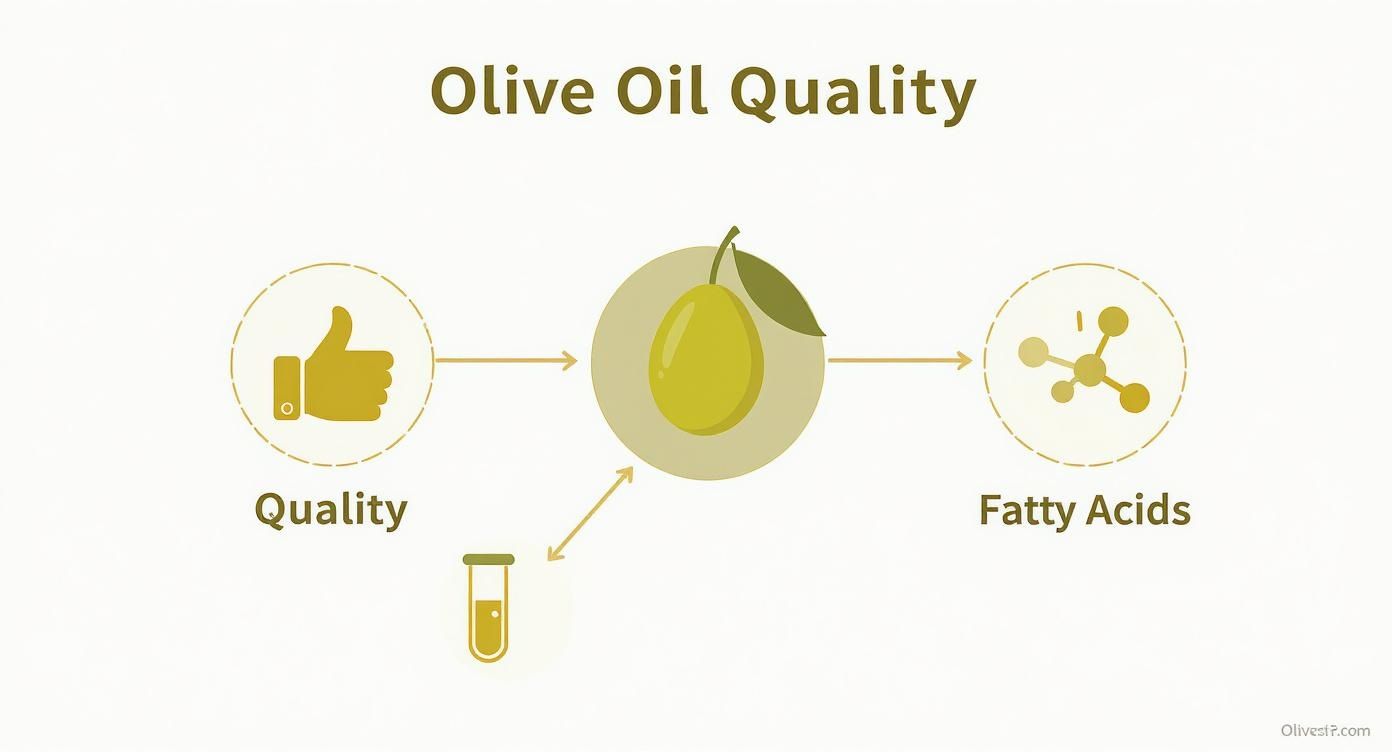
As you can see, it all begins with the integrity of the fruit. Healthy olives with their fatty acids perfectly intact are the sole foundation for creating a low-acidity, high-quality oil.
The Golden Standard of Quality
This chemical marker is so trustworthy that it forms the very backbone of international grading standards. Extra Virgin Olive Oil (EVOO), the highest grade obtainable, must, by law, have a free acidity of 0.8% or less. Any oil that fails this test simply cannot be called “extra virgin,” no matter how beautiful its color or how convincing its label.
Here is a quick breakdown of the acidity thresholds for different olive oil grades.
Olive Oil Acidity Levels at a Glance
This table offers a clear, side-by-side comparison of the maximum free acidity allowed for the most common grades of olive oil.
| Olive Oil Grade | Maximum Free Acidity (%) |
|---|---|
| Extra Virgin Olive Oil | ≤ 0.8% |
| Virgin Olive Oil | ≤ 2.0% |
| Lampante Olive Oil | > 2.0% |
| Refined Olive Oil | ≤ 0.3% |
| Olive Oil (Blend) | ≤ 1.0% |
Notice something interesting? While refined oil has a very low acidity, that purity is achieved through an industrial chemical process that also strips the oil of its flavor, aroma, and life-giving antioxidants. In stark contrast, the low acidity of an EVOO is a natural, unforced result of quality and care.
In essence, acidity is a measure of degradation. A low number proves that the oil is as close to the natural, fresh-squeezed juice of the olive as possible, with its chemical soul fully intact.
The fundamental composition of olive oil is a story in itself. If you'd like to dive deeper into the building blocks of this liquid gold, check out our guide on what olive oil is made of.
Why 0.8% Is the Global Mark of Excellence
Walk through the sun-drenched groves of Tuscany, the bustling markets of Spain, or the brightly lit aisles of your local grocery store. You’ll find a single, powerful number that separates the good olive oil from the truly great: 0.8%. This figure isn’t some arbitrary target or a clever marketing slogan. It is the global mark of excellence for extra virgin olive oil. But how did the world land on this specific number?
It’s the culmination of decades of scientific research and international cooperation. Governing bodies and scientists worked together to forge a reliable, universal language for quality. Think of it as the gold standard in currency—a benchmark that holds its value no matter where you are in the world.
The 0.8% figure represents the absolute maximum allowable free fatty acid content for an oil to earn the prestigious “extra virgin” crown. It’s a scientific line drawn in the sand, a testament that the oil was born from healthy, undamaged olives that were processed almost immediately after being plucked from the tree.
A Unified Global Standard
This isn't just a quaint European rule. The agreement around this acidity threshold is remarkably consistent across the globe, creating a unified quality control system that protects all of us. Whether it's the European Union or the United States Department of Agriculture (USDA), the standard is the same.
This international consensus on olive oil acidity reveals a shared, unwavering commitment to quality. The 0.8% free acidity measurement is uniformly established across the International Olive Council (IOC), the EU, and USDA standards for the extra virgin grade. California's 2025-2026 standards echo this, specifying that extra virgin olive oil must contain no more than 0.8 grams of free oleic acid per 100 grams of oil.
This powerful alignment means you can trust that a bottle of certified extra virgin olive oil from California is held to the exact same chemical benchmark as one from a tiny, family-run mill in Greece or Italy.
More Than Just a Number
But the 0.8% limit is about so much more than chemical purity. It's a powerful indicator of an oil's entire story—its flavor, its health benefits, and its ability to stay fresh in your pantry.
Here’s why it’s the cornerstone of quality:
- Flavor Integrity: While you can't taste acidity itself, high acidity is a direct result of fruit damage and decay. An oil with high acidity almost always comes with a host of unpleasant "off" flavors from fermentation or oxidation. Keeping acidity below 0.8% is the first line of defense against these taste defects.
- Higher Antioxidant Levels: The same gentle, rapid handling that keeps acidity low also preserves the oil's delicate polyphenols. These powerful antioxidants are the secret behind both the profound health benefits and the complex, peppery flavors of a world-class olive oil.
- Longer Shelf Life: Free fatty acids are unstable. They are prone to oxidation—the very process that makes oil go rancid. An oil with low acidity is far more stable and will stay vibrant and fresh much longer than one with a higher FFA content.
In short, the 0.8% standard isn't just a rule producers must obey. It’s a promise to you, the consumer, that the oil in the bottle possesses the fundamental integrity needed for exceptional taste, health, and freshness.
When producers meet this benchmark, they earn the right to label their oil as extra virgin. Understanding the rigorous process behind this can give you even more confidence in your choices. For a closer look, you can read our guide on extra virgin olive oil certification. This number is your most reliable assurance that you're buying a product made with integrity and care.
The Enemies of Low Acidity in the Grove
An exceptionally low acidity level in olive oil is never an accident. It is the result of a hard-won battle against nature and time, fought every single day in the olive grove. The story of an oil’s quality, and its final acidity number, begins long before the olives ever meet the press. It starts right there, on the tree.
The enemies in this fight are brutally simple: bruising, pests, and delay. Any one of these can break an olive's delicate skin. And the moment that protective shield is compromised, the clock on its quality starts ticking with furious speed. A break in the skin unleashes enzymes that begin devouring stable fats, and that is precisely what drives acidity up.
The Bruise: The First Compromise
The most common culprit is a simple bruise. Aggressive harvesting methods, where olives are beaten from branches with rakes or violent mechanical shakers, inflict a thousand tiny injuries. Even if they are invisible to the naked eye, each impact ruptures cell walls deep inside the olive.
Once those cells are broken, enzymes get to work, transforming pristine, stable fats into free fatty acids. This is why the final acidity is a direct report card on how carefully the olives were handled. Gentle hand-picking or using soft nets to catch the falling fruit minimizes this damage, protecting the olive’s integrity from the very first moment. To see how the best producers do it, you can learn more about different olive oil harvesting techniques.
A bruised olive is a wounded olive. Inside, the countdown has begun. The longer it waits, the higher its acidity will rise, forever marking the oil with a sign of its rough handling.
The Pest: The Olive Fruit Fly
Another major threat is the infamous olive fruit fly (Bactrocera oleae). This tiny insect is a devastating force for olive growers across the world. The female fly punctures the olive's skin to lay her eggs, effectively opening a door for bacteria and fungi to march right in.
As the larvae hatch and begin to consume the olive pulp, they leave behind a trail of destruction that accelerates decomposition. This damage sends free fatty acid levels skyrocketing, often pushing an oil's acidity far beyond the extra virgin limit. A severe infestation can ruin an entire harvest, turning what should have been a premium oil into a worthless, low-grade product.
The Delay: The Race Against Time
Perhaps the most unforgiving enemy of all is time itself. Even perfectly healthy, hand-picked olives are locked in a desperate race against the clock. The moment they are separated from the tree, they are cut off from their life source and immediately begin to break down.
Leaving harvested olives in bags or piles, even for a single day, can be fatal to quality. The olives on top crush the ones at the bottom, and the lack of air circulation causes them to ferment. This process generates heat, which kicks the enzymatic reactions into overdrive and sends acidity levels soaring.
- Ideal Window: The world’s best producers press their olives within 4 to 12 hours of harvest.
- The Danger Zone: Waiting more than 24 hours is a virtual guarantee of a significant, quality-killing spike in acidity.
This delicate balance is easily thrown off. We saw a dramatic example in 2023 when Spain, a massive global producer, suffered a catastrophic 50% drop in production due to severe droughts. This crisis had a direct impact on acidity levels, as compromised fruit and delayed harvests became common—the two key drivers of high acidity. You can find more insights on the global olive oil market on Fortune Business Insights.
Ultimately, every decision made in the grove is a test. The final acidity number isn’t just a metric; it’s the unfiltered truth about how well those tests were passed.
How Acidity Influences Flavor and Freshness
Imagine a detective arriving at a crime scene. They cannot rewind time to witness the event, but the clues left behind tell the entire story. In the world of olive oil, the acidity level is one of those crucial clues. While you can't actually taste the free fatty acids themselves, that single number on a lab report speaks volumes about the oil's past and predicts its future in your kitchen.
It’s a common mistake to believe "acidity" means the oil will taste sour or tart, like lemon juice. Nothing could be further from the truth. Instead, think of the acidity percentage as a silent measure of the oil's purity and health. A low acidity level doesn't automatically guarantee a fantastic oil, but a high one is a dead giveaway that something went terribly wrong. It is the very foundation upon which great flavor is built.
The Taste of Trouble
When an oil's acidity is high, it is a clear sign that the olives were compromised—bruised, overripe, or left sitting too long before pressing. You won't taste the free fatty acids, but you will absolutely taste the fallout from that damage. We call these sensory defects, and they are the ghosts of poor handling that haunt the final product.
These "off" flavors are the tell-tale signs of elevated acidity:
- Fusty: A swampy, musty taste that comes from olives fermenting in piles without oxygen.
- Winey-Vinegary: A sharp, sour note caused by aerobic fermentation, where bacteria get to work making acetic acid.
- Musty: An earthy, moldy flavor that develops when the oil comes into contact with moldy olives or dirty equipment.
A low acidity level, especially one well below the 0.8% extra virgin threshold, is your best assurance that the oil is clean, pure, and free from these flavor-killing defects.
Acidity as a Predictor of Shelf Life
Beyond flavor, an olive oil's acidity is directly linked to its freshness and how long it will last. Free fatty acids are unstable molecules, making them highly vulnerable to oxidation. Oxidation is the enemy—it's the chemical reaction that turns a vibrant, healthy oil into a rancid, unpleasant one.
Imagine an oil with low acidity as a tightly sealed fortress, well-defended against oxygen's relentless attacks. An oil with high acidity, on the other hand, has its gates thrown wide open. Those free fatty acids act as a welcome mat for oxygen to rush in and begin its destructive work, degrading the oil at a much faster pace.
This means an oil with higher acidity will go rancid much more quickly. It won't just lose its beautiful flavor; it will also lose its powerful health benefits, like its antioxidant-rich polyphenol content. A low acidity number is one of your most reliable indicators of an oil's potential to stay fresh.
Of course, proper storage is just as vital for preserving that freshness. Using a quality container, like the Giulietta Blue Oil Bottle, helps protect your oil from light and air, maintaining its low acidity and fantastic flavor.
Connecting the Dots to Your Kitchen
Once you grasp this connection, you will never look at a bottle of olive oil the same way again. That acidity number is no longer just a technical spec; it's a direct measure of quality and a forecast of its freshness. An oil boasting a very low acidity—say, 0.2%—was almost certainly made from pristine olives that were rushed to the mill and handled with meticulous care.
This kind of quality control doesn't just prevent defects; it preserves the delicate, complex flavors that make an exceptional olive oil so special—the notes of fresh-cut grass, artichoke, or almond. To truly appreciate these nuances, it helps to know what you're tasting for. You can sharpen your senses by learning how to taste olive oil properly, which will let you personally confirm the quality that a low acidity number promises.
How to Read an Olive Oil Label Like an Expert
https://www.youtube.com/embed/aEIglK2CJLg
Walking into the olive oil aisle can feel like stepping into a labyrinth. Bottles shout competing claims, fancy seals promise authenticity, and prices are all over the map. But once you know the code, the label on every bottle tells a story. Think of yourself as a detective—your mission is to learn the language and separate the pretenders from the true artisans.
The first and most important clue is the phrase "Extra Virgin Olive Oil." This isn't marketing fluff; it's a legally defined grade that guarantees the oil has a free acidity below the 0.8% threshold. But here's the secret: that's just the minimum requirement. The best producers don’t just meet the standard—they shatter it.
Beyond the Basics: Look for the Numbers
Truly exceptional producers treat their acidity level like a badge of honor. They know that achieving an incredibly low number, often below 0.3%, is the direct result of their obsessive care. So, they will proudly print that specific acidity number right on the label.
When you see a bottle that says "Acidity < 0.2%," you're looking at a producer who is supremely confident in their product. They are telling you, in no uncertain terms, that their olives were pristine, healthy, and pressed within hours of being picked. Its absence doesn't automatically mean an oil is bad, but its presence is a powerful signal of superior quality. It’s a green flag waving you toward a better bottle.
A specific, low acidity number on the label is one of the strongest indicators of a high-quality product. It moves beyond the minimum legal requirement and showcases a producer's commitment to excellence, signaling an oil likely to be fresher and more flavorful.
The All-Important Harvest Date
Next, your eyes should hunt for a harvest date. Do not confuse this with a "best by" or "bottling" date. A "best by" date is often set two years after bottling, but the oil could have been sitting in a storage tank for a year before that. The harvest date is the oil’s true birthday.
Olive oil is fresh fruit juice, period. It's at its absolute peak of flavor and health in the first year after the olives are picked and pressed. An honest producer will always tell you when their olives were harvested, often specifying the season (e.g., "Fall 2023"). If you cannot find a harvest date, put the bottle back. It is a major red flag that the producer may be hiding the oil's true age.
For those keen on mastering the art of label interpretation, our detailed guide on olive oil labeling offers an even deeper dive into what every term means for you.
Other Clues of Quality
With those two critical checkpoints passed, a few other details can confirm you're on the right track. A truly great olive oil is a work of agricultural art, and the label should reflect that.
Look for these final green flags to solidify your choice:
- Specific Origin: Vague terms like "Product of Italy" can mean the oil is a blend from olives grown all over, some of which may be low quality. Look for a specific estate, region, or mill (e.g., "Tuscany, Italy" or "Produced at the Garcia Estate").
- Dark Bottle: Light is one of olive oil's greatest enemies, causing it to oxidize and go rancid quickly. Quality oil is almost always packaged in dark green or black glass, or even a tin, to protect it.
- Olive Varietal: Just like wine grapes, different olive varieties (like Arbequina, Koroneiki, or Picual) produce oils with unique flavor profiles. Mentioning the varietal shows a level of craft and care that mass-producers often skip.
To make this even easier, think of it as a quick comparison.
Olive Oil Label Red Flags vs Green Flags
| Green Flags (Signs of Quality) | Red Flags (Potential Warnings) |
|---|---|
| Specific Harvest Date clearly listed | Missing harvest date, or only a "Best By" date |
| Low acidity level printed on the label (e.g., < 0.3%) | No mention of acidity, just "Extra Virgin" |
| Specific region, estate, or farm named as the origin | Vague origin, like "Product of Mediterranean" |
| Packaged in a dark glass bottle or opaque tin | Packaged in a clear or light-colored bottle |
| Olive variety (or varieties) named | No mention of olive varietals |
| Official quality seals (e.g., PDO, PGI) | Over-the-top, meaningless marketing terms like "Gourmet" or "Premium" |
By turning these clues into a mental checklist, you can transform a confusing shopping trip into a confident, informed decision. You’re no longer just a shopper; you’re an expert in the making, and the label gives you everything you need to find the good stuff.
Common Questions About Olive Oil Acidity
Even after you understand the science, a few nagging questions about olive oil acidity always seem to surface. It's a topic tangled in myths and, frankly, a lot of confusing marketing. Let's tackle the most common questions head-on with some straight, no-nonsense answers.
Think of this as your personal myth-busting guide.
Can I Actually Taste the Acidity in My Olive Oil?
This is, without a doubt, the biggest source of confusion. The answer is a simple, resounding no. Free acidity is a chemical measurement determined in a laboratory. It has no taste or aroma. You could not tell the difference between a 0.2% and a 0.7% oil just by tasting them.
But here is the crucial distinction: you can absolutely taste the problems that lead to high acidity. High acidity is the direct result of damaged, overripe, or poorly handled olives. The nasty off-flavors that come from that damage—think musty, vinegary, or fusty notes—are what your palate detects.
So while you don’t taste acidity itself, you taste the defects that caused it. A low acidity number is your first and best defense against those unpleasant flavors.
So, Does Lower Acidity Always Mean Better Taste?
Not necessarily, but it’s the price of admission for a great-tasting oil. Think of it like a high-performance car. Having a perfectly tuned engine is essential to win a race, but you still need a skilled driver at the wheel.
In the same way, an exceptionally low acidity level (say, 0.15%) proves the oil was born from pristine, healthy olives. It has the potential for greatness. The actual taste—the performance—comes down to other factors:
- Olive Variety: A Spanish Picual tastes completely different from an Italian Coratina.
- Harvest Time: Green, early-harvest olives yield bold, peppery notes, while riper olives result in softer, buttery flavors.
- Milling Skill: The artisan running the mill has a profound impact on the final character of the oil.
An oil can have incredibly low acidity but a very mild, simple taste. On the other hand, an oil with high acidity will almost never taste good. So, low acidity clears the stage, proving the potential is there for the oil's true personality to shine.
Why Don’t All Bottles Show the Exact Acidity Level?
This is a combination of legal requirements and marketing strategy. To be labeled "Extra Virgin," a producer simply has to prove the oil's acidity is below the 0.8% legal limit. There is no law that says they must print the exact number on the bottle.
But for top-tier producers, that number is a source of immense pride. An oil with an acidity of 0.2% isn't just meeting the standard; it's demolishing it. Displaying that number on the label is a badge of honor. It’s a direct signal to you, the shopper, that their oil isn't just squeaking by—it’s in a different league entirely.
When you see a specific, low acidity number on a label, you are looking at a producer's proud declaration of quality. Its absence might suggest the oil is perfectly fine, but likely much closer to the 0.8% legal limit. It’s a clue that helps you separate the good from the truly exceptional.
Does Cooking Raise the Acidity of Olive Oil?
Here's another stubborn myth that refuses to go away. Normal home cooking—sautéing vegetables, pan-searing chicken—will not increase an oil's free acidity. Acidity is a fixed chemical property of the raw oil, a snapshot of its quality before you even turn on the stove.
The real concern when cooking is an oil's smoke point. This is the temperature at which it begins to break down and smoke. High-quality extra virgin olive oil has a surprisingly high smoke point, usually between 375°F and 410°F (190°C to 210°C). That makes it a fantastic and safe choice for most of your daily cooking.
Heating an oil far past its smoke point will degrade it and create unhealthy compounds, but that is a different issue entirely from its acidity level. You can confidently use your best EVOO for cooking without worrying that you're somehow making it more acidic. The quality you start with is the quality you get.
At Learn Olive Oil, we believe that understanding these details transforms your relationship with this ancient food. It moves you from being a shopper to a connoisseur, empowered to choose the very best for your table. Explore our guides and start your journey to mastering the world of premium olive oil today.
Discover the World of Premium Olive Oil at https://learnoliveoil.com.


Leave a comment