Imagine a flavor that captures the fierce Mediterranean sun, the ancient, mineral-rich soil, and the crisp sea air—all in a single, golden drop. That is the promise of authentic Greek olive oil. It is far more than a simple cooking fat; it's a direct link to history and a cornerstone of a profoundly healthier way of living.
Understanding Greece's Liquid Gold
Forget the bland, pale oil that has languished in the back of your cupboard for who knows how long. We are talking about an elixir that has been the gold standard of quality for millennia. It’s time to look past the bewildering supermarket aisle and discover a story of ancient groves, of families who have perfected their craft across generations, and of a food that is truly bursting with life.
When people think of olive oil, Italy or Spain often leap to mind. Yet, here is a surprising fact: Greece is the world's largest producer of extra virgin olive oil—the absolute pinnacle of quality. An astonishing 80% or more of all Greek olive oil meets this supreme standard, a testament to a culture that simply refuses to cut corners on quality.
This guide is your passport into that world. We won't just share recipes; we will pull back the curtain and show you exactly what makes this liquid gold so precious.
What You Will Discover
Here, you will gain the kind of insider knowledge that transforms you from a casual shopper into a true connoisseur. Forget the marketing jargon and confusing labels. We will give you the tools to confidently choose, taste, and use Greek olive oil to elevate every single meal. You are about to learn:
- The Ancient Roots: How thousands of years of tradition are alive in the taste of your bottle today.
- Signature Flavors: What makes the Koroneiki olive forge such a bold, peppery, and unforgettable profile.
- Decoding the Label: What "PDO," "cold-pressed," and harvest dates actually mean for the flavor in your bottle.
- Tasting Like an Expert: A simple method to identify freshness and world-class quality from the very first taste.
The goal is simple: to help you experience the real deal. We want you to pour a stream of vibrant, emerald-gold oil that smells like freshly cut grass and finishes with that classic peppery kick—the undeniable proof of purity and potent antioxidants.
This journey starts with a new perspective: real Greek olive oil is not just another ingredient you toss into a pan. It is the very soul of a dish. It’s the starting point for a more vibrant kitchen and a healthier life. The powerful link between this ancient food and modern wellness is undeniable; you can learn more about olive oil's health benefits and discover its profound role in a well-lived life.
Prepare to see, smell, and taste this timeless treasure in a way you never have before. Let's begin.
A Journey Through Ancient Olive Groves
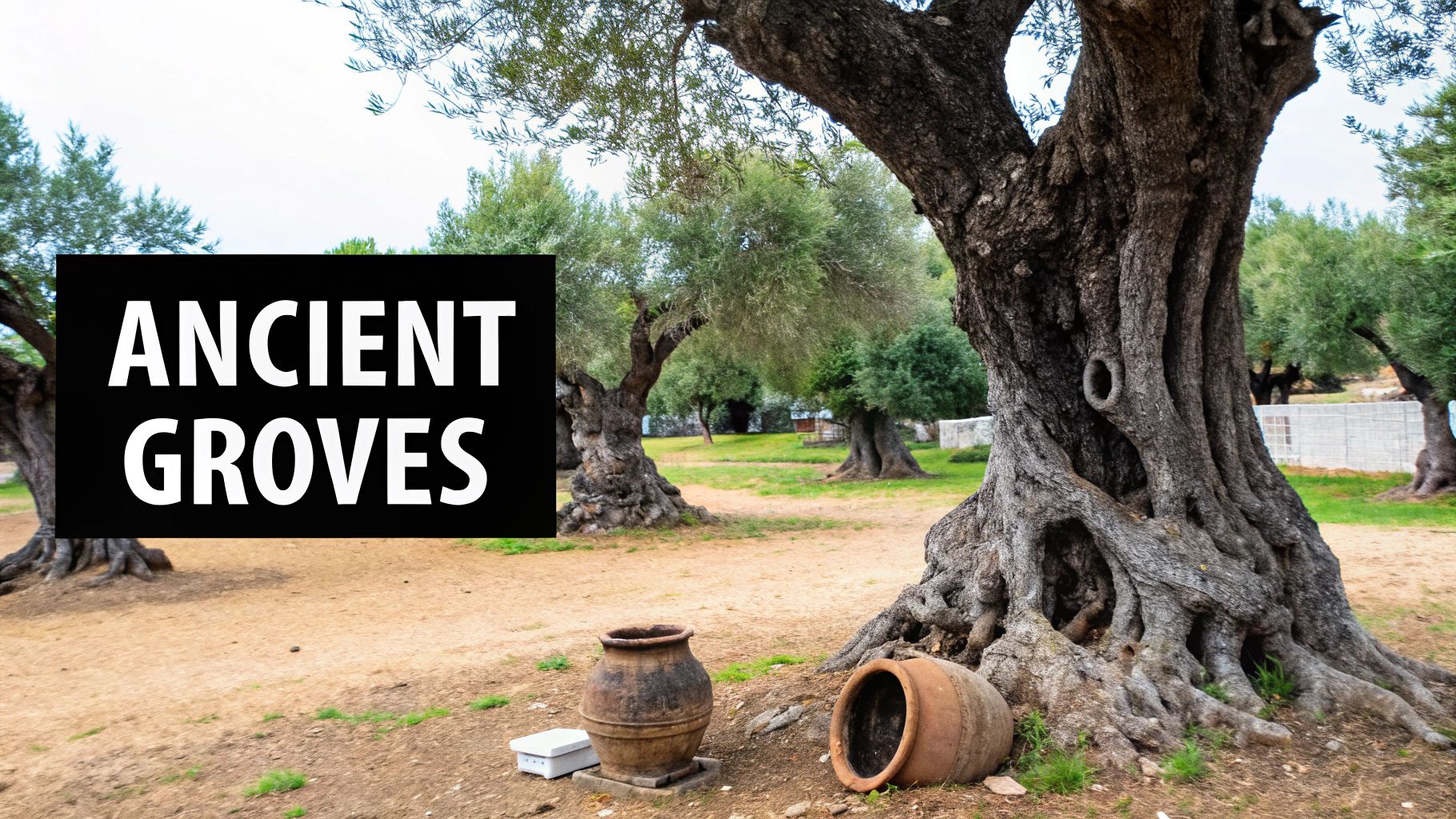
Long before the first philosopher posed a question, long before the first stone was laid for the Parthenon, the olive tree had already sunk its roots deep into the heart of Greece. This is not a story of years or even centuries; it is a story of millennia. To truly understand Greek olive oil, you must imagine yourself walking through these ancient groves, where every gnarled trunk has a story to tell.
Our journey begins on the island of Crete with the Minoans, more than 4,000 years ago. They were the pioneers, among the very first to cultivate the olive systematically. They recognized its immense value, and for them, it was far more than food. It was wealth, a source of light, and a powerful medicine.
This profound respect for the olive tree only grew, eventually weaving itself into the very fabric of Greek identity. Legend tells us it was a gift from the gods—specifically from Athena, the goddess of wisdom. She won the patronage of Athens not with a show of force, but by planting the first olive tree on the Acropolis, a gift deemed more valuable than any other.
A Sacred Pillar of Society
The olive branch swiftly became a potent symbol of peace, victory, and a direct connection to the divine. Winners at the ancient Olympic games were not crowned with gold, but with olive wreaths—a prize considered far more honorable. The oil itself was sacred, used to anoint kings, victorious athletes, and even the deceased in their final rites.
This cultural reverence shaped its role in daily life.
- A Source of Light: Simple clay lamps filled with olive oil were what held back the darkness in homes and temples.
- A Healing Balm: It served as a base for all manner of ointments and medicines, prized for its ability to soothe and heal.
- A Culinary Staple: Most importantly, it was the cornerstone of the Greek diet, bringing sustenance and rich flavor to nearly every meal.
This legacy of respect and tradition is what continues to define the quality of Greek olive oil today. Modern producers see themselves not just as farmers, but as custodians of a history passed down through countless generations.
The Enduring Legacy in Every Bottle
The methods have certainly evolved, but the core principles of caring for the land and respecting the tree remain unchanged. This unbroken connection to the past is what makes a bottle of Greek olive oil more than just a product on a shelf. It is a living piece of history.
Every drop of authentic Greek olive oil carries the echo of ancient rituals and the wisdom of generations who understood the tree’s true worth. It is a direct link to a culture that has revered this liquid gold for thousands of years.
You can also see this heritage reflected in the country's economy. Greece has always been a titan in the olive oil world, consistently ranking among the top global producers. Over the last decade, Greek olive oil production has averaged an impressive 264,800 metric tons annually. Olive cultivation is a colossal part of Greek agriculture, covering 20% of the nation's farmland.
The fierce pride in regional traditions and the refusal to compromise on quality are not modern marketing inventions. They are the continuation of an ancient promise—a promise to honor the gift of the olive tree. If you're curious about the broader history, you can check out our guide on the origin of olive oil.
This profound history is the invisible ingredient, the one that truly sets authentic Greek olive oil apart from all others.
Exploring Greece's Unique Olive Terroir
To truly grasp the soul of authentic Greek olive oil, you must embrace a simple yet profound concept: terroir. It’s a French word, often used in the world of wine, but it perfectly captures the essence of olive oil. Think of terroir as the unique fingerprint of a place. It is the sum of everything—the specific soil, the angle of the sun, the salty sea breeze, and the distinct microclimate—all working in concert to create a flavor that simply cannot be replicated anywhere else.
Just as a grapevine in one valley yields a wine utterly different from its cousin a few miles away, the same holds true for olives. This concept is universal, and understanding how soil type shapes the taste of agricultural products is key. An olive tree clinging to the rocky, windswept hills of Crete will produce a radically different oil than one thriving in the sheltered, fertile plains of Kalamata.
This is precisely why "Greek olive oil" is not one singular flavor. It is a vibrant spectrum of tastes, and every single bottle tells the story of its specific corner of Greece. That is the magic of terroir.
The Peloponnese Peninsula: Where Legends Grow
The Peloponnese peninsula is the absolute heartland of Greek olive oil production. It's a rugged, sun-drenched landscape responsible for a massive portion of the country's entire output. This region is a stunning tapestry of different terroirs, from coastal plains caressed by the sea to soaring mountainous highlands, each stamping its own unique character onto the oil.
This is the ancestral home of two of Greece's most legendary olive varieties:
- Koroneiki: Often called the "queen of olives," the tiny Koroneiki is a true titan of flavor. Oils made from this olive are typically robust, with a brilliant green hue and classic notes of fresh-cut grass, green banana, and a distinctive peppery kick in the back of your throat. That tingle is your proof—it means the oil is packed with healthy antioxidants.
- Kalamata: Famous worldwide as a rich, meaty table olive, the Kalamata also produces a wonderfully fruity and smooth oil when picked for pressing. It tends to be less bitter than a Koroneiki oil, offering a much milder, almost sweet profile that is incredibly versatile.
The sheer diversity within the Peloponnese means you can discover a whole range of styles. An oil from Lakonia might be intensely pungent and grassy, while one from Messenia could be far more delicate and buttery.
Crete: The Island of Ancient Groves
Crete, the largest of the Greek islands, has a bond with the olive tree that stretches back thousands of years. The island is dotted with some of the oldest olive trees on the planet, their gnarled, twisted trunks standing as silent witnesses to this enduring legacy.
The Cretan terroir is defined by its intense sunshine, rocky soil, and the constant caress of sea air. This environment forces the trees to struggle, and that struggle is what produces olives with an incredible concentration of flavor and polyphenols. The dominant Koroneiki olive thrives here, yielding an oil that is famously robust, aromatic, and intensely flavorful. It's the lifeblood of the celebrated Cretan diet for good reason.
To taste Cretan olive oil is to taste history itself. The combination of relentless sun and ancient soil creates a liquid gold that is bold, complex, and brimming with the vitality of the island.
To give you a clearer sense of how these regional stars differ, here is a quick guide to some of the most important olive varieties you will encounter.
Major Greek Olive Varieties and Their Flavor Profiles
| Olive Variety | Primary Region(s) | Common Flavor Notes |
|---|---|---|
| Koroneiki | Peloponnese, Crete | Grassy, green banana, artichoke; robust with a peppery finish. |
| Kalamata | Peloponnese | Mildly fruity, smooth, sometimes with notes of almond or sweet herbs. |
| Athinolia | Peloponnese (Lakonia) | Balanced, with notes of ripe tomato, herbs, and a gentle bitterness. |
| Manaki | Peloponnese (Argolis) | Delicate and sweet; notes of ripe apple, citrus, and a smooth, buttery feel. |
| Kolovi | Lesvos Island | Exceptionally smooth and delicate; nutty, buttery, with hints of herbs. |
This table is merely a starting point. The real joy comes from exploring these differences for yourself and discovering which regional profiles you love most.
A Spectrum of Regional Flavors
While the Peloponnese and Crete are the undisputed titans in the world of Greek olive oil, they are by no means the only places producing exceptional quality. Other regions contribute their own unique voices to the choir, adding incredible depth to the country's offerings.
For instance, the island of Lesvos is known for the Kolovi olive. It produces a delicate, golden oil with a smooth, buttery texture and subtle notes of herbs and nuts. It’s a completely different world from the assertive punch of a Cretan Koroneiki.
This regional diversity is precisely what makes exploring Greek olive oil so rewarding. It’s a sensory journey through the mountains, coastlines, and islands of a country whose very identity is inseparable from the olive tree. Each oil isn’t just a product; it’s a postcard from the place it was born.
The Art of Crafting Exceptional Olive Oil
What separates a truly memorable Greek olive oil from the bland, generic liquid on the supermarket shelf? It’s not one single thing. It is a chain of critical decisions—a journey from the olive grove to the bottle where every single step matters profoundly.
This is where true craftsmanship is either honored or lost forever.
The path to an extraordinary olive oil begins with how the olives leave the tree. Large, industrial operations often rely on massive mechanical shakers that violently strip the branches. It’s fast and efficient, but it bruises the delicate fruit, mixing perfectly ripe olives with underripe and overripe ones.
This aggressive approach is a recipe for mediocrity. A bruised olive begins to oxidize and degrade the moment it's damaged, creating off-flavors before it even reaches the mill.
Harvesting with Respect
In stark contrast, the best oils come from a far more gentle and deliberate harvest. Many traditional producers in Greece still swear by hand-harvesting, using small, handheld rakes to carefully comb the olives from the branches onto nets spread below.
It is slow, painstaking work that requires many hands. But this gentle handling is non-negotiable if you want to protect the fruit and ensure the olives arrive at the mill in perfect, unbroken condition. It is the first critical step toward capturing the vibrant, fresh flavors that define a world-class extra virgin olive oil.
After that, it's a race against the clock.
The clock starts ticking the second an olive is picked. To lock in peak freshness and halt oxidation in its tracks, the fruit must be pressed within just a few hours—ideally, under 12 hours. Any longer, and you risk fermentation and decay, which will destroy the quality of the final oil.
This incredible sense of urgency is what separates the artisans from the mass-producers. It’s a race against time that they are determined to win, year after year. For a deeper look into the entire process, you can explore our detailed guide on how olive oil is made.
The Meaning of Cold-Pressed
Once the olives reach the mill, they are washed and crushed into a thick, fragrant paste. And this is where you encounter one of the most important—and most misunderstood—terms on any olive oil label: cold-pressed or cold extraction.
This isn't a marketing slogan; it is a critical quality standard. To use this term, the temperature of the olive paste must be kept below 27°C (about 80°F) throughout the entire extraction process. Why all the fuss about temperature?
Heat is the natural enemy of both flavor and health in olive oil. Applying heat would certainly squeeze out more oil, but it would come at a terrible cost, destroying the very essence of what makes extra virgin olive oil so special.
- Delicate Flavors: Heat literally cooks away the volatile aromatic compounds that create those beautiful grassy, fruity, or herbaceous notes.
- Powerful Antioxidants: The healthy polyphenols—the compounds that give a great oil that peppery kick in the back of your throat and offer huge health benefits—are incredibly fragile and break down when heated.
By keeping the process cool, producers choose quality over quantity. They get less oil from their olives, but the oil they do get is pure, bursting with flavor, and loaded with all the natural goodness of the fruit.
The result of all this hard work is liquid gold. It is an unrefined, unfiltered, raw product that tastes exactly like the place it came from—the pure essence of the Greek terroir, captured in a bottle. You can taste that dedication in every last drop.
How to Buy Authentic Greek Olive Oil
Walking into the olive oil aisle can feel like stepping into a minefield. You're faced with dozens of bottles, all dressed in beautiful labels, whispering promises of authenticity and sun-drenched Greek hillsides. But behind that charming facade, many are hiding a disappointing secret—they are bland, old, or worse, outright fakes.
Your mission is to arm yourself with the knowledge to see right through the marketing noise. And it’s simpler than you might think. You don’t need to be a professional taster; you just need to know what to look for and what to walk away from.
This is about turning that aisle-induced confusion into confidence. It all begins by learning to read the language on the label, which holds all the clues to separate the genuine article from the impostors.
Decoding the Label Guarantees
The most important words you can find on any bottle are Extra Virgin Olive Oil. This isn't just a fancy marketing term; it's a legally defined grade. It is your guarantee that the oil was extracted using only mechanical means (no chemicals or heat) and that it meets strict standards for both chemical purity and taste. If it does not say "Extra Virgin," you are looking at a lower-quality, often refined, product.
But for truly high-quality Greek olive oil, you can look for even stronger assurances of its origins.
- PDO (Protected Designation of Origin): This is the gold standard. A PDO seal is a rock-solid guarantee that every single step of the process—from growing and harvesting the olives to pressing and bottling the oil—happened in a specific, named geographical region, like Kalamata or Sitia.
- PGI (Protected Geographical Indication): This seal is another powerful indicator of quality. It promises that at least one key stage of production occurred in the designated region, linking the oil’s unique character directly to its homeland.
Think of these certifications as your shield against vaguely labeled "Mediterranean blends." They are a producer's promise that the oil in your hand is a true expression of its unique terroir.
Spotting the Red Flags of Inferior Oil
Just as important as knowing what to look for is knowing what to avoid. The producers of cheap, low-grade oil are banking on you not paying close attention to the details. Here are the warning signs that should immediately make you skeptical.
If you find yourself stuck, always remember this one simple rule: light, heat, and air are the mortal enemies of olive oil. Any packaging that ignores this fundamental truth is a massive red flag.
This single principle can help you instantly weed out poor choices. For a more detailed look, you might want to check out this guide on how to spot fake olive oil.
Here is a practical checklist to run through:
- Clear Glass Bottles: Olive oil degrades incredibly fast when exposed to light. A producer who cares about their product will never bottle it in clear glass. Always reach for dark green or brown glass bottles, or better yet, an opaque tin.
- Missing Harvest Date: A "best by" date is often set two years after bottling, which tells you nothing about when the olives were actually picked. Freshness is everything. Look for a harvest date on the label—the best producers are proud to display it.
- Vague Origin: Be wary of labels that say "Product of the Mediterranean" or "Packed in Italy" (but sourced from who-knows-where). A proud Greek producer will clearly state the region and often the specific village or estate.
This process chart shows the simple, traditional journey of crafting high-quality Greek olive oil, from the tree to your table.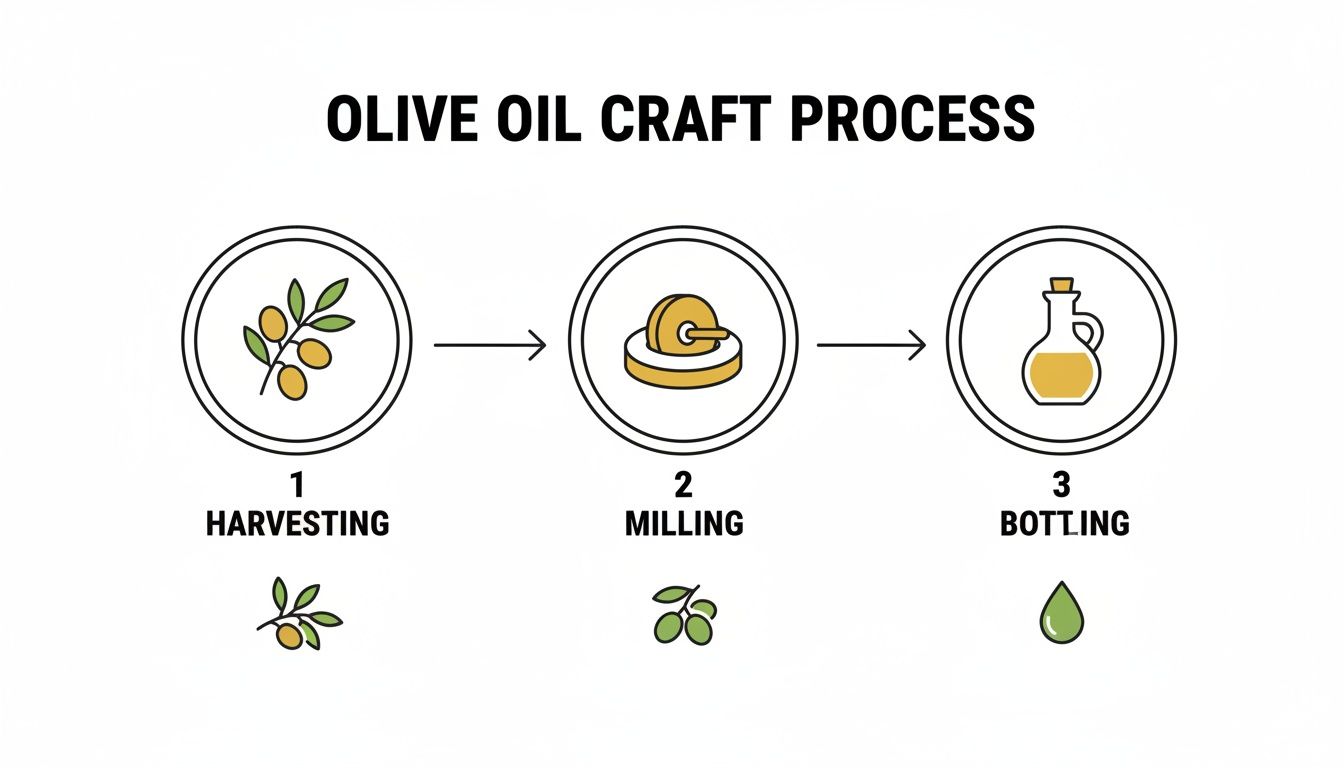
Each step is a critical link in the chain. The care and speed taken here are essential to preserving the oil's vibrant flavor and powerful health benefits.
Olive production in Greece can swing dramatically from one year to the next. Harvests have hit a high of 1,793.52 thousand tons one year only to drop to 775.64 thousand tons in another, often due to weather and climate challenges. Despite these fluctuations, Greece remains a dominant global force, and its liquid gold is a cornerstone of its agricultural exports. This variability makes choosing an oil from a specific, reliable harvest even more important. By following these simple rules, you’re not just buying a product—you're choosing to honor a timeless craft.
A Guide to Tasting and Culinary Pairings
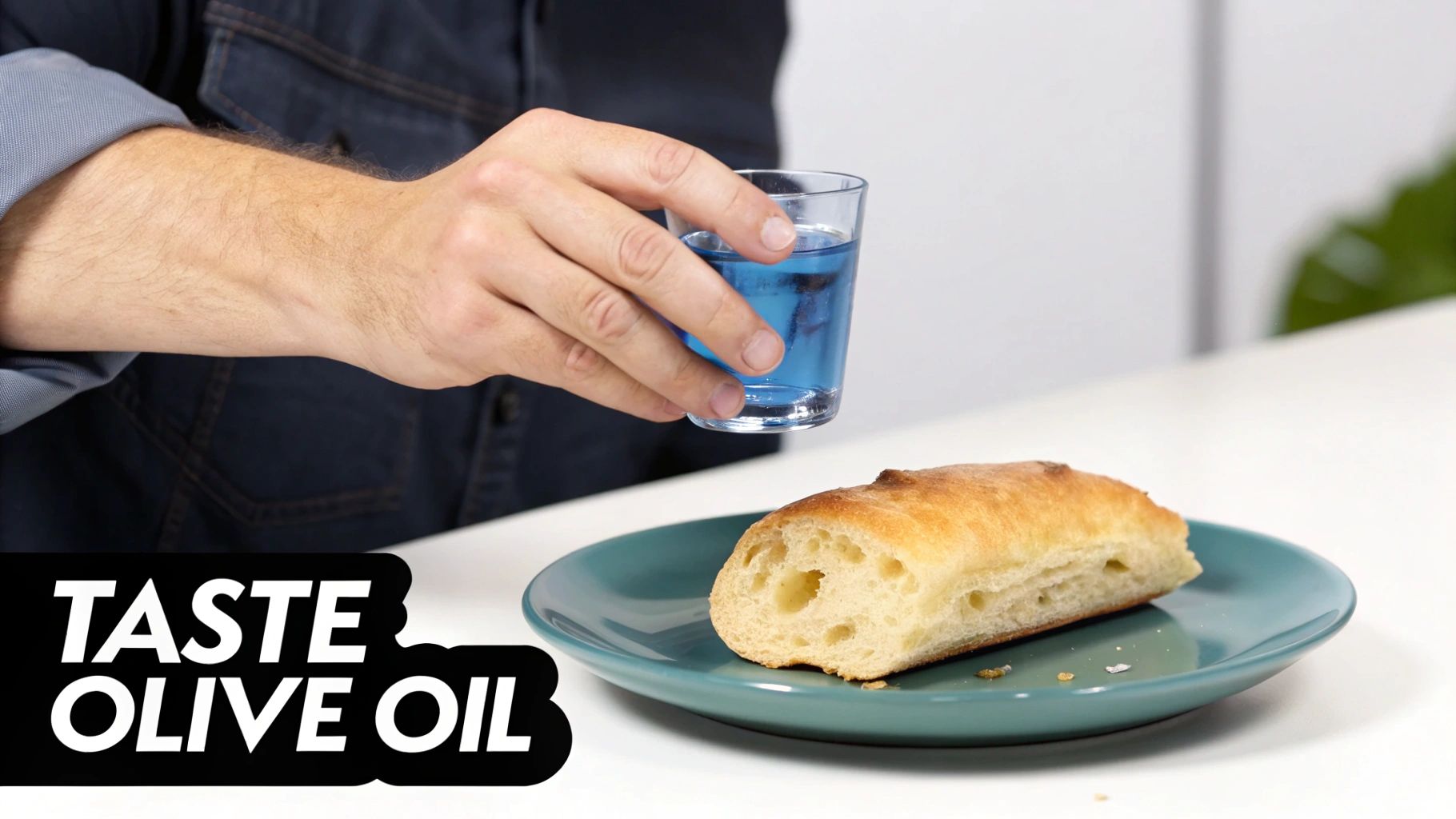
Now for the real fun. We have talked about the history, the regions, and the process, but it is time to move from knowledge to pure experience. Tasting high-quality Greek olive oil is a sensory journey, an art form that anyone can master. It is your chance to connect directly with the terroir and craftsmanship we have been exploring and let the oil speak for itself.
Professional tasters use a simple ritual to awaken their senses and unlock an oil's true character. It involves far more than a quick dip of bread. By learning their method, you can start to spot the subtle clues that signal freshness, complexity, and exceptional quality.
How to Taste Olive Oil Like an Expert
This is not about being an intimidating connoisseur; it is simply about paying attention. Start by pouring about a tablespoon of oil into a small, clean glass. A wine glass or even a shot glass will work perfectly. Cup the glass in one hand to gently warm the oil, which helps release all those beautiful, volatile aromas.
Smell (The Aroma): Give the oil a gentle swirl. Now, bring the glass to your nose and inhale deeply. What do you smell? A truly fresh oil should evoke something green and natural—freshly cut grass, tomato leaves, artichoke, or even a hint of green banana. These are all fantastic signs of a healthy, well-made oil.
Slurp (The Flavor): Take a small sip. Now for the part that feels a little strange: slurp it. Draw in a bit of air along with the oil, letting it spread across your entire tongue. This simple action emulsifies the oil and helps your taste buds pick up its full range of flavors.
Savor (The Finish): Finally, swallow the oil and pay close attention to the sensation at the back of your throat. This is where the magic truly happens.
The most crucial step is noticing the finish. A high-quality extra virgin Greek olive oil, rich in healthy polyphenols, will deliver a distinct peppery or spicy kick that makes you cough. This pungency is not a flaw; it is the ultimate hallmark of freshness and antioxidant power.
Embrace that cough! It is the signature of a truly vibrant, living food. The three positive attributes you are looking for are fruitiness (the aromas you smelled), bitterness (a pleasant note on the tongue), and pungency (that peppery finish). For a more in-depth guide, you can find great resources on how to taste olive oil to really refine your palate.
Perfect Pairings to Elevate Your Meals
Once you can identify an oil’s character—whether it’s robust and peppery or delicate and buttery—you can start pairing it with food to create truly memorable dishes. The key principle is to match intensity. A powerful oil will easily overwhelm a delicate dish, while a mild one will get lost next to bold flavors.
Here are a few classic pairings to get you started:
Robust & Peppery Oils: These assertive oils, often from Koroneiki olives grown in Crete or the Peloponnese, demand bold flavors. Drizzle them generously over grilled steaks, hearty bean soups, roasted vegetables like broccoli or cauliflower, and bitter greens like arugula.
Medium & Fruity Oils: A well-balanced oil with notes of herbs and ripe fruit is incredibly versatile. This is your go-to for finishing grilled fish, tossing with pasta, dressing a classic Greek salad (horiatiki), or as a base for vibrant sauces and marinades.
Delicate & Mild Oils: These smoother, more buttery oils are best when their subtle notes can shine through. They are absolutely ideal for baking, making mayonnaise or aioli from scratch, or for dressing delicate salads with mild lettuces.
Ultimately, the best pairing is whatever you enjoy most. Do not be afraid to experiment. Use your new tasting skills to guide you, and you will soon find yourself using Greek olive oil not just as an ingredient, but as a star performer that brings every dish to life.
Your Questions About Greek Olive Oil Answered
So, you are ready to make Greek olive oil a permanent resident in your kitchen, but a few questions might still be lingering. Let's tackle those common head-scratchers so you can feel completely confident when you buy, store, and cook with this liquid gold.
What Makes Greek Olive Oil Different?
The heart of the answer is the olive itself. The lion's share of Greek olive oil comes from the Koroneiki olive. It’s a small olive, but don't let its size fool you—it produces an oil that’s famously robust, with an intensely grassy and peppery flavor that truly stands apart. That vibrant green color and pungent kick on the finish? That is its unmistakable signature.
Compare that to Italian oils, which are more of a regional patchwork, running the gamut from mild and buttery up north to intensely fruity down south. Spanish oils, often made from Picual or Arbequina olives, are generally known for their smooth, fruity notes, sometimes with a hint of almond or tomato. They are all wonderful, but the Greek profile is consistently, and proudly, more assertive and herbaceous.
How Should I Store My Olive Oil?
Think of your olive oil's three mortal enemies: heat, light, and air. Protecting it from them is not a suggestion; it is the golden rule for preserving its flavor and health benefits.
Find a cool, dark spot for it, like a cupboard or pantry. The worst place you can keep it is right next to the stove, where the constant temperature swings will destroy it in no time. Always, always screw the cap on tight after you use it. Oxygen is what makes oil go rancid, so you want to keep it out. Once you've opened a bottle, try to use it within 3 to 6 months for the best taste.
Treat your extra virgin olive oil like a fresh juice, not a pantry staple meant to last forever. Its vibrant qualities are fleeting, and its enemies—light, heat, and air—are relentless. Proper storage isn't just a suggestion; it's an essential act of preservation.
Can I Cook With High-Quality Greek Olive Oil?
Yes, absolutely! The myth that you can't cook with good extra virgin olive oil is one of the most stubborn and misguided pieces of kitchen advice out there. It is just plain wrong.
A high-quality extra virgin Greek olive oil has a smoke point somewhere between 375-410°F (190-210°C). That is perfectly suitable for nearly all home cooking, from sautéing and roasting to even light frying.
In fact, because it is full of stable monounsaturated fats and protective antioxidants, it holds up better under heat than many refined seed oils. So not only can you cook with it, but you will also be adding incredible flavor to your food.
At Learn Olive Oil, we believe that understanding this liquid gold is the first step to truly enjoying it. From the ancient groves to your kitchen table, our goal is to make the world of premium olive oil simple and rewarding. Discover the World of Premium Olive Oil.
 Learn Olive Oil
Leave a comment