If you believe there’s one “best” olive oil for every meal you cook, I’m afraid you’ve been misled. The truth is, the best choice isn't a single bottle. It’s a carefully chosen team of oils, each a specialist perfectly suited for the task at hand. For a delicate salad or a finishing drizzle, a bold, aristocratic Extra Virgin Olive Oil (EVOO) is king. But for the blistering heat of a searing pan, a more humble and refined light olive oil is the smarter, and far more economical, pick.
Why Your Kitchen Needs More Than One Olive Oil
Have you ever stood in the olive oil aisle, paralyzed by choice? You’re staring at a wall of green bottles, each whispering promises of ‘extra virgin’ purity and rustic Italian charm. But what does any of it really mean for the chicken you’re cooking tonight? Too often, we surrender, grab one bottle, and use it for everything from dressing a salad to searing a steak—only to wonder why the smoke alarm is screaming again.
Let’s end that confusion for good.
Here is a simple, powerful truth: using one type of olive oil for all your cooking is like trying to build a house with only a hammer. It’s the wrong tool for most of the jobs. Each grade of olive oil possesses its own unique character, flavor, and tolerance for heat. This isn’t about being a culinary snob; it's about mastering basic kitchen chemistry.
The right oil doesn't just prevent your food from sticking to the pan. It unlocks and elevates flavor, preserves precious nutrients, and honors the ingredients you so carefully selected. Using the wrong one is the fastest way to sabotage a perfectly good meal.
The Problem with a One-Size-Fits-All Approach
Relying on a single, all-purpose bottle of olive oil is a recipe for disappointment. If you pour a delicate, expensive finishing oil into a hot pan, you will watch in horror as it begins to smoke and turn bitter, incinerating its beautiful, complex flavors and, with them, your hard-earned money. On the flip side, a neutral, refined oil will contribute nothing but grease to a fresh Caprese salad, completely missing the peppery, vibrant punch it so desperately needs.
This guide will arm you with a simple framework for choosing the right oil for the right job, so you never again waste another drop of that liquid gold. You’ll learn not just what to buy, but exactly how to use it to make every single dish that leaves your kitchen just a little bit better.
Here’s what a winning olive oil strategy looks like:
- For finishing and dressings: A high-quality, unapologetically flavorful Extra Virgin Olive Oil with a strong personality.
- For everyday sautéing and roasting: A versatile, workhorse regular olive oil or a solid, everyday EVOO.
- For high-heat searing or deep-frying: A refined or "light" olive oil with a much higher smoke point.
Once you internalize these distinct roles, you stop guessing and start cooking with intent. That once-confusing aisle in the grocery store suddenly transforms into an arsenal of culinary tools, ready for your command.
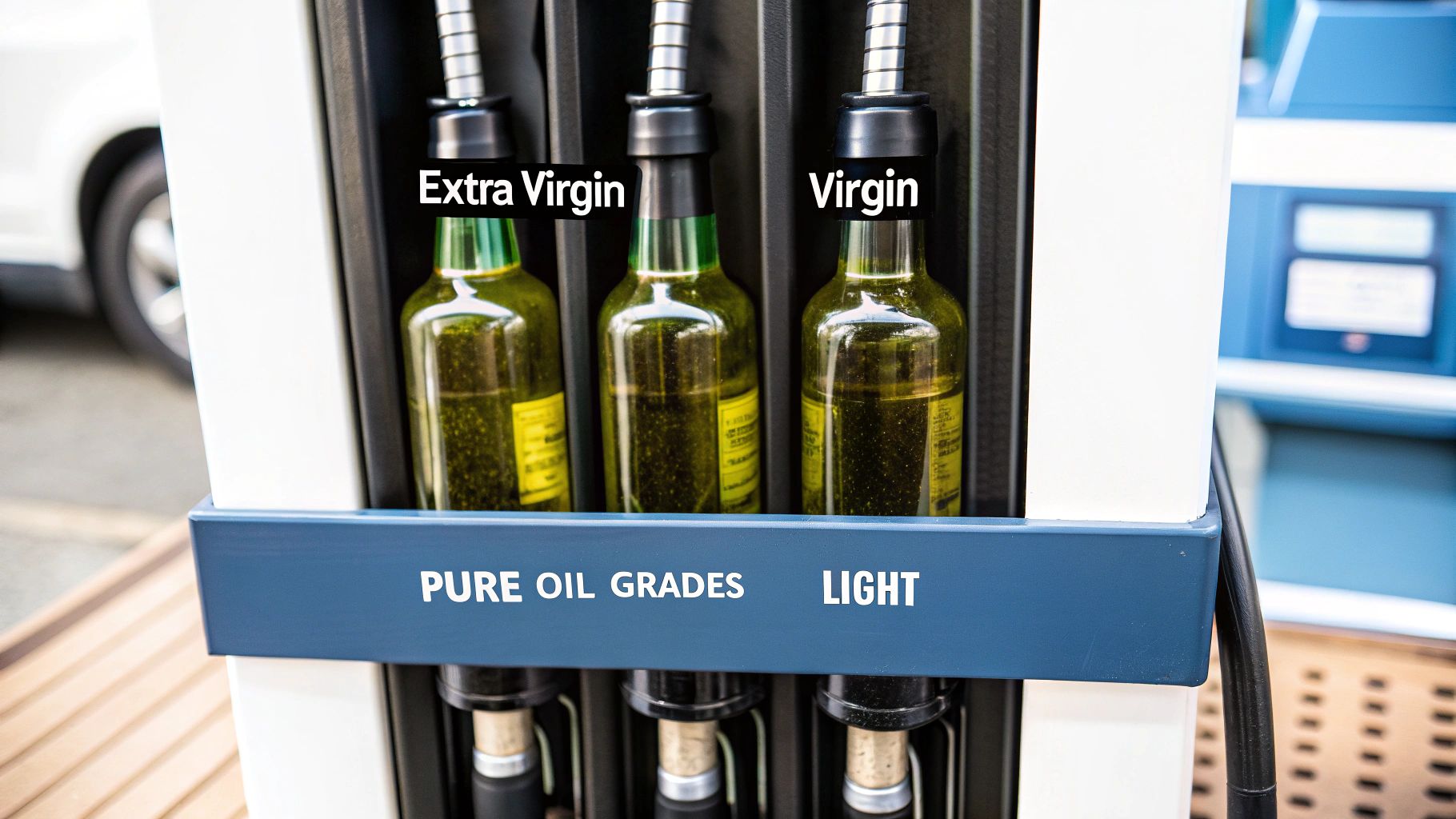
Walking down the supermarket aisle, you're faced with a wall of olive oil bottles. Extra Virgin, Pure, Light, Virgin… it's easy to feel like you need a secret decoder ring. But understanding these labels is the first step to becoming a better cook.
Think of it this way: you wouldn't use a delicate finishing nail to frame a house, right? The same logic applies here. Using the wrong olive oil can ruin a dish, either by burning it or overpowering subtle flavors. The secret is matching the right oil to the right job.
Each grade of olive oil tells a story about how it was made—from the way the olives were pressed to whether heat or chemicals were involved. This journey from fruit to bottle determines everything: its flavor, its smoke point, and where it truly shines in your kitchen.
The Gold Standard: Extra Virgin Olive Oil
Let's start at the very top. Extra Virgin Olive Oil (EVOO) is the purest expression of the olive—the highest quality you can get. It's made simply by crushing fresh olives and extracting their juice, with no heat or chemicals permitted. This cold-press method ensures all the good stuff remains intact—the vital antioxidants, the health-giving polyphenols, and those vibrant, complex flavors that sing on the palate.
To earn the "extra virgin" crown, an oil must meet fiercely strict standards. It must have a free acidity level below 0.8% and pass a rigorous taste test by a certified panel, proving it has zero flavor defects and a distinct, fruity quality. This is your "finishing oil." Deploy it for drizzling over a finished pasta, dressing a crisp salad, or simply for dipping a warm piece of crusty bread.
Virgin and Refined Olive Oils: The Workhorses
One step down the ladder, you will find Virgin Olive Oil. It's made the same way as EVOO—no chemicals, no heat—but it's just a little less perfect. It might have minor flavor flaws or a slightly higher acidity (up to 2%), so it doesn't quite make the "extra" cut. It's still a good, unrefined oil.
Then we come to the refined oils, which are typically labeled simply "Olive Oil" or "Pure Olive Oil." These begin as oils with flavor defects that are then processed to clean them up. This refining process renders the oil neutral in taste and gives it a much higher smoke point, which is precisely what you need for everyday cooking and frying. A small amount of virgin or EVOO is often blended back in to restore a hint of that classic olive oil character.
What About "Light" Olive Oil?
This is perhaps the most misunderstood label on the shelf. "Light" has nothing to do with calories or fat. It refers only to the oil's light, neutral flavor and pale color. It's a highly refined oil, making it a fantastic choice for baking or high-heat frying where you don't want any flavor interference.
Globally, the European Union is the undisputed king of olive oil, producing almost 70% of the world's supply. Spain is the giant in the room, churning out around 1.41 million tons each year. This is where most of the world's highest-quality olive oil comes from.
To help you keep it all straight, here’s a quick cheat sheet.
A Quick Guide to Olive Oil Types
This table breaks down the essential differences between common olive oil grades to help you choose the right one at a glance.
| Olive Oil Type | Processing Method | Flavor Profile | Best Culinary Use |
|---|---|---|---|
| Extra Virgin | Cold-pressed, no heat or chemicals | Robust, peppery, grassy, fruity | Drizzling, finishing, dressings, dipping |
| Virgin | Cold-pressed, no heat or chemicals | Milder, with slight flavor imperfections | Dressings, low-heat cooking |
| Pure/Olive Oil | Refined, then blended with virgin oil | Neutral, with a hint of olive flavor | Sautéing, roasting, general cooking |
| Light/Extra Light | Highly refined, minimal flavor | Completely neutral and flavorless | High-heat frying, baking, searing |
Mastering these distinctions is a game-changer. For a more in-depth look, you can explore the full range of different types of olive oil. This knowledge is your foundation for making smarter, more delicious choices in the kitchen.
The Great Olive Oil Smoke Point Myth
For years, a persistent and damaging myth has echoed through kitchens everywhere. You've heard it, I've heard it, and we've probably all repeated it: "Don't cook with extra virgin olive oil, its smoke point is too low." This single piece of bad advice has robbed countless meals of the rich flavor and profound health benefits that only a high-quality EVOO can bring to the table.
It’s time to set the record straight, once and for all.
This old-school thinking stems from a fundamental misunderstanding of what a "smoke point" actually is and how different fats behave under heat. The notion that EVOO is too fragile for a hot pan simply doesn't hold up to scientific scrutiny. In fact, the very opposite is often true.
Why Quality Matters More Than a Number
An oil's stability isn't determined by a single temperature. When choosing an olive oil for cooking, you must also consider its grade and the resilience of its nutrients. A true extra virgin olive oil is extracted mechanically—crushed, not chemically treated—which means it retains the highest levels of natural antioxidants and polyphenols.
Think of these powerful compounds as the oil’s personal bodyguards. They protect it from breaking down when you turn up the heat. In fact, studies have shown that EVOO's antioxidant content remains remarkably stable during cooking, far more so than many common seed oils.
This infographic breaks down the typical smoke points for different grades of olive oil.
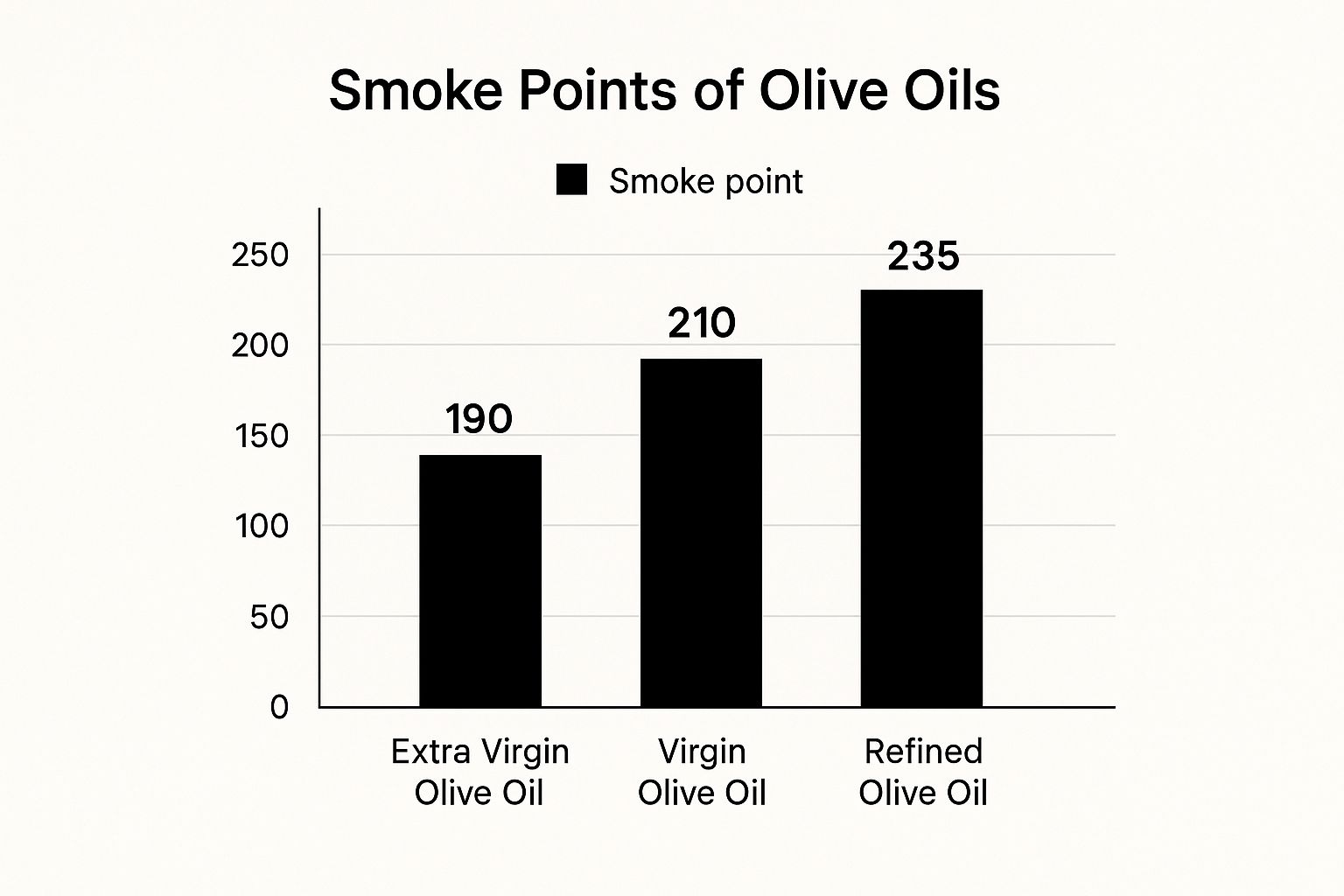
As you can see, even on the lower end, EVOO's smoke point is well above the temperatures needed for most home cooking.
Here's the reality: a high-quality EVOO generally has a smoke point somewhere between 190–210°C (374–410°F). Most stovetop sautéing happens around 177°C (350°F). You have plenty of room to maneuver.
So where did this destructive myth originate? It likely started because low-quality, poorly filtered, or old EVOOs can smoke at lower temperatures. But that is a flaw in a specific bottle, not a fundamental rule for the entire category.
The key takeaway is this: A high-quality EVOO is far more stable under heat than you've been led to believe. Its antioxidant content gives it a protective shield that many refined oils simply don't have.
What does this mean for your cooking?
It means you can—and should—use your best olive oil for more than just drizzling over salads. Go ahead and sauté your vegetables, pan-sear a beautiful piece of fish, or even use it for roasting. You'll unlock a world of deep, complex flavor that refined oils just can't match. To really get into the weeds of the science, it’s worth digging deeper into the olive oil smoke point and how it all works.
Embracing this simple truth will not only make your food taste better, but it will also simplify your kitchen.
Pairing Your Oil with Your Cooking Method
Alright, let's put all that theory into practice. The real magic isn't just knowing what's in the bottle; it's knowing how that translates to the pan. Think of this as your kitchen game plan, a guide to matching the right olive oil to your cooking technique so you get fantastic results every single time.
What’s the secret to perfectly crispy roasted vegetables that don't taste burnt? How do you make a vinaigrette that elevates your salad instead of overpowering it? This is where we connect the dots, moving from abstract concepts like smoke points to the satisfying sizzle of food in a hot skillet.
Sautéing and Pan-Frying
For everyday sautéing—your go-to for softening garlic and onions or whipping up a quick stir-fry—you need an oil that can stand up to moderate heat and contribute something special to the dish. This is the perfect job for a high-quality, robust Extra Virgin Olive Oil. Its smoke point is comfortably above the typical sautéing temperature of around 350°F (177°C), making it a safe and delicious choice.
If you’re seeking a budget-friendly workhorse, a good quality "Pure" or regular olive oil is also an excellent option. It has a milder flavor and performs reliably, cooking your ingredients beautifully without any risk of scorching.
Roasting and Baking
When you're cranking up the oven to roast vegetables or meats, often up to 400°F (205°C), you need an oil that’s stable. The last thing you want is for the oil to break down and impart a funky, off-taste to your food. While a robust EVOO can certainly handle it, this is a great time to reach for a standard olive oil.
Its refined quality gives it the stability to withstand that prolonged, high heat. And for baking, where a neutral flavor is paramount, a "light" olive oil is the undisputed champion. It adds the necessary fat your recipe demands without introducing any strong olive taste, allowing the flavors of your cake or cookies to take center stage.
Finishing and Raw Applications
Now, this is the moment for your prized bottle—that exceptional Extra Virgin Olive Oil you’ve been saving. When you’re not applying heat, the flavor of the oil ceases to be a cooking medium and becomes a star ingredient in its own right.
Never compromise on quality for finishing oils. A final drizzle of a peppery, grassy EVOO over a finished steak, a fresh pasta dish, or a simple bowl of soup can transform the entire meal from good to unforgettable.
Use your best EVOO for:
- Vinaigrettes: The fruity, complex notes of a great EVOO are the very soul of a memorable salad dressing.
- Drizzling: A final swirl of high-quality oil adds a luxurious layer of flavor and richness right before serving.
- Dipping: A fantastic EVOO served with fresh bread is an appetizer in its purest, most elegant form.
Olive Oil and Cooking Method Matchmaker
To make things even easier, I've put together a quick cheat sheet. Use this chart to quickly identify the best type of olive oil for your specific cooking needs, from high-heat searing to delicate finishing.
| Cooking Method | Ideal Olive Oil | Smoke Point Range (°F) | Why It Works |
|---|---|---|---|
| Sautéing | Extra Virgin / Olive Oil | 350-410°F | Perfect heat tolerance for stovetop cooking with added flavor. |
| Roasting | Olive Oil / EVOO | 390-470°F | Provides great stability for higher oven temperatures. |
| Baking | Light Olive Oil | ~470°F | Neutral flavor won't interfere with sweet or savory baked goods. |
| Finishing | Extra Virgin Olive Oil | N/A | Delivers maximum flavor and aroma to finished dishes. |
Once you master these pairings, you’ll find yourself cooking with more confidence and intention. For an even deeper dive, our complete guide on using olive oil for cooking has more tips and tricks. This simple, strategic approach ensures every bottle in your pantry has a purpose, helping you create incredible meals every single time.
How to Read an Olive Oil Label Like a Pro
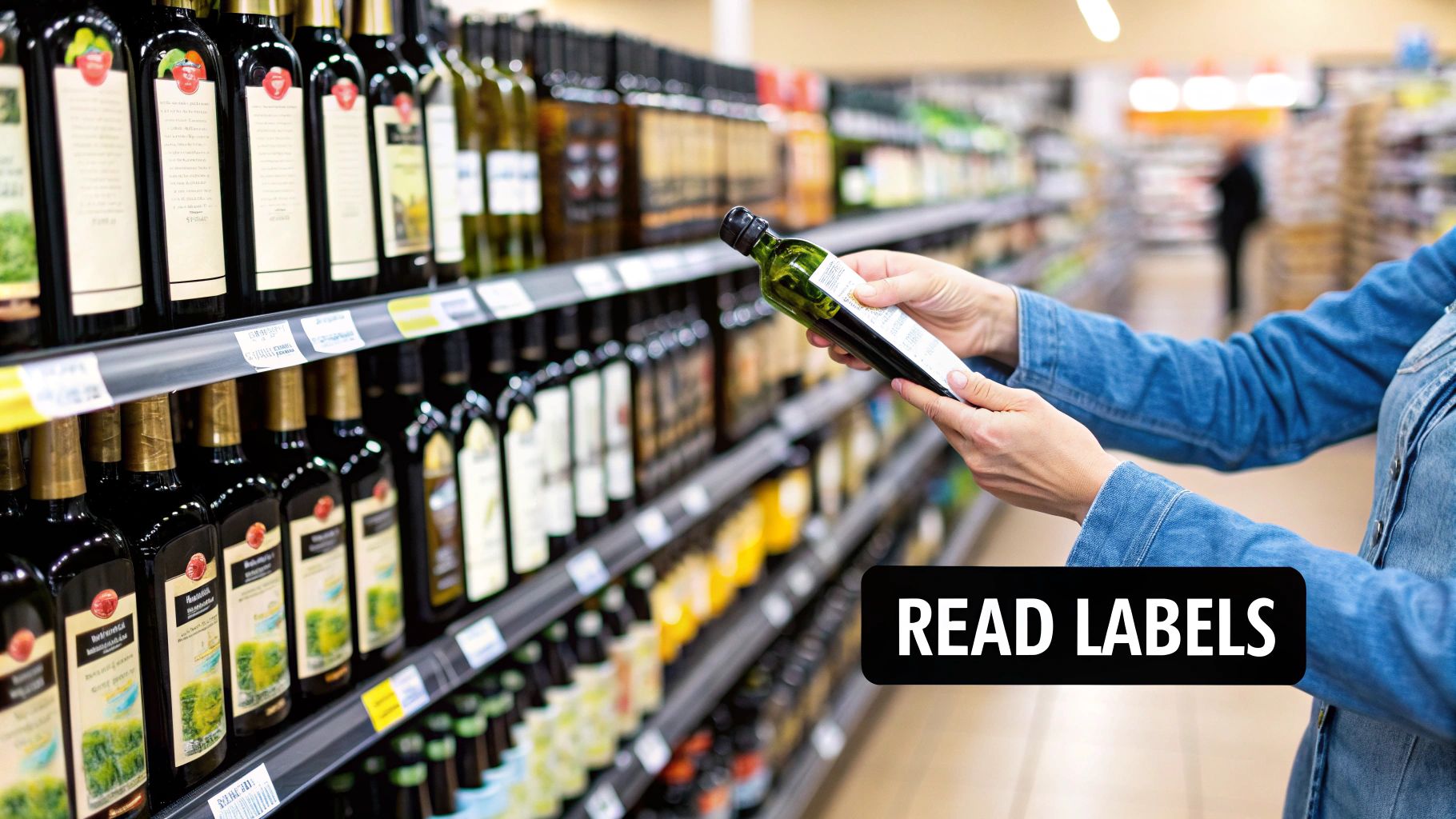
Walking into the olive oil aisle can feel like stepping into a trap. You’re faced with a wall of bottles that look almost identical, yet one is priced at $7 and its neighbor is $37. The secret to spotting the difference isn’t some hidden magic; it’s written right there on the label for anyone to see.
Think of the label as your personal guide. It holds all the clues you need to distinguish a fresh, authentic, and flavorful oil from a stale, fraudulent imposter. Once you learn to read this code, you'll never feel lost in that aisle again.
Your Most Trusted Friend: The Harvest Date
If you look for only one thing on the bottle, make it the harvest date. Unlike wine, olive oil is a perishable product. It's a fresh fruit juice, and its bright flavors and incredible health benefits begin to fade from the very moment the olives are pressed.
Do not be fooled by a "Best By" or "Use By" date. Those are often set two years after bottling, but they tell you nothing about how old the oil truly is. The harvest date is the oil’s birthday, and you always want the most recent one you can find. A bottle without a clear harvest date is a massive red flag—it’s as if the producer is trying to hide its age.
Look for a harvest date within the last 12 to 18 months. The fresher the oil, the more intense its flavor and the higher its antioxidant content. This single piece of information is the most reliable indicator of quality you can find.
Decoding Certifications and Origin
An oil's origin story matters. A label that proudly specifies its exact place of origin is making a promise of quality and traceability. Be wary of vague terms like "Product of Italy," which can be dangerously misleading. That often means only that the oil was bottled there, while the olives themselves could be a blend from various countries.
Instead, look for official seals that guarantee authenticity. These certifications are like a pedigree for olive oil, verifying its geographic roots and strict production standards.
Here are a few of the most respected seals to look for:
- PDO (Protected Designation of Origin): This is the gold standard. It guarantees the oil was produced, processed, and prepared entirely within a specific geographic region using traditional methods.
- PGI (Protected Geographical Indication): This seal ensures at least one stage of production happened in the designated region, linking the final product back to that specific area.
Spotting one of these seals is a strong signal that you’re holding a genuine, high-quality product. For a deeper dive, you can learn all the details about understanding olive oil labeling. With this knowledge, you can shop with the confidence of a seasoned chef and ensure the best olive oil to cook with always ends up in your cart.
A Global Tour of Olive Oil Flavors
Your olive oil journey doesn't stop with a single bottle from Italy. To truly find the best oil for your kitchen, you must begin to think like a traveler. Just as with wine grapes, the terroir—the unique combination of soil, climate, and geography—gives olives a distinct and undeniable sense of place.
This means the oil in your pan is more than just a fat; it's an ingredient that can transport your entire dish to another part of the world. Once you understand these global differences, you’re not just matching an oil to a cooking method, you're pairing it with an entire cuisine.
Flavors from Around the Mediterranean and Beyond
Imagine the bold, peppery kick of a Spanish Picual olive oil. It’s absolutely perfect for drizzling over a hearty paella or a chilled gazpacho, standing up to big flavors in a way a milder oil simply cannot. That’s what regional pairing is all about.
Now, let's journey over to Greece, where Koroneiki olives yield an intensely grassy and aromatic oil. When you drizzle this over a simple Greek salad with tomatoes, cucumbers, and feta, you’re not just dressing it—you’re completing it. It’s like tasting the sunshine and rugged hills of the Greek isles.
This global appreciation for olive oil is definitely on the rise. Worldwide consumption is projected to climb from 2.45 million to 2.84 million metric tons. While the average person in Spain uses about 12 liters a year, Americans are still just at one liter, which means there's a huge world of flavor left to explore. You can find more details on these global olive oil consumption patterns.
This isn't just about cooking; it's about storytelling. The right olive oil tells the story of its homeland, and using it brings that story to your plate.
Finally, consider the buttery, almost nutty notes of a California Arbequina. Its smooth, gentle profile is incredibly versatile, making it a fantastic choice for baking or for a delicate piece of grilled fish where you don’t want to overwhelm the star of the show. Learning these nuances is what separates good cooks from great ones, and our guide on what olive oil tastes like can help you sharpen your palate.
Your Olive Oil Questions, Answered
Theory is great, but what happens when you’re actually standing at the stove with a hot pan? Let's tackle some of the most common questions that pop up in the kitchen.
Can I Really Fry with Extra Virgin Olive Oil?
Yes, you absolutely can—and for most of your daily cooking, you should. A good quality Extra Virgin Olive Oil has a smoke point somewhere between 375°F and 410°F. This range is well above the typical temperature for stovetop sautéing, which hovers around 350°F.
What's more, EVOO's high antioxidant content makes it surprisingly stable when heated, protecting it from breaking down. While you might want a more budget-friendly, refined oil for deep-frying, EVOO is perfectly safe and adds incredible flavor to everyday pan-frying. It's a perfect example of why just looking at a single smoke point number doesn't tell the whole story.
What's the Deal with "Light" Olive Oil?
When you see "light" on a label, it’s talking about flavor and color, not calories. Let’s be clear: all olive oils have the same amount of fat and calories.
"Light" olive oil is a highly refined oil with a very neutral taste and a pale color. This refining process also gives it a high smoke point, making it a solid choice for high-heat cooking or baking when you specifically don't want that classic olive flavor coming through.
Olive oil’s three greatest enemies are light, heat, and air. How you store your oil is just as important as the bottle you choose.
How Do I Keep My Olive Oil from Going Bad?
To protect that beautiful flavor and keep your oil fresh, store it in a cool, dark place. A kitchen cupboard away from the oven or stove is perfect.
Always make sure the cap is sealed tightly after you use it. Oxygen is the enemy here, and keeping it out is the best way to prevent your oil from going rancid. And whatever you do, avoid the refrigerator! The condensation and repeated temperature changes can actually damage the oil's quality much faster than just leaving it in the pantry.
At Learn Olive Oil, we believe that knowing the story behind your ingredients is the secret to becoming a better cook. Our resources are here to help you explore the world of premium olive oil with confidence.


Leave a comment