You’ve probably heard the old kitchen rule: don't cook with olive oil because its smoke point is too low. It's a persistent myth, but it's just that—a myth. The truth is, there isn't one single olive oil smoke point. Instead, it's a wide range, stretching anywhere from 350°F to over 460°F (that’s 177°C to 238°C).
What really matters is which bottle of olive oil you're reaching for. The type and quality of the oil are what truly dictate how well it stands up to heat.
What Is the Real Olive Oil Smoke Point?
So, why the huge variation in temperature? It all comes down to how the oil is processed.
Think of it this way: the more refined an oil is, the higher its smoke point. During the refining process, things like free fatty acids and tiny bits of olive fruit—what we might call impurities—are filtered out. These are the very compounds that start to burn and smoke first.
A high-quality extra virgin olive oil is packed with these natural compounds, which contribute to its amazing flavor and aroma but also mean it will start to smoke at a lower temperature. On the other hand, a "light" or refined olive oil has had most of these particles removed, giving it a much higher tolerance for heat.
This chart breaks down how the smoke points stack up across the three main types of olive oil.
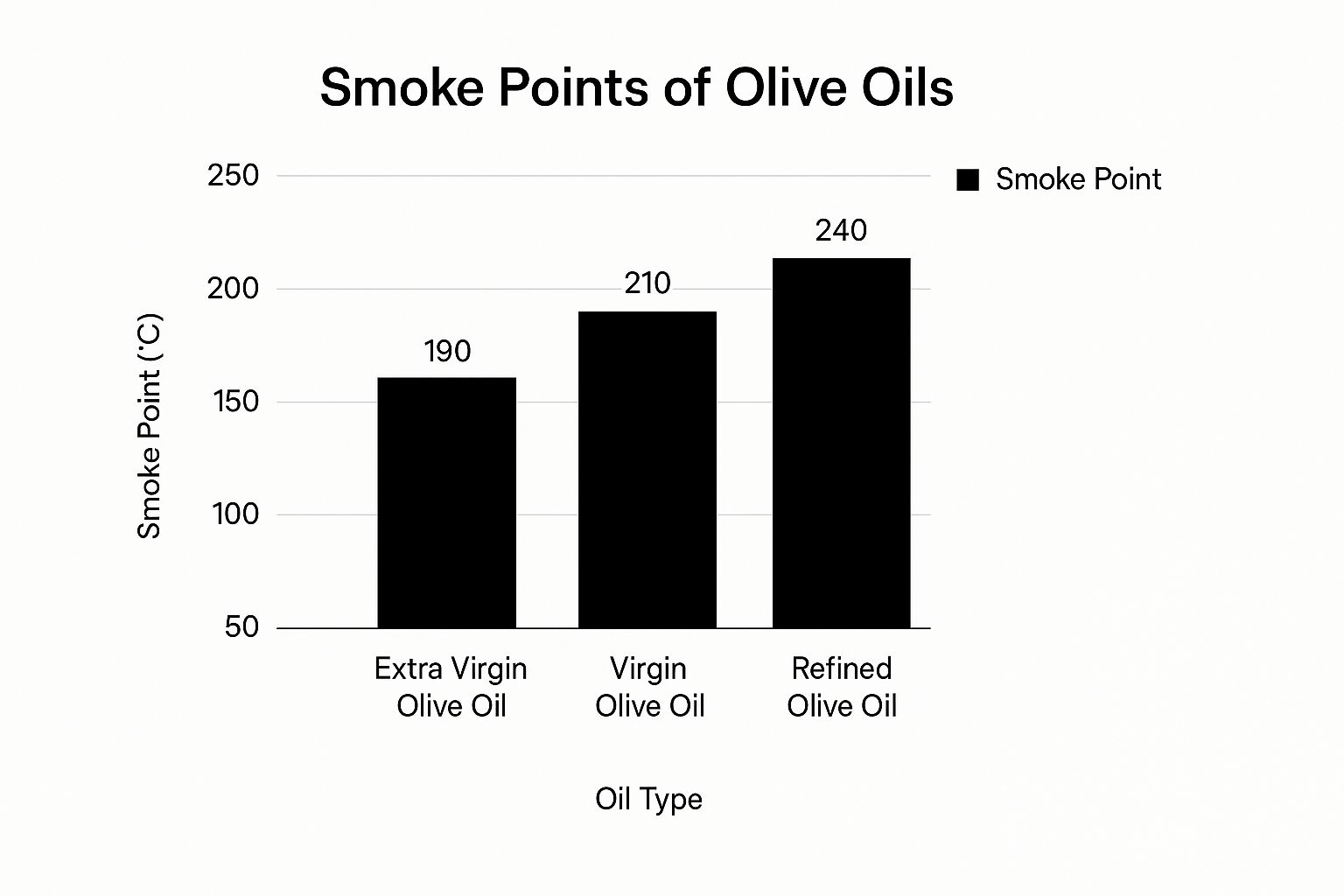
As you can see, the heavily refined oils are your go-to for high-heat cooking, while the more delicate extra virgin oils are best suited for lower temperatures.
A Look at the Numbers
Let's put some concrete figures to this. A good quality extra virgin olive oil generally has a smoke point around 410°F (210°C). That’s perfectly fine for most everyday cooking, like sautéing.
But when you move into the more processed varieties, like light olive oil or olive pomace oil, the smoke point can climb as high as 468°F (242°C). This broad spectrum exists simply because refinement strips away the particles that burn first. The food science experts at Colorado State University explain how this processing impacts all sorts of cooking oils, not just olive oil.
The smoke point isn't a pass/fail test for an oil's quality. Instead, it’s a guide to help you match the right oil to the right cooking method, ensuring both great flavor and kitchen safety.
With this in mind, it's clear the conversation around the olive oil smoke point is far more interesting than just a single number. Each type of olive oil has its own place in the kitchen, and knowing the difference is key.
Olive Oil Smoke Point Comparison by Type
To make things even clearer, here’s a quick reference table. It’s a handy guide to help you choose the right olive oil for whatever you're cooking up next.
| Olive Oil Type | Typical Smoke Point (°F) | Typical Smoke Point (°C) | Best For |
|---|---|---|---|
| Extra Virgin Olive Oil (EVOO) | 350–410°F | 177–210°C | Sautéing, pan-frying, finishing, dressings |
| Virgin Olive Oil | ~420°F | ~215°C | Sautéing, baking, light frying |
| Refined (Pure/Light) Olive Oil | 425–465°F | 218–240°C | Roasting, searing, deep-frying |
| Olive Pomace Oil | ~460°F | ~238°C | High-heat frying and searing |
This table shows just how versatile olive oil can be. From a delicate EVOO for your vinaigrette to a robust refined oil for searing a steak, there's an option for almost any culinary task.
What Does "Smoke Point" Actually Mean in Your Kitchen?
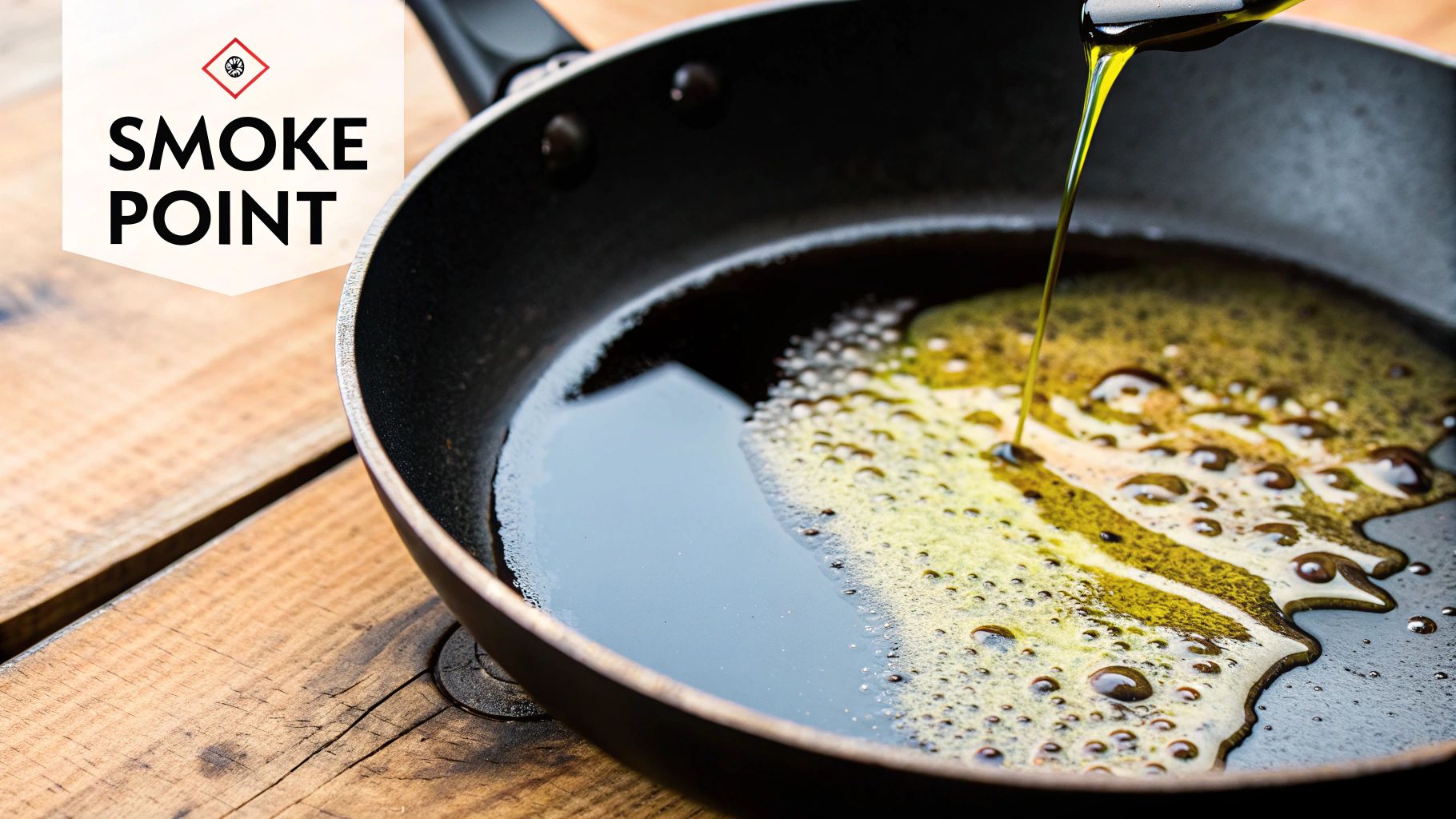
Let's cut through the jargon and talk about what the olive oil smoke point really means for your cooking. Forget the dense, scientific definitions for a second. Think of it like this: you know that moment when toast goes from perfectly golden to a smoking, bitter piece of char? That's exactly what happens to your oil.
When you see that first, faint wisp of bluish smoke curling up from your pan, that's your oil sending up a flare. It’s a signal that it has hit its limit and is starting to chemically break down. This isn't just "getting too hot"—it's the very structure of the fat molecules beginning to decompose.
The Science Behind the Smoke and That Awful Burnt Taste
So, what's really going on when the oil starts to smoke? The good stuff—the healthy fatty acids and delicate phytonutrients that make olive oil special—begin to oxidize and fall apart under the intense heat. As they break down, they release a whole bunch of new, less-desirable compounds into the air.
One of the main culprits here is acrolein. This is the chemical that gives burnt food that sharp, acrid smell and taste. It's the reason overheated oil turns your beautiful ingredients into something bitter and unpleasant.
That visible smoke is your oil's last-ditch effort to tell you it's no longer at its best. It has started forming compounds that not only taste terrible but can also strip away the nutritional benefits you were hoping to get.
This is why the smoke point is so much more than just a number on a chart. It’s a practical boundary that helps you protect the flavor, quality, and healthiness of your food.
What Happens When Oil Is Pushed Past Its Limit?
Once an oil goes past its smoke point, a few key things happen that you can see, smell, and definitely taste:
- Nutrients Are Destroyed: Those wonderful, health-promoting polyphenols and antioxidants in extra virgin olive oil are fragile. High heat makes them degrade quickly.
- Flavor Goes Bad: The oil loses its delicious, nuanced flavors and instead takes on a harsh, rancid, or burnt taste that infects your entire dish.
- Harmful Stuff Is Created: The chemical breakdown produces potentially harmful compounds that can then be absorbed by the food you're cooking.
Learning to spot the smoke point isn't about being a chemist in your kitchen. It's about building a cook's intuition. Seeing that smoke is simply a signal to turn down the heat, protecting your oil so it can make your food better, not worse.
How Quality and Freshness Impact Olive Oil’s Smoke Point
Think about the difference between a crisp, freshly picked apple and one that's been sitting on the counter for weeks—they're worlds apart. The same exact principle applies to olive oil. The real-world olive oil smoke point has less to do with the label on the bottle and everything to do with the oil's quality and age.
It's not a static number but a direct reflection of the oil's health and purity.
The science behind this comes down to something called Free Fatty Acid (FFA) content. You can think of FFA as tiny, unstable impurities floating around in the oil. The best extra virgin olive oils are made from healthy olives that are pressed very quickly after being picked, which keeps the FFA level incredibly low. This clean, stable structure is precisely what gives high-quality EVOO a surprisingly high smoke point.
On the other hand, oil made from damaged, overripe, or delayed-processing olives will have a much higher FFA. These free fatty acids are volatile and break down easily, causing the oil to start smoking at a much lower temperature.
The Role of Filtration and Age
Filtration is another important piece of the puzzle. Have you ever seen cloudy, unfiltered olive oil? While it has a certain rustic appeal, those tiny, suspended bits of olive fruit will burn very quickly when heated, dragging down the oil's overall smoke point. A well-filtered oil is clear because those particles have been removed, giving you a cleaner burn and a more reliable cooking temperature.
Finally, there's the unavoidable factor of age. Olive oil is a fresh-squeezed fruit juice, and it has a shelf life. Its biggest enemies are heat, light, and air, which all cause it to break down over time.
As olive oil gets older, oxidation naturally causes its FFA content to rise. That bottle of EVOO that’s been sitting in your pantry for two years will have a lower smoke point today than it did when you first bought it, no matter how good it was initially.
This is why buying fresh, high-quality olive oil is a direct investment in your cooking. A low FFA means more than just a higher smoke point—it also means better flavor and more of the healthy antioxidants you're looking for.
From Theory to the Frying Pan
This direct link between quality and performance is why a top-tier extra virgin olive oil is perfectly suitable for most of your daily cooking needs. A premium EVOO with very low acidity can have a smoke point reaching up to 410°F (210°C), which is comfortably above the standard temperatures for pan-frying and sautéing (typically around 350-375°F). You can find more details about how well EVOO holds up to heat in this guide on cooking with olive oil from OliveOilLovers.com.
Ultimately, to really understand smoke point, you need to think beyond the label. Here’s what truly matters:
- Freshness Is Everything: Look for a harvest or press date on the bottle. The closer you are to that date, the lower the FFA and the higher the smoke point.
- Quality Trumps Grade: Don't be surprised when a premium, well-made EVOO outperforms a cheap, refined "light" olive oil. Its superior chemical makeup and low FFA give it more stability.
- Store It Properly: Protect your oil! Keep it sealed tight in a cool, dark cabinet. This slows down the aging process and helps preserve its high smoke point for longer.
When you make freshness and quality your top priorities, you're guaranteeing that the oil in your pan is stable, delicious, and ready to perform.
How Olive Oil Compares to Other Cooking Fats
When you line up all the fats in your kitchen, it's easy to assume the one with the highest smoke point is the winner. But that single number doesn't give you the full picture. The real question we should be asking is: how well does an oil hold up when you actually start cooking?
This is where the conversation about olive oil smoke point gets really interesting. A high-quality EVOO is a kitchen superstar, not just because of its temperature threshold, but because of its incredible oxidative stability. Think of this as the oil's internal defense system against breaking down under the stress of heat.
An oil with a high smoke point but low stability is like a sprinter who gasses out halfway through the race. On the other hand, an oil with high stability, like a good EVOO, is a marathon runner. It remains strong and steady throughout the entire cooking process.
Why Stability Matters More Than Smoke Point
So, what gives extra virgin olive oil this impressive endurance? It all comes down to its chemical makeup, specifically two key elements: a high concentration of stable monounsaturated fats and a rich supply of powerful antioxidants, also known as polyphenols. These antioxidants act like tiny bodyguards, protecting the delicate fat molecules from being damaged by heat.
In contrast, many common seed oils, such as canola or sunflower, are predominantly made of less stable polyunsaturated fats. While they might boast a higher initial smoke point on the label, these fats are far more vulnerable to heat. They can break down quickly, forming unhealthy compounds you definitely don't want in your food. This is precisely why an oil with a slightly lower smoke point but superior stability is often the healthier and better-performing choice.
A fascinating study that put various cooking oils to the test revealed just how resilient EVOO is. Even after a punishing six hours of continuous deep frying, its smoke point stayed firm at around 375°F (190°C), barely budging. Meanwhile, oils like sunflower and canola saw their smoke points plummet by as much as 100 to 150 degrees, proving they degrade much faster under pressure. You can dive deeper into these heat stability findings to see just how well EVOO performs.
Cooking Oil Showdown: Smoke Point vs. Stability
To really see how these oils stack up in a practical sense, it helps to look beyond a single number. The table below compares some common kitchen fats not just on smoke point, but also on their fat type and overall stability, giving you a much clearer idea of what’s happening in your pan.
| Cooking Oil | Smoke Point (°F) | Primary Fat Type | Oxidative Stability |
|---|---|---|---|
| Extra Virgin Olive Oil | 350–410°F | Monounsaturated | Very High |
| Avocado Oil (Refined) | 520°F | Monounsaturated | High |
| Canola Oil (Refined) | 400°F | Polyunsaturated | Low |
| Coconut Oil (Refined) | 450°F | Saturated | Moderate |
| Butter | 302°F | Saturated | Very Low |
As you can see, even though refined avocado oil has a staggering smoke point, EVOO's fantastic combination of stable fats and protective antioxidants makes it a true top-tier choice for nearly every cooking method.
While a high number looks impressive on a label, it's the oil's stability that truly dictates its performance and healthfulness when the heat is on.
This remarkable stability is why you can confidently reach for a quality extra virgin olive oil for everything from a gentle sauté to a vigorous pan-sear, knowing it won't break down and compromise the quality of your meal.
Matching Your Olive Oil to Your Cooking Method
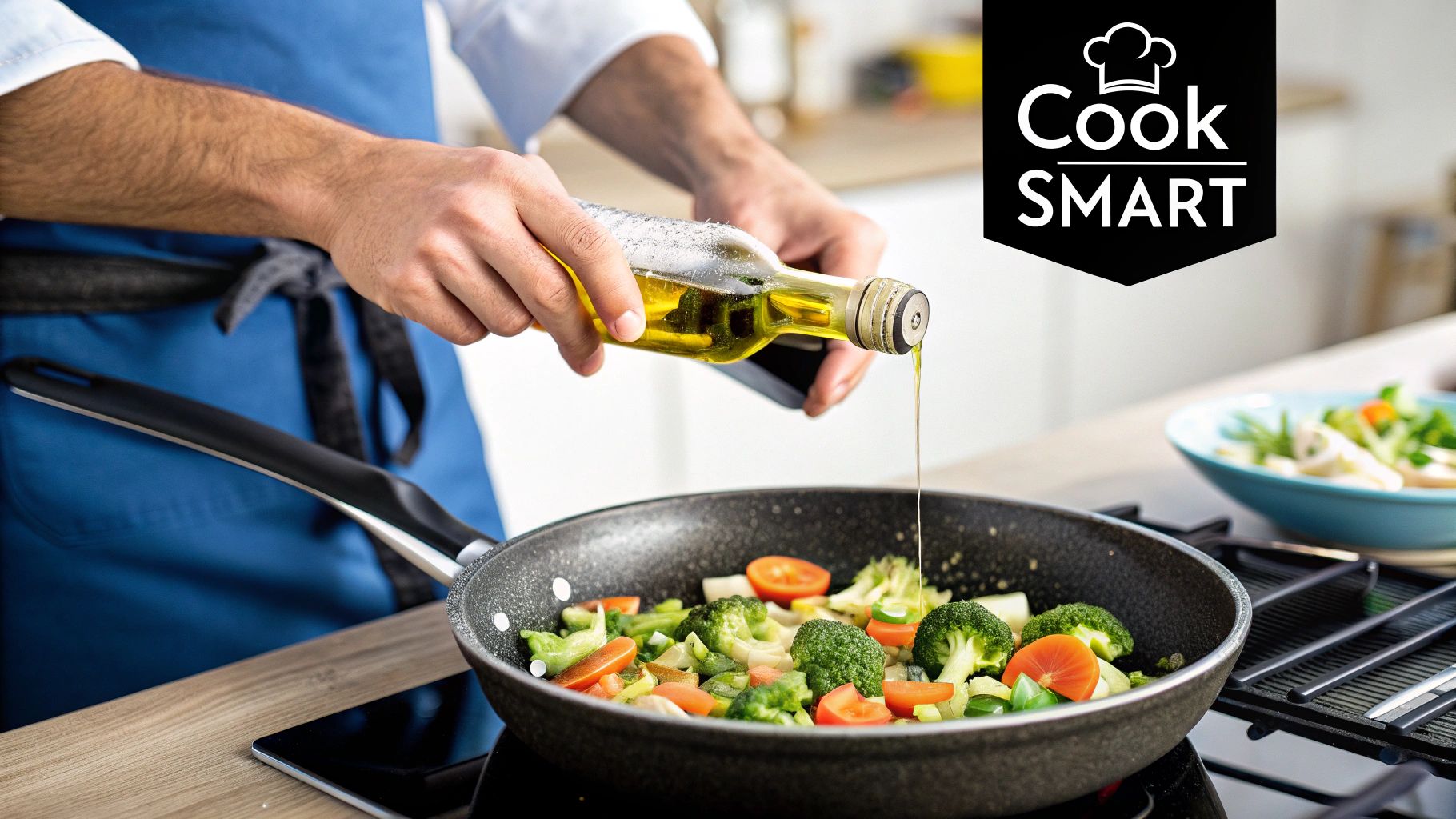
This is where the rubber meets the road—or, in our case, where the oil meets the pan. All that science about olive oil smoke point, quality, and stability comes down to one thing: stepping into your kitchen and choosing the right oil with total confidence.
It's less about memorizing strict rules and more about making smart, intuitive choices. The goal is simple: protect the flavor of your food and the incredible health benefits packed inside that bottle of olive oil.
Think of your olive oils like different tools in a workshop. You wouldn't use a delicate finishing hammer to smash concrete, right? In the same way, different olive oils are built for different jobs in the kitchen. And believe it or not, your premium extra virgin olive oil is the perfect multi-purpose tool for most of what you do every day.
Everyday Cooking with Extra Virgin Olive Oil
Let's bust a huge myth right now: you absolutely can, and should, cook with the good stuff. A high-quality EVOO is your best friend for the vast majority of your stovetop cooking. With a smoke point that can easily reach up to 410°F (210°C), it's more than tough enough for common cooking methods.
- Sautéing: Most sautéing happens between 320-350°F, a temperature range where EVOO feels right at home. It gently cooks your vegetables or chicken, all while infusing them with its wonderful, complex flavor.
- Pan-Searing: Getting that perfect crust on a piece of fish or a scallop? That happens around 375-400°F. A fresh, stable EVOO handles this heat beautifully, creating a delicious sear without breaking down and smoking you out.
- Roasting: When you roast vegetables or chicken in the oven, you're typically in the 350-400°F range. Tossing your ingredients in EVOO doesn't just stop them from sticking; it adds a layer of rich, fruity character that neutral oils simply can't.
For these jobs, using a top-notch EVOO isn't just safe—it’s a flavor upgrade. You’re not just cooking with fat; you’re cooking with flavor.
The goal is to use heat to make your food incredible, not to scorch your oil. When you match a stable, flavorful EVOO with everyday cooking temperatures, you get the best of both worlds: amazing taste and all the nutritional goodness intact.
When to Reach for Refined Olive Oil
So, what about those searingly hot jobs? This is where a more affordable, refined olive oil—often labeled just "olive oil" or "light olive oil"—gets its moment to shine. These oils have been processed specifically to remove the very compounds that burn at lower temperatures, pushing their smoke point up to a blistering 465°F (240°C) or higher.
This makes them the smarter, more economical pick for things like deep-frying. Since the intense refining process has already stripped away the delicate flavors and most of the antioxidants, you’re not paying a premium for qualities that would just be destroyed by that kind of heat anyway. You save your wallet and use an oil that’s perfectly suited for the task.
By matching your oil to your cooking method, you stop guessing and start cooking with purpose. If you're curious to dive deeper, you can explore the different grades and their best uses across the fascinating world of premium olive oil on Learn Olive Oil.
Debunking Common Myths About Cooking With Olive Oil
A lot of confusing information floats around about the olive oil smoke point, which can make anyone second-guess themselves in the kitchen. Let’s clear the air and bust a few of these persistent myths so you can cook confidently.
Probably the biggest myth out there is that you can never fry with extra virgin olive oil. This is simply not true. As we've seen, a high-quality EVOO can have a smoke point as high as 410°F (210°C).
That temperature is comfortably above what you need for most home cooking, like pan-frying, which typically happens around 350-375°F. So, a good EVOO isn't just safe for searing and sautéing—it's an outstanding choice.
Does Heat Destroy All the Health Benefits?
Another common misconception is that the moment you heat olive oil, all its amazing health benefits vanish in a puff of smoke. That's a massive oversimplification. While it’s true that very high heat for long periods can reduce some of the delicate polyphenols, the oil's fundamental structure holds up incredibly well.
The heart-healthy monounsaturated fats, which are the main component of olive oil, are very stable when heated. This means that even after cooking, olive oil keeps its healthy fat profile, making it a much more resilient option than many common seed oils.
When you cook with EVOO within its proper temperature range, you're still getting plenty of its health benefits and all that incredible flavor.
Unpacking the Truth About Cooking Fats
Ultimately, these myths come from a basic misunderstanding of how different fats react to heat. Here’s a quick reality check:
-
Myth: You can't fry with extra virgin olive oil.
- Truth: A quality EVOO has a smoke point high enough for most home cooking, including pan-frying. Its impressive stability actually makes it one of the safest fats for the job.
-
Myth: Heating destroys all of olive oil's health benefits.
- Truth: While some delicate compounds are sensitive to extreme heat, the oil’s core of stable monounsaturated fats remains intact. You are absolutely still using a profoundly healthy cooking fat.
Choosing to cook with olive oil isn’t about making a compromise. Once you understand its real properties, you can finally move past the old myths and embrace one of the most flavorful, versatile, and healthy fats in your kitchen.
Frequently Asked Questions About Olive Oil
Alright, we've walked through the science behind smoke points, but let's get down to what really matters in your kitchen. Here are answers to some of the most common questions I hear, designed to give you total confidence next time you reach for that bottle.
How Can I Tell If My Oil Is Too Hot?
You're looking for one unmistakable sign: a continuous wisp of thin, bluish smoke. This is very different from the gentle, harmless steam you might see when adding moist ingredients to a hot pan.
If you spot that bluish smoke, it's a warning signal. It means the oil is breaking down, and you’ll likely notice a harsh, acrid smell to go with it. When this happens, your best bet is to cut the heat, carefully discard the oil, give the pan a quick wipe, and start over on a lower flame.
Does Storage Affect the Smoke Point?
It absolutely does. Think of heat, light, and air as the three arch-enemies of olive oil. When your oil is exposed to them, a process called oxidation kicks into high gear, which increases the oil's free fatty acid content. As those acids go up, the smoke point goes down.
To keep your oil in peak condition and maintain its smoke point:
- Store it in a cool, dark place, like a pantry or cabinet—never next to the stove.
- Always make sure the cap is on tight to keep oxygen out.
Honestly, proper storage is the single best thing you can do to protect your oil. It ensures every drizzle performs just as beautifully as the first.
Is It Okay to Reuse Frying Oil?
I know it can feel wasteful, but I generally advise against reusing olive oil after high-heat cooking, especially frying. Each time you bring it up to a high temperature, you're degrading its quality and lowering its smoke point.
The oil becomes less stable with every use, making it much more likely to burn and impart off-flavors the next time around. For the best taste and performance, fresh oil is always the way to go.
Does a Darker Color Mean Better Oil?
That’s a common misconception, but the answer is no. The color of olive oil, which can range from a brilliant green to a soft golden yellow, really just tells you about the olive varietal and how ripe it was at harvest.
Color is not a reliable indicator of quality, flavor, or its smoke point. Instead of judging a bottle by its color, look for a harvest date to gauge freshness and stick with producers you trust.
At Learn Olive Oil, we're passionate about demystifying the world of high-quality olive oil. From decoding labels to mastering tasting techniques, we offer the expert insights you need to cook and drizzle with the best. Explore our guides and begin your journey at Learn Olive Oil.

 Learn Olive Oil
Leave a comment