Ever feel a bit lost in the olive oil aisle? You're not alone. Staring at that wall of green bottles, you can’t help but wonder: am I about to pay a premium for a dud? The truth is, it’s a gamble. But it doesn’t have to be. The real trick to buying good olive oil isn't about falling for a pretty label—it's about learning to read the subtle clues that separate liquid gold from cleverly disguised junk.
Let’s be brutally honest. A shocking number of bottles on your local supermarket shelf simply aren't what they claim to be.
The Secret World of Supermarket Olive Oil
Walk down that grocery aisle and you're faced with a sea of green glass and labels whispering sweet nothings about "authentic Italian flavor" next to pictures of sun-drenched groves. But here’s the cold, hard truth: the oil inside that bottle has likely been on a long, complicated, and often deceptive journey to get to you.
The global olive oil market is a behemoth. To put it in perspective, the U.S. alone imported a staggering 362,618 tons in a single recent season. An ocean of that—about 86%—comes from just four countries: Spain, Italy, Tunisia, and Turkey. With that kind of volume, there's immense pressure on producers, and quality is often the first casualty.
Why Your "Italian" Oil Might Not Be Italian
Here’s a little secret most shoppers miss, a clever bit of wordplay that deceives millions: a label that says "Bottled in Italy" is not the same as "Product of Italy." It's a world of difference. It often means olives or even finished oil from Spain, Tunisia, or Greece were shipped to Italy in giant tankers, mixed together, and then poured into fancy bottles.
What you end up with is a generic, soulless blend with no distinct origin, no single story, and little to no real quality oversight. It’s a numbers game where traceability evaporates. An oil from a single, named estate tells a story of place and care. An oil blended from three different continents is just a commodity.
The most jarring statistic I've come across—one that should make you sit up and pay attention—is that studies have shown as much as 69% of imported olive oil labeled "extra virgin" in the U.S. failed to meet the official standards.
Let that sink in. You’re likely paying a premium for something that could be old, rancid, or even worse, cut with cheap soybean or canola oil. This is a big deal. If you're serious about arming yourself against fraud, our deep dive on how to spot fake olive oil is a must-read.
To help you make smarter decisions right there in the grocery store, I've put together a quick comparison table. Think of it as your cheat sheet for distinguishing between the red flags of low-quality oils and the green flags of genuinely good extra virgin olive oil.
Quick Guide to Spotting Fake vs. Real Olive Oil
| Indicator | Low-Quality 'Olive Oil' | High-Quality 'Extra Virgin' Oil |
|---|---|---|
| Bottle | Clear glass bottle (exposes oil to damaging light) | Dark glass, tin, or ceramic (protects from light) |
| Origin | Vague terms like "Packed in" or "Product of Mediterranean" | Specific origin: "Product of Spain" or a named estate/region |
| Date | Only a "Best By" date, or no date at all | A clear Harvest Date (the most crucial indicator of freshness) |
| Price | Suspiciously cheap (e.g., under $10 for a large bottle) | Priced reasonably for a craft product (reflects quality) |
| Flavor | Greasy, waxy, bland, or no taste | Peppery, grassy, fruity, or pleasantly bitter finish |
| Certifications | None, or just generic organic labels | Third-party seals like PDO, PGI, or California's COOC seal |
Think of this table as your first line of defense. Once you start noticing these details, you'll find it far easier to filter out the impostors and focus on the oils that are actually worth your money.
Your Quick-Start Defense Plan
So, what can you do on your very next shopping trip? Don't get overwhelmed; get smart. The power shifts back to you the moment you know which signals to look for and which to ignore. This isn’t about becoming a world-class taster overnight—it’s about spotting the red flags hiding in plain sight.
Here are the first three things I tell everyone to check. They’ll immediately rocket your chances of bringing home a great bottle.
-
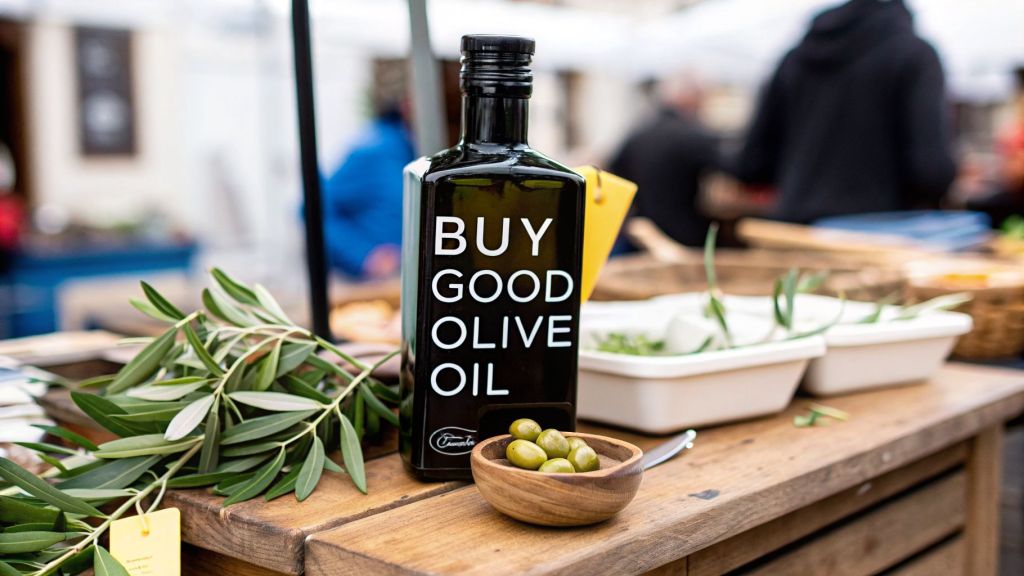
A Dark Bottle or Tin: Light is public enemy number one for olive oil. It massacres the oil, destroys the healthy antioxidants, and makes it go rancid with shocking speed. Any producer who truly cares about their product will shield it in dark green glass or an opaque tin. A clear glass bottle is a giant red flag that screams, "We don't care!"
-
A Single Country of Origin: Flip that bottle over and read the fine print. Does it clearly state "Product of Spain" or "Product of Greece"? Perfect. If it lists a cocktail of countries or uses a vague, meaningless phrase like "Product of the Mediterranean," put it back on the shelf.
-
A Harvest Date: This is, without a doubt, the single most important piece of information on the label. Olive oil is fresh-pressed fruit juice, and it’s best when it’s young. Look for a harvest date that's as recent as possible. Always, always trust the harvest date over a "Best By" date, which is often just an arbitrary two-year guess.
Mastering these three simple checks will put you ahead of 90% of shoppers out there. It’s the first step in turning a game of chance into a confident, rewarding choice.
Decoding the Label Like a Pro
When you're standing in the grocery aisle staring at a wall of olive oil, the bottle's label is your most powerful ally. Do not get distracted by pretty pictures of sun-drenched Italian hillsides—that’s just marketing fluff. The real story, the one that matters, is in the fine print. Learning to read it is the single most important skill for finding a truly great olive oil.
Think of yourself as a detective on a mission. The clues are all there, you just need to know where to look.
The Only Date That Really Matters
The first thing I always look for isn't a fancy seal or a poetic description. It's a date. But not the one you think.
Ignore the "Best By" or "Use By" date. That date is usually set two years after the oil was bottled, and frankly, it tells you almost nothing about freshness. Olive oil is perishable fruit juice. Its mortal enemies—time, light, and air—start their attack immediately.
The most crucial piece of information on any bottle is the Harvest Date. This tells you exactly when the olives were picked from the tree. A producer who is proud of their oil will display this date clearly. Always, always look for the most recent harvest season you can find. It’s your guarantee of life and vitality.
What Do All Those Terms Mean?
Once you've zeroed in on a recent harvest date, your eyes will start scanning other terms. Some are meaningful, while others are just noise designed to confuse you. Here's how to tell them apart.
-
Extra Virgin Olive Oil (EVOO): This is the top grade, and it's the only one you should be buying. It means the oil was extracted without chemicals or high heat and has passed both lab tests and a sensory panel. But here's the catch: just seeing "EVOO" on the label is a starting point, not a guarantee of high quality.
-
First Cold Press / Cold-Pressed: These phrases are almost entirely meaningless today. They're a fossil from old, outdated production methods. Modern high-quality olive oil is made using a centrifuge in a temperature-controlled environment (below 80.6°F or 27°C), so it's all technically "cold-pressed." Seeing this on a modern label is redundant—it’s like a car company bragging that their new model comes with a steering wheel.
To make this easier when you're shopping, you can use this simple mental flowchart to guide your decision.

It really boils down to this: prioritize a recent harvest date and a specific origin over vague marketing claims and prices that seem too good to be true.
The Power of Seals and Certifications
Seals can be a fantastic shortcut to quality, but you have to know which ones actually mean something. Some represent tough, independent verification, while others are just logos you can buy.
PDO and PGI seals are your most reliable allies from Europe. A PDO (Protected Designation of Origin) seal guarantees the olives were grown, pressed, and bottled in a specific geographical area using traditional methods. A PGI (Protected Geographical Indication) seal is similar, but slightly less strict, requiring at least one phase of production to happen in the designated region. These seals are your assurance of authenticity.
If you're looking at oils from the U.S., these are the seals to trust:
-
COOC Seal (California Olive Oil Council): This is one of the world's most stringent certifications. To earn this seal, an oil must pass both chemical analysis and a blind tasting by a professional sensory panel to ensure it's truly extra virgin and free of defects.
-
NAOOA Quality Seal (North American Olive Oil Association): This program randomly buys oils right off store shelves and tests them to make sure they meet international standards. It's a strong sign that a company is committed to quality control and isn't afraid to be tested.
The U.S. market alone consumes over 410,000 tons of olive oil, and with global consumption nearing 3 million tons, the shelves are flooded with options. This is why knowing your labels is so vital. Even with a recent 6.4% rise in imports, which could impact prices, verifying quality through harvest dates and trusted seals is the only way to get the fresh, healthy oil you're paying for.
Of course, these label-reading skills are useful for more than just olive oil. If you want to get better at decoding everything in your pantry, it's worth learning how to read food labels like a pro.
For an even deeper dive into the specifics of oil labels, our comprehensive guide covers everything you need to know about what to look for on an olive oil label.
Your Palate Is the Ultimate Lie Detector
Labels and harvest dates can get you close, but the real moment of truth happens when the oil hits your tongue. Your own senses are the best tool you have; they can tell you things a lab report never could. A truly great extra virgin olive oil has character—it speaks to you with vibrant aromas and flavors.
This is where shopping for olive oil gets fun. Forget stuffy tasting rooms. You can do this right in your own kitchen with just a small glass and the oil you want to test.

How to Taste Like a Professional
You might be tempted to grab a piece of bread, but the pros skip it. Bread actually masks the oil’s true character. Instead, they use a specific technique to warm the oil and unlock its hidden aromatic compounds.
Pour about a tablespoon of oil into a small, clean glass—a wine glass or even a shot glass will do the trick. Cup the bottom of the glass in one palm and cover the top with your other hand. You're using your own body heat to gently warm the oil for a minute or so.
Now, lift the glass to your nose, remove your hand, and take a deep, deliberate sniff. What do you smell? A high-quality oil should smell fresh and green. You might pick up notes of fresh-cut grass, green apple, almond, or even tomato leaf. If it smells waxy, stale, or like nothing at all, that's a huge red flag.
Next, it's time for the "slurp." Take a small sip of oil. With your teeth slightly apart, suck in a bit of air. It’s a noisy, somewhat awkward-sounding action, but it sprays the oil across your entire palate, allowing you to experience its full complexity. For a more detailed walkthrough, our complete guide on how to taste olive oil like an expert breaks it down perfectly.
The Three Pillars of Great Olive Oil
When you taste, you aren't looking for a generic "oily" or "buttery" flavor. You're actually hunting for three specific, positive attributes. These tell you the oil is authentic, fresh, and bursting with the good stuff.
-
Fruitiness: This is the aroma of fresh, healthy olives, perceived through both your nose and mouth. It can range from delicate and ripe (think apples and nuts) to intense and grassy (like green tomato vines).
-
Bitterness: Don't be afraid of bitter! A distinct bitterness on your tongue is a fantastic sign. It means the olives were green and fresh when harvested, not overripe and mushy. A lack of bitterness often points to an old or poorly made oil.
-
Pungency: This is that peppery tickle or cough-inducing sensation at the back of your throat. This kick comes from oleocanthal, a powerful anti-inflammatory compound found only in fresh, high-quality olive oil. The more it makes you cough, the healthier the oil likely is!
A true extra virgin olive oil should taste like a fresh fruit or vegetable juice, not a fat. It should feel clean and vibrant in your mouth, never leaving behind a greasy, waxy film.
Common Defects to Watch For
Knowing what’s good is only half the battle; you also need to spot the bad. If you taste any of the following, the oil is flawed and certainly not worth a premium price. These defects are almost always the result of poor handling, processing, or storage.
-
Rancid: This is the most common flaw by far. A rancid oil smells and tastes like old nuts, stale crackers, or even wax crayons. It’s the result of oxidation from too much exposure to air, light, or heat.
-
Fusty/Musty: This defect gives off a smell reminiscent of sweaty socks or damp, moldy hay. It happens when olives are piled up and stored for too long before milling, causing them to ferment anaerobically.
-
Winey-Vinegary: You'll notice a sharp, acidic flavor and aroma, much like a bad wine or vinegar. This is also a result of fermentation, just a different type than the fusty defect.
By learning to recognize these key characteristics—both positive and negative—you put yourself in the driver's seat. You’re no longer at the mercy of a pretty label or a slick marketing campaign. You're empowering your own palate to make the final call, turning the simple act of buying olive oil from a gamble into a confident and rewarding choice.
Why the Back of the Bottle Is More Important Than the Front
The real story of an olive oil isn't told by the fancy label on the front. It's hidden in the details on the back—where it came from, who made it, and even the type of bottle it's in. These clues separate a truly exceptional oil from the forgettable ones lining most supermarket shelves.
Think of it this way: would you rather have a wine from a specific, celebrated vineyard in Napa, or one simply labeled "Red Wine from Planet Earth"? The choice is obvious. The same logic applies directly to olive oil. When you see an oil that proudly names a single estate or a specific region like Crete, Greece or Andalusia, Spain, you’re looking at a product with accountability. The producer is staking their reputation on the unique character of that specific place.
On the flip side, you have the mass-market blends. These are often a cocktail of oils from several different countries, all blended together to create a consistent—but usually bland—flavor profile. They’re built for volume, not for character.
Single Estate vs. The Global Blend
When you're standing in the aisle, your first real decision is between an oil with a specific home and one that’s a citizen of nowhere.
A single-estate oil means the olives were grown and pressed right on one property. This gives you incredible transparency. You know the farmer had their hands on the entire process, from tending the trees to bottling the oil. Their reputation is literally in that bottle.
You just don't get that with the big, blended oils. Those are commodities, plain and simple. They're often mixed from different harvests and even different countries just to hit a certain price point. The end result is an anonymous product that completely lacks the vibrant, distinct notes of a carefully crafted, single-origin oil.
My best advice? Always choose an oil with a story—one that comes from a place you can actually point to on a map. You're casting a vote for true quality and character, not just another commodity.
How It’s Farmed Shapes the Flavor
It’s not just about the where, but also the how. Many traditional olive groves are centuries old, with trees given plenty of space to grow. This method is incredibly labor-intensive, but it’s known for producing olives with deep, wonderfully complex flavors.
Then you have the modern approach: high-density orchards. Here, the olive trees are planted close together, almost like grapevines, which allows for efficient mechanical harvesting. This technique can produce very good, consistent oil, but some purists argue it can miss some of the nuance you get from olives grown on ancient, traditionally farmed land.
Neither way is necessarily "wrong," but knowing the difference helps you understand what you're buying. An oil from a small, family-run grove in Tuscany will taste completely different from one made in a massive, modern orchard in California. And that diversity is what makes olive oil so exciting. If you want to dive deeper into how geography shapes flavor, you can explore our guide to olive oil origins and terroirs.
Defending Your Oil from Its Greatest Enemies
Here's a crucial tip: even the world's best olive oil can be ruined before you even get it home. Its two greatest enemies are light and air. Once exposed to either, the oil immediately begins to degrade, destroying its beautiful flavors and healthy compounds.
This is why the packaging is so incredibly important. I'll say it flat out: a quality producer will never bottle their oil in clear glass. It's a huge red flag that they don’t care about protecting the product inside.
Instead, look for these guardians of quality:
- Dark Glass: Deep green or amber bottles are your first line of defense against damaging UV rays.
- Tins or Cans: Opaque metal offers a complete barrier to light. This is an excellent choice.
- Ceramic: Though less common, these bottles also provide total protection from light.
If you see an oil sitting on the shelf in a clear plastic jug or a see-through glass bottle, just walk away. The producer is telling you everything you need to know about their priorities.
The global olive oil scene is bigger than ever. Production recently hit a staggering 3.507 million tons for the 2025/26 crop year, and it’s fascinating to see that non-EU countries now contribute 40% of the world's total output. With 58 producing countries in the mix, we have more choices than ever before. This is fantastic news, but it also means we have to be smart shoppers. Always check for a recent harvest date and insist on an oil that’s bottled in a protective tin or dark glass.
Protecting Your Investment from Its Enemies
So, you've navigated the tricky world of olive oil labels and brought home a bottle of the good stuff. Congratulations! But your job isn't quite done. To make sure that beautiful oil tastes just as amazing in a month as it does today, you must protect it from its mortal enemies.

Think of it this way: once that bottle is opened, it has three sworn enemies: light, heat, and air. Exposure to any of these will trigger oxidation, which quickly turns a vibrant, peppery oil into something flat and rancid. Your liquid gold deserves better.
Storing Your Oil for Peak Freshness
I see it all the time: a lovely bottle of olive oil sitting right next to the stovetop, a victim in plain sight. While convenient, the constant heat is one of the quickest ways to murder its delicate flavors and destroy its health benefits. That is the single worst place you can keep it.
Instead, find a home for your oil in a cool, dark cabinet or pantry. It needs to be away from the stove, the oven, and any windows where sunlight can strike it. This one simple habit makes an enormous difference.
People often ask me, "Should I refrigerate my olive oil?" My answer is always a firm no. It won't technically harm the oil, but the cold will cause it to solidify and can brutally mute its complex aromas. You then have to wait for it to come back to room temperature, which is just an unnecessary, frustrating step.
The Clock Is Ticking
Once you break that seal, the countdown begins. Every time you open the bottle, you let in a little more air, and the oxidation process gets a little boost. This is precisely why buying a giant tin that you won’t finish for a year is a false economy.
As a rule of thumb, plan to use an opened bottle of olive oil within 60 to 90 days. After that, even a top-tier oil will start to lose its magic. It won't be unsafe to eat, but all those wonderful peppery and fruity notes you paid a premium for will have faded into a ghost of what they once were.
Putting Your Best Oil to Work
A truly great olive oil isn't meant to be saved for a special occasion—it's meant to be enjoyed now! The best way to honor the producer's craft is to use it while it’s at its absolute peak of flavor and vitality.
-
As a Finisher: This is where a high-quality oil truly sings. A generous drizzle over a warm bowl of beans, grilled fish, or roasted vegetables just before serving is transformative. The heat from the food unlocks its incredible aromas.
-
In Vinaigrettes: A vibrant, character-rich olive oil is the soul of a great salad dressing. It can single-handedly elevate a simple bowl of greens into something truly memorable.
-
For Low-Heat Cooking: Can you cook with extra virgin olive oil? Absolutely. Most EVOOs have a smoke point around 375-405°F, which is perfectly fine for sautéing. That said, I'd save my most complex, expensive bottle for finishing and use a more affordable (but still high-quality) EVOO for my daily cooking.
Learning about proper olive oil storage is just as crucial as learning how to buy the right bottle. When you protect your oil correctly, you ensure every last drop delivers the flavor and vitality it was meant to have.
Busting Common Olive Oil Myths
Even after you've learned to read labels and can spot a good bottle from a bad one, a few tricky questions always seem to pop up. The olive oil world is filled with confusing terms and persistent myths, so let’s get those sorted. Answering these common questions is the final piece of the puzzle to becoming a truly confident buyer.
You know what to look for, but a few lingering doubts can still make you hesitate in the grocery aisle. Let's tackle them head-on, so nothing stands between you and a fantastic bottle of oil.
Does 'Light' Olive Oil Have Fewer Calories?
Absolutely not. This is perhaps one of the most successful—and misleading—marketing ploys in the food industry. When you see "Light" or "Extra Light" on a label, it refers only to the oil's flavor and color, never its calorie count.
These are heavily refined oils. The industrial refining process strips out the natural color, aroma, and all those wonderful, peppery notes you expect from extra virgin olive oil. What's worse, it also destroys nearly all the healthy polyphenols that make EVOO so beneficial.
Here's the bottom line: all olive oils, no matter the grade, have about 120 calories per tablespoon. If you're buying olive oil for health benefits and great taste, you have to choose Extra Virgin. There is no substitute.
Can I Trust The Fridge Test?
The infamous "fridge test" is an old wives' tale that just won't die. The myth goes that if you stick your olive oil in the refrigerator and it solidifies, it must be pure extra virgin olive oil. This is a completely unreliable and useless method.
While it’s true that the monounsaturated fats in real EVOO start to congeal in the cold, so do many other refined oils, including fraudulent ones. An oil's solidifying point depends on its unique chemical profile, determined by the specific olive varieties and even the climate where they grew. I’ve seen some incredible, high-quality EVOOs that don't fully solidify, and cheap, fake oils that do.
Your palate is a far more accurate instrument than your refrigerator. A sensory test is the only real confirmation of quality. Does it smell fresh, grassy, or like green tomatoes? Does it have a fruity taste followed by a pleasant bitterness and a peppery kick in the back of your throat? Trust your senses, not a debunked kitchen experiment.
Is More Expensive Always Better?
While an unbelievably low price is a dead giveaway for poor quality, a sky-high price tag doesn't guarantee a superior oil. A bottle’s cost is wrapped up in all sorts of things: fancy packaging, import duties, huge marketing budgets, or just simple brand prestige. Don't let the price tag alone make your decision.
I have often found that a moderately priced bottle from a small, dedicated producer at a local specialty shop or farmers' market can run circles around an expensive, big-name brand from the supermarket. Your best bet is to fall back on what you now know:
- Look for a harvest date to ensure freshness.
- Find a single-country origin and, ideally, a specific producer or estate.
- Seek out trusted certifications like PDO or COOC.
- Make sure it's in a dark bottle or tin to protect it from light.
Use these indicators of quality to guide you, not just the price.
What Does Unfiltered Mean?
When you see "unfiltered" on a label, it simply means the oil contains tiny, microscopic particles of olive fruit that weren't filtered out after pressing. This often gives the oil a cloudy look and can contribute to a more intense, robust flavor. Many people, especially those who love super-fresh oil (often called Olio Nuovo), seek out this punchy character.
The trade-off, however, is shelf life. Those leftover fruit solids can cause the oil to spoil faster. Filtered oil, on the other hand, has had those particles removed, resulting in a crystal-clear appearance and a longer shelf life.
Neither is inherently better—it really just comes down to your personal taste and how quickly you plan to use the oil. If you go for an unfiltered bottle, just make a point to use it up within a few months of opening to enjoy it at its absolute best.
At Learn Olive Oil, we believe that understanding the nuances of olive oil transforms it from a simple pantry staple into a source of culinary delight and health. Our mission is to give you the confidence to explore this world, from tasting like a pro to choosing the perfect bottle. Discover the World of Premium Olive Oil and start your journey with us today.
 Learn Olive Oil
Leave a comment