Yes, you absolutely can—and you really should—cook with high-quality olive oil. Depending on the type, the smoke point of olive oil spans a wide range from about 325°F to 470°F (163°C to 243°C). This makes it a fantastic and surprisingly stable choice for just about any cooking method you use at home.
Can You Really Cook With Good Olive Oil?
Let’s settle this common kitchen debate once and for all. A persistent myth—the idea that your beautiful extra virgin olive oil is too precious for the stove—has stuck around for far too long. And it’s keeping countless home cooks from unlocking some truly incredible flavors.
This outdated advice has created a widespread fear of a smoking pan. It has us pushing those gorgeous, healthy oils to the back of the pantry, saving them only for a last-minute drizzle. But the reality is much more exciting. The smoke point of olive oil isn't some frightening, hard-and-fast limit you must never approach. It’s better to think of it as a helpful signal—a clue that tells you about the oil's quality, how stable it is, and where it will truly shine in your kitchen.
Rethinking Heat and Olive Oil
Getting comfortable with this idea is the key to unlocking real confidence in the kitchen. We're here to tear down those old, restrictive rules and show you how to see your olive oil as more than just a condiment. It's a powerful and versatile cooking partner. It's time to forget the anxiety and finally embrace the sizzle.
Your bottle of liquid gold is more than just a finishing touch. It's a robust, flavorful, and stable fat that belongs on the heat, transforming everyday meals from mundane to magnificent when used correctly.
Once you have the right information, you’ll start to trust your ingredients. You'll quickly see how different olive oils behave under heat and why a high-quality extra virgin olive oil is often far more stable than you've been led to believe. To kickstart your journey, you can learn more about how to cook with olive oil and unlock its true potential.
This guide will help turn that bottle from a simple dressing into your go-to ally for everything from a gentle sauté to a hearty roast.
What a Smoke Point Actually Reveals About Your Oil
That first wisp of blue smoke curling up from your pan is more than just a sign to turn down the heat. It’s a distress signal—a tiny flag of surrender from your cooking oil. Most of us see it and think we’re on the verge of burning dinner, but it’s really a message about what’s happening inside the oil itself.
The smoking point of olive oil is its breaking point. It's the exact temperature where the oil stops being a stable, beautiful fat and starts to chemically decompose. This isn't just about burning; it's a fundamental change happening at the molecular level.
Once an oil hits this threshold, its best qualities are on a countdown. The delicate, peppery flavors you chose it for begin to degrade, replaced by a harsh, acrid taste. Even worse, the very nutrients that make olive oil so good for you—like its powerful polyphenols and antioxidants—are rapidly destroyed by the intense heat.
The Science Behind the Smoke
So, what sets this thermal tipping point? The answer lies with microscopic compounds called free fatty acids, or FFAs. Think of them as tiny, volatile troublemakers floating around in your oil.
The more FFAs an oil contains, the more easily it breaks down under heat. An oil with fewer of these acids is more stable and can handle higher temperatures before it starts to smoke. This simple relationship is the key to understanding why different types of olive oil behave so differently in a hot pan.
The smoke point isn’t a grade of an oil's quality, but rather a clue about its history. It tells you about its journey from the olive grove to your kitchen, revealing its level of refinement and its true purpose on your stove.
A high smoke point doesn't automatically mean "better," and a lower one doesn't mean "worse." For example, a highly refined, light-tasting olive oil will have a sky-high smoke point because the industrial refining process strips out nearly all its FFAs. But that same process also removes much of the flavor, aroma, and nutritional goodness.
On the other hand, a bold, unfiltered extra virgin olive oil has a lower smoke point precisely because it’s a less processed, more natural product. It holds onto more of its original character—and more of those FFAs. To get into the nitty-gritty, you can explore our complete guide that details the complexities of the olive oil smoke point and what it means for your cooking.
Understanding this trade-off is central to choosing the right oil for the job. It’s not about finding the one with the absolute highest heat tolerance. It’s about knowing what that number really means and matching the right oil to the right task. That’s how you get the perfect balance of flavor, nutrition, and performance every single time.
Understanding The Different Types of Olive Oil
Not all olive oil is created equal. I like to think of it as a sprawling family, from the vibrant, complex matriarch that is Extra Virgin Olive Oil to its more practical, processed cousins. Each one has a distinct personality, a unique story of how it was made, and a specific job it does best in the kitchen.
Understanding this family tree is the secret to mastering the smoke point of olive oil. The journey from the olive grove to the bottle determines everything—its flavor, its nutritional punch, and precisely how much heat it can handle before it starts to break down.
Extra Virgin Olive Oil: The Unprocessed Original
Extra Virgin Olive Oil (EVOO) is the head of the family, the purest expression of the olive. It’s made simply by crushing fresh olives and extracting the juice, a cold-press process that preserves its stunningly complex flavors and a wealth of powerful antioxidants called polyphenols.
Because it's so minimally processed, EVOO naturally contains more of those free fatty acids we talked about earlier. This is what gives it a lower smoke point, but it's also the very reason it's such a nutritional champion.
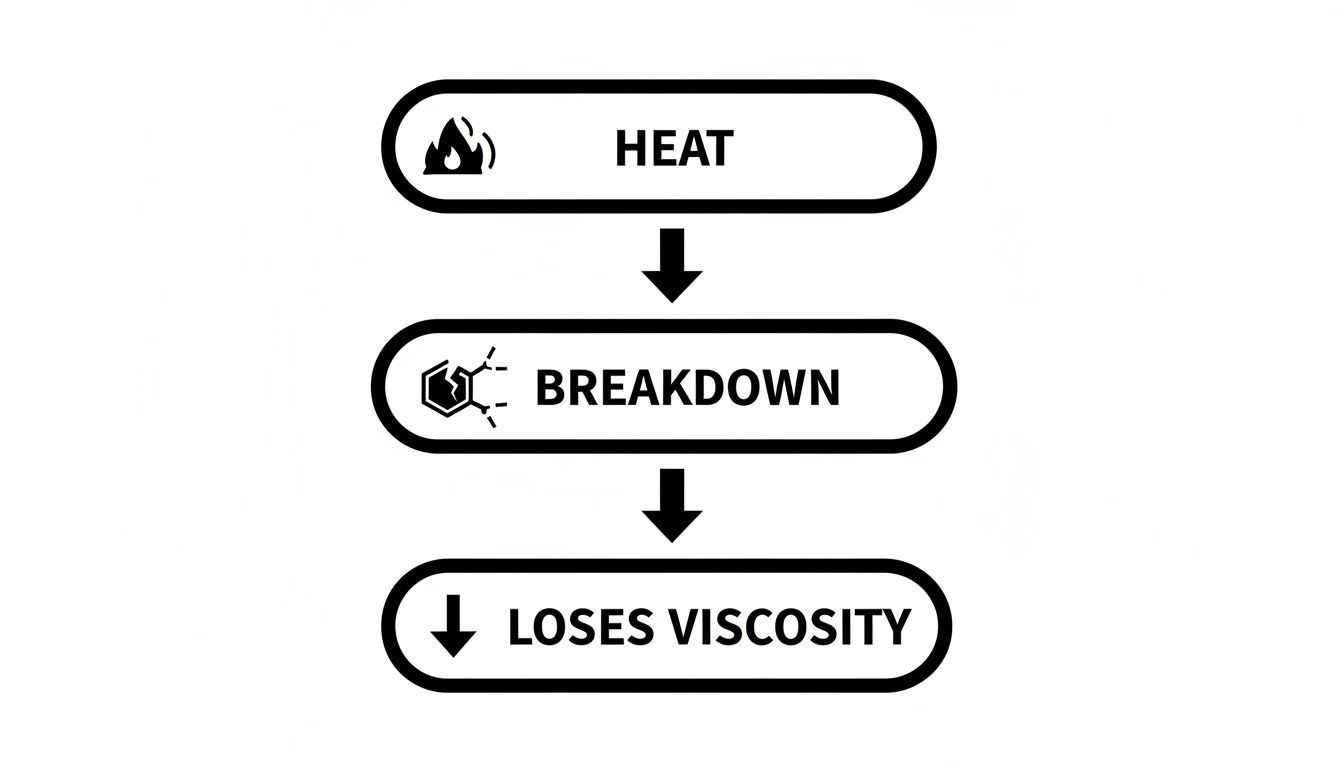
This flowchart really drives the point home: cranking up the heat is the first step toward degrading your oil and stripping away its quality.
Virgin and Refined Olive Oils: The Dependable Workhorses
Next in line is Virgin Olive Oil, a close relative to EVOO but with slightly higher acidity and a milder flavor. It’s still a high-quality, unrefined oil, just not quite up to the stringent standards of its extra virgin sibling. Its smoke point is very similar, making it a good, albeit less common, cooking companion.
Then we meet Refined Olive Oil, often just labeled ‘olive oil’ or sometimes ‘light’ olive oil. This one has gone through processing—using heat and other methods—to strip out impurities and neutralize those free fatty acids. This industrial makeover dials back its flavor and aroma but dramatically raises its smoke point.
The great trade-off is clear: the very process that gives refined oil a higher smoke point also strips away the polyphenols that make EVOO a health powerhouse. You gain heat stability, but you lose a lot of the nutritional density and flavor.
Olive Pomace Oil: The Distant Cousin
Finally, there’s Olive Pomace Oil. This type is extracted from what’s left over after the first press—the skins, seeds, and pulp—using chemical solvents and high heat. It’s then refined, resulting in a neutral-tasting oil with a very high smoke point, but it’s the furthest removed from the original fruit. You can learn more by exploring our detailed guide on the different types of olive oil.
The smoke points vary dramatically across these grades, a fact that should absolutely guide your choices in the kitchen.
- Extra Virgin Olive Oil: 325°F to 410°F
- Virgin Olive Oil: 325°F to 400°F
- Refined Olive Oil: 390°F to 470°F
- Olive Pomace Oil: Up to 460°F
Remember, freshness and quality matter immensely. A top-tier, low-acidity EVOO will often hit the higher end of its smoke point range.
Choosing Your Olive Oil From Sauté to Sear
To make this crystal clear, here’s a quick guide to help you grab the right bottle for the job. Think of this as your cheat sheet for matching the oil's heat tolerance and flavor to your cooking method.
| Olive Oil Type | Smoke Point (°F) | Flavor Profile | Ideal For Sautéing (325-375°F) | Ideal For Roasting (375-425°F) | Ideal For Frying (350-375°F) |
|---|---|---|---|---|---|
| Extra Virgin | 325-410°F | Grassy, peppery, fruity | Yes, excellent for flavor | Yes, for lower-temp roasting | Yes, for pan-frying |
| Virgin | 325-400°F | Milder, less complex | Yes, a good alternative | Good, similar to EVOO | Good, if available |
| Refined (Pure) | 390-470°F | Neutral, very mild | Yes, for neutral flavor | Excellent, very stable | Excellent, for deep frying |
| Pomace | ~460°F | Neutral | No, flavor is lacking | Yes, for high heat | Yes, cost-effective option |
By understanding these distinctions, you're not just cooking smarter; you're getting the most flavor, nutrition, and value out of every single bottle.
The Hidden Factors That Alter an Oil’s Smoke Point
Ever wonder why your oil started smoking way sooner than the temperature on the bottle suggested? It’s because that number is a lab-tested ideal, not an ironclad guarantee for your kitchen. The real smoke point of your oil is a moving target, influenced by a handful of things that happen long after it leaves the mill.
Think of your oil's stability as a constant battle against three invisible enemies: heat, light, and air. Time is their greatest ally. An old, oxidized bottle of olive oil that’s been sitting on your counter for a year will break down and start smoking far quicker than a fresh, vibrant one. Every moment it's exposed, it loses a little of its integrity.
This is why proper storage isn't just a friendly suggestion—it's your best defense. When you keep your oil in a cool, dark place, you become the guardian of its quality, ensuring it performs at its peak from the first pour to the last.
Beyond the Bottle Itself
It’s not just about age and storage, though. The very pan you cook with can play a part. Tiny, leftover bits of food from your last meal act like kindling, kickstarting the oil's breakdown and lowering the smoke point on the spot. A clean pan is a stable pan.
These variables mean even a refined olive oil, with its high theoretical smoke point, depends on you. Its processing allows it to reach temperatures of 390–468°F (199–243°C), making it a workhorse for high-heat cooking, but poor handling can easily erase that advantage.
The number on the label is a lab-tested ideal. The smoke point in your kitchen is a direct result of how well you’ve cared for your oil.
Among these hidden factors, how you properly store food to extend its shelf life, including your olive oil, is one of the most crucial and overlooked details. Improper storage invites rancidity and will drop that smoke point much faster than you’d expect.
Finally, remember that every time you heat oil, you change its chemistry. Reusing frying oil might seem economical, but you're starting with a product that's already partially broken down. It's guaranteed to smoke sooner, at a lower temperature, and will impart off-flavors to whatever you're cooking. As you'll see when you learn more about how olive oil goes rancid, freshness is everything.
A Practical Guide to Cooking with Olive Oil
Alright, enough with the theory. Let's get this knowledge onto the stove where it belongs. This is where you swap abstract numbers for real results, turning that understanding into confident, everyday cooking. It’s time to stop worrying about a smoking pan and start trusting your senses.
The first step? Match your oil to your mission. For everyday tasks like sautéing vegetables or pan-frying chicken, a quality extra virgin olive oil isn't just safe—it's fantastic. You’re not just cooking the food; you’re infusing it with flavor. Those grassy, peppery notes in a good EVOO can elevate a simple dish into something special.
Because of its powerful antioxidant compounds, quality olive oil often makes an appearance on any good anti-inflammatory foods list. Using it within the right temperature range helps preserve these benefits, making it a choice that’s both functional and flavorful.
Choosing the Right Oil for the Job
But what about when things get really hot? For searing a steak to get that perfect crust or roasting potatoes until they’re impossibly crisp, a refined olive oil is the smarter, more stable choice. Its higher smoke point means it won't break down and create acrid, off-flavors, letting you get that beautiful browning without any kitchen drama.
Here’s a simple breakdown:
- For Sautéing & Light Frying: Grab a robust Extra Virgin Olive Oil. Its flavor is a huge plus, and its smoke point is more than high enough for most medium-heat cooking.
- For High-Heat Roasting & Searing: A Refined (Pure or Light) Olive Oil is your best bet. Its neutral profile and high heat tolerance make it a clean, reliable cooking medium.
- For Dressings & Finishing: This is where your best, most aromatic EVOO gets to shine. Drizzle it generously over soups, salads, and grilled fish right before serving.
Trust Your Senses, Not Just the Numbers
Forget obsessing over a thermometer. Your best tools are right there in your kitchen: your eyes, ears, and nose.
Oil that’s ready for cooking doesn’t smoke; it shimmers. Look for that subtle, wavy pattern to ripple across the surface of the pan. That’s your green light.
Then, listen for the sizzle. The sound of your food hitting the hot oil should be a lively, energetic crackle—not a timid fizzle or an angry roar. That sound is the sweet spot where perfect browning begins.
The best cooks don't just follow numbers. They develop a feel for the heat, listening for the perfect sizzle, watching for the telltale shimmer in the pan, and smelling the fragrant aromas that tell you everything is going exactly as it should.
A good extra virgin olive oil generally has a smoke point between 325°F and 410°F (163–210°C). That’s a surprisingly wide range, making it perfectly suitable for most stovetop cooking, which usually happens around 350°F. Because a true EVOO has very low free fatty acids (under 0.8%), it holds up beautifully for the vast majority of your meals.
Once you master these simple cues, you’ll stop being a rule-follower and start becoming a more intuitive, masterful cook. You’ll just know when your pan is ready, and that confidence leads to delicious results, every single time.
How To Become a Savvy Olive Oil Buyer
Walking down the olive oil aisle can feel overwhelming. The shelves are packed with bottles that use clever marketing and confusing terms to hide what’s actually inside. But you don't need to be a connoisseur to see through the noise.
With a little insider knowledge, you can learn to spot true quality from a mile away and walk out with a bottle you'll love.
Look for the Harvest Date, Not the "Best By" Date
The first thing to do is ignore the pretty front label and flip the bottle around. You're hunting for the single most important detail: the harvest date.
Freshness is everything for olive oil. That’s when its flavor is most vibrant and its health benefits are at their peak. A "best by" date is often set two years from bottling, not harvesting, so it tells you very little. No harvest date? That's a huge red flag.
Decode the Country of Origin
Next, you need to play detective with the language on the label. Marketers love to use phrases like “Packed in Italy” or “Bottled in Spain.” This sounds impressive, but it’s often a trick.
It could mean the oil was sourced from multiple countries, blended together, and only put into a bottle in that location.
What you really want to see is the phrase “Product of” followed by a single country. Even better is the name of a specific estate or region. This tells you the olives were grown, pressed, and bottled right there, which is a much stronger guarantee of authenticity and quality.
Ignore meaningless marketing fluff like “first press” or “cold-pressed.” Since virtually all modern extra virgin olive oil is made this way, these terms are now just empty buzzwords used to imply a higher quality that may not exist.
The quality of the oil you choose directly impacts its stability and performance in the kitchen, which is why understanding the smoking point of olive oil is so critical. A fresh, well-made oil has a more robust structure and simply performs better under heat.
To keep learning, check out our complete guide on how to buy olive oil and never get fooled by a slick label again.
By focusing on what really matters—the harvest date and the true origin—you can confidently bypass the marketing hype. You’re no longer just guessing; you’re making a smart choice for better flavor, health, and cooking every single time.
Common Questions About Olive Oil Smoke Points
Let's tackle some of the most common questions—and myths—that come up when we talk about heating olive oil. Getting these answers straight will give you the confidence to cook without worrying about ruining your oil or your meal.
If My Extra Virgin Olive Oil Smokes, Is It Ruined?
Not exactly, but think of it as a yellow light. Seeing a few wisps of smoke is your oil's way of telling you it's right on the edge of breaking down chemically. The best thing to do is turn the heat down right away.
Your oil hasn't been completely ruined for that one dish, though some of its beautiful, delicate flavors and a few nutrients might be slightly diminished. The real goal is to prevent it from smoking heavily or for a long time. Keep an eye out for a lively shimmer on the oil's surface—that's the sweet spot just before the smoke point.
A wisp of smoke is a signal, not a failure. It’s your oil telling you to adjust the heat. React quickly, and you’ll save both your oil and your dish.
Is Refined "Light" Olive Oil Unhealthy?
While it’s true that refined (often labeled 'light' or 'pure') olive oil doesn't have the same powerful antioxidant punch or nuanced flavor as a good EVOO, it's far from unhealthy. It's still a fantastic source of stable monounsaturated fat, the same heart-healthy kind found in avocados.
In fact, because of its higher smoke point, refined olive oil can be a chemically safer choice for high-heat cooking than a delicate EVOO pushed past its limits. The healthiest approach is always using the right tool for the job—or in this case, the right oil for the temperature.
Can I Reuse Olive Oil After Frying?
It's really not a good idea. Every time you heat oil to frying temperatures, its chemical structure degrades a little more, and its smoke point gets lower and lower.
If you try to reuse it, you're starting with a less stable oil that will break down and smoke much faster. This not only creates off-flavors that can make your food taste burnt and bitter but can also lead to the formation of harmful compounds. For the best flavor, safety, and performance, always start with fresh oil.
At Learn Olive Oil, we believe understanding your ingredients is the key to becoming a more confident and creative cook. From the grove to your table, we make learning about olive oil simple and rewarding. Discover the World of Premium Olive Oil.
 Learn Olive Oil
Leave a comment