Yes, your olive oil will absolutely go rancid. It’s a sad kitchen tragedy, really. We treat that beautiful bottle of golden liquid like a timeless pantry staple, believing it will last forever. But the truth is, your prized EVOO is a perishable product on a countdown from the moment it was pressed.
It’s not a matter of if, but when.
The Hidden Truth in Your Pantry
That lovely bottle of olive oil sitting on your countertop holds a fragile secret. While we treat it with the same permanence as salt or sugar, its vibrant flavor and potent health benefits are fleeting, with a surprisingly short lifespan. To understand why this happens, you have to meet the primary villain in this story: oxidation.
Imagine you’ve just sliced into a crisp, perfect apple. You set a slice on the counter and walk away. When you return, its beautiful white flesh has begun to turn a sad, bruised brown. That’s oxidation in action—a natural chemical reaction that happens when something is exposed to air. Your olive oil is undergoing the same invisible process, just much, much more slowly.
A Thief Hiding in Plain Sight
Rancidity isn't just a matter of spoilage; it's a quiet chemical thief. Over time, oxidation systematically dismantles the healthy fats and powerful antioxidants (like polyphenols) that make extra virgin olive oil a nutritional powerhouse. This insidious process strips the oil of everything you bought it for:
- Its lively, peppery flavor.
- Its fresh, grassy aroma.
- Its powerful anti-inflammatory properties.
What’s left behind is a flat, greasy liquid that smells like old crayons or forgotten nuts. It can ruin a perfectly good meal and, far worse, introduces undesirable compounds into your body. Understanding this vulnerability is the first step toward protecting your investment and your palate—a key concern for anyone who values high-quality food and beverage products.
The shocking truth is that rancid oil isn't a hypothetical problem; it's a widespread epidemic. Millions of consumers have become so accustomed to the flat taste of low-quality, stale oil that they don’t even recognize the defect when they taste it.
How Common Is This Problem?
This isn't just an issue for home kitchens. Even at the highest levels of production, rancidity is a persistent and embarrassing challenge.
At a recent World Olive Oil Competition, it was identified as the second most common defect, appearing in a staggering 27 percent of faulty samples. Out of 627 total defects found by expert tasters, 172 were flagged for rancidity, revealing just how prevalent this hidden problem truly is.
Here's a quick rundown to help you spot and stop rancidity in its tracks.
Olive Oil Rancidity At a Glance
| Factor | Description | What to Do |
|---|---|---|
| Air (Oxygen) | Exposure to air triggers oxidation, breaking down healthy fats. | Seal the bottle tightly after every single use. Never leave it open. |
| Light | UV light acts as a catalyst, dramatically speeding up the oxidation process. | Store your oil in a dark, opaque bottle, hidden away from sunlight. |
| Heat | Warmth accelerates all chemical reactions, including oxidation. | Keep it in a cool, dark place like a pantry—never next to the stove. |
| Warning Signs | Look for a waxy, crayon-like smell or a stale, greasy taste. | If it smells or tastes off, your instincts are right. It's time to toss it. |
| Prevention | Buy fresh, use it promptly, and store it like a precious ingredient. | Check the harvest date and buy a size you can use within a few months. |
By keeping these key points in mind, you can ensure the olive oil you use is always fresh, flavorful, and full of the health benefits you expect.
The Four Enemies of Fresh Olive Oil
Picture this: your olive oil is a fragile, living thing. It's a snapshot of flavor and health, captured at the perfect moment in a sun-drenched olive grove. But from the second it's bottled, there are four relentless forces working to break it down. These are the invisible enemies of freshness, and knowing how to fight them is the secret to protecting your oil.
These four culprits are Oxygen, Light, Heat, and Time. They don't work alone; they form a destructive alliance, each one amplifying the others' power, pushing your beautiful oil toward the brink of rancidity. This process is called oxidation—a slow, silent chemical reaction that unravels everything that makes olive oil so good for you.
Oxygen: The Instigator
The attack begins the moment you twist open a new bottle. Oxygen from the air rushes in and ignites a chemical chain reaction. It’s the very same process that turns a cut apple brown, but inside a bottle of oil, the damage is much harder to see at first.
Every oxygen molecule that dissolves into the oil begins to dismantle its healthy fatty acids and degrade its precious polyphenols. Those polyphenols are the powerful antioxidants that give great olive oil its peppery kick and most of its health benefits. This is exactly why a half-empty bottle goes bad so much faster than a sealed one—the more air in the bottle, the more oxygen is available to fuel the fire of decay.
Light: The Accelerator
If oxygen starts the fire, then light is the gasoline. Light, especially the invisible UV rays from sunlight, is a powerful catalyst for oxidation. An olive oil stored in a clear glass bottle on a sunny kitchen counter can turn rancid in just a few weeks, not months.
This is why you almost always see high-quality olive oils sold in dark green or black glass, or even better, in metal tins. That's not just for aesthetics; it's a suit of armor against this potent enemy. Keeping your oil in the dark is one of the easiest and most crucial things you can do to keep it fresh.
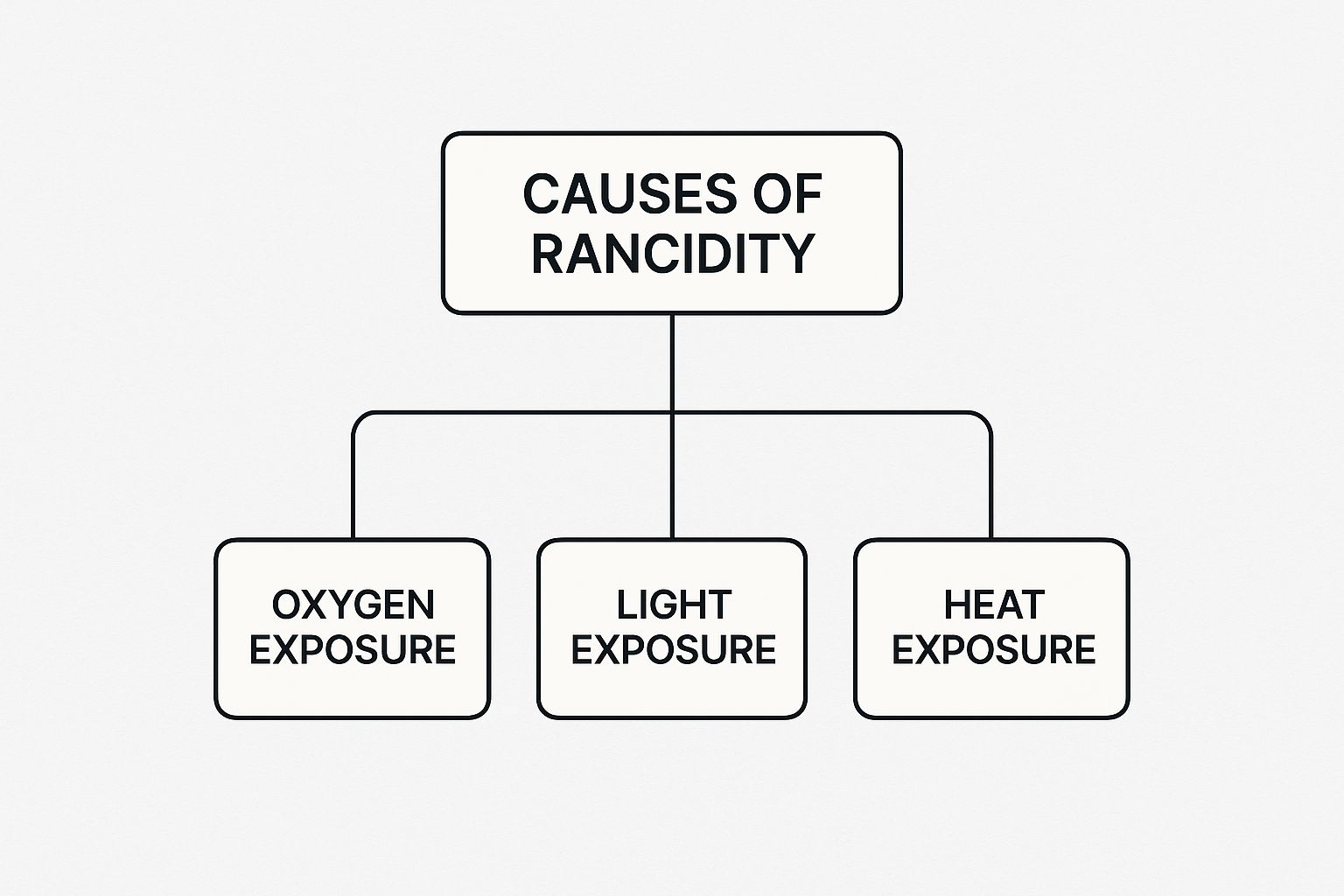
As you can see, these environmental factors all point in one direction: the degradation of your olive oil.
Heat: The Energizer
Heat brings a chaotic energy to the party. When you store olive oil somewhere warm—like right next to your stove or in a cabinet above the oven—its molecules start vibrating much faster. This extra energy turbocharges the rate of oxidation, causing the oil to go rancid at a shocking speed.
Even a little bit of consistent warmth makes a huge difference over time. The perfect storage spot is cool and stable, like a dark pantry or a classic cellar. Heat is a silent partner to oxygen and light, working behind the scenes to make sure their destructive work happens much, much faster.
Time: The Battlefield
And finally, we have time. Time is the battlefield where the other three enemies wage their relentless war. The clock starts ticking from the very moment the olive is crushed into oil. Even with perfect storage, an olive oil’s peak vibrancy will eventually fade.
This is why the harvest date printed on a bottle is so incredibly important. It reveals the oil's true age, not just when it was put in the bottle. Honesty in labeling is everything, as some producers try to hide old, degraded oil. Knowing how to spot fake olive oil is a skill every olive oil lover should possess.
Once you understand these four enemies, you can turn your kitchen from a battlefield into a sanctuary for your liquid gold.
How to Spot Rancid Olive Oil with Your Senses
Forget a chemistry set or a high-tech lab. The best tools you have for sniffing out bad olive oil are the ones you were born with: your nose and your palate. Learning to trust your senses is the key, and it’s easier than you might think to become a confident rancidity detective.
The truth is, many of us have grown so used to the taste of stale, low-quality oils that we mistake it for the real deal. This isn't just a hunch; it's a widespread problem. A shocking report from the University of California-Davis revealed that 69 percent of imported extra virgin olive oils they tested failed to meet international quality standards, with rancidity being a common culprit.
The Smell Test: Your First Powerful Clue
Your first and most immediate clue is the aroma. Pour a little oil into a small glass, cup it in your hands to warm it slightly (this helps release the aromatic compounds), and take a deep, deliberate sniff.
What should you be looking for? Fresh, high-quality olive oil smells green and alive. Think fresh-cut grass, zesty herbs, artichoke, or even a hint of green banana. These are wonderful signs, indicating a healthy oil packed with antioxidants.
Rancid oil, on the other hand, just smells… sad. The most common giveaway is an aroma that’s unmistakably like crayons, wax, or old putty. It might also remind you of stale nuts that have been forgotten in the back of a cupboard for months. If it smells waxy and tired, it is almost certainly past its prime.
The Big Red Flag: What if it has no smell at all? That's also a bad sign. A true extra virgin olive oil should always have a distinct, fresh fragrance. A complete lack of aroma often means it's old, overly refined, or has simply lost all its vibrant character.
The Taste Test: The Unmistakable Verdict
While your nose can tell you a lot, the taste test delivers the final, irrefutable verdict. To really get a feel for it, you'll want to taste it like the pros do. Our guide on how to taste olive oil can walk you through the simple "slurp" technique they use to pick up every nuance.
Go ahead and take a small sip, letting it coat your tongue.
- Rancid Oil: The feeling in your mouth will be greasy and heavy. It often leaves an unpleasant, fatty film behind, and the flavor is completely flat—no freshness, no fruitiness, no life.
- Fresh Oil: A good extra virgin olive oil should have some fruitiness, a pleasant bitterness on the sides of your tongue, and often a peppery kick in the back of your throat. That pungency is a signature of healthy polyphenols and a great sign of freshness.
If the oil tastes stale and greasy without any of those positive bitter or peppery notes, it's turned. Trust what your palate is telling you. It knows.
Cracking the Code on Your Olive Oil Bottle
Think of the label on your olive oil bottle as a secret message. Most of us just scan for a familiar brand and toss it in the cart. But if you know what to look for, that label tells you everything you need to know about the oil's real age and quality.
Learning to read it is the single best way to avoid bringing home a bottle that's already past its prime. It’s a simple skill that transforms you from a casual shopper into a savvy buyer, ensuring you always get the fresh, flavorful oil you're paying for.
The Only Date That Really Matters
Your eyes probably jump straight to the "Best By" date. Here's a pro tip: ignore it. That date is mostly for marketing and is usually stamped two years from the day the oil was bottled, not when it was made. That oil could have been sitting in a giant tank for a year or more before it ever made it into that bottle.
The date you must find is the Harvest Date. Sometimes it's called the "Press Date," and it tells you exactly when the olives were crushed to make the oil. This is the oil’s true birthday, and it's when the countdown on its freshness officially began.
Always look for a recent harvest date, preferably within the last year. If an oil was harvested more than 18 months ago, it’s already on the decline, no matter what the "Best By" date says.
This one piece of information cuts through all the marketing fluff. A producer who is proud of their product will display the harvest date clearly on the label. If you can't find one, that's a major red flag.
A Peek Under the Hood: Quality Numbers
Every now and then, you might see some technical terms on a label, like "Peroxide Value" (PV). Don't let the name intimidate you; it's a surprisingly straightforward concept. The peroxide value is a direct measurement of how much the oil has already oxidized. It's like checking the mileage on a used car—the lower the number, the fresher the oil is and the more life it has left.
For an oil to legally be called "extra virgin," its peroxide value must be below 20 meq O₂/kg according to international standards. A really low PV tells you the oil was made carefully and hasn't been exposed to much oxygen or light. As the oil gets older, that number slowly climbs, warning you that rancidity is setting in. You can dive deeper into these specifics by checking out the international olive oil standards at BHOOC.com.
By focusing on the harvest date and understanding what a low peroxide value means, you're now armed with some serious insider knowledge. You can walk down the grocery aisle and see the bottles for what they really are, allowing you to pick a winner every single time.
The Best Way to Store Your Olive Oil
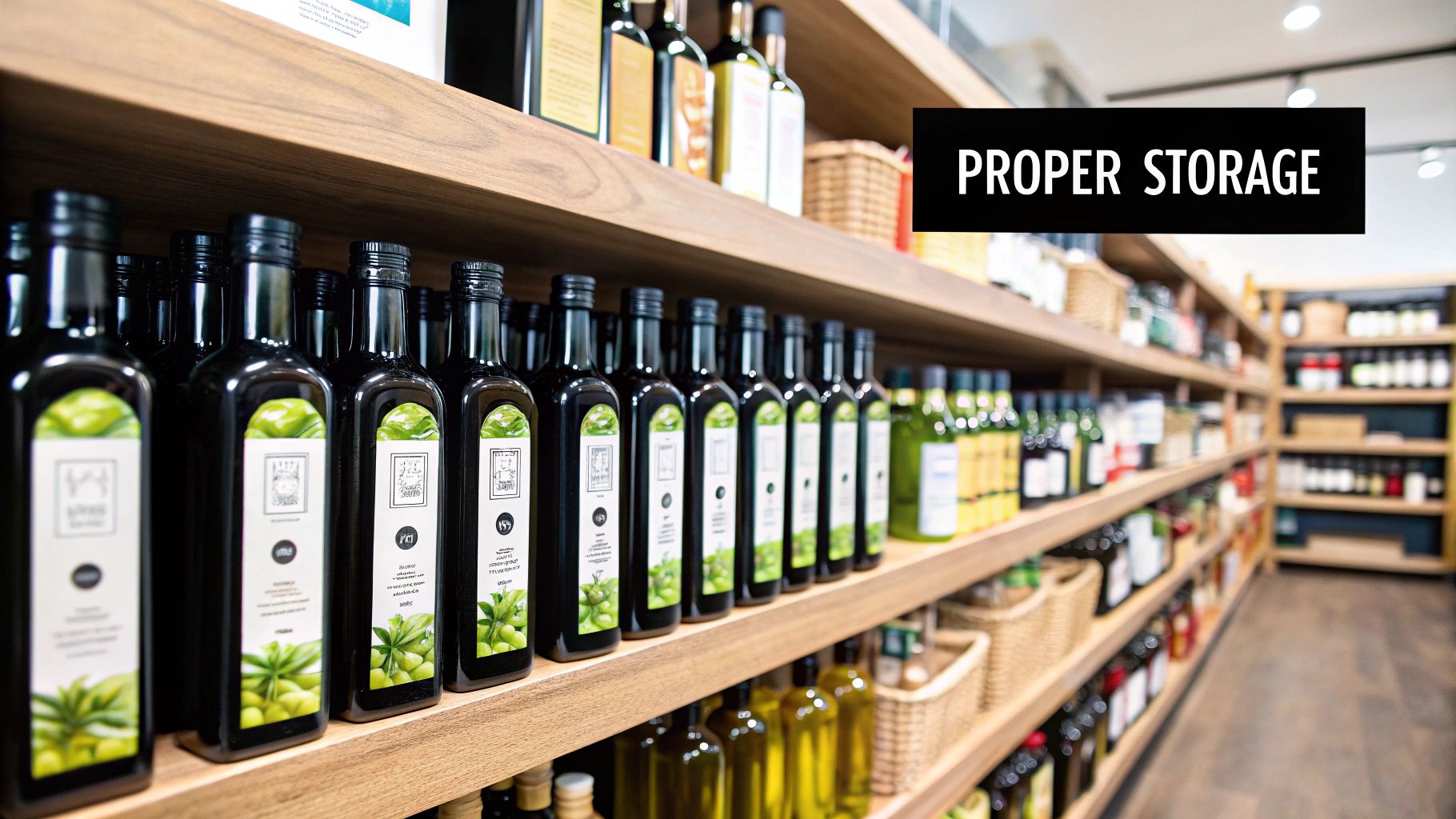
So, we've identified the four culprits behind spoiled olive oil: light, heat, oxygen, and time. Now it’s time to turn that knowledge into action and build an impenetrable fortress around your liquid gold. Thankfully, protecting your oil isn't complicated. It just requires following a few simple, unbreakable rules.
Think of it this way: every good habit you build is another layer of defense. You're actively preserving the vibrant flavor and potent health benefits you paid good money for. Let's make these defensive measures second nature.
Rule One: Defeat the Light
Light is a relentless enemy of freshness. UV rays are basically a fast-forward button for rancidity, kickstarting the chemical decay that ruins your oil. The solution? Simple. Keep it in the dark.
Your first line of defense is the bottle itself. When you're at the store, always reach for olive oils sold in dark, opaque glass (think deep green or brown) or metal tins. These containers are the armor your oil desperately needs. A clear glass bottle sitting on a sunny kitchen counter is a recipe for disaster, and it can turn a beautiful, fresh oil stale in just a few weeks.
Of course, the container is only half the battle. Your oil needs a dark home. A closed kitchen cabinet, a cool pantry, or a cellar are all perfect spots, shielded from both direct sunlight and the ambient light in your kitchen.
Rule Two: Suffocate the Oxygen
Oxygen is the primary fuel for oxidation. The second it makes contact with your oil, the clock starts ticking much faster. Your mission is to cut off its supply as much as possible.
This is probably the easiest rule to follow, yet it's the one people forget most often. The moment you're done pouring, screw the cap back on—immediately and tightly. Don't just leave the bottle sitting open next to the stove while you finish cooking.
Every second that bottle is open, more air seeps in, fueling the very process that will make it go rancid. It's such a small habit, but it makes a massive difference in how long your oil stays fresh and delicious.
A common myth suggests that refrigerating olive oil will keep it fresh longer. While the cold does slow oxidation, it creates other issues. Condensation can form inside the bottle when you take it out, introducing water that can actually accelerate spoilage. For a full breakdown, you can learn more about the specifics of how to store olive oil and see why the pantry almost always wins.
Rule Three: Control the Heat
Heat is like an energy drink for chemical reactions. It makes every molecule in your oil vibrate faster, dramatically speeding up its journey toward rancidity. The single most common mistake people make is storing their olive oil right next to the stove.
It might be convenient, but those constant blasts of heat from your cooktop are slowly cooking the oil right in its bottle. The same goes for storing it in the cabinet above the stove, on top of the refrigerator, or near any other appliance that gives off warmth.
The ideal storage spot is consistently cool, somewhere between 55–65°F (13–18°C). A dark pantry or a cellar is perfect, but any cabinet far from a heat source will do the trick. Mastering these simple, everyday habits is the real secret to extending the life of your olive oil, ensuring every last drop is as delicious as the first.
When It's Time to Part Ways with Your Olive Oil
You've played detective, trusted your nose and taste buds, and the verdict is in: your olive oil has gone rancid. So, what's next? The answer is simple and firm—it's time to toss it.
There's no bringing it back from the brink. Once those vibrant, peppery notes are gone, they're replaced by a flat, waxy, or crayon-like taste that will taint any dish it touches. But the problem isn't just about disappointing flavor.
When you consume rancid oil, you're introducing harmful free radicals into your body, which can contribute to oxidative stress. This completely cancels out the very health benefits you were hoping to get from a quality olive oil in the first place.
Respect Your Food and Your Body
You might stumble upon advice online suggesting you can use old oil for things like conditioning a wooden cutting board. While an oil that's simply old and has lost its flavor might be okay for this, a truly rancid oil has no business being in your kitchen, period. The unpleasant smell will linger, and the same compounds that make it unhealthy to eat aren't doing your kitchen tools any favors either.
The most important takeaway is this: never compromise on the quality of what you eat. Respect your ingredients, protect your health, and insist on the fresh, vibrant flavor that makes extra virgin olive oil so special.
Ultimately, understanding how to keep olive oil fresh is your best defense against waste. With what you know now, you can confidently enjoy olive oil as it was meant to be—alive with flavor, delicious, and incredibly nourishing.
Frequently Asked Questions About Olive Oil
Even with the best storage habits, a few questions always pop up. Here are some quick, practical answers to the most common things people ask about keeping their olive oil fresh and delicious.
Can Rancid Olive Oil Make You Sick?
While a small taste won't send you to the hospital, you really don't want to be eating rancid oil. The immediate problem is flavor—it will make any dish it touches taste awful.
But more importantly, rancid oil is full of free radicals. Over time, consuming these can contribute to oxidative stress and inflammation in the body, which is the exact opposite of what you want from a high-quality olive oil. You're losing all the health benefits and adding something harmful instead.
Does Unopened Olive Oil Go Rancid?
Yes, absolutely. An unopened bottle is safe from oxygen, but it's not immune to heat, light, or the simple passage of time.
Remember, the clock starts ticking from the harvest date, not when it was bottled. Think of it as fresh-pressed juice; it has a finite lifespan. You'll want to use any bottle of olive oil, sealed or not, within 12 to 18 months of its harvest for the best possible quality.
At the end of the day, olive oil is a perishable food. Treat it with the same care you would any fresh produce, and you'll always get to enjoy it at its peak.
How Long Does Olive Oil Last After Opening?
Once you break that seal, oxygen rushes in and the countdown speeds up. To get the best flavor and all the health benefits, you should aim to finish a bottle within 30 to 60 days of opening it.
This is why buying smaller bottles more frequently is a much better strategy than getting a giant jug that will sit in your pantry for months. It might seem economical, but that oil will slowly degrade with every passing day. For a more detailed breakdown, our complete guide to olive oil freshness is a great resource.
What Is the Best Container for Olive Oil?
The container is your first line of defense. Look for olive oil sold in materials that block out its enemies, light and air.
Your best bets are dark green or brown glass bottles, or even better, opaque metal tins. Avoid clear glass bottles at all costs! Constant exposure to light is one of the quickest ways to ruin a perfectly good oil. And of course, always make sure the cap seals tightly.
At Learn Olive Oil, we believe that understanding your ingredients is the key to a better kitchen. From decoding labels to mastering tasting notes, we're here to help you navigate the world of high-quality olive oil with confidence.
Discover the World of Premium Olive Oil at learnoliveoil.com
 Learn Olive Oil
Leave a comment