The different grades of olive oil aren't just fancy names on a label; they're a promise, defined by razor-sharp criteria: how the oil is made, its level of free acidity, and what it tastes and smells like. The undisputed champion, Extra Virgin, is nothing more than cold-pressed olive juice with an acidity below an astonishingly low 0.8%. At the other end of the spectrum, you’ll find refined oils like ‘Pure’ or ‘Light’—oils engineered for a neutral taste and a high smoke point.
Why Olive Oil Grades Matter More Than You Think
Ever stood in the grocery aisle, paralyzed by a wall of olive oil bottles, wondering why one commands twice the price of another? It’s not just clever marketing—it's a story of quality, and the grade on that label tells you everything you need to know.
Think of this guide as your decoder ring. Understanding the grades of olive oil transforms you from a baffled shopper into a confident cook who knows exactly what you’re buying and, more importantly, why.
The Foundation of Quality
At its heart, olive oil is just the juice pressed from olives. But the journey from the ancient tree to your kitchen table is what forges its final grade. It’s not just about the type of olive; it’s about how meticulously the fruit was handled, how it was extracted, and the final, unassailable chemical and sensory results.
This process creates a clear pyramid of quality, which you can see at a glance below.
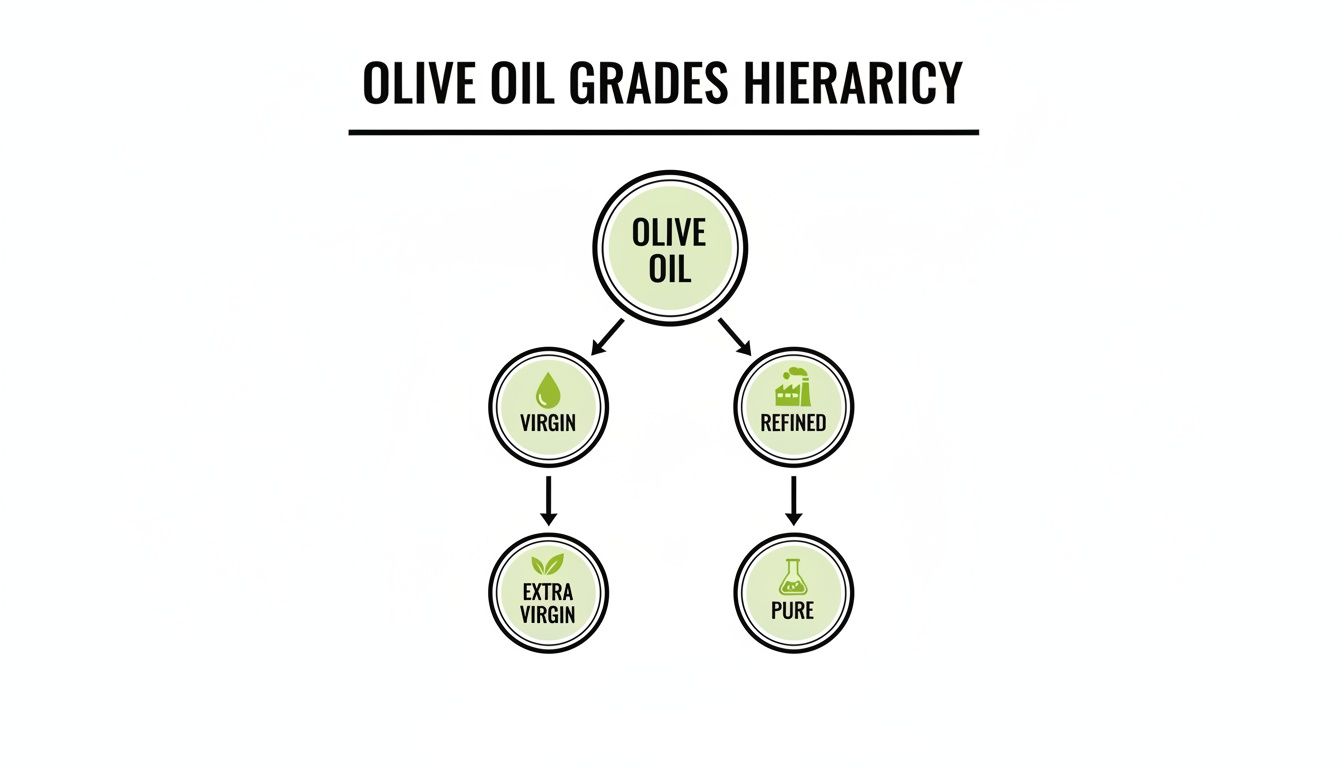
As this chart reveals, the first great divide is between "virgin" and "refined." Virgin oils are made using only mechanical means—no chemicals, no scorching heat. Refined oils, however, are processed to create a neutral base. This single difference has a seismic impact on everything from flavor and aroma to health benefits.
For a quick breakdown of what sets each grade apart, here's a simple comparison of the most common types you'll find on the shelf.
Olive Oil Grades At a Glance
| Grade | Production Method | Free Acidity | Flavor Profile | Best For |
|---|---|---|---|---|
| Extra Virgin | Cold-pressed, no heat or chemicals | Under 0.8% | Fruity, peppery, complex | Finishing, dressings, dipping |
| Virgin | Cold-pressed, no heat or chemicals | Under 2.0% | Milder, with some defects | General cooking, sautéeing |
| Pure Olive Oil | Blend of refined and virgin oils | Under 1.0% | Neutral, very mild flavor | High-heat cooking, frying |
| Light Olive Oil | Blend of refined and virgin oils | Under 1.0% | Very neutral, light color | Baking, frying, high-heat cooking |
This table gives you a solid starting point for deciphering the labels you see in the store. The key takeaway? The less processing an oil undergoes, the more of its natural soul—and health benefits—it retains.
Acidity: A Tiny Number with a Huge Impact
One of the most critical scientific measurements separating a good olive oil from a truly great one is its free fatty acidity. This isn't about how sour the oil tastes; it's a precise chemical measure of how much the oil has begun to break down.
A lower acidity level is a testament to healthier olives, processed with speed and obsessive care.
The tiny difference between 0.8% acidity and 2.0% acidity is what separates a world-class Extra Virgin Olive Oil from a standard Virgin Olive Oil. That one percentage point tells a story of quality from grove to bottle.
This chemical integrity directly dictates the oil’s flavor, aroma, shelf life, and health-boosting properties. An oil with low acidity will be bursting with antioxidants and have those vibrant, complex flavors you expect from a great EVOO. You can learn more about acidity in olive oil and see just how vital it is.
Extra Virgin: The Gold Standard of Olive Oil
If the world of olive oil had a royal family, Extra Virgin Olive Oil (EVOO) would be wearing the crown. You see its name everywhere, and it almost always commands a higher price. But this isn't just marketing hype; it’s a legally defined standard of excellence—a promise of purity and flavor that puts it in a class all its own.
Think of it this way: it’s the difference between freshly squeezed orange juice and juice from concentrate. One is the pure, unadulterated essence of the fruit, bursting with a character that tells you where it came from. The other is a product engineered for consistency, but it loses that straight-from-the-grove soul along the way.
EVOO is that fresh-squeezed juice. It’s made simply by mechanical means—crushing healthy, ripe olives and spinning them to extract the oil. No heat. No chemical solvents. Just pure, unrefined liquid gold. This gentle method, often called "cold-pressing," is designed to protect the very heart of the olive.
The Science of Purity
What truly gives EVOO its top-tier status comes down to two strict, non-negotiable criteria: pristine chemistry and a flawless sensory profile. First, its free fatty acidity must be below 0.8%. This isn't a measure of taste, but a precise chemical marker of the oil’s stability and the quality of the olives used.
Second, it must pass a rigorous taste test by a certified panel of experts, trained to sniff out the slightest imperfection. An oil can have perfect lab results, but if it has any hint of a musty, rancid, or fermented note, it fails. It cannot be called Extra Virgin. Simply put, it has to be perfect. You can learn more about the full meaning of Extra Virgin Olive Oil in our detailed guide.
This uncompromising standard is why EVOO reigns supreme. As the gold standard, Extra Virgin Olive Oil holds an impressive 52.8% market share in Europe alone. Sales are projected to climb from USD 15.6 billion in 2025 to USD 19.8 billion by 2035, showing just how much people value its quality and health benefits. You can explore more about these market trends and olive oil production forecasts in this recent analysis on OliveOilTimes.com.
More Than Just an Ingredient
The real magic of EVOO is what that purity unleashes in your kitchen. Because it's unrefined, it keeps the highest concentration of polyphenols—powerful antioxidants responsible for many of its health perks and that signature peppery kick or pleasant bitterness.
A great EVOO isn't just a cooking fat; it's a finishing condiment. It's that final, transformative touch that turns a simple dish into something unforgettable, adding layers of flavor that salt and pepper alone can only dream of.
Think about how EVOO shines in these moments:
- Drizzled over a Caprese salad: A fruity, herbaceous EVOO elevates the fresh mozzarella and ripe tomatoes, tying everything together in perfect harmony.
- Finishing a grilled steak: A bold, peppery oil cuts through the richness of the meat, adding a complex, spicy counterpoint.
- As a simple dip for crusty bread: Here, the oil isn't just a vehicle for flavor; it is the flavor, showcasing notes of green apple, almond, or fresh-cut grass.
In these cases, using a lesser oil would be like painting a masterpiece with watered-down colors. The quality of the final dish depends entirely on the quality of your ingredients. This is why knowing the different grades of olive oil is so crucial—understanding when to reach for that liquid gold is what separates a good cook from a great one.
Virgin and Pure Olive Oil: The Everyday Workhorses
If Extra Virgin Olive Oil is the star of the show, then think of Virgin and Pure olive oils as the indispensable supporting cast. These are the true workhorses in your kitchen—the bottles you reach for every day when the delicate, nuanced flavors of a pricey finishing oil are simply not what the job requires.
They are not "lesser" oils; they simply have a different purpose. While EVOO is meant to be tasted and savored, these grades are built for the daily grind of cooking. Knowing when to use each one is the secret to getting the most out of every bottle you buy.
Virgin Olive Oil: The Understated Sibling
Virgin Olive Oil is Extra Virgin’s closest relative. It is born from the exact same process: olives are simply crushed and pressed, with no chemicals or high heat involved. It’s still pure, unrefined fruit juice. The key difference lies in slightly less stringent quality standards.
It’s a subtle but vital distinction. While EVOO must have a perfect flavor profile and acidity below 0.8%, Virgin Olive Oil is permitted to have minor sensory flaws and a free acidity level of up to 2.0%. This means its flavor might be a bit milder or less vibrant, but it remains a very good, natural product.
This grade is a fantastic choice for general cooking. It’s perfect for sautéing vegetables or pan-frying chicken, where its solid quality and more wallet-friendly price point make perfect sense. You get a pleasant olive flavor without burning through your expensive finishing oil.
This second-tier grade holds an important spot in the market. Though EVOO gets all the glory, Virgin Olive Oil consistently makes up 20-25% of the premium olive oil segment in major European markets, proving its value as a high-quality cooking oil. You can see more data on these market dynamics at CertifiedOrigins.com. This makes it a key player among the different grades of olive oil.
Pure Olive Oil: The Neutral Champion
Now, let's clear up the confusion around the bottle simply labeled "Olive Oil" or sometimes "Pure Olive Oil." The name can be deceiving. "Pure" doesn't mean it’s in its most natural state—quite the opposite. This grade is a specific blend, engineered for versatility and high-heat cooking.
This oil begins as lampante olive oil, a grade unfit for consumption due to high acidity and off-flavors. It then undergoes a refining process using heat and filters, which strips away all those undesirable qualities. The result is a completely neutral, colorless, and odorless oil. To restore a hint of character, producers will then blend in a small amount (usually 5-15%) of Virgin or Extra Virgin Olive Oil.
This blending creates an oil with a few key advantages for certain kitchen tasks:
- Neutral Flavor Profile: It won't dominate your ingredients, which is exactly what you want when a strong olive taste isn't needed.
- Higher Smoke Point: The refining process makes it much more stable under heat, making it a great choice for frying, deep-frying, and baking.
- Affordability: It's one of the most budget-friendly options, ideal for everyday cooking where you might use a lot of oil.
Since it's a mix of refined and virgin oils, it’s a totally different animal from its unrefined cousins. You can take a deeper look into what makes Pure Olive Oil unique in our companion guide. Ultimately, it serves as the blank canvas of the olive oil world, giving you a reliable cooking fat when robust flavor just isn't the goal.
Refined and Light Olive Oil: Understanding Processed Oils
So, what happens when olives don't quite make the cut for Virgin or Extra Virgin status? Perhaps the fruit was slightly bruised or a little too ripe. They aren't just thrown away. Instead, they enter the world of refinement, where they’re given a new life and a completely different mission in the kitchen.
This is where you find oils labeled simply "Olive Oil," "Light," or "Extra Light." It's easy to dismiss these as "bad" oils, but that's a common misconception. They're just different—engineered for tasks where a neutral flavor and high heat tolerance are more important than a bold, fruity character.
From Flawed to Functional: A Blank Canvas
Think of it like this: an artist might choose a premium, hand-stretched linen canvas for a masterpiece where every brushstroke needs to shine. That’s your EVOO. But for a simple background wash, a smooth, uniform surface is all that's needed. That’s where refined olive oil comes in.
The refining process is a series of steps using heat, steam, and natural clays to correct any flaws. It strips away high acidity, off-flavors, and unwanted colors or aromas, resulting in a perfectly neutral, stable, and clean-tasting oil.
The goal of refinement isn't to destroy the oil, but to transform it. It takes an oil with imperfections and turns it into a reliable cooking medium that’s consistent every single time.
This transformation gives the oil a much higher smoke point, often reaching 400-450°F (204-232°C). This makes it a fantastic choice for searing, sautéing, and frying—jobs where a delicate EVOO would simply burn, wasting its beautiful flavor and your money. Its neutral taste also means it won’t overpower the other ingredients in your dish, which is exactly what you want for baking or deep-frying.
Demystifying "Light" and "Extra Light"
Here's where one of the biggest myths in the olive oil aisle lives. When you see "Light" or "Extra Light" on a bottle, it's easy to assume it has fewer calories or less fat. That's some clever marketing, but it's completely misleading.
Let's set the record straight: all olive oils have the exact same number of calories—about 120 per tablespoon. The term "Light" has nothing to do with health or diet. It refers exclusively to two things:
- Light in Color: The refining process removes the deep green and golden pigments, leaving a pale, straw-colored oil.
- Light in Flavor: All the distinct olive notes are gone, resulting in an almost tasteless product.
This quality makes it a go-to for bakers who want the monounsaturated fats of olive oil without any of the taste, or for frying delicate foods like tempura. Refined olive oil, often blended with just a touch of virgin oil for color and labeled simply as "Olive Oil," is a true workhorse. In fact, it's so practical that it makes up about 20-25% of the olive oil consumed in the European Union.
It's simply a different tool for a different job. While these refined oils are part of the olive oil family, they are worlds away from another processed product called pomace oil. You can check out our guide on pomace oil vs olive oil to understand that important distinction.
How To Pair Olive Oil With Your Cooking
All this talk about acidity and production methods is fascinating, but what does it actually mean for your dinner tonight? This is where the oil meets the pan. You don't need a culinary degree to use olive oil like a pro. You just need to grasp one simple concept: treat olive oil as an ingredient, not just a cooking fat.
Think of it like the salt in your kitchen. You have your standard table salt for boiling pasta water, and then you have that beautiful, flaky sea salt you sprinkle over a finished dish. You wouldn't waste the expensive stuff in boiling water, right? And you'd never get that satisfying crunch from plain old table salt. Each has its job. Olive oil grades work exactly the same way.
The secret is all about matching the intensity of the oil to the intensity of the dish. A bold, peppery EVOO can elevate a hearty steak but will completely steamroll a delicate piece of fish. On the other hand, a neutral, refined oil is perfect for frying because it gets out of the way and lets your ingredients be the star. It's all about creating harmony.
The Finishing Touch: Extra Virgin Olive Oil
So, when should you reach for that bottle of liquid gold? The answer is simple: anytime the oil's flavor is meant to be a star of the show. A high-quality EVOO is at its absolute best when it isn't exposed to prolonged, intense heat, which can dull its complex aromas and degrade those healthy polyphenols.
This is your finishing oil, the final flourish that turns a good dish into a great one. Don't be shy about using it for:
- Drizzling and Dipping: This is where EVOO truly sings. A fruity, robust oil drizzled over a warm bowl of soup, creamy hummus, or a simple plate of fresh mozzarella and tomatoes is nothing short of transformative. It’s also the perfect partner for a loaf of crusty bread.
- Salad Dressings: Forget the store-bought stuff. A simple vinaigrette made with a quality EVOO, a splash of vinegar, and a pinch of salt lets the oil's unique character—be it grassy, nutty, or spicy—define the entire salad.
- Finishing Cooked Dishes: Just before serving, a final swirl of EVOO over grilled fish, roasted vegetables, pasta, or even a perfectly cooked steak adds a layer of richness and peppery complexity that cuts through fat and brightens every single bite.
Think of your best EVOO as a condiment, not just a cooking medium. It’s the last thing you add to bring all the other flavors into focus, just like a squeeze of fresh lemon or a sprinkle of flaky salt.
Everyday Cooking: The Role of Virgin and Pure Oils
Now, let's talk about the daily grind in the kitchen. For general sautéing, pan-frying, and roasting, you need a reliable workhorse. This is where Virgin Olive Oil and the grade simply labeled "Olive Oil" (often called Pure Olive Oil) step in.
These oils have a much more neutral flavor profile and are more budget-friendly, so you won't feel guilty using them for everyday tasks. They still deliver the heart-healthy monounsaturated fats that make olive oil such a smart choice, but without the premium price tag of a top-shelf EVOO. Virgin oil will have a mild olive flavor, while "Olive Oil" will be almost completely neutral.
High-Heat Applications: Using Refined Oils
For those times you really need to crank up the heat for deep-frying, searing, or even baking, "Light" or "Extra Light" olive oil is your best friend. And remember, "light" only refers to the oil's color and flavor, not its calorie count!
Because these oils have been refined, their smoke point is significantly higher, often climbing above 400°F. This stability is crucial. Frying with a delicate EVOO would not only be a waste of money, but the oil would break down, creating bitter flavors and a kitchen full of smoke. The neutral taste of light olive oil also ensures it won't interfere with the flavor of your delicious baked goods or crispy fried foods.
To make things even easier, we've put together a quick-reference guide. Keep this chart handy, and you’ll never second-guess which bottle to grab again.
Your Ultimate Olive Oil Pairing Guide
This chart is your cheat sheet for matching the right olive oil to the right dish, ensuring you get the best flavor and performance every time you cook.
| Culinary Use | Recommended Grade | Why It Works | Example Dishes |
|---|---|---|---|
| Finishing & Drizzling | Extra Virgin (EVOO) | Adds a burst of fresh, complex flavor as the final touch. | Drizzling on soups, grilled steak, bruschetta, dipping bread. |
| Salad Dressings | Extra Virgin (EVOO) | Its robust character is the star of any vinaigrette. | Classic balsamic vinaigrette, lemon-herb dressing, Caesar dressing. |
| Low-Heat Sautéing | Virgin or EVOO | Gentle heat preserves some flavor without burning the oil. | Sautéing garlic and onions, wilting spinach, cooking delicate fish. |
| General Roasting | Virgin or Pure Olive Oil | Provides good heat transfer without a premium cost. | Roasting potatoes, carrots, chicken, or other vegetables. |
| High-Heat Frying | Light or Refined Oil | High smoke point prevents burning and off-flavors. | Frying chicken, searing scallops, making French fries. |
| Baking | Light or Refined Oil | Its neutral flavor won’t overpower cakes, cookies, or bread. | Olive oil cakes, focaccia, muffins, and quick breads. |
By matching the grade to the task, you’re not just cooking smarter—you’re getting the most value and flavor out of every single drop.
Decoding the Label and Storing Your Oil
You've figured out which grade of olive oil you need. But your job's not done yet. Standing in the grocery store aisle can feel like navigating a minefield of beautiful labels and persuasive marketing. Learning to see past the pretty pictures to find the truly important details is what separates a novice from a savvy olive oil buyer.
It’s easy to get distracted by romantic images of sun-drenched groves. My advice? Ignore all of that and turn the bottle around. Think of yourself as a detective looking for clues of freshness and authenticity. They're all there—if you know what to look for.
Reading the Label Like a Pro
Your goal is simple: find the freshest, highest-quality oil on that shelf. Some information is just marketing fluff, but a few key details are non-negotiable.
Here’s what you should zero in on:
- The Harvest Date: This is it—the single most important date on any bottle of extra virgin olive oil. Remember, olive oil is a fruit juice, and fresh is always best. A recent harvest date means you're getting peak flavor and the most health benefits.
- Best-By Date: Take this one with a grain of salt. It’s often set two years after the oil was bottled, not harvested. An old oil can sit in a tank for a year, get bottled, and still have a "fresh" best-by date. The harvest date tells the real story.
- Country of Origin: Don't be fooled by vague phrases like “Product of Italy.” This can simply mean olives from several countries were blended and bottled there. Look for specific estates or regions—that's a sign the producer is proud of their specific terroir.
A producer who puts a recent harvest date and a specific place of origin right on the label isn't just selling oil; they're selling confidence. It tells you they stand behind their product and have nothing to hide.
Spotting Seals of Quality and Smart Packaging
Beyond the dates, keep an eye out for official seals. Certifications like PDO (Protected Designation of Origin) or PGI (Protected Geographical Indication) are a big deal. They are legally-enforced guarantees that your oil is from a specific place and was made according to strict, high-quality standards.
Finally, you really can judge an oil by its bottle. Light is a major enemy of olive oil, causing it to degrade and lose its flavor fast. Any producer worth their salt will bottle their oil in dark green or brown glass, or even an opaque tin. That clear glass bottle might look beautiful, but it's a huge red flag that the oil inside is not being protected.
Once you get that liquid gold home, your job is to shield it from its three biggest foes: heat, light, and air. Proper storage is every bit as important as smart shopping. These simple habits will ensure your oil tastes great from the first pour to the last. For a deeper dive, check out our guide on the best practices for olive oil storage to keep your oil in perfect condition.
A Few Lingering Questions About Olive Oil
Even after you've got a handle on the different grades, a few questions always seem to pop up. Let's clear the air on these common myths so you can feel like a pro in the olive oil aisle.
So, Can I Actually Fry with Extra Virgin Olive Oil?
Yes, you can! This is probably one of the biggest misconceptions about olive oil. A good quality EVOO has a smoke point somewhere between 375-410°F (190-210°C). That’s more than high enough for most home cooking, like pan-frying chicken or sautéing vegetables.
Why the hesitation, then? It really comes down to two things: cost and flavor. You're paying a premium for that beautiful, peppery taste, and some of that character does fade with high heat. But for everyday cooking, a solid EVOO is perfectly safe and adds a fantastic layer of flavor.
Does 'Light' Olive Oil Have Fewer Calories?
Nope, not a single calorie less. This is just a clever marketing term that trips a lot of people up. All olive oils, no matter the grade, have the same amount of calories—about 120 calories per tablespoon.
When a label says "Light" or "Extra Light," it’s talking about the flavor and color, not the fat content. The refining process strips out the robust taste and deep color, leaving behind a very neutral oil. It’s a choice for your palate, not your diet.
Think of it this way: 'Light' describes the oil's personality—mild taste, pale color—and has absolutely nothing to do with its nutritional stats. It's a key distinction to remember at the grocery store.
What's the Single Most Important Date on an EVOO Bottle?
If you only look for one thing, make it the 'Harvest Date.' It's the most honest indicator of freshness. Olive oil is just like a fruit juice; it's at its absolute best right after it's pressed. This date tells you exactly when that happened.
Always grab the bottle with the most recent harvest date. That’s how you get an oil packed with the most flavor, aroma, and all those healthy polyphenols. A "best by" or "expiration" date can be misleading, as it’s often stamped two years from the bottling date, not the harvest date. An old oil can easily be hiding behind a future expiration date.
Here at Learn Olive Oil, we're passionate about helping you understand these nuances. It's what allows you to choose better, cook smarter, and truly enjoy everything olive oil has to offer. To dive deeper and explore more of our guides, come visit us at https://learnoliveoil.com.
 Learn Olive Oil
Leave a comment