Let's shatter the biggest myth right now. Acidity in olive oil has nothing to do with a sour taste. It's a chemical fingerprint—invisible to your tongue—that reveals the hidden story of the olive's journey from the tree to the bottle. It is the single most powerful clue to an oil’s quality.
The Most Misunderstood Secret of Great Olive Oil
Imagine you’re a detective arriving at a crime scene. Your first move isn't to guess what happened. It’s to hunt for clues—fingerprints, footprints, anything that tells the story of what went down. In the world of olive oil, acidity is your number one clue. It’s not a flavor; it’s the forensic evidence of the oil’s entire life story.
This one number speaks volumes. It reveals whether the olives were pristine and healthy or bruised and broken. It whispers secrets about whether they were rushed to the mill in hours or left to decay for days, their precious essence slowly breaking down.
The True Meaning of Low Acidity
When you see a low acidity number, it’s not promising a certain flavor. It is guaranteeing something far more profound: purity and freshness.
- It means the fruit was flawless: Olives picked at peak ripeness, free from bruises and insect bites, naturally surrender oil with vanishingly low acidity.
- It proves the processing was lightning-fast: The great producers know that time is the enemy of quality. They crush their olives mere hours after picking, locking in that grove-fresh character.
- It shows obsessive care: From the grove to the bottle, every step was managed with military precision to prevent the oil from degrading.
Think of acidity as the oil’s ‘freshness score.’ A low score is a badge of honor, proof that the olives were handled with masterful care. A high score is a red flag signaling damage, delays, and decay.
Why This Metric Is the Gatekeeper of Greatness
This chemical measurement is so critical that it acts as the official guardian of olive oil’s most sacred category. An oil cannot legally be called "Extra Virgin Olive Oil" unless its free fatty acidity falls below the strict international threshold of 0.8%. It is a black-and-white rule. This is just one of many details people often get wrong, and you can uncover more common olive oil myths to become a savvier buyer.
Ultimately, the world's best olive oil artisans are obsessed with one thing: chasing that low acidity number. Not because of how it tastes, but because of the powerful story it tells. It’s their transparent report card, proving their commitment to quality from a sun-drenched grove all the way to your kitchen.
What Acidity in Olive Oil Actually Measures
So, what are we really measuring when we talk about acidity in olive oil? It has nothing to do with a sour or tangy flavor—a widespread misconception. The truth is far more elemental.
Picture an olive oil molecule as a perfectly built structure. The overwhelming majority of this structure consists of stable molecules called triglycerides—these are the strong, intact building blocks. The acidity measurement is simply a chemical test that counts how many of those blocks have broken apart.
These broken pieces are known as Free Fatty Acids (FFAs). The percentage you see on a lab report is the weight of these FFAs relative to the oil's total weight. A higher number means more of the oil's structure has disintegrated. It's a brutally honest measure of freshness and integrity.
What Causes Acidity to Rise?
This molecular collapse doesn't happen by accident. It is almost always the result of damage, delay, or sloppiness somewhere between the olive grove and the bottle.
Several key culprits can send acidity levels skyrocketing:
- Damaged Fruit: Olives bruised by rough harvesting, attacked by pests, or broken in transport begin to decay instantly. This damage unleashes enzymes that immediately start breaking down the stable triglycerides.
- Long Waits: The clock starts ticking the second an olive leaves the branch. The longer the fruit languishes in piles before being crushed, the more time those destructive enzymes have to create free fatty acids. Speed is everything.
- Improper Storage: Once pressed, the oil remains vulnerable. Exposing it to its mortal enemies—heat, light, and oxygen—accelerates this breakdown.
This is why understanding what olive oil is made of at its molecular core is so revealing. The acidity level tells a story. It exposes exactly how much care was taken to protect the oil's natural structure from the very beginning.
Acidity is the fingerprint left on the oil. It’s an undeniable record of its journey, revealing every bruise, every delay, and every shortcut. A low number is proof of a clean, masterful process.
Acidity's Impact on Price and Quality
This measurement isn't just a technicality for chemists; it's the critical factor that determines an oil's grade and, consequently, its price. The entire olive oil industry is built upon strict standards based on these FFA levels.
For an oil to earn the coveted Extra Virgin Olive Oil (EVOO) classification, its free acidity must be no higher than 0.8%. That’s the benchmark for excellence.
Oils with acidity up to 2% are relegated to the "virgin olive oil" category. Anything higher is deemed lampante, a low-grade oil considered unfit for human consumption until it undergoes harsh industrial refining.
The price gap between these grades is enormous. For example, in Spain, extra virgin olive oil might fetch around €440 per 100 kg, while virgin oil is closer to €399, and lampante can plunge to €360. This chasm shows just how much that one number dictates value in the global market.
When you understand what acidity in olive oil truly measures, you realize it's not some intimidating scientific term. It's simply a report card on quality.
How Acidity Separates Good Oil from Great Oil
As you stand in the olive oil aisle, confronted by a sea of bottles, you should know that one of the most powerful signs of quality is a number you'll almost never see printed on the label: its acidity level. In the olive oil universe, acidity isn't about taste—it's a precise chemical scorecard. This single metric draws the stark line between an exceptional oil and an ordinary one.
Think of it this way: low acidity is a sign that everything went right. The olives were perfect, harvested gently, and pressed immediately. High acidity tells a story of bruising, delays, or damage, where the oil has begun to decay. It’s the clearest indicator of purity and freshness you can find.
The Official Grades of Olive Oil
The standards that define whether an oil is "Extra Virgin" or something lesser are set by bodies like the International Olive Council (IOC). These global benchmarks are built almost entirely around the level of free fatty acidity, creating an undeniable quality pyramid.
This isn't a subjective judgment call from a tasting panel. It's a cold, hard chemical analysis performed in a lab.
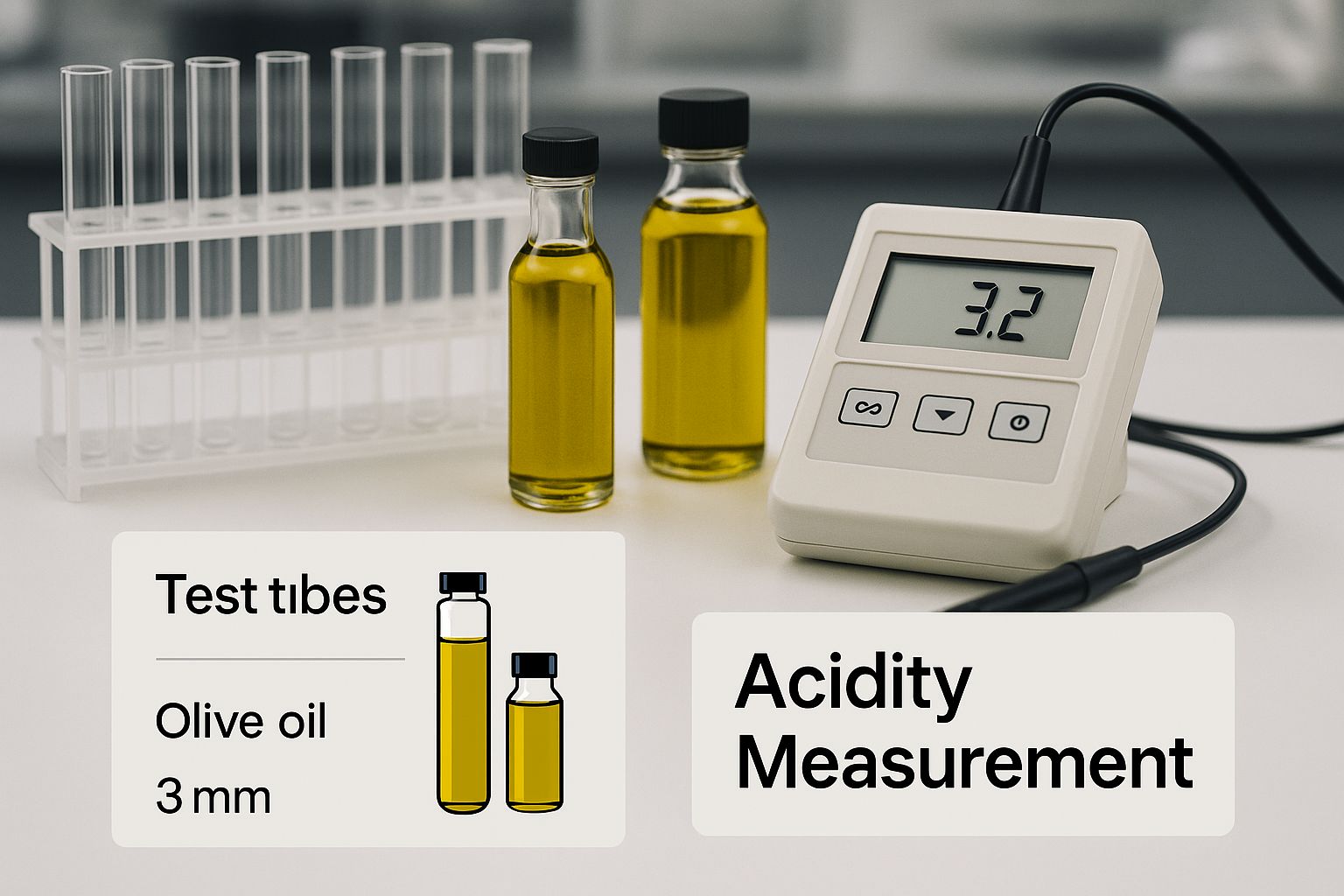
As you can see, grading an oil is a scientific process. The results of these tests determine what an oil can be called and how it can be sold.
Let’s examine how these grades stack up.
Olive Oil Grades Explained by Acidity Level
This simple table breaks down the official classifications. It shows you exactly how that percentage of free fatty acids determines the grade you see on the label.
| Olive Oil Grade | Maximum Acidity (% Oleic Acid) | What It Means for Quality |
|---|---|---|
| Extra Virgin Olive Oil | ≤ 0.8% | This is the pinnacle of quality. It comes from flawless, healthy olives pressed almost immediately. To earn this title, it must also pass strict sensory tests for perfect flavor and aroma. |
| Virgin Olive Oil | ≤ 2.0% | A decent, unrefined oil, but it has detectable flaws. Perhaps the fruit wasn't perfect, or there were delays in processing. It's still pure, just not pristine enough for the "Extra Virgin" crown. |
| Lampante Virgin Oil | > 2.0% | You'll never see this on a shelf for direct sale. Its high acidity and unpleasant flavors mean it's deemed unfit to eat as is. It must be sent to an industrial refinery to be stripped of its defects. |
As you can see, the chasm between a world-class oil and one requiring industrial intervention is just a few percentage points. This highlights how critical fanatical attention to detail is, from grove to bottle.
The Problem with "Pure Olive Oil"
So what about those bottles labeled "Olive Oil," "Pure Olive Oil," or "Light Olive Oil"? Where do they fit in? This is where the waters get muddied for consumers. These oils are almost always a blend of refined oil and a tiny amount of virgin olive oil.
The term "Olive Oil" on a label almost always means you are buying a refined product. It’s an oil that failed the test for "Extra Virgin" and had to be chemically treated to remove its off-flavors and high acidity.
The refining process uses heat and chemicals to strip out every flaw, but it’s a scorched-earth policy. It also obliterates the good stuff—the vibrant flavor, the intoxicating aroma, and most of the healthy antioxidants. Diving into the full meaning of Extra Virgin Olive Oil reveals just how vast the difference is.
While refined oil is fine for high-heat cooking where you want no flavor, it is a ghost of a true EVOO, lacking its character and health benefits. The acidity level is the very first clue that separates them.
Why Low Acidity Matters for Flavor and Health
If you can’t taste acidity, why on earth should you care about it? It sounds like an obscure detail for chemists, not for someone who just wants a delicious, healthy oil.
But here is the secret the best producers have known for generations: that little number is a promise. It’s a promise of quality that you can taste and feel.
Low acidity isn't just a figure on a lab report; it’s the direct result of a process that protects both flavor and health. Remember what causes acidity to rise—bruised fruit, long delays, and sloppy handling. Those are the very same things that create disgusting, off-flavors.
An oil with high acidity is far more likely to taste muddy, musty, or rancid. So, while you can't taste the acidity itself, you absolutely taste its consequences.
The Inseparable Link Between Acidity and Antioxidants
Beyond flavor, low acidity is your best guarantee of nutritional power. The true magic of a great extra virgin olive oil lies in its payload of polyphenols. These are the potent antioxidant compounds responsible for the oil’s peppery kick, its pleasant bitterness, and its famous anti-inflammatory health benefits.
But here’s the catch: these remarkable compounds are incredibly delicate.
They are the first casualties when olives are damaged or when the oil is exposed to its enemies: oxygen and heat. The same carelessness that sends free fatty acid levels soaring also demolishes the polyphenol content.
An olive oil with low acidity is a signal that its precious cargo of healthy compounds has been successfully protected. Chasing a low acidity number isn’t about the number itself; it's about ensuring you get an oil that delivers the powerful health benefits you’re paying for.
Flavor and Health Are Two Sides of the Same Coin
Think of it this way: those vibrant, peppery, and slightly bitter notes in a world-class olive oil? That's the taste of health. Those sensations are the direct result of high levels of beneficial compounds like oleocanthal.
- Low Acidity Oil: Points to healthy olives and meticulous processing. This careful handling preserves polyphenols, creating bold, complex flavors and delivering potent health benefits.
- High Acidity Oil: A red flag for damaged olives and poor handling. This negligence destroys polyphenols, resulting in bland or rancid flavor while stripping the oil of its life-giving properties.
Ultimately, you want an oil that is bursting with vitality. A low acidity in olive oil is the clearest chemical proof you can get that the oil in your bottle is exactly that. It’s a guarantee that the vibrant, nutritional power locked inside the fresh olive completed its journey all the way to your table.
If you want to go deeper, understanding olive oil's polyphenol content is the next vital step. It’s the difference between an oil that merely cooks and one that truly nourishes.
Decoding the Label to Find a Low Acidity Oil
Picture yourself in the grocery aisle, facing a wall of olive oil. The green glass and rustic labels all seem to whisper promises of quality. How do you find the hidden gem—the one with vibrant flavor and the low acidity you now know to look for—when that number is almost never on the bottle?
The secret isn’t in finding a specific percentage. It's in learning to read the clues the producer leaves for you. You must become a detective, seeing past the marketing slogans designed to distract you.
First and foremost: your eyes should immediately scan for the harvest date. This is, without question, the most crucial detail on any bottle. Do not be fooled by the "best by" date; that’s often just an arbitrary two-year guess from the bottling date. The harvest date tells you when the olives were actually picked—the only true measure of freshness. An oil without a harvest date has a secret it doesn't want to share.
What to Look For and What to Ignore
Once you've found a bottle with a recent harvest date, you can piece together the other clues. Some are vital signs of quality, while others are mere noise.
-
Ignore "First Cold Press": Honestly, this term is mostly marketing fluff. Virtually all real extra virgin olive oil is made this way. Seeing it on a label tells you nothing special about the oil's quality or its acidity in olive oil. It's a relic from a bygone era.
-
Look for Seals of Approval: Keep an eye out for official certifications like PDO (Protected Designation of Origin) or PGI (Protected Geographical Indication). These are not just fancy stickers; they are legally binding promises. They guarantee the oil comes from a specific region and was produced under strict rules that naturally lead to lower acidity.
-
Demand Dark Glass: Any serious producer knows that light is olive oil’s mortal enemy. Oil bottled in dark glass or an opaque tin is a non-negotiable sign that the maker cares about protecting their product. Light degrades oil, causing its acidity to rise. Clear bottles are a giant red flag.
While the exact acidity number is rarely printed on the label, these clues—harvest date, protective packaging, and certifications—are reliable proxies. They empower you to make an educated choice and bring home an oil that is genuinely extra virgin in quality.
Making sense of these details is your best strategy for finding a top-notch product. For a deeper dive, our guide to understanding olive oil labeling breaks down every term you might encounter. Armed with this knowledge, you can walk into any store and confidently pick out an oil that delivers on freshness, flavor, and the low acidity that defines true quality.
The Global Quest for Ultra-Low Acidity
From the ancient, gnarled groves of Andalusia to the sun-drenched hills of Crete, the world’s finest olive oil producers are locked in a quiet, relentless contest. The goal is simple, but achieving it is anything but: pushing the acidity in olive oil as low as humanly possible.
This isn't just for bragging rights. It’s a high-stakes economic game where a fraction of a percentage point can make or break a harvest's value. Acidity has become the universal language of quality, a single, unforgiving number that sets international trade prices and shapes the reputations of entire brands.
A Market Driven by Quality
As consumers have grown more sophisticated, they've begun to look past generic "olive oil." They are now actively seeking the vibrant flavor and well-documented health benefits that only true Extra Virgin Olive Oil can provide. This seismic shift has forced producers to invest millions in perfecting their techniques.
You can see this obsession with low acidity at every stage of modern production:
- Precision Harvesting: The days of aggressively beating olives from trees are over. Today, gentle mechanical shakers coax the fruit from branches to prevent the bruising that starts the clock on decay.
- Rapid Milling: Producers literally race against time. Many premium estates now mill their olives within an astonishing four to six hours of picking to halt any degradation in its tracks.
- Advanced Extraction: State-of-the-art, oxygen-free milling systems are now the gold standard for high-end oils, protecting them from oxidation and preserving both low acidity and precious antioxidants.
In the multi-billion dollar olive oil market, controlling acidity isn't just a best practice—it's the bedrock of the entire premium industry. It is the key to delivering the quality that a new generation of consumers demands.
The Economic Power of a Single Number
This intense focus on quality is a massive economic engine. In 2022, global olive oil production stood at around 2.74 million tonnes, with giants like Spain and Italy setting an incredibly high bar. Their entire business model hinges on keeping acidity low enough to meet the strict EVOO standard.
This is especially true in Europe, where over 60% of the world's olive oil is consumed. The global market, valued at a staggering USD 8.96 billion in 2024, is built on the promise of a healthy, flavorful product—a promise that high acidity shatters. You can dig deeper into the global olive oil market trends to see just how significant this is.
This relentless quest for lower and lower acidity is shaping the future of the industry, ensuring the bottle of EVOO in your kitchen is the product of immense care, passion, and investment.
Common Questions About Olive Oil Acidity, Answered
Let's tackle a few of the questions that always come up when discussing acidity in olive oil. Getting these straight will make you a much smarter shopper.
Can You Actually Taste Acidity in Olive Oil?
Not a chance. It’s a complete myth that acidity is a flavor you can taste. Free fatty acidity is a chemical parameter that can only be measured in a laboratory.
If you ever try an olive oil that tastes sour or vinegary, you are not tasting acidity. You are experiencing a major defect, likely from olives that began to ferment before they were pressed. That's a sign of terrible production, not a high acidity level.
Does "Light" Olive Oil Mean It Has Less Acidity?
This is one of the most misleading marketing terms on the shelf. When you see "light" on a label, it refers to a lighter flavor and color—not fewer calories or lower acidity.
In reality, "light" olive oil is a refined product. It began its life as a very poor-quality oil with high acidity and off-flavors. It was then sent to an industrial plant and treated with heat and chemicals to strip away all defects, along with its color and taste.
While the refining process does lower the final acidity number, it also obliterates the healthy compounds and delicious flavor that make extra virgin olive oil so special. A true extra virgin olive oil achieves its low acidity naturally, through quality and care.
So, Is a Lower Acidity Level Always a Good Thing?
Yes, absolutely. When you're searching for high-quality extra virgin olive oil, a lower acidity level is one of the strongest indicators of a well-made, fresh, and healthy product.
The international standard for EVOO demands an acidity of 0.8% or less. But the truly exceptional, award-winning oils often boast acidity levels well below 0.3%. A number that low is a testament to perfection—from harvesting flawless fruit at the ideal moment to expert milling and careful storage.
At Learn Olive Oil, we believe that understanding these details transforms how you shop for, taste, and enjoy this incredible food. Our expert guides are designed to help you discover the world of premium olive oil with confidence. Start your journey and elevate your appreciation for this liquid gold!


Leave a Reply