Yes, you can fry in olive oil. And once you discover the truth, you'll likely never go back to those pale, lifeless seed oils again. For years, a persistent myth has haunted kitchens worldwide—a whisper that this liquid gold is fit only for drizzling on salads. But that whisper is wrong. Dangerously wrong.
The reality? High-quality olive oil is not only perfectly safe for frying, it's the healthier, more flavorful, and frankly, the smarter choice.
The Surprising Truth About Frying With Olive Oil
Let's shatter a myth right now. For decades, home cooks have been fed a lie: that olive oil’s smoke point is too low for high-heat cooking, a "fact" that warns of toxic fumes and ruined meals. This idea isn't just slightly off the mark—it’s a complete misunderstanding of what makes a great frying oil.
You see, the real secret to a superior frying oil isn't its smoke point. Not by a long shot. The true measure of an oil’s courage under fire is its oxidative stability—a fancy term for how well it resists breaking down when the heat is on. And in this arena, high-quality olive oil is an undisputed champion.
If you find this surprising, consider the Mediterranean diet, lauded as one of the healthiest on earth. Do you think they shy away from frying? For centuries, they've been frying everything from fish to vegetables in olive oil. This isn't a modern health fad; it's a time-tested culinary wisdom built on one simple, powerful fact: olive oil works beautifully in a hot pan.
What gives it this rock-solid stability? It’s all in its natural chemical armor.
- Monounsaturated Fats: Olive oil is overwhelmingly rich in oleic acid, a monounsaturated fat that is, at a molecular level, a fortress against heat. It’s simply more stable than the fragile polyunsaturated fats found in most seed oils.
- Antioxidant Bodyguards: Extra virgin olive oil comes armed with a private security force: potent antioxidants called polyphenols. These compounds don't just sit there; they actively defend the oil, protecting it from breaking down under thermal assault.
- Flavor Infusion: When you fry with a good olive oil, you aren't just cooking; you're transforming. You're adding a layer of rich, nuanced flavor that a bland, soulless vegetable oil could never dream of delivering.
Much of the fear surrounding this topic stems from flimsy information repeated ad nauseam. To see just how pervasive this misinformation is, it's worth exploring the most stubborn olive oil myths that continue to mislead home cooks. We're here to give you the facts, so you can confidently reach for that bottle of olive oil for nearly all your frying adventures.
Why Smoke Point Isn't the Whole Story
For years, smoke point has been preached from the gospel of every kitchen blog and celebrity chef show. It's the one number they've all pointed to as the absolute law—the final word on an oil's fitness for frying. But what if this single-minded obsession has been leading us all down the wrong path?
The truth is, an oil's smoke point is merely a visual signal—the temperature at which you first see that tell-tale wisp of blue smoke. It is not some invisible tripwire where the oil suddenly becomes toxic. The real, and profoundly more important, measure of an oil's mettle is its oxidative stability.
This is the key that unlocks why olive oil reigns supreme in the frying pan. Imagine it this way: a Formula 1 race car can hit an incredible top speed (a high smoke point), but it’s a delicate, finicky machine. An all-terrain armored vehicle, however, is built for brutal punishment. It can withstand the most hostile conditions without falling apart.
Extra virgin olive oil is that armored vehicle.
The Real Powerhouse: Oxidative Stability
Oxidative stability is an oil’s innate ability to resist breaking down under stress. An oil with high stability holds its chemical structure, retains its nutrients, and refuses to form harmful compounds, even at typical frying temperatures. This is where extra virgin olive oil doesn’t just compete—it completely dominates, leaving many highly-refined oils looking weak and defenseless.
This infographic cuts through the noise and reveals the truth about olive oil's performance in your kitchen.
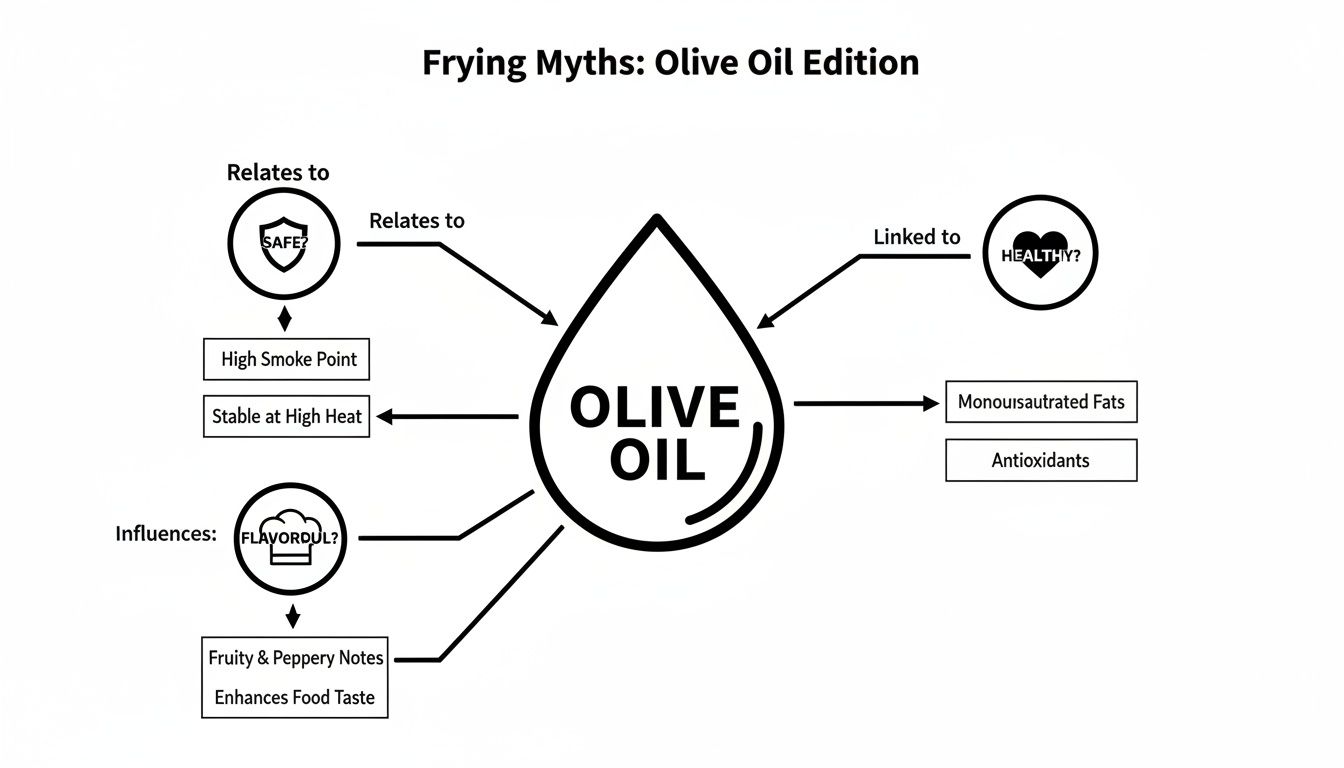
As you can see, olive oil's legendary status is built on a foundation of safety, health, and flavor—three crucial pillars that the smoke point metric alone simply cannot support.
What gives EVOO this incredible battlefield endurance? It deploys two secret weapons:
- A Sturdy Fat Structure: It’s composed primarily of monounsaturated fats. From a chemical standpoint, these fats are remarkably stable and far less prone to reacting with oxygen when heated.
- Antioxidant Bodyguards: It's teeming with natural defenders called polyphenols. These compounds act as tiny, vigilant bodyguards, actively neutralizing threats and protecting the oil from heat-induced damage.
This one-two punch is what makes all the difference. While a refined seed oil may boast a high smoke point on its label, it has been stripped bare of its natural antioxidants during processing, leaving it utterly exposed and vulnerable to the ravages of heat.
Putting Numbers to the Myth
The old wives' tale that EVOO can't handle the heat is easily dismantled by science. The smoke point for a quality extra virgin olive oil isn't as low as you've been led to believe, typically ranging from 380°F to 410°F (193°C to 210°C). This is comfortably above the temperatures required for most home cooking, including pan-frying and even deep-frying, which is usually done around 350°F to 375°F.
In fact, studies have demonstrated that EVOO’s potent combination of stable oleic acid and protective polyphenols allows it to withstand high temperatures for hours without breaking down. It dramatically outclasses oils like canola and soybean in this regard. When heated, those common seed oils can produce up to 25% more polar compounds—a key indicator of unhealthy oil degradation. You can learn more from experts about the smoke point of EVOO in different cooking scenarios and discover just how capable it truly is.
Choosing an oil based only on its smoke point is like judging a person's character by their height. When you look deeper, the superior structure and protective antioxidants in extra virgin olive oil make it the undeniable winner for safe, healthy, and incredibly flavorful frying.
Choosing Your Champion For The Pan
Let's be brutally honest: not all olive oils are created equal. This truth becomes painfully obvious the second you turn up the heat. The grocery store aisle is a minefield of confusing labels—'Pure,' 'Light,' 'Extra Virgin'—all competing for your dollar.
But the secret to picking the winner has nothing to do with a fancy label. It’s about understanding the journey the oil took from the olive grove to that bottle. And there are two very different journeys.
The Unrefined Powerhouse: Extra Virgin Olive Oil
Extra Virgin Olive Oil (EVOO) is the real deal—the purest, most unadulterated form you can buy. It’s crafted by simply pressing fresh olives, with no high heat or chemical trickery involved. This cold-pressing method is the key, because it preserves the oil’s most precious assets: its polyphenols.
Think of polyphenols as the oil's life force. They are powerful antioxidants that not only give EVOO its signature peppery flavor but also bestow it with incredible stability under heat. This unrefined, natural state makes EVOO the undisputed champion for most frying tasks.
The Processed Contenders: Refined Olive Oils
And then there are the others: 'Pure' and 'Light' olive oils. Don't let the wholesome names fool you. These are refined oils. That means they have been subjected to an industrial process involving heat and chemical solvents to strip out flavors, colors, and so-called "impurities."
This refining process does grant them a higher smoke point and a neutral taste, but it comes at a steep cost. The very compounds that make EVOO so healthy and stable—those life-giving, protective polyphenols—are almost entirely obliterated.
A refined oil might look impressive on paper with its high smoke point, but stripped of its natural antioxidant shield, it is actually far less stable. It breaks down much faster under the stress of repeated heating.
Here’s a simple analogy. EVOO is like a fresh, whole apple, bursting with life and nutrients. Refined olive oil is like processed applesauce from a jar; it may have started as an apple, but most of the goodness was sacrificed long ago. For a deeper dive, we offer a complete guide on how to pick the best olive oil to cook with.
For your everyday pan-frying and sautéing, a quality EVOO is your indispensable ally for both health and spectacular flavor. If you must deep-fry on a tight budget, a refined olive oil is a passable, though inferior, option. Of course, the oil is only part of the equation; great results also depend on your equipment, like when it comes to choosing the best deep fryer for your kitchen.
But when flavor, stability, and nutritional power are on the line, extra virgin takes the gold medal. Every single time.
How Frying With Olive Oil Actually Makes Food Healthier
What if I told you that frying—a cooking method so often demonized—could actually make your food better for you? It sounds like a paradox, a fantasy even. But this is precisely what happens when you use a quality extra virgin olive oil. It is the single most compelling reason to welcome it into your hot pan.
The magic lies in a stunning discovery: the potent compounds in olive oil don't just vanish in the heat—they transfer directly into your food, upgrading your entire meal from the inside out.
This idea is a complete game-changer. When you fry with a high-quality EVOO, you are no longer just cooking; you are actively enriching your ingredients with health-promoting properties. The very same antioxidants that give the oil its incredible stability are passed into whatever you’re cooking. A humble dish becomes something profoundly more nutritious.
Think about it. When you pan-fry a medley of vegetables in a standard refined oil, you are mostly just adding fat. But fry those same vegetables in EVOO, and you are transforming them into an antioxidant-rich meal that helps your body combat cellular damage.
This isn't just wishful thinking; it's a scientific fact. The antioxidants in extra virgin olive oil are remarkably resilient and can withstand typical frying temperatures. They create a protective shield around your food, enriching it with beneficial compounds while simultaneously helping to reduce the formation of harmful ones that can be created during high-heat cooking.
The Nutritional Transfer Effect
The most astonishing proof comes from a study that should forever change how we view frying. Researchers at the University of Granada in Spain set out to discover what truly happens when you fry vegetables in extra virgin olive oil. They took everyday ingredients—potatoes, tomatoes, and eggplants—and fried them in EVOO.
The results were nothing short of extraordinary. The phenolic compounds from the olive oil literally migrated into the vegetables, boosting their total antioxidant levels by an incredible 3 to 5 times compared to their raw state. These are the very same potent phenolics known to help slash the risk of stroke by up to 30% and heart disease by 25%.
This is a massive nutritional advantage. You are making your food healthier simply by choosing the right oil for your pan.
More Than Just Health
Beyond the lab, there is an undeniable benefit to your senses. Frying with EVOO imparts a complex, often peppery flavor that bland, neutral seed oils could never replicate. It introduces a delicious depth that elevates everything from a simple fried egg to a perfectly seared steak.
- For Vegetables: It coaxes out their natural sweetness while adding a savory, satisfying finish.
- For Fish: It helps forge that perfect crispy skin while keeping the flesh moist and tender.
- For Meats: It’s the key to forming a gorgeous, golden-brown crust that seals in every drop of juice.
When you use a high-quality oil, you aren’t just frying; you’re building layers of flavor that make your food infinitely more interesting and delicious. The same antioxidants responsible for the health benefits, the polyphenols, are also what create that distinctive, mouth-watering taste. To truly appreciate this connection, you can learn more about the numerous polyphenol-rich olive oil benefits that extend far beyond the frying pan.
Choosing to fry with extra virgin olive oil isn't a compromise. It's the ultimate culinary power move—a simple switch that makes your food more delicious and genuinely better for you.
A Practical Guide to Perfect Frying
Knowing the science is one thing, but true mastery happens at the stove. Confidence in the kitchen is forged by turning knowledge into perfectly cooked food. So, let’s leave the theory behind and get our hands dirty with the practical techniques that will deliver a flawless, golden-brown triumph every single time.
You don't need a thermometer to know when your oil is ready. Trust your senses. Watch the surface of the oil in the pan—when you see it begin to shimmer, like heat waves rising from summer asphalt, your pan is primed for action.
Mastering Pan Control
Achieving that perfect, crispy crust isn’t about luck; it’s about discipline. These simple rules are what separate soggy disappointments from a professional-grade sear.
- Pat Your Food Dry: Moisture is the sworn enemy of crispiness. Water and hot oil are a volatile mix. Before anything touches the pan, pat it completely dry with a paper towel. This single step prevents dangerous splattering and is your ticket to the deep, even browning you crave.
- Don't Overcrowd the Pan: This is the cardinal sin of pan-frying. Piling too much food into the pan causes the oil's temperature to plummet, forcing the food to steam in its own juices instead of frying. Give each piece its own space. Cook in batches if you must—your patience will be rewarded with a superior texture.
When you master pan management, you unlock the full potential of cooking with olive oil. We have even more secrets for using olive oil for high heat cooking that can take your skills to the next level.
Reusing Your Olive Oil Safely
So, you've finished frying. Can you reuse the oil? With a high-quality olive oil, the answer is a resounding yes—but only if you treat it right. Good olive oil is remarkably durable, but its lifespan depends entirely on how you care for it after the cooking is done.
Let the used oil cool down completely. Then, strain it through a fine-mesh sieve or several layers of cheesecloth to purge it of all leftover food particles. Store this clean, filtered oil in a sealed, dark container, far from heat and light.
This filtered oil is easily good for another one or two frying sessions. But keep a watchful eye. If the oil ever looks dark, smells funky, or starts to foam when you heat it, its tour of duty is over. Discard it and start fresh.
Even if you’re just cooking at home, the principles of oil care are universal. Guides on choosing the best commercial deep fryer, for instance, always hammer home the importance of proper oil filtration and maintenance for these very same reasons.
Follow these simple, practical steps, and you’ll be on your way to frying perfection.
Frying Your Way To a Longer Life
The decision to fry with olive oil is more than a simple culinary choice—it’s an embrace of a way of life that has sustained entire cultures for centuries. Across the Mediterranean, people have long thrived on diets where this liquid gold is not just an ingredient, but the very heart of their cuisine. Their remarkable longevity is no accident. This isn’t some new health trend; it is ancient wisdom, now validated by modern science.
The connection between cooking with olive oil and aging well is stronger than ever. Study after study confirms that diets built around olive oil lead to dramatically lower rates of chronic disease. When you choose to fry with it, you are tapping into this powerful, life-affirming tradition.
Let’s be perfectly clear: this doesn’t magically make all fried food "health food." The point is far more profound: when you choose to fry, the oil you use has a massive and lasting impact on your well-being.
The Science of Healthier Aging
This is not folklore. The proof is in the data. A landmark Spanish study that tracked over 2,000 older adults unearthed a stunning revelation. Participants who ate more foods fried in olive oil—the standard in 85% of Spanish households—actually aged in a slower, healthier manner.
Over a three-year period, these individuals developed significantly fewer health problems, slowing their aging process by an estimated 10-15%. This powerful effect demonstrates why olive oil is a true cornerstone of Mediterranean diets, which are linked to a 25% lower risk of death from all causes. You can explore the research yourself and see how olive oil frying supports healthy aging.
By embracing this timeless wisdom, you’re doing more than just making dinner. You are making a delicious investment in a healthier, more vibrant future—one bite at a time.
Got Questions? Let's Talk Frying With Olive Oil
Even after all the science and myth-busting, a few nagging questions always seem to pop up. Let's tackle them head-on, so you can walk to your stove with absolute confidence.
Will My Food Taste Like Olives?
This is the number one fear, but the simple answer is: not really. A bold, peppery extra virgin olive oil will certainly add a beautiful background note—which is fantastic with fish or roasted vegetables—but it’s a complementary flavor, not an overpowering one. The heat has a way of mellowing it perfectly.
If you’re still hesitant, simply choose an EVOO labeled "delicate" or "mild." These are made from olive varieties with a much softer, more buttery character. You get all the phenomenal health benefits without any of the assertive "olivey" taste.
Can I Actually Deep-Fry With Extra Virgin Olive Oil?
Absolutely. A good quality EVOO has a smoke point between 380°F and 410°F. Since most deep-frying is done right around 350°F, you have a comfortable and perfectly safe margin. In fact, its superior stability makes it a much healthier choice than many of the common seed oils.
That being said, deep-frying requires a lot of oil. For that reason alone, many home cooks reserve their premium extra virgin olive oil for pan-frying and finishing, opting for a more economical refined (or "light") olive oil for the deep fryer.
The crucial takeaway is this: from a pure health and safety standpoint, EVOO is an excellent choice for deep-frying. The decision usually just comes down to cost and the flavor profile you desire.
How Can I Tell if My Olive Oil Is Good Quality?
Using a high-quality oil is the non-negotiable secret to getting the best results and health benefits. Here’s your cheat sheet for the grocery store:
- Insist on "Extra Virgin": This is the highest grade. It’s your guarantee that the oil is unrefined and still packed with all of its powerful, protective antioxidants.
- Hunt for a Date: Look for a harvest date printed on the bottle. The fresher the oil, the better its flavor and the more potent its health benefits will be.
- Choose Dark Packaging: Light is the mortal enemy of olive oil. Always buy oil that comes in a dark glass bottle or a tin to protect it from degradation.
At Learn Olive Oil, we believe that understanding your oil is the first step to better cooking and better health. We provide expert guides, tasting notes, and recommendations to help you navigate the world of premium olive oil with confidence. Discover the World of Premium Olive Oil.
 Learn Olive Oil
Leave a comment