Yes, olive oil goes bad. It's a sad but true fact of kitchen life. The culprit is a natural process called rancidity. Think of it as your beautiful, vibrant oil slowly breaking down as it's assaulted by its three greatest enemies: air, light, and heat. This process doesn’t just murder the flavor; it ruthlessly strips the oil of its healthy fats and nutritional superpowers.
If you've ever tasted something greasy and flat, or caught a strange whiff of crayons or old putty, you've met rancid oil. And it’s a taste you don’t soon forget.
The Moment of Doubt in Your Kitchen
It happens to all of us. You reach for that trusted bottle of olive oil, ready to anoint a salad or get a pan sizzling. But you stop. Your hand hovers, arrested by a single, nagging thought: "Wait a minute… is this still good?"
That moment of hesitation is more critical than you might think. It’s not just about dodging a funky taste in your dinner. It’s about ensuring you get what you paid for—both in the explosion of flavor and in the powerhouse of health benefits. You chose that bottle for its peppery zest and potent antioxidants, but time and the elements can quietly conspire to steal every last thing that makes it great.
Why Freshness Is Everything
When olive oil turns, it loses the very essence of what makes it a kitchen champion. The chemical process, known as oxidation, transforms a beautiful, lively oil into a dull, lifeless fat that can do more damage than good to your cooking.
Here’s what you lose when your oil spoils:
- Vibrant Flavor: The fresh, peppery, and fruity notes vanish, replaced by a stale, waxy taste that can drag down an entire dish.
- Powerful Antioxidants: Those amazing health-boosting compounds, like polyphenols, are the very first casualties of oxidation.
- Aromatic Bouquet: A great olive oil smells incredible—grassy, fruity, and alive. A bad one? It might not smell like much, or worse, it could reek of something unpleasant like old nuts or even crayons.
This guide is your secret weapon against that moment of doubt. Forget confusing expiration dates and clever marketing hype. We’re going to arm you with the practical, sensory skills that professional tasters stake their reputations on every single day.
You'll learn to trust your own senses to spot the difference between a peak-quality olive oil and one that's long past its prime. This is your first step to becoming the authority in your own kitchen, guaranteeing every meal starts with ingredients at their absolute best. Let's bid farewell to that uncertainty and say hello to flavor you can always count on.
The 3 Silent Enemies of Freshness
From the instant it's pressed, your olive oil is locked in a constant, hidden war against three relentless foes: light, heat, and air. Think of them as thieves in the night, silently stripping your oil of its vibrant flavor, potent antioxidants, and delicate aroma. Every day is a battle for its very soul.
Imagine that beautiful, golden-green olive oil as a delicate work of art. Leaving it on a sunny countertop is like hanging a priceless painting in direct sunlight—the brilliant colors will inevitably fade to a dull whisper. The same thing happens to your oil. Light, especially UV light, kickstarts the chemical reactions that break down the very compounds that make it so healthy and delicious.
This is precisely why high-quality olive oils are almost always sold in dark glass bottles or opaque tins. It’s not just for aesthetics; it’s essential armor against that first silent enemy.
The Unseen Damage from Heat and Air
Heat is just as destructive. Storing your bottle right next to the stove might seem convenient, but that constant warmth is an invitation to disaster. Heat acts like a fast-forward button, accelerating every chemical process that turns a fresh, peppery oil into something stale and lifeless.
But the most insidious enemy of all is air. The second you unseal that bottle, oxygen rushes in and begins a process called oxidation. It's the same reaction that turns a cut apple brown. Oxygen molecules attack the healthy fats and antioxidants in the oil, setting off a chain reaction that corrupts its structure. This is the very definition of rancidity.
This isn't just about taste; it's a measurable drop in quality. Studies show that peroxide values—a key chemical marker for oxidation—can skyrocket in just a few months when an oil is poorly stored. In contrast, keeping it somewhere cool, dark, and sealed can preserve its quality for a year or even longer. If you want to dive into the science, you can read more about the mechanics of olive oil rancidity.
Oxidation is a slow-motion heist. Every day your bottle sits half-empty or in a warm spot, a little more of its precious flavor and nutritional value is stolen. An oil that started as a vibrant, healthy product can become a shadow of its former self, often before you even notice.
Knowing these three enemies is the first step to winning the war. By controlling your oil's exposure to light, heat, and air, you take command of its destiny. You ensure every drop you pour is as spectacular as the day it was made.
Your Senses Are the Ultimate Olive Oil Test
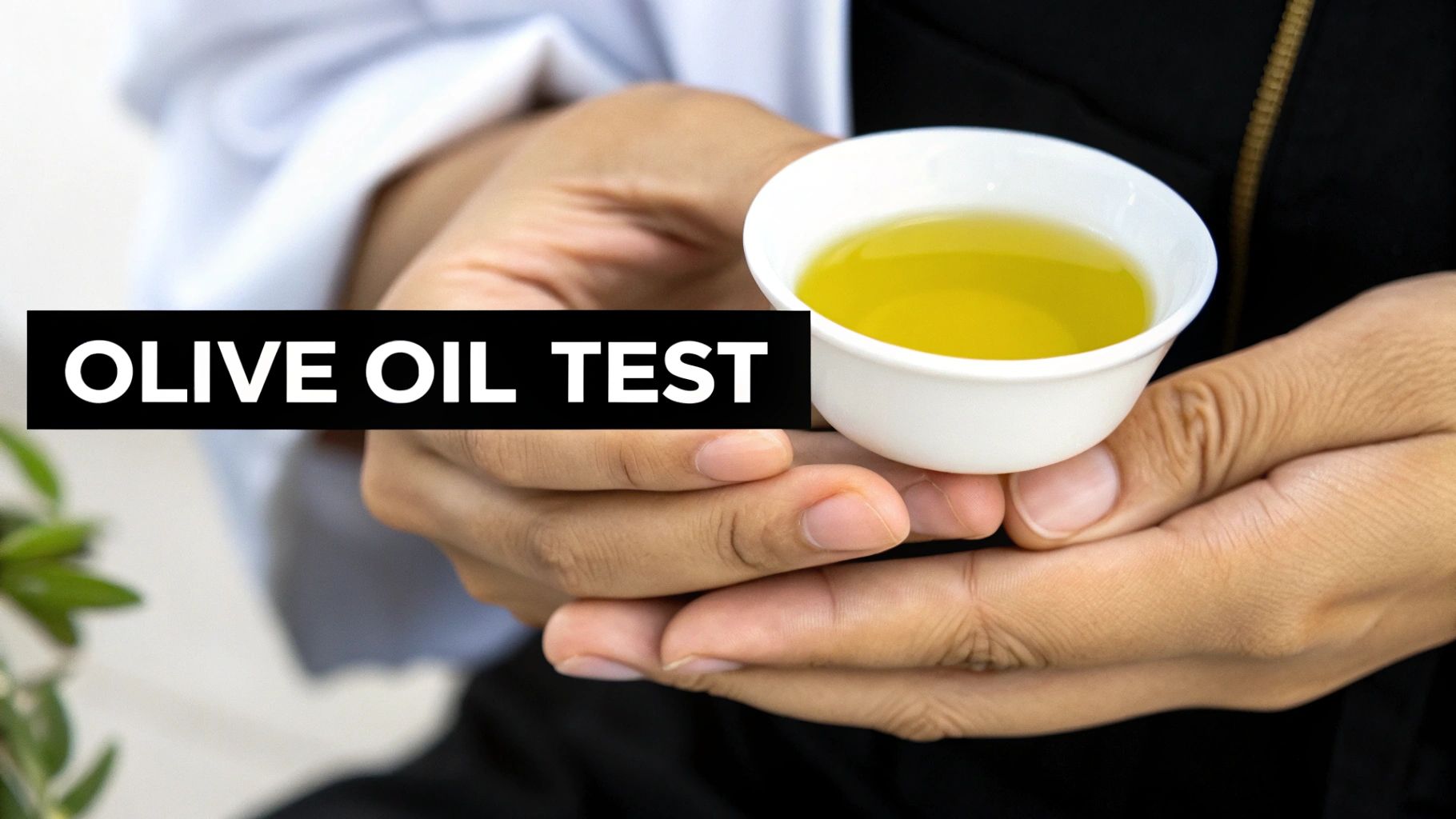
It’s time to put your senses to work. Forget the printed date on the bottle for a moment—that’s just a suggestion, often a misleading one. Your nose and your palate are the only true judges of an oil’s character. They can tell you a story of vibrant freshness or reveal the sad tale of an olive oil gone bad.
This isn't some complex laboratory procedure. It’s a simple sensory ritual that professional tasters use every day to separate the spectacular from the spoiled. All you need is a small cup and a moment of focus to become the expert detective in your own kitchen.
Start by pouring about a tablespoon of olive oil into a small, clean cup. A little wine glass or even a shot glass is perfect for this. You don’t need much, just enough to get a real feel for its aroma and flavor.
The Warm-Up and Swirl
Now, cradle the cup in the palm of one hand and place your other hand over the top, trapping the air inside. The idea is to gently warm the oil with your body heat, coaxing it to release its volatile aromatic compounds—the very molecules that carry its unique story.
Slowly swirl the cup for about 30 seconds. This simple motion increases the oil's surface area, letting those aromas gather under your hand, just waiting for you. It's a critical step, much like letting a fine wine breathe.
Step One: The Aroma Test
Bring the cup right up to your nose, lift your hand, and take a deep, decisive sniff. What do you smell? This is your first and most powerful clue.
- Signs of a Fresh Oil: You should be greeted by clean, lively scents. Think freshly cut grass, green tomato, crisp apple, or perhaps a hint of artichoke. These are the beautiful signatures of a healthy, vibrant oil.
- Warning Signs of Rancidity: If you get a whiff of something waxy like a crayon, putty-like, or a dusty smell reminiscent of stale nuts, the verdict is in. Your oil is rancid.
A great olive oil should smell like a garden—alive and bursting with freshness. A bad one smells like the forgotten corner of a junk drawer—stale, dull, and lifeless. Trust your nose; it almost never lies.
For those who want to truly master this skill, you can explore more techniques on how to test olive oil at home to sharpen your palate.
Step Two: The Taste Test
Here we go—the moment of truth. Take a small sip of the oil, just enough to coat your tongue. Now, slurp it a bit as you draw in some air. This action emulsifies the oil and sprays it across all your taste buds, releasing even more of its flavor secrets.
So, what are you experiencing?
- Bitterness on the Tongue: A pleasant bitterness, especially along the sides of your tongue, is an excellent sign. This is the taste of healthy polyphenols hard at work.
- Peppery Finish in the Throat: After you swallow, you should feel a pungent, peppery sensation at the back of your throat that might even make you cough. This "kick" is the classic calling card of a fresh, high-quality extra virgin olive oil.
- The Greasy, Lifeless Mouthfeel: If the oil just feels greasy, heavy, and has no real flavor, it has gone bad. It will lack any bitterness or peppery kick; it will simply feel like a bland, oily film in your mouth.
By running this simple "detective test," you empower yourself to see beyond labels and expiration dates. You learn to listen to what the oil itself is telling you, ensuring every dish you create starts with an ingredient that is truly alive with flavor.
Decoding the Secrets on the Label
Walking down the olive oil aisle can feel like trying to crack a secret code. You’re met with a wall of bottles, all plastered with dates and terms—'Best By,' 'Bottling Date,' 'Harvest Date'—that seem helpful but often just cloud the issue. Most of us have been conditioned to grab the bottle with the furthest 'Best By' date, but when it comes to olive oil, that’s a classic rookie mistake.
That date is little more than a manufacturer's best guess, usually stamped for 18 to 24 months after the oil was bottled. But here’s the secret they don’t want you to know: the oil could have been sitting in a massive storage tank for a year before it was even put in that bottle. From the very start, that 'Best By' date could be hiding a much older oil.
To truly know what you're getting, you must become a label detective and search for a different clue.
The Only Date That Truly Matters
The single most important piece of information on any bottle of good olive oil is the Harvest Date. This tells you when the olives were actually picked and pressed into oil. Think of olive oil as fresh-squeezed fruit juice—because that’s precisely what it is. Its life begins the moment it's made, and from that point on, the clock is ticking.
Always, always look for the most recent harvest date you can find.
Here’s an easy way to think about it: The 'Bottling Date' is like knowing when a letter was sealed in an envelope. The 'Harvest Date' tells you when the letter was actually written. Which one gives you a better sense of how fresh the message is?
The Olive Oil Date Decoder
To make smarter choices at the store, it helps to have a quick cheat sheet. This table breaks down what those common dates really mean for the oil inside the bottle.
| Label Term | What It Really Means | Your Action |
|---|---|---|
| Harvest Date | The month and year the olives were picked and pressed. This is the oil's "birth date." | This is your north star. Always choose the most recent date available. |
| Bottling Date | When the oil was put into the bottle. It could be months or even a year after the harvest. | A decent backup if you can't find a harvest date, but it's not the full story. |
| Best By Date | A manufacturer's estimate of quality, typically 1.5-2 years after bottling. | Ignore this. It's often misleading and tells you very little about actual freshness. |
With this decoder, you can cut through the marketing noise and focus on what really counts: the oil's true age.
The Two Timelines of Freshness
Once you bring a bottle home, its lifespan follows two very different paths: the time it spends sealed, and the time after you break that seal. An unopened bottle is a little time capsule, protecting the precious oil from its greatest enemy—oxygen. But the second you twist that cap, a new, much faster countdown begins.
-
Unopened Shelf Life: When stored properly in a dark, cool place, a sealed bottle of extra virgin olive oil will hold onto its peak quality for about 12 to 24 months from its harvest date. The dark glass or tin is its protective armor.
-
Opened Shelf Life: The moment that seal is broken, oxygen floods in and the oxidation assault begins. The oil’s bright, peppery notes and powerful health benefits begin to fade with surprising speed. To enjoy it at its absolute best, you should plan to use an opened bottle within one to three months.
Industry guidance confirms that under realistic kitchen conditions—with ambient light, room temperature, and repeated openings—the quality of an opened oil can plummet below acceptable levels in as little as two to four months. Learn more about these olive oil quality statistics on internationaloliveoil.org.
By focusing on the harvest date and understanding how quickly things change after opening, you take back control. You're no longer just guessing in the grocery aisle; you're a connoisseur who knows exactly how to pick a winner every single time.
To dive even deeper into what all the other terms mean, check out our full guide on olive oil labeling.
Mastering the Art of Olive Oil Storage
So, you’ve brought home a beautiful bottle of extra virgin olive oil. A brilliant choice! Now, the mission is to ensure it stays that way from the first magnificent drizzle to the very last drop. It’s not difficult, but it does demand that you treat that liquid gold with a bit of respect.
One of the most tragic mistakes I see people make is keeping their olive oil right next to the stove. It looks lovely, of course, and it's certainly convenient. But that constant, simmering heat is the fastest way to murder a perfectly good oil and send it hurtling down the road to rancidity. Your oil’s happy place isn't in the spotlight; it's somewhere cool, dark, and stable. Think of a kitchen pantry or a cupboard, far away from the oven's battlefield.
Debunking Common Storage Myths
Let's clear up a persistent myth right away: the refrigerator is not your olive oil's friend. While it's certainly cold, it's actually too cold. Chilling your oil causes its natural waxes to clump together and solidify, making it cloudy and thick. Bringing it back to room temperature and then chilling it again creates a yo-yo effect that can also introduce condensation inside the bottle—and water is no friend to fresh oil.
The rules for keeping your oil perfect are refreshingly simple.
- Embrace the Dark: Light is a primary enemy. Keep your bottle tucked away in a dark cabinet or pantry.
- Keep It Cool: Find a spot with a steady, cool temperature. That means away from the stove, dishwasher, or a sunny windowsill.
- Seal It Tight: Oxygen is the number one cause of oxidation, which leads to those dreadful off-flavors. Always screw that cap back on tightly the moment you're done pouring.
Think of it like this: you're creating a quiet, private retreat for your oil, protecting it from the heat, light, and air of a busy kitchen. Every time you follow these steps, you're preserving the incredible flavor and health benefits you paid for.
Smart Buying and Pouring Habits
How you buy and use your oil matters just as much as where you store it. Those giant tins might seem like a bargain, but for most of us, they’re a trap. A larger container means that as you use the oil, the remaining amount is exposed to more and more oxygen, for a longer period of time.
The smarter move? Buy smaller bottles more frequently. You’ll be much more likely to use it up while it’s still at its vibrant, peppery peak.
If you like to keep a small amount on the counter for daily use, pour it into a dark, opaque cruet or dispenser. Just remember one crucial rule: never top it off. Always finish what's inside and give the dispenser a thorough wash before refilling. This prevents you from contaminating your fresh supply with old, slightly oxidized oil. These small habits make all the difference, and you can find even more tips on the best practices for olive oil storage. Good storage isn't just for oil, of course; similar principles apply when preserving freshness for other kitchen staples, too.
So, Your Olive Oil Went Bad. Now What?
You've done the sniff and taste test, and the verdict is in: the olive oil is undeniably rancid. Your first instinct might be to pour it down the sink, but wait. Making a smarter, more sustainable choice is easier than you think.
First, let's be clear about what you're dealing with. While rancid oil tastes awful and has been stripped of all its amazing health benefits, a small amount isn’t going to make you sick in the way food poisoning would. Its greatest crime is culinary—it will absolutely annihilate the flavor of any dish it touches. So, while its days in your kitchen are over, its useful life is far from finished.
Before you toss that bottle, consider giving it a second career. That expired oil can be surprisingly useful around the house.
From the Pantry to the Workshop
Even when it's no longer fit for your salad, old olive oil has properties that make it a fantastic multi-purpose helper for everyday tasks. Think of it as a natural, chemical-free lubricant and conditioner just waiting for a new job.
Here are a few clever ways to repurpose that bottle:
- Condition Wooden Tools and Cutting Boards: A light coat of oil can bring dry, thirsty wood back to life, preventing cracks and reviving its natural luster.
- Season Cast Iron Pans: Use it to build up that perfect non-stick patina on your cast iron skillet—a classic technique that keeps them in prime cooking condition.
- Silence Squeaky Hinges: Just a single drop on a noisy door hinge can work wonders. It's a quick, quiet, and satisfying fix.
- Create a Homemade Furniture Polish: Mix two parts old olive oil with one part lemon juice or vinegar for a simple, effective polish that cleans and shines wood surfaces.
The choice to repurpose old oil isn't just about being resourceful; it also contributes to broader strategies for reducing food waste. Every little bit helps, and small household habits really do add up.
The economic impact of spoilage is staggering. When even a small fraction of the global crop goes bad, it results in tens of thousands of tonnes of downgraded oil and millions in lost revenue. You can discover more insights about the market effects of spoilage on certifiedorigins.com.
By finding a new job for that bottle of oil, you’re not just saving it from the landfill; you’re giving it a valuable second life. If you're looking for even more ideas, you can explore our guide on what to do when you ask yourself, "Can you use expired olive oil?".
Your Olive Oil Questions Answered
We get asked about olive oil all the time. Is this bottle still good? Did I store it wrong? It's a common point of confusion in the kitchen, so let's clear up some of the biggest questions once and for all.
Can Eating Olive Oil That Has Gone Bad Make You Sick?
Let's tackle the big one: accidentally using a little bit of rancid olive oil won't give you food poisoning. While the taste is certainly unpleasant, it’s not dangerous in small amounts.
The real problem with an olive oil gone bad is what it does to your cooking. It will impart a stale, crayon-like taste that can completely ruin a dish you've worked hard to create. Even worse, the healthy fats have degraded and those powerful, health-boosting antioxidants are long gone. You're left with all of the calories and none of the benefits.
Does Putting Olive Oil in the Fridge Keep It Fresh?
This is a popular myth, but it actually harms your oil more than it helps. The cold temperature causes the natural waxes in the oil to solidify, turning it cloudy and thick. You’ll have to wait for it to return to room temperature just to pour it.
This constant chilling and warming cycle can also introduce condensation into the bottle, and water is the enemy of freshness. It will only accelerate your oil's decline.
Forget the fridge. The best place for your olive oil is a cool, dark pantry or cupboard, far from the stove. Think of it like a wine cellar—a stable, cool temperature is what you're aiming for.
What Is the Most Important Date on an Olive Oil Bottle?
Always, always look for the Harvest Date. Ignore the "Best By" or "Use By" date if you can. The harvest date is the oil's true birthday—it tells you when the olives were actually picked from the tree and pressed.
An olive oil is at its peak for about 18 months from its harvest date. A "Best By" date, on the other hand, is often just a guess based on when the oil was bottled, which could have been many months after it was made. For genuine freshness, the harvest date tells the real story.
At Learn Olive Oil, we believe that really understanding your ingredients is the key to becoming a better cook. We're here to help you decode labels, master storage, and truly appreciate this liquid gold.
Explore our guides at https://learnoliveoil.com

 Learn Olive Oil
Leave a comment