Picture this: ancient olive groves basking in the Mediterranean sun. Heavy, granite wheels turning slowly, crushing ripe olives to release a trickle of pure, golden liquid. That’s the powerful, romantic story marketers sell you with the words olive oil first press.
But I’m going to let you in on a secret whispered among honest producers but rarely shouted in the marketplace: in the modern world of olive oil, that phrase is more of a ghost story than a reliable mark of quality.
The Enduring Allure of The First Press
The term ‘first press’ just feels right, doesn’t it? It conjures images of tradition, purity, and the absolute pinnacle of quality. It paints a picture of a single, gentle squeeze that coaxes out only the most precious oil, leaving the inferior dregs behind.
Historically, that’s precisely how it worked. Producers would layer olive paste between woven mats and place them in a hydraulic press. The very first run produced the nectar—the finest oil. A second press, sometimes with hot water added to extract every last drop, would follow, but the quality would plummet.
But here’s the unvarnished truth: modern technology has rendered that entire process obsolete for crafting high-quality olive oil. The best extra virgin olive oils you can buy today aren't "pressed" in that old-fashioned sense at all. They are extracted using a far superior method: the centrifuge.
From Ancient Pressing to Modern Extraction
Imagine the spin cycle on your washing machine, but engineered with the precision of a Swiss watch. After olives are milled into a thick paste, the entire mixture is spun at astonishing speeds.
This rapid spinning separates everything by density—the oil, water, and olive solids part ways with clean, surgical precision. The whole process is immaculate, incredibly efficient, and—this is critical—done at low temperatures. Keeping things cool is non-negotiable for preserving the oil’s delicate flavors and its symphony of health benefits.
This single, continuous extraction is so thorough that there’s no usable paste left for a "second press" to create edible oil. The leftover solids, called pomace, might be blasted with solvents to wring out the final drops, but that resulting oil is a vastly inferior product that can never, ever legally be labeled Extra Virgin.
In essence, any bottle of authentic Extra Virgin Olive Oil you buy today is, by its very nature, the product of a single, first extraction. The term "first press" has become utterly redundant.
This isn't just a matter of semantics; it’s the key to unlocking the secret of genuinely great olive oil. Marketers know that "olive oil first press" sounds authentic and moves bottles off shelves. Yet, seeing it on a label tells you precisely nothing about the oil’s actual quality, its freshness, or its flavor. It's one of many common deceptions that can lead you astray. To arm yourself further, you can explore some of the most pervasive olive oil myths.
So, if this cherished term is merely a marketing echo, how do you spot true quality? The answer lies on the label, but you have to look beyond the puffery. It's in the other words—the ones that are regulated, meaningful, and tell the true story of the liquid gold inside the bottle.
From Ancient Millstones to Modern Marvels
To truly grasp why "first press" is more of a charming ghost from the past than a modern reality, you must picture how olive oil was born. Imagine massive, heavy granite millstones, slowly grinding whole olives—pits and all—into a thick, fragrant paste. This is the romantic image etched in our collective memory.
That olive paste was then meticulously spread onto round, woven mats, typically made from hemp or coconut fiber. These mats were stacked high, creating a column that entered a hydraulic press. A gentle, initial squeeze was applied, and from this genuine first press, the purest, most flavorful oil would trickle out. This was the liquid gold.
To wring out every last drop, producers would sometimes hit the leftover paste with a second, far more powerful press, often adding hot water to release more oil. It worked, but the resulting liquid was a world away from the first batch—harsher, less nuanced, and of a dramatically lower quality. This stark difference is what gave the term "first press" its power and meaning.
The Modern Centrifuge: A Quantum Leap in Quality
Now, let's journey to a state-of-the-art olive mill today. The hero of this story isn't a press at all; it's a centrifuge. This incredible machine has utterly transformed the industry, making the old pressing method—and the entire concept of a "second press"—obsolete for producing high-quality oil.
Picture a high-tech, industrial-sized salad spinner. The olive paste is fed into a horizontal decanter spinning at thousands of rotations per minute. Pure centrifugal force separates the three components of the paste—oil, water, and solids—by their different densities. It’s breathtakingly clean and efficient.
The modern centrifuge isn't just a replacement for the press; it's a monumental upgrade. It extracts oil in a single, continuous, and enclosed process that shields it from its greatest enemies: oxygen, heat, and light.
This method does a vastly superior job of preserving the oil’s delicate flavors and health-boosting antioxidants than ancient methods ever could. There's simply no valuable paste left over for a "second press."
The infographic below brilliantly illustrates this evolution from the romantic past to the precise reality of what defines quality today.
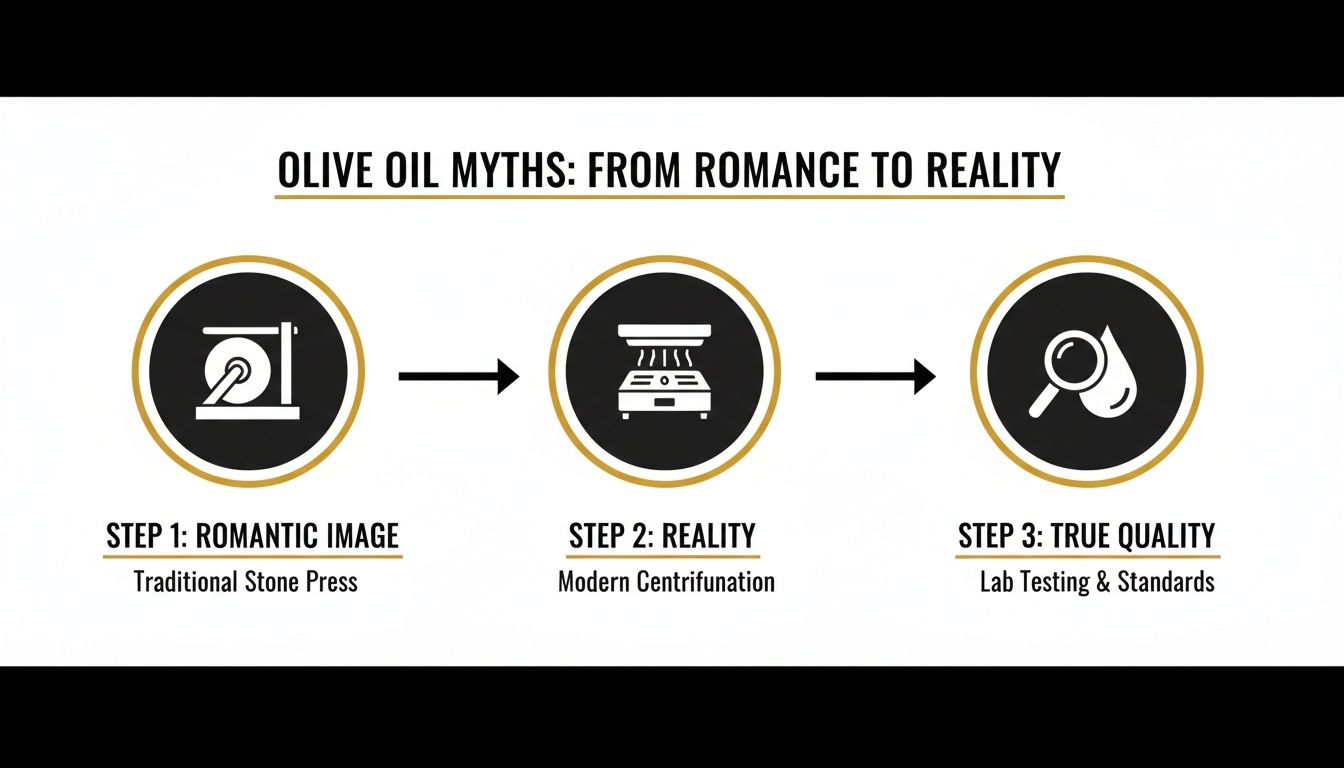
The crucial takeaway? We must shift our focus from the nostalgic romance of a "press" to the scientific precision that actually guarantees a superior oil.
Why This Matters for Global Production
This technological leap from pressing to centrifugation is precisely why virtually all extra virgin olive oil today is, technically, a "first press" product. The term historically signified the highest grade, extracted directly from olives without chemicals or excessive heat. Modern methods achieve this gold standard in one clean step.
This premium category dominates the global market, which is projected to reach 3.507 million tons. Spain remains the undisputed leader, with about a quarter of the world's 11.7 million hectares of olive groves. The country recently produced an estimated 1.419 million tons—a massive 66% increase from the previous season. If you're curious, you can discover more insights about these global production figures and trends.
How to Decode Olive Oil Labels Like an Expert
So, we’ve laid the romantic but misleading ghost of "first press" to rest. The question now becomes intensely practical: if that beloved phrase isn't the secret password to quality, what is? How do you stand in a grocery aisle, faced with a wall of bottles, and choose a genuinely extraordinary olive oil?
You learn to read the label like a pro. It's about ignoring the marketing siren song and homing in on the real clues—the regulated, legally defined terms that tell the true story of what’s inside the bottle. With a little insider knowledge, you can cut through the fantasy and buy with the confidence of a seasoned connoisseur.
Look for the Gold Standard: Extra Virgin Olive Oil
This is your North Star. "Extra Virgin Olive Oil" (EVOO) is the single most important phrase on any label because it's a legally protected grade, representing the absolute peak of olive oil quality. It's not just a fancy name; it's a promise backed by stringent international standards.
To earn this title, an oil must be extracted from fresh olives using only mechanical means—no chemicals, no excessive heat. Critically, it must also pass two grueling tests. A chemical analysis must confirm its free fatty acid level is incredibly low (below 0.8%), and a certified tasting panel must find it utterly free of any taste defects while possessing positive notes of fruitiness.
Think of "Extra Virgin" as a diploma from the world’s toughest olive oil school. It’s the highest honor, and any oil that achieves it has proven its mettle.
The Truth About Temperature: Cold Extracted
While "first press" is an echo of the past, terms related to temperature are very much alive and incredibly important. Look for phrases like "Cold-Extracted" or "Cold-Pressed". These terms are regulated and serve as your guarantee that the olive paste was kept below a specific temperature—typically 27°C (80.6°F)—during the entire extraction process.
Why does this matter so much? Heat is the mortal enemy of flavor and health. Keeping the process cool is paramount for preserving the delicate, volatile compounds that give EVOO its vibrant taste and the powerful polyphenols that provide its incredible health benefits. A bottle that proudly states it was cold-extracted is telling you the producer chose quality over quantity.
"Cold-Extracted" isn't just jargon; it's a producer’s signal that they took the difficult but necessary steps to protect the oil's soul—its flavor and its antioxidant power. It’s a mark of true craftsmanship.
This one phrase separates the artists from the industrial producers, giving you a clear window into the care that went into the bottle. A full understanding of these terms is the first step in mastering olive oil labeling and making smarter choices.
The Fresher, the Better: The Harvest Date
Here is a simple truth that will forever change how you buy olive oil: olive oil is fresh fruit juice. Unlike wine, it does not improve with age. It is at its absolute zenith the moment it is made and begins a slow, steady decline from there.
This makes the Harvest Date the most vital piece of information on any label.
Do not be fooled by the "Best By" date, which can often be two years from the bottling date, not the harvest. You need to know when the olives were picked and milled. Look for a specific harvest date or season (e.g., "Harvest: October 2023").
- Look for the most recent harvest: Always choose the freshest oil available on the shelf.
- Use it promptly: Once you open a bottle, aim to use it within a few months to enjoy it at its peak. Air is its enemy.
- Seals of Authenticity: Look for seals like PDO (Protected Designation of Origin) or PGI (Protected Geographical Indication). These European Union certifications guarantee the oil was produced, processed, and prepared in a specific geographic area using traditional methods, adding another layer of trust.
Armed with these three key indicators—Extra Virgin, Cold-Extracted, and a recent Harvest Date—you're no longer guessing. You're ready to choose a bottle based on fact, not marketing fiction.
Olive Oil Label Decoder: What Matters vs. What Doesn't
Navigating the olive oil aisle can feel overwhelming, with bottles shouting all sorts of claims. To make it easier, here's a quick guide to separate the genuinely useful information from the marketing noise.
| Term on the Label | What It Really Means | Is It a Key Quality Indicator? |
|---|---|---|
| Extra Virgin | The highest legal grade. Low acidity (<0.8%), no flavor defects, extracted without chemicals or high heat. | Yes, Absolutely. This is the most important term to look for. |
| Harvest Date | The month and year the olives were picked and milled. Indicates freshness. | Yes, Critically. Olive oil is best when fresh. Look for the most recent date. |
| Cold-Pressed / Cold-Extracted | The oil was extracted at a low temperature (under 27°C / 80.6°F), preserving flavor and nutrients. | Yes. A strong sign that the producer prioritized quality. |
| First Press / First Cold Press | An outdated marketing term from the era of hydraulic presses. All modern EVOO is from a single extraction. | No. It's meaningless on a modern EVOO label. Ignore it. |
| Light / Lite Olive Oil | Refers to a lighter color or flavor, not fewer calories. It's a highly refined oil with little taste. | No. This indicates a lower-grade, refined oil, not a quality one. |
| Pure Olive Oil | A blend of refined olive oil and a small amount of virgin olive oil for flavor. | No. This is a lower-quality grade, far below Extra Virgin. |
| PDO / PGI Seal | Certifies the oil's geographical origin and adherence to traditional production methods for that region. | Yes. A good sign of authenticity and traceability. |
| Best By Date | A manufacturer's suggestion for peak quality, often 18-24 months from the bottling date, not harvest. | Not really. The Harvest Date is a much more reliable indicator of freshness. |
Think of this table as your cheat sheet. When you're in the store, focus on the terms in the "Yes" column—Extra Virgin, Harvest Date, Cold-Extracted, and any authenticity seals. If you prioritize those, you'll bring home a fantastic bottle every time.
The Sensory Secrets of a Superior Olive Oil
Labels give you the facts, but they cannot tell you the most important thing about an olive oil: its soul. The real proof of quality isn't printed on a bottle; it's an experience you can taste, smell, and feel. Learning to trust your senses is the final, most rewarding step in becoming a confident olive oil buyer.
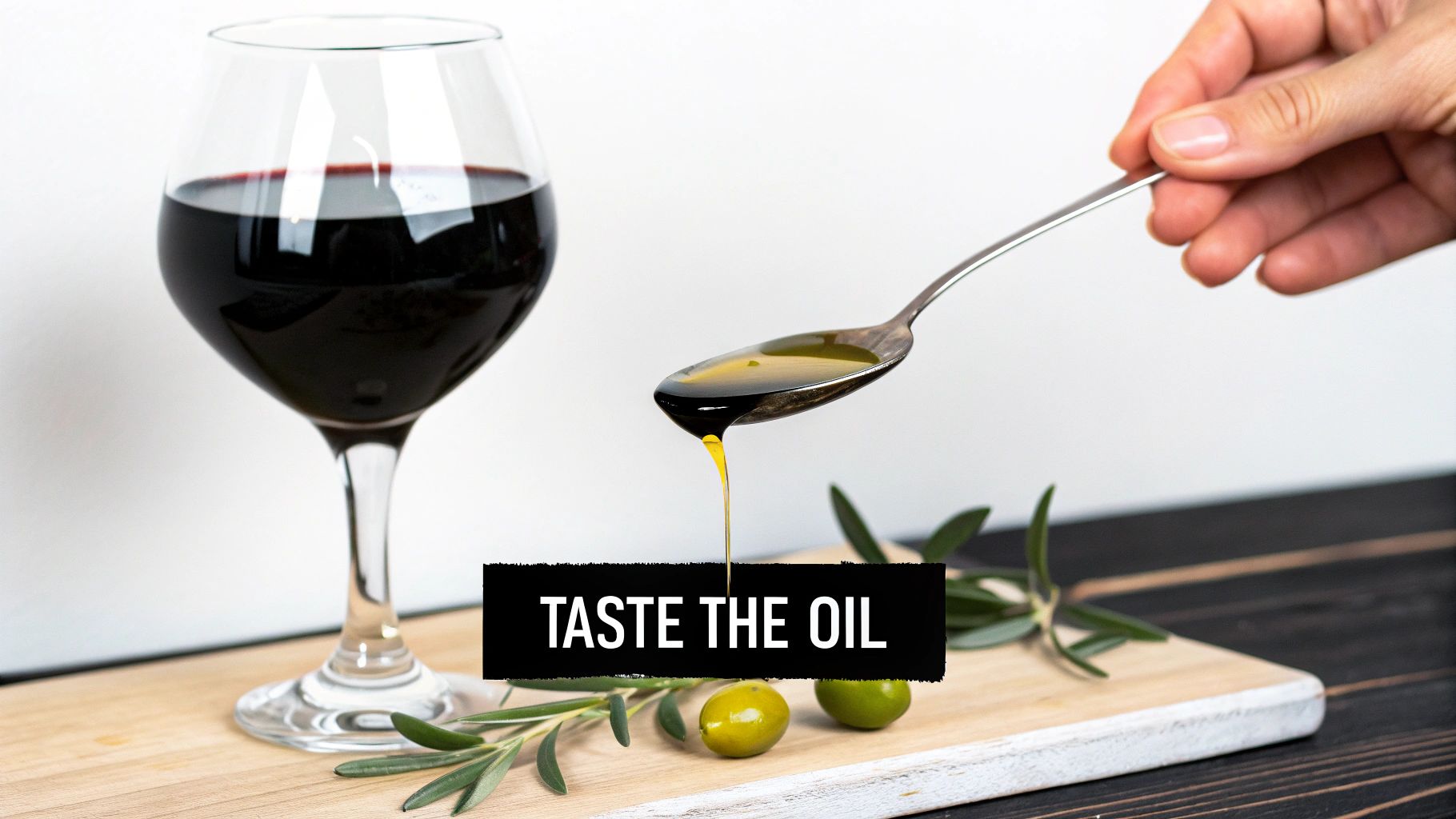
Many of us grew up thinking olive oil should be mild, buttery, and nearly unnoticeable. But a truly great extra virgin olive oil is the polar opposite of a neutral cooking fat. It is vibrant and complex, designed to awaken your palate with three distinct characteristics that professionals live and die by.
The Trio of Positive Attributes
Professional tasters are always searching for a harmonious balance of three key sensations. Once you know what they are, you’ll never think about olive oil the same way again. They are fruitiness, bitterness, and pungency.
- Fruitiness (The Aroma): This is all about what you smell. A high-quality oil should smell fresh, green, and alive—like the fruit it came from. The aromas can range from freshly cut grass and green banana to artichoke, tomato leaf, or even nutty almond. If you don't smell anything fresh, that's a major red flag.
- Bitterness (The Taste): This is a virtue, not a flaw! A pleasant bitterness on your tongue is a direct signal of fresh, unripe olives and a high concentration of powerful antioxidants. It tells you the oil is not only healthy but was made with exceptional care.
- Pungency (The Sensation): This is that peppery or spicy kick you feel in the back of your throat a moment after you swallow. That distinctive sting is the signature of oleocanthal, a potent anti-inflammatory compound found only in fresh, high-quality extra virgin olive oil.
Think of it this way: fruitiness is the oil’s personality, bitterness is its backbone, and pungency is its voice. A great oil needs all three to tell its complete story.
The two qualities many consumers mistake for flaws—bitterness and pungency—are actually the loudest announcements of a fresh, healthy, and superior extra virgin olive oil. Embrace the pepper, seek out the bitterness.
How to Taste Olive Oil Like a Pro
You don’t need a special blue glass or a sommelier’s license to start tasting like an expert. The next time you open a bottle, take a moment to perform this simple sensory check right in your kitchen. It's a small ritual that connects you to the oil’s character and tells you everything you need to know about its quality.
- Warm and Swirl: Pour about a tablespoon of oil into a small glass. Cup the glass in one hand and cover the top with your other to trap the aromas inside. Gently swirl it for about 30 seconds to warm the oil with your body heat.
- Smell Deeply: Uncover the glass, bring it to your nose, and take a deep breath. What do you smell? Fresh grass, green apples, herbs? If it smells fresh and fruity, you're on the right track. If it smells waxy, musty, or like nothing at all, the oil is likely old or of poor quality.
- Sip and Slurp: Take a small sip of the oil. Now, do what the pros do and slurp it by drawing some air in through your mouth. This action, called "strippaggio," spreads the oil across your entire palate and helps release its aromatic compounds, giving you the full flavor experience.
- Feel the Finish: Swallow the oil and pay attention. Do you feel a slight sting or a peppery tickle in your throat that makes you want to cough? That's the pungency—the calling card of those healthy polyphenols at work.
This simple process transforms olive oil from a mere ingredient into an experience. For those who want to dive deeper, you can find a more detailed walkthrough on how to taste olive oil and refine your palate even further.
By trusting your senses, you move beyond marketing buzzwords like "first press." You learn to recognize the authentic signatures of freshness and quality—the vibrant fruitiness, the assertive bitterness, and the telltale peppery finish that truly define an exceptional olive oil.
How to Protect Your Liquid Gold at Home
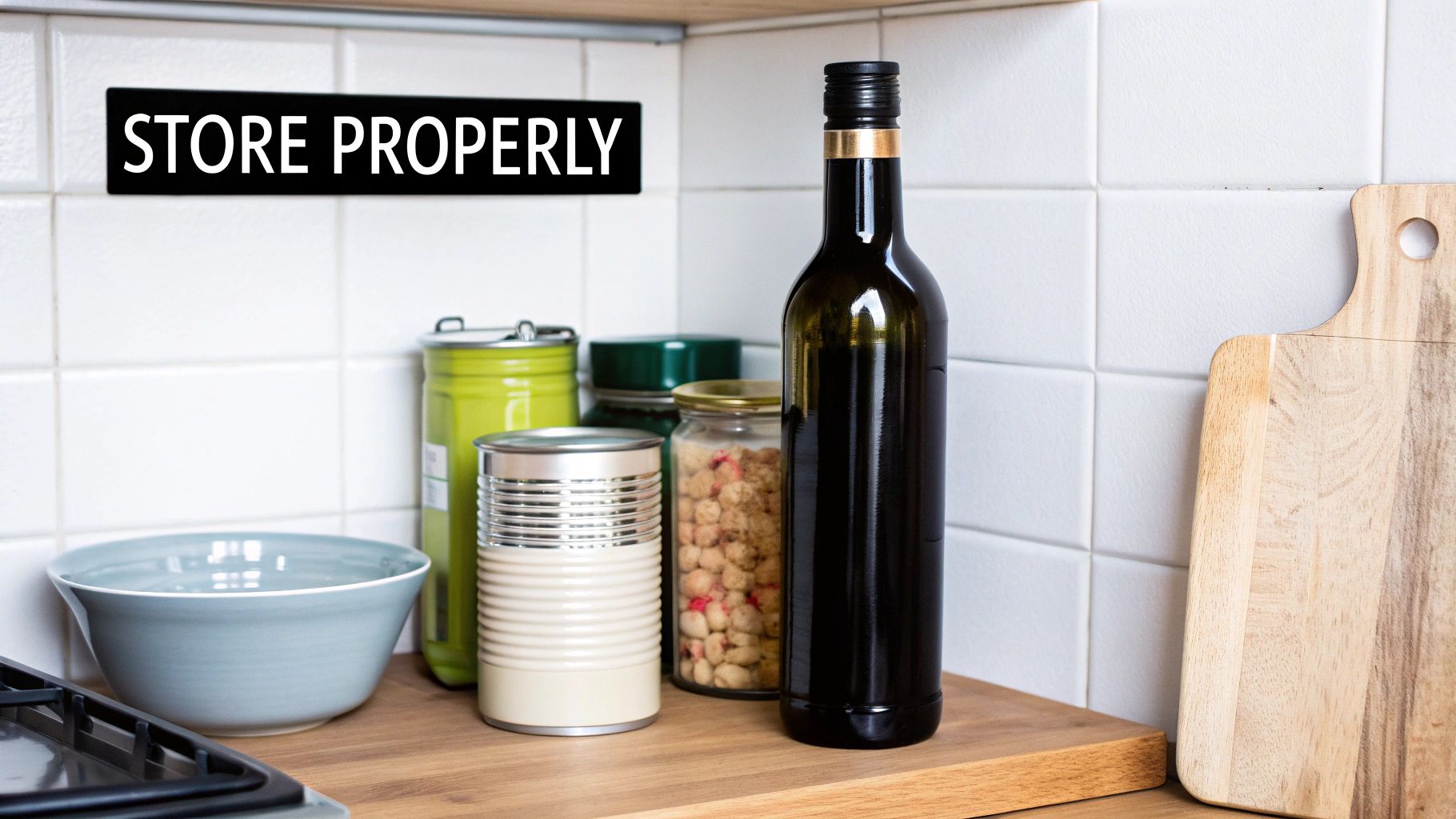
You’ve done the hard part—you’ve sorted through the labels and brought home a bottle of genuinely fantastic extra virgin olive oil. But your job isn't quite done. Think of that bottle as an investment in flavor and health, and how you store it is just as important as how you picked it out.
Olive oil is, at its heart, a fresh fruit juice. And just like any fresh juice, it's perishable. Its lively flavors and potent health benefits are delicate and can disappear surprisingly quickly if you don't look after it properly. Unfortunately, the modern kitchen is practically a minefield for a good bottle of oil.
There are three sworn enemies of olive oil that you need to defend against: light, heat, and air. Let any of them get to your oil, and you kickstart the process of oxidation. That's what turns your beautiful, peppery liquid gold into something flat, stale, and lifeless.
Defeating the Enemies of Freshness
The good news is that protecting your oil isn't complicated. It just takes a few simple, conscious habits. Once you know what the threats are, the solutions are pretty straightforward.
First, let's tackle light. Both direct sunlight and the fluorescent lights in your kitchen are incredibly destructive, rapidly accelerating rancidity. This is precisely why you should steer clear of any olive oil sold in a clear glass bottle, no matter how appealing the label looks.
- Always Choose Opaque Containers: Look for dark green or black glass, tins, or even ceramic containers. These materials act as a shield, blocking the harmful light rays that want to get to the oil.
- Store in a Dark Place: Don't just rely on the bottle. The ideal spot for your olive oil is in a cool, dark pantry or cupboard, well away from any windows.
Next up is heat. Storing oil near a heat source is probably the fastest way to ruin it. Heat dramatically speeds up the oxidation process, destroying the delicate flavor compounds and beneficial polyphenols that make extra virgin olive oil so special in the first place.
The most common mistake is also the most damaging: keeping your olive oil on the countertop right next to the stove. It's convenient, sure, but the constant exposure to heat is a death sentence for its quality.
Smart Buying and Usage Habits
Finally, there's air. Oxygen is the last piece of the puzzle. The moment you break the seal on a new bottle, the clock starts ticking much faster. Every time you open the cap, you introduce more oxygen, which slowly begins to degrade the oil.
This means you should buy a bottle size that actually matches how much you cook. A giant three-liter tin might seem like a bargain, but if it takes you a year to get through it, the last half will be a sad shadow of its former self. A good rule of thumb is to buy a size you can finish within two to three months of opening.
The global demand for high-quality, authentic olive oil first press is soaring, with the market projected to grow from $20,314.68 million to $30,631.81 million by 2032. This growth is fueled by people who get it—they understand its value. Protecting your purchase at home means you actually get to enjoy what you paid for. You can learn more about the global olive oil market trends to see how consumer awareness is shaping the industry.
By treating your oil with a little care—keeping it in the dark, away from heat, and using it up in a timely manner—you honor the hard work of the producer and ensure every single drop is as delicious as the day it was made. For a deeper dive, check out our complete guide on proper olive oil storage.
Answering Your Biggest Olive Oil Questions
Navigating the world of olive oil can feel like walking through a minefield of myths and confusing labels. Even after we've cleared up the whole "first press" story, a few other common questions always seem to pop up. Let's tackle these head-on, so you can feel completely confident when you're shopping, cooking, and drizzling.
Does "Light" Olive Oil Have Fewer Calories?
Absolutely not. This is one of the most cynical marketing tricks in the grocery store. When you see "Light" or "Extra Light" on an olive oil label, it refers only to the oil's flavor and color—and has nothing to do with calories.
Every single olive oil, from the most powerful Extra Virgin to the palest "Light" version, packs the exact same caloric punch: about 120 calories per tablespoon. "Light" olive oil is a heavily refined product, stripped of its distinctive aroma, flavor, and, crucially, all those health-boosting polyphenols. It's a neutral-tasting oil for high-heat cooking, but it lacks the soul and health benefits that make Extra Virgin Olive Oil so special.
Is Cooking with Extra Virgin Olive Oil a Waste?
Not only can you cook with it, you absolutely should. There is a stubborn myth that you can’t cook with EVOO, and it is simply wrong. It’s an outdated idea that prevents people from adding incredible flavor and nutrients to their food. A high-quality EVOO has a smoke point between 375-410°F (190-210°C), which is more than high enough for most home cooking, including sautéing, roasting, and even some light frying.
Here’s the secret: the oil’s stability under heat is directly tied to its quality. The fresher the oil and the higher its antioxidant count, the better it holds up. Cooking with a good EVOO isn't a waste; it infuses your dishes with complex flavors that a refined oil could never hope to achieve. Don't relegate the good stuff to salads—use it and enjoy it.
Does a Dark Green Color Signal Better Quality?
Not in the slightest. This is a classic case of judging a book by its cover. An olive oil's color tells you about the olive variety used and how ripe it was at harvest; it says absolutely nothing about quality.
An intensely green oil from early-harvest olives can be just as magnificent as a buttery, golden-hued oil from a later harvest. In fact, professional olive oil tasters use special cobalt-blue glasses for tastings. Why? To completely hide the oil's color so it cannot sway their judgment of its aroma and flavor. The only true measures of quality are what you can smell and taste—freshness, vibrancy, and a clean finish—not the shade of green or gold in the bottle.
The most important lesson is to trust your nose and your palate, not your eyes. An oil that smells and tastes fresh, vibrant, and clean is a high-quality oil, regardless of its color.
Because it's impossible to judge an oil by its appearance, learning to spot fraudulent products is a crucial skill for any consumer. You can discover more about this in our guide on how to spot fake olive oil.
What's the Deal with Unfiltered Olive Oil?
Unfiltered olive oil, which you might see sold as Olio Nuovo ("new oil") right after the fall harvest, still contains tiny, suspended particles of olive fruit. These little bits give the oil its signature cloudy look and an intensely robust, peppery, and super-fresh flavor that many people go crazy for.
But there's a trade-off. While that intense flavor is fantastic, those same fruit particles cause the oil to spoil much more quickly than its filtered cousin.
- Filtered Oil: The olive solids have been removed, giving you a clear oil with a much longer shelf life and a more stable flavor. This is the standard for most high-quality EVOO.
- Unfiltered Oil: The solids are left in, delivering a bold, straight-from-the-mill taste. Think of it as a seasonal treat that you should use up fast, usually within a few months.
It really comes down to personal taste and how you plan to use it. If you want a potent, fresh, and zesty character, grab an unfiltered oil and enjoy it quickly. For everyday cooking and a longer-lasting, consistent quality, filtered is the way to go. Beyond simply understanding the product, many also wonder about the origins of olive oil. For those interested in the plant itself, here's a helpful resource on growing an indoor olive tree.
At Learn Olive Oil, we believe that understanding the nuances of this incredible food is the first step to truly appreciating it. We're here to guide you through every step, from the olive grove to your kitchen table.
 Learn Olive Oil
Leave a comment