The smoke point for olive oil isn't a single magic number; it spans a surprisingly wide range, typically from 375°F to 465°F (190°C to 240°C). Where a specific bottle falls on that spectrum comes down to one thing: how much it’s been refined.
Your everyday extra virgin olive oil has a lower smoke point, hovering around 375°F, while the more processed "light" olive oils can take the heat much better before they cry uncle.
Your Essential Guide to Olive Oil Smoke Points
Let's get one thing straight about cooking with olive oil: heat isn't the villain. Not understanding the heat is. The smoke point is that critical moment when your oil goes from a gentle shimmer to a plume of smoke. That smoke is your oil's desperate SOS signal that it's starting to decompose.
When an oil starts smoking, it’s not just making your kitchen hazy. It's actively destroying the fantastic flavors and health benefits you paid good money for. This is the dividing line between a beautiful golden-brown sear and a bitter, burnt disaster. Getting this right is what separates the kitchen pros from the hacks.
Understanding the Numbers
The exact smoke point of olive oil isn't set in stone; it's a moving target that depends on the purity and quality of the oil. It's such a common point of confusion that a recent International Olive Council report found that improper high-heat cooking accounts for a staggering 15% of consumer complaints in a global market worth over $10 billion. That's a lot of ruined dinners.
When oil hits its smoke point, it's not just smoking—it's producing a continuous stream of bluish smoke. This process creates unpleasant, acrid compounds (like acrolein) that will make your food taste harsh and bitter. To see how olive oil stacks up against others, a comprehensive cooking oil smoke point chart can be an invaluable reference.
The secret to great cooking isn't avoiding heat; it's respecting the limits of your ingredients. An oil's smoke point is its most important boundary, and knowing it is the first step to unlocking its true potential for flavor.
This chart gives you a clear visual for the typical smoke points of the olive oils you'll find on the shelf.
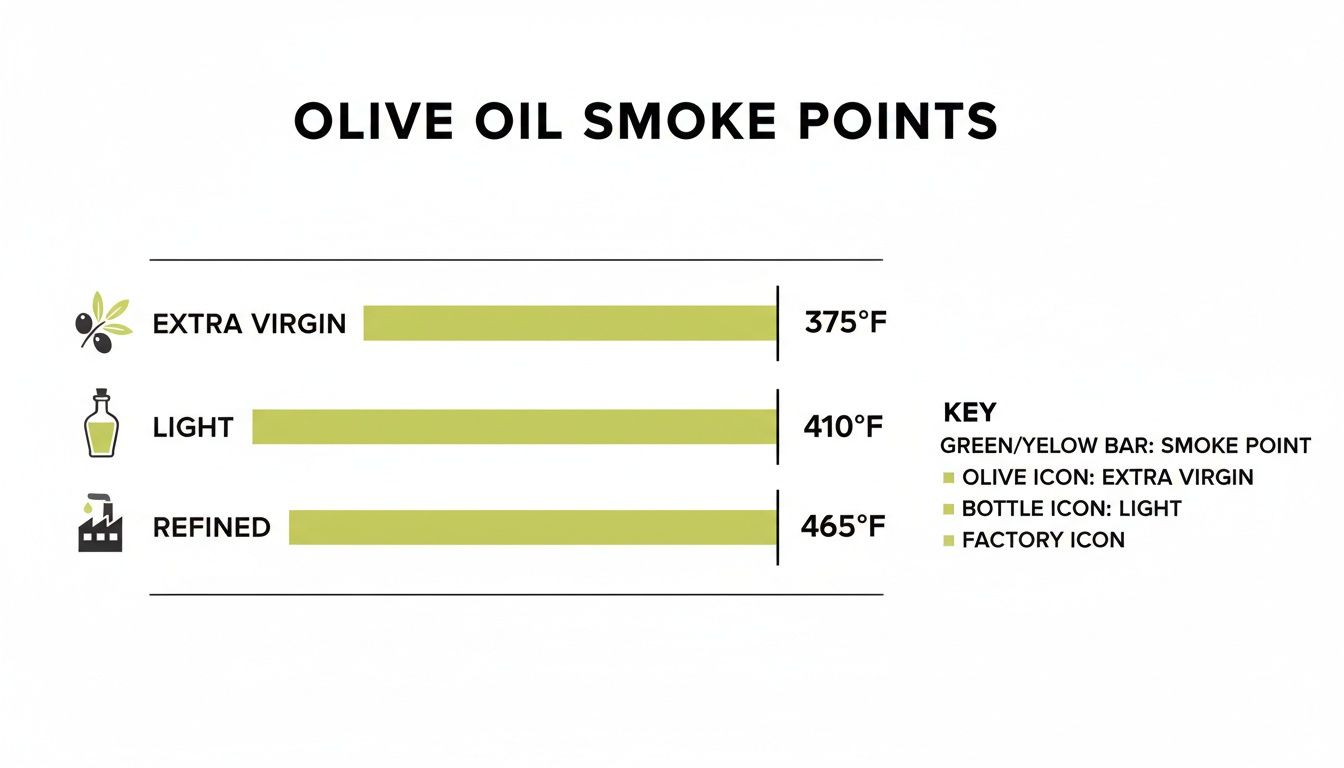
As you can see, the more refined the olive oil, the better it handles high temperatures. It's a fundamental trade-off between flavor and heat tolerance.
Olive Oil Smoke Point Quick Reference Chart
To make it even easier, here’s a quick-glance table to help you match the right olive oil to your cooking method.
| Olive Oil Type | Typical Smoke Point (°F) | Typical Smoke Point (°C) | Best For |
|---|---|---|---|
| Extra Virgin | 350°F – 410°F | 175°C – 210°C | Sautéing, roasting, baking, finishing |
| Virgin | ~420°F | ~215°C | General-purpose cooking, sautéing |
| Refined ("Light") | 435°F – 465°F | 225°C – 240°C | Frying, searing, high-heat cooking |
| Pomace | ~460°F | ~238°C | Deep frying, high-heat applications |
This table should clear up any confusion and ensure you're getting the best performance and flavor from your oil every single time.
Why This Matters in Your Kitchen
It all comes down to a simple truth: use the right tool for the job. Each type of olive oil has its own personality, and knowing that is the key to making it shine.
-
Extra Virgin Olive Oil (EVOO): This is your flavor powerhouse. With its lower smoke point and big, bold taste, it’s perfect for sautéing over medium heat, roasting vegetables, baking, or drizzling over a finished dish to bring it to life.
-
Refined or "Light" Olive Oil: These are your workhorses for high heat. They have a much higher smoke point and a neutral flavor, making them a superb choice for searing a steak or frying.
Mastering this one concept will instantly make you a better, more confident cook. If you want to go deeper into what makes each grade so different, you can explore the different kinds of olive oil and become a true expert.
What a Smoke Point Actually Means for Your Food
Let's ditch the textbook definitions for a moment. Think about toasting a perfect piece of bread in a pan. There's that magical moment where the butter sizzles and the crust turns a beautiful golden brown. The whole kitchen smells amazing. But if you look away for just a moment too long, you're left with a bitter, burnt piece of carbon.
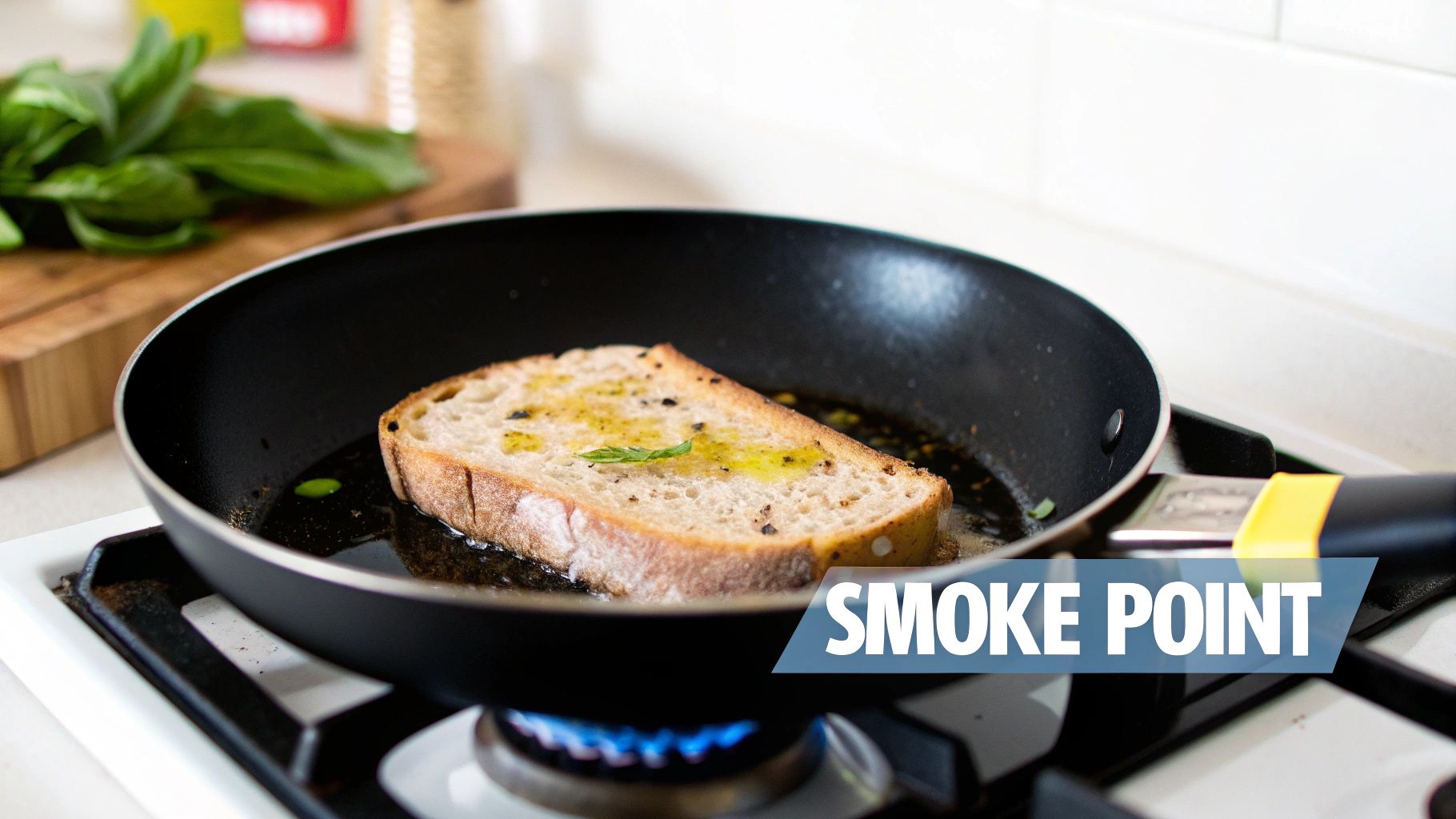
An oil’s smoke point is that exact same tipping point. It’s the specific temperature where its fats and nutrients start to break down, creating a cascade of problems for your food. It's the point of no return for both flavor and health.
The Chemical Tipping Point
When oil hits its smoke point, it’s not just "burning"—it’s undergoing a full-on chemical meltdown. The healthy monounsaturated fats that make olive oil so good for you begin to oxidize and decompose under the intense heat.
This process releases a nasty compound called acrolein, which is responsible for that sharp, acrid smell and the bitter taste that can completely ruin a dish. It’s the very same substance that makes burnt food so repulsive. Pushing your oil past its smoke point isn't a simple cooking mistake; it's a flavor tragedy.
Worse yet, the breakdown generates free radicals—unstable molecules that can cause cellular damage. The very health benefits you were hoping to get from using a good oil are destroyed, and harmful compounds are created in their place.
The Attack on Flavor and Nutrients
Beyond creating foul tastes, hitting the smoke point obliterates everything that makes a high-quality olive oil special in the first place. Those delicate, nuanced flavors—whether peppery, grassy, or buttery—are the first casualties. They are volatile compounds that simply vanish in the heat.
Even more tragically, the precious polyphenols and antioxidants are destroyed. These are the powerful micronutrients celebrated for their anti-inflammatory and disease-fighting properties.
Think of the smoke point as the temperature at which your oil’s nutritional soul is extinguished. The vibrant, life-giving properties are vaporized, leaving behind a degraded, less healthy, and foul-tasting fat.
Knowing this limit is the secret to keeping both the amazing taste and the incredible health benefits locked inside every bottle. To see how different oils stack up, you can check out a complete cooking oil smoke points chart to compare their heat tolerance.
What to Look For Before the Smoke
Your own senses are your best defense against this culinary disaster. Long before you see a thick plume of smoke, the oil will give you subtle clues. It’s a progressive breakdown, not an instant explosion.
Here’s what to watch for as your pan heats up:
- Shimmering: The first sign you have properly heated oil is a gentle shimmer across its surface. It will also look thinner and flow more easily, almost like water. This is your ideal cooking zone.
- Wisps of Smoke: If you see the first few faint wisps of smoke, you are right on the edge of the smoke point. Consider this your final warning to either turn down the heat or add your ingredients to cool the pan immediately.
- Continuous Smoke: A steady stream of blue-gray smoke means you've gone too far. The oil is breaking down, the flavor is shot, and harmful compounds are forming. At this point, your only move is to carefully and safely discard the oil, wipe the pan clean, and start over.
Mastering the olive oil smoke temperature isn't about memorizing a bunch of numbers. It’s about paying attention, using your senses, and respecting your ingredients. That's the real difference between a meal that sings with flavor and one that just tastes burnt.
Why Extra Virgin and Refined Oils Behave So Differently
It's a common kitchen question: why can one olive oil handle the heat of a searing pan while another starts smoking almost immediately? The answer isn't about brand or price—it's about the journey each oil takes from the olive grove to your shelf.
Not all olive oils are created equal, and their smoke points are undeniable proof. To really get why a vibrant, peppery extra virgin olive oil acts so differently from a pale, refined one, you have to look at how they’re made. The story is about craftsmanship, purity, and the very soul of the oil.
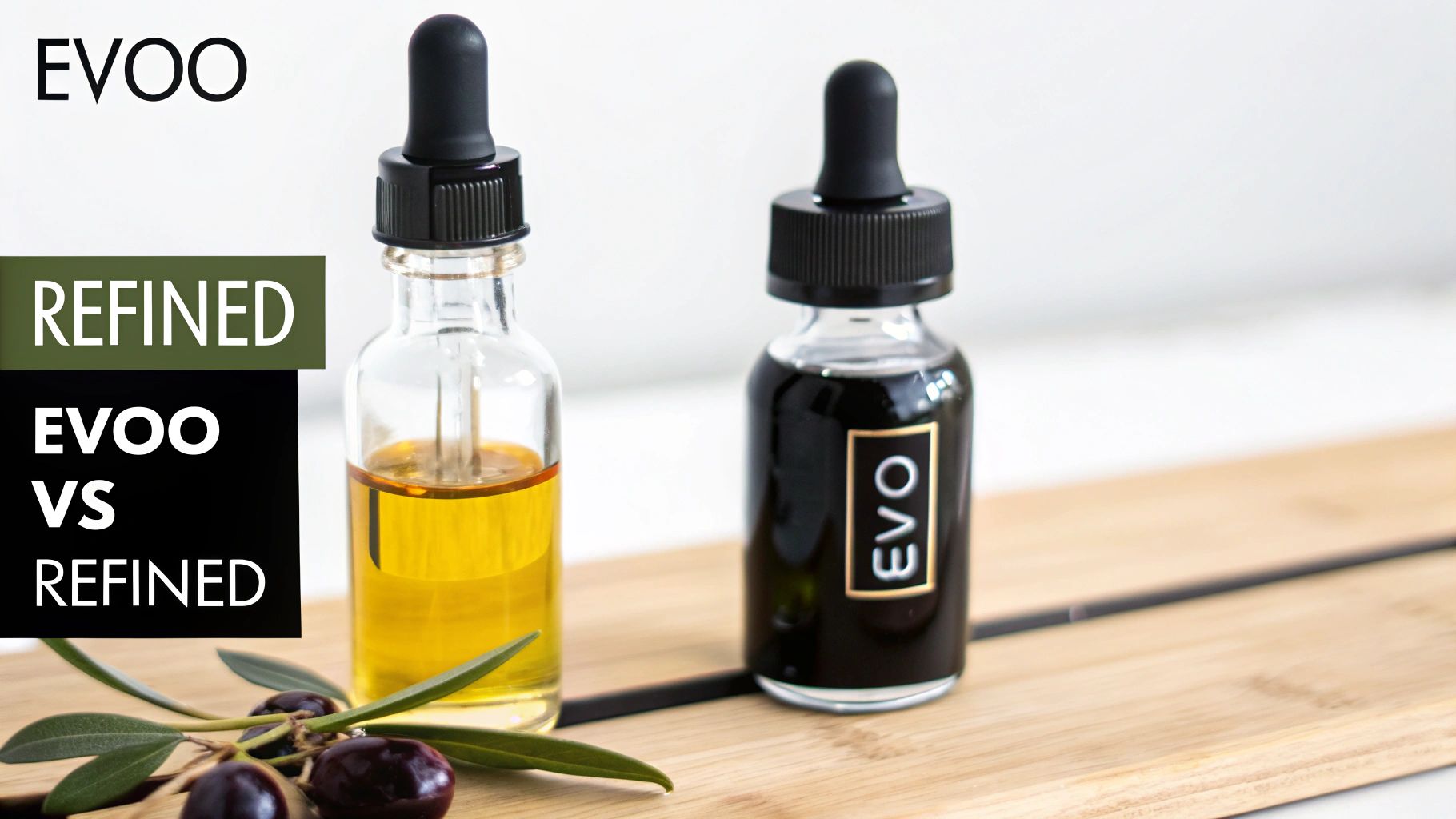
It all boils down to one critical factor: processing. The more an oil is processed, the higher its smoke point tends to be. This is the fundamental trade-off with every bottle—a choice between robust, natural flavor and high-heat stability.
The Purity of Extra Virgin Olive Oil
Think of Extra Virgin Olive Oil (EVOO) as the purest expression of the olive. It’s essentially fresh-squeezed juice, cold-pressed from the fruit without any chemicals or intense heat. This gentle handling preserves its incredible flavor and health-boosting polyphenols, but it also leaves in the very things that make it more delicate.
These natural components—tiny particles of the olive fruit itself—are what give EVOO its unique character, its color, aroma, and that peppery finish we love. But under high heat, these same particles are the first to burn, which brings down the overall olive oil smoke temperature.
This is precisely why a high-quality EVOO is best used as a finishing touch, perfect for dressings, drizzling over pasta, or for a gentle sauté where its complex personality can shine without being scorched. To go deeper, it’s worth understanding the core differences in olive oil grades.
The Role of Free Fatty Acids
The main villain when it comes to low smoke points is something called a free fatty acid (FFA). In the world of fats, most molecules are stable, happy structures called triglycerides. But when those structures break apart—due to stress like bruised olives or a long delay before pressing—they release FFAs. These rogue molecules are volatile and unstable, and they start to smoke at much lower temperatures.
A low FFA level is the hallmark of a superior, well-made olive oil. It’s a sign that the olives were handled with care from tree to bottle, creating a more stable oil that can withstand more heat.
For an oil to earn the "extra virgin" label, its FFA level must be below 0.8%. The lower that number gets, the higher the quality of the oil and, usually, the higher its smoke point will be within the EVOO range. This explains why some EVOOs are much better for cooking than others.
The Engineering of Refined Olive Oil
Now, let's look at refined olive oil, the kind often labeled as "light" or just "olive oil." This oil starts out as a lower-grade virgin oil that didn't meet the standards for flavor or quality, often due to high FFA levels. To make it usable, it goes through an intense industrial purification process.
This refining journey is aggressive and involves several key steps:
- Neutralization: An alkaline substance is used to strip out all those pesky free fatty acids.
- Bleaching: The oil is filtered through activated clay or charcoal to remove pigments and other organic bits.
- Deodorization: High-pressure steam at blistering temperatures blasts away any unpleasant tastes and smells.
The end product is a pale, neutral oil with almost no flavor, color, or aroma. But in the process, nearly all the volatile compounds and FFAs—the very things that cause a low smoke point—have been completely removed.
That’s why refined olive oil is a high-heat champion. Stripped of its natural "impurities," it becomes incredibly stable and can boast a smoke point as high as 465°F (240°C). It’s an oil engineered for performance, not flavor, making it a perfect, affordable choice for deep-frying or searing when you need sustained high heat.
The Hidden Factors That Alter Your Oil's Smoke Point
That smoke point number you see on a bottle of olive oil? Think of it as a starting point—a best-case scenario measured in a pristine lab. But in your kitchen, the real-world smoke point is a moving target. A few powerful, and often invisible, factors can change it dramatically. Knowing what they are is the key to protecting your oil's flavor and getting the best results every time you cook.
The biggest influence, by a long shot, is how much the oil has been refined. We've touched on this already, but it's worth repeating: filtering and processing an oil strips out the tiny natural particles and free fatty acids that are the first to burn. This process essentially fortifies the oil against heat, giving it a much higher tolerance for high-temperature cooking like searing and frying.
The Power of Refinement
Refined olive oil is practically engineered for heat stability. By removing those so-called “impurities,” manufacturers create a product that can reach a smoke point of 390–465°F (199–240°C). This makes it a surprisingly tough and reliable choice for high-heat cooking, even outperforming many common seed oils in certain tests.
This resilience is why so many restaurant kitchens rely on it. It’s estimated that 75% of commercial frying in the U.S. uses refined olive oil, which can cut costs by up to 15% compared to using pricier virgin grades. The smoke point can vary within that range, and it all comes down to the free fatty acid content. Recent trials on premium Andalusian oils showed that levels below 0.3% can push the smoke point to 430°F or higher. If you're interested in the market side of things, you can find a report with olive oil production insights on certifiedorigins.com.
The smoke point on the label assumes a perfect, fresh oil. How you treat that oil from the moment you buy it determines whether it lives up to that number or fails you when you need it most.
Of course, this high heat tolerance comes at a price. The refining process strips away the nuanced, peppery, and grassy flavors that make extra virgin olive oil so special. It's a classic trade-off: you sacrifice character for a higher heat threshold.
Age and Storage: The Silent Saboteurs
Beyond how an oil is made, two silent killers are at work in your pantry: age and storage. Olive oil is a perishable food. It’s essentially fresh fruit juice, and it starts to break down from the moment it’s bottled. Over time, its three mortal enemies—oxygen, light, and heat—will systematically lower its smoke point.
Just picture that bottle of EVOO sitting on the counter right next to your stove. Every day, the sunlight from the window and the warmth from the cooktop accelerate the breakdown of its fats. This process increases the free fatty acid content, making the oil less stable and quietly causing its smoke point to drop.
This is why proper storage isn't just a friendly suggestion; it's a command for anyone who invests in good olive oil. Follow these non-negotiable rules:
- Keep it Cool: Your oil belongs in a cool, dark place like a pantry or cupboard. Keep it far away from the stove or a sunny windowsill.
- Keep it Dark: Always buy oil in dark glass bottles or opaque tins. These act as a shield, protecting it from damaging light.
- Keep it Sealed: Oxygen is the enemy. Screw the cap on tightly after every single use to keep air out.
A fresh, well-stored bottle of olive oil will perform just like you expect it to. An old, poorly stored one is an expensive disappointment waiting to happen. To really get a handle on this, it helps to understand the fundamentals of olive oil freshness and how it impacts everything from flavor to cooking performance.
Matching the Right Olive Oil to Every Cooking Method
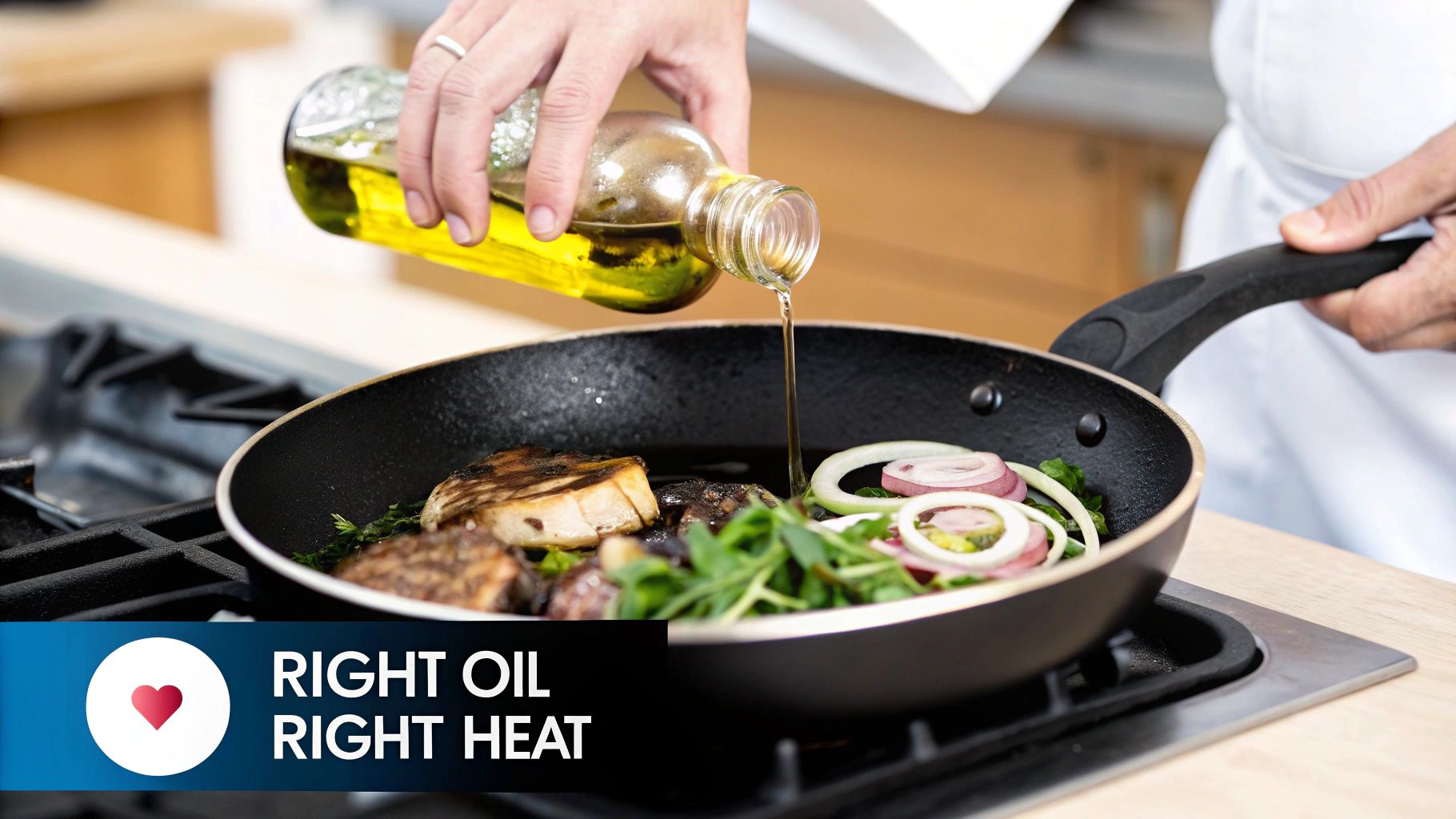
All this talk about smoke points is great, but how does it actually translate to your kitchen when you're making dinner? Let's move from the science to the stove and figure out which olive oil to grab for any cooking task. This is all about making sure you get fantastic results every single time, without a smoke alarm in sight.
Think of it this way: you wouldn't use a delicate finishing salt for brining a turkey, and the same principle applies here. The oil you choose for gently sweating onions should be different from the one that can handle the high heat of searing a steak. Getting it right is the secret to a sublime meal.
Sautéing and Pan-Frying
Sautéing is easily the most common cooking method, usually done over medium to medium-high heat. We're talking about a temperature range of 300°F to 350°F (150°C – 175°C). A good quality Extra Virgin Olive Oil is perfectly suited for this. Its smoke point is well above this range, so its complex, peppery flavors can infuse your food without any risk of burning.
For pan-frying, where you might push the temperature a bit higher toward 375°F (190°C), a high-quality EVOO is still a great pick. But if you're frying something breaded that needs a little more time in the pan, reaching for a virgin or refined olive oil gives you a bit more of a safety buffer. You'll get a clean taste and that perfect golden-brown crust.
The secret to a perfect sauté isn't just the ingredients; it's using an oil that complements, rather than competes with, your food. A good EVOO doesn’t just prevent sticking—it actively builds a layer of delicious flavor from the moment it hits the pan.
Roasting and Baking
When you pop a tray of vegetables or meat in the oven, you're usually setting it somewhere between 375°F and 425°F (190°C – 220°C). It sounds hot, but remember that the food's surface temperature is often lower due to its own moisture. This makes a robust Extra Virgin Olive Oil a fantastic choice for roasting; it adds incredible flavor and helps create that wonderful caramelized exterior we all love.
The same logic applies to baking. Most recipes hover around 350°F (175°C), which is well within the comfort zone for EVOO. Try swapping it in for neutral oils in cakes or muffins—it can add a subtle, fruity complexity that really elevates the final product. Getting familiar with the different olive oil types for cooking will make you a pro at picking the right one for any recipe.
Searing and High-Heat Frying
Searing is all about creating that deep, flavorful crust on meat or fish, and it demands high, direct heat—often climbing to 400°F to 450°F (205°C – 232°C). At these temperatures, the smoke point isn't just a suggestion; it's a critical factor.
This is where refined ("light") olive oil truly shines. With its impressive smoke point reaching up to 465°F (240°C) and a much more neutral flavor, it's the ideal choice for these intense cooking jobs. It lets you get that perfect sear without a cloud of acrid smoke taking over your kitchen.
To make things even simpler, here’s a quick-reference table to help you match the right olive oil to your cooking method.
Matching Olive Oil to Your Cooking Method
This table is your go-to guide for pairing common cooking techniques with their typical temperatures and the best olive oil for the job.
| Cooking Method | Typical Temperature (°F) | Recommended Olive Oil Type | Why It Works |
|---|---|---|---|
| Sautéing | 300°F – 350°F | Extra Virgin | Adds rich flavor and remains stable at medium heats. |
| Roasting | 375°F – 425°F | Extra Virgin or Virgin | The oil’s flavor enhances vegetables and meats beautifully. |
| Pan-Frying | 350°F – 375°F | Virgin or Refined | Provides a higher heat tolerance for crisping foods. |
| Searing | 400°F – 450°F | Refined ("Light") | Its high smoke point prevents burning and off-flavors. |
By keeping these simple guidelines in mind, you can cook with confidence, knowing you're not only protecting the flavor of your oil but also getting the most delicious results from your food.
Frequently Asked Questions About Cooking with Olive Oil
Let's clear the air and finally put some of the most persistent olive oil myths to rest. We're going to tackle the biggest questions home cooks have, armed with straight-up facts and a little bit of science. This is where we separate long-held fiction from culinary fact, so you can feel completely confident every time you reach for that bottle.
Is It Unsafe to Cook with Extra Virgin Olive Oil?
This is, without a doubt, the single biggest misunderstanding about olive oil. The rumor that you can't—or shouldn't—heat extra virgin olive oil is just plain wrong. It is perfectly safe.
A quality EVOO has a smoke point that usually falls somewhere between 375°F and 410°F. Now, think about your everyday cooking. A typical sauté sizzles along at around 320°F, which is well below the oil's breaking point.
The idea that it’s somehow dangerous is simply a myth. In fact, high-quality EVOO is loaded with stable monounsaturated fats and protective antioxidants, which actually make it more stable under heat than many other common oils. It’s not just safe for sautéing, roasting, and baking—it's fantastic for it. The only time you might want to grab a different oil is for extreme-heat searing or deep-frying, where a highly refined oil is still king.
What Happens to the Health Benefits When I Heat It?
This question gets right to the heart of why so many of us choose olive oil in the first place. People worry that a hot pan will destroy all the good stuff, but that concern is mostly overblown.
The main health benefit of olive oil comes from its high concentration of oleic acid, a famously heat-stable monounsaturated fat. This powerhouse fat stays intact and beneficial even when you cook with it. While it's true that very high heat can start to degrade some of the more delicate polyphenols and antioxidants, the loss isn't nearly as dramatic as you'd think.
The real damage doesn’t come from gently heating your oil; it happens when you push it past its smoke point. That’s the true point of no return, where beneficial compounds break down and harmful ones can form. As long as you stay below that point, cooking with olive oil is a far healthier choice than using many other fats.
So, while you'll get the absolute biggest antioxidant hit by using it raw in a vinaigrette, you're still making an excellent, healthy choice by using it in your pan.
How Can I Tell if My Oil Is About to Smoke?
Your own senses are the best tools you have. Learning to read the signals from the oil in your pan is the secret to perfect temperature control.
Long before it starts to smoke, a properly heated oil will begin to shimmer. You’ll see delicate, wavy lines moving across its surface as it becomes noticeably thinner, flowing almost like water. This shimmering is your green light—it's the perfect moment to add your food.
If you start to see thin wisps of blue-gray smoke rising from the surface, you’ve hit the olive oil smoke temperature. It will have a sharp, acrid smell that’s impossible to miss. Don't confuse this with the harmless steam that billows up when you add moist food to a hot pan. If your oil is truly smoking, its flavor is already ruined. The best thing to do is carefully discard it, wipe the pan clean, and start over with slightly lower heat.
Does Adding Food Stop the Oil from Smoking?
It absolutely does, and this isn't just a happy accident—it’s a fundamental cooking technique that pros use to manage heat. This is precisely why preheating your pan and oil is so important.
When you add your ingredients (which are almost always at room temperature or colder), they immediately cause the temperature of the oil and the pan to drop.
By getting the oil hot and shimmering before you add anything, you ensure the temperature settles into the perfect cooking zone. This lets you get a fantastic sear without ever risking a burnt, smoky mess. If you add food to cool oil, the pan will struggle to heat up, steaming your ingredients instead of browning them. Mastering this one simple sequence—heat the pan, then the oil, then add the food—is the key to getting great results every time.
At Learn Olive Oil, we believe that understanding the 'why' behind the 'how' makes you a better, more intuitive cook. From the groves to your table, we're here to make the world of olive oil simple, enjoyable, and rewarding.
Discover the World of Premium Olive Oil at https://learnoliveoil.com

 Learn Olive Oil
Leave a comment