The secret to any bottle of olive oil is hidden in plain sight. It all comes down to a deceptively simple question: was the oil merely pressed from the fruit, or did it need a rescue mission? A true Extra Virgin Olive Oil is nothing more than the fresh, cold-pressed juice of olives. That’s the whole story.
Lower grades, those bottles labeled 'Light' or simply 'Olive Oil', are a different animal entirely. These are born from a process of correction, refined with heat and sometimes solvents to erase flaws. The result is a neutral, lifeless oil—a ghost of what it could have been.
Why All Olive Oil Is Not Created Equal
Take a moment to consider that bottle of olive oil sitting in your pantry. It likely holds more secrets than you realize. It's dangerously easy to grab a bottle labeled 'extra virgin' and assume you've bought the best, but the truth is far more intricate, and far more rewarding.
The journey an olive takes—from a sun-drenched grove, through a modern mill, and finally to your kitchen—is what forges its character, its health benefits, and its rightful place in your cooking. This isn't just about a label; it's about a process. A commitment.
This guide will shatter the myth that all olive oils are interchangeable. We are going to peel back the marketing jargon to reveal the agriculture, the science, and the culinary tradition that determine what’s really inside that bottle.
A First Glance at the Core Distinctions
Grasping the fundamental categories is your first step toward making smarter, more confident choices in the grocery aisle. Knowing what truly separates one oil from another will not only make you a more masterful cook but can elevate a simple dish into something truly memorable.
Here’s a quick summary to arm you with the basics. This table lays out the main olive oil grades you'll encounter, highlighting what truly sets them apart.
Olive Oil At a Glance
| Olive Oil Type | Processing Method | Acidity Level | Common Use Case |
|---|---|---|---|
| Extra Virgin Olive Oil | Mechanical (Cold-Pressed) | Very Low (<0.8%) | Drizzling, Dressings, Sautéing |
| Virgin Olive Oil | Mechanical (Cold-Pressed) | Low (<2.0%) | General Cooking, Marinades |
| Refined Olive Oil | Chemical/Heat Processed | Very Low (Post-Refining) | High-Heat Frying, Baking |
| Olive Pomace Oil | Solvent Extraction | Varies | Industrial Food Production |
Do you see that acidity level? It’s one of the most critical, non-negotiable markers of quality and purity. To truly understand why this number is a gatekeeper for excellence, you can discover the crucial role of olive oil acidity.
Mastering this single factor is a powerful shortcut to identifying a superior oil. It’s the kind of insider knowledge that separates a confused shopper from a confident, well-informed cook.
How Olive Oil's Journey Shapes Its Quality
The real story of an olive oil begins long after the olives leave the tree. While the fruit itself sets the stage, the journey from grove to bottle is what truly defines the final product. It’s a process that splits into two distinct paths: one rooted in careful craftsmanship, the other in industrial efficiency.
True Extra Virgin Olive Oil is purity in a bottle. Think of it as fresh-squeezed olive juice, extracted using only mechanical methods. No high heat, no chemical solvents—just gentle pressure that preserves the oil’s most delicate and valuable components: its vibrant flavors, rich aromas, and powerful health benefits.
This is the very soul of the term 'first cold press'. While modern producers use centrifuges rather than old-school presses, the core principle is sacrosanct. The temperature is strictly kept below 27°C (around 80°F) to protect the fragile phenols and antioxidants that make an oil exceptional.
Choosing to cold-press is a deliberate trade-off: quality over quantity. You get less oil from the fruit, but what you do get is liquid gold—nutritionally potent and bursting with the authentic taste of the olive itself.
This meticulous, artisanal method stands in stark contrast to the way refined oils are born. Those oils typically start with lower-quality olives—fruit that might be damaged, overripe, or simply not worthy of the extra virgin standard.
Craftsmanship vs. Correction
To make these lesser oils usable, they are subjected to an intense industrial refining process. This involves high heat, deodorization, and chemical solvents designed to strip away flaws, foul odors, and any off-flavors. While the process salvages the oil, it also wipes out nearly all of its natural character and beneficial compounds.
The end product is a bland, neutral oil often sold simply as 'Olive Oil' or 'Light Olive Oil'. The difference is as clear as night and day: one method is about preservation, while the other is about correction. One is an art; the other is a rescue mission. For a closer look at the equipment and steps, you can dive into the details of how olive oil is made.
Global Harvests and What They Mean for You
Beyond the mill, the quality and availability of the olive oil you buy are profoundly influenced by global agriculture. A single bad weather year in a key region can trigger dramatic shifts in harvests, impacting the price and consistency of the oil on your local shelf.
The world's olive oil supply hinges on the fortunes of just a few countries. For example, in a recent crop year, Spain—the world’s largest producer—was projected to yield about 1.3 million tons out of a global total of roughly 3.1 million tons. Meanwhile, a severe drought in Italy was expected to slash its output to between 170,000 and 200,000 tons, a catastrophic fall from previous years. On the other hand, good weather in Greece was set to boost its production to nearly 250,000 tons. You can read more about these trends in the global olive oil production forecasts on oleista.com.
These regional fluctuations send shockwaves across the entire market. A poor harvest in Spain can lead to global shortages and higher prices, sometimes tempting producers to blend oils from different sources to keep up with demand. This is why understanding the whole journey—from the quiet olive grove to the bustling global marketplace—is so critical for anyone who cares about finding true quality.
A Practical Comparison of Olive Oil Grades
Stepping into the olive oil aisle can feel like a pop quiz you didn't study for. Labels shout terms like "Extra Virgin," "Pure," and "Light," but what do they truly signal about the liquid inside? Understanding these official grades is the key to moving beyond marketing claims and making choices that will genuinely elevate your cooking.
The differences aren't just about subtle flavor notes; they represent entirely different products forged by wildly different processes. One is a raw, vibrant fruit juice, while another is a heavily refined commodity. Choosing the right one is less about finding the "best" and more about matching the right tool to the right job.
Let's break down what these grades actually mean for your kitchen.
Extra Virgin: The Gold Standard of Purity
At the absolute pinnacle of the hierarchy sits Extra Virgin Olive Oil (EVOO). This isn’t just a fancy name; it’s a strict legal and chemical definition. To earn this title, an oil must be extracted solely through mechanical means—no heat, no chemical solvents.
It then has to pass rigorous lab tests and, just as importantly, a sensory evaluation by a certified panel of tasters.
Crucially, its free fatty acid level (a key indicator of quality) must be below 0.8%. But the real magic of EVOO lies in what this gentle process preserves: a complex bouquet of aromas, flavors, and powerful health-promoting compounds. That peppery tickle you feel at the back of your throat from a high-quality EVOO? That's the signature of oleocanthal, a potent anti-inflammatory polyphenol you simply won't find in lower grades. To really grasp what sets it apart, it helps to understand the full meaning of extra virgin olive oil.
Virgin Olive Oil: Good, but Flawed
Just one step below EVOO is Virgin Olive Oil. Like its extra virgin cousin, it’s produced without heat or chemicals. It is, for all intents and purposes, pure, unrefined olive juice.
So, what’s the difference? Quality. Virgin olive oil has minor defects in flavor or aroma and a slightly higher acidity level, allowed up to 2.0%. It’s still a good, unadulterated oil, but it just doesn't meet the flawless standard required for the "extra" designation. You’ll rarely see this grade on store shelves in many countries, as producers often refine it instead.
Think of it this way: If EVOO is the flawless, prize-winning fruit, Virgin Olive Oil is the slightly bruised but still perfectly edible apple from the same tree. It’s natural and wholesome, just not perfect.
The visual below shows just how vast the spectrum of flavor can be, from the robust notes of a great EVOO to the near-total neutrality of refined oils.
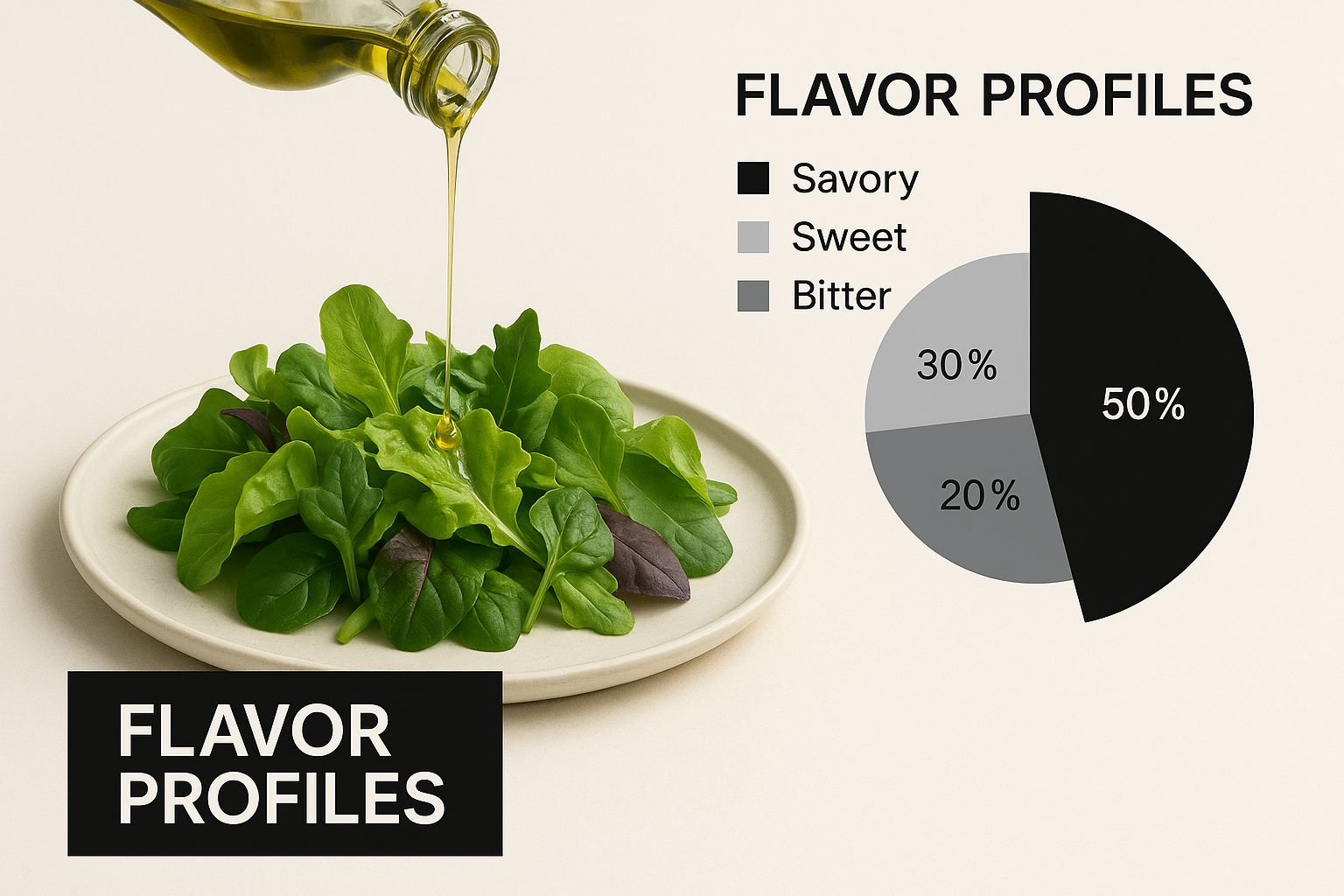
This spectrum makes it clear that the journey from fruit to bottle directly shapes the final taste, with EVOO offering by far the most complex and vibrant character.
Refined Olive Oil: The Neutral Workhorse
Now we enter a completely different category. Oils labeled simply "Olive Oil," "Pure Olive Oil," or "Light Olive Oil" are made almost entirely from refined olive oil. These products start out as virgin oils with significant defects—think high acidity or an unpleasant taste—that make them unfit for consumption on their own.
They undergo an industrial process using heat, charcoal filters, and other agents to strip away these flaws. This refining process neutralizes the flavor, removes the color, and unfortunately destroys virtually all the beneficial polyphenols and antioxidants. The result is a bland, pale yellow oil.
To give it some semblance of olive oil character, producers blend in a small amount of EVOO or Virgin Olive Oil (usually just 5-15%) before bottling.
The following table lays out the key differences to help you decide which oil to grab for the job at hand.
Olive Oil Grade Comparison
| Attribute | Extra Virgin Olive Oil (EVOO) | Virgin Olive Oil | Refined Olive Oil ('Light'/'Pure') |
|---|---|---|---|
| Production Method | Mechanical, cold-pressed, no heat or chemicals. | Mechanical, no heat or chemicals. | High heat and chemical refining, then blended. |
| Flavor Profile | Complex, from fruity and grassy to peppery and bitter. | Mild olive flavor with noticeable sensory defects. | Neutral, bland, and nearly flavorless. |
| Polyphenol Content | High (100-1000+ mg/kg). Rich in antioxidants. | Moderate, but lower than high-quality EVOO. | Extremely low. Benefits are stripped during refining. |
| Smoke Point | 375-410°F (190-210°C) | Around 390°F (200°C) | Higher, up to 465°F (240°C) due to refining. |
| Best For | Finishing, dressings, sautéing, roasting, dipping. | General cooking where a mild olive flavor is desired. | High-heat frying, baking, when a neutral oil is needed. |
Ultimately, choosing the right grade isn't about superiority; it's about purpose. An assertive EVOO is a finishing touch, a condiment to make a dish sing. A refined oil is a functional tool for high-heat applications where you want the ingredients, not the oil, to be the star.
How Global Trade Shapes Your Olive Oil Choices
The journey olive oil takes from a sun-drenched grove to your kitchen is rarely a straight line. It’s a complex voyage shaped by global economics, national appetites, and trade agreements that create massive differences in the bottles you see on the shelf. What's available in your local store is a direct result of who produces the most, who consumes the most, and how those powerful forces interact.
Getting a handle on this global chess match is your best defense against a market filled with smoke and mirrors. It explains why prices swing wildly from one season to the next, why the country of origin on a label tells a crucial story, and how economic pressures can sometimes compromise the authenticity of the oil itself.
This isn't just abstract economics; it's the hidden story inside every bottle.
Spain: The Global Export Powerhouse
When you think of olive oil production, think of Spain. It’s the undisputed giant in the room. As the world's largest producer and exporter, Spain's market movements set the pace for everyone else. Its massive, efficient groves produce a torrent of olive oil that flows to nearly every corner of the globe, dictating both availability and cost.
This dominance means that Spanish olive oil often forms the backbone of many blended products you see on shelves. A bottle might scream "Italy" from its label, but a closer look at the fine print often reveals a blend of oils sourced from Spain or other Mediterranean countries. This practice isn't necessarily a bad thing, but it shows why you can't always judge an oil by its brand's nationality.
The sheer scale of Spanish exports directly impacts what you pay. A bumper harvest in Andalusia can lower the price of a bottle in Ohio, a reality we break down in our guide on understanding extra virgin olive oil prices.
Italy: The Insatiable Consumer
While Italy is famous for its legendary olive oil culture, it has a big secret: it can’t produce nearly enough to satisfy its own people. Italian domestic consumption is so high that the country is both a major exporter and one of the world's largest importers of olive oil.
To meet this relentless demand, Italian companies frequently bring in bulk oil from Spain, Greece, and Tunisia. They then blend these imported oils with their own to create the products sold under familiar Italian labels. This is a perfectly legal and common industry practice, but it highlights the crucial difference between "bottled in Italy" and "product of Italy."
"Bottled in Italy" simply tells you where the final packaging happened. "Product of Italy" should mean the olives were grown and pressed there. That distinction is everything if you're looking for the unique terroir of a specific Italian region.
The Rise of New Contenders
The global market isn't just a two-player game between Spain and Italy. Other nations are increasingly making their mark, shipping high-quality, single-origin oils directly to consumers who are hungry for authenticity.
Greece, with its ancient olive traditions and unique varietals like Koroneiki, is a key player. Likewise, Tunisia has emerged as a major force, using its favorable climate to become a significant producer of high-quality extra virgin olive oil. These countries are starting to challenge the old model of just selling their oil in bulk to be blended and bottled elsewhere.
Recent trade figures show these shifting dynamics in sharp relief. Spain remains the leader, exporting around 944,000 metric tons in a recent season. Italy followed with 307,000 tons, but Tunisia and Greece showed their growing strength, exporting 251,000 and 231,000 tons, respectively. You can dive deeper into these global olive oil trade volumes on exportimportdata.in.
This trend is fantastic news for anyone who loves good olive oil. It means more choices, greater transparency, and more chances to taste oils that truly reflect the place they came from. It also means the differences between oils are becoming more pronounced, offering a richer and more diverse world to explore.
Matching the Right Oil to the Right Dish
Using the wrong olive oil can ruin a dish. The right one? It can make it sing. This simple truth is often what separates a good home cook from a great one. All the knowledge about acidity, polyphenols, and production methods only becomes powerful once you put it to work in your kitchen.
Think of this as your practical playbook for culinary success. Let's move beyond abstract rules and dive into specific, real-world scenarios that show you exactly how to match the oil to the meal. It's time to make every drop of oil in your pantry count.
For Bold Finishing and Uncooked Dishes
When a dish is done cooking, that final drizzle of oil isn't just a garnish—it's a critical flavor component. This is the moment for your most assertive, high-quality Extra Virgin Olive Oil to shine. Treat it like a condiment, not just a cooking fat.
A bold, grassy Tuscan EVOO with a peppery kick, for instance, provides the perfect counterpoint to a rich, grilled steak or a hearty bean soup. That pungent bite cuts through the fat and adds a layer of complexity that salt and pepper alone can never achieve. But drizzling that same powerful oil over a delicate piece of poached cod would be a disaster; it would completely overwhelm the fish.
- Steak and Roasted Meats: Reach for a robust EVOO with high polyphenol content.
- Hearty Soups and Stews: A grassy, pungent oil adds a burst of freshness at the end.
- Bruschetta and Dipping: Let your best, most flavorful oil be the star of the show.
- Bitter Greens Salad: You need a strong oil to stand up to the boldness of arugula or radicchio.
For Delicate Dressings and Everyday Sautéing
Not every dish calls for a flavor bomb. For lighter applications, a milder, more buttery EVOO is your secret weapon. These oils—often from Spain (like those made from the Arbequina olive) or parts of Southern France—offer fruity notes without the aggressive bitterness or pepperiness of their more intense counterparts.
This makes them perfect for vinaigrettes where you want the vinegar or lemon juice to take the lead, with the oil providing a smooth, rich foundation. This type of EVOO is also a true workhorse for everyday sautéing. Its smoke point is more than high enough for cooking vegetables or chicken breasts over medium heat, and it imparts a subtle, pleasant flavor that enhances ingredients rather than masking them.
The key is balance. You're looking for an oil that contributes character without stealing the spotlight. It's the supporting actor that makes the star look even better.
For Baking and High-Heat Cooking
Now, let's clear up the role of refined olive oil—the kind often labeled simply "Olive Oil" or "Light Olive Oil." Its greatest strengths are its neutrality and its high smoke point, which can climb as high as 465°F (240°C).
This is the bottle to grab when you're deep-frying, searing a scallop, or baking a cake where you don't want any olive flavor to intrude. Using a powerful EVOO in a delicate lemon pound cake would introduce unwanted grassy or bitter notes. The neutral character of a refined oil ensures the lemon and butter remain the heroes. Plus, its stability at high temperatures makes it a safer, more reliable choice for frying, preventing the oil from breaking down and creating off-flavors.
Making the right choice boils down to understanding the role the oil plays. Are you adding a finishing flavor, or do you just need fat for cooking? Answering that simple question will guide you to the right bottle nearly every time. For a deeper dive, check out our complete guide to choosing the right olive oil types for cooking. This is where the differences truly matter, turning a good meal into an unforgettable one.
Still Have Questions About Olive Oil?
Even after getting the basics down, a few common questions always seem to pop up. Let's clear up some of the most persistent myths and confusing points so you can feel more confident at the grocery store and in your own kitchen.
Can I Actually Cook With Extra Virgin Olive Oil?
Yes, you absolutely can. This is probably one of the biggest and most stubborn myths out there. A good quality extra virgin olive oil has a smoke point somewhere between 375°F and 410°F (190-210°C), which is plenty high for most home cooking, including sautéing and even pan-frying.
What makes EVOO stable enough for cooking? It’s packed with stable monounsaturated fats and protective antioxidants. While you probably wouldn't waste your priciest, most aromatic finishing oil on high-heat searing, a solid everyday EVOO is a healthy, safe, and flavorful option for almost all your cooking needs.
What Does "Light" Olive Oil Mean, Anyway?
"Light" is just a marketing term. It refers to the oil's light flavor and color—it has nothing to do with calories or fat. All olive oils have the same number of calories, spoonful for spoonful.
"Light" olive oil is really just refined olive oil. It's been processed with heat and filters, which strips out the natural color and that classic olive taste, leaving a very neutral product. That neutrality makes it a decent choice for things like high-heat frying or certain baking recipes where you want a fat but don't want any olive flavor coming through.
Remember this: 'Light' means a light taste, not a lighter impact on your diet. The real choice between light oil and EVOO comes down to flavor and what you're cooking, not health.
What’s the Right Way to Store Olive Oil?
Olive oil has three mortal enemies: oxygen, light, and heat. Protecting your oil from these three is the key to keeping it fresh and preserving all its health benefits. The best spot for it is in a cool, dark place like a pantry—definitely not sitting on the counter right next to your stove.
Make sure you seal the cap tightly after each use to keep air out. The best containers are dark green glass bottles or tins that don't let any damaging light through. For the best taste, try to use your oil within 12-18 months of the harvest date and finish an open bottle within a few months.
At Learn Olive Oil, we believe that knowing these details is what takes your cooking from good to great. Dive into the world of premium olive oil with our expert guides and handpicked recommendations. Start your journey and elevate your appreciation for this liquid gold!

 Learn Olive Oil
Leave a comment