The words "extra virgin olive oil" aren't just a fancy label on a bottle you grab at the supermarket—they are a legally protected promise. A promise of unmatched quality, absolute purity, and flavor that can transform a meal from ordinary to unforgettable.
Think of it as the freshly squeezed, unadulterated juice of the olive, meticulously produced to preserve every ounce of its natural goodness and profound health benefits. It's the highest grade of olive oil money can buy, and frankly, it's the only one you should ever want in your kitchen.
What Exactly Makes Olive Oil “Extra Virgin”?
Walk down any supermarket aisle and you'll be met with a confusing wall of olive oil. You’ll see bottles labeled "Pure," "Light," or just "Olive Oil," all clamoring for your attention, often with a much smaller price tag. But here’s a secret the big food companies don’t want you to know: most of these are pale, lifeless imitations of the real thing.
The extra virgin olive oil definition isn't some clever marketing slogan. It’s a strict, internationally recognized standard, as precise as the classifications for a world-class wine. It certifies that an oil has passed a grueling series of chemical and sensory tests designed to prove its superior quality.
More Than Just Another Cooking Oil
Viewing authentic EVOO as just another cooking fat is like comparing a glass of freshly squeezed orange juice to a sugary, watered-down concentrate. They simply aren't in the same league. Real extra virgin olive oil delivers a complex, aromatic experience and a treasure trove of health-promoting compounds that are utterly destroyed in the production of lesser oils.
The stakes for your pantry and your well-being are surprisingly high. Choosing the right bottle means unlocking a world of benefits:
- Vibrant, Nuanced Flavors: Real EVOO can be the star of a meal. Its notes can dance from peppery and pungent to grassy and buttery, elevating everything from a humble salad to a perfectly grilled steak.
- Powerful Health Benefits: It’s brimming with antioxidants and anti-inflammatory compounds, like oleocanthal, that you won't find in refined oils.
- True Value for Your Money: Cheaper oils might seem like a bargain, but you're paying for a ghost—a product stripped of almost all its taste and nutritional value.
To give you a quick, clear picture, let's break down the core pillars of what makes an olive oil truly "extra virgin."
Extra Virgin Olive Oil at a Glance
This table reveals the strict criteria an oil must meet to earn the coveted EVOO classification. It’s a tough club to get into.
| Defining Pillar | What It Means in Simple Terms |
|---|---|
| Mechanical Extraction | The oil is extracted using only physical force (pressing or spinning), with zero chemicals or high heat. It’s the fresh, unadulterated juice of the olive. |
| Low Free Acidity | Must have a free acidity level of less than 0.8%. This chemical test is a direct measure of the oil's quality and the health of the fruit it came from. |
| Low Peroxide Value | Must be below 20 meq O2/kg. This test reveals the extent of oxidation, essentially a measure of how fresh the oil is right now. |
| No Sensory Defects | A trained tasting panel must find zero flavor defects (like musty, rancid, or metallic tastes). The oil has to be perfect to the human palate. |
| Positive Fruitiness | The oil must have a noticeable and pleasant fruity flavor, which can be grassy, peppery, or even buttery. It must taste like fresh olives. |
These pillars work in concert, ensuring that every bottle labeled "extra virgin" is a pure, flavorful, and profoundly healthy product.
Choosing real extra virgin olive oil is an investment in your food and your health. It’s about moving beyond a generic ingredient and embracing a product with character, integrity, and a story that begins in the olive grove.
This guide will arm you with the knowledge to see past the confusing labels and confidently spot the difference between a genuine treasure and a cleverly disguised imposter. We'll explore the science, the sensory experience, and the production process that sets this liquid gold apart. Understanding the difference between virgin and extra virgin olive oil is a fantastic place to start your journey.
By the end, you'll see exactly why this strict definition is your best defense in the search for quality.
The Unseen Science in Every Perfect Bottle
Behind the romantic image of sun-drenched olive groves lies cold, hard science. It's in the sterile environment of a laboratory where the real story of an extra virgin olive oil is told, where chemical markers serve as the unwavering guardians of quality.
These standards aren't just arbitrary numbers; they are the chemical proof of a producer's commitment to excellence, from the moment an olive is picked to the second the bottle is sealed. They provide the first and most powerful line of defense against the widespread fraud and mislabeling that plague the olive oil industry.
The Freshness Test: Free Fatty Acidity
Imagine biting into a crisp, perfect apple. Now, picture that same apple after it's been dropped and bruised. That damaged spot immediately begins to break down. A similar process happens with olives. This decay releases fatty acids, and Free Fatty Acidity (FFA) is the scientific measure of that damage.
An oil with high FFA comes from olives that were bruised, overripe, smashed during harvest, or left to rot in a pile for too long before milling. It's a direct reflection of the fruit's condition and the care taken throughout the entire process. The rule is simple and unforgiving: the lower the FFA, the healthier the fruit and the fresher the oil.
To qualify as extra virgin, an olive oil must have a Free Fatty Acidity of less than 0.8%. This isn't a suggestion; it's a non-negotiable ceiling. Top-tier producers, however, often aim for exceptionally low levels—sometimes as little as 0.1-0.3%—as a true mark of their craft.
This stringent requirement ensures that only oil from the absolute best, most carefully handled olives can ever earn the "extra virgin" title. It's why EVOO commands a premium price—a price that reflects its demanding standards. With the United States being the world's largest importer of olive oil, consuming 35-40% of global imports, there's a huge demand for this top-tier quality. You can find more details in this in-depth olive oil market analysis from Fortune Business Insights.
The Shelf-Life Test: Peroxide Value
If acidity tells us about the oil's condition at birth, Peroxide Value (PV) tells us how well it's aging. The moment oil is pressed, it begins a battle with oxygen in a process called oxidation—the same chemical reaction that makes other fats and oils go rancid.
Peroxide value is a snapshot of how much oxidation has already occurred. A high number means the oil is on a fast track to becoming stale, losing its vibrant flavors, wonderful aromas, and potent health benefits. This is often caused by poor storage, exposure to heat and light, or simply old age.
To be classified as extra virgin, an oil must have a Peroxide Value of less than 20 meq O2/kg. This helps guarantee that the oil was fresh when bottled and has been properly protected from the elements that cause it to degrade. These chemical benchmarks are critical, as they also protect the powerful antioxidants that make EVOO so valuable. To dive deeper into this, you can learn more about olive oil polyphenol content here.
The pyramid below helps visualize how these scientific standards create a foundation for the quality, purity, and flavor that we expect from a true extra virgin olive oil.
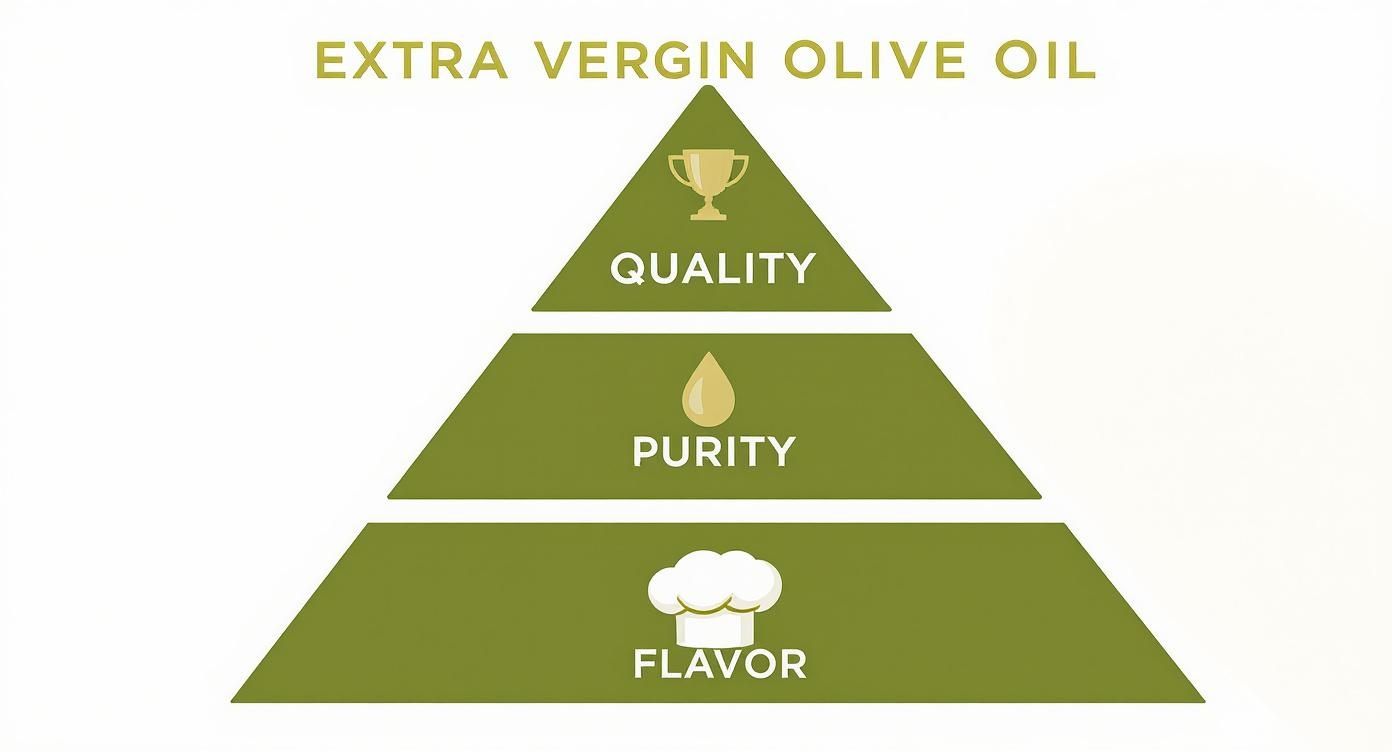
As you can see, you can't have exceptional flavor without purity, and you can't have purity without meeting the highest quality standards.
These two scientific tests—FFA and Peroxide Value—are the invisible backbone of the extra virgin olive oil definition. They provide an objective, undeniable measure of an oil's integrity, ensuring that what's inside the bottle is as pristine as the label promises.
Official Grades of Olive Oil: A Chemical Comparison
To put EVOO's high standards into perspective, it's helpful to see how it stacks up against other common grades of olive oil. This table breaks down the key chemical differences.
| Olive Oil Grade | Maximum Free Acidity | Peroxide Value (meq O2/kg) | Sensory Standard |
|---|---|---|---|
| Extra Virgin Olive Oil | ≤ 0.8% | ≤ 20 | No defects, fruity taste |
| Virgin Olive Oil | ≤ 2.0% | ≤ 20 | Minor defects allowed |
| Refined Olive Oil | ≤ 0.3% | ≤ 5 | No sensory standard (processed) |
| Olive Oil | ≤ 1.0% | ≤ 15 | No sensory standard (blend) |
The numbers don't lie: the requirements for extra virgin olive oil are in a class of their own, guaranteeing not just chemical purity but also the absence of any taste defects.
Why It Must Taste and Smell Perfect
Lab reports and chemical analyses are just the first hurdle. Think of them as the passport an oil needs to even be considered for the "extra virgin" title. But the lab only tells half the story. The final judgment—the one that separates a merely good oil from a truly exceptional one—doesn't happen in a test tube. It happens on the palate of a trained taster.
An oil can have a perfect chemical profile—low acidity, low peroxides—and still fail to make the cut. Why? Because the extra virgin olive oil definition demands a level of sensory perfection that science alone cannot measure. It has to be flawless.
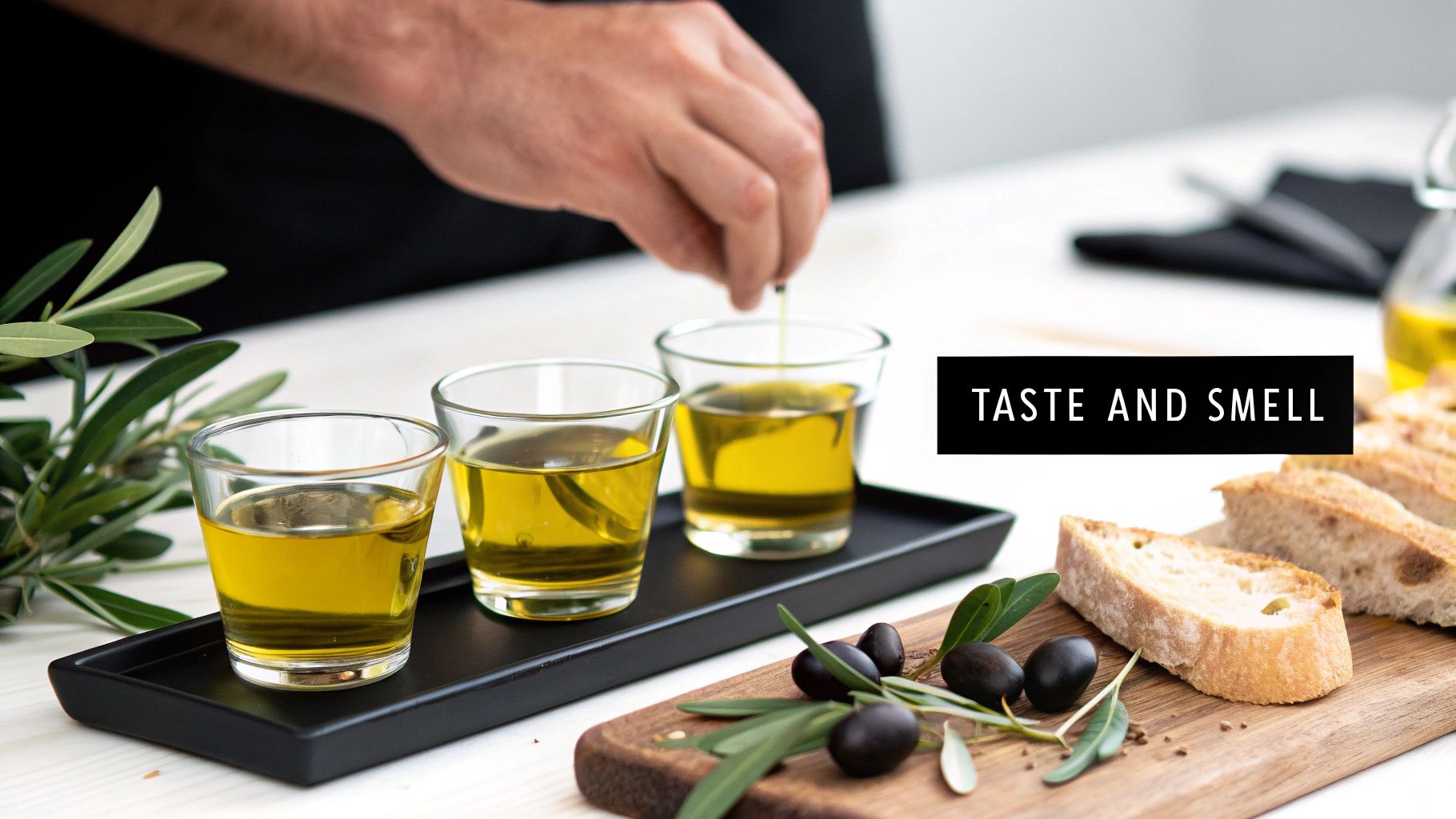
This is where the fascinating world of organoleptic assessment comes into play. Highly trained tasting panels act as the ultimate guardians of quality, and for them, there are two simple, non-negotiable rules.
The First Rule: Zero Defects Allowed
The first rule is one of absolute purity: an extra virgin olive oil must have zero taste or aroma defects. Not even a whisper of something being "off." It’s like a world-class orchestra—one musician hitting a single sour note can ruin the entire performance.
These defects are storytellers, revealing that something went terribly wrong somewhere between the olive grove and the bottle. Their names are wonderfully descriptive:
- Rancid: The most common flaw, smelling like old walnuts, stale crackers, or even wax crayons. This is the tell-tale sign of oxidation from age or improper storage (too much light, heat, or air).
- Fusty: This is the unpleasant smell of sweaty socks or a pile of olives that have started to ferment. It’s what happens when harvested olives sit in piles for too long before being crushed.
- Musty: An earthy, damp, or moldy aroma that screams that moldy fruit was used to make the oil.
- Winey-Vinegary: A sharp, sour note, like vinegar or nail polish remover. This is caused by aerobic fermentation when the olive paste is exposed to too much air.
If a professional taster detects any of these flaws, the oil is immediately disqualified. It cannot be called extra virgin. End of story.
The Second Rule: Fruitiness Is Mandatory
Once an oil proves its complete lack of flaws, it faces the second test. It has to taste and smell like what it is: the juice of fresh, healthy olives. This positive attribute is simply called fruitiness. It’s the vibrant, lively character that confirms the oil was made from fruit harvested at its absolute peak.
But "fruitiness" isn't just one flavor. It's a whole symphony of potential aromas and tastes that make exploring different oils so exciting.
An oil’s fruitiness is its personality. It can be delicate and buttery, with hints of ripe apple and almond, or it can be bold and green, with powerful notes of fresh-cut grass, artichoke, or green tomato leaf. Neither is better than the other; they are just different expressions of the olive's soul.
This fruitiness is the very heart of the oil. It’s what makes one bottle perfect for drizzling over a delicate fish and another the ideal companion for a hearty steak. The presence of these pleasant notes is every bit as important as the absence of defects.
Trusting Your Own Senses
You don't have to be a certified taster to start picking up on these qualities. With a little practice, your own palate is a surprisingly reliable guide. One of the most telling signs of a high-quality, fresh EVOO is often a peppery or pungent tickle in the back of your throat that might even make you cough.
Don't mistake this for a flaw—it's a hallmark of excellence! That peppery kick comes from oleocanthal, a powerful anti-inflammatory polyphenol found only in fresh, high-quality olive oil. You're literally tasting its health benefits. The best way to build your confidence is to learn the right technique, and you can easily master the art of how to taste olive oil with a few simple steps.
Ultimately, the sensory analysis ensures that the promise made in the lab is actually delivered to your kitchen. It guarantees an oil that isn't just chemically sound, but is also a genuine pleasure to taste and smell—a true, unblemished juice of the olive.
The Journey from Olive Grove to Your Kitchen
Creating authentic extra virgin olive oil is a frantic, unforgiving race against the clock. The second an olive leaves its branch, its quality is on the line. Every single decision from that moment on—from how it's handled to how quickly it's milled—determines whether the oil inside will be a vibrant, peppery elixir or just another bland cooking liquid.
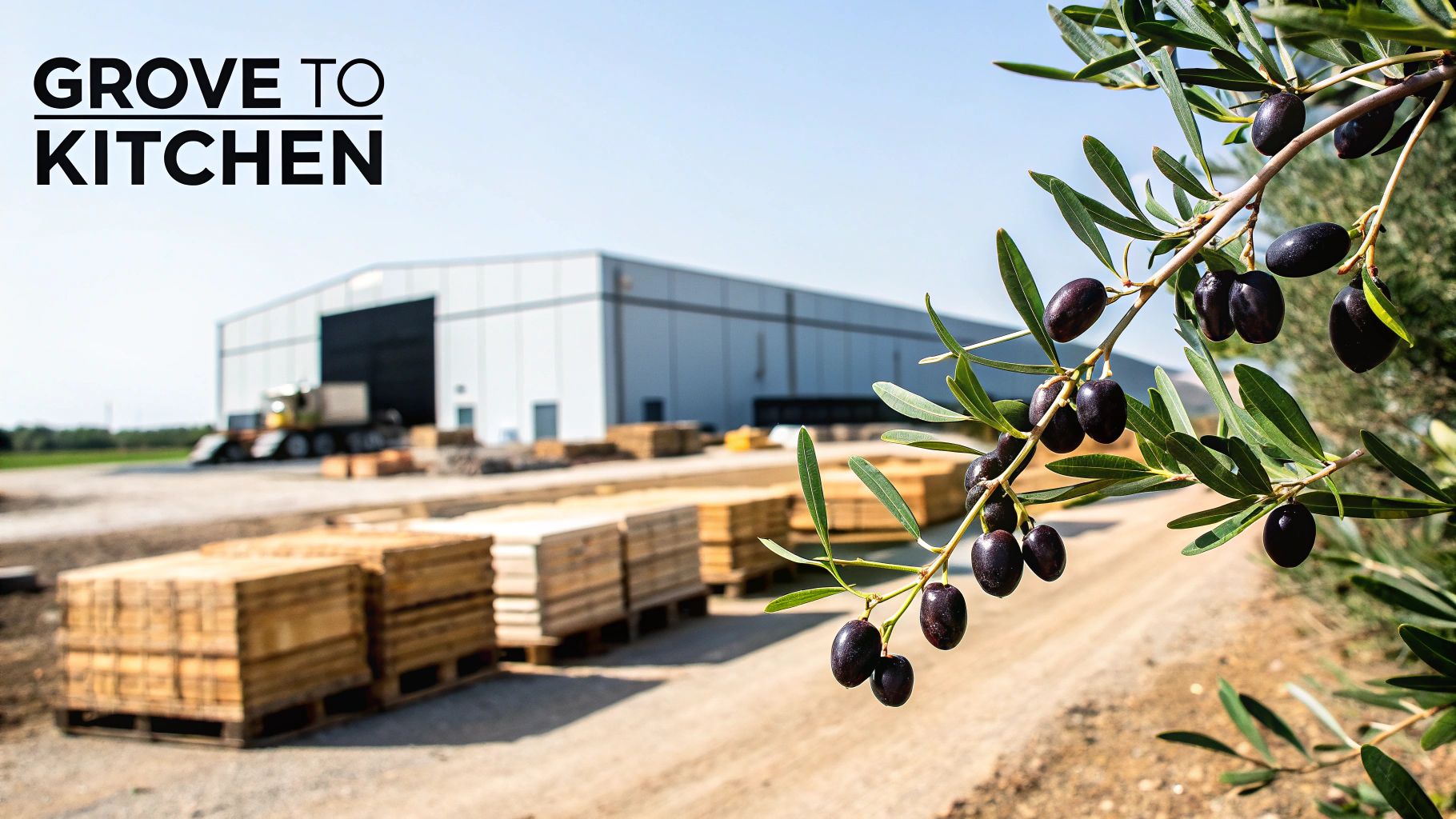
This process is where the true extra virgin olive oil definition comes to life. We're not talking about industrial refining here; we're talking about capturing the pure, unadulterated essence of a fresh fruit before it has a chance to degrade.
Debunking the "First Press" Myth
You’ve no doubt seen "first cold press" printed on olive oil labels. It conjures up romantic images of ancient stone wheels slowly grinding olives, doesn't it? While it's a lovely thought, that term is mostly a relic from a bygone era.
Modern EVOO production has evolved. Today, all extra virgin olive oil comes from the very first mechanical extraction—there is no such thing as a "second press" for EVOO. The term you really want to look for is “cold-extracted” or “cold-pressed.” This is the modern guarantee of quality.
This distinction is critical. It means the entire process, from crushing the olives into a paste to separating out the oil, happens at a controlled, cool temperature—specifically below 27°C (80.6°F). Why does this matter so much? Because heat is the mortal enemy of high-quality olive oil. It may squeeze out a few extra drops, but it completely torches the delicate aromas and healthy polyphenols that give EVOO its signature flavors and incredible health benefits.
From Tree to Bottle in a Matter of Hours
The journey of a world-class olive oil is all about precision and speed. It’s a beautifully simple process that honors the olive as the delicate fruit it truly is.
Here’s how that urgent timeline plays out:
- Harvested at Peak Ripeness: Olives are picked at the perfect moment—often just as they transition from green to violet—to lock in the ideal balance of flavor and antioxidants.
- Immediate Milling: The freshly picked olives are rushed to the mill, ideally within 4-6 hours. This breakneck speed is vital to prevent bruising, fermentation, and oxidation, all of which would ruin the final product.
- Washing and Crushing: At the mill, olives are gently washed to remove leaves and dirt. Then, they’re crushed pits and all into a thick, intensely fragrant paste.
- Separation: This paste is slowly mixed to help the tiny oil droplets clump together. Finally, a high-speed centrifuge spins the paste, using pure mechanical force to separate the brilliant green-gold oil from the water and solid pulp.
What you get at the end isn't just another cooking fat. It's fresh fruit juice in its purest form—aromatic, alive, and packed with flavor. That quality is a direct result of the speed and meticulous care taken every step of the way.
This painstaking process is why true EVOO is such a perfect canvas for culinary creativity. For anyone who loves to experiment in the kitchen, it serves as an excellent base for infusions. In fact, there are all kinds of creative gifts for infusing oils and vinegars that celebrate this very idea. To dive deeper into this fascinating journey, you can explore our detailed guide on how olive oil is made.
How to Spot Real EVOO on the Shelf
The supermarket aisle can feel like a minefield. You’ve learned the science, the sensory rules, and the story of how true extra virgin olive oil is made. Now, it’s time to apply that knowledge where it matters most: with your wallet in hand, facing a wall of confusing bottles.
This is your practical field guide to cutting through the marketing noise and finding the real liquid gold.
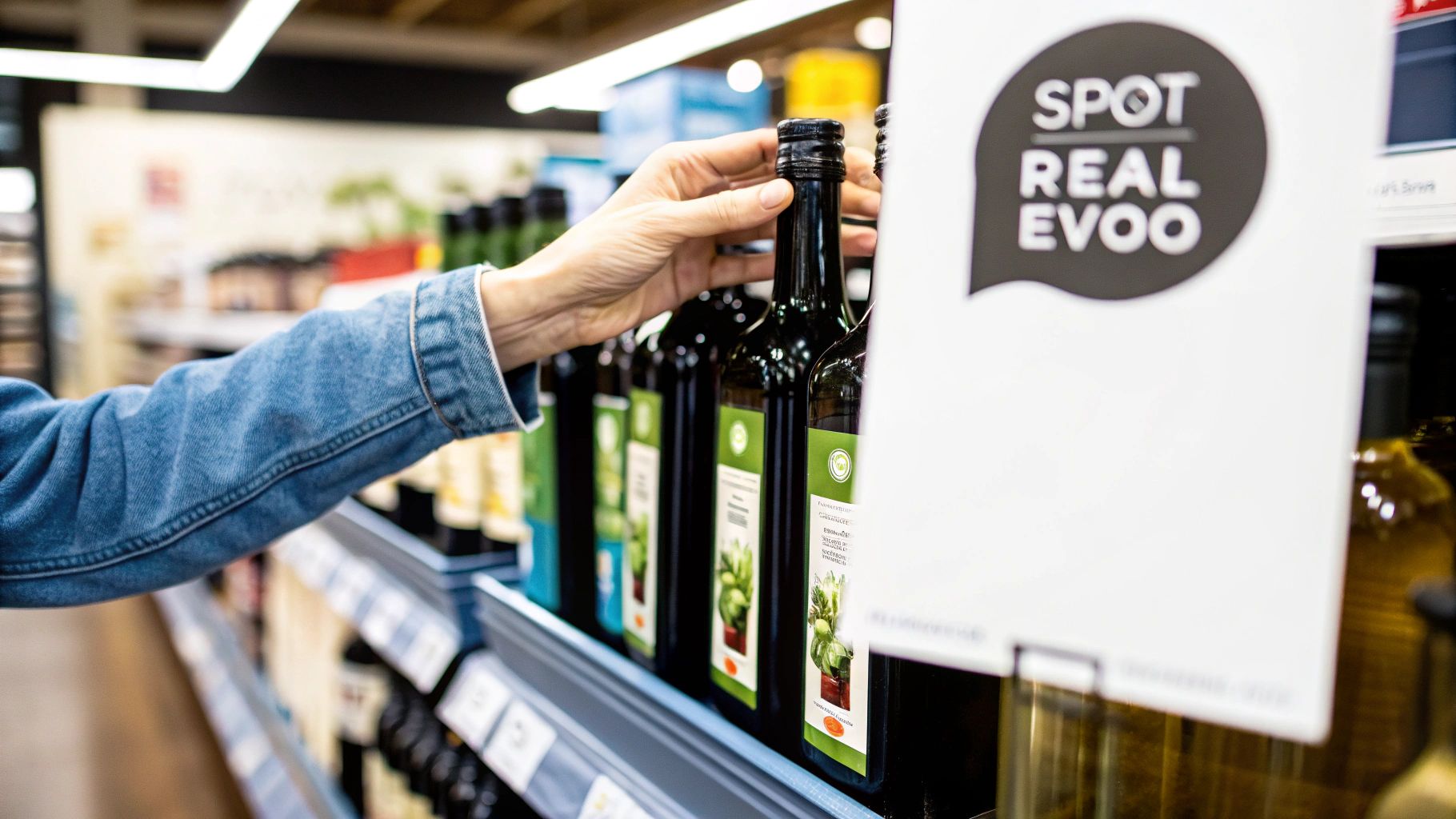
Spotting an authentic bottle isn't about luck; it's about knowing exactly what to look for. A proud, transparent producer will give you all the clues you need right on the label.
Read the Label Like a Detective
The bottle itself is your first piece of evidence. Ignore the fancy graphics on the front and turn it around to find the critical details that separate a quality product from a questionable one.
Here’s what you absolutely must look for:
- A Harvest Date: This is the single most important detail on the bottle. Olive oil is a fresh fruit juice, and it starts to degrade from the moment it’s made. A harvest date (e.g., "Harvested October 2023") tells you exactly when the olives were picked and milled, giving you a true measure of its freshness.
- Country of Origin: Be specific here. A label that says "Product of Italy" is far better than one that says "Packed in Italy." The latter could mean the oil was produced somewhere else entirely and only bottled there. Look for the actual country or even the specific region where the olives were grown.
- Third-Party Certifications: Seals from reputable organizations act as a guarantee of quality. Look for designations like PDO (Protected Designation of Origin) or seals from groups like the California Olive Oil Council (COOC). These certifications mean the oil has been independently verified to meet strict standards.
The "Best By" date is often a marketing tool, not a reliable indicator of freshness. It's typically set two years from bottling, not harvesting. Always prioritize the harvest date to ensure you're buying an oil that's less than 18 months old.
Once you know the green flags, the red flags become glaringly obvious. If a bottle doesn't provide this basic information, the producer might have something to hide. It's a common tactic, and our guide on how to spot fake olive oil dives even deeper into these deceptive practices.
Avoid the Impostors Hiding in Plain Sight
The grocery store shelves are crowded with bottles that use the words "olive oil" but have very little in common with the real deal. These are the refined products you must avoid if you want true flavor and health benefits.
Stay away from bottles labeled:
- ‘Pure Olive Oil’
- ‘Light Olive Oil’
- ‘Olive Oil’
These terms are a red flag that the oil inside is a blend, primarily made of refined olive oil that has been chemically treated to strip away flaws—and with them, all the taste, aroma, and nutrients. A tiny amount of virgin olive oil is sometimes added back in for a hint of color and flavor, but it’s a pale shadow of the real thing.
Price and Packaging Tell a Story
Finally, use some simple common sense. Two physical clues can tell you a lot about the oil before you even read the label.
First, consider the bottle. True EVOO is sensitive to light, which causes it to degrade quickly. Reputable producers will always bottle their oil in dark glass or an opaque tin to protect it from light damage. Clear bottles are a major red flag—the producer either doesn't know or doesn't care about quality.
Second, think about the price. Producing high-quality EVOO is a labor-intensive and costly process. If a large bottle is selling for a price that seems too good to be true, it almost certainly is. That bargain bottle is likely old, of poor quality, or not 100% extra virgin.
The global olive oil market is a complicated business. In 2022, world production hit 2.7 million tonnes, but climate challenges are creating immense pressure. Spain, the world's largest producer, saw a catastrophic 50% drop in production in 2023 due to extreme drought, which has a ripple effect on global prices. This context helps explain why authentic, fresh EVOO carries a premium price—it reflects the genuine cost of quality in a volatile market.
Why This Strict Definition Really Matters
So, after all the science, the sensory panels, and the harrowing journey from the olive grove to your kitchen, you might be wondering: why bother? Why does the definition of extra virgin olive oil matter so much when a cheaper bottle is right there on the shelf?
It boils down to this: those strict standards are your only guarantee of getting the two things that truly count—superior flavor and real health benefits. These are the very qualities that are completely obliterated when an oil is refined.
The Flavor That Transforms Your Food
In the kitchen, real extra virgin olive oil isn't just a cooking fat; it's a game-changer. Its character can take a simple dish and make it unforgettable. Think about the magic that happens when a peppery, vibrant EVOO hits a slice of a perfectly ripe tomato, bringing its sweetness to life.
Or imagine the fresh, grassy notes drizzled over a hearty bean soup, adding a final layer of complexity that cuts through the richness. This transformative power is a direct result of the cold-extraction process. It carefully preserves the delicate aromatic compounds that heat and chemical refining destroy, so you’re tasting the true, unadulterated essence of the olive.
The definition of extra virgin olive oil is your assurance that you aren't just adding fat to a dish, but adding character, depth, and a story. It's the difference between cooking in two dimensions and cooking in three.
The Source of Its Health-Giving Power
Beyond pure flavor, the real value of this strict definition is what it means for your well-being. The same meticulous process that locks in taste also protects the oil's most potent nutritional compounds: polyphenols.
These are powerful antioxidants that give EVOO its famous health halo. They’re what create that signature peppery sensation at the back of your throat—a clear sign of oleocanthal, a natural compound with incredible anti-inflammatory properties. But here's the catch: these compounds are incredibly fragile and are easily destroyed by heat, light, and air.
The rigorous standards for EVOO are designed to ensure these delicate powerhouses survive the journey from the olive to your body, where they can help fight oxidative stress and reduce inflammation. When you opt for a refined oil, you're choosing to leave those benefits on the factory floor. The "extra virgin" classification isn't just a label; it’s a promise of purity, flavor, and vitality that makes every drop worth it.
Your Top Questions About Extra Virgin Olive Oil Answered
Even after you know what makes an olive oil "extra virgin," a few stubborn myths can still trip you up at the store or in the kitchen. Let's clear the air and tackle some of the most common questions head-on. This will help you feel more confident and get the absolute most out of every drop.
Can I Actually Cook With Extra Virgin Olive Oil?
Yes, you absolutely can, and you should! This is probably the biggest and most persistent myth about EVOO. People worry that heat will ruin it, but that's not the whole story.
While it’s true that scorching, high-temperature cooking can break down some of the delicate flavors and healthy polyphenols, a good extra virgin olive oil has a surprisingly high smoke point.
Most quality EVOOs have a smoke point somewhere between 190°C and 215°C (375°F to 420°F). That range is more than high enough for nearly all of your daily cooking needs.
- Sautéing and Pan-Frying: Go for it. It's perfectly safe and infuses your food with incredible flavor.
- Roasting: Excellent for roasting vegetables and other ingredients up to around 200°C (400°F).
- Baking: It’s a fantastic, heart-healthy replacement for butter or other oils in countless recipes.
The bottom line is simple: don't be afraid to cook with extra virgin olive oil. Its stability under heat makes it a safe, healthy, and delicious choice for almost everything you do in the kitchen.
Does a Greener Olive Oil Mean It’s Higher Quality?
Here’s another common pitfall. The color of olive oil can swing from a deep, grassy green to a light, golden yellow, but color tells you absolutely nothing about its quality.
So, what determines the color? It's all about the type of olive used and how ripe it was when picked. Early-harvest oils from less-ripe, green olives are packed with chlorophyll, which gives them that vibrant green hue. Oils made from olives left to ripen longer tend to be more golden.
In fact, professional olive oil tasters use special cobalt-blue glasses for their sensory analysis. This is done specifically to hide the oil's color so it can't influence their judgment. Instead of looking at the color, check the harvest date and origin to gauge quality.
What’s the Right Way to Store My Olive Oil?
To keep your oil fresh and preserve all its amazing flavor and health benefits, you need to protect it from its three biggest enemies: heat, light, and air.
Always keep your olive oil in a cool, dark place, like a pantry or cupboard. The worst spot you can put it is right next to the stove, where heat will quickly destroy it.
After you use it, screw the cap back on tightly to keep oxygen out. An unopened bottle stored correctly can last up to two years from the harvest date. But once you open it, try to use it within 3 to 4 months to enjoy it while it's at its absolute best.
At Learn Olive Oil, we believe that understanding the world of premium olive oil should be simple and rewarding. We provide expert insights to help you choose, taste, and cook with the best oils from around the globe, turning every meal into a masterpiece. https://learnoliveoil.com
 Learn Olive Oil
Leave a comment