That little white label on your olive oil bottle? Most people treat it like junk mail—a quick glance at the calories, then straight into the mental trash bin. But this is a costly mistake.
That label is a treasure map. Hidden in plain sight, the extra virgin olive oil nutrition label tells a secret story about the oil’s quality, its health-giving power, and its journey from a sun-drenched grove to your kitchen.
Learning to read it is the single most important skill you can possess to separate liquid gold from the disappointing, sometimes fraudulent, impostors lining store shelves.
The Secret Story Your Olive Oil Label Is Telling You
Think of that nutrition panel not as a boring chart of numbers, but as your personal decoder ring. It’s a compact guide that, once you understand its language, transforms dry nutritional jargon into powerful, practical knowledge. This guide will show you how to peer past the slick marketing slogans and uncover the truth hidden in the fine print.
You'll soon be able to analyze the serving size, interpret the all-important fat profile, and read between the lines to trace the oil’s true origin. Mastering these details will permanently change how you shop, cook, and think about this ancient, life-giving food.
Why This Skill Matters More Than Ever
Learning to read the label isn’t just about numbers; it’s about making confident, informed choices for your health and your family’s. A true extra virgin olive oil is a fresh, potent source of disease-fighting compounds. But the market is flooded with inferior products disguised by clever marketing.
The good news? The proof of quality is right there on the bottle, waiting for an educated eye to spot it. You just need to know the secrets.
We'll break down:
- Serving Size & Calorie Quality: Why 120 calories of olive oil is one of the smartest investments in your health.
- The Fat Breakdown: How to instantly spot the "hero" fat that defines a world-class oil.
- The Fine Print: The secrets hidden in plain sight, like origin and harvest date, that marketers hope you'll ignore.
To give you a head start, here’s a quick overview of what we'll be looking for on the label and why each part is so important.
Key Sections of an EVOO Nutrition Label at a Glance
| Label Section | What It Reveals | Why It's Critical |
|---|---|---|
| Serving Size | The standard amount (usually 1 tbsp) that all other numbers are based on. | Puts the calorie and fat content into a real-world, practical context. |
| Fat Breakdown | The ratio of monounsaturated, polyunsaturated, and saturated fats. | The sky-high monounsaturated fat content is the nutritional signature of an authentic, healthy EVOO. |
| Ingredients | Confirms if it’s 100% olive oil or a deceptive blend. | For EVOO, this should list only one thing: extra virgin olive oil. Anything else is an immediate red flag. |
| Country of Origin | Where the olives were grown and the oil was produced. | Reveals the oil's traceability and potential quality. "Product of Italy" can be dangerously misleading. |
Each of these sections offers a clue. When you put them all together, you get the full, unvarnished story of what’s inside the bottle.
To truly understand the secret story your olive oil label is telling you, it's helpful to start with a comprehensive guide on how to read nutrition labels effectively, empowering you to make informed choices for all your food purchases.
This isn’t just about buying olive oil; it’s about investing in an authentic product that delivers real benefits. For a deeper dive into the world of olive oil labeling regulations and what they mean for consumers, you can explore the fundamentals of olive oil labeling.
Alright, let's start decoding.
Understanding Serving Sizes and Calorie Quality
The first number you’ll see on any extra virgin olive oil nutrition label is the Serving Size. This is your north star, the reference point for everything else on the panel. It’s almost always one tablespoon (about 14 grams).
This isn't a random guess. It’s a standardized unit that makes it possible to fairly compare different brands. Without it, you’d be lost, trying to weigh the nutritional info from a tiny bottle against a giant tin. This consistent starting point ensures you're always making an apples-to-apples—or in our case, olive-to-olive—comparison.
The Truth About Olive Oil Calories
Right below the serving size, you’ll find the calorie count. It usually clocks in at around 120 calories. I know what you’re thinking. For anyone who has ever counted calories, that number can feel alarmingly high.
But this is where you must look beyond the number and consider the source. These are not the empty, inflammatory calories from a bag of chips. They are high-quality, energy-dense calories that come entirely from healthy fats—the very kind your body craves to function at its best. Think of it this way: you’re getting the concentrated goodness of the olive. That high calorie count is a sign of purity, not a problem to be avoided.
The nutrition label on extra virgin olive oil is globally regulated to provide consumers with standardized, accurate nutritional information. In the United States, the Food and Drug Administration (FDA) requires that every bottle of olive oil presents a Nutrition Facts panel formatted according to strict guidelines, ensuring details like total calories, total fat, and saturated fat are clearly disclosed per one-tablespoon serving. Discover more insights about olive oil label compliance on bhooc.com.
That caloric density is precisely why olive oil is a cornerstone of heart-healthy eating patterns like the Mediterranean diet. A little goes a long way, providing lasting energy and helping you feel full and satisfied. It’s all about the quality of the calories, not just the quantity.
To dig a bit deeper into how much is just right, check out our guide on the ideal olive oil serving size and how it fits into your daily routine.
Decoding the Fats: The Good, the Bad, and the Exceptional
Now we arrive at the heart of the matter: the fat breakdown on the nutrition label. The "Total Fat" number is just the headline. The real story—the one that separates a truly magnificent oil from a mediocre one—is hiding in the lines below. This is where you find proof that you’re holding liquid gold.
You’ll see three types of fat listed: Saturated, Polyunsaturated, and Monounsaturated. Think of them as actors in a play. Each has a role, but they are far from equal.
- Saturated Fat: This is a background actor with a small, non-speaking part. It's always present in tiny amounts, usually just a gram or two per serving. This is perfectly normal.
- Polyunsaturated Fat: These are solid supporting characters. Also found in small amounts, they include beneficial omega-3 and omega-6 fatty acids.
Then, of course, you have the undisputed star of the show.
The Power of Monounsaturated Fat
The one number you must focus on is next to Monounsaturated Fat. In a high-quality extra virgin olive oil, this figure should tower over the others, often making up 70-80% of the total fat. This number is your direct window into the oil's concentration of oleic acid—the powerhouse fatty acid celebrated for its profound health benefits.
This single data point is perhaps the most reliable indicator of authenticity on the entire label. It's the nutritional fingerprint proving the oil in your hands is the genuine, health-boosting article. A high monounsaturated fat content is directly tied to the anti-inflammatory and heart-healthy properties that have made olive oil a cornerstone of healthy eating for thousands of years. If you want to dig into the science, you can learn more about what olive oil is made of and why this particular composition is so vital.
Here's a look at the very top of the label, which sets the stage for the fat breakdown.
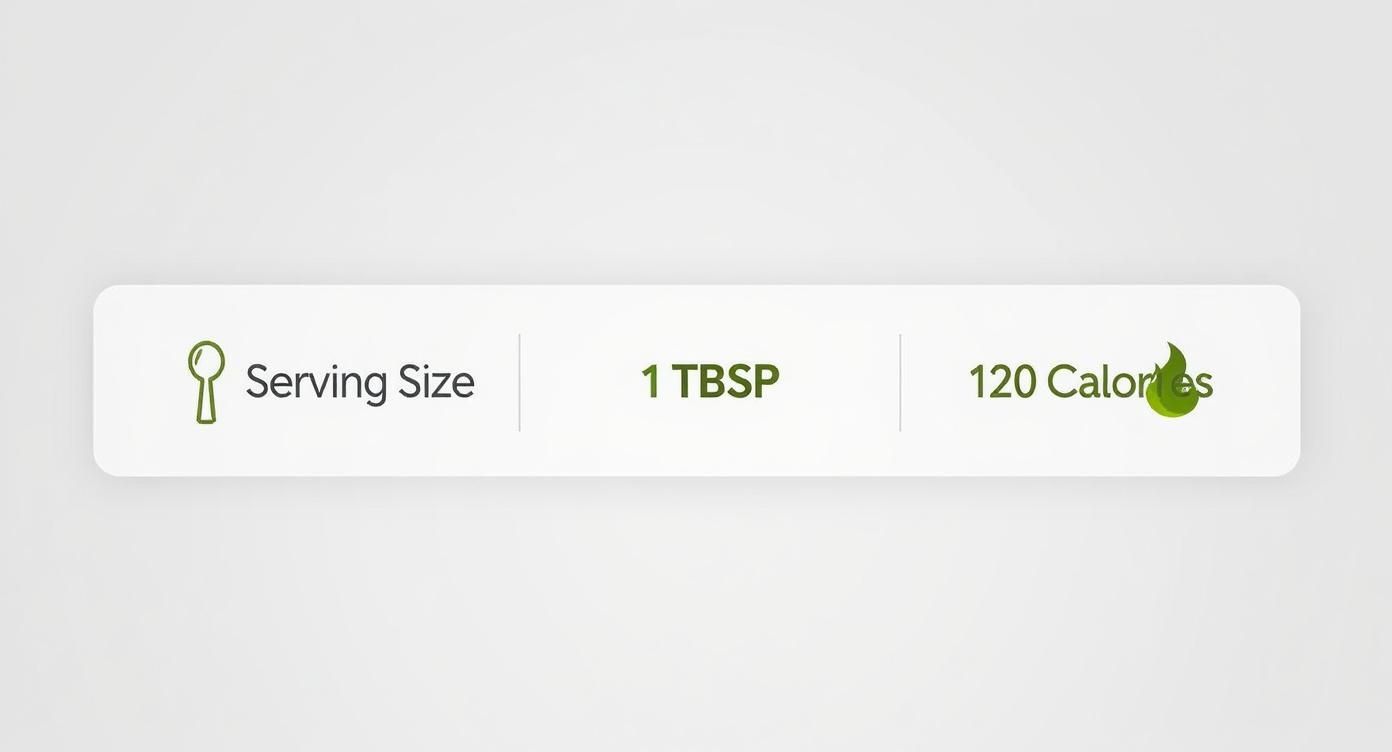
It establishes the standard serving size and calorie count, but the real test of quality comes next.
What to Look for on the Label
When you scan the fat section, you aren't just reading numbers; you're verifying quality. For a typical 14g serving (one tablespoon), the profile of an excellent oil will look something like this:
- Total Fat: 14g
- Saturated Fat: ~2g
- Polyunsaturated Fat: ~1.5g
- Monounsaturated Fat: ~10.5g
See how that works? The monounsaturated fat isn't just a little higher—it's the overwhelming majority. This isn't an accident. It's the natural fingerprint of oil pressed from healthy, high-quality olives.
So, the next time you're standing in the olive oil aisle, forget the fancy bottle and the marketing buzzwords for a moment. Flip it over, go straight to the nutrition facts, find that monounsaturated fat line, and let the numbers tell you the real story.
What the Nutrition Label Doesn’t Tell You
Sometimes, what’s missing from a label tells you more than what’s there. Take a close look at a bottle of real extra virgin olive oil, and you'll see a beautiful string of zeros. That’s not a mistake; it’s a mark of purity.
Seeing zero grams of Trans Fat is a huge victory for your heart. Spotting zero milligrams of Cholesterol confirms you're looking at a 100% plant-based product, completely free of the artery-clogging stuff found in animal fats. The same goes for Sodium and Protein—their absence is exactly what you want to see.
But for all its utility, the standard nutrition panel leaves out EVOO’s secret weapon.
The Hidden Power of Polyphenols
The most powerful, health-giving compounds in extra virgin olive oil are completely invisible on the nutrition facts panel. I’m talking about polyphenols.
These incredible antioxidants are the very soul of the oil. They are responsible for its peppery kick, its vibrant grassy notes, and the profound health benefits that have made olive oil legendary for centuries. These are the compounds that work behind the scenes to protect your cells from damage and fight inflammation. They are the true measure of an oil’s vitality.
You know that pungent, slightly bitter sensation you get at the back of your throat from a really good olive oil? That’s not a flaw. That’s the taste of health—a direct signal that the oil is packed with powerful polyphenols.
Unfortunately, the FDA doesn't require producers to list polyphenol content on the label. This means you have to become a detective, hunting for other clues that point to a high-potency oil. If you want to get really good at this, digging into olive oil polyphenol content is the perfect next step.
So, without a number on the box, how do you find an oil loaded with these hidden gems? You learn to look for other markers of quality—the tell-tale signs that an oil is the real deal.
Finding Clues Beyond the Label
While the polyphenol count may be missing, other clues on the bottle can steer you toward a great choice. Think of these as the "tells" of a superior oil.
- A Recent Harvest Date: Freshness is everything. Polyphenols are fragile and degrade over time, so an oil from the most recent harvest will always pack a bigger punch.
- "Cold-Pressed" or "Cold-Extracted": This isn't just marketing jargon. It means the oil was made without high heat, which is crucial for preserving those fragile polyphenol compounds.
- Dark Glass Bottle: Light is the enemy of good olive oil. A dark, opaque bottle acts like a shield, protecting the oil and its healthy properties from breaking down.
These details, while outside the official nutrition box, complete the story. They tell you the producer didn't just meet the minimum standards—they went the extra mile to deliver an oil with maximum flavor and health benefits.
Reading the Fine Print Beyond the Nutrition Box
Once you've sized up the fats and calories, your real detective work begins. The most telling clues about an olive oil's quality aren't in the nutrition facts panel at all—they're hidden in the fine print scattered elsewhere on the bottle. This is where you separate the truly exceptional oils from the pretenders.
Your first stop should be the ingredients list. It ought to be beautifully simple.
You're looking for one thing and one thing only: "Extra Virgin Olive Oil." If you spot anything else, like other oils, flavorings, or preservatives, it’s a hard pass. True EVOO stands alone, and 100% purity is non-negotiable.
Pinpointing the True Origin
Next, scan the label for the Country of Origin. Here, specificity is your best friend. A label that simply says "Product of Spain" is okay, but one that names a specific region, like "Product of Andalusia, Spain," is far better. It shows a commitment to a particular terroir and makes the oil's journey traceable.
Be very skeptical of vague wording like "Bottled in Italy" or "Packed in Greece." This is a classic trick. It often means a blend of oils from various countries was simply packaged there, which tells you nothing about where the olives were actually grown or the quality of the oil itself.
In the European Union, labeling laws have tightened up considerably to combat these misleading practices. EU regulations now require labels to clearly state where the olives were grown and milled, giving you a much clearer picture of what you're buying. To learn more, check out the details on EU olive oil label requirements at contedoro.com.
This move toward transparency is a huge win for shoppers, helping you connect the oil you buy directly to its source.
The Most Important Date on the Bottle
Finally, we get to what is arguably the single most important detail on the entire label: the Harvest Date. You can pretty much ignore the "Best By" date, as it's often set two years out from bottling and doesn't reflect freshness. The harvest date, however, tells you exactly when the olives were picked and pressed.
Think of extra virgin olive oil as fresh-squeezed fruit juice—because that's precisely what it is. It does not get better with age. The flavor, aroma, and health benefits are at their absolute peak right after pressing.
Always reach for the bottle with the most recent harvest date. An oil from a harvest within the last year is your best shot at experiencing the vibrant, peppery taste and getting the full nutritional punch you paid for.
As brands look to better communicate quality and freshness, many are also exploring how technology can enhance the consumer experience. The evolution of new tech packaging solutions for brands is a fascinating area to watch.
How to Spot Deceptive Marketing and Labeling Traps
https://www.youtube.com/embed/cOjhqfld3X8
Let's be honest: the olive oil aisle is a minefield of clever marketing designed to confuse you. Marketers are experts at using words that sound positive but mean the opposite. It’s time to arm yourself with the knowledge to see right through their tricks.
Watch out for words like "Pure" or "Light." On an olive oil bottle, these are practically confessions of a low-quality product. They absolutely do not mean "Extra Virgin." In reality, they signal that you're looking at a refined oil, one that's been industrially processed to the point where its flavor, nutrients, and very soul have been stripped away.
The term "Light" is probably the most misleading of them all. It only refers to a milder flavor profile or a paler color—never fewer calories. It's a classic bait-and-switch, targeting health-conscious shoppers with the promise of "less" when all you're getting is a less effective, less healthy oil.
Unmasking Fraudulent Practices
Beyond just misleading terms, outright fraud is shockingly common in the olive oil world. It's one of the most counterfeited food products globally, plagued by issues of dilution with cheaper oils and blatant mislabeling of origin and quality. In just the last three years, there have been over 170 documented cases of olive oil fraud, which has led to tighter regulations. You can learn more about how the EU is combating this issue on merieuxnutrisciences.com.
This long history of deception means you have to be vigilant. You are your own best advocate in the grocery store aisle, learning to look past the slick front label to find the hard facts on the back. For a deeper dive, our guide on how to spot fake olive oil gives you even more tools.
The real story of an oil's quality isn't told by marketing buzzwords. It’s revealed by a recent harvest date, a specific and verifiable origin, and official seals of quality like PDO (Protected Designation of Origin).
These are the details that matter. They are your proof of authenticity, ensuring you're spending your money on a genuine health product, not just a bottle of beautifully packaged, empty promises. By focusing on these facts, you gain the power to choose wisely.
Your Olive Oil Label Questions, Answered
Alright, we've broken down the nutrition label piece by piece. But let's be honest, standing in the grocery aisle, a few key questions always seem to pop up. Let's tackle them head-on so you can feel confident grabbing the right bottle every time.
Why Is Extra Virgin Olive Oil So High in Calories?
Yes, it's a calorie-dense food. A single tablespoon will run you about 120 calories, and it's all from fat. But here's the crucial difference: these are not the empty calories you get from a bag of chips.
Think of it as premium fuel for your body. The calories in EVOO come from healthy monounsaturated fats that provide lasting energy and carry those incredible health benefits we've been talking about. That caloric density is actually a sign of its purity, not something to fear.
Does "Light" Olive Oil Have Fewer Calories?
Nope. Not even a little bit. This is probably one of the biggest and most misleading marketing tricks in the olive oil aisle.
"Light" on an olive oil label has absolutely nothing to do with calories or fat. It only refers to a lighter, more neutral flavor and a paler color. These oils are refined, which means they've been processed and stripped of the very polyphenols and nutrients that make extra virgin olive oil a superstar. If you see "Light," just walk away.
Key Takeaway: "Light" olive oil is a marketing gimmick for a refined, less healthy product. It has the same calories as EVOO but none of the real benefits.
What Is the Single Most Important Thing to Look For?
If you only remember one thing, make it this: find the Harvest Date.
Extra virgin olive oil is, at its heart, fresh fruit juice. And like any juice, it's best when it's fresh. Time is its enemy. An oil from the most recent harvest guarantees you're getting the best flavor and the highest possible level of healthy polyphenols. The "Best By" date is far less important—always prioritize the harvest date.
How Can I Tell If an Oil Is High in Healthy Polyphenols?
This is a great question, especially since the extra virgin olive oil nutrition label doesn't list polyphenol content. You have to become a bit of a detective and look for clues.
Here’s what to look for:
- A recent harvest date: Freshness equals potency. The newer the oil, the more polyphenols it will have.
- "Cold-Pressed" or "Cold-Extracted": This wording confirms the oil was made without high heat, which is essential for protecting those delicate, healthy compounds.
- A peppery finish: When you taste a high-quality EVOO, you should feel a distinct peppery or slightly bitter kick in the back of your throat. That's not a flaw—that's the taste of polyphenols at work!
At Learn Olive Oil, we're passionate about helping you understand exactly what's in your bottle. Knowing how to read the label is the first step toward a healthier and much more delicious kitchen.
 Learn Olive Oil
Leave a comment