That plate of pasta you still dream about from that little trattoria? The one that haunts your tastebuds with its impossible depth of flavor?
I’m willing to bet the secret wasn’t some arcane chef’s technique or a rare, exotic herb flown in from the hills of Tuscany.
The secret was almost certainly the olive oil.
The simple truth is this: the best olive oil for pasta is a world-class Extra Virgin Olive Oil, selected with the precision of a master jeweler choosing the perfect diamond. It’s the single ingredient that can elevate a perfectly fine dish into a soul-stirring memory.
From Good Pasta to Great Art
Most people make a tragic mistake. They treat olive oil like a utility player—a simple cooking fat grabbed off the supermarket shelf. That’s like asking a concert violinist to perform with a child's plastic toy. The instrument is fundamentally wrong. The music will always, always fall flat.
A truly magnificent olive oil isn't just another ingredient. It is the very soul of the dish. It’s the quiet, foundational note that makes every other flavor burst into a glorious symphony.
This guide is your roadmap. Your invitation to see, smell, and taste the monumental difference a phenomenal oil can make. We will look past the deceptive marketing slogans and get to the heart of how a simple drizzle can transform your cooking forever. Your journey from pasta maker to pasta maestro begins right now.
Your Fast Track to Perfect Pairings
To get started, it helps to think of olive oils in three basic categories, much like you would with wine. Each has a unique personality that’s perfect for different kinds of dishes. This simple framework is the first step to building your culinary intuition.
- Delicate & Buttery Oils: Think of these for whisper-light seafood dishes, pesto, or simple aglio e olio where you don't want to bully the main ingredients.
- Medium & Fruity Oils: These are your versatile workhorses. Absolutely fantastic for vegetable-based sauces, chicken pasta, or a classic marinara.
- Robust & Peppery Oils: Reach for these titans when you need an oil that can go toe-to-toe with big flavors, like a rich bolognese or a fiery arrabbiata.
The goal is harmony. A delicate oil lets the subtle flavors of fresh clams shine through, while a robust oil can hold its own against a hearty meat ragù without getting lost.
We'll dive deeper into how you can identify these profiles yourself. But for now, here’s a quick reference chart to get you started immediately.
Quick Guide to Pairing Olive Oil with Pasta
| Pasta Dish Type | Recommended Olive Oil Flavor Profile | Why It Works |
|---|---|---|
| Seafood Linguine or Aglio e Olio | Delicate, Buttery, Mildly Fruity | A gentle oil complements the subtle flavors of garlic, herbs, and seafood without overpowering them. |
| Pesto or Primavera | Medium, Grassy, Herbaceous | The green, fresh notes in the oil amplify the basil in pesto or the crispness of spring vegetables. |
| Hearty Meat Sauce (Bolognese) | Robust, Peppery, Bold | A strong, spicy oil cuts through the richness of the meat and tomato, adding complexity and balance. |
| Spicy Arrabbiata or Puttanesca | Robust, Pungent, Spicy | The peppery kick of the oil enhances the heat from the chili flakes and complements the bold, savory ingredients. |
Decoding the Labels From Extra Virgin to Everyday
Walking down the olive oil aisle can feel like being ambushed. You're hit with a wall of glass bottles, each one shouting confusing terms at you: ‘Extra Virgin,’ ‘Virgin,’ ‘Pure,’ and even ‘Light.’ It's easy to dismiss these as clever marketing ploys designed to part you from your money.
They are not. The difference between them is as dramatic as the one between fresh-squeezed orange juice and a watered-down, sugary concentrate from a carton.
Mastering these grades is the single biggest leap you can take toward choosing the perfect olive oil for your pasta. Nail this, and I promise you, every single dish you make will taste more alive, more authentic, and more delicious.
The Champion: Extra Virgin Olive Oil
Extra Virgin Olive Oil (EVOO) is, without a sliver of a doubt, the undisputed king. Think of it as the purest essence of the olive—the first, cold press of the fruit with absolutely no heat or chemicals involved. This gentle extraction means all those delicate, complex flavors and powerful, health-boosting antioxidants are preserved in their most perfect state.
To legally wear the "extra virgin" crown, an oil must have an acidity level below 0.8%. It also must pass a grueling sensory test by a panel of experts to ensure there are absolutely no flavor defects. It’s the gold standard, and for very good reason.
This is precisely why EVOO is the ultimate finishing oil for pasta. A generous, final drizzle allows its peppery, fruity, or grassy notes to blossom, adding a layer of breathtaking complexity that lesser oils simply cannot replicate.
That term ‘cold-pressed’ isn’t just marketing fluff; it’s a sacred promise. It means the oil was extracted at temperatures below 27°C (80.6°F), a crucial step that protects the very compounds that give EVOO its incredible taste and health benefits.
Understanding Other Olive Oil Grades
As you descend the ladder from EVOO, the quality and flavor intensity take a catastrophic nosedive. These oils are typically processed with more heat and sometimes chemicals, which brutally strips them of their character.
- Virgin Olive Oil: This is a small step down. It's also from the first press, but it has a slightly higher acidity (up to 2.0%) and may suffer from minor flavor flaws. It’s still a decent oil, but it lacks the vibrant, electric personality of a true EVOO.
- Pure Olive Oil (or just 'Olive Oil'): Here's where we see a precipitous drop in quality. This is a blend, usually a tiny drop of virgin oil mixed with a vast amount of refined olive oil. The refining process uses heat and solvents to treat defective oils, stripping away nearly all of their flavor, aroma, and nutrients.
- Light or Extra Light Olive Oil: Do not be fooled. ‘Light’ refers only to the flavor and color, not the calories. This is the most heavily refined grade, rendering it almost tasteless. It’s useful only for high-heat cooking where you want absolutely no olive flavor.
As you start exploring, you'll notice that different olive varietals produce different oils. Getting to know a specific type like Arbequina olive oil can really help you dial in your preferences. The world's love for good olive oil on pasta is undeniable, with Italy leading the way by consuming a staggering 486,000 tonnes in 2022 alone. That passion is built on a foundation of high-quality oil.
For anyone serious about making incredible pasta, the choice is clear. The nuanced, beautiful flavors that elevate a dish can only come from a bottle of genuine Extra Virgin Olive Oil. To dig even deeper into what’s on the bottle, you can check out our complete guide on https://learnoliveoil.com/olive-oil-labeling.
Tasting Olive Oil Like an Italian Nonna
A truly great olive oil has a personality. It’s never just ‘oily’; it has its own language, a vocabulary that can be sharp and grassy or smooth and nutty. Learning to understand this language is the real secret to creating pasta dishes with perfect, breathtaking harmony. It's what separates a cook from a culinary artist.
Forget what you think you know about tasting. We're not going to be delicately sipping from a spoon. To truly unlock an oil’s character, you must master the professional’s "slurp" technique. I know it feels a bit silly at first, but that quick, sharp intake of air is non-negotiable. It aerates the oil, spraying its volatile aromatic compounds across your entire palate and revealing complexities you’d otherwise miss completely.
This is your first step to identifying the three pillars of a high-quality olive oil. For an even deeper dive, our guide on how to taste olive oil walks you through the entire professional process, step by step.
The Three Voices of Olive Oil
Every exceptional Extra Virgin Olive Oil tells a story through three distinct sensations. Think of it like learning to hear the individual instruments in an orchestra—each one plays a critical role in the final symphony of flavor.
-
Fruttato (The Aroma): This is your first impression, the scent that greets you before the oil even touches your tongue. Pour a little into a small glass, warm it in your hands, swirl, and inhale deeply. Does it remind you of a freshly mown lawn? Or is it more ripe and buttery, with hints of almond or banana? That fruity aroma is the foundation of the oil's entire personality.
-
Amaro (The Bitterness): Next comes the bitterness, a sensation you'll feel mostly on the sides of your tongue. Do not fear it! In the world of premium olive oil, bitterness isn't a flaw; it's a badge of honor. It signals the presence of fresh, green olives and healthy antioxidants like polyphenols.
-
Piccante (The Peppery Finish): Finally, you should feel a pungent, peppery tickle or even a "sting" in the back of your throat that might make you cough. That kick comes from oleocanthal, a potent anti-inflammatory compound. A strong piccante is the calling card of a fresh, robust oil made from olives harvested early in the season.
This handy decision tree shows how these three characteristics point you toward an oil's profile.
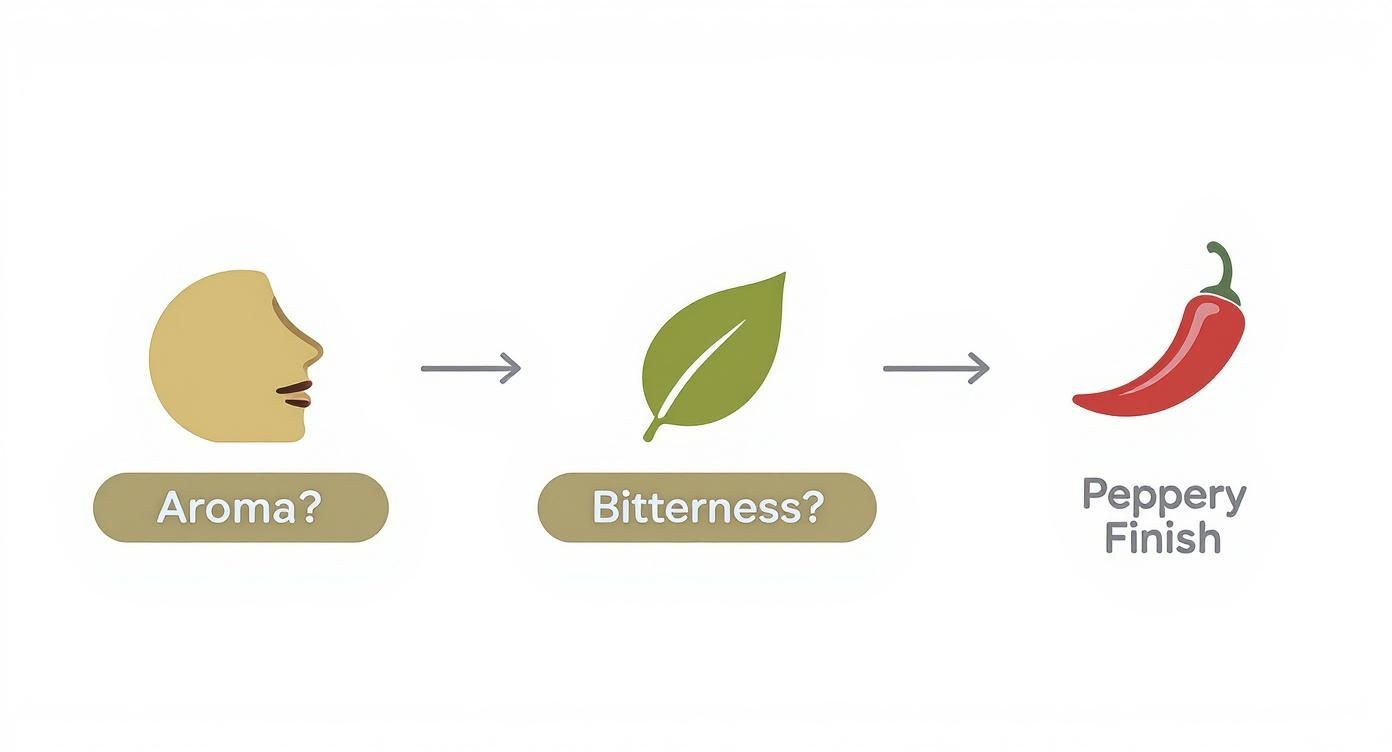
As you can see, the journey starts with the aroma (fruttato) and then moves through the levels of bitterness and pepperiness to classify the oil.
Finding Your Perfect Flavor Profile
Based on the intensity of these three elements—fruttato, amaro, and piccante—oils generally fall into one of three main profiles. Getting a feel for these is the key to finding the best olive oil for pasta.
An oil’s profile isn’t about "good" versus "bad." It’s about matching the right personality to the right dish. The goal is balance, where the oil elevates the ingredients without steamrolling them.
-
Delicate Profile: These oils whisper; they don't shout. They have low bitterness and just a mild peppery finish. The fruttato here is often buttery, floral, and subtle.
-
Medium Profile: Here you'll find a beautiful harmony between the fruity, bitter, and peppery notes. The aroma is usually greener and more herbaceous. This is your versatile, all-around champion for the kitchen.
-
Robust Profile: These oils make a statement. They are bold and assertive, with a pronounced bitterness and a strong peppery kick that definitely stings the throat.
Once you learn to taste for these three core elements, you stop just buying a bottle of cooking fat. You start selecting a foundational ingredient that will define the entire character of your dish.
Pairing Your Oil with Your Pasta Sauce
This is where the real magic happens. Moving past theory and into the kitchen, marrying the right oil to the right sauce is what separates a good meal from an unforgettable one. It's about creating a culinary conversation where the oil and the sauce bring out the absolute best in each other.
Think of it this way: a delicate, buttery Ligurian oil will whisper sweet nothings to a light seafood linguine, while a bold, peppery Tuscan oil can stand its ground next to a rich, hearty bolognese.
Let's treat this section as your personal playbook. We'll go beyond the general rules and get into specific examples that will sharpen your instincts. Soon, you'll be creating your own signature dishes that feel perfectly, unforgettably balanced without even thinking about it.
For Light and Delicate Sauces
We're talking about sauces where the ingredients are the stars and need a gentle spotlight, not a floodlight. These are your simple seafood dishes, classic garlic and oil (aglio e olio), and light vegetable pastas like a spring primavera.
For these dishes, you absolutely need an oil with a delicate profile. A mild, buttery oil—perhaps from Northern Italy or the South of France—acts as a complement, not a competitor. It adds a silky texture and just a whisper of fruitiness that elevates the sweetness of shrimp or the subtle bite of garlic without overpowering them.
A Quick Word of Caution: The wrong choice here is a culinary crime. Drizzling a robust, peppery oil over a delicate clam sauce is like playing heavy metal at a classical concert—all the beautiful nuance is completely lost in the noise.
For Herbaceous and Green Sauces
Now, let's turn our attention to sauces built around fresh herbs and greens. Think of a classic basil pesto, a zesty salsa verde, or a vibrant pasta salad loaded with asparagus, peas, and mint. The dominant flavors here are bright, green, and wonderfully alive.
Your goal is to find an oil that speaks the same language. A medium-profile oil with distinct grassy and herbaceous notes is the perfect partner. It will amplify the freshness of the basil or dill, creating a seamless, layered flavor experience. In essence, the oil becomes a natural extension of the sauce itself. A Sicilian oil with notes of green tomato leaf would be absolutely divine here.
For Rich and Hearty Sauces
This is the territory of big, bold flavors. We're talking about slow-simmered bolognese, spicy arrabbiata, or a decadent, creamy carbonara. These sauces are deep and complex, and they demand an oil that can hold its own at the table.
Here, a robust-profile oil is non-negotiable. Its assertive bitterness and peppery kick (piccante) are essential for cutting through the richness of cured pork, aged cheese, or ground meat. It acts as a counterpoint, preventing the dish from feeling heavy or one-dimensional. A powerful Tuscan or Umbrian oil is exactly what’s needed to bring balance and an unforgettable finish.
To dig deeper into how the right oil can form the foundation of your cooking, explore our detailed guide to making sauces with olive oil.
Olive Oil and Pasta Sauce Pairing Matrix
To make things even clearer, here’s a quick-reference chart to help you visualize these pairings. Think of it as a cheat sheet for your next pasta night.
| Olive Oil Profile (Region/Flavor) | Best For These Sauces | Tasting Notes & Rationale |
|---|---|---|
| Delicate (e.g., Ligurian, French) | Aglio e Olio, Seafood Linguine, Primavera, White Wine Sauces | Smooth, buttery, and slightly sweet. It adds richness without masking the subtle flavors of garlic, shellfish, or fresh vegetables. |
| Medium (e.g., Sicilian, Apulian) | Pesto, Salsa Verde, Herb-Based Sauces, Pasta with Greens | Grassy, green, and sometimes nutty. It harmonizes with the fresh herbs, amplifying their bright character and creating a unified flavor profile. |
| Robust (e.g., Tuscan, Umbrian) | Bolognese, Arrabiata, Carbonara, Rich Meat Ragu | Peppery, bitter, and bold. The strong flavors cut through fat and richness, cleansing the palate and adding complexity to hearty dishes. |
Ultimately, choosing the best olive oil for pasta is a game of matchmaking. By considering the weight and character of your sauce, you can select an oil that completes the dish, turning a simple meal into something truly special.
Cooking with Olive Oil the Right Way
Let's obliterate a myth that haunts kitchens everywhere: the idea that you should never cook with your good olive oil. So many home cooks hoard their best Extra Virgin Olive Oil for finishing drizzles, paralyzed by the fear that a little heat will instantly vaporize its flavor and destroy its health benefits.
It's time to put that old wives' tale to bed. The truth is, high-quality EVOO is not only perfectly safe for cooking, it’s often the superior choice.
The notion that all EVOOs have a low smoke point is a gross oversimplification. A fresh, top-tier EVOO is loaded with powerful antioxidants called polyphenols. These little warriors do more than give the oil its peppery kick; they make it remarkably stable under heat. They fight off oxidation far better than the refined seed oils you might be using instead.
When you start a pasta sauce by gently warming garlic in a good EVOO, you aren’t burning off the flavor. You are infusing it into the very soul of your dish. This creates a foundational layer of complexity that a last-minute drizzle simply can't replicate. To get a real handle on this, you can learn more about how to cook with olive oil.
The Soffritto Secret
Consider the classic Italian soffritto—that holy trinity of onion, celery, and carrot slowly softened in olive oil. This isn't just step one; it's the bedrock of countless legendary pasta sauces.
Using a robust, flavorful olive oil here is a game-changer. The oil acts as a vehicle, pulling all those delicious, fat-soluble flavors out of the vegetables and creating a perfectly balanced base for everything that comes next. When you're prepping these aromatics, a good bamboo chopping board makes life a whole lot easier. Sure, a neutral oil gets the job done. But a quality EVOO joins the party, adding its own fruity or spicy notes to the mix.
Heat, Stability, and a Bit of Common Sense
The trick is simply managing your heat. You're not deep-frying. You’re typically sautéing over medium heat, which is well below the smoke point of a decent EVOO. For reference, a good one usually has a smoke point somewhere between 350-410°F (177-210°C). That’s more than enough heat for building just about any pasta sauce you can dream up.
The rule is simple: use your head, not your fears. If your oil is smoking, the pan is too hot for any oil. A gentle sizzle is the sound of flavor building, not flavor being destroyed.
This isn't some fringe idea. The world is catching on. Globally, olive oil consumption has nearly doubled since the 1990s, and you can bet pasta dishes are a huge part of that story.
So please, I urge you: use your good EVOO to start your sauce. Use it to finish it. Use it wisely at every step in between, from that first gentle sizzle to the final, beautiful drizzle. Your pasta will thank you.
Your Olive Oil Questions Answered
Even with the best map, you're bound to have a few questions on the journey. The world of olive oil is full of fascinating details, and it's only natural to wonder how to get the most out of every last drop.
Think of this section as your personal olive oil hotline. We're tackling the most common questions about choosing, storing, and using olive oil for pasta, giving you the clear, straightforward answers you need to cook with complete confidence.
Does the Color of Olive Oil Matter?
This is one of the most stubborn myths out there: the greener the oil, the better the quality. The truth? The color of an olive oil tells you almost nothing about its flavor or quality. It simply reflects how much chlorophyll was in the olives when they were pressed.
A beautiful golden oil can be just as complex and peppery as a vibrant green one. In fact, professional tasters use special blue-tinted glasses to completely hide the oil's color so it won’t sway their judgment. Instead of relying on your eyes, let your nose and your taste buds be your guide. They will tell you the real story.
How Should I Store My Olive Oil?
Your beautiful bottle of extra virgin olive oil has three mortal enemies: heat, light, and air. These are the villains that kickstart oxidation, a process that slowly robs the oil of its incredible flavors and health benefits.
To keep your oil at its peak, just follow these simple rules:
- Find a cool, dark home for it. A pantry or cupboard, far away from the stove, is perfect.
- Keep the cap on tight when you're not using it. This minimizes its exposure to oxygen.
- Buy bottles you’ll use within a few months of opening. Freshness is everything.
A common mistake is storing olive oil in the refrigerator. While it won't ruin the oil, the cold causes it to solidify and can create condensation when you take it out, which isn't ideal. A cool cupboard is all you need.
Can I Trust the Best-By Date?
The "best-by" date on a bottle is more of a suggestion than a hard-and-fast rule. What you should really be looking for is the harvest date. An oil from the most recent autumn harvest will always be the freshest and most vibrant choice.
The freshness clock starts ticking the moment the oil is bottled, which is why understanding its lifespan is so crucial. If you want to take a deeper dive, check out our complete guide on whether olive oil expires.
As pasta dishes become more popular, so does the demand for great oil. The United States is now the second-largest consumer of olive oil in the world, getting through around 390,000 tonnes each year. You can see more data on these consumption trends at ers.usda.gov.
At Learn Olive Oil, we're dedicated to helping you explore this liquid gold with confidence. Start your journey today and discover the world of premium olive oil.

 Learn Olive Oil
Leave a comment