Before you pour another drop, I need you to know something critical: "Extra Virgin" isn't just a fancy phrase on a bottle. It's a promise. A legally-binding guarantee of purity, flavor, and unmatched quality. It’s the one term that separates pure, unadulterated olive fruit juice from something far, far less.
The Shocking Truth Hiding in Your Pantry
The term extra virgin olive oil, or EVOO, represents the absolute highest grade of olive oil known to man. It's a standard of perfection. To understand it, stop thinking of it as a common cooking oil and start thinking of it as what it truly is: fresh-squeezed juice, pressed directly from the olive fruit itself, completely untouched by heat or chemical processing.
This isn't just clever marketing; it's a strictly regulated standard. To earn this prestigious title, an oil must be extracted using only mechanical means—just pressure, plain and simple. No solvents, no refining, nothing that would alter the oil from its pristine, natural state. This pure, unblemished process is what locks in the oil's explosive flavor and life-giving health benefits.
The Two Pillars of EVOO Quality
Earning the EVOO grade is like passing a brutal, two-part final exam. These tests are mandatory. They serve as the unforgiving gatekeepers that filter out inferior, lower-quality oils.
The standard is built on two key areas of evaluation:
- Chemical Analysis: In the sterile silence of a lab, scientists scrutinize the oil for specific quality markers. One of the most important is free fatty acidity, which must register below an incredibly low 0.8%. A low acidity level is the tell-tale sign that the olives were healthy, unbruised, and handled with extreme care from harvest to milling.
- Sensory Evaluation: Next, a certified panel of human tasters samples the oil. Their job is to ensure it has zero taste defects while also identifying its positive attributes—the symphony of fruitiness, the pleasant bitterness, and the peppery kick that signifies greatness.
So, when you see "Extra Virgin" on a label, it is a declaration that the oil inside has passed both of these demanding tests.
To earn its name, an olive oil must be perfect in both its chemistry and its taste. A single flaw in either category means it simply cannot be called 'Extra Virgin'.
This dual-certification process is what makes the EVOO grade so trustworthy. The strict chemical criteria were established by bodies like the International Olive Council, which sets the standards for most olive oil-producing countries. This ensures that a bottle labeled EVOO meets a global benchmark for excellence. For a closer look at this process, you can explore the details of extra virgin olive oil certification.
The Two Trials Every True EVOO Must Pass
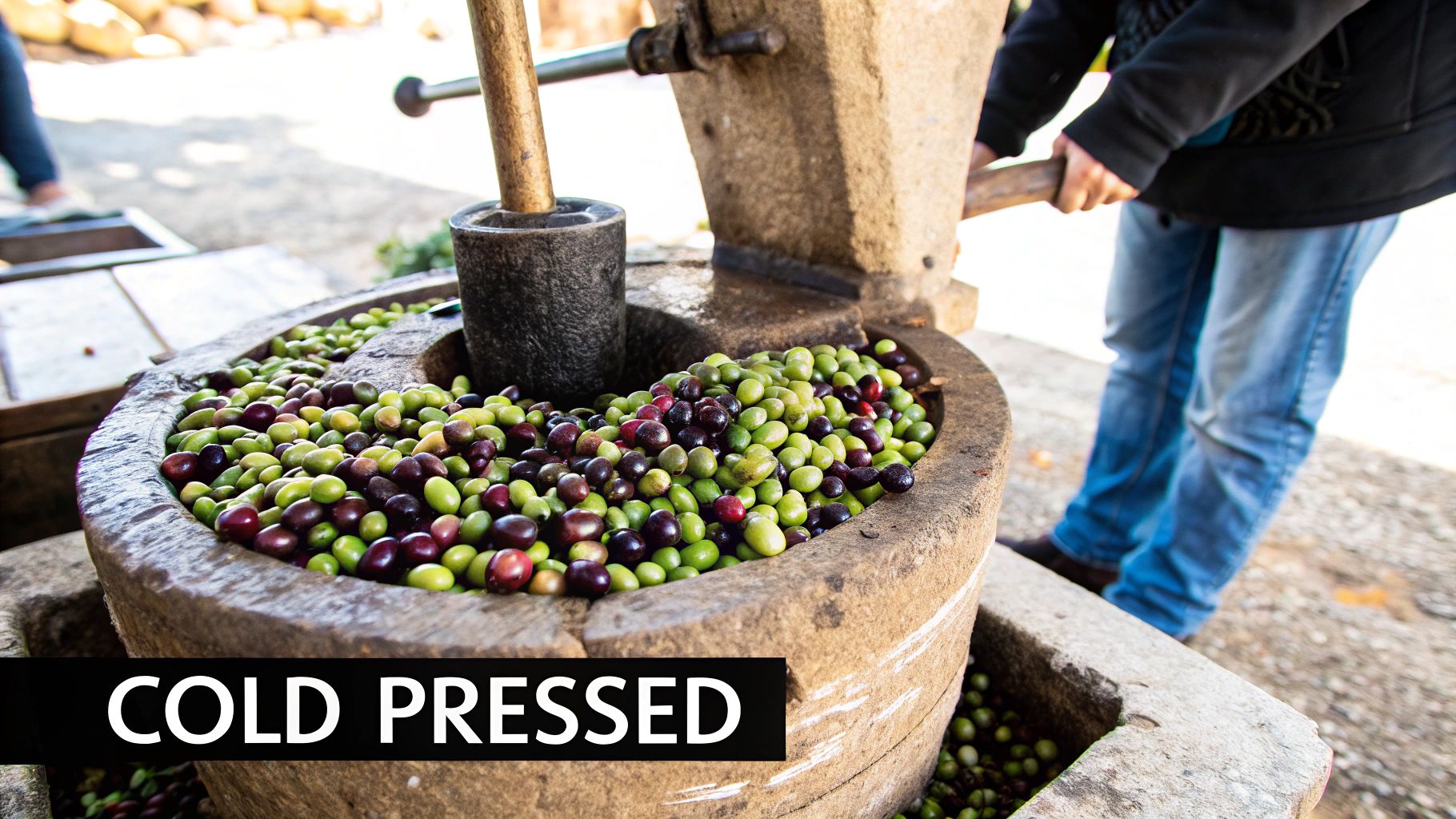
Before any olive oil can be crowned with the coveted "Extra Virgin" title, it must prove its worth not once, but twice. Think of it as a two-round championship fight. The first round is fought in a lab, under the cold, impartial eye of science. The second is judged by the finely tuned senses of a trained human panel.
An oil has to win both rounds to be crowned a champion. There are no shortcuts.
The Laboratory Gauntlet
First, the oil faces a rigorous chemical analysis. Here, scientists act as referees, measuring specific markers that reveal the oil's freshness, how it was handled, and its overall integrity. A failure at this stage is an instant disqualification—the oil is out of the running for the EVOO title.
While the lab checks for several key metrics, two stand out as the most critical indicators of an oil's pedigree. These numbers tell a story about the entire process, from the health of the olives on the tree to the skill of the miller.
- Free Fatty Acidity (FFA): This is arguably the single most important chemical benchmark. To be called extra virgin, the oil’s acidity must be below 0.8%. A low FFA is a direct sign of healthy, fresh olives that were processed with lightning speed. Think of it like the difference between a crisp, perfect apple and one that’s bruised and starting to rot. You can dive deeper into the science of acidity in olive oil to see why this number matters so much.
- Peroxide Value: This metric essentially acts like a timer, measuring how much oxidation the oil has already suffered. A low peroxide value means the oil is fresh and has been properly protected from its enemies—light, heat, and air.
Only after an oil passes this cold, hard chemical review can it move on to the next, more subjective challenge.
An oil can have perfect chemistry, but if it fails the taste test, it can never be called Extra Virgin. The human palate is the final, non-negotiable judge.
The Sensory Showdown
The second trial is all about taste and smell. It takes place in a quiet tasting room, where a panel of certified sensory experts convenes for a disciplined organoleptic assessment. Their job isn't to decide if they like the oil, but to hunt for imperfections.
The tasters are trained to detect any official taste defects, such as a musty, rancid, or vinegary flavor profile. The presence of even a single one of these flaws means immediate failure. No exceptions.
If the oil is proven to be completely free of defects, the panel then looks for its positive attributes. A truly great EVOO should have a harmonious balance of three key characteristics:
- Fruity: These are the notes that remind you of fresh olives, whether they're green or ripe. You might also pick up hints of other things like green apple, tomato leaf, or fresh-cut grass.
- Bitter: A clean, pleasant bitterness on the tongue is actually a very good sign. It often indicates that the oil is fresh and packed with healthy polyphenols.
- Pungent: This is that peppery or spicy sensation you feel in the back of your throat. It might even make you cough! That kick is another hallmark of a high-quality oil, rich in powerful antioxidants.
Only an oil that triumphs in both the lab and the tasting room has truly earned the right to be called extra virgin olive oil. It’s a title that certifies a flawless journey from the grove to your bottle.
The Journey from Olive Grove to Liquid Gold
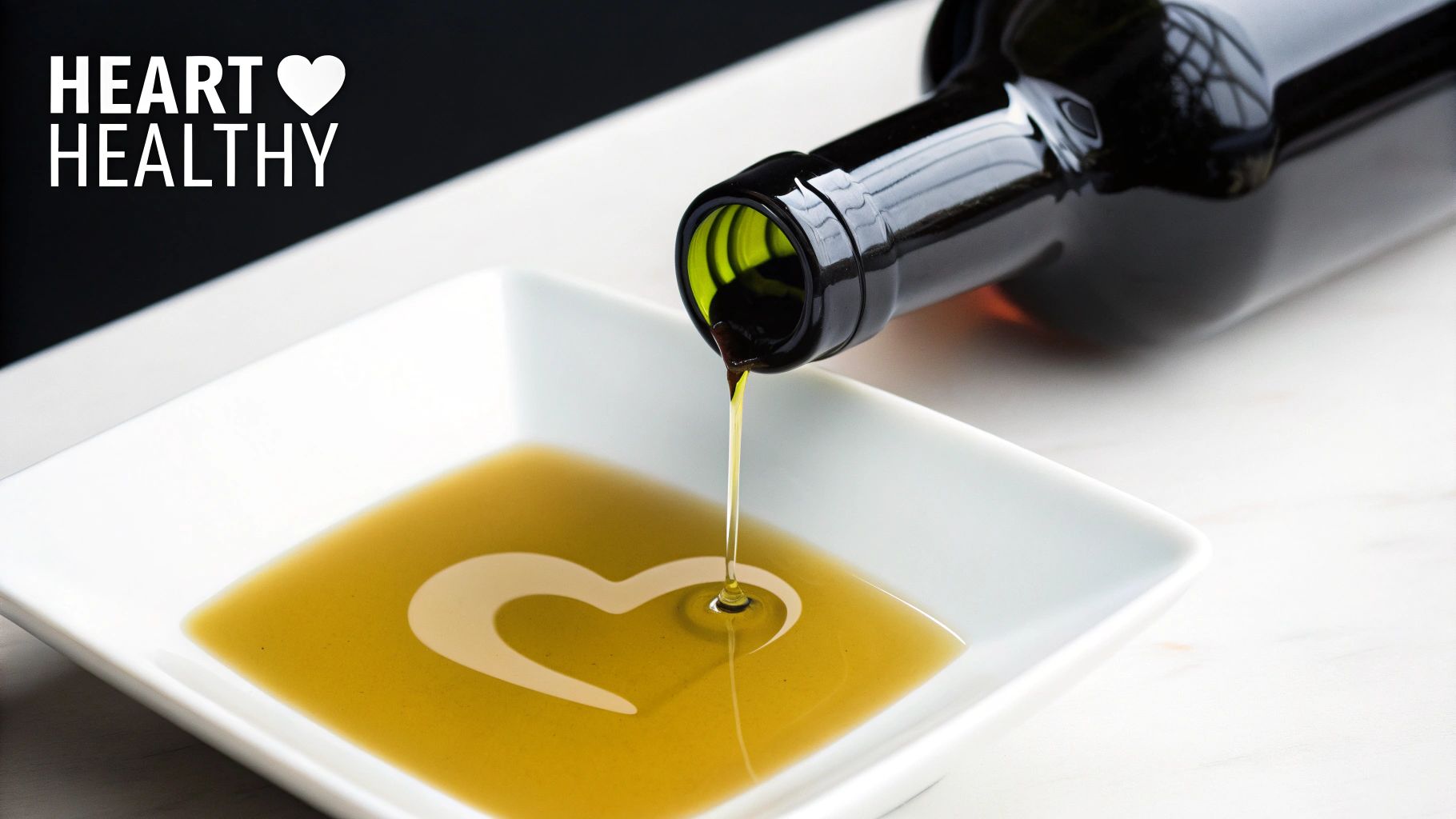
Have you ever wondered how a simple olive, hanging from a sun-drenched branch, becomes that flawless, vibrant oil in your kitchen? It's not manufacturing; it's a meticulous craft—a story of perfect timing, careful temperature control, and generations of technique. This very journey is what separates true extra virgin olive oil from everything else.
The whole process really begins in the grove. The quality of the final oil is decided long before the olives ever see a mill. For a superior oil, the fruit has to be picked at the absolute perfect moment of ripeness, usually when it's just starting to blush from green to purple. They must be handled gently, as any bruising will cause the fruit to oxidize and spoil, introducing defects that would instantly disqualify the oil from earning the extra virgin grade.
The Critical First Squeeze
As soon as the olives are picked, the clock starts ticking. The best producers know this and rush their harvest from the grove to the mill within a matter of hours, not days. This race against time is crucial for preserving the freshness, locking in those delicate flavors, and protecting all the health-boosting compounds inside.
You’ve probably heard the term “cold press.” It’s a romantic phrase that brings to mind ancient stone wheels, and while that's part of its history, today's top-tier method is actually called “cold extraction.” The core principle, however, hasn't changed a bit and is fundamental to what extra virgin olive oil is all about.
The non-negotiable rule is simple: produce the oil without adding heat. If the temperature climbs above a certain point—around 27°C or 80.6°F—it starts to essentially cook the olive paste. This destroys the enzymes and phenols that give the oil its signature peppery flavor and powerful antioxidant benefits.
Think of it as one gentle, temperature-controlled squeeze designed to coax out only the purest, most flavorful juice. In stark contrast, mass-market oils often rely on high heat and even chemical solvents to wring out every last drop, sacrificing quality and flavor for the sake of higher yields.
Preserving Purity at Every Step
This commitment to purity doesn't stop at extraction. Every single part of the process is designed to protect the oil’s fragile, vibrant character.
At the mill, the journey breaks down into three key stages:
- Crushing: Whole olives, pits and all, are crushed into a thick, uniform paste.
- Malaxation: This paste is then slowly and gently stirred. This crucial, temperature-controlled step encourages the tiny oil droplets to clump together, making them easier to separate.
- Extraction: Instead of a press, modern mills use a centrifuge that spins the paste at high speed. This separates the pure oil from the water and solid olive matter without any need for heat.
This beautiful symphony of nature and technology ensures that what ends up in your bottle is nothing less than pure, unadulterated fruit juice, packed with flavor and brimming with polyphenols. To dive deeper into the craftsmanship involved, you can learn about the complete process of making olive oil and see how it all comes together.
How to Read an Olive Oil Label Like an Expert
Walking down the olive oil aisle can feel like navigating a minefield of beautiful bottles and hollow promises. This section is your decoder ring. We're going to turn you into a label detective, teaching you how to spot the critical clues that signal true quality and separate the real deal from the imposters.
Your first move? Ignore the flashy, artfully designed front label. The real story—the evidence that separates liquid gold from a clever fake—is almost always tucked away in small print on the back. That's where the truth lives.
Look for Dates, Not Slogans
The single most important piece of information on any bottle is the harvest date. Olives are a fruit, which means olive oil is essentially a fruit juice. And just like with juice, freshness is everything. A harvest or press date tells you exactly when the journey from tree to bottle began, giving you a clear window into the oil's vitality.
A "best by" date, on the other hand, is often just a two-year guess from the bottling date, not the harvest. An oil can sit in a massive tank for a year or more before it's even bottled, making that "best by" date dangerously misleading. Always, always look for a recent harvest date.
Pinpoint the Origin
Next, you'll want to hunt for a specific origin. Vague phrases like “Product of the Mediterranean” or even “Product of Italy” should raise an immediate red flag. This language often means the oil is a blend of olives from multiple countries, which were simply mixed together and bottled in one location.
What you're looking for is specificity. You want to see the name of a single estate, a particular region, or even a town. Better yet, look for official seals of origin that legally guarantee the oil's provenance.
Protected Designation of Origin (PDO) or Protected Geographical Indication (PGI) seals are legally binding certifications. They promise that the oil was grown, milled, and bottled entirely within a specific, named geographical area, all while adhering to that region's strict local standards.
Exposing Deceptive Marketing Terms
Finally, you have to learn to see through the marketing fluff. Many terms are designed to sound appealing but are actually used to disguise a lower-quality product.
This diagram shows the official quality pyramid, making it crystal clear where true extra virgin olive oil stands.
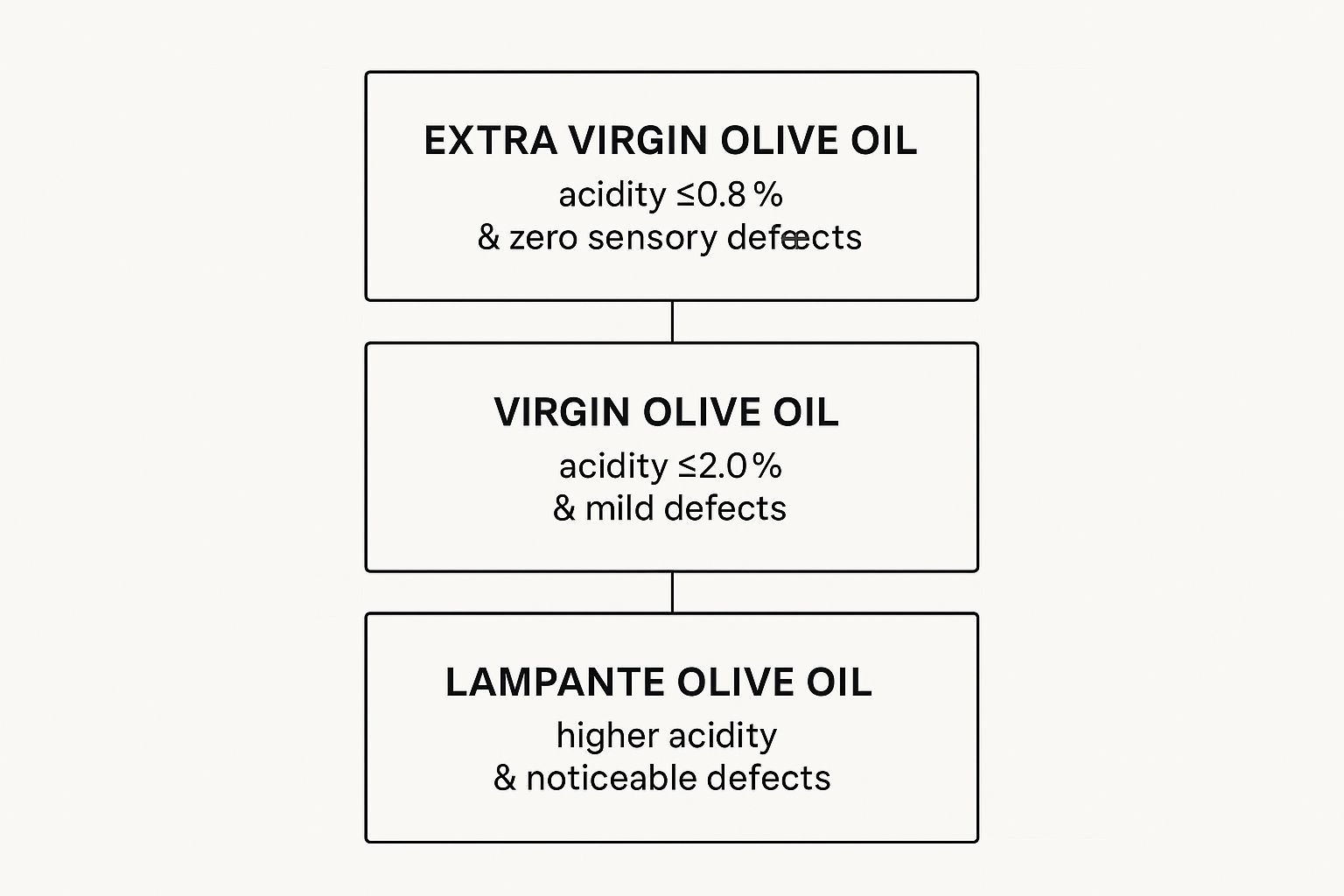
As you can see, EVOO is the only grade that must have zero sensory defects and the lowest acidity. It sits alone at the top.
Olive Oil Grade Comparison
To make these differences even clearer, let's break down the three main grades you'll find on the shelf.
| Attribute | Extra Virgin Olive Oil (EVOO) | Virgin Olive Oil | Olive Oil (Refined/Blend) |
|---|---|---|---|
| Production Method | First cold mechanical pressing | First cold mechanical pressing | Heat/chemical refining; blended with virgin oil |
| Acidity Level | < 0.8% | < 2.0% | N/A (Chemically altered) |
| Sensory Defects | Zero defects | Minor defects allowed | Stripped of flavor/aroma; often has defects |
| Flavor Profile | Fruity, peppery, complex | Mild, but with some off-flavors | Neutral, bland, or oily |
| Health Benefits | Highest in polyphenols & antioxidants | Lower in beneficial compounds | Minimal to none |
This table highlights why EVOO is in a class of its own—it's the only grade held to a standard of perfection in both chemistry and taste.
Be particularly wary of these common culprits you'll see on labels:
- "Pure" Olive Oil: Sounds pristine, doesn't it? It's a lie. In reality, it’s a refined oil blended with a tiny bit of virgin oil just to add a hint of color and flavor back in.
- "Light" Olive Oil: This has nothing to do with calories. It refers to a light flavor and color, a result of heavy refining that strips away nearly all the taste and the health benefits.
By focusing on harvest dates, specific origins, and official seals, you can navigate the shelves with confidence. For an even deeper dive, our guide on understanding olive oil labeling offers more expert tips to ensure you always bring home the best.
Using Your EVOO to Elevate Every Meal
So you've done the hard work—you’ve learned to read the labels and brought home a fantastic bottle of extra virgin olive oil. Now for the fun part. This is where you take all that knowledge from the store shelf to the kitchen and make its quality sing on the plate.
First, let's obliterate a stubborn myth: the idea that you can't cook with good EVOO. That's simply not true. While its most delicate flavors are best appreciated raw, a quality EVOO has a smoke point between 350°F and 410°F, which is plenty high for most home cooking. It’s a wonderful choice for gently sautéing vegetables or roasting potatoes to a perfect golden-brown crisp. For a more detailed look, check out our guide on how to cook with olive oil.
The Art of Finishing
While cooking with EVOO is great, its real magic shines when you use it as a finishing oil. This is its highest calling. A generous drizzle just before a dish hits the table isn't just an ingredient—it's the final touch that pulls everything together.
Think about the difference it can make:
- A simple bowl of pasta suddenly tastes complex and incredibly fragrant.
- A hearty soup gets a bright, peppery lift.
- A piece of grilled fish is instantly elevated with a fresh, grassy finish.
Don't be afraid to get creative, either. A drizzle of a robust, fruity EVOO over a scoop of vanilla ice cream or a slice of rich chocolate cake creates a sweet and savory contrast that’s absolutely stunning.
Think Like a Chef: Pairings
The real secret to using EVOO like a pro is matching its intensity and flavor profile to your food. Some oils are mild and buttery, others are intensely grassy, and some have a sharp, peppery kick. Learning how to pair these different characters will completely change your cooking. It's not just about using it; it's about making it a star ingredient. For example, mastering flavorful marinades is a great way to let the oil's character infuse directly into your ingredients.
Treat your extra virgin olive oil like a fine wine. A bold, peppery oil from Tuscany is perfect for a hearty steak, while a delicate, buttery oil from Liguria is better suited for a delicate piece of sea bass.
Let the oil’s personality be your guide. A pungent, grassy oil can cut right through the richness of a bean stew, while a milder, almond-noted oil is the perfect complement to a fresh Caprese salad. This is how you stop just using olive oil and start featuring it.
Common Questions About Extra Virgin Olive Oil
Even after you get the hang of the basics, a few questions always seem to pop up and cause a bit of confusion. Let's clear the air and tackle them head-on with some straight-up answers.
You've probably wondered about color. Does a deep green oil mean it's better than a golden one? The short answer is no. A world-class EVOO can range from vibrant green to a shimmering, buttery gold.
That color is simply a clue about when the olives were picked. Greener oils come from less ripe olives, which are packed with chlorophyll. Golden hues usually mean the fruit was a bit riper at harvest. In fact, professional tasters use special cobalt blue glasses so they can't be influenced by the color at all.
Storing and Sourcing Your Oil
So, what's the best way to store your precious EVOO? Just remember its three biggest enemies: oxygen, light, and heat.
Keep your bottle in a cool, dark place like a pantry—and definitely not next to your stove. Always twist that cap on tight. For the best taste, try to use it within a few months of cracking it open.
This brings up a big one: can you actually trust a "Product of Italy" label? Not always, unfortunately. That phrase can be a bit of a trick, often just meaning the oil was bottled in Italy using olives sourced from all over the world.
The real proof is in the seal. Look for a PDO (Protected Designation of Origin) or PGI (Protected Geographical Indication) certification. These are legally binding guarantees that the olives were grown, pressed, and bottled in the specific region named on the label.
And what if you open a bottle and find that the oil is cloudy? Don't panic! It's not a sign that it's gone bad.
Cloudiness is actually common in fresh, unfiltered, artisanal oils. Those are just tiny, flavorful bits of olive fruit suspended in the oil. This style, sometimes called olio nuovo ("new oil"), is a real treat, but it's best to use it up quickly since the sediment can make it spoil a little faster.
At Learn Olive Oil, we think knowing these details is what turns you from a shopper into a true connoisseur. Explore our guides and keep discovering the incredible world of premium olive oil.

 Learn Olive Oil
Leave a comment