Think of an extra virgin olive oil certification as a stamp of authenticity on the oil's passport. It’s a seal from an official organization that confirms the oil has passed a battery of strict chemical and sensory tests. This is your most reliable way to know you're getting the real deal—an oil that's genuinely fresh, free from any off-flavors, and made from top-quality olives. In a marketplace flooded with confusing labels, this seal is your best friend.
Why EVOO Certification Is Your Quality Guarantee
Have you ever found yourself standing in the grocery store aisle, staring at a wall of olive oil bottles all screaming "extra virgin"? It's a common, and frankly, overwhelming experience. The term "extra virgin" is one of the most abused phrases in the entire food world. Without a trustworthy verification system, it's incredibly easy to spend good money on a bad bottle.
This is where an official certification cuts through all the marketing fluff. It's so much more than a shiny sticker on the label; it’s a promise of quality, backed by independent, scientific testing. When you see that seal, you know the oil inside has been thoroughly vetted, protecting you from the rampant mislabeling and fraud that plagues the industry.
The Problem with Uncertified Oils
A startling number of bottles labeled "extra virgin" just don't meet the standard. The oil inside might be old, damaged from poor storage, or even cut with cheaper, refined vegetable oils. Without that certification seal, you're essentially flying blind, risking buying an oil that has none of the characteristics that make EVOO special.
Here's what you often miss out on with uncertified oils:
- Real Flavor: Instead of the fresh, vibrant, and peppery notes of a true EVOO, you might get something that tastes flat, greasy, or even unpleasantly rancid.
- Health Benefits: Those powerful antioxidants, particularly polyphenols, are delicate and degrade over time. An old or poorly made oil will have lost most of the health benefits you’re paying for.
- A Clear Story: There’s no accountability. You have no verifiable way to know where the olives came from, when they were picked, or how the oil was actually made.
The Power of a Certified Seal
When you choose a certified oil, you're not just buying a product; you're investing in a guarantee. It tells you the oil has cleared two critical hurdles: a detailed chemical lab analysis and a sensory tasting by a panel of trained experts. It's this two-pronged approach that truly separates authentic EVOO from the imposters.
A certification seal is your assurance of quality. It confirms the oil's origin, freshness, and adherence to the highest global standards. It turns a hopeful guess in the grocery aisle into a confident, informed decision.
The global hunger for authentic EVOO makes these standards more critical than ever. The extra virgin olive oil market was valued at a massive USD 27.11 billion in 2024 and is expected to almost double by 2033. Strict regulations from major producing countries like Spain and Italy, such as the Protected Designation of Origin (PDO), are vital for protecting consumers and upholding quality in this exploding market. Learn more about the global EVOO market trends.
Ultimately, when you reach for a bottle with an official certification, you're doing more than just buying olive oil. You're supporting producers who are truly committed to their craft. You're ensuring that the "liquid gold" you bring into your kitchen is the real thing—delicious, healthy, and worth every penny.
Decoding the Key EVOO Certification Seals
Walking down the olive oil aisle can feel like trying to read a foreign language. The bottles are covered in a confusing jumble of seals, stamps, and logos, each making a different promise. If you want to make a truly informed choice, you need to know what they mean. Think of this section as your personal translator, turning those confusing acronyms into clear guarantees of quality.
An extra virgin olive oil certification is much more than just a pretty sticker; it’s a legally binding verification of where that oil came from and, just as importantly, how it was made. These seals represent strict agricultural and production standards that uncertified oils simply don't have to meet.
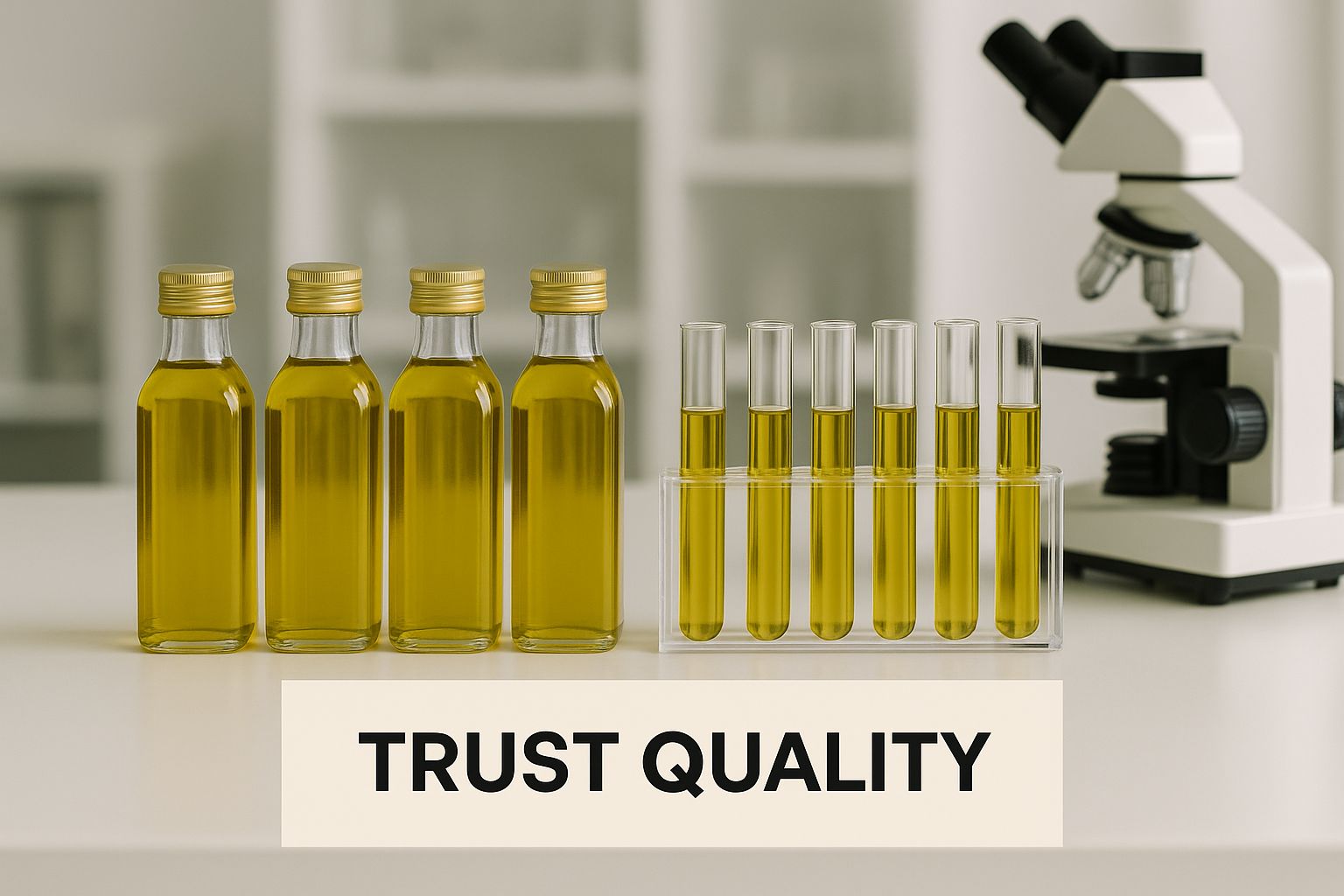
Ultimately, every trusted seal is backed by a rigorous process. It’s all designed to ensure the product you bring home is authentic, fresh, and high-quality.
To help you navigate the shelf, let's compare some of the most important seals you're likely to encounter.
Key EVOO Certification Seals at a Glance
This table breaks down the most common certifications, what they really guarantee, and who is behind them.
| Certification Seal | Primary Guarantee | Geographic Requirement | Governing Body |
|---|---|---|---|
| PDO / DOP | Terroir & Tradition: Every step of production (growing, pressing, bottling) occurred in a specific, named region. | Strictly Local: 100% of the process must happen within the designated area. | European Union |
| PGI / IGP | Regional Character: At least one major production step occurred in the named region. | Flexible Local: Ties the oil's character to a place but allows some steps (e.g., bottling) to happen elsewhere. | European Union |
| USDA Organic | Farming Method: Olives grown without synthetic pesticides, fertilizers, or GMOs. | None: Certifies the farming practice, not the origin or EVOO quality grade. | U.S. Department of Agriculture |
| COOC Seal | Freshness & Purity: Meets strict chemical standards and passes a sensory taste panel. | California Only: Must be made from 100% California-grown olives. | California Olive Oil Council |
Seeing these seals side-by-side helps clarify their purpose. A PDO/PGI seal is all about place, while a COOC or organic seal is focused on the process and final quality.
The European Union’s Terroir Seals: PDO and PGI
The European Union has two of the most respected and stringent certification systems in the world. Both are built to protect regional agricultural heritage, guaranteeing that a product is deeply connected to a specific place.
-
Protected Designation of Origin (PDO): This is the gold standard for geographic protection. A PDO seal (DOP in Italian and Spanish) guarantees that every single step of the process—from growing and harvesting the olives to pressing and bottling the oil—happened within one specific, tightly defined area. It’s a promise of 100% local character and traceability.
-
Protected Geographical Indication (PGI): The PGI seal (IGP in Italian and Spanish) is also a mark of regional quality, just with slightly more flexible rules. It requires that at least one stage of production (like growing, pressing, or bottling) happened in the named region. This still ties the oil's defining characteristics to its geography but allows for certain steps to happen elsewhere.
Here's a simple analogy. A PDO olive oil is like a wine made entirely from grapes grown, fermented, and bottled on a single, historic estate. A PGI oil is more like a wine where the grapes came from a renowned region, but perhaps the bottling took place at a great facility nearby. Both signify quality, but PDO offers that deeper, more profound connection to a single place.
When you see a PDO or PGI seal, you are buying more than just olive oil; you are buying a taste of a specific place, protected by law. It’s an assurance that the oil’s unique flavors are a direct result of the local soil, climate, and traditions.
Quality Seals from Around the Globe
While the EU's terroir system is famous, other important certifications focus squarely on chemical purity and sensory quality, no matter where the olives were grown.
USDA Organic
That familiar green and white USDA Organic seal isn't specific to olive oil, but it’s still a valuable indicator of quality farming. It guarantees the olives were grown without synthetic pesticides, fertilizers, or genetically modified organisms (GMOs). While it doesn’t certify the oil as "extra virgin," it does ensure adherence to strict organic farming practices, which very often go hand-in-hand with high-quality production.
California Olive Oil Council (COOC)
As California's olive oil industry has blossomed, so has the need for a local, trusted quality standard. The California Olive Oil Council (COOC) provides one of the most rigorous certification programs outside of Europe.
To earn the COOC Seal of Certification, an oil must meet three tough criteria:
- It must be made from 100% California-grown olives.
- It must pass a chemical analysis that is even stricter than the international standards for EVOO.
- It has to be deemed fresh, fruity, and free of any flavor defects by a professional blind-tasting panel.
For American-made oils, this seal is a powerful guarantee of both freshness and quality. It gives you confidence that you’re buying authentic, locally produced extra virgin olive oil. By understanding these key seals, you transform from a hopeful buyer into an educated consumer, ready to select a bottle with full confidence in its story and quality.
The Science and Senses Behind a Certified Oil
So, what does it really take for an olive oil to earn an official “extra virgin” certification? It’s not just a fancy label someone slaps on a bottle. Earning that seal of approval is a tough, two-part trial. Think of it like a world-class athlete who has to pass both a rigorous physical and a demanding skills test.
The oil has to prove its mettle in two arenas: first, in a lab under a microscope, and second, before a panel of highly trained taste experts. This dual-gated process is what gives a true certification its weight. It guarantees the oil isn't just pure and fresh on a chemical level, but that it also tastes and smells exactly like a premium extra virgin olive oil should.
Let's pull back the curtain on how it's done.
The Chemical Health Checkup
First up is the lab work. This is the purely objective, data-driven part of the process—a full chemical workup that acts as a health report for the oil. Technicians run a battery of tests to measure key biomarkers, which tell the true story of the oil’s quality, freshness, and authenticity. There's no room for opinion here; it’s all about cold, hard science.
While the full analysis gets pretty technical, there are three key metrics you should know about:
-
Free Fatty Acidity (FFA): If there’s one number to know, it’s this one. FFA is the single most critical indicator of the health of the olives when they were crushed. A low FFA means the fruit was healthy and milled right away. To even be considered extra virgin, an oil’s FFA has to be under 0.8%. The really great oils? They often clock in below 0.3%.
-
Peroxide Value (PV): This measurement tells you how fresh the oil is by tracking oxidation. Oxygen, light, and heat are the enemies of olive oil, and over time they cause peroxides to form, which is the first step toward rancidity. A low peroxide value means you have a fresher, more stable oil with a longer shelf life.
-
Polyphenol Content: You've probably heard about these. Polyphenols are the powerful natural antioxidants that give EVOO its famous health benefits and contribute to its bold, peppery flavors. While not always a required metric for a basic certification, a high polyphenol count is the calling card of a truly superior, robust oil.
This chemical profile creates an undeniable baseline. If an oil fails at this stage, it’s out. It can’t be called extra virgin, no matter how it tastes.
The lab analysis is the oil's report card. It provides concrete proof of the olive quality, the care taken during milling, and the oil's overall freshness. An oil can't hide its flaws from a chemical test.
The Human Element: Organoleptic Testing
Passing the lab test is crucial, but it’s only half the journey. Next, the oil has to face the second, equally critical evaluation: the sensory analysis, known in the industry as organoleptic testing. This is where science meets the senses.
Forget any ideas of a casual tasting party. This is a highly controlled, scientific procedure run by a certified tasting panel—a group of 8 to 12 people with palates trained to be as precise as lab instruments. Following strict international protocols, they taste the oil from special blue-tinted glasses so color can't influence their judgment. Their job is to hunt for two things: the complete absence of flaws and the clear presence of positive flavors.
Hunting for Defects
The panel’s first and most important job is to ensure the oil is perfectly clean. If they detect even one "defect," the oil is immediately disqualified from the extra virgin category. It’s a pass/fail test. These off-flavors are tell-tale signs of low-quality fruit or mistakes made during production and storage.
Common defects the panel is trained to spot include:
- Rancid: The flavor of old nuts or crayons. This comes from an old, oxidized oil.
- Fusty/Muddy: Tastes a bit like dirty socks. This happens when olives were piled up and started to ferment before being milled.
- Musty: An earthy, moldy taste, usually from moldy olives or dirty equipment.
- Winey/Vinegary: A sour, sharp taste that comes from aerobic fermentation, like in wine-making.
Confirming Positive Attributes
If an oil passes the defect test—a huge accomplishment in itself—the panel then moves on to confirm its positive qualities. These are the characteristics that make a great EVOO sing. There are three key positive notes they look for:
- Fruitiness (Fruity): This is the aroma and taste of fresh, healthy olives. It can be delicate and floral, or robust and grassy, just like the fruit itself.
- Bitterness (Bitter): That clean, pleasant bitterness on the tongue is a fantastic sign. It indicates the olives were fresh and packed with healthy polyphenols.
- Pungency (Pungent): That peppery kick or spicy sting you feel in the back of your throat. This is the signature of oleocanthal, a potent anti-inflammatory compound unique to high-quality EVOO.
Only an oil that is completely free of defects and has some noticeable fruitiness can officially earn the "extra virgin" title. It’s this demanding combination of hard data from the lab and the refined judgment of human experts that makes a certification a true guarantee of quality.
How Certification Shapes Price and Buying Habits
Walk down any olive oil aisle, and the price differences can be jarring. You’ll see a giant, generic bottle of "extra virgin" selling for the same price as a much smaller bottle proudly displaying a certification seal. It begs the question: is an extra virgin olive oil certification really worth paying more for?
The short answer is yes, and that price tag tells a story. It’s a story about everything that happened long before that bottle ever hit the shelf.
A higher price on a certified bottle isn't just a random markup. It's a direct reflection of the incredible effort, expense, and unwavering commitment it takes to meet some seriously tough quality standards. Think of it as paying for a verifiable promise—a guarantee of authenticity that oils without a seal simply can't back up.
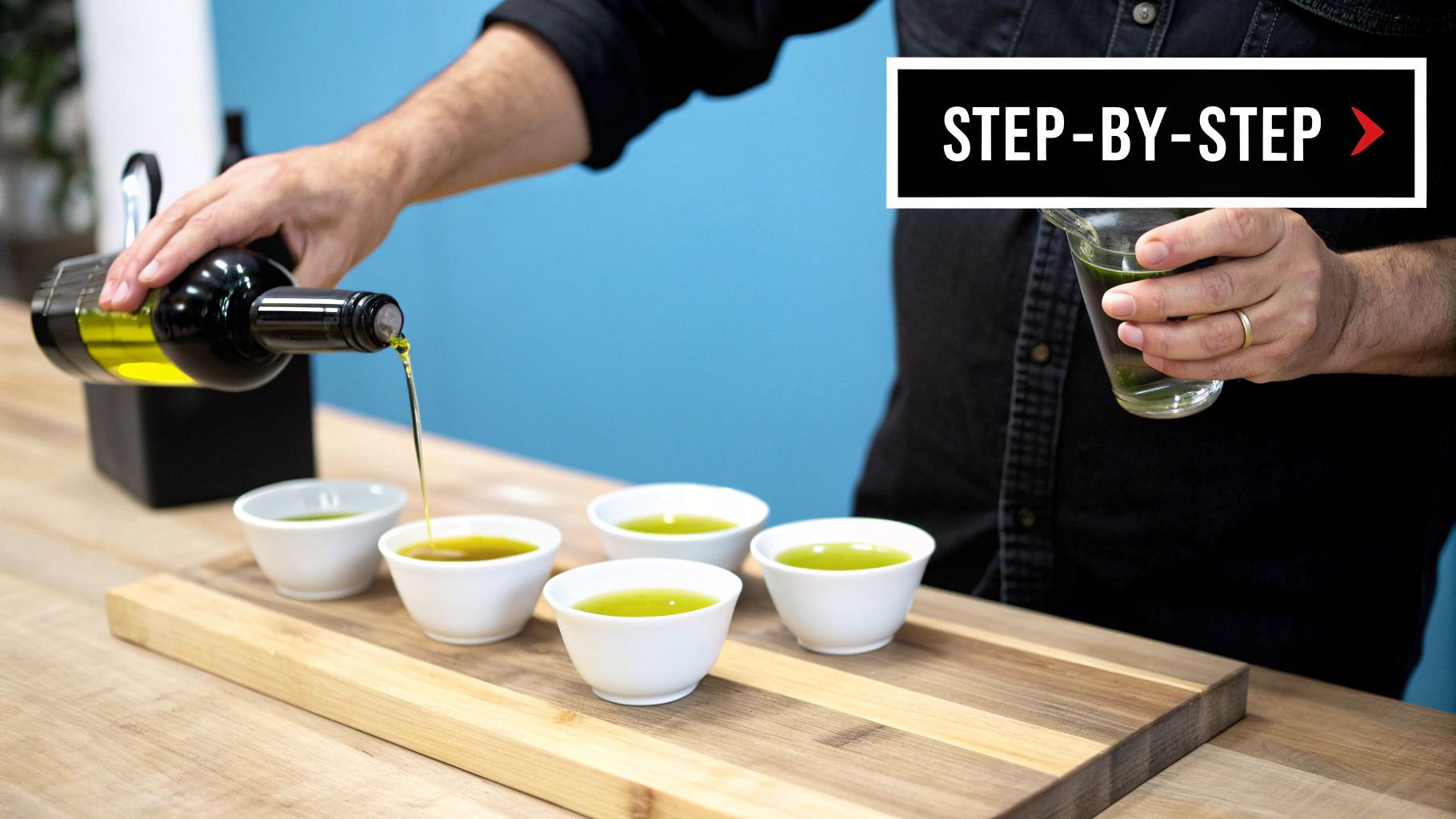
That premium you pay is an investment in a whole chain of quality control. This includes:
- Meticulous Production: Certified oils often come from smaller, traditional groves. Here, olives are hand-picked at their absolute peak ripeness to capture the best possible flavor and the highest polyphenol count.
- Rigorous Third-Party Testing: Every single batch has to pass expensive chemical lab tests and be evaluated by an accredited sensory panel. This proves the oil meets strict criteria for both purity and taste.
- Traceability and Transparency: Seals like PDO and PGI demand a paper trail. This documentation traces the oil all the way from a specific grove right to the bottle you hold, confirming its origin is the real deal.
These steps are costly and take time, but they're what it takes to produce something truly exceptional. When you choose a certified EVOO, you're not just buying cooking oil; you're supporting an entire system built on excellence.
The Psychology of Price and Quality
Here’s where things get interesting. With extra virgin olive oil, the usual rules of bargain hunting get flipped upside down. While most shoppers are conditioned to look for the best deal, savvy EVOO buyers often see a higher price as a sign of quality, not a deterrent.
A suspiciously cheap bottle? That’s usually a red flag. It often hints at old oil, sloppy production methods, or, even worse, outright fraudulent labeling.
In the world of premium olive oil, price is often a proxy for trust. A higher cost suggests the producer has invested in the certifications and careful processes necessary to create a superior product, building consumer confidence.
This isn't just a hunch; the data backs it up. Shoppers who actively seek out high-quality olive oil are heavily influenced by origin certifications. One study found that a remarkable 83% of regular EVOO buyers deliberately look for trusted labels like PDO and PGI.
Even more telling, the same research showed that for premium Italian PGI olive oil, consumer preference actually increased along with the price. It's a clear sign that buyers equate cost with quality. You can dive deeper into these consumer buying habits and the impact of certification to see the data for yourself.
Justifying the Premium with Confidence
Ultimately, seals like PDO and PGI create a powerful bridge of trust between the person who made the oil and the person who buys it. They serve as a simple, reliable shortcut to quality. Instead of trying to decode confusing marketing claims on a label, you can just look for the seal and feel confident you're getting exactly what you paid for.
This confidence is what justifies the higher price. You’re paying for the peace of mind that comes from knowing the oil’s unique flavor is a direct result of its specific terroir. You're paying for the assurance that its health benefits are fully intact and that its journey from a particular region in Spain, Italy, or Greece to your kitchen has been completely verified.
The certification turns a simple grocery run into a deliberate choice for quality, authenticity, and incredible taste.
The Global Journey of Certified Olive Oil
When you pick up a bottle of certified extra virgin olive oil, you're holding the final chapter of a story that spans continents. That small seal on the label is more than just a sticker; it’s a passport that has guided the oil from a sun-drenched grove in the Mediterranean to your kitchen counter. To really get what that certification means, we need to look at the massive global trade that makes it all possible.
This isn't a small-scale operation. The world's olive oil trade is a huge, interconnected system dominated by a handful of major players. The European Union, with Spain and Italy leading the charge, is the heartland of production. On the other side of the world, you have massive importing countries that love EVOO but can't produce nearly enough to satisfy their own demand.
America's Huge Appetite for Olive Oil
The United States is a prime example of this imbalance. Americans have fallen in love with extra virgin olive oil, but our domestic groves produce less than 5% of what the country actually uses. This gap leaves us almost entirely dependent on imports.
The numbers are pretty staggering. In the 2023/24 season alone, the U.S. brought in a whopping 362,618 tons of olive oil, mostly from Spain, Italy, Tunisia, and Turkey. Because we rely so heavily on these shipments, our market is incredibly vulnerable to what happens overseas. For example, a couple of bad harvests in Spain sent EU export prices through the roof, climbing to a peak of €987.8 per 100 kg in July 2024. That's a huge jump from just €298.8 back in September 2020. If you're curious about the nitty-gritty, you can explore the olive oil market report to see just how closely these events are linked.
It’s a classic ripple effect. A long drought in Andalusia, Spain, can mean you’ll be paying more for that certified bottle of EVOO at your local store in Ohio.
How Certification Brings Order to a Wild Market
In a global market this volatile, where prices swing wildly and supply can be a question mark, certification becomes an anchor. It’s not just a stamp of quality—it's a symbol of trust and reliability.
Just think about the journey that imported bottle has taken. It’s crossed thousands of miles, been handled by countless people, and cleared complex customs hurdles. Without a respected, internationally recognized certification, how could an importer or a consumer ever be sure they're getting the real deal?
Certification is like a universal language for the olive oil trade. A PDO seal from Italy or a PGI from Greece means the same thing to a buyer in New York as it does to one in Tokyo. It gets everyone on the same page about quality.
This shared language is what keeps the whole system running smoothly. Here’s why it’s so critical:
- It Greases the Wheels of Trade: Certifications make international business much simpler. When a buyer in the U.S. sees a trusted seal, they don't have to second-guess the quality, which speeds up deals and reduces risk.
- It Upholds Quality Standards: Importing countries can use these certifications to keep low-quality or fake products out. This protects consumers from being tricked by fraudulent oils trying to pass as extra virgin.
- It Shapes Trade Policy: These seals can even influence high-level trade agreements. The quality guarantees that come with certification can lead to better terms, like lower tariffs, giving certified producers a real advantage.
Ultimately, that little seal on your bottle represents a promise that has been kept across borders, through droughts and economic shifts, all to deliver a product you can trust. It’s proof that even in a sprawling, complex global system, a commitment to quality can be verified and delivered.
A Practical Checklist for Buying Certified EVOO
Walking down the olive oil aisle can feel overwhelming, but you don't need to be a professional taster to pick a fantastic bottle. With a little know-how, you can confidently spot a genuinely high-quality, certified EVOO every single time. Let's turn what you've learned into a simple shopping routine.
Think of this as your field guide to finding liquid gold. By looking for a few key details, you can easily sidestep the imposters and take home an oil that truly delivers on flavor and health.
Your Step-by-Step Shopping Guide
Ready to shop like a pro? Keep this mental checklist handy for your next trip to the store. It’s quick, straightforward, and focuses on the markers that matter most.
-
Hunt for the Seal: First things first, scan the bottle for an official extra virgin olive oil certification seal. For European oils, keep an eye out for the distinct red-and-yellow PDO (Protected Designation of Origin) or the blue-and-yellow PGI (Protected Geographical Indication) logos. In the U.S., the California Olive Oil Council (COOC) seal is an excellent sign of freshness and quality. These seals are your best shortcut to the real deal.
-
Find the Freshest Date: This one is non-negotiable. Olive oil is essentially fresh fruit juice, and its quality goes down over time. Look for a harvest date or press date printed on the label. You'll want to grab the bottle with the most recent date, preferably from a harvest within the last year. A "best by" date set far in the future is much less reliable and can be a bit deceptive.
-
Check the Container: Light is one of olive oil's biggest enemies—it causes oxidation, which ruins the flavor and destroys the health benefits. Always, always choose oil packaged in dark, opaque glass bottles or metal tins. A producer who cares about their oil would never put a premium product in clear glass; it offers no protection from light damage.
-
Read the Fine Print: A good label tells a story. Look for the specific city, region, or even the single estate where the oil was produced. Vague descriptions like "Bottled in Italy" or "Product of Multiple Countries" are major red flags. Artisanal producers are proud of where their oil comes from and will state it clearly.
A suspiciously low price is often the biggest warning sign of all. The cost of meticulous farming, third-party testing, and proper bottling means authentic, certified EVOO will never be the cheapest option on the shelf.
Red Flags to Avoid
Knowing what not to buy is just as important as knowing what to look for. If you spot any of these on a bottle that claims to be "extra virgin," it’s best to just put it back on the shelf.
- Clear Bottles: Exposing the oil to light shows a producer who doesn't prioritize quality.
- Vague Origins: Phrases like "Mediterranean Blend" are meaningless and suggest the oil could be from anywhere and of any quality.
- Missing Dates: No harvest or press date? The producer likely has something to hide about the oil's age.
- Rock-Bottom Prices: If a large bottle costs just a few dollars, you can be almost certain it's not real EVOO.
By following these simple steps, you're no longer just guessing. You're making a smart choice based on real, verifiable marks of quality, freshness, and authenticity.
Frequently Asked Questions About EVOO Certification

Even after you know what to look for, a few questions always come up when you're standing in the grocery aisle. Let's tackle some of the most common ones, clear up a few myths, and show how understanding an extra virgin olive oil certification makes you a much more confident shopper.
Is an Expensive Olive Oil Always Better?
Not necessarily, but with EVOO, price is often a pretty reliable clue about quality. Think of it this way: a higher price tag helps cover the cost of careful harvesting, proper milling, and the rigorous certification process that genuine producers go through. It's an investment you can taste.
While a high price doesn't guarantee you'll personally love its flavor profile, an unbelievably low price for a big bottle should set off alarm bells. That's often a sign of a low-quality product or, worse, a bottle that isn't what it claims to be.
Certification seals like PDO or PGI provide a much more reliable guarantee of quality than price alone. They are your best assurance that the oil is authentic, regardless of its cost.
When in doubt, trust the seal. It’s a far better guide than the price tag alone.
What Is the Most Important Detail on an EVOO Label?
If you look for just one thing besides a certification seal, make it the harvest date or press date. Unlike wine, olive oil is a fresh product that starts to degrade the moment it's made. You always want the freshest bottle you can get your hands on.
A harvest date tells you exactly when the olives were picked and pressed, giving you a true measure of freshness. Look for oil harvested within the last year for the best flavor and health benefits.
Don't be fooled by a "best by" date. This date is often set two years or more from the bottling date, not the harvest date, which can easily disguise an old, tired oil.
Does Light Olive Oil Have Fewer Calories?
No, and this is probably the biggest myth out there. When a label says "light" or "extra light," it’s talking about the oil's color and flavor—not its calorie count.
"Light" olive oil is a highly refined product. It’s been processed to strip away its natural color, aroma, and taste, leaving behind a neutral-tasting oil.
It has the exact same number of calories as extra virgin olive oil but contains none of the beneficial polyphenols, antioxidants, or incredible flavors that make EVOO a powerhouse for both health and cooking. For superior taste and real health benefits, a certified Extra Virgin Olive Oil is always the right choice.
At Learn Olive Oil, we're dedicated to helping you discover the rich world of authentic olive oil. From understanding labels to mastering tasting techniques, we provide the expert insights you need to choose and enjoy the very best. Explore our guides and start your journey at https://learnoliveoil.com.

 Learn Olive Oil
Leave a comment