Imagine you could bottle the flavor of a sun-drenched afternoon in a Mediterranean grove. If you could capture the peppery, vibrant life of an olive plucked fresh from the branch… you would have a bottle of true virgin olive oil.
So, what is the secret locked inside that little word, "virgin"? It's not marketing fluff. It is a simple, unbreakable promise: purity.
Unlike refined oils, which are often stripped of their soul by chemical solvents and high heat, virgin olive oil is the pure, unadulterated juice of the olive. It is extracted by mechanical means alone—a guarantee that nothing has come between the fruit and the bottle to steal its natural character.
The Unbroken Promise in Every Drop
The term 'virgin' isn't just a label; it's a hard-earned seal of quality that begins its life long before the oil ever sees a bottle. The story starts in the grove. Just as with any healthy fruit trees, the quality of the final product is a direct reflection of the health and care of its source.
When you see "virgin" on a label, you are looking at the final chapter of a story—a story that honors the olive's natural state, from the living tree all the way to your kitchen.
The rules are brutally strict. First and foremost, the oil must be extracted using only physical force—think of the gentle, persistent crush of a traditional stone press or the powerful spin of a modern centrifuge. This delicate handling is the secret to preserving the oil’s fleeting flavors, its complex aromas, and the potent antioxidants that heat or chemicals would instantly destroy.
To put it simply, virgin olive oil is fresh fruit juice. It is a direct, honest confession of the olive’s quality, the soil that nourished it, and the skill of the person who produced it.
The Foundation of Authenticity
This commitment to purity isn’t just a philosophy; it’s backed by cold, hard science. The International Olive Council (IOC) has carved clear benchmarks in stone. For an oil to earn the "virgin" classification, its free fatty acidity must be below 2.0%.
Think of this number as a report card for the olives themselves. A low acidity level is proof of healthy, undamaged fruit that was rushed from the tree to the mill. Its more famous cousin, extra virgin olive oil, must meet an even more demanding standard of less than 0.8% acidity. These meticulous rules ensure that every drop carries the true, untarnished soul of a freshly picked olive. You can discover more about latest olive oil production forecasts and trends to see how these standards define the global market.
Here's a quick look at what "virgin" promises you when you see it on a label.
The Purity Checklist for Virgin Olive Oil
| Core Principle | What It Means for You | Why It Matters for Quality |
|---|---|---|
| Mechanical Extraction Only | No chemicals or high heat were used to get the oil out of the olives. | This is the only way to preserve the oil’s natural flavor, aroma, and health benefits like antioxidants. |
| Fresh Fruit Source | The oil is made from fresh, healthy olives, not damaged or overripe ones. | Healthy fruit delivers lower acidity and a far superior taste, free from defects that ruin the experience. |
| Strict Acidity Limits | The oil must have a free fatty acidity level of 2.0% or less. | This is a scientific guarantee of the fruit's quality and the producer's skill and care. |
Ultimately, these principles work in concert to promise that the bottle you buy contains the pure, authentic juice of the olive, exactly as nature created it.
The Race Against Time from Grove to Mill
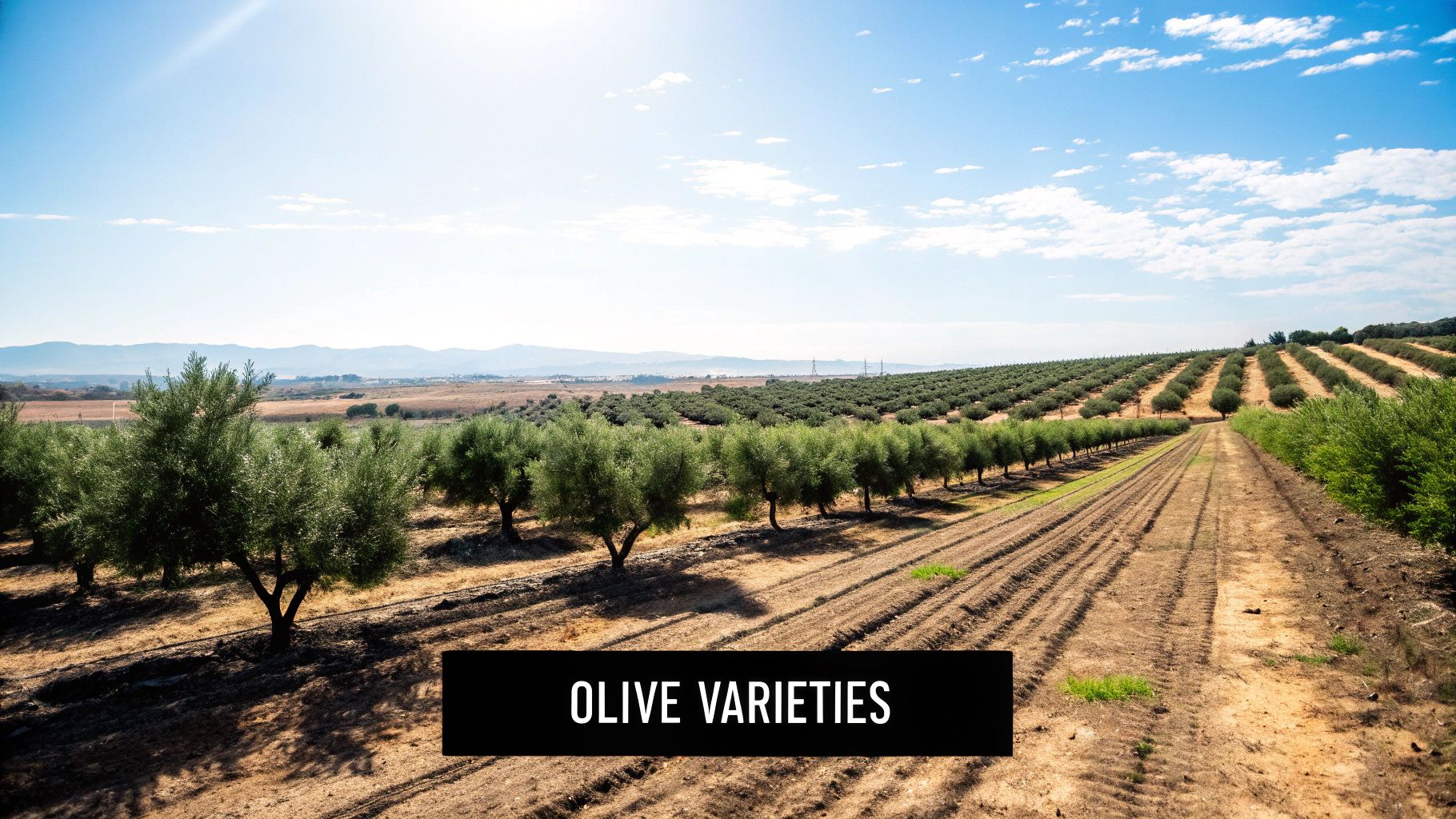
Crafting a truly great virgin olive oil isn't merely a process; it's a desperate sprint against the clock. From the very second an olive leaves its branch, an invisible stopwatch begins to tick. Every minute that slips by is another battle lost to the elements—air, light, and heat—that conspire to degrade the very essence of the fruit.
Think about the difference between a glass of freshly squeezed orange juice and the stuff you pour from a can. One is alive, electric, a direct expression of the fruit. The other is a ghost, a product of an industrial process that has lost its vitality. For virgin olive oil, capturing that "fresh-squeezed" character is the entire game.
This obsession with urgency is what separates an exceptional oil from a mediocre one. The entire goal is to halt oxidation in its tracks—the same insidious chemical reaction that turns a cut apple brown. Oxidation is the enemy. It murders the very compounds that give the oil its peppery fire, its fruity perfume, and its legendary health benefits.
The Critical Harvest Window
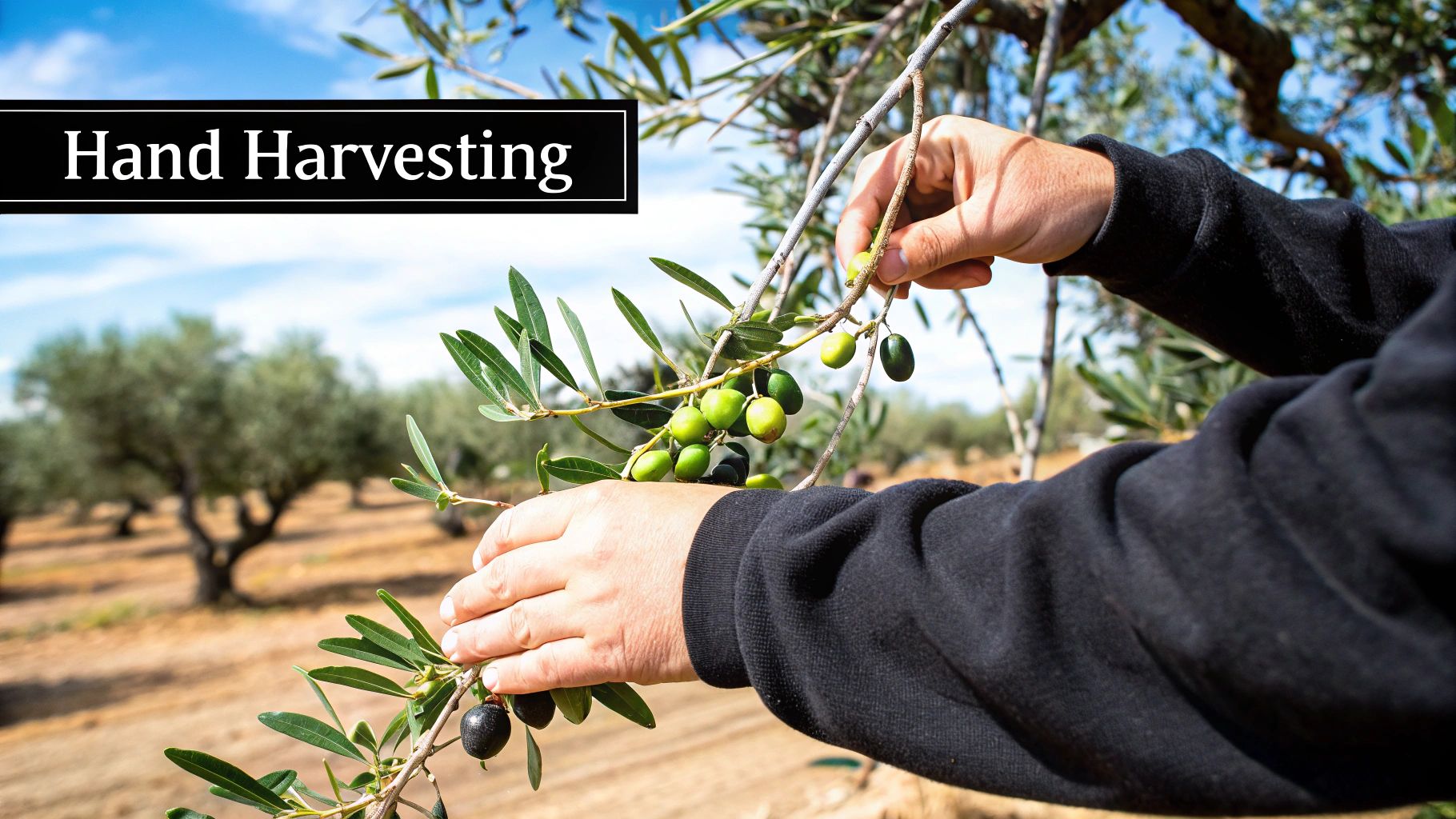
Harvesting olives isn't just about picking them; it's about picking them in one perfect, fleeting moment. This is an art form, a secret passed down through generations. Producers watch their groves like hawks, waiting for the invaiatura—that magical instant when the olives begin to blush from green to a deep purplish-black.
Pick too soon, and the oil will be brutally bitter, the yield frustratingly low. Wait too long, and the overripe olives will produce an oil that is flat, bland, and riddled with defects.
When that window cracks open, it's all hands on deck. The olives must be handled with the reverence of a bomb disposal expert. Every bruise, every tiny break in the skin, kicks off the process of decay and sends the oil's acidity soaring. This is why the world's best producers still harvest by hand or with gentle mechanical rakes—they need the fruit to arrive at the mill as pristine as it was on the tree.
This fanatical devotion to speed and gentle handling is a massive part of the answer to how olive oil is made when quality is the only thing that matters.
"The clock is the olive farmer’s greatest adversary. A world-class oil is often defined not by weeks or days, but by the handful of hours between the tree and the press."
From Tree to Press in Mere Hours
The journey from the grove to the mill is arguably the most nail-biting part of the entire operation. To shield the fruit's integrity, this trip must be mind-bogglingly fast. While pressing within 24 hours is a decent benchmark, the true artisans of the craft aim for a much tighter window—often a mere 4 to 6 hours.
This furious turnaround slams the brakes on the natural breakdown of the fruit and keeps oxidation locked out, which is the secret to capturing all those healthy polyphenols and vibrant flavors. This relentless focus on speed ensures the final oil is a pure, unblemished reflection of the olive itself. It’s more than just oil; it’s the essence of a perfect harvest, bottled through skill, care, and a great deal of haste.
The Art of Cold Pressing Explained
When you hear the phrase “mechanically pressed,” you might picture a cold, industrial process. The reality is far more beautiful—it is a moment where physics and tradition dance together. This is the moment the solid olive fruit is gently persuaded to release its liquid gold.
It is also the very heart of what makes virgin olive oil, well, virgin. The oil is simply pressed from the fruit using only physical force. There are no chemicals. There is no high heat. There is only pure, mechanical persuasion.
The journey begins after the olives are crushed into a thick, uniform paste. From there, the oil maker has two main options. They can embrace tradition, spreading the paste onto fiber mats and squeezing them in a classic press. Or, they can turn to modern technology and use a centrifuge, which spins the paste at incredible speeds to separate the oil from the water and solids.
Either way, the principle is identical: a purely physical separation. This is what guarantees the oil is an unadulterated, unrefined fruit juice, true to the olive from which it came.
The Magic of Low Temperatures
This brings us to a phrase you've surely seen: "cold pressing." In the world of olive oil, these two words are a powerful signal of quality. I like to think of it like brewing a delicate tea. If you pour boiling water over fragile green tea leaves, you scorch them, leaving you with a bitter, disappointing mess. But if you use water that is just the right temperature, you unlock a world of subtle, wonderful flavors.
The exact same principle applies to olives. To protect the oil’s most valuable—and most fragile—components, the entire extraction process must remain cool.
Officially, international standards dictate that the olive paste must be kept below 27°C (80.6°F) during the entire process. This isn't just a friendly guideline—it's an ironclad rule that directly shapes the quality and taste of the final oil.
Why all this fuss about temperature? Keeping things cool is non-negotiable for a few critical reasons:
- It Preserves the Aroma: The compounds that give olive oil its incredible fruity and grassy scents are extremely volatile. A little bit of heat, and poof—they vanish into thin air.
- It Protects the Antioxidants: Those healthy polyphenols—the very ones that give a great virgin olive oil its signature peppery kick—are incredibly delicate. Heat destroys them.
- It Maintains Nutritional Value: High temperatures can actually corrupt the oil's chemical structure, causing its acidity to rise and stripping away its health benefits.
If you want to dive deeper, our guide on what cold-pressed olive oil is breaks it all down. At the end of the day, this careful, temperature-controlled method is what separates a truly exceptional olive oil from a generic, flavorless one. It's more than a technique; it is a solemn promise to keep the very soul of the olive intact.
The Unseen Science of Purity
Beyond the sun-drenched groves and the whirring of the mill, the true essence of a virgin olive oil is locked away inside its very chemistry. It’s an invisible world of metrics that tells the real story of quality, and the single most important number on that report card is its free fatty acidity (FFA).
Now, "acidity" might sound intimidating, but the concept is surprisingly simple. Picture a perfectly healthy, unblemished olive. Inside, its fats are stable and well-structured. But the moment that olive is bruised, left too long after picking, or mishandled during milling, that elegant structure begins to shatter, releasing free fatty acids.
So, you can think of the acidity level as a direct, scientific measure of an oil’s integrity. A low FFA isn't just a number; it is irrefutable proof of healthy fruit and meticulous care at every single step of the journey.
Cracking the Code on the Label
The official grades of virgin olive oil are not determined by vague marketing terms—they are defined by strict, internationally recognized acidity thresholds. Learning what these numbers mean is like learning to speak the secret language of olive oil quality.
- Extra Virgin Olive Oil: This is the pinnacle, the gold standard. It must have a free acidity of less than 0.8%. This astonishingly low number is a signal that the olives were practically perfect and the entire process was executed without a single flaw.
- Virgin Olive Oil: Still a good, unrefined oil, but it's permitted a free acidity of up to 2.0%. That slightly higher percentage points to some minor bumps in the road—perhaps the fruit was a little overripe, or there were small delays in processing.
Any oil with an acidity above 2.0% cannot legally be called "virgin" olive oil. It is typically classified as lampante oil and sent away to be refined. To really get into the weeds, you can explore our guide on understanding olive oil acidity.
Acidity in olive oil has nothing to do with taste—it's a silent measure of purity. A low FFA is the chemical signature of a perfectly executed harvest, a direct reflection of the oil’s pristine condition.
This visual helps to show how different production choices can affect the final quality metrics, including that all-important acidity.
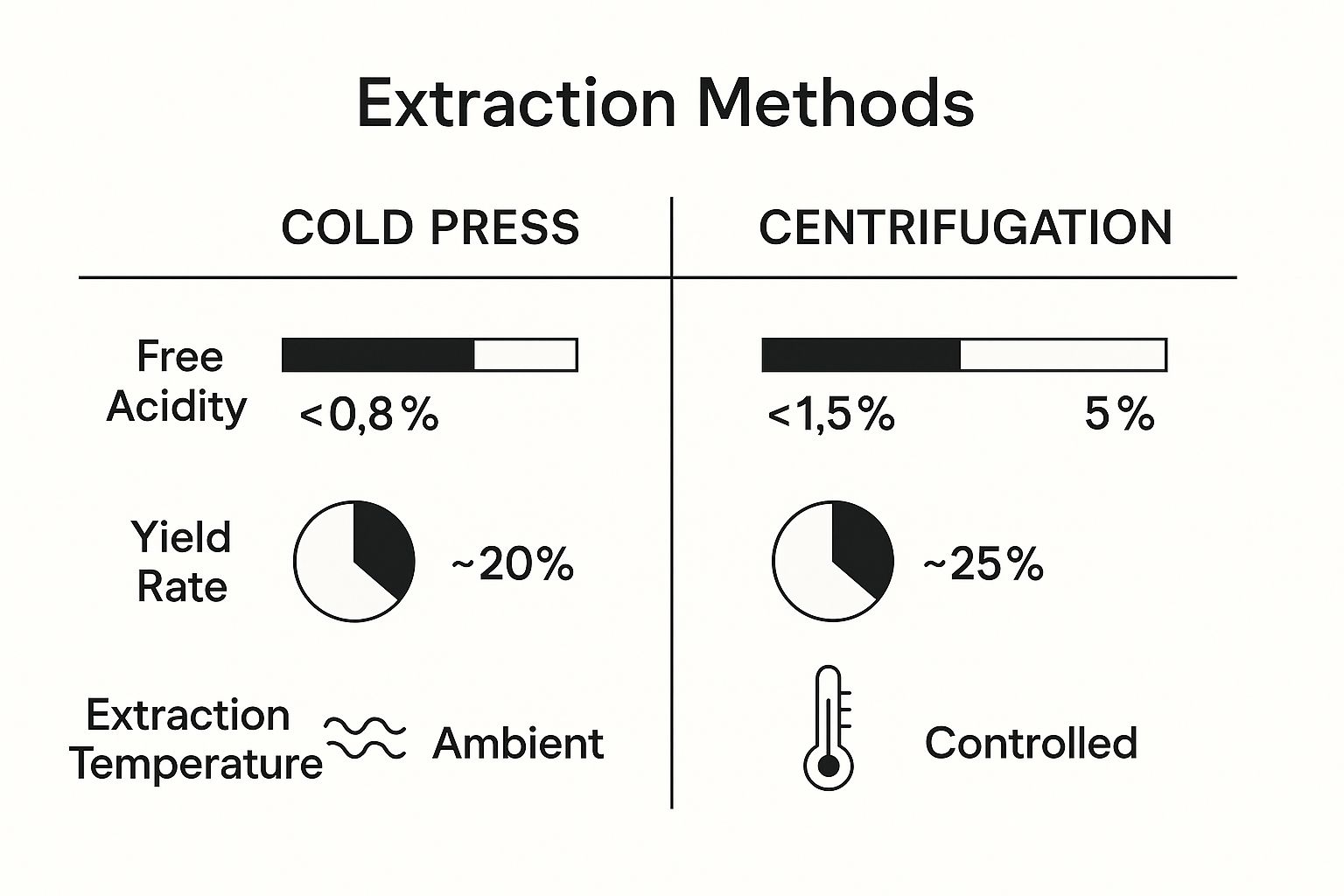
As you can see, producers often have to balance maximizing their yield against maintaining the low temperatures and gentle handling needed to keep acidity at an absolute minimum. For the best oils, quality always wins.
A Comparison of Virgin Olive Oil Grades
To put it all into perspective, let's compare the key grades side-by-side. This table breaks down the crucial differences you'll find when shopping for olive oil.
| Quality Grade | Acidity Level | Production Method | Flavor Profile |
|---|---|---|---|
| Extra Virgin Olive Oil | Less than 0.8% | Mechanical extraction only; no heat or chemicals. | Fresh, fruity, and complex. No sensory defects. |
| Virgin Olive Oil | Less than 2.0% | Mechanical extraction only; no heat or chemicals. | Good flavor, but may have minor sensory imperfections. |
| Olive Oil | Varies (refined) | A blend of refined oil and some virgin oil. | Mild, neutral flavor, lacking the complexity of virgin oils. |
Ultimately, whether you're choosing an Extra Virgin or a Virgin oil, you're getting a natural, unrefined product. The difference lies in that tiny percentage point—a small number that tells a huge story about care, craft, and quality.
How Experts Taste for Quality and Flaws
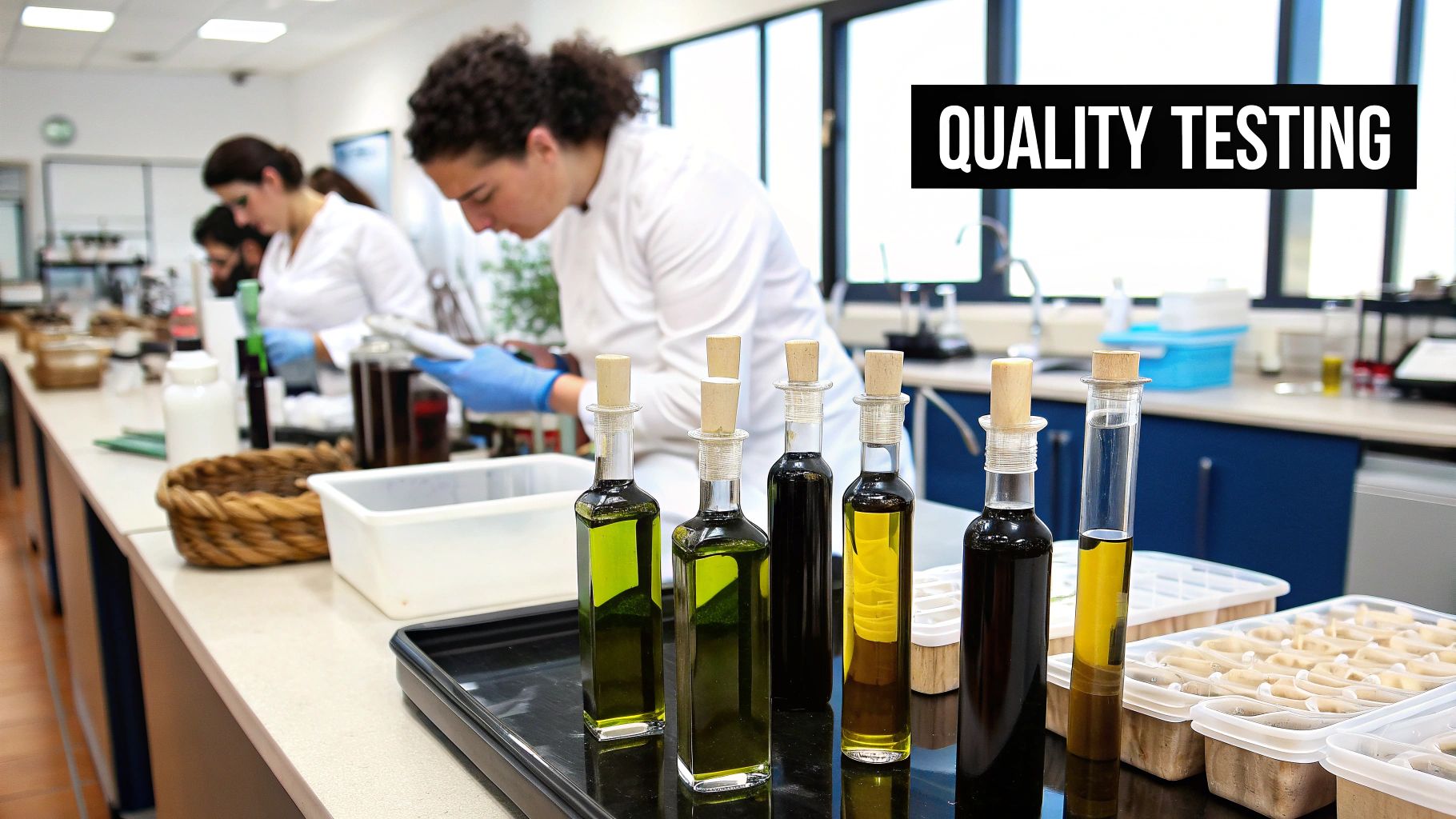
While lab tests provide the cold, hard numbers, the ultimate proof of an olive oil’s quality is found in the tasting. Professional tasting, known officially as organoleptic assessment, isn't about simply deciding if you "like" an oil. It is a disciplined, systematic hunt for perfection—and, just as importantly, for any flaw that would betray its purity.
Think of it like a master wine sommelier who can identify a grape's origin and vintage from a single sip. For certified olive oil tasters, the process is every bit as rigorous. It is a sensory investigation designed to confirm that the oil’s journey from a healthy olive to the bottle was flawless. Any misstep along that path leaves an unmistakable, ghostly signature in the final taste and aroma.
This expert tasting is the ultimate gatekeeper. An oil can boast a perfect acidity score, but if a trained panel of tasters detects even a single defect, it cannot be classified as extra virgin. End of story.
The Holy Trinity of Positive Attributes
Trained tasters are searching for a harmonious balance of three key positive notes. These are not just pleasant flavors; they are direct, irrefutable signs of the oil's freshness, the quality of the original olives, and the presence of healthy antioxidant compounds.
- Fruitiness: This is the core aroma of fresh, healthy olives. It can be delicate and floral or bold and grassy, conjuring up notes of artichoke, green tomato leaf, or freshly cut herbs.
- Bitterness: That sharp, bitter note on your tongue is not a defect—it is a badge of honor. It is the taste of potent antioxidants drawn from fresh, green olives.
- Pungency: This is the peppery or spicy sensation that grabs you at the back of your throat. It’s caused by a powerful anti-inflammatory compound called oleocanthal and is a dead giveaway of a freshly milled, high-quality oil.
The peppery sensation that makes you cough is often called the "oleocanthal sting." Far from being a flaw, experts celebrate it as proof of a powerful and healthy virgin olive oil.
Identifying the Deal-Breakers
Just as critical as finding those positive traits is ensuring there are absolutely zero defects. These negative flavors are the ghosts of poor harvesting or production practices, and their presence is an automatic disqualification for any high-grade virgin olive oil.
The most common flaws include:
- Rancid: A stale, waxy, or crayon-like taste. This is the calling card of oxidation from too much exposure to light, heat, or air.
- Fusty: A fermented, swampy flavor that occurs when olives are piled up and stored for too long before being milled.
Learning to spot these nuances takes practice. This disciplined approach is similar across different sensory fields, and you can see parallels in guides on how to taste coffee like a professional.
Ready to try it yourself? Our complete guide on how to taste olive oil will walk you through the exact same steps the pros use.
How to Choose a True Virgin Olive Oil
So, you now understand the secrets that make virgin olive oil special. But how do you turn that knowledge into power when you’re standing in a crowded supermarket aisle, confronted by a wall of bottles? The good news is, it’s easier than you think once you learn to read the story each bottle is telling.
Your first and most powerful clue is the grade itself. Always look for the words "Extra Virgin Olive Oil" printed clearly on the label. This isn't just advertising copy; it's the highest legal classification in the world, a guarantee that the oil has survived a brutal battery of chemical and sensory tests. Anything less is a compromise.
But don’t stop there. True quality has nothing to hide. The best producers are proud to share the details of their hard work. They know that transparency is what separates them from the crowd in a global market valued at over $19.4 billion and still growing. You can dive deeper into the expanding olive oil market on fortunebusinessinsights.com.
Decoding the Label
Next, become a detective and hunt for proof of freshness. A vague "best by" date is often misleading and nearly useless on its own. The real prize you're searching for is a harvest date. This simple piece of information tells you exactly when the olives were picked, giving you a true benchmark for the oil's age and vitality.
Then, check for the origin. A specific town, region, or even a single estate is a fantastic sign. Vague labels like "Product of the Mediterranean" are often a red flag, suggesting the bottle contains a blend of oils from various unknown sources.
Finally, the bottle itself is a dead giveaway.
An honest producer protects their oil. If it's in a clear glass bottle, leave it on the shelf. Dark glass or an opaque tin is non-negotiable for shielding the oil from light—its number one enemy after it leaves the mill.
These small details are what separate the genuine article from the impostors. Learning to spot them is critical, which is why we created a full guide on how to spot fake olive oil. By prioritizing these key indicators—grade, harvest date, specific origin, and protective packaging—you can confidently pick a bottle that delivers the authentic, vibrant quality you’re paying for.
Answering Your Olive Oil Questions
Even after you get the hang of what makes virgin olive oil tick, a few questions always seem to pop up. Let's clear up some of the most common ones so you can feel like an expert every time you reach for that bottle.
Is "Cold Pressed" the Same as "Extra Virgin"?
That's an excellent question, and the answer is no—but they are closely related. Think of "cold pressed" as the how. It's the chemical-free, low-heat mechanical method that is required to produce any true virgin olive oil.
"Extra Virgin" is the what. It’s the highest grade an oil can possibly achieve. To earn this prestigious title, an oil must not only be cold-pressed, but it must also pass a series of difficult chemical and sensory tests. It needs a flawless flavor profile and a free fatty acidity below 0.8%.
So, while every bottle of extra virgin olive oil is by definition cold-pressed, not every cold-pressed oil possesses the exceptional quality to be called "extra virgin."
Why Does My Olive Oil Taste Peppery or Bitter?
If your olive oil leaves a sharp, peppery kick in your throat or has a distinct bitterness, congratulations—you've got the real deal! That sensation isn't a flaw; it's the signature of a high-quality, fresh oil.
These assertive flavors come from incredibly healthy antioxidants called polyphenols. One of these, oleocanthal, is a natural anti-inflammatory compound that creates that unmistakable peppery feeling.
A mild, buttery oil can be pleasant, but that pungent bite is the oil’s way of shouting that it's packed with health benefits. It is a bold announcement of freshness and quality.
How Should I Store My Virgin Olive Oil?
To keep your olive oil tasting incredible, you must protect it from its three greatest enemies: oxygen, light, and heat. Exposing your oil to these will rapidly murder its beautiful flavors and aromas.
Here’s how to give your oil the care it deserves:
- Find a cool, dark home for it, like a kitchen cabinet or pantry. The worst places you can keep it are next to the stove or on a sunny windowsill.
- Always seal the cap tightly after you pour. The less air that gets inside, the better.
- Buy oil in dark glass bottles or tins. Clear glass is a terrible shield against light, which can ruin a great oil with surprising speed.
For the best possible experience, try to use an opened bottle within a few months. Proper storage makes certain the last drop you pour is just as delicious as the first.
Discover the world of premium olive oil with Learn Olive Oil. We provide expert insights, tasting guides, and recommendations to help you choose the best oil every time. Start your journey and explore our resources.
 Learn Olive Oil
Leave a comment