Picture this. You're standing in the grocery store aisle, a bottle of gleaming extra virgin olive oil in your hand. You're committed to your gluten-free life, and that means you question everything. So you wonder, "Is this truly safe for me?"
Let me put your mind at ease with the short, simple answer: yes, pure extra virgin olive oil is one of the most trustworthy friends you can have in your kitchen.
The Simple, Reassuring Truth About Olive Oil
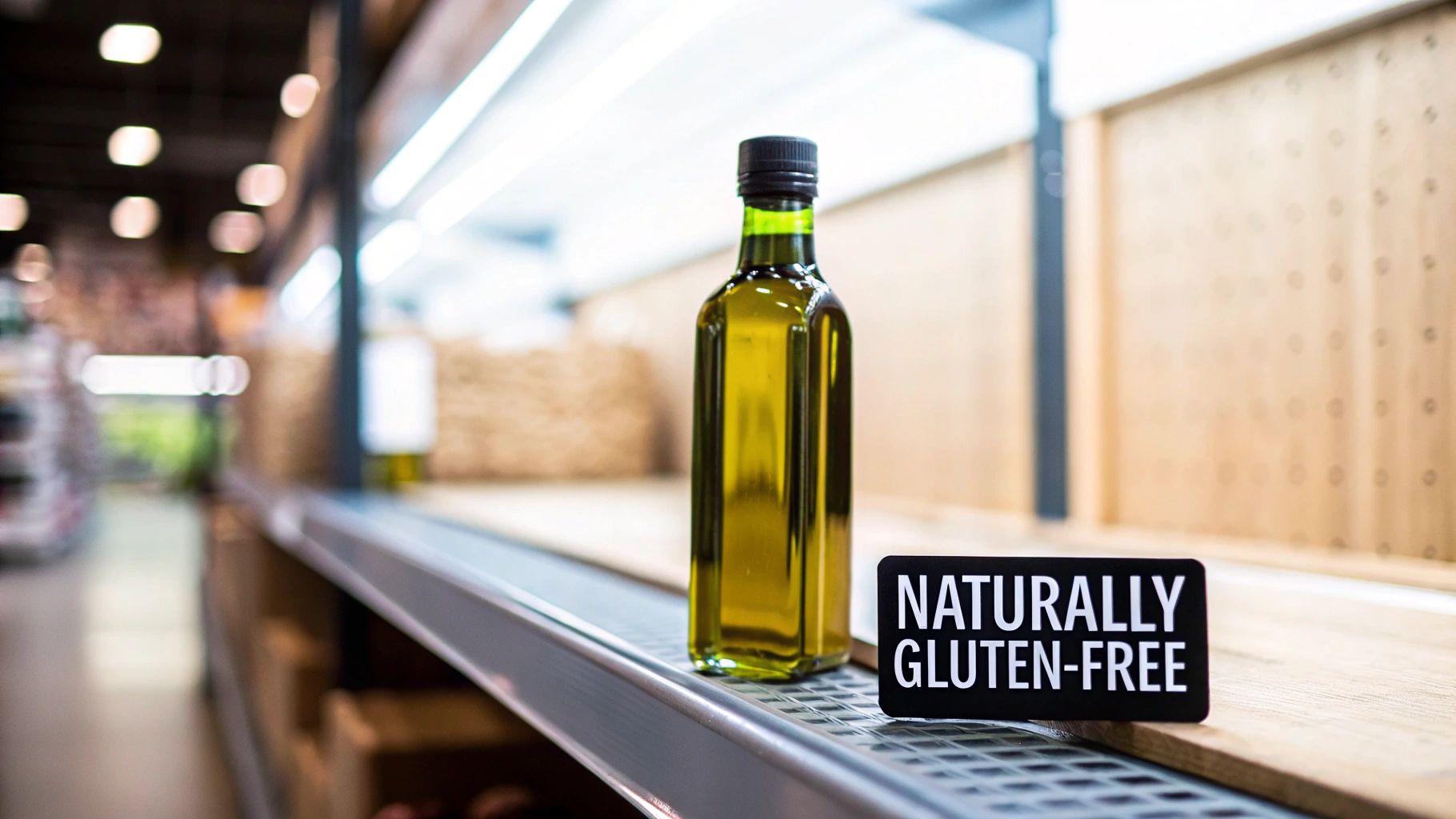
Here is a foundational truth: pure, high-quality extra virgin olive oil is born from one ingredient and one ingredient alone—the humble olive. The process is a masterpiece of simplicity. Fresh olives are plucked from ancient trees and pressed to release their liquid gold. That’s the entire story.
You will find no grains like wheat, barley, or rye in this narrative. No gluten-containing additives, no hidden villains. This is why olive oil has anchored healthy diets for millennia. The "extra virgin" designation itself is a sacred promise of purity. Unlocking the meaning of extra virgin olive oil reveals it's the highest, most unadulterated grade, extracted without the trespass of chemicals or intense heat.
So, if the oil itself is a paragon of safety, why does a shadow of doubt even exist? Because the journey from a sun-drenched grove to your pantry shelf can introduce a few modern-day complications.
Where a Tiny Risk of Cross-Contamination Hides
The real concern isn't the olive oil, but the world it travels through. The possibility of cross-contamination, while remarkably rare, can surface if the oil is bottled or stored in a facility that also dances with wheat-based products.
Imagine it: a microscopic cloud of airborne flour, or equipment that wasn't scoured with military precision between production runs. In theory, these could introduce minute traces of gluten.
But here is the profoundly good news. Overwhelming evidence shows this is an incredibly minor risk.
A landmark 2021 survey revealed a stunning statistic: over 99% of tested extra virgin olive oil samples from leading brands were utterly free from any gluten contamination. The rare instances that showed trace amounts were traced back to packaging and storage facilities—never the oil itself.
These numbers should grant you a deep sense of peace. Pure extra virgin olive oil is, by its very nature, one of the safest and most wholesome choices for a gluten-free life. Your power lies in knowing what to look for, transforming you from a worried shopper into a confident connoisseur.
Here’s a quick checklist to arm you with that confidence.
Extra Virgin Olive Oil Gluten-Free Checklist
| Attribute | Gluten-Free Status | Reason |
|---|---|---|
| Base Ingredient | Naturally Gluten-Free | Made 100% from olives, a fruit. |
| Production Process | Naturally Gluten-Free | Olives are simply pressed to extract oil. No grains are involved. |
| Additives | Naturally Gluten-Free | True extra virgin olive oil contains no additives or flavorings. |
| Risk Factor | Low to None | The only potential risk is cross-contamination, which is rare. |
The verdict is in. Both the science and the very soul of the product confirm that extra virgin olive oil is a foundational ingredient you can build your health upon.
How Olives Become Naturally Gluten-Free Oil
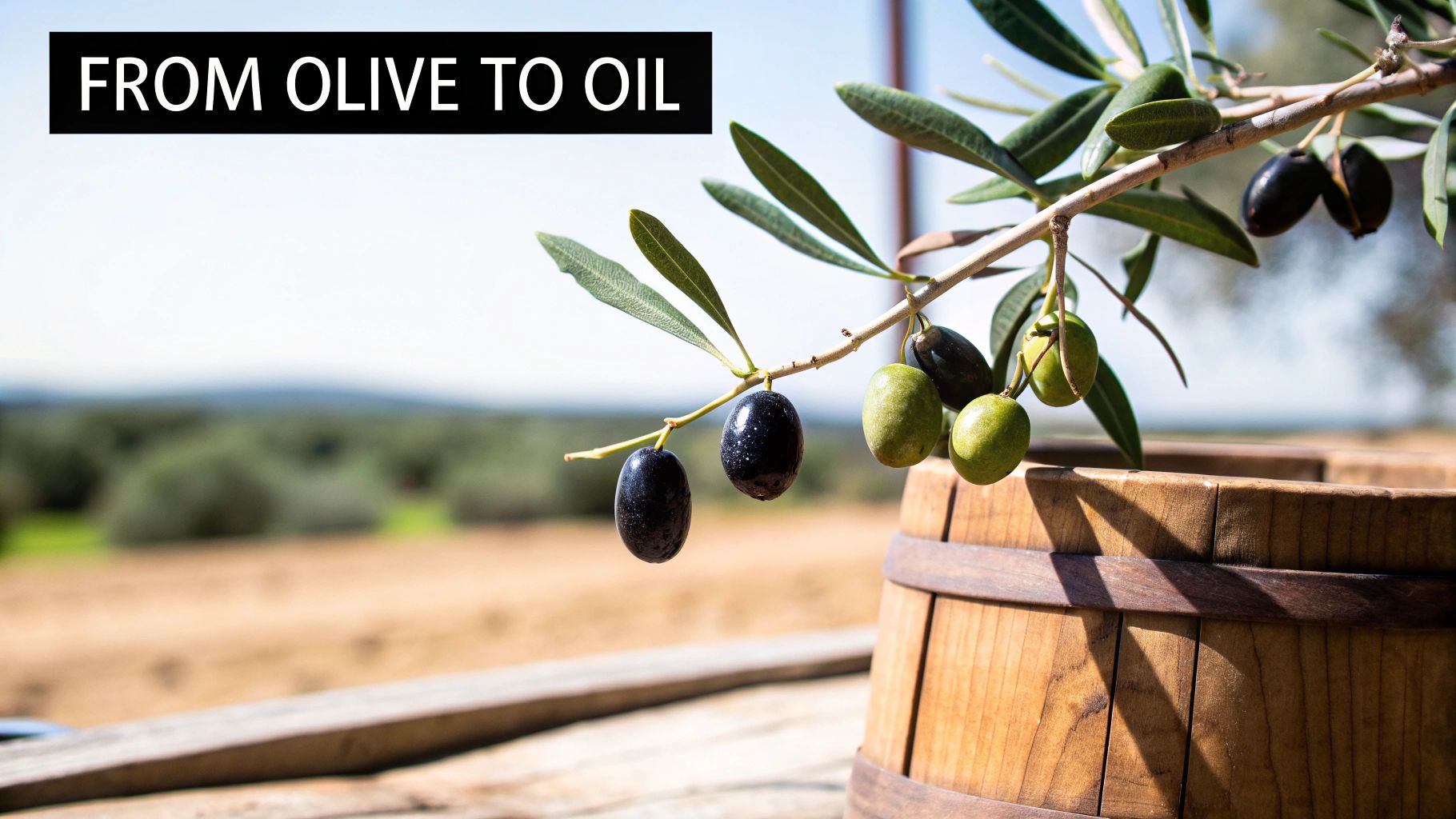
Transport yourself to a sun-drenched olive grove in the Mediterranean. The only ingredients here are soil, water, and sunlight. This is where the story of truly gluten-free olive oil begins, using a process so pure it has been honored for thousands of years. The journey from olive to oil is a testament to nature, not a feat of complex manufacturing.
Think of it like squeezing an orange for fresh juice. You wouldn't expect to find anything but orange in your glass, would you? The same elemental logic applies. The timeless craft of making olive oil is beautifully straightforward: olives are harvested, crushed, and then pressed to liberate their oil. No grains, no additives, no gluten.
At its heart, the process is one of profound and elegant simplicity.
The First Cold Press: A Promise of Purity
When you see the words "first cold press" etched on a bottle of fine olive oil, recognize it as a mark of integrity. It is a solemn promise that the oil was extracted using only mechanical force—no scorching heat, no chemical solvents, and absolutely no foreign ingredients.
The process is refreshingly primal and unfolds in a few key steps:
- Harvesting: Ripe olives are gathered by hand, straight from their branches.
- Washing: They're given a gentle rinse to wash away dust or leaves.
- Crushing: The whole olives—pits and all—are milled into a thick, fragrant paste.
- Pressing: This paste is then slowly pressed, using immense mechanical pressure to coax out the rich, golden oil.
And that is all. What emerges is the purest possible expression of the olive. This method not only insulates the oil from potential gluten sources but also locks in its powerful antioxidants and sublime flavor.
The sheer genius of this ancient technique is its simplicity. It relies on pressure, not intricate formulas or added ingredients, to create the final product. Gluten simply cannot enter the equation because it was never part of the original, perfect recipe.
Once you grasp this authentic craft, it becomes clear why pure, extra virgin olive oil is inherently gluten-free. It isn't gluten-free by accident; it's gluten-free by design. You can explore this fascinating journey from tree to bottle in our guide on how olive oil is made.
Unmasking the Hidden Danger of Cross-Contamination
We've established a comforting truth: pure extra virgin olive oil, in its natural state, is impeccably gluten-free. It’s a simple product born from a single fruit. But if you live with celiac disease or a serious gluten sensitivity, you know the modern world is seldom that simple. Even the most pristine ingredient can be compromised on its journey to your table.
The true danger isn't in the oil, but in the environment surrounding it. The risk, however small, is cross-contamination. This is the invisible variable that can transform a safe product into a serious threat for some.
Imagine a bustling, modern bottling facility. On one production line, glorious, pure olive oil flows into bottles. But just a few feet away, the same company might be creating an infused dipping oil that uses breadcrumbs for texture. Or perhaps they're bottling a salad dressing that relies on a wheat-based thickener.
How a Safe Product Can Be Compromised
Gluten can infiltrate a gluten-free product in surprisingly subtle ways. It doesn't take much—even microscopic traces can trigger a reaction in highly sensitive individuals. Examining the complete olive oil manufacturing process reveals just how many steps are involved, each a potential point of contact.
Here are the most common scenarios where a breach can occur:
- Shared Equipment: If the same bottling lines, pumps, or storage tanks are used for both pure olive oil and products containing gluten—without an ironclad, certified cleaning protocol in between—tiny particles can easily make the leap.
- Airborne Particles: In a factory that also handles wheat flour, airborne dust can settle on surfaces and machinery, eventually finding its way into otherwise pure olive oil.
- Storage and Transport: Even if bottled with perfect care, the containers might be stored in a warehouse right next to pallets of flour or other gluten-containing goods.
The core issue isn't a defect in the olive oil, but a failure in the protective bubble around it. It’s about safeguarding the oil’s pristine nature from the grove all the way to the sealed bottle.
This awareness is your greatest asset, much like how people seek out hypoallergenic products to create a safer home. This isn't about fear; it's about empowerment. By understanding these potential risks, you become a formidable consumer who knows exactly what to look for on a label and which questions to ask.
How to Read Labels and Choose a Truly Safe Olive Oil
Now that you understand the slim-but-real risk of cross-contamination, you can stride down the grocery aisle with confidence, not anxiety. Think of it as acquiring a new skill—the art of reading an olive oil label to instantly spot the truly safe products and sidestep any with unnecessary risk.
Your most powerful ally in this mission is the “Certified Gluten-Free” seal. This isn't just clever marketing; it’s a non-negotiable guarantee. It signifies that an independent third party has subjected the product and the facility to rigorous testing to ensure it meets strict safety standards. For absolute, unshakable peace of mind, this seal is your gold standard.
Decoding the Secret Language of Labels
Beyond that certification, it's time to become a food detective and search for subtle clues. Some labels contain advisory statements that are immediate red flags, especially if you have a high sensitivity to gluten.
Here’s a quick guide to help you make a safe choice, every single time.
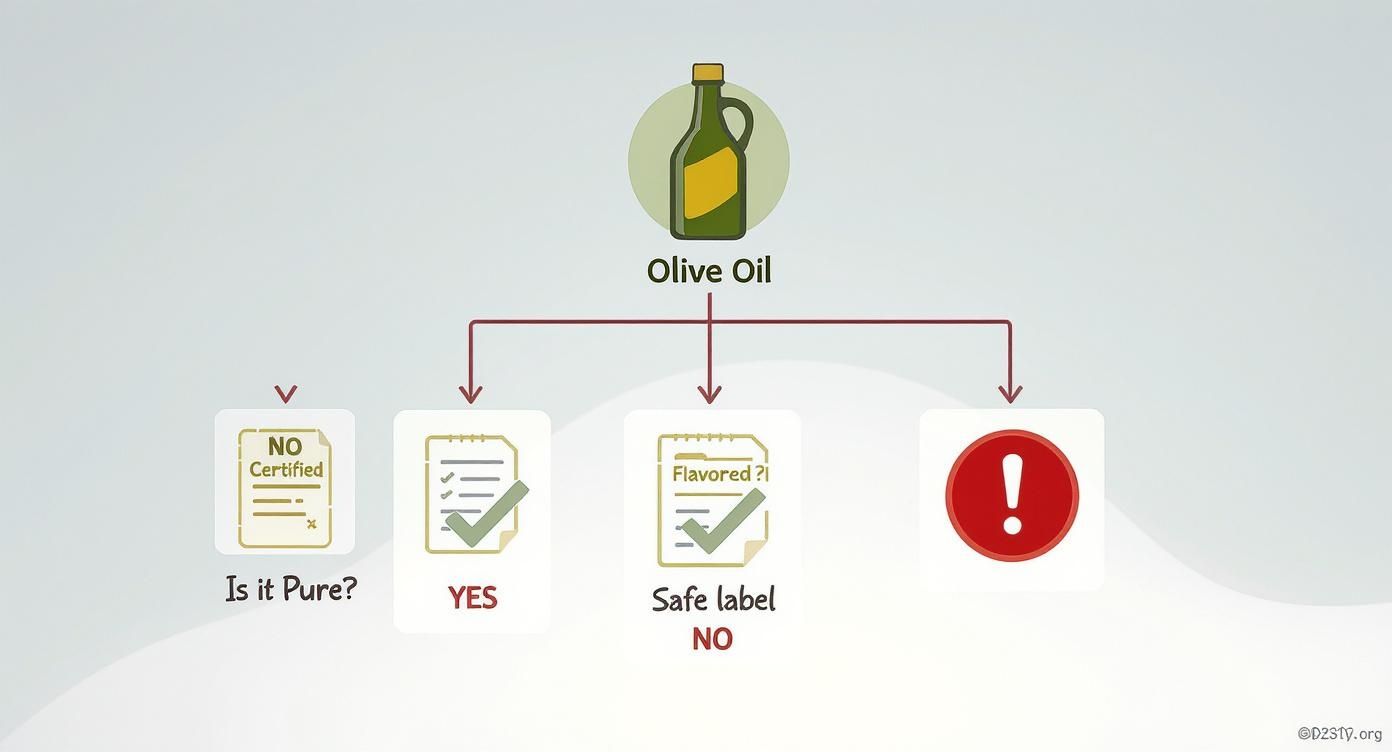
This decision tree simplifies the process, guiding you from checking for purity to seeking official certification, and ultimately pointing you toward the safest possible choice.
- Look for: A "Certified Gluten-Free" seal. This is your safest bet, without question.
- Be cautious of: Vague warnings like "produced in a facility that also processes wheat." This is a clear signal that cross-contamination is a recognized possibility.
- Investigate further: If you're purchasing a flavored or infused oil, scrutinize the entire ingredient list. You're hunting for hidden gluten sources like certain broths or flavor enhancers. For a deeper look, see our guide on understanding olive oil labeling.
It also helps to know the official standards. The U.S. Food and Drug Administration (FDA) mandates that any product labeled 'gluten-free' must contain less than 20 parts per million (ppm) of gluten. The fantastic news is that independent tests consistently show that reputable brands of extra virgin olive oil are well below this threshold, often testing under an incredible 5 ppm.
By making certified products your priority and learning to spot these key phrases, you transform label-reading from a chore into a powerful tool for protecting your health.
Navigating the Treacherous World of Flavored and Infused Oils
You’ve mastered the art of selecting a pure, high-quality extra virgin olive oil. But then your eye catches them—the alluring bottles of garlic, Tuscan herb, or chili-infused oils. This is the moment to sharpen your focus and become extra vigilant, because flavored oils play by a completely different, and often more dangerous, set of rules.
Unlike pure olive oil, which is a beautifully simple, single-ingredient product, infused oils are complex concoctions where gluten can easily hide in plain sight.
The true risk is concealed within the flavorings themselves. Many additives, broths, and thickeners used to create those rich, savory tastes can contain wheat or barley. For example, a "smoky grill" flavor might derive its authentic taste from a barley-based malt extract. This is precisely why you must approach every flavored oil with a healthy dose of skepticism.
Knowing Which Flavors to Distrust
Not all infusions are created equal. Some carry a much higher risk of containing hidden gluten, turning what appears to be a safe choice into a serious problem for anyone with celiac disease or gluten sensitivity. Your best defense is to become a master at reading ingredient labels.
Here’s a simple way to assess the risks:
- Low-Risk Infusions: Oils flavored with whole, simple ingredients are generally your safest bet. Think of oils infused with real chili peppers, whole cloves of garlic, or sprigs of rosemary that you can often see suspended in the bottle.
- High-Risk Infusions: Be extremely wary of oils with complex or vague flavor descriptions. Terms like "savory herb blend," "grill flavor," or "roasted chicken essence" are red flags that often signal the use of pre-made flavor packets, which can contain gluten as a filler or binder.
Here is the most critical rule to remember: if an ingredient list is vague or simply lists 'natural flavors,' you should be suspicious. True transparency is the hallmark of a genuinely gluten-free product.
Learning how to make infused olive oil at home is a brilliant way to enjoy endless flavor combinations without a shred of worry. But when you're in the store, the rule is simple: when in doubt, stick to products that are explicitly certified gluten-free to ensure every drop is both delicious and completely safe.
Your Gluten-Free Olive Oil Questions, Answered
Alright, we've laid the groundwork. You now know that pure olive oil begins its life 100% gluten-free, but that the modern journey from grove to grocer can introduce tiny risks. Let's tackle some of the real-world questions that arise when you're putting this knowledge into practice.
This is where theory becomes action—making confident choices at the grocery store and when dining out.
Are 'Light' and 'Regular' Olive Oils Also Gluten-Free?
Yes, they are. When you see terms like "light," "pure," or "regular" on a bottle, they refer to the oil's flavor profile and processing method, not to anything that has been added. These oils, just like their extra virgin cousin, are made from olives and nothing more.
But here's the crucial point: they face the exact same potential for cross-contamination during bottling. Therefore, the same rules of vigilance apply. You must still scan the label for warnings about shared equipment or, for ultimate safety, a gluten-free certification. The grade of the oil does not change your safety checklist.
Can I Trust the Olive Oil at a Restaurant?
This is where your healthy skepticism must be at its peak. While the oil itself is almost certainly gluten-free, restaurant kitchens can be chaotic environments where cross-contamination thrives.
Picture that small dish of olive oil served with a bread basket. Has that same dish been used for something else? Was it poured from a bottle that a chef handled immediately after dusting pasta with flour? These are the real-world scenarios you must consider.
For anyone with celiac disease or a high sensitivity, the smartest strategy is to politely decline the communal dipping oil. If a dish you order requires olive oil, it is always wise to ask your server how the kitchen manages cross-contamination to protect gluten-sensitive diners.
Which Olive Oil Brands Are Certified Gluten-Free?
Providing a definitive, unchanging list is difficult, as brands can alter their facilities or certifications. The greatest skill you can develop is not memorizing a list of "safe" brands, but learning to instantly spot a trustworthy certification on any bottle you pick up.
Look for a seal from a reputable third-party organization, such as the GFCO (Gluten-Free Certification Organization). This is your gold standard. Brands that often carry these types of certifications include:
- California Olive Ranch
- Lucini Italia
- Bragg
However, you must always check the label on the specific bottle you intend to buy. When you choose a certified product, you are no longer guessing—you are relying on independent, scientific testing that confirms the oil is safe for you to enjoy.
At Learn Olive Oil, we are passionate about illuminating every detail of this liquid gold, from the ancient groves to your dinner table. The more you understand how this incredible food is crafted, the more empowered you become to choose the perfect, healthy oils for your life.
Ready to continue your journey? Explore more expert guides and dive deeper into the world of premium olive oil at https://learnoliveoil.com.


Leave a Reply