Every bottle of olive oil you hold has a story to tell—a story stretching back more than 6,000 years. But before we unravel the empires and trade routes that carried it across the world, let’s get to the very heart of the matter. Olive oil’s astonishing tale begins not in Italy or Greece, but in the sun-drenched wild olive groves of the Eastern Mediterranean, in the lands we now know as Syria and Palestine.
The Ancient Secret Inside Your Olive Oil Bottle
This is where humanity first unlocked the secret of the wild olive tree. They took its intensely bitter fruit and, through sheer ingenuity, transformed it into the liquid gold that would one day fuel entire civilizations. This isn't just a quaint historical fact; it’s the key to understanding why olive oil became so deeply woven into the fabric of culture, cuisine, and commerce for millennia.
To truly grasp where olive oil originates, you must picture a time before recorded history. Hunter-gatherers discovered the incredibly tenacious Olea europaea tree, a plant that thrived in poor, rocky soil with precious little water—a true miracle of nature. The leap from merely eating the olives to pressing them for oil was a monumental breakthrough for these early societies.
From Wild Harvest to Cultivated Treasure
This profound shift didn't happen by accident. It was born of meticulous observation and pressing necessity. Early farmers in the Levant soon realized the oil from these olives was valuable for much more than just food. It could illuminate their nights, anoint their skin, and serve as a sacred offering to their gods.
This revelation sparked the very first wave of olive cultivation. People began selecting the best trees—those that yielded the most fruit or the richest oil—and embarked on the slow, patient process of domestication. This is the true genesis of olive oil's history.
The domestication of the olive tree was a turning point. It allowed for a stable, predictable supply of oil, transforming it from a rare commodity into a foundational pillar of society.
This was no overnight success. It was a painstaking, generational endeavor. Archaeologists have unearthed ancient olive pits and the remains of primitive stone presses in this region dating back to the Chalcolithic period, giving us indisputable proof of this agricultural revolution. It's an incredible story of human persistence.
The simple methods they developed laid the groundwork for everything that followed. To fully appreciate the bottle sitting in your kitchen, it helps to understand these foundational steps. You can learn more about the fascinating process and discover how olive oil is made in our detailed guide.
From these humble origins, the knowledge of growing olives and making oil began its slow but inexorable march across the ancient world. The very soul of the oil you enjoy today is still tethered to these ancient roots, defining its quality and flavor in ways we’ll explore next.
How Liquid Gold Fueled Ancient Empires
To really understand where olive oil comes from, you must see it for what it was to the ancient world: an engine of progress. This wasn't just another item on the dinner table. It was the currency, the medicine, and the fuel that powered entire civilizations, helping them rise from scattered tribes into dominant empires.
The story begins with the seafaring masters of the Mediterranean. The ingenious Minoans on the island of Crete, one of the very first hubs of systematic production, built a thriving economy on the back of olive cultivation. They weren't just pressing oil for their own lamps—they were trading it across the sea, forging a commercial network that made them a formidable power. We know this because archaeologists have unearthed enormous storage jars, called pithoi, capable of holding staggering amounts of oil, proving just how central it was to their society.
From Trade Good to Sacred Symbol
After the Minoans, it was the Greeks who elevated the olive to a status that was almost divine. To them, the olive tree was a direct gift from the goddess Athena—a powerful symbol of peace, wisdom, and prosperity. It became so deeply embedded in their culture that champions at the first Olympic games were not crowned with gold, but with a simple wreath of olive branches—the highest honor imaginable.
This reverence had a very practical side. Greek city-states passed laws to protect their precious olive groves, and the oil itself became a standard for trade. Their skill in cultivation allowed them to produce oils of exceptional quality, which they shipped across the Mediterranean in distinctive clay pots called amphorae. The legacy of this trade can still be seen today in shipwrecks discovered on the seafloor, their cargo holds still filled with these ancient containers.
The Roman Empire's Olive Oil Machine
Then came the Romans, the true masters of scale and logistics, who took this foundation and built an empire-wide industry upon it. As Roman legions conquered new lands, they brought not just their swords, but olive cultivation with them. From the sun-baked hills of Hispania (modern Spain) to the fertile coasts of North Africa, they planted massive groves to feed the insatiable demand of Rome and its sprawling territories.
This was no accident. Olive oil was a strategic resource, as vital to a Roman soldier as his armor. Consider all the ways they used it:
- Fuel: Millions of terracotta lamps across the empire burned olive oil, literally lighting up the civilized world.
- Hygiene: Lacking soap, Romans would slather themselves in oil and scrape it off with a strigil to cleanse their skin.
- Medicine: Physicians like Hippocrates documented dozens of medicinal uses for olive oil, from treating wounds to soothing digestive ailments.
- Cuisine: And of course, it was a cornerstone of their diet, providing critical calories and flavor.
The Romans built a system so efficient that remnants of their massive stone presses survive to this day. In Rome, an artificial hill called Monte Testaccio stands as a silent monument, made almost entirely of broken olive oil amphorae—a testament to the sheer volume of oil that once flowed into the capital.
Evidence shows this tradition of systematic production began thousands of years ago. Archaeological finds reveal that olive oil originates from the Mediterranean, with civilizations in present-day Syria, Palestine, and Crete making it over 5,000 years ago. By the Late Bronze Age, around 1800 BCE, stone presses and storage jars were already common, marking the true dawn of this ancient industry. You can explore more data on global olive oil production history to see how these ancient roots have grown over time.
This journey through history is more than a timeline; it's a core part of the product's identity. To dig deeper into this rich history, you can read our complete guide on the true origins of olive oil and its cultural impact. This liquid gold wasn't just another commodity—it was the lifeblood of antiquity, shaping economies, defining cultures, and fueling the very progress of Western civilization.
Uncovering The Modern Capitals of Olive Oil
While olive oil’s story begins in the ancient world, its modern chapter is written by a handful of powerhouse nations. Understanding where olive oil comes from today means looking at a global industry defined by massive scale, deep-seated regional pride, and the dance between tradition and technology. To truly know the oil in your kitchen, you must know the modern capitals that guide its journey to your pantry.
Spain is, without a doubt, the center of this universe—the undisputed olive oil superpower. Its vast, sun-drenched groves, especially in the Andalusia region, are a breathtaking sight. Imagine a sea of silver-green leaves stretching to the horizon. Spain produces such a staggering amount that it accounts for nearly half of the world's entire supply. This isn't just about volume; the sheer efficiency of Spanish production heavily influences global prices and availability.
The Mediterranean Power Trio
Beyond Spain's commanding lead, two other countries form the historic trifecta of olive oil production: Italy and Greece. In these places, olive oil is woven into the very fabric of life, and deep traditions create oils with fiercely protected identities.
In Italy, olive oil is more than an agricultural product; it's a cultural birthright. From the bold, peppery oils of Tuscany to the golden, delicate varieties from Sicily, the oil’s character is inextricably linked to its specific home. This passionate regionalism is why Italian producers have been such strong advocates for quality designations that guarantee authenticity. To get a better sense of this incredible variety, you can dive deeper into the distinct characteristics of olive oils from Italy.
Greece, meanwhile, feels like the spiritual home of the olive. Greeks consume more olive oil per person than anyone else on Earth—they truly live and breathe it. Production here often comes from smaller, family-owned groves that have been tending to ancient varieties, like the famous Koroneiki olive, for generations. The result is oils that are intensely aromatic and brimming with flavor.
While we now see olive oil as a culinary staple, it was once a multi-purpose resource essential for daily life, as this infographic shows.
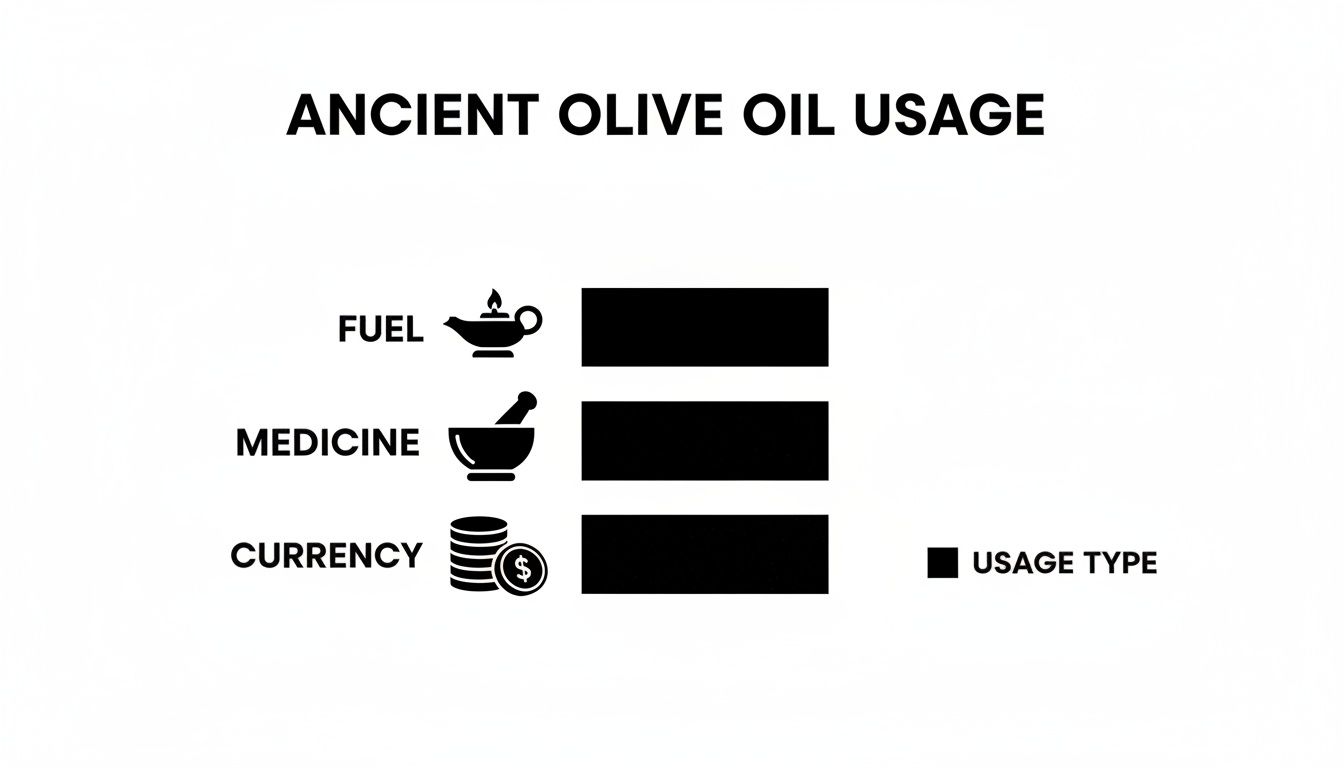
It’s clear that for ancient societies, olive oil was much more than just food. It was a cornerstone of their economy, medicine, and day-to-day existence.
The Other Global Players
Spain, Italy, and Greece may be the most famous names, but they don't tell the whole story. A few other key nations are vital to the global supply chain, each adding its own flavor to the modern world of olive oil.
- Tunisia: As a major producer in North Africa, Tunisia is a quiet giant, often exporting its high-quality oil in bulk to be bottled elsewhere.
- Turkey: Straddling Europe and Asia, Turkey has an incredible diversity of olive cultivars and a production industry that's rapidly modernizing.
- Portugal: Sharing the Iberian Peninsula with Spain, Portugal produces some fantastic oils, particularly from its northern regions, that are finally getting the international recognition they deserve.
The table below gives you a snapshot of who's who in the world of olive oil production, showing just how concentrated the industry is.
Top Olive Oil Producers by Region and Volume
| Country | Recent Annual Production (Metric Tons) | Key Production Regions |
|---|---|---|
| Spain | 1,200,000 – 1,400,000 | Andalusia, Castilla-La Mancha, Extremadura |
| Italy | 250,000 – 350,000 | Puglia, Calabria, Sicily |
| Greece | 200,000 – 300,000 | Peloponnese, Crete |
| Turkey | 180,000 – 220,000 | Aegean Region, Marmara Region |
| Tunisia | 150,000 – 200,000 | Sfax, Mahdia |
| Portugal | 120,000 – 150,000 | Alentejo, Trás-os-Montes |
These numbers make it clear: a small group of Mediterranean nations truly dominates the global market.
In fact, these six countries—Spain, Italy, Greece, Tunisia, Turkey, and Portugal—are the engine room of the olive oil world. Their collective output dictates everything from market trends to the variety of oils you see on the shelf.
Amazingly, these top six producers account for over 90% of the world's supply, with recent forecasts estimating their combined output at around 2.65 million tons. This incredible concentration comes down to their ideal climates, centuries-old groves, and the widespread adoption of modern farming techniques. Ultimately, this Mediterranean core shapes the price, quality, and character of the olive oil you use every single day.
How a Place Creates Flavor in The Bottle
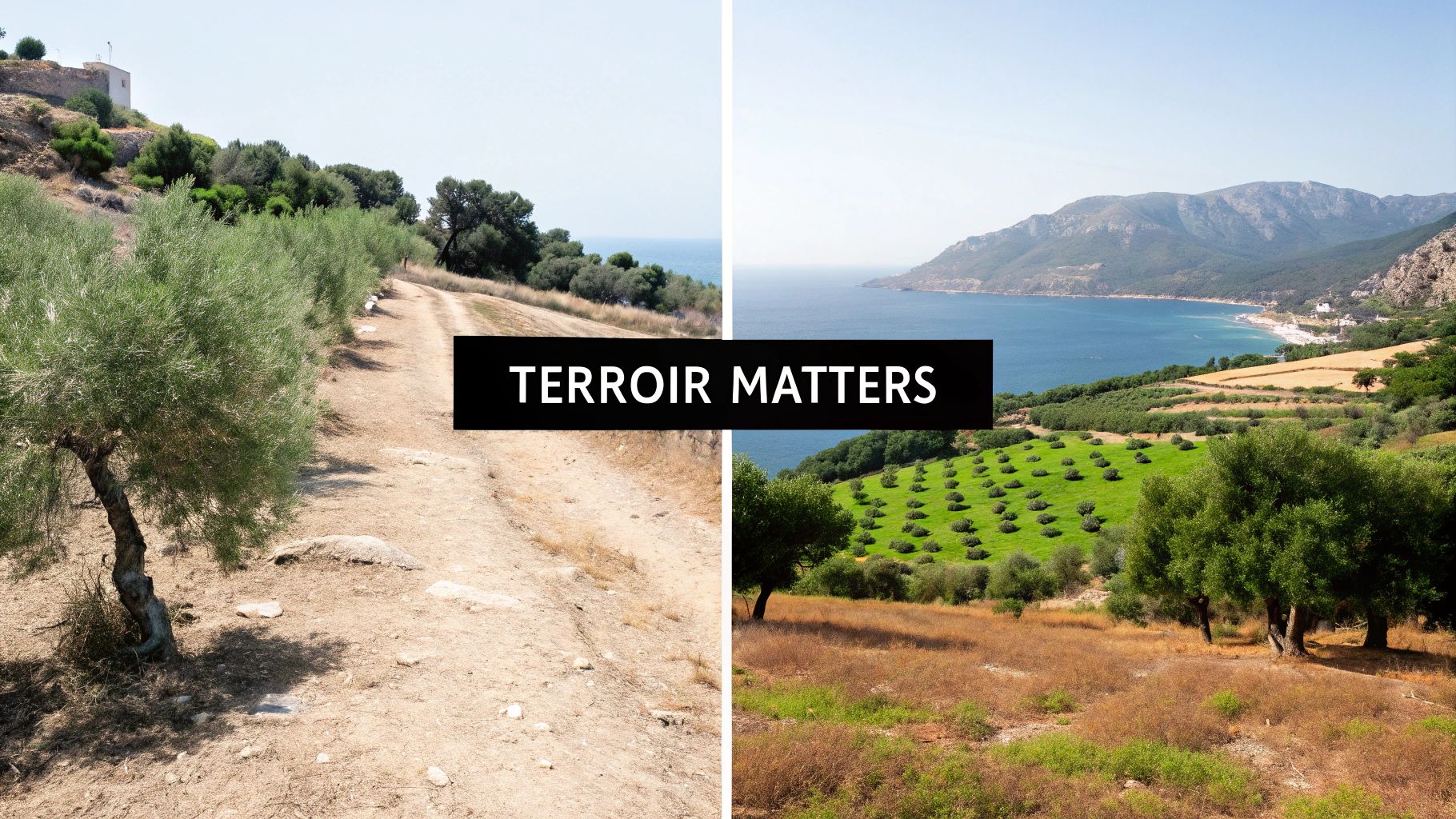
Have you ever wondered why a Sicilian olive oil can taste so wildly different from one made just across the water in Greece? It’s the same fruit, grown under the same Mediterranean sun. Yet one might burn with peppery fire, while the other is as soft as butter.
The secret isn't some strange alchemy. It's a concept wine lovers have treasured for centuries, and it's just as vital for olive oil: terroir.
Simply put, terroir is the idea that a place—its specific soil, its unique climate, even the very air—leaves an unmistakable signature on what is grown there. For olive oil, this isn't some romantic notion; it is the single most important factor determining the symphony of flavors you'll find in every bottle.
The Three Pillars of Olive Oil Terroir
To truly understand how a place shapes flavor, you must look at three critical elements. Think of them as the legs of a stool—remove one, and the entire structure collapses. Each plays a distinct role in creating the oil’s final personality, answering the deeper question of where olive oil gets its unique taste.
First, there’s the olive variety, or cultivar. Just as there are thousands of kinds of apples, there are over 1,500 known olive cultivars.
- Spain’s famous Picual olive is known for creating bold, peppery oils with a hint of tomato leaf.
- Italy’s powerhouse Coratina olive produces intensely fruity and bitter oils.
- Greece’s beloved Koroneiki olive yields delicate, aromatic oils with notes of green grass and artichoke.
Each cultivar holds the genetic blueprint for a certain flavor profile. But that blueprint is merely the starting point.
How Climate and Soil Write the Final Story
The second pillar is climate. A sun-scorched coastal grove in Andalusia, Spain, forces olive trees to struggle, concentrating the flavors in their fruit and producing a robust, intense oil. Compare that to a cool, breezy hillside in Tuscany, where olives ripen more slowly, often resulting in a more elegant, grassy, and nuanced oil. Even something as simple as the amount of rainfall in a single year can dramatically alter the taste.
Finally, we have the soil. The earth's makeup—whether it’s rocky limestone, volcanic soil, or rich clay—directly influences the tree's health and the chemistry of the olives. This is where the oil gets its mineral notes and much of its complexity. Volcanic soils, for instance, can lend a unique spiciness and depth that you just won't find anywhere else.
Terroir is the honest conversation between a plant and its home. In olive oil, you can taste the sun, the wind, and the earth of a very specific place, captured in liquid form.
This interplay between olive, climate, and soil is what makes olive oil so endlessly fascinating. A Coratina olive grown in the rocky soil of Puglia will produce a very different oil than the exact same type of tree grown in California’s fertile Central Valley. The place itself becomes an ingredient.
Interestingly, this is also why the health benefits can vary. The stress a plant endures from its environment can ramp up its production of protective compounds. You can learn more about the connection between an oil's origin and its healthful properties by exploring the science behind olive oil polyphenol content and how terroir affects it.
So, when you taste an olive oil, you aren't just tasting a fruit. You’re tasting a landscape, a specific moment in time, and a unique story of survival. The next time you open a bottle, take a moment to consider its home—it’s the secret behind everything you’re about to experience.
Decoding The Map on Your Olive Oil Label
The label on your olive oil bottle is a treasure map, but its language can feel cryptic. It's often covered in acronyms and geographical claims that all promise a story about where the oil came from.
Learning to read this map is the single most powerful skill you can develop as a buyer. It transforms a confusing supermarket aisle into a curated gallery of authentic, regional flavors. This is your field guide to becoming a confident shopper, ensuring the bottle you choose is a genuine expression of its home.
The Gold Standard: PDO
The most important certification to look for is PDO, which stands for Protected Designation of Origin. Think of this as the gold standard for authenticity—a legally binding guarantee that is notoriously difficult for producers to earn.
A PDO seal tells you that every single step of the journey—from growing and harvesting the olives to pressing and bottling the oil—happened within one specific, named geographical region. It’s a closed-loop system. The olives can't be from one place and the oil pressed in another. Everything must originate from that single location.
This certification protects unique regional oils with characteristics tied directly to their terroir. When you see that PDO seal, you’re holding a product with an undeniable sense of place.
The Regional Promise: PGI
A bit different, but still a valuable mark of quality, is PGI, or Protected Geographical Indication. A PGI seal guarantees that at least one major stage of production happened in the named region.
For instance, the olives might be grown in a specific area known for its unique cultivar, even if they are pressed at a modern facility just outside its borders. While not as strict as PDO, PGI still provides a strong link between the oil and its geographical home, protecting regional recipes and production methods.
"These certifications aren't just marketing fluff; they are your frontline defense against fraud. They ensure that an oil labeled 'Kalamata' is truly from the Kalamata region of Greece, made from Koroneiki olives, and not just a generic blend."
To help you tell these crucial labels apart at a glance, here’s a simple breakdown of what each one promises.
Decoding Olive Oil Origin Labels
The two most important geographical certifications are PDO and PGI. This table makes it easy to see the difference and understand what you're buying.
| Certification | What It Guarantees | Example |
|---|---|---|
| PDO | 100% of the growing, pressing, and production process occurred in the named region. | Kalamata PDO from Greece. |
| PGI | At least one stage of the production process occurred in the named region. | Toscano PGI from Italy. |
Knowing what these labels mean is a game-changer. For more context on reading food packaging, this guide on general food labelling information is a great resource for becoming a more informed consumer overall.
By seeking out these seals, you support traditional producers and ensure your money rewards true craftsmanship. For a complete overview of everything to look for, check out our full guide to understanding olive oil labeling.
Choosing the Right Olive Oil for Your Kitchen
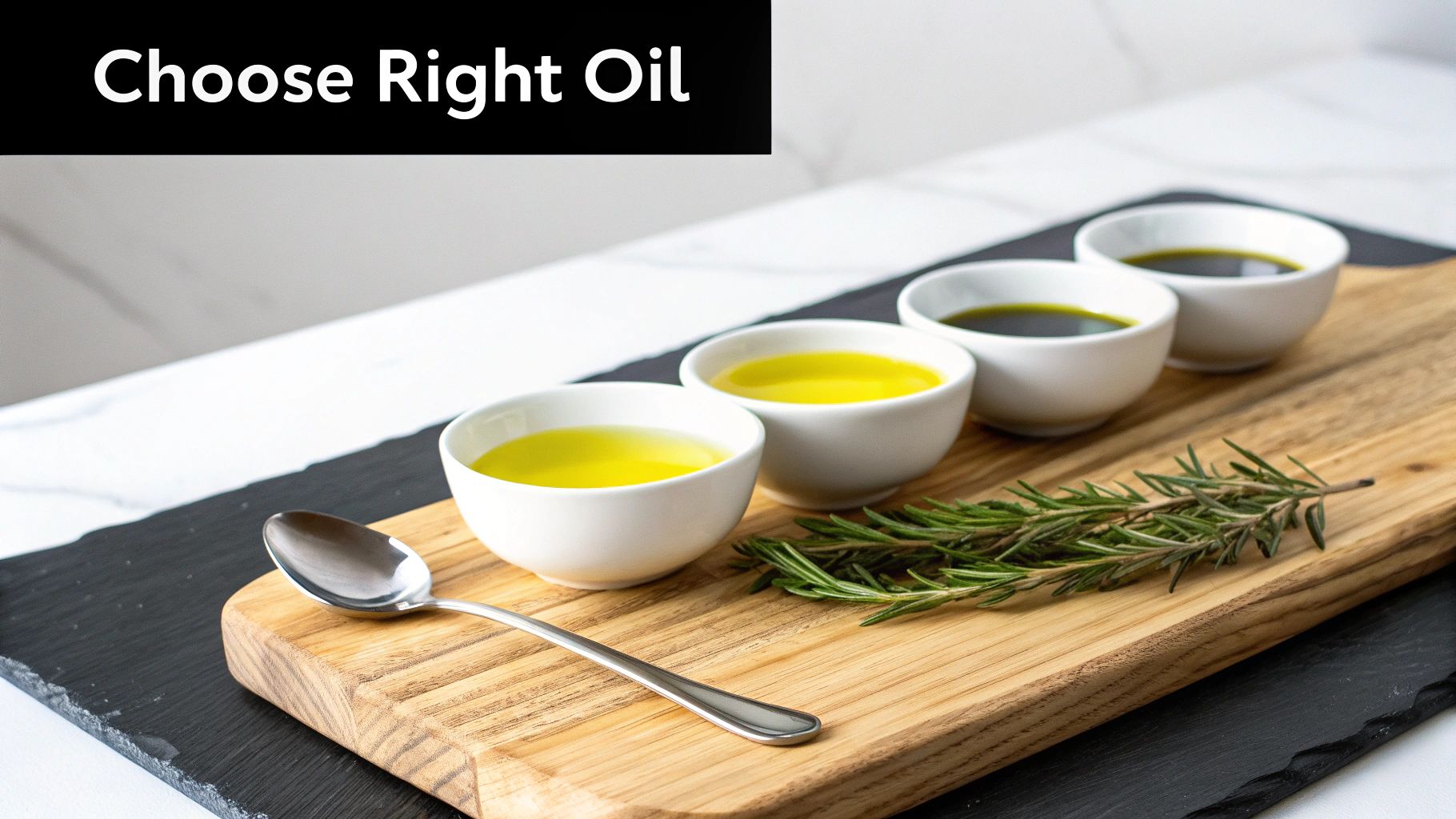
Knowing where your olive oil comes from is far more than a history lesson. It is the secret to unlocking its true potential in your kitchen. So, let's apply everything we've learned to the choices you make every day. This isn’t about memorizing strict rules; it's about developing your instincts.
Think of olive oils as having distinct personalities, each one shaped by its homeland. A bold, peppery oil is precisely what you want for finishing a steak or drizzling over a hearty bean soup. A soft, buttery oil, on the other hand, is the perfect, subtle partner for delicate baked fish or a light vinaigrette.
This is where the oil's origin becomes your trusted guide. The story of a place—its climate, its soil, its native olives—translates directly into the flavor in the bottle.
Matching Origin to Your Dish
Let's get practical. Picture yourself in the grocery store, staring at that wall of bottles. Instead of grabbing a generic "product of Italy" blend, stop and think about what you plan to cook.
-
For Bold, Robust Flavors: Grilling red meat, roasting root vegetables, or making a powerful garlic bread? You need an oil that can hold its own. Look for oils from Southern Italy (like those made from the Coratina olive) or the heart of Spain (from the Picual olive). These oils are famously robust, often bringing a peppery kick that elevates savory dishes.
-
For Delicate, Fruity Notes: Baking a lemon and olive oil cake, dressing a simple green salad, or gently sautéing seafood? Here, you need a more subtle touch. Oils from Greece (Koroneiki olives) or the South of France often deliver this profile—think grassy, smooth, and just a little bit sweet. For a bottle that fits this profile, you might look at something like this Smooth Organic Extra Virgin Olive Oil.
Your pantry should have more than one type of olive oil, just as a painter needs more than one color. A finishing oil and a general-purpose cooking oil are the perfect start.
When you start with the meal you want to create, you let the food’s character guide your choice of oil. It’s a simple shift that makes a world of difference.
Building Your Culinary Confidence
Don't be afraid to experiment! The most exciting part of this is discovering your own preferences. Grab a small bottle from a region you've never tried before. When you get home, taste it on its own with a piece of bread and pay close attention to the flavors. Is it grassy? Fruity? Does it have a spicy finish?
This simple act of tasting connects you directly to the oil's terroir—that unique sense of place we've been exploring. It transforms a simple ingredient into an experience, letting you travel through the ancient groves of the Mediterranean with every meal you make. Choosing the right olive oil isn’t a test; it's an adventure in flavor.
Common Questions About Where Olive Oil Comes From
Once you start digging into the history of olive oil, more questions naturally arise. It’s a fascinating topic, and connecting that ancient story to the bottle in your hand can be tricky. Here are straightforward answers to the questions we hear most often.
Is Italian Olive Oil Always the Best?
Absolutely not. This is perhaps the single biggest misconception in the world of olive oil. While Italy produces some of the most phenomenal oils on the planet, its name on the label isn't a silver bullet for quality.
Real quality comes down to the producer’s commitment, the specific olive varieties they grow, and how meticulously they handle the harvest and milling process. Spain, the world's largest producer, makes stunning, award-winning oils, as do Greece, Portugal, and Tunisia. A beautifully crafted extra virgin olive oil from a small estate in Crete can easily blow a generic, mass-produced Italian brand out of the water. The takeaway? Judge the producer, not just the passport.
Where Is the Oldest Olive Oil Region?
The true cradle of olive oil is the Eastern Mediterranean. We're talking about the Levant—an area that includes modern-day Syria, Lebanon, and Palestine. This is where it all began.
Archaeologists have unearthed ancient olive presses and pottery fragments with oil residue that date back over 6,000 years in this region. It’s here that our ancestors first figured out how to transform the humble olive into liquid gold.
While the Levant is the earliest known starting point, the Greek island of Crete has its own ancient and storied history. Olive cultivation was the backbone of the Minoan civilization, with a sophisticated industry thriving there more than 4,000 years ago.
How Do I Know If My Olive Oil Is Authentic?
With so many bottles on the shelf, knowing what’s real is crucial. The best way to be sure is to look for official certifications on the label.
- PDO (Protected Designation of Origin): This is the gold standard. It’s a legal guarantee that every step of the process—from growing and harvesting the olives to pressing and bottling the oil—happened within a single, specific geographical area using traditional methods.
- PGI (Protected Geographical Indication): This seal is also a great sign, ensuring that at least one key stage of production took place in the region named on the label.
If an oil doesn’t have one of these certifications, check out the producer’s website. Good producers are proud of their story. They'll be transparent about where their groves are, what olives they use, and how they make their oil.
Here at Learn Olive Oil, we believe that knowing an oil's story is the first step to truly appreciating its taste. We offer expert guides to help you explore the world of high-quality olive oil, from reading labels to tasting like an expert. Start discovering the incredible stories in every bottle today. https://learnoliveoil.com


Leave a comment