In the world of fine food, some truths are held to be self-evident. And this is one of them: Spanish olive oil is far more than a bottle you grab at the store. It is the lifeblood of an entire cuisine, the undisputed gold standard for quality and flavor recognized across the globe. This is not mere opinion; it's a fact proven by the sheer, staggering volume and centuries of tradition. Nearly half of the world's finest "liquid gold" begins its life basking under the Spanish sun.
A Legacy Bottled: The Essence of Spanish Olive Oil
Imagine, for a moment, standing among endless rows of silvery-green olive trees, a landscape cultivated for millennia. This is where the story of Spanish olive oil begins. It's a tale not just of numbers—Spain produces an astonishing over 40% of the world's supply—but of a deep, almost spiritual connection between the land, the people, and the olive itself.
This dominance is no happy accident. It is the hard-won culmination of generations of families perfecting the art of growing, harvesting, and pressing. In this guide, we will pull back the curtain on this incredible world. You will see past the generic labels and confusing jargon and emerge, I promise, a true connoisseur.
It's An Ingredient, Not Just a Condiment
First things first: let us banish the thought of olive oil as just another fat for the frying pan. A great Spanish olive oil is a primary ingredient, a flavor-enhancer capable of defining an entire dish. It is the peppery kick in a chilled gazpacho, the grassy aroma that elevates a simple salad, and the golden foundation for a perfectly cooked fish.
Of course, its role in the kitchen is matched by its incredible health benefits. High-quality extra virgin olive oil is loaded with polyphenols—powerful antioxidants known for promoting heart health and fighting inflammation.
If you remember just one thing from this guide, let it be this: premium Spanish olive oil is essentially fresh-squeezed fruit juice. This simple concept is the key to understanding its vibrant flavors, its powerful health benefits, and why it deserves a place of honor on your counter, not hidden in a cupboard.
What You'll Discover Inside
Think of this guide as your personal passport to the world of Spanish olive oil. We’ll explore the distinct personalities of oils from different regions, demystify the most important olive varieties, and teach you how to read a label like a seasoned expert. We'll also touch on the fascinating history that shapes every bottle; you can dive deeper into the ancient roots of this culinary staple and learn more about the olive oil origin that has influenced cooking for centuries.
By the time you're done, you'll understand why Spanish olive oil isn't just a product; it’s an experience. You'll walk away with the confidence to:
- Choose with Confidence: Effortlessly navigate the store shelves and pick a bottle that delivers genuine quality and flavor.
- Taste with Understanding: Begin to identify the subtle notes that separate a good oil from a truly great one.
- Cook with Creativity: Unlock the full potential of this amazing ingredient, transforming everyday meals into something memorable.
Let us begin our journey into the world of Spanish olive oil, where every single drop tells a story of sun, soil, and soul.
A Flavor Journey Through Spain's Olive Regions
To truly know Spanish olive oil, you must first understand its landscape. Forget the map for a moment and trust your palate. The flavor in every bottle is a liquid postcard, telling a story of the soil, the sun, and the centuries of tradition that nurtured it. Spain is not one single, massive producer; it is a vibrant mosaic of climates and terroirs, each bestowing a unique personality upon the oil it creates.
Our journey begins in Andalusia, the undisputed heartland of Spanish olive oil. This southern region isn't just where most of the oil is made—it is the very soul of Spain's liquid gold.
Andalusia: The Sun-Drenched Soul
When you hear about Spain’s dominance in the olive oil world, you are really hearing the story of Andalusia. This sprawling, sun-baked region is home to the famous mar de olivos, or "sea of olive trees." It's a breathtaking sight, especially in the province of Jaén, where millions of trees stretch to the horizon in every direction. The oils from here are powerful, robust, and unapologetically bold.
They are typically made from the Picual olive, which yields an oil with a signature peppery kick and notes of green tomato leaf. This is not a shy, retiring oil; it is a confident expression of its sunny origins, perfect for standing up to strong flavors in stews, grilled meats, and hearty vegetable dishes.
The scale of production here is simply staggering. Spain is the undisputed global powerhouse, producing over 40% of the world's supply. Andalusia is the engine driving this machine, having produced an incredible 1.41 million metric tons in 2025. It's not just about quantity; the region earned 93 awards at a single prestigious international competition, proving its commitment to quality. You can dive deeper into the latest market trends and Spain's production figures at certifiedorigins.com.
Catalonia: The Delicate Counterpoint
From the intense character of the south, we travel northeast to Catalonia. Here, the olive oil narrative shifts entirely. The landscape is different, the climate milder, and the olives tell a much softer, more delicate story. This region is home to the beloved Arbequina olive.
If Andalusian Picual is a bold statement, Catalonian Arbequina is an elegant whisper. These oils are often sweet, fruity, and exceptionally smooth, with gentle notes of apple, banana, and almond. Their delicate nature makes them the perfect finishing oil.
Imagine drizzling a golden-green stream of Arbequina oil over a piece of grilled fish, a fresh salad, or even a scoop of vanilla ice cream. Its job is not to dominate but to elevate, adding a subtle layer of fruitiness that harmonizes with everything else on the plate.
This incredible regional diversity is what makes Spanish olive oil so versatile and celebrated. While it shares a Mediterranean heritage with its neighbors, the unique profiles from each region truly set it apart. For those curious about how these flavors stack up, take a look at our guide on olive oils from Italy.
Castilla-La Mancha: The Rising Star
Sitting between these two giants is Castilla-La Mancha, the famous backdrop for Don Quixote's adventures. For centuries, its olive oil flew under the radar, but today it is forging its own powerful identity. This arid, high-altitude plateau is the heartland of the Cornicabra olive, a variety as resilient and stubborn as the landscape itself.
The oils from here strike a fascinating balance, bridging the peppery power of Andalusia and the fruity grace of Catalonia. A classic Cornicabra oil has a distinct progression of flavors:
- A Fruity Start: It often opens with notes of green apple and avocado.
- A Bitter Middle: You'll notice a pleasant bitterness on the palate, a sure sign of its freshness and high antioxidant content.
- A Pungent Finish: It leaves you with a distinct peppery sensation that lingers in the throat.
This complexity makes it a fantastic all-around oil, just as good in a salad dressing as it is in a pan for sautéing. The story of Castilla-La Mancha is one of rediscovery, proving that you can find remarkable Spanish olive oil far beyond its most famous groves.
Getting to Know the Olives Behind the Oil
If Spain’s regions give olive oil its soul, the olive varieties themselves give it a voice. Getting to know the main types is like learning the secret language of the groves. It is the difference between simply buying olive oil and truly understanding its personality, how it will behave in your kitchen, and the exact experience you will get from the very first taste.
The good news? You don't need to memorize dozens of names. Let's focus on the four titans of the Spanish olive world. Master these, and you'll be choosing your next bottle with total confidence.
Picual: The Bold Foundation
First up is Picual, the bold, confident backbone of Spanish oil. It's the undisputed king, accounting for about 50% of Spain's entire olive production and reigning supreme in the sun-drenched fields of Andalusia. Its signature is a powerful, peppery finish that leaves a distinct tickle in the back of your throat.
Do not mistake that kick for a flaw—it is the hallmark of quality. That sensation comes from oleocanthal, a potent polyphenol with natural anti-inflammatory properties. Picual oils are loaded with these antioxidants, which not only pack a healthy punch but also give the oil incredible stability and a long shelf life. Its robust character is perfect for hearty dishes where you want the oil's flavor to stand tall, not fade into the background.
This map gives you a great visual of where these incredible olives thrive, linking the major regions to their unique characteristics.
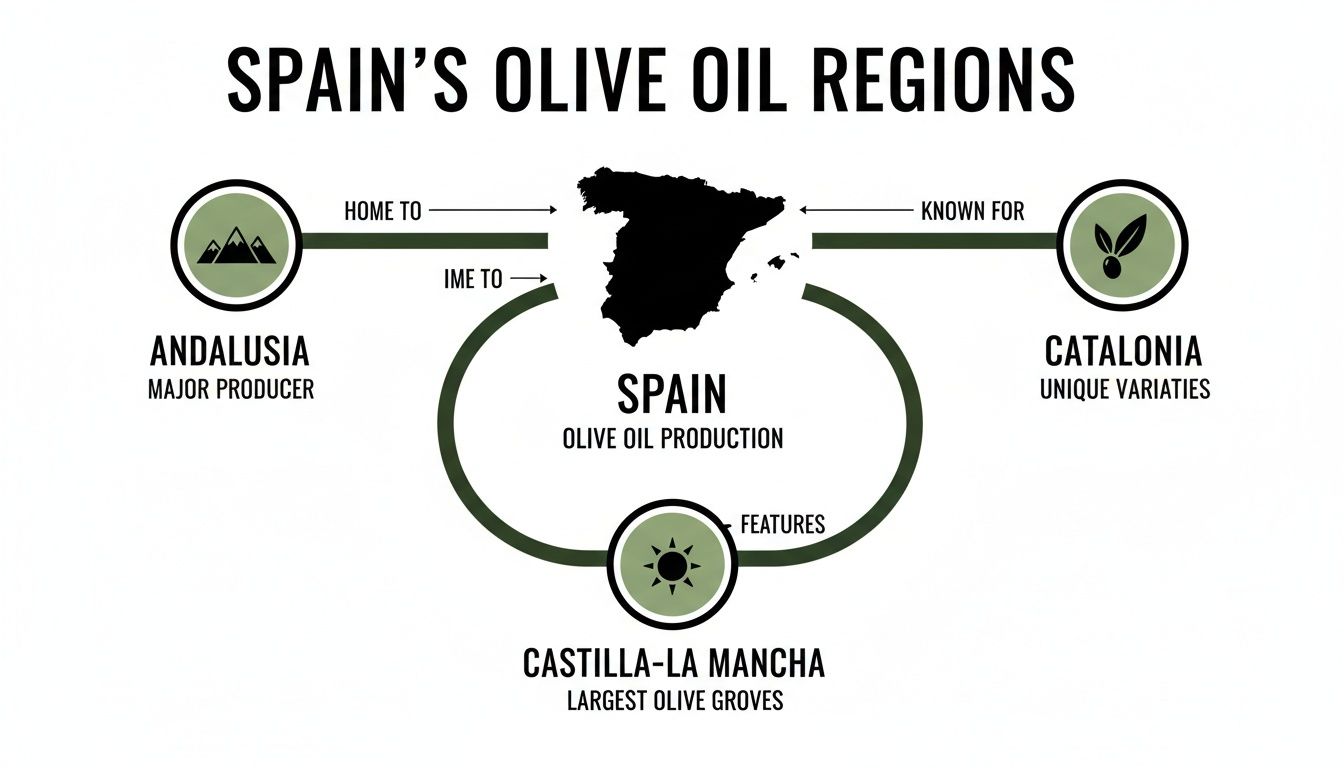
As you can see, regions like Andalusia, Catalonia, and Castilla-La Mancha each cultivate a distinct identity in the world of olive oil.
Arbequina: The Delicate Fruit Bomb
Now, let's travel from the bold south to the gentle northeast to meet Arbequina. If Picual is a fiery flamenco dancer, Arbequina is a graceful ballerina. This small, delicate olive yields an oil that is wonderfully sweet, smooth, and buttery.
Forget pepper and tomato leaf; here you will find notes of ripe apple, banana, and almond. With very little bitterness or pungency, it's an incredibly approachable oil and a favorite for anyone just starting their journey into the world of premium olive oil.
Expert Tip: Arbequina is the ultimate finishing oil. Its subtle fruitiness is best appreciated raw—drizzled over grilled fish, fresh greens, or even a simple scoop of vanilla ice cream. Heat tends to mute its delicate aromas, so save this one for that final, flavourful touch.
Hojiblanca: The Versatile Artist
Hojiblanca, named "white leaf" for the silvery underside of its foliage, is a true all-rounder. It strikes a beautiful balance, sitting right between the assertiveness of Picual and the gentleness of Arbequina.
It offers a complex profile that starts with a sweet entry before finishing with a light, peppery kick. You might pick up intriguing notes of fresh-cut grass, green almond, and aromatic herbs. This versatility makes it a fantastic workhorse in the kitchen, just as at home in a vinaigrette as it is in a pan for sautéing vegetables. It is the oil that plays well with almost everything.
Cornicabra: The Robust Character
Finally, there’s Cornicabra, the resilient survivor from the high plains of Castilla-La Mancha. Its name, meaning "goat's horn," comes from its distinctively curved shape. This olive produces an intensely fruity oil that takes you on a remarkable flavor journey.
A taste of Cornicabra often begins with notes of green apple and avocado before building to a pronounced, pleasant bitterness and a pungent, peppery finish. It’s a complex, full-bodied oil that stands up beautifully to roasting, grilling, and other high-heat cooking. Its powerful flavor won’t get lost in rich stews or gamey meats. The compounds behind these amazing flavors are fascinating; for a deeper dive into the science, you can read more on what olive oil is made of in our detailed guide.
To help you keep these straight, here's a quick cheat sheet on the fantastic four of Spanish olives.
A Flavor Guide to Spanish Olive Varieties
| Olive Variety | Primary Flavor Profile | Aroma Notes | Best Culinary Use |
|---|---|---|---|
| Picual | Bold, peppery, pleasantly bitter | Tomato leaf, green olive, fig tree | Roasting, frying, drizzling on hearty soups and stews |
| Arbequina | Sweet, fruity, buttery | Ripe apple, banana, almond | Finishing salads, grilled fish, vegetables, desserts |
| Hojiblanca | Balanced, sweet entry, peppery finish | Fresh-cut grass, green almond, herbs | Vinaigrettes, sautéing, marinades, pasta dishes |
| Cornicabra | Intensely fruity, bitter and pungent | Green apple, avocado, leafy greens | High-heat cooking, grilling, roasting meats and vegetables |
Think of this table as your starting point. The real fun begins when you start tasting and discovering which "voice" speaks to you the most.
Decoding the Secrets on the Label
So, what truly separates a phenomenal Spanish olive oil from an average one? It is not magic; it is craftsmanship and transparency. The clues are hiding in plain sight on the bottle, waiting for someone who knows the language to read them.
Think of the label as the oil’s birth certificate. It tells you its story: where it came from, how it was made, and, most importantly, how much life and flavor it still has locked inside. Learning to translate this information is the single most powerful skill you can develop as a discerning buyer.
More Than Just "Extra Virgin"
Seeing "Extra Virgin Olive Oil" (EVOO) on a label is a great start, but it's just the beginning of the story. It is a legally defined quality grade, a promise that the oil was extracted mechanically—no chemicals—and meets certain purity standards, like having a free acidity level below 0.8%.
But within that top tier exists a vast spectrum of quality. A truly exceptional EVOO is like freshly squeezed fruit juice—vibrant, aromatic, and packed with personality. A mediocre one might technically meet the standard, but it's more like a concentrate that has been sitting on a shelf too long, its vitality gone.
The Promise of Cold Extraction
You'll often see terms like "cold-pressed" or "cold extraction" on a bottle. This is not just marketing speak. It is a crucial guarantee that the olive paste was kept cool (below 80°F or 27°C) during the entire process.
Why does this matter so much? Because heat is the enemy of flavor and health. Keeping things cool ensures that the delicate, volatile aromas and the powerful, healthy polyphenols are preserved. A producer could use heat to extract more oil from the olives, but they would be sacrificing the very soul of the fruit.
When you choose an oil marked with "cold extraction," you are choosing an oil made with patience. The producer prioritized preserving the olive’s natural character over maximizing their yield—a true sign of a quality-first philosophy.
Your Three-Point Checklist for Quality
Navigating the olive oil aisle becomes simple once you know what to look for. Focus on these three non-negotiable signs of authenticity and freshness, and you cannot go wrong.
-
A Recent Harvest Date: Olive oil is perishable fruit juice. You want to see a harvest date, not just a vague "best by" date. The fresher, the better. An oil from the most recent autumn harvest will always deliver the most vibrant flavor and health benefits.
-
A Dark, Protective Bottle: Light is olive oil’s kryptonite, causing it to go rancid quickly. Good producers know this and always bottle their liquid gold in dark glass or opaque tins. A clear bottle is a major red flag.
-
A Seal of Origin: Look for a quality seal like a D.O.P. (Denominación de Origen Protegida). This is a legally binding guarantee that the oil was grown, produced, and packaged in a specific region using traditional methods. It is your assurance of authenticity, connecting the oil directly to its unique terroir.
For those who want to dig even deeper, we have a complete guide where you can learn more about olive oil labeling and what every term means. Mastering these details transforms shopping from a guessing game into a confident choice, ensuring the bottle you bring home is one you’ll truly savor.
How to Taste Olive Oil and Trust Your Palate
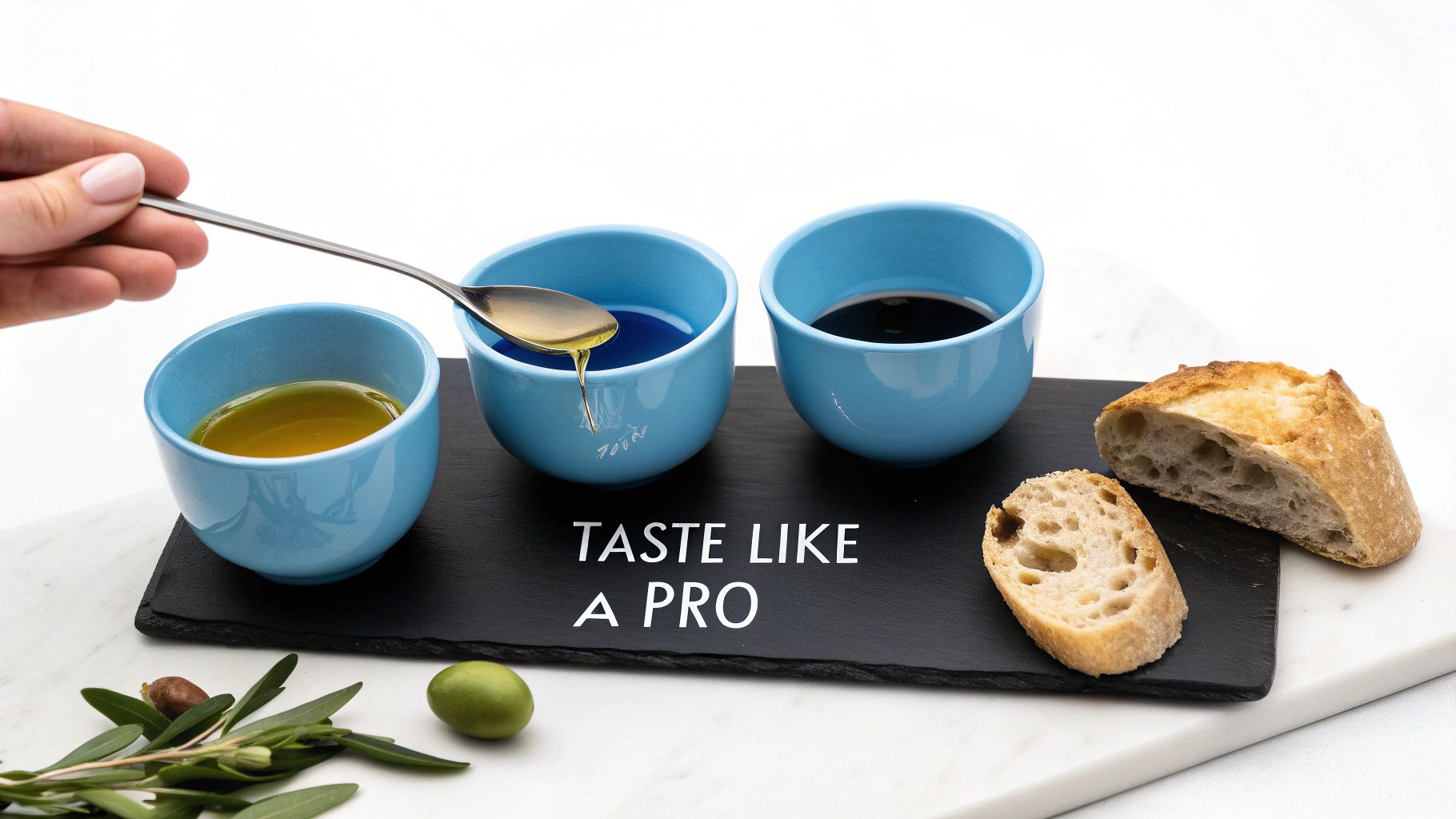
Tasting a fantastic Spanish olive oil is not some stuffy, academic exercise. It is one of life's simple, genuine pleasures. It is a moment where you connect with the sun, the soil, and the very soul of the groves where the olives were grown. This is your chance to stop merely using olive oil and start truly experiencing it.
You need no complex rituals or fancy equipment. The process professionals use is surprisingly straightforward, and it is designed to do one thing: unlock the oil's full story. It all begins with waking up the aromas that have been waiting inside the bottle.
The Professional Tasting Technique
Pour just a small amount of oil—about a tablespoon is perfect—into a small, rounded glass. A little wine glass or even a shot glass works wonderfully. You just need a shape that helps concentrate the aromas.
Now, cup the glass in your hands to gently warm the oil. Swirl it slowly for about 30 seconds. This simple motion coaxes the volatile compounds to release, creating the oil's unique bouquet. Bring the glass to your nose and take a good, deep sniff. What do you smell? Freshly cut grass? Ripe tomatoes? Perhaps even green almonds?
Then comes the fun part: the "slurp." Take a small sip of oil into your mouth while also inhaling a little bit of air. It might feel strange at first, but that energetic slurp sprays the oil across your entire palate, hitting every taste bud and revealing all its subtle notes.
This simple method—the warm, the swirl, and the slurp—is the key to unlocking a deeper appreciation. It turns you from a passive consumer into an active taster, ready to decipher the messages inside the bottle.
The Three Pillars of Quality
As you taste, do not worry about finding a long list of obscure flavors. Instead, focus on identifying three positive attributes that are the undeniable hallmarks of any high-quality, fresh extra virgin olive oil.
-
Fruitiness (Frutado): This is the aroma of fresh, healthy olives. It can be intensely green and grassy (think artichoke or tomato leaf) or soft and ripe (like banana or apple). A vibrant, fresh fruitiness is the very first sign of a well-made oil.
-
Bitterness (Amargo): Do not be alarmed by a pleasant bitterness on your tongue! This is not a flaw; it is a badge of honor. This taste, often like chicory or dandelion greens, signals the presence of fresh olives and powerful antioxidants.
-
Pungency (Picante): This is that peppery or spicy kick you feel in the back of your throat. It might even make you cough once or twice. That kick comes from oleocanthal, a potent anti-inflammatory polyphenol. The stronger the peppery finish, the more of these healthy compounds are in the oil.
These three characteristics should work in harmony. A truly great Spanish olive oil will have a beautiful balance of all three, creating a complex and deeply satisfying experience.
For a more detailed walkthrough, you can find a comprehensive guide on how to taste olive oil that will help you refine your palate. Once you learn to spot these positive markers, you will have the confidence to identify true quality and choose an oil that elevates every single meal.
A Practical Guide to Buying and Storing Your Oil
Alright, you have journeyed through the groves and learned the language of the olives. Now it's time to put that knowledge to work where it really counts: the grocery store. Let's turn that confusing aisle into a gallery of choices you can navigate with total confidence.
Your first mission is to become a label detective. When you scan the shelves, your eyes should immediately dismiss any bottle made of clear glass or sitting under bright, hot display lights. Those are red flags—signs that the oil has been compromised before you even touch it. Instead, hunt for dark green or brown glass bottles, or even better, an opaque tin.
When you're choosing a Spanish olive oil, understanding the role of different containers for food packaging is key to keeping it fresh. A protective bottle isn't just a fancy extra; it is a non-negotiable shield against light, the number one enemy of fresh olive oil.
The Supermarket Checklist
Once you have zeroed in on the properly packaged oils, it is time to interrogate the label. Ignore the marketing fluff on the front—the real story is in the details. This simple checklist will guide you to a superior bottle every time.
-
Find the Harvest Date: This is your most important clue. Look for a specific date or season, like "Harvested Autumn 2024." If all you see is a "best by" date, which can be two years after bottling, you are flying blind. Freshness is everything.
-
Confirm the Origin: Does the label specify a region, like Andalusia or Catalonia? Even better, does it name the specific olive, like Picual or Arbequina? A generic "Product of Spain" label can sometimes be a sign of a lower-quality blend from all over.
-
Look for a Seal: A D.O.P. (Denominación de Origen Protegida) seal is your ultimate guarantee. It is a legally binding promise that the oil in that bottle is authentically from the place it claims and was made according to strict standards.
The Spanish olive oil market moves fast, which is great news for us. It means there is a steady flow of fresh products hitting shelves worldwide. Just to give you an idea, in May 2025, Spain's olive oil sales hit 120,095 tons, a 21% jump over the monthly average. This robust trade means high-quality, recently harvested oils are always being exported, ready for you to find. You can dig deeper into the bustling Spanish olive oil market on oleista.com.
Protecting Your Liquid Gold at Home
Congratulations, you have brought home a fantastic bottle! Now, your job is to protect it. Just remember this simple mantra: olive oil has three enemies—light, heat, and air. Your mission is to keep them all at bay.
Your pantry is your ally. Store your olive oil in a cool, dark cupboard, far away from the stove and any sunny windows. Heat from cooking will rapidly destroy the oil’s delicate flavors and health benefits.
Whatever you do, do not pour your beautiful oil into one of those clear glass cruets to display on the counter. It might look nice, but you are essentially exposing it to a slow death by light. Always keep the cap screwed on tight to protect it from air, which causes oxidation and will eventually turn the oil rancid.
By following these simple buying and storing tips, you are honoring the entire journey of the oil, from the grove to your kitchen. You are making sure that the vibrant, peppery, or fruity flavor you paid for is there in every single drop, from the first pour to the very last.
Common Questions About Spanish Olive Oil
Let's clear the air. When it comes to something as beloved as Spanish olive oil, a great many myths and half-truths float around that can make anyone feel a bit lost. It is time to cut through the noise and get straight to the facts.
Think of this as your personal myth-busting guide to solidify what you know and clear up any lingering confusion.
Can I Cook with Extra Virgin Spanish Olive Oil?
This is perhaps the biggest misconception out there, and the answer is a resounding yes. The old wives' tale about not heating extra virgin olive oil is simply outdated.
A high-quality EVOO has a smoke point somewhere between 375–410°F (190–210°C). This range is more than high enough for everyday cooking like sautéing, roasting, and even some light frying. Using a good Spanish oil is not just about adding fat—it is about adding layers of incredible flavor, from the peppery bite of a Picual to the buttery, mellow notes of an Arbequina.
What Does the Acidity Level on a Bottle Mean?
Low acidity is one of the clearest signs of a top-tier oil, but it has nothing to do with a sour taste. It is a chemical measure of the free fatty acids (FFA) in the oil, a key marker of quality and freshness.
To be legally classified as "extra virgin," an oil must have an FFA below 0.8%. But the truly great producers chase much lower numbers, often hitting an impressive 0.1% to 0.3%. A low acidity level is proof that the olives were healthy, handled with care, and milled right after being picked—all hallmarks of an exceptional oil.
Should I Buy Filtered or Unfiltered Olive Oil?
This one truly boils down to personal taste and how you plan to use the oil. Unfiltered oil, often called olio nuovo (new oil), is cloudy because it still contains tiny bits of olive fruit. This gives it a bolder, more rustic flavor profile that some people love.
The catch? Those same fruit particles make the oil spoil much, much faster. Filtered oil, on the other hand, is crystal clear because those solids have been removed. This gives you a cleaner expression of the olive's flavor and a much longer shelf life, making it the more practical choice for everyday cooking.
How Long Does Spanish Olive Oil Last Once Opened?
It is best to think of olive oil like fresh-squeezed juice. It is a fresh product that does not get better with age. Once that bottle is open, its biggest enemies—light, heat, and air—start to attack its delicate flavors and health benefits.
For the best taste and aroma, you should plan to use an open bottle within 2 to 3 months. Always keep it sealed tightly in a cool, dark cupboard. This simple habit makes all the difference in preserving the vibrant character you paid for.
If your interest in Spanish culture extends beyond its liquid gold, you might find that discovering the best way to learn Spanish is a fantastic way to connect even more deeply with its rich heritage.
At Learn Olive Oil, we're dedicated to helping you discover the vibrant world of premium olive oil with confidence. Explore our expert guides and tasting tips to elevate your culinary journey. https://learnoliveoil.com
 Learn Olive Oil
Leave a comment