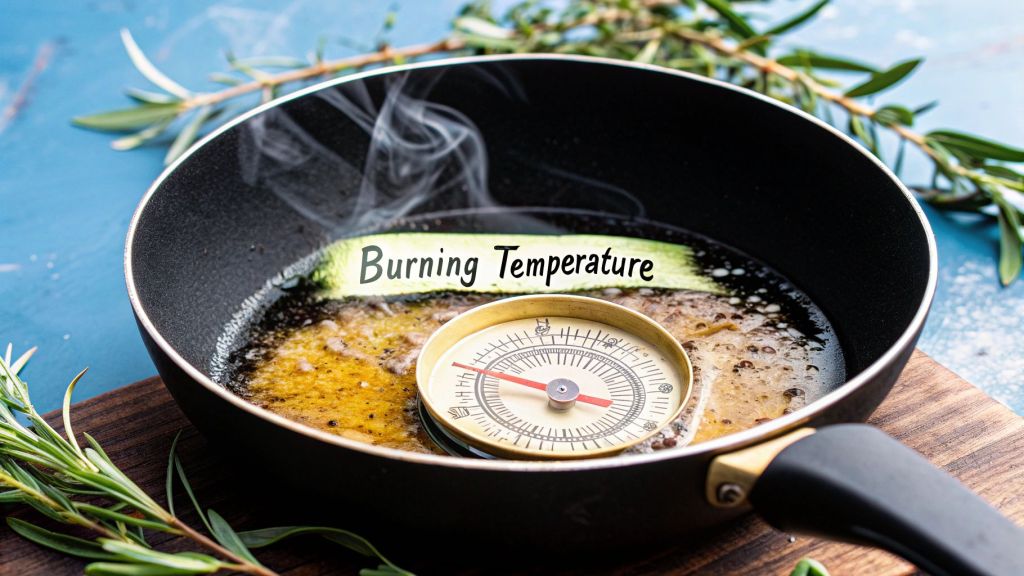
Let’s be honest. When someone mentions the “burning temperature” of olive oil, a single, inflexible number probably pops into your head. But the truth is far more interesting—and useful. Olive oil’s smoke point isn’t one number, but a surprisingly vast range, stretching from a respectable 350°F (177°C) for some extra virgin oils clear up to a blistering 470°F (243°C) for their refined cousins.
This huge spectrum holds the secret to unlocking your kitchen’s potential. It means that, yes, even your prized extra virgin olive oil is more than capable of handling most home cooking, from a gentle sauté to a robust roast. It’s time to finally put that old, tired myth that it can't handle the heat to bed for good.
Your Kitchen’s Most Misunderstood Ingredient
Picture this: you’re searing a beautiful piece of chicken, coaxing out that perfect golden-brown crust. The kitchen fills with an incredible aroma. Then, you see it—a wisp of acrid smoke. The satisfying sizzle turns into an angry splutter. In that instant, you know you’ve crossed a line. The dish—and your appetite—is probably ruined.
It’s this exact fear, a phantom fed by decades of culinary myths, that forces so many home cooks to relegate their best olive oil to the sad fate of a simple salad dressing.
But here is the secret most people never learn: high-quality extra virgin olive oil is a warrior in the pan, far more stable than you’ve been led to believe. We are about to walk through the why behind this incredible resilience, so you can stop being a cautious cook and finally start using this liquid gold with the confidence it deserves.
The Three Faces of Olive Oil
Before we go any further, you must understand a critical fact: not all olive oil is created equal. The vital differences between them, especially the level of refinement, are what truly dictate how they’ll perform when the heat is on.
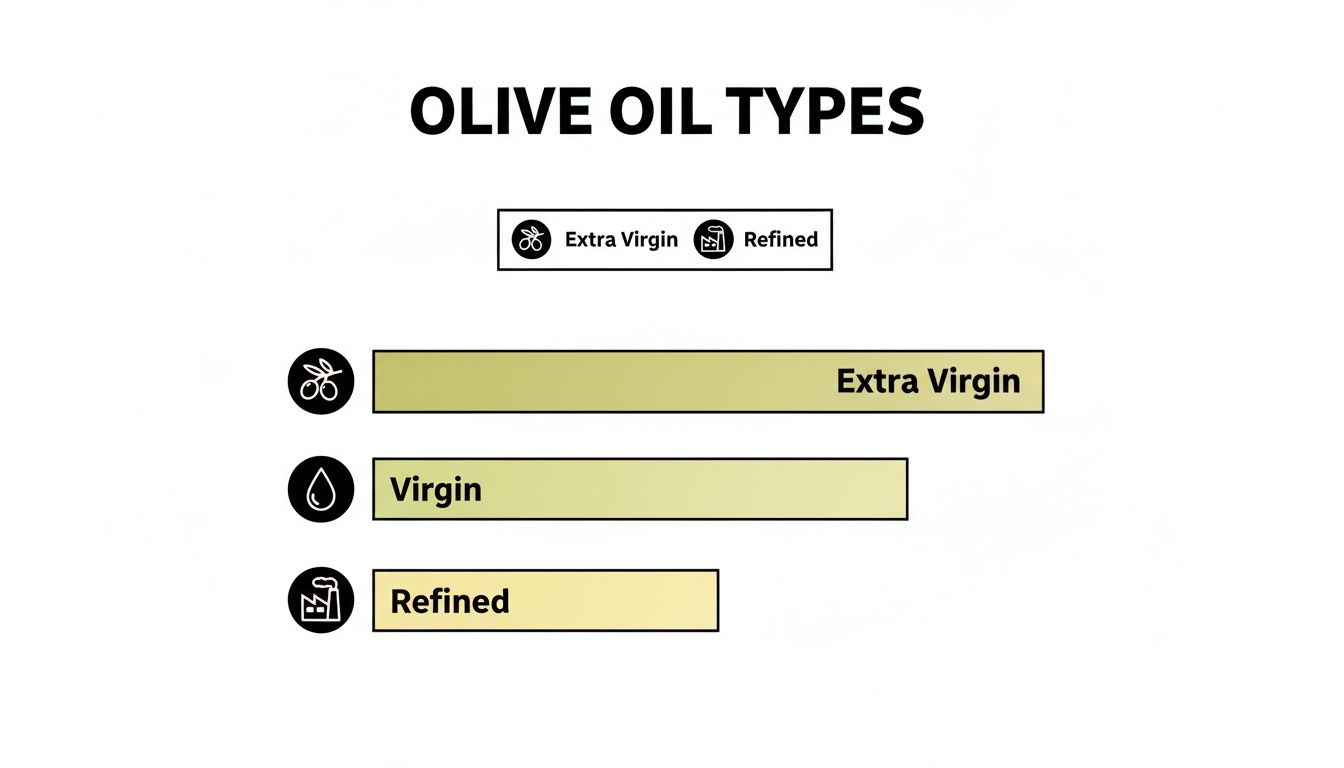
As you can see, the journey from a fresh, minimally processed extra virgin to a highly refined oil creates entirely different products, each built for a specific job in your kitchen.
Grasping these categories is the master key to unlocking olive oil’s potential. It’s not about memorizing one magic number; it’s about choosing the right tool for the job. To explore the finer points, you can learn more about the specific burning point of olive oil and see how it plays out in your favorite recipes.
Here's the most important takeaway: An oil's smoke point is a signpost, not a cliff. It's the point where fats begin to break down, but a high-quality oil has natural antioxidants that act as a defense, making it much more stable than its smoke point alone would suggest.
So, what does that smoke signal really mean when you’re standing at the stove? Let's break it down.
Making Sense of Smoke Point in Your Kitchen
Let's clear the air about the term 'smoke point.' For countless home cooks, it sounds like a culinary doomsday clock—a single temperature that, once crossed, instantly destroys your oil and your dinner. But that’s not how it works in the real world.
Think of it less as a cliff and more as a helpful warning sign. It’s the ‘check engine’ light in your car. It isn't a signal of total engine failure, but it’s telling you to pay attention because things are getting a little too hot under the hood. A single wisp of smoke doesn’t mean your meal is ruined.
What's Actually Happening in the Pan?
On a chemical level, the smoke point is simply the temperature where an oil’s fats start to visibly break down. This chemical collapse unleashes a storm of compounds, most notably one called acrolein. That’s the villain behind the acrid, burnt smell and the bitter, unforgiving taste that follows.
This process does two things you want to avoid at all costs. First, it injects harsh, unpleasant flavors that can completely overpower your food. Second, it starts to destroy the good stuff in the oil, like the healthy polyphenols that give high-quality extra virgin olive oil its prized health benefits.
The key is to see this signal as a matter of quality, not just safety. If you want to dive deep into how this works with top-tier oils, our complete guide on the smoke point of EVOO has you covered.
Key Takeaway: The smoke point isn’t a fire alarm. It's a culinary cue that your oil is getting too hot and its flavor and chemical structure are starting to change.
Do not mistake the gentle, wispy vapors that rise from hot oil for true smoke. Olive oil contains a tiny amount of water, and as it heats, this can steam off. Real smoke is a distinct bluish-gray and carries a sharp, nasty smell you cannot possibly miss.
Smoke Point vs. Flash Point: A Critical Distinction
Here’s a fact that should put your mind at ease: a smoking pan is a fixable problem, not a five-alarm fire. The actual olive oil burning temperature is dramatically higher than its smoke point.
It helps to think of it in three distinct stages:
- Smoke Point: This is where the oil starts to visibly smoke and break down. For most olive oils, this range is between 350°F and 470°F (177°C – 243°C).
- Flash Point: If you keep cranking the heat well past the smoke point, you’ll eventually hit the flash point, usually around 600°F (315°C). Here, the vapors can ignite for a second if they meet a flame, but they won't stay lit.
- Fire Point: This is the real danger zone, which happens at about 680°F (360°C). At this temperature, the oil will catch fire and sustain a flame, creating a dangerous grease fire.
Frankly, you'd have to be trying pretty hard to hit the flash point or fire point in a normal home kitchen. Your stovetop burner on high will rarely get a pan hotter than 500-550°F. The smoke point is your early warning system, giving you plenty of time to dial back the heat long before you're anywhere near real danger. This is the practical knowledge that helps you cook with confidence, not fear.
Why Extra Virgin Olive Oil Handles Heat Better Than You Think
Let’s tackle the biggest myth in the olive oil world head-on, shall we? For years, you’ve likely been told to save your best extra virgin olive oil for salads and finishing drizzles, terrified that a hot pan will instantly ruin it. It's a piece of kitchen advice so common, it's practically gospel.
But what if that advice is just plain wrong?
Consider this: for generations, home cooks across the Mediterranean have been pan-frying everything from fish to vegetables in extra virgin olive oil without a second thought. This isn't some kind of culinary recklessness; it's a tradition that modern science is now decisively backing up. It turns out, your prized bottle of EVOO is a lot tougher than you've been led to believe.
The Secret Armor of a High-Quality EVOO
The mistake most of us make is getting fixated on a single number: the smoke point. Yes, the official smoke point for extra virgin olive oil can hover around 374°F (190°C), which sounds lower than many refined oils. But that number doesn't even begin to tell the whole story.
A true, high-quality EVOO comes with its own natural defense system. It’s packed with powerful antioxidants called polyphenols and has a very low level of free fatty acids (FFAs). You can think of these compounds as the oil’s personal bodyguards, ready to fight off heat and oxidation.
This natural armor is what makes EVOO so remarkably stable under heat. While the fats in highly processed seed oils start breaking down and oxidizing quickly, the polyphenols in EVOO essentially sacrifice themselves first. They protect the oil’s structure, flavor, and all its nutritional goodness. You can explore the science behind this in our deep dive on the extra virgin olive oil smoke point.
Putting the Numbers in Perspective
The old canard that olive oil can't handle the heat is an outdated belief that recent data has soundly debunked. While some lower-quality EVOOs might tap out at lower temperatures, a good bottle is surprisingly versatile.
Extra virgin olive oil's resilience comes from its chemical structure, not just its smoke point. Its wealth of antioxidants makes it one of the most stable cooking oils available, far more so than many oils with higher smoke points but fewer protective compounds.
The numbers really confirm this. A quality extra virgin olive oil, prized by health-conscious cooks, has a smoke point that sits comfortably at 374°F (190°C), making it a solid choice for everyday frying. That puts it right on par with lard. For comparison, refined 'light' olive oil can climb to an impressive 450°F (232°C).
In fact, food quality experts have confirmed the smoke point of olive oil can range anywhere from 347°F (175°C) all the way up to 464°F (240°C), depending entirely on its grade and freshness. This often matches or even beats common oils like canola.
So, What Does This Mean for Your Cooking?
It means you can finally liberate that good bottle of EVOO from the pantry shelf! It is perfectly safe—and delicious—for a whole range of cooking methods that go far beyond a simple vinaigrette. The key is simply using it correctly.
Here’s where a good EVOO really shines:
- Sautéing: Perfect for building a flavor base with garlic, onions, and vegetables.
- Pan-frying: Ideal for getting a beautiful sear on chicken, fish, and other proteins.
- Roasting: Drizzle it generously over vegetables or potatoes before they hit the oven.
- Stir-frying: Works great for quick, medium-high heat cooking.
The robust, peppery notes of a good EVOO can add an incredible depth of flavor to your cooked dishes—something a neutral, refined oil just can't do. By using it for everyday cooking, you’re not only making your food taste better but also infusing it with those powerful, heat-resistant antioxidants. It’s time to stop saving the good stuff and start enjoying it.
Choosing Refined Olive Oil For High-Heat Cooking
While a phenomenal extra virgin olive oil is the undisputed star in most kitchens, even the best actor can't play every part. Sometimes, you need a specialist—a culinary stunt double ready for the inferno of a deep fryer or the blistering heat of a wok.
This is precisely where refined olive oils, often labeled as 'light,' 'pure,' or simply 'olive oil,' step into the spotlight. Think of it this way: if EVOO is a luxury sedan, refined oil is a stripped-down race car. It’s been engineered for one thing: pure performance under extreme heat.
The refining process intentionally strips out the complex, delicate compounds like polyphenols that give EVOO its flavor and aroma. In return, you get an oil with a dramatically higher tolerance for heat and a smoke point that can reach a scorching 470°F (243°C).
Engineered for Stability and Heat
This isn't about making an inferior product; it's about creating a specialized tool for a specific job. The refining process uses heat and filters to remove impurities and, crucially, almost all the free fatty acids (FFAs).
This meticulous cleanup is what makes the oil so incredibly stable. When those volatile FFAs are gone, there’s very little left to break down and start smoking when the pan gets screaming hot. That stability is the secret to its high-heat prowess.
Think of it like this: the same process that removes the peppery flavor and deep green color also removes the very elements that are most sensitive to heat. It’s a trade-off that gives you an oil with a neutral flavor and an exceptionally high smoke point.
This makes it the perfect choice for any cooking that requires intense, sustained heat without adding its own strong flavor. You can get a perfectly crispy tempura or golden-brown french fries without filling your kitchen with acrid smoke or changing the taste of your food.
The Numbers Behind the Performance
The performance of refined olive oils isn't just talk; the data shatters common myths. These oils can hit smoke points between 450-470°F (232-243°C), making them ideal for high-heat favorites like tempura or wok-seared dishes you'd find in a busy restaurant kitchen.
For perspective, one industry chart lists olive pomace oil at 460°F and extra light olive oil at an impressive 468°F. The refinement process slashes free fatty acids down to as little as 0.05%, a massive factor in its stability compared to EVOO's <0.8% FFA content. This reliability is why refined oils are so common in commercial kitchens, where deep-frying routinely hits 375°F.
When operating commercial deep fryers, understanding these thermal properties is crucial for preventing oil breakdown and ensuring consistent results.
When to Reach for Refined Olive Oil
So, when should you grab the refined olive oil instead of its extra virgin cousin? Here are the scenarios where it truly shines:
- Deep-Frying: Its high smoke point and neutral taste are perfect for frying everything from chicken to donuts.
- Searing: Need a ripping hot pan to get a deep crust on a steak or fish? Refined oil won't break down and smoke you out.
- High-Heat Stir-Frying: The fast, intense cooking in a wok demands an oil that can handle the temperature without burning.
- Baking: When you want the moisture from an oil in a cake or muffin without any distinct olive flavor, 'light' olive oil is the answer.
Ultimately, choosing the right oil is about understanding the job at hand. For more on this, check out our guide on selecting a high smoke point olive oil. Keeping both a high-quality EVOO and a reliable refined olive oil in your pantry gives you the versatility to tackle any recipe with confidence.
How Quality And Freshness Impact Your Oil's Performance
That smoke point you see on a chart? It’s not a law of physics. Think of it as a helpful guideline, a starting point. In the real world, how your olive oil behaves in the pan depends on a few hidden variables that can make one bottle of extra virgin olive oil perform very differently from another.
Once you understand these factors, you become a much savvier shopper and a more confident cook. It all boils down to the oil's purity, its age, and its chemical integrity. Let’s pull back the curtain on what really dictates how much heat your oil can handle.
The Role of Free Fatty Acids
The single most important factor is the Free Fatty Acid (FFA) content. On a high-quality bottle, you'll often see this listed as "acidity." Imagine the oil is made of strong, stable chains. Free fatty acids are the weak links in those chains—they’re fatty acids that have broken free from their intended structure.
These rogue molecules are volatile and unstable. When you heat them up, they’re the very first things to start breaking down and smoking, which in turn lowers the oil's overall smoke point. A lower FFA percentage means you have a stronger, more stable oil that can take the heat. This is precisely why a premium extra virgin olive oil, with its very low acidity, is surprisingly resilient in a hot pan.
Why Freshness Is Non-Negotiable
Just as critical as acidity is freshness. At its heart, olive oil is a fresh-pressed fruit juice, and like any juice, it starts to degrade over time. Exposure to oxygen, light, and heat causes the oil to oxidize.
This oxidation process naturally increases the FFA content, creating even more of those weak links we just talked about. An old, stale oil is already partially broken down before you even twist the cap. Its smoke point is compromised from the get-go and it will start to smoke at a much lower temperature than a fresh, vibrant oil would. You can learn more about how time and storage degrade your oil in our detailed explanation of what causes olive oil rancidity.
The key takeaway is simple: a fresher oil with lower acidity will always have a higher, more reliable smoke point. Always check the harvest date on the bottle, not just the "best by" date, to ensure you're getting the freshest product possible.
The link between freshness, acidity, and heat tolerance isn't just theory; it's a measurable scientific fact. A landmark study found that the smoke point for high-grade virgin olive oils could be anywhere from 390°F to a staggering 464°F (199-240°C), all depending on these exact factors. For instance, EU regulations require an FFA level below 0.8% for an oil to earn the "extra virgin" label—a standard directly tied to its ability to handle heat.
The Question of Filtration
Finally, let's talk about filtration. Unfiltered oils, sometimes called olio nuovo, look cloudy because they contain tiny, suspended bits of the olive fruit itself. While these particles can give the oil a robust, intense flavor, they are also very quick to burn.
When you heat an unfiltered oil, these little solids will scorch and smoke long before the oil itself reaches its smoke point. This can trick you into thinking your oil is overheating when it really isn't. For any kind of high-heat cooking, a clear, filtered oil is a much better bet for a predictable and higher olive oil burning temperature.
Practical Ways To Cook With Olive Oil Confidently
All the science in the world doesn’t mean a thing if it doesn't change what you do at the stove. It’s time to put that knowledge into practice and turn that bottle of olive oil from a source of anxiety into your kitchen’s most reliable partner. Let’s get practical with simple, actionable advice you can use tonight.
The goal isn't to have you hovering over the pan with a thermometer. It's about learning to trust your senses—the sound, the smell, and the look of the oil. This is how real kitchen intuition is built.
Trusting Your Senses
Listen to your pan. A gentle, steady sizzle when food hits the oil is the sound of success. It tells you the heat is just right for cooking efficiently, without being anywhere near the smoke point.
A loud, aggressive crackle, on the other hand, is a warning sign. It means the heat is too high or your food has too much water on it. If you hear that, just dial back the flame. The most important cue, though, comes from your nose. If you smell anything acrid or bitter, you’ve pushed the oil too far.
Kitchen Dos and Don'ts
To make things even clearer, here are some straightforward rules for the road. Following these will help protect your oil’s flavor and health benefits, guaranteeing great results every time. Understanding and managing cooking surface temperatures is the foundation for achieving that perfect sear without ever overdoing it.
- DO add your food to the pan right when the oil starts to shimmer. That little ripple is the visual cue that it’s at the perfect temperature for sautéing.
- DON'T ever leave an empty pan with oil in it unattended on a high flame. That’s the fastest way to hit the smoke point.
- DO use a high-polyphenol EVOO for everyday sautéing. Those powerful antioxidants act like little bodyguards, making it more stable under heat and adding incredible flavor.
- DON'T panic if you see gentle wisps of vapor. This is often just a bit of water steaming off, not the acrid, blue-tinged smoke of burning oil.
The most practical skill you can develop is heat management. Start your pan on medium heat, let the oil warm up gradually, and adjust the temperature as you cook. This control is the secret to never burning your oil.
Finally, remember that your oil's performance starts long before it hits the pan. Proper storage is non-negotiable. Keep your olive oil sealed tightly in a cool, dark place. Light and heat are the enemies of freshness; they kickstart oxidation and can lower an oil's smoke point over time. Treat your oil well, and it will treat you well in return.
Common Questions About Cooking With Olive Oil
Even after we've broken down the science, a few practical questions almost always come up in the kitchen. This is where we clear up any lingering confusion so you can walk up to the stove and cook with total confidence.
The goal here is simple: to make using olive oil second nature. Let's get these common myths and mix-ups sorted out.
Can I Really Deep-Fry With Olive Oil?
You absolutely can. In fact, generations of Mediterranean cooks have been doing it for centuries. The trick is simply picking the right tool for the job.
You wouldn't want to waste your prized, peppery extra virgin olive oil for deep-frying, but a good refined olive oil is perfect. With a smoke point that can hit 470°F (243°C), it’s more than sturdy enough for the typical 350-375°F (177-190°C) needed for deep-frying. It offers a wonderfully stable and clean cooking medium that won't burn on you.
The old myth that you can't fry with olive oil is probably one of the biggest misunderstandings in cooking. If you choose the right grade, it's not just possible—it's fantastic for getting that perfect light, crispy texture without any heavy, greasy taste.
So go ahead and make those zucchini fritters or that fried chicken. You’ll get beautiful, golden results without smoking out your kitchen.
What Is The Difference Between Smoke and Vapor?
This one trips up a lot of people, and it’s a crucial distinction. Not everything you see rising from a hot pan is smoke.
- Vapor: Think of this as simple steam. Olive oil naturally contains a trace amount of water, and as the oil heats, that water evaporates. Vapor is harmless, looks like white steam, and doesn't really smell like anything.
- Smoke: This is your signal that the oil is breaking down. Real smoke has a distinct bluish-gray tint, stings your eyes, and gives off that sharp, acrid smell you can't ignore. This is that nasty acrolein we talked about earlier, telling you the oil has gone past its smoke point.
Seeing a few gentle wisps of vapor is perfectly normal. Seeing and smelling that pungent smoke is your cue to turn down the heat immediately. If it's heavy, it's best to start over.
Does The Olive Oil Burning Temperature Matter When Baking?
It matters, but not in the way you might expect. When you set your oven to 400°F (204°C), the food itself—whether it's a sheet pan of potatoes or a cake—doesn't actually reach that temperature internally.
The oil gets absorbed by the food, and the food’s own moisture content keeps the oil from ever getting close to its smoke point. You can confidently roast vegetables with a flavorful EVOO at high heat or use a lighter refined olive oil in your cake batter for moisture. The burning temperature is a concern for direct heat in a pan, not the gentler, ambient heat inside an oven.
Here at Learn Olive Oil, we're firm believers that truly understanding an ingredient is the key to unlocking its potential. From picking out the right bottle to knowing exactly how to use it, we're here to give you the expert insights you need.
Elevate your cooking by learning more at https://learnoliveoil.com.
 Learn Olive Oil
Leave a comment