You’ve heard the warnings whispered in kitchens and declared on cooking shows: “Never, ever cook with extra virgin olive oil! It can’t take the heat.” It’s a piece of advice so common, so widely believed, that it has become one of the most persistent—and damaging—myths in all of cooking.
And it’s holding you back.
Let's settle this debate, once and for all.
The fear stems from a simple misunderstanding of what a “burning point” actually is. You see, oil doesn’t just spontaneously combust. It follows a predictable sequence. It first reaches its smoke point, then its flash point, and only then—long after your food would be a charred, inedible mess—its fire point.
Grasping this simple sequence is the key to unlocking a world of flavor you’ve been told to fear.
The Great Olive Oil Heat Debate, Finally Settled
Think of it like this: you’re toasting a slice of bread. First, it hits that perfect, mouth-watering golden brown. This is your olive oil in its sweet spot, shimmering beautifully in the pan, releasing its incredible aromas, and cooking your food to perfection.
But if you get a phone call and forget about it, that toast starts to smoke. This is the oil’s built-in alarm system—its smoke point. It’s the oil telling you, “Hey, I’m starting to break down here.” Only after that warning—after the smoke—does it risk catching fire.
The secret to brilliant cooking is staying in that beautiful, golden-brown stage, long before heavy smoke even enters the picture.
A Chef's Perspective on Heat
Step into any serious professional kitchen, and you’ll see something that might surprise you. Chefs aren’t afraid of using good olive oil over high heat. Why? Because they know a secret that most home cooks don’t: a quality extra virgin olive oil has a shockingly high tolerance for heat.
They don’t fear the heat; they respect and control it. This gives them the confidence to sauté, roast, and even fry with it, coaxing out the most exquisite flavors from both the oil and the food.
The secret isn’t avoiding heat; it’s mastering it. Once you learn to read the signals your oil is giving you, you can harness its full spectrum of flavors without ever pushing it past its limits.
My goal is to give you that same professional confidence. We’ll cut through the confusing jargon and give you a simple, clear guide to proper olive oil cooking temperatures.
By the end of this, you won’t just know the numbers on a chart—you’ll possess the practical skill to use your olive oil to its fullest, most delicious potential.
Smoke Point vs. Burning Point: What You Really Need to Know
This is where true mastery begins. Let’s finally clear the air on the term that has sabotaged more meals than any other: the “burning point.” Here is the most important thing you need to understand: the smoke you see rising from your pan is not the main event. It’s merely the opening act.
Think of an oil’s smoke point as its early warning system. It’s the precise temperature where the oil stops shimmering gracefully and starts to chemically break down. You’ll notice a continuous, faint wisp of bluish smoke. This is not a fire. But it is a critical message from your pan, saying, “I’m reaching my limit!”
From Smoke to Flame
What’s actually causing that smoke? The culprits are called free fatty acids. Imagine them as the most delicate, volatile little compounds in the oil—the first to surrender when the heat gets turned up. The more of these an oil contains, the sooner it will send up that smoky SOS. This tiny detail becomes profoundly important when we compare different types of olive oil. For a deeper dive into the science, you can learn more about the olive oil smoke point.
If you ignore that signal and keep cranking the heat, you enter the real danger zone. The oil will eventually hit its flash point, and then its fire point. These are the true “burning points”—the temperatures where the vapors can actually ignite, either as a brief flash or a sustained flame.
It’s a clear, step-by-step process, not a single, terrifying event.
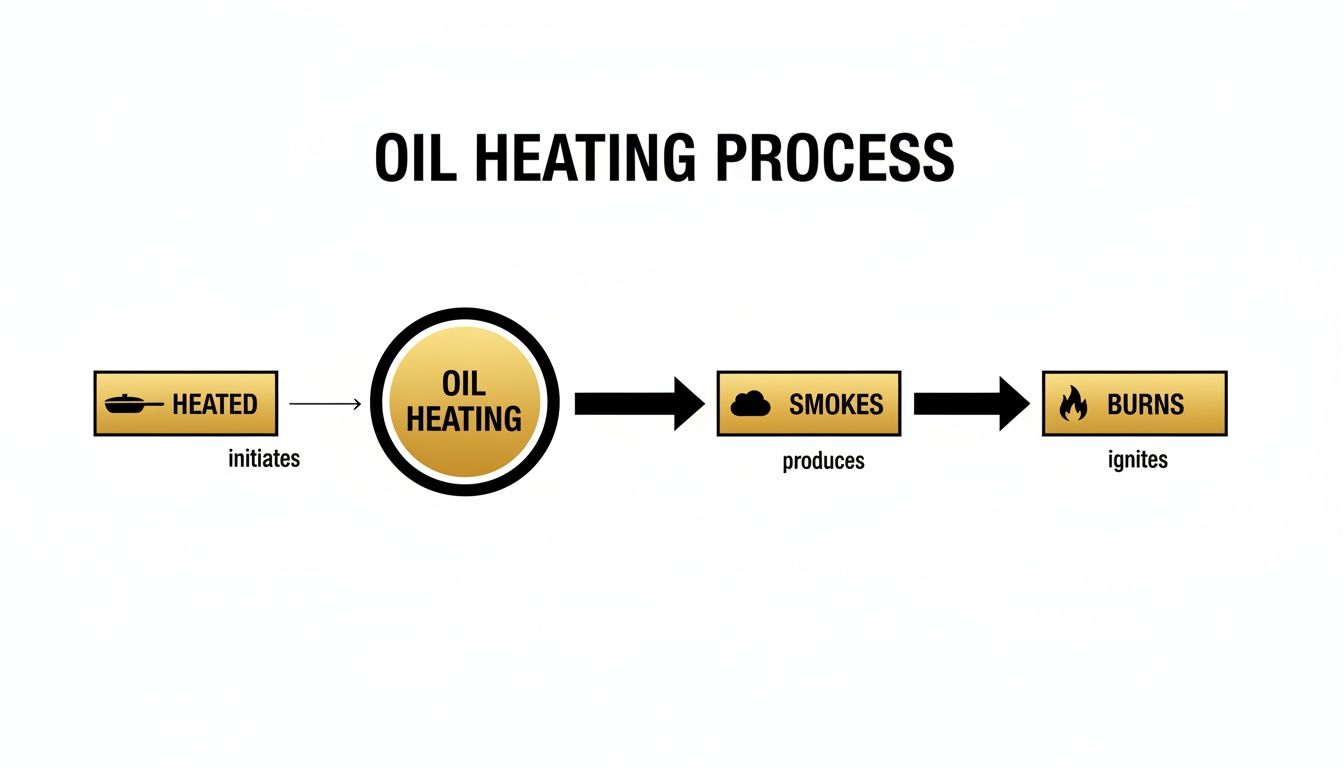
As you can see, smoking is a distinct, early step that happens long before any real fire hazard.
The Real-World Difference
Confusing these stages is like seeing a candle wick smoke for a split second and shouting that the house is on fire. The smoke is just the prelude. And here’s the good news: there is a massive temperature gap between that first wisp of smoke and any real danger in your kitchen.
Here is the game-changing fact for every home cook: olive oil's flash point—the temperature where vapors can actually ignite—is a staggering 600°F (315°C). This is dramatically higher than its smoke point, and it’s the reason professional chefs use it with such confidence.
This huge safety margin is why, in the EU—which produces over 50% of the world’s olive oil—Italian grandmothers have been frying eggplant at 375°F for generations without a second thought. The oil’s natural phenolic compounds, often found at 200-500 mg/kg in top-tier extra virgin oils, act as powerful stabilizers. In fact, lab tests show they resist oxidation up to 20% better than an oil like canola.
Once you understand this sequence, you’re back in command. That first hint of smoke isn’t a sign of failure; it’s a signal to be acted upon. Recognizing it gives you precise control, ensuring your food tastes exactly the way you intended.
Why Not All Olive Oils Are Created Equal
So, we've established that smoke is just a warning, not a disaster. But why does one bottle of olive oil start smoking at a lower temperature than another? The answer isn’t found in a factory or a lab. It starts in the olive grove.
Imagine the difference between a glass of freshly squeezed orange juice and a glass made from concentrate. One is pure, vibrant, and alive with character. The other has been processed, heated, and stripped of its very soul. Olive oil follows the exact same story.
The Impact of Purity and Processing
An olive oil’s character—including how it stands up to heat—boils down to a single, crucial factor: its purity. The less processed an oil is, the more of its natural goodness, and therefore its stability, it retains.
The key players here are those Free Fatty Acids (FFA). Think of them as tiny, unstable troublemakers in the oil. They are the first to break down when the heat is on, and they are what trigger the smoke.
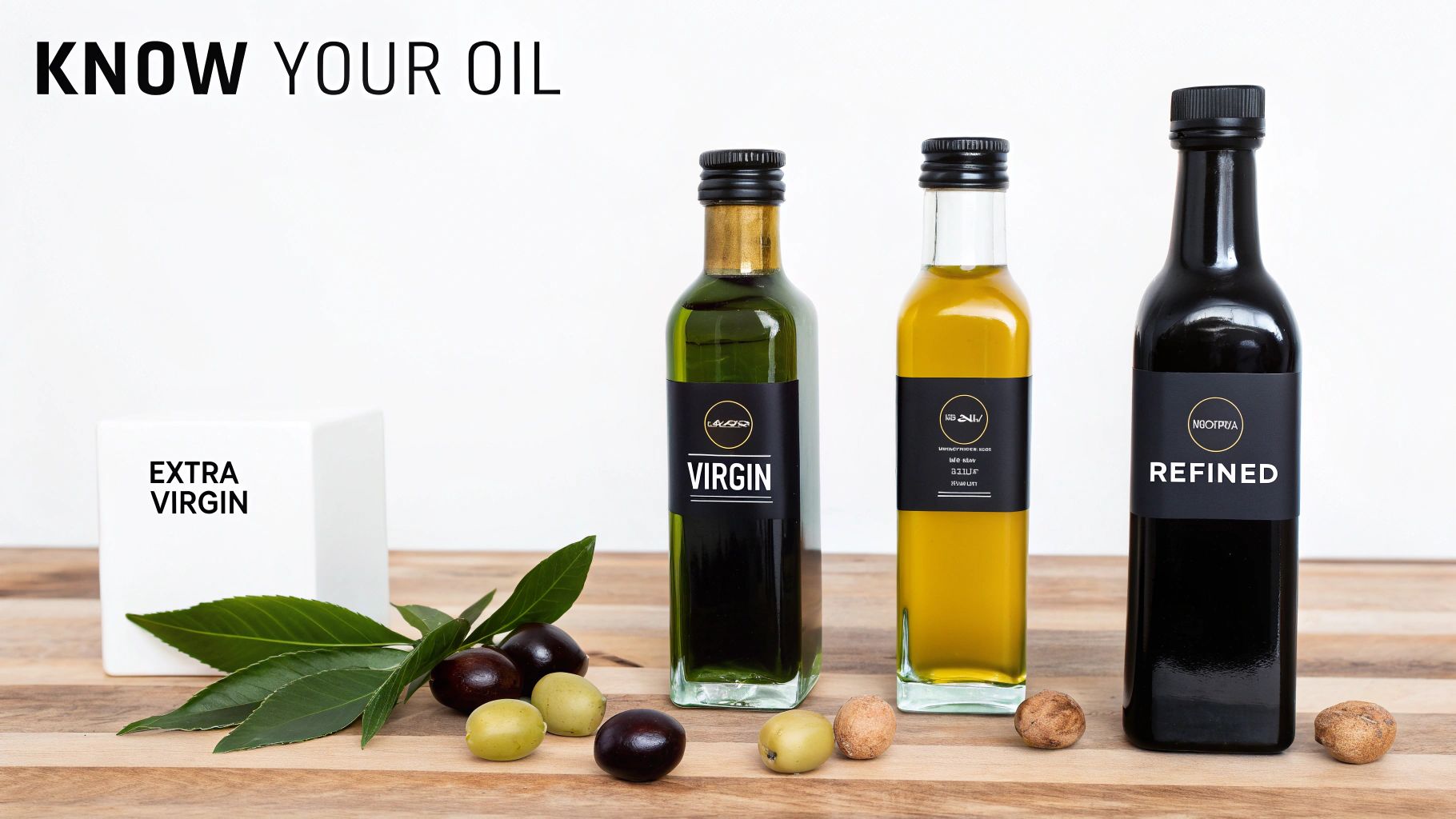
- Extra Virgin Olive Oil (EVOO): This is the prize. The pure, unadulterated, cold-pressed juice of the olive. To earn its name, it must have a very low FFA level—less than 0.8%—which is a primary reason it handles heat so remarkably well.
- Refined or 'Light' Olive Oil: This oil has been treated with heat and chemicals to remove flaws. While this process strips out most of the flavor and nutrients, it also eliminates nearly all free fatty acids. The result? A much higher smoke point, but a completely neutral, characterless oil.
But the story doesn't end there. A high-quality EVOO has another weapon in its arsenal: polyphenols. These powerful antioxidants are like a natural suit of armor, protecting the oil from heat damage and helping it maintain its structural integrity.
The less an oil has been tampered with, the better it can defend itself in a hot pan. Its natural compounds work in harmony, creating a cooking partner that is more stable, flavorful, and resilient.
Head-to-Head: A Look at the Different Grades
Understanding the differences in olive oil is like having a secret weapon in the grocery aisle. Beyond cooking, each type offers different health benefits. For instance, high-quality fats are crucial for weight management, and you can learn more about using olive oil for weight loss.
Here’s a fact that surprises most people: a good extra virgin olive oil has a smoke point between 375°F and 410°F (190°C to 210°C). This impressive stability comes from its high concentration of monounsaturated fats—it's roughly 73% oleic acid—which are far more heat-resistant than the fats in many common seed oils.
Even after cooking at 350°F, a quality EVOO can retain 85% of its valuable antioxidants. Compare that to refined oils, which can lose up to 50% under the same conditions.
A Quick Guide to Olive Oil Heat Tolerance
To make it crystal clear, here’s a simple breakdown of what to expect from each type of olive oil. This table will help you choose the right oil for the right job, every time.
| Olive Oil Type | Typical Smoke Point (°F/°C) | Key Characteristics | Best For |
|---|---|---|---|
| Extra Virgin | 375°F – 410°F (190°C – 210°C) | High in antioxidants, robust flavor, low acidity. | Sautéing, roasting, dressings, finishing. |
| Virgin | ~390°F (199°C) | Pure, but with minor flavor defects and higher acidity than EVOO. | General cooking, when a strong flavor isn't needed. |
| Refined ('Light') | 450°F – 470°F (230°C – 240°C) | Neutral flavor and color, very low acidity. | High-heat frying, baking, when you don't want any oil flavor. |
As you can see, the "best" oil truly depends on your mission. While a refined oil can technically withstand more heat, a high-quality extra virgin olive oil is far more versatile—and delicious—for everyday cooking than you’ve been led to believe.
The Health and Flavor Cost of Overheating Oil
Pushing your olive oil past its smoke point isn't just a simple cooking mistake. It is an act of sabotage against both your health and the beautiful flavor you paid good money for.
The moment you see that lazy, grey smoke curling up from your pan, you are witnessing a chemical breakdown with devastating consequences.
That delicate, peppery, fruit-forward extra virgin olive oil begins a bitter transformation. All the wonderful aromatic compounds that give it character are the first to be annihilated by the heat. What was once liquid gold turns into an acrid, unpleasant grease that will taint every ingredient it touches.
The Flavor Heist
Imagine a chef preparing a perfect, delicate filet of sole. He gently places it in a pan shimmering with high-quality EVOO. But he gets distracted for just a moment and returns to find the kitchen filled with a sharp, biting smoke.
The beautiful fish is now seared in an oil that tastes like burnt toast, completely obliterating its subtle sweetness. The dish is ruined—not by bad technique, but because the oil's limits were disrespected. This is precisely what happens when fragrant EVOO is allowed to turn into a bitter mess.
But the loss of flavor is only half the crime. The real tragedy is what’s happening on a molecular level.
When your oil starts smoking, it's an unmistakable signal that its healthy compounds are being destroyed and potentially harmful ones are being created. Smoking oil is, by definition, unhealthy oil.
The Nutritional Downfall
High-quality extra virgin olive oil is hailed as a superfood for one primary reason: its polyphenols. These are the powerful antioxidants responsible for that peppery kick you feel in your throat and a whole host of health benefits. They are also incredibly fragile.
When you overheat your oil, you are systematically incinerating these precious compounds. The very elements that make EVOO a pillar of a healthy diet are literally going up in smoke.
In their place, the oil begins to produce free radicals—unstable molecules known to cause cellular damage. To truly grasp why this is so critical, you can learn more about the role of olive oil polyphenol content and why protecting it is paramount.
Respecting your oil's smoke point isn't about following an arbitrary rule; it’s about preserving the integrity of your food. It's the non-negotiable step that ensures your meal is both delicious and genuinely good for you.
Mastering Heat: A Practical Guide to Cooking with Olive Oil
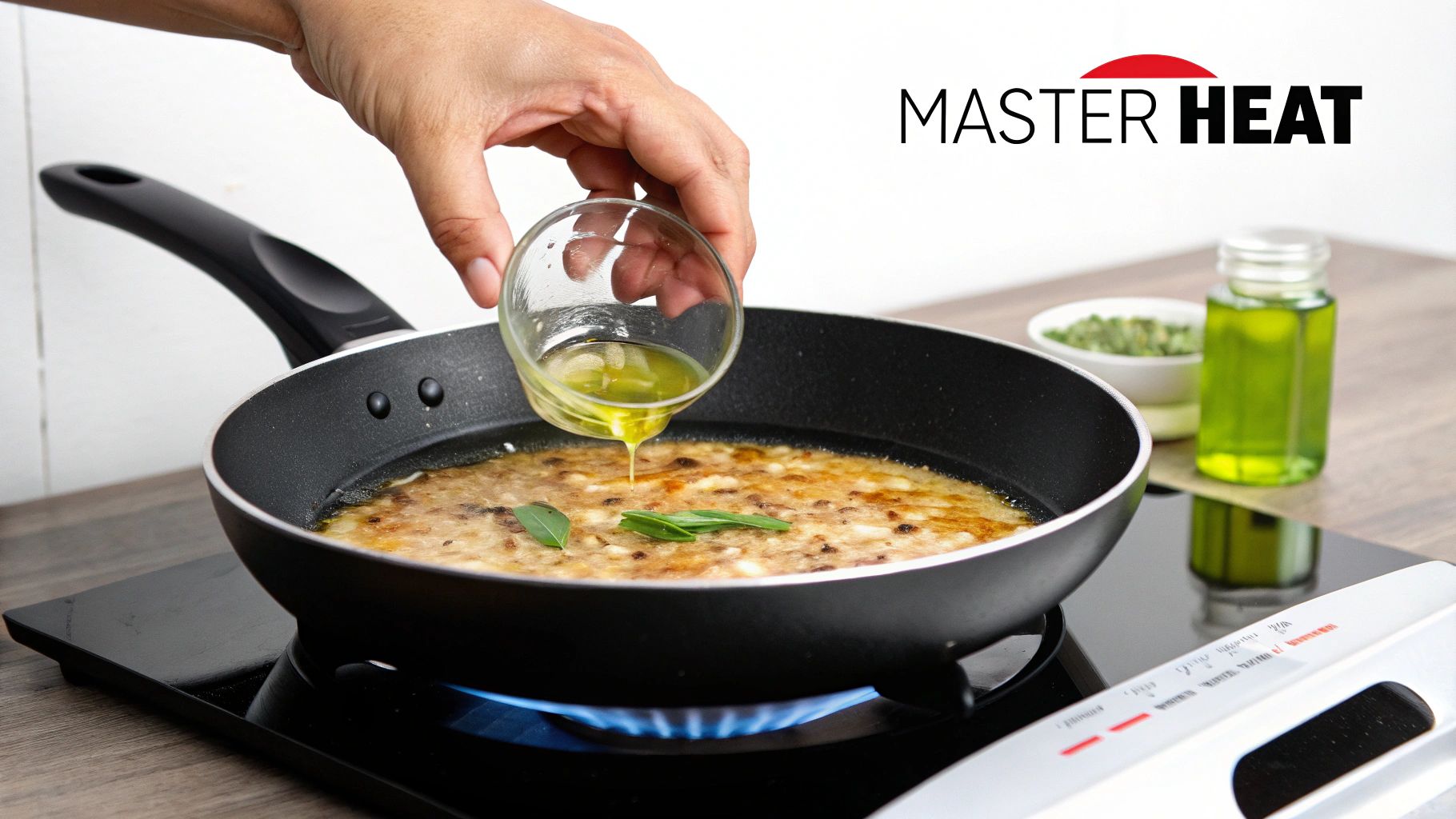
Alright, enough with the theory. Let’s get our hands dirty in the kitchen, where it really counts. Learning to cook with olive oil isn’t about memorizing a chart of temperatures; it’s about developing an instinct for your ingredients and trusting your senses.
The biggest myth we need to bust is that you can only use extra virgin olive oil for drizzling on salads. That is a colossal waste of its potential. A good EVOO is surprisingly sturdy and remarkably versatile, making it a brilliant choice for sautéing vegetables, pan-searing a beautiful piece of fish, or even light roasting. The secret is to listen to your pan. What you want is a gentle, steady sizzle—that’s the sound of success. If you see wisps of smoke, you’ve pushed it too far.
Choosing Your Oil for the Job
Start thinking about your olive oil the way a painter thinks about their colors. Your choice must be deliberate, because the right oil can elevate a dish from good to unforgettable.
Here is my simple playbook:
- For Low-Heat & Finishing: This is the moment for your absolute best, most flavorful Extra Virgin Olive Oil. Its vibrant, peppery notes are the star of the show. Drizzle it with abandon over soups, salads, and finished pasta.
- For Sautéing & Roasting (up to 400°F): A high-quality Extra Virgin Olive Oil is still your best friend here. Its natural antioxidants provide a protective shield against the heat, lending a wonderful depth of flavor you simply can’t get from neutral oils.
- For High-Heat Frying & Searing: For this demanding work, you need a Refined or ‘Light’ Olive Oil. It boasts a sky-high smoke point—around 465°F—which delivers clean, crisp results without adding its own flavor, allowing your main ingredients to shine. In a professional kitchen, getting the most from your oil means keeping your gear pristine, which includes proper commercial deep fryer cleaning.
Here’s the simple rule: The more flavor you want the oil to contribute, the less processed it should be. The higher the heat you need, the more that refinement becomes your ally.
To put this in perspective, extra virgin olive oil easily outperforms butter, with a smoke point of 375-410°F compared to butter's 350°F. That’s a 10-20% advantage that makes a huge difference in the pan. Science confirms this: olive oil's high monounsaturated fat content (around 75%) helps it stay stable. In one oven test, it held strong at 356°F for 28 hours, losing only about 10% of its valuable phenols.
For specialty oils, certifications like PDO guarantee an origin like Crete, where some oils can reach a smoke point of 405°F. A 2023 study even found that refined olive oil at 465°F is superb for deep-frying, reducing oil absorption in food by 15% compared to sunflower oil. You can explore more findings like these at CertifiedOrigins.com.
Protecting Your Investment
Your first line of defense in preserving your oil’s quality—and its smoke point—happens long before you even touch the stove. Proper storage is non-negotiable.
Heat, light, and air are the mortal enemies of olive oil. They accelerate oxidation, which increases those free fatty acids that lower the smoke point.
Always store your olive oil in a cool, dark place, like a pantry or cabinet—never, ever next to the stove. An opaque, tightly sealed bottle is your best weapon. When you protect your oil from these elements, you ensure it will perform exactly as it should, delivering on both flavor and stability every single time you cook.
Your Burning Questions Answered
We’ve traveled from the olive grove to the frying pan, dismantling the science of what happens when oil meets heat. But the kitchen is where the most pressing questions arise. Here, we tackle the common "what ifs" and "can I reallys" that stand between you and a perfect meal.
Let's clear up the last bit of confusion and put these stubborn myths to bed for good.
Can I Really Deep-Fry With Olive Oil?
Yes, you absolutely can—but you have to choose the right tool for the job. You would never use your finest, most aromatic extra virgin olive oil for deep-frying. Its beautiful, complex flavors would be incinerated, and frankly, it would be an expensive mistake.
The hero for this task is a refined or 'light' olive oil. With a smoke point soaring around a stable 465°F (240°C), it’s perfectly suited for high-heat frying. Even better, some studies suggest that foods fried in olive oil absorb fewer unhealthy compounds than those cooked in other seed oils. For crispy, delicious results with no unwanted flavors, refined olive oil is a fantastic—and often healthier—choice.
If My Olive Oil Smokes, Is the Food Ruined?
Not necessarily, but you must treat it as a final warning. If you see just a few delicate wisps of smoke, the oil is only beginning to break down. Act fast! Lower the heat or pull the pan off the burner for a moment. In most cases, you can save the dish.
However, if the oil is smoking heavily and continuously, you've gone too far. Unhealthy compounds are forming, and the flavor is turning acrid. At that point, the only smart move is to discard the oil, wipe the pan clean, and start over. Don't risk tainting a perfectly good meal.
The difference between a wisp of smoke and a plume of smoke is the difference between a warning and a failure. Learning to spot that first signal gives you complete control.
Does the Age of Olive Oil Affect Its Smoke Point?
Yes, and this is a critical detail most home cooks miss. Olive oil is a fresh product—think of it more like fruit juice than a permanent pantry staple. Its quality degrades over time, a process accelerated by its three enemies: heat, light, and air.
As an oil ages and oxidizes, its free fatty acid content increases. And as we now know, those are the volatile compounds that lower the smoke point. This means an old bottle of EVOO that’s been sitting on your counter will start smoking at a much lower temperature than a fresh, properly stored one. This is why buying fresh and storing it in a cool, dark place is non-negotiable for both flavor and performance.
Why Do Different Sources Give Different Smoke Points for EVOO?
You’ve noticed something that confuses many people! The smoke point of Extra Virgin Olive Oil isn't a single number; it's a range, typically from 375°F to 410°F (190°C to 210°C). This variation comes down to one simple factor: quality.
A truly superior EVOO with extremely low free fatty acids (well under 0.3%) and a high count of protective polyphenols will have a smoke point at the top of that range. Conversely, a lower-grade EVOO with acidity closer to the legal limit of 0.8% will start to smoke much sooner. This is why investing in a premium oil gives you more than just better flavor—it gives you more versatility and confidence in the kitchen. To see how it stacks up against others, you can review a comprehensive cooking oil smoke points chart.
Grasping these details is what transforms you from someone who just uses olive oil into someone who truly understands it, ready to unlock its full potential with every dish you create.

 Learn Olive Oil
Leave a comment