Have you ever poured olive oil and noticed a gentle haze, a bit of cloudiness that sets it apart from the perfectly clear oils on most store shelves? That beautiful, rustic look is the hallmark of unfiltered olive oil. It's oil in its most natural state, holding onto tiny, flavorful fragments of the olive itself.
Why Real Olive Oil Should Be Cloudy
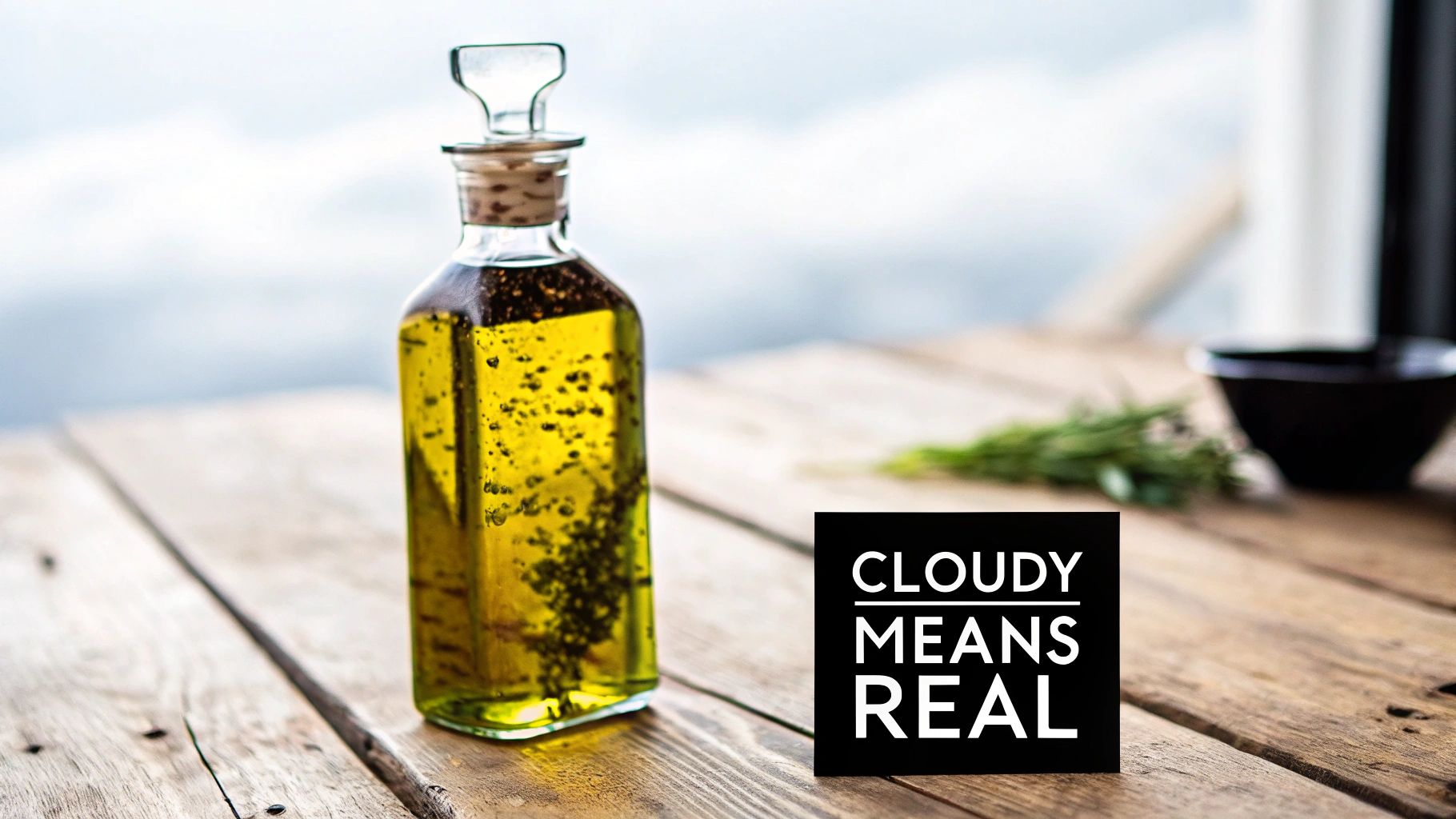
Picture opening a bottle of olive oil so fresh it tastes like you're standing in the grove during harvest. That’s the experience promised by the cloudy depths of an unfiltered oil. For years, we’ve been conditioned to think that crystal-clear means high quality. But when it comes to artisanal olive oil, the exact opposite is often true.
That signature cloudiness isn’t a flaw—it’s a mark of authenticity.
It helps to think of it like fresh-squeezed orange juice versus the filtered kind from a carton. The pulp in the juice adds flavor and texture, right? The haze in unfiltered olive oil is the same idea. It’s made up of microscopic bits of the olive fruit, intentionally left behind to preserve the oil’s true soul. These particles are packed with flavor and a higher concentration of powerful antioxidants.
The Character Within the Cloud
Choosing not to filter an oil is a conscious decision by the producer. It’s a commitment to delivering the most robust and potent product possible by keeping intervention to a minimum. Nothing is stripped away. The result is an oil that is often more:
- Flavorful: You’ll notice a bolder, peppery, and grassy taste profile.
- Aromatic: It carries the vibrant, fresh scent of a living olive grove.
- Nutrient-Dense: It holds onto more polyphenols, the celebrated antioxidant compounds known for their health benefits.
The cloudiness in fresh olive oil is a visual promise of a fuller, more complex taste and aroma. It’s the closest you can get to tasting oil straight from the press, capturing a fleeting moment of peak flavor right after the harvest.
This rustic character is exactly what chefs and food lovers look for when they want an oil to be a star ingredient, not just a cooking fat. While this cloudiness is a sign of a fresh, unfiltered product, other factors can affect its appearance, like temperature. If you've noticed your oil's clarity has changed, you can explore what causes cloudy olive oil in our detailed guide.
Ultimately, embracing the cloud means shifting your perspective. It’s not an imperfection to be wary of, but a hallmark of quality to celebrate—a sign that you’re holding a more potent, delicious version of a timeless kitchen staple.
From Grove to Bottle: A Minimalist Approach
The journey of an olive from a sun-drenched branch to your kitchen is a race against time, but for unfiltered olive oil, it’s also a story of intentional restraint. It's defined as much by what isn't done to it as what is.
Everything starts at the harvest. The olives are picked and rushed to the mill to be cold-pressed, a purely mechanical process that crushes the fruit into a thick paste and coaxes out the precious oil. Right at this moment, the path diverges, separating the artisanal, unfiltered oils from their mass-market cousins.
Patience Over Industrial Filtering
Most commercial oils are immediately pushed through industrial filters, often made of cotton or cellulose. This step efficiently strips out every last bit of olive fruit particle, resulting in a perfectly clear, uniform product with a long shelf life. But that clarity comes at a price—this aggressive filtering can also remove some of the delicate compounds that give olive oil its incredible flavor, aroma, and health benefits.
Unfiltered olive oil, on the other hand, takes a gentler, more patient route.
Instead of being forced through a filter, the fresh-pressed oil is simply allowed to rest. It's moved into large stainless steel tanks in a cool, quiet room. This traditional, hands-off method is called racking, or natural decantation.
Here, gravity does all the work. Over several weeks, the heavier sediment—those tiny, flavorful bits of olive flesh and skin—slowly settles to the bottom of the tank.
This isn’t about skipping a step; it’s a deliberate choice to preserve the oil’s integrity. The producer then carefully transfers the clearer oil from the top, leaving the dense sediment behind. The result is an oil that’s still a bit cloudy, packed with the character of the olive it came from. For a deeper dive into the full production process, check out this guide on how olive oil is made.
Why Less Is More
This philosophy of minimal intervention is what makes unfiltered olive oil so special. By avoiding the stripping process, producers are bottling a truer expression of the harvest. Each bottle delivers a more complete nutritional and sensory experience.
This gentle method preserves:
- Higher Polyphenol Counts: These potent antioxidants, which give great olive oil its peppery kick and anti-inflammatory power, remain suspended in the oil.
- Richer Flavor Profiles: Those tiny olive particles contribute to a more robust and complex taste, with notes that are often more grassy, fruity, and bold.
- A More Intense Aroma: The volatile compounds that create that fresh, vibrant scent of a top-tier oil are kept right where they belong—in the bottle.
Ultimately, choosing an unfiltered oil is about embracing authenticity. That slight cloudiness isn't a flaw; it's a sign of a richer, more genuine product that brings the full, unadulterated essence of the olive from the grove to your table.
Filtered vs. Unfiltered Olive Oil: A Head-to-Head Comparison
Walking down the olive oil aisle can feel overwhelming. With so many bottles vying for your attention, how do you choose? The decision often comes down to one crucial distinction: was the oil filtered, or was it left in its natural, rustic state?
This isn't about one being "good" and the other "bad." It's about two different philosophies that result in two very different products for your kitchen. One is a consistent, reliable workhorse, while the other is a vibrant, flavorful star meant for the spotlight. Let's break down how they really stack up.
H3: Appearance and Aroma: Clear and Bright vs. Hazy and Herbaceous
The first thing you'll notice is how they look in the bottle. Filtered olive oil is what most of us are used to seeing—it’s crystal clear, with a beautiful golden-green hue that shines. This clarity comes from passing the freshly pressed oil through fine filters that catch every last bit of olive pulp, giving it a polished, clean appearance.
Unfiltered olive oil, on the other hand, is proudly cloudy. That gentle haze isn’t a flaw; it's the signature of a less-processed oil. It’s full of tiny, microscopic bits of the olive fruit that remain suspended in the oil, giving it a more authentic, straight-from-the-mill character.
This difference in appearance translates directly to the aroma. A filtered oil usually has a clean, more subtle scent. Unfiltered oil is a different story—it smells alive. It hits you with a powerful and complex bouquet of fresh-cut grass, artichoke, or green tomato leaves. It’s like smelling the olive grove itself.
This infographic breaks down the simple, modern process that helps unfiltered oil retain its authentic character.
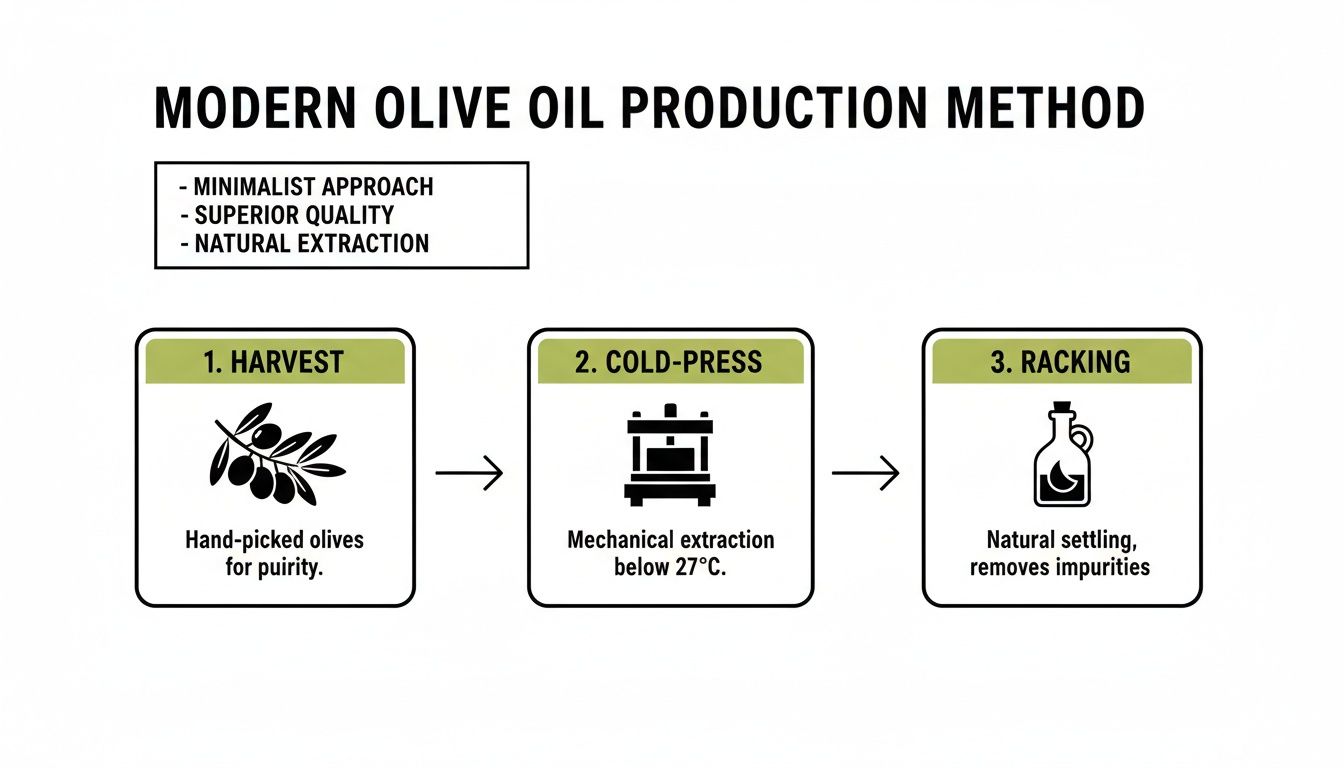
The key step here is "racking," which uses gravity to gently separate the oil from the sediment. This preserves the delicate compounds that aggressive, industrial filtering can strip away.
H3: Flavor Profile: Smooth and Buttery vs. Robust and Peppery
Now for the taste test. Filtered olive oil tends to have a clean, smooth, and sometimes buttery flavor. It's reliably consistent and less assertive, making it a fantastic all-rounder in the kitchen that supports other ingredients without stealing the show.
Unfiltered olive oil delivers a much bolder experience. The flavor is complex and dynamic, often starting with a burst of fruitiness and finishing with a peppery, grassy, and robust kick. That little tingle you feel at the back of your throat? That’s the calling card of oleocanthal, a potent anti-inflammatory compound that signals a fresh, high-quality oil.
The choice really boils down to your goal. Filtered oil gives you a neutral, dependable base for cooking. Unfiltered oil is an ingredient in its own right, designed to be tasted and celebrated.
H3: Health Properties and Shelf Life
This is where things get really interesting. Those tiny bits of olive pulp floating in unfiltered olive oil are loaded with polyphenols—powerful antioxidants with proven health benefits. While the filtering process creates that beautiful clarity, it can also remove a good portion of these healthy compounds.
Because of this, unfiltered oils typically have a higher polyphenol count, giving them an edge in antioxidant and anti-inflammatory power. You can learn more by exploring our detailed guide on whether unfiltered olive oil is the better choice for you.
What’s surprising is how this affects shelf life. Although the sediment will eventually cause the oil to spoil more quickly after opening, those same particles initially act as a natural preservative. In fact, studies have shown that unfiltered oils can retain 90% of their initial polyphenols after 18 months, while filtered oils may only hold on to 70%.
H3: Unfiltered vs. Filtered Olive Oil At a Glance
To make it even simpler, here's a side-by-side look at the key differences. This table should help you decide which bottle to grab based on what you’re cooking tonight.
| Characteristic | Unfiltered Olive Oil | Filtered Olive Oil |
|---|---|---|
| Appearance | Cloudy or hazy with visible sediment | Crystal clear and bright |
| Flavor Profile | Robust, peppery, grassy, complex | Smooth, buttery, clean, mild |
| Aroma | Intense, fruity, and herbaceous | Delicate and subtle |
| Polyphenols | Higher concentration of antioxidants | Lower concentration |
| Best Used For | Finishing, drizzling, dipping, dressings | Everyday cooking, sautéing, baking |
| Shelf Life | Shorter once opened (use within a few months) | Longer and more stable over time |
In the end, there isn't one "best" oil—just the right oil for the job. Your filtered oil is the dependable kitchen workhorse for everyday cooking. Your unfiltered oil is the star of the show, perfect for adding that final, flavorful punch and a boost of nutrition.
How to Taste Olive Oil Like an Expert
Reading about unfiltered olive oil is one thing. To truly grasp what makes it special, you must experience it yourself. Tasting olive oil isn't just about what hits your tongue; it’s a full sensory journey that reveals everything about the oil's freshness, the quality of the olives, and the craftsmanship behind it. Let's walk through the professional method—it might feel a little different, but it unlocks a whole world of flavor.
First, pour about a tablespoon of oil into a small, clean glass. A wine glass works beautifully, but even a shot glass will do. You just want something that helps concentrate the aromas. Cup the bottom of the glass with one hand to gently warm it and cover the top with your other hand. Now, swirl it for around 30 seconds. This small amount of warmth coaxes the oil to release its most delicate and fragrant compounds.
The Aromatic Journey
Now for the big reveal. Lift your hand from the top of the glass and take a deep sniff. What do you smell? A great unfiltered olive oil should never smell greasy or heavy. Instead, it should smell alive and green. You might pick up scents of freshly cut grass, artichoke, green tomato leaf, or even the sharp note of green almonds.
Those vibrant, fresh aromas are the direct payoff of the oil being unfiltered. By keeping those tiny bits of olive fruit in the mix, the producer locks in more of the natural aromatic compounds. In fact, professional sensory panels have found this minimalist approach preserves 25-40% more of those flavor volatiles. It’s why the scent is so much bigger and bolder.
The Professional Slurp
This next part is going to feel a little strange, but trust me, it’s the single most important trick in the book. Take a small sip of oil, but don't swallow it yet. Purse your lips and suck a quick burst of air in through the oil, like you’re slurping a noodle. This is what the pros call the stripaggio technique.
That "slurp" is magic. It aerates the oil and sprays it across every single taste bud in your mouth, unlocking flavors you'd completely miss if you just swallowed. Pay attention to the texture. Is it creamy, smooth, or buttery? Let it coat your tongue and the roof of your mouth.
You're looking for a progression of flavors here. It often starts with fruity or nutty notes at the front of your tongue, then moves to a pleasant bitterness on the sides—that bitterness is a fantastic sign of freshness and healthy antioxidants.
The Signature Peppery Finish
Finally, swallow the oil. This is the grand finale. Give it a few seconds. Do you feel a peppery tickle or a little kick at the back of your throat? That sensation is the signature of oleocanthal, a powerful anti-inflammatory compound that’s a hallmark of high-quality olive oil. A strong peppery finish isn't just a taste—it’s proof that you're dealing with a fresh, high-polyphenol oil.
That kick can range from a gentle warmth to a full-on, cough-inducing punch. The stronger that peppery finish, the more of those amazing, healthy compounds the oil contains. This whole process, from the first swirl to the final swallow, is a skill. To sharpen your palate, check out our in-depth guide on how to properly taste olive oil. With a little practice, you'll be able to spot an exceptional unfiltered olive oil from an average one in a single taste.
Buying and Storing This Liquid Gold
So, you understand the craft behind unfiltered olive oil and can taste the difference. Now you're ready to bring a bottle of that authentic, cloudy goodness home. But finding a great oil is only half the battle—keeping it that way is just as important.
When you're browsing the aisle, your eyes might be drawn to a beautiful clear glass bottle showing off the oil’s rustic haze. Don't fall for it. Light is one of olive oil's biggest enemies, and a clear bottle is basically an open invitation for it to destroy the delicate flavors and precious antioxidants inside.
Always, always reach for oil in dark, opaque glass bottles or metal tins. Think of them as a suit of armor, shielding the contents from light and preserving all that vibrant character.
How to Read the Label Like a Pro
First thing's first: ignore the "Best By" date. It's often more of a marketing suggestion than a true measure of freshness. The single most important piece of information on that label is the Harvest Date.
Look for a specific month and year. This tells you exactly when the olives were picked and pressed. To get the absolute best flavor and health benefits, you want to enjoy an unfiltered olive oil as close to its harvest as possible.
A clear harvest date is the sign of a producer who is proud of their product. If you can't find one, it's best to leave that bottle on the shelf. It’s a quiet admission that the oil is probably old.
Also, keep an eye out for seals of origin, like PDO (Protected Designation of Origin). These certifications are a guarantee that the oil comes from a specific place and meets strict quality standards, from the grove all the way to the bottle.
Protect Your Investment with Proper Storage
You’ve picked out a fantastic bottle—now what? The absolute worst place to put it is right next to your stove. It might be convenient, but the constant heat will rapidly degrade the oil, turning its vibrant, peppery notes into something flat and stale.
The key to preserving your unfiltered olive oil is simple: keep it cool and dark. A pantry or a kitchen cabinet away from the stove or oven is the perfect spot. The ideal temperature is cellar temperature, around 55-60°F (13-15°C), but a dark spot at room temperature will work just fine.
Remember that the very sediment that gives this oil its personality also means it has a shorter shelf life once opened. It will spoil faster than its filtered cousin. For this reason, it’s a good idea to buy smaller bottles that you’ll use up within a few months. For a deeper dive, our guide to perfect olive oil storage has even more detailed advice.
Following these simple rules ensures that every drop you pour delivers the full, sensational experience the producer intended, from the very first drizzle to the very last.
How to Use Unfiltered Olive Oil in Your Kitchen
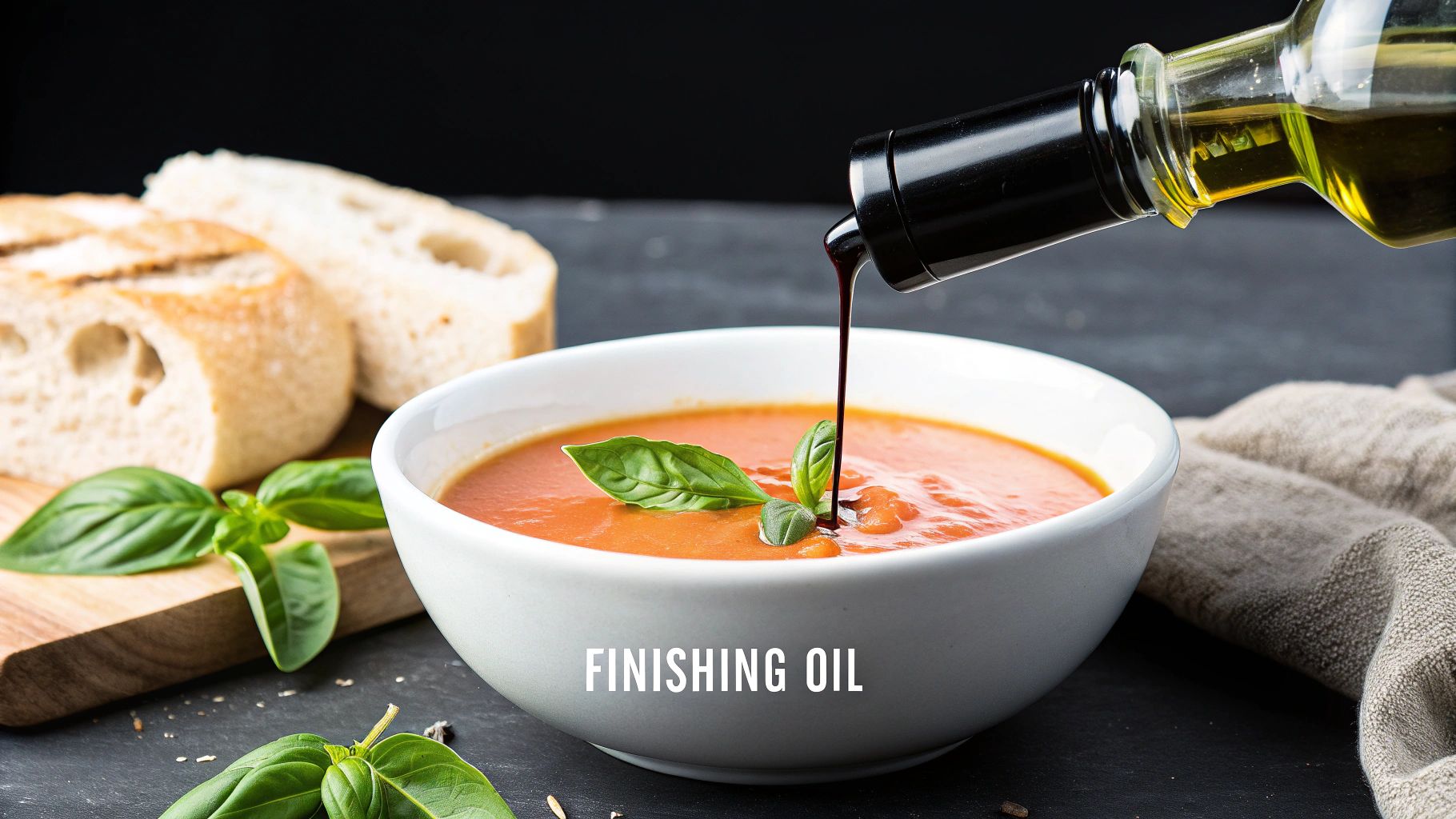
So, you've brought home a beautiful bottle of cloudy, rustic olive oil. You can almost taste its bold, authentic flavor just by looking at it. But what now? How do you get the most out of it?
First, and this is the most important rule: unfiltered olive oil is a finishing oil, not a cooking oil.
Its real magic comes out when you add it to a dish after the heat is off. Those delicate little olive particles that give the oil its incredible flavor and peppery bite will burn at high temperatures. If you cook with it, that beautiful ingredient will turn bitter and harsh. Treat this liquid gold with a bit of respect—use it raw to let its true character shine.
Think of it as the final touch, that last-minute flourish that takes a good dish and makes it truly memorable. Its whole purpose is to be tasted in its pure, unheated state.
Elevate Everyday Dishes
The best way to use unfiltered olive oil is to put its intense flavor right in the spotlight. Forget generic advice; we're talking about specific pairings that really make its powerful, grassy notes sing. A generous drizzle just before a dish hits the table can transform something simple into a culinary moment.
Here are a few mouth-watering ideas to get you started:
- Simple Soups and Stews: A swirl of unfiltered oil over a hearty tomato soup or a white bean chili adds a layer of peppery richness that cuts through the warmth beautifully.
- Grilled or Roasted Proteins: Finish a perfectly grilled piece of fish, a seared steak, or roasted chicken with a quick drizzle. The oil’s fresh notes brighten up all those smoky, savory flavors.
- Pasta and Grains: Instead of a heavy sauce, try tossing hot pasta or farro with a good pour of unfiltered oil, some fresh garlic, and parsley. It's simple, but absolutely stunning.
The rule of thumb is easy: if the dish is ready for the table, it’s ready for unfiltered olive oil. Its job is to enhance, not to be cooked.
This oil also holds its own in richer dishes. For some great inspiration, check out delicious recipes like Roast Beef with Mushrooms and White Wine Cream Sauce.
Classic Pairings and Dips
Sometimes, the simplest uses are the most profound. Unfiltered olive oil and warm, crusty bread are a match made in heaven. Just pour a little into a shallow dish, add a crack of black pepper and a pinch of flaky sea salt, and you have the perfect appetizer.
This simple pleasure is good for you, too. Unfiltered olive oil can have up to 30% more polyphenols than its filtered cousins. These are powerful antioxidants linked to all sorts of anti-inflammatory benefits, which is a big reason why health-conscious food lovers seek it out.
Consider these classic applications:
- Bruschetta: Drizzle it generously over toasted bread piled high with fresh tomatoes and basil.
- Vegetables: A final splash can completely transform steamed asparagus, roasted broccoli, or boiled new potatoes.
- Salads: Make a powerful vinaigrette with it, or simply drizzle it straight over fresh greens with a squeeze of lemon juice.
When you save this special oil for finishing touches, you're not just getting the best flavor—you're honoring the craft that went into making it and unlocking its full, unadulterated potential in your own kitchen.
Common Questions About Unfiltered Olive Oil
Even after getting the hang of what makes unfiltered olive oil special, a few practical questions always seem to pop up. Stepping into this world often means unlearning a few old habits and embracing a more rustic, direct-from-the-mill philosophy. Let's tackle some of the most common curiosities so you can buy, use, and enjoy this liquid gold with total confidence.
Think of this as the final piece of the puzzle—the practical know-how that turns a curious shopper into a savvy connoisseur.
Is the Sediment at the Bottom Safe to Eat?
Yes, absolutely. That cloudy stuff at the bottom isn't a defect; it's the heart and soul of the oil! It's just tiny, harmless bits of the olive fruit itself, and it's completely edible.
Most people don't even notice it, but some find the very bottom layer can taste a bit bitter. You can give the bottle a gentle shake before pouring to mix it all back in, or just pour carefully and leave the thickest sediment behind. It really just comes down to personal taste.
Why Did My Cloudy Oil Turn Clear?
Don't worry, this is perfectly normal. In fact, it's supposed to happen. When you first get a bottle of fresh unfiltered olive oil, it’s at its peak cloudiness. Over time, gravity simply does its job, and those suspended olive particles slowly drift to the bottom.
So, a bottle that’s been on your shelf for a couple of months will naturally look clearer than one you just bought. This isn’t a sign the oil has gone bad. Think of it more as a visual reminder that the clock is ticking—it's a good nudge to start using it up and enjoy that peak flavor before the sediment itself starts to speed up spoilage.
An oil clearing over time isn’t a sign of it going bad; it's just a natural part of its life cycle. That initial cloudiness is a temporary state, a beautiful sign of the oil's youth right after the harvest.
Can I Use Unfiltered Olive Oil for Cooking?
I'd strongly advise against it. The very same olive particles that give the oil its signature cloudy look and robust flavor have a very low smoke point. When you heat them, they burn fast.
This will not only ruin your meal with a bitter, acrid taste but also destroy the beautiful qualities of the oil you paid for. This is a finishing oil, through and through. Save it for raw uses where its complex, peppery notes can really shine—think drizzling over a finished dish, making dressings, or creating dips.
Does Cloudy Always Mean Better Quality?
Not necessarily. Cloudiness tells you one thing for sure: the oil is unfiltered. But it’s not an automatic guarantee of overall quality. A truly great olive oil, filtered or not, always starts with top-notch, healthy olives picked at the perfect moment and pressed with care.
Always look for the other critical signs of quality, like a recent harvest date on the bottle and a fresh, vibrant, grassy smell when you open it. Think of cloudiness as a sign of the oil's style—rustic and bold—not a standalone badge of superiority.
At Learn Olive Oil, we believe that knowing the story behind your food makes every bite better. We're here to share expert insights that help you explore the world of high-quality olive oil with confidence and joy.
 Learn Olive Oil
Leave a comment