Let me ask you a question. Have you ever wondered why the same bottle of olive oil behaves perfectly one day, yet turns into a smoking, bitter mess the next?
The answer isn't a mystery. It lies in a single, critical number that most home cooks misunderstand: the olive oil burn temp. This temperature isn’t one fixed point. It’s a moving target, a secret number that fluctuates between a respectable 350°F for a high-quality extra virgin olive oil and a blistering 465°F for its highly refined cousin.
This number is the oil's smoke point. It’s the precise moment your oil cries uncle, breaking down under the heat. When it smokes, it waves a white flag, surrendering its incredible flavor and potent health benefits. Master this one concept, and you'll unlock the secret to using olive oil not just as an ingredient, but as your most powerful tool in the kitchen.
What Is The Real Burn Temp For Olive Oil?
Let's shatter a myth that holds back countless home cooks. There's a persistent fear that olive oil, especially the good stuff, is too delicate for heat. This fear is costing your food incredible flavor.
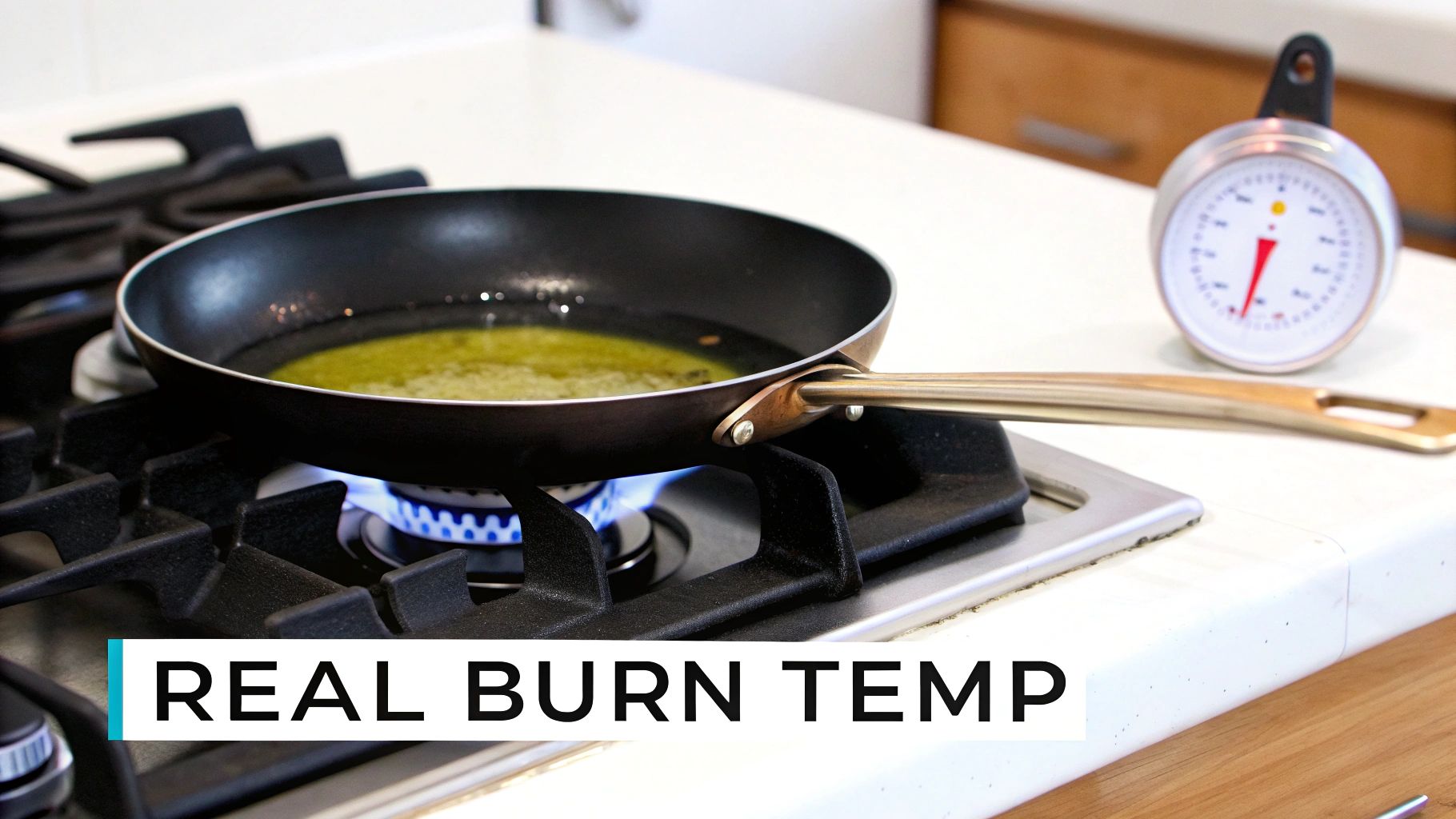
The truth is, there is no single "burn temp" for olive oil. The real temperature depends entirely on the oil's pedigree.
Imagine this: a world-class extra virgin olive oil is brimming with delicate plant compounds and free fatty acids. These are the very things that deliver that peppery bite and a treasure trove of health benefits. But they are fragile. They are the first to burn. A refined olive oil, by contrast, has been systematically stripped of these elements. The result is an oil that can withstand scorching heat, but at the cost of its very soul—its flavor, its aroma, and its nutritional power.
A Tale Of Two Oils
The difference is as clear as night and day when you place them side-by-side.
A truly great, unrefined Extra Virgin Olive Oil (EVOO) commands a smoke point between 350–410°F (177–210°C). This range makes it shockingly versatile, a far cry from the "drizzling only" reputation it’s been saddled with. It’s more than capable of sautéing vegetables to perfection, roasting potatoes to a golden crisp, and even handling a respectable shallow fry.
In the other corner, you have the heat warriors: refined or "light" olive oils. These have been engineered for one purpose—to endure intense heat. Their smoke points soar to a staggering 465°F (240°C). They won't flinch in a screaming hot pan, but they will bring none of the rich, complex flavor or antioxidant firepower of their unrefined brethren.
This chart drives the point home with brutal clarity, revealing the chasm between a flavorful EVOO and a heat-stable refined oil.
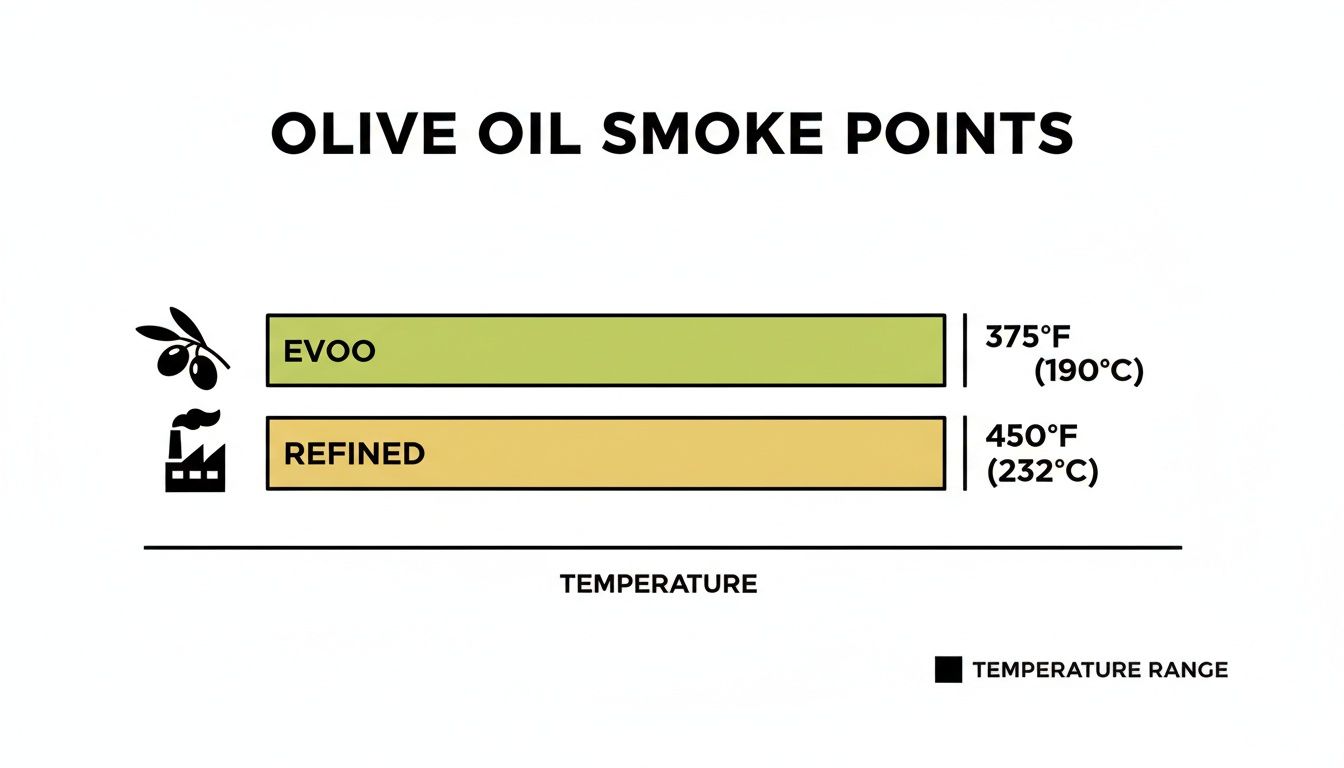
The visual tells the whole story: refined oils are built for thermal stability, while extra virgin oils offer a masterful balance of profound flavor and impressive heat tolerance.
Olive Oil Smoke Points at a Glance
For your convenience, here is a quick reference guide. Consider this your roadmap to choosing the right olive oil for any culinary mission.
| Olive Oil Type | Refinement Level | Typical Smoke Point Range (°F) | Ideal Culinary Use |
|---|---|---|---|
| Extra Virgin Olive Oil | Unrefined | 350–410°F | Sautéing, roasting, finishing, dressings |
| Virgin Olive Oil | Unrefined | ~390°F | Sautéing, baking |
| Refined (Light) Olive Oil | Refined | 425–465°F | Frying, searing, high-heat cooking |
| Olive Oil (Blend) | Blend of Refined & Virgin | ~420°F | General-purpose cooking, roasting |
This table isn't about memorizing rules; it's about empowering you to cook with confidence. While the exact smoke point will dance around depending on the specific bottle, these ranges are your trusted guide for every kitchen adventure.
The smoke point isn’t just a number; it’s a conversation between your oil and your pan. Learning to read its signals—the first shimmer, the fragrant aroma, the gentle sizzle—is the true mark of a confident cook.
If you wish to delve into the science of how oils behave under fire, this ultimate guide to oil smoke points is a phenomenal resource. It transforms abstract numbers into practical, real-world knowledge.
To see how olive oil measures up against the other oils in your pantry, our own cooking oil smoke points chart is an invaluable tool. Once you internalize these fundamentals, you’ll graduate from merely following recipes to making intuitive, masterful decisions that elevate every dish you create.
Why Not All Olive Oils Are Created Equal
Think of olive oil like you think of wine. The grape varietal, the soil, the climate, the skill of the vintner—all of these converge to create the final product. The story is identical for olive oil. Its entire journey, from the branch to your bottle, dictates its character and its performance in your pan.
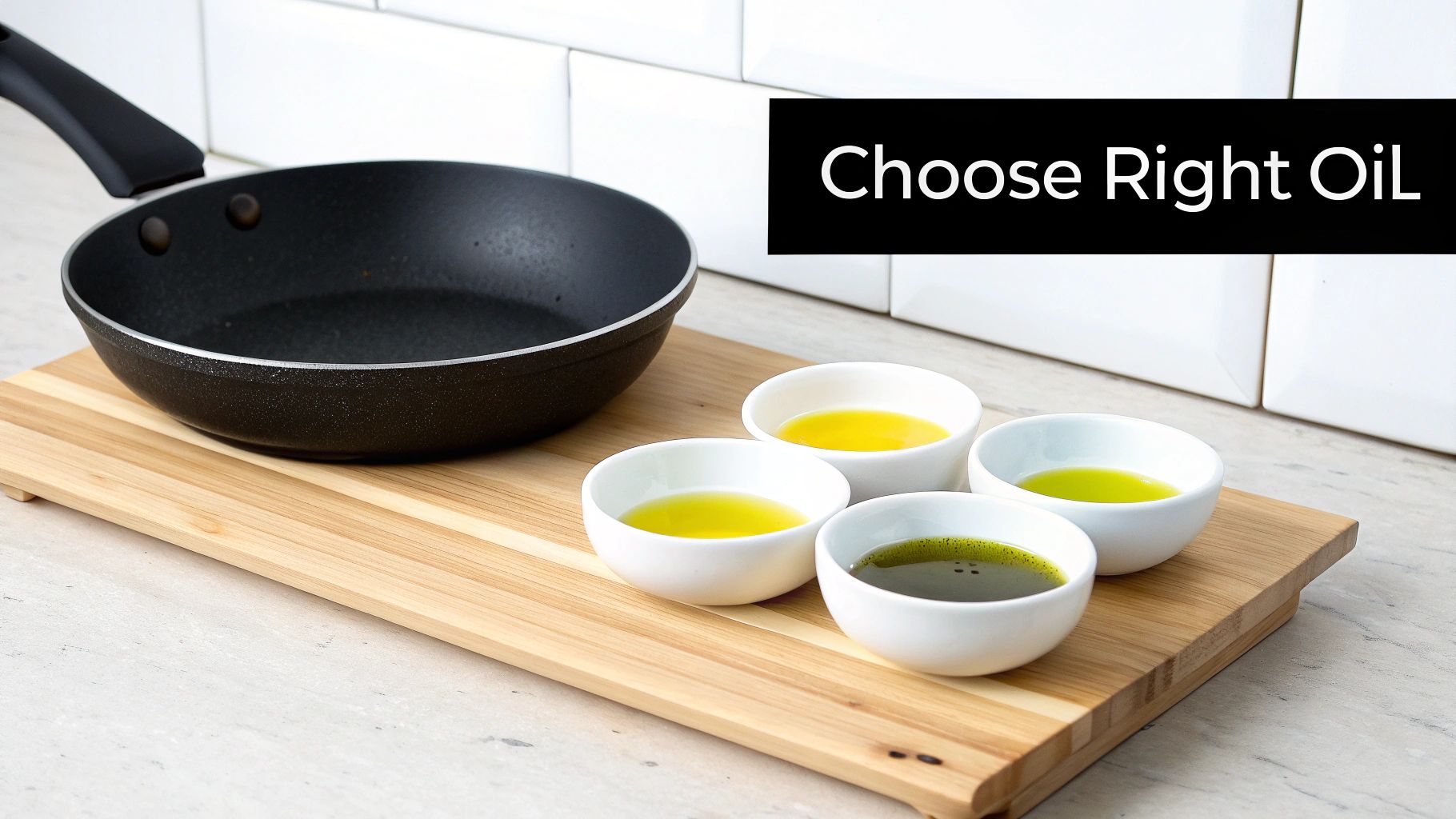
Standing in the grocery store aisle, the wall of olive oil can seem impenetrable. But the truth is simpler than you think. Every bottle falls into one of two camps: unrefined or refined. Grasping this single distinction is the key that unlocks the door to culinary mastery. It’s what separates a sublime finishing drizzle from a high-heat workhorse.
The Heart of the Matter: Free Fatty Acids
At the microscopic level, the single most important factor is a component called free fatty acids (FFA). Picture them as tiny, volatile troublemakers floating in your oil. The more of these you have, the more eagerly your oil will break down and smoke under heat.
A world-class Extra Virgin Olive Oil is defined by its astonishingly low FFA content, legally required to be below 0.8%. This isn't just a technical specification; it's a testament to quality. It tells you the olives were harvested and pressed with meticulous care. Standard virgin oils have a slightly higher FFA, while refined oils have had these volatile acids aggressively stripped away.
A low free fatty acid level is the secret weapon of a high-quality olive oil. It’s what gives a premium EVOO surprising resilience in a hot pan, allowing it to hold its own long after lesser oils have started to smoke.
This simple chemical fact means a premium, low-acid EVOO possesses a much more robust burn temp than its reputation suggests. It is not merely a finishing oil; it's a formidable cooking partner.
Filtration: The Unsung Hero of Stability
Another critical factor that separates the contenders from the pretenders is filtration. Immediately after pressing, olive oil is a cloudy liquid, rich with microscopic particles of olive fruit. While these solids impart a bold, rustic flavor, they are also the first to burn.
- Unfiltered Oils: These are beautifully raw and bursting with character. But the suspended solids cause them to scorch at lower temperatures. Reserve these liquid treasures for drizzling over a finished dish or whisking into a vibrant vinaigrette.
- Filtered Oils: By passing the oil through filters, these solids are removed. The result is a crystal-clear oil with dramatically improved heat stability. A filtered EVOO delivers the best of both worlds: exceptional flavor combined with a respectable smoke point perfect for most daily cooking.
Refined oils undergo an intense filtration process, which, along with other chemical treatments, gives them their sky-high smoke points. They trade the nuanced flavor and healthful polyphenols of a true EVOO for pure, unadulterated heat resistance. You can discover more about the different types of olive oil and how their journey from grove to bottle defines their destiny in your kitchen.
The Hidden Factors That Alter Your Oil's Burn Temp
Have you ever had this happen? Your trusted bottle of olive oil works beautifully one day, but the next, it starts smoking before the pan is even hot. You're not imagining things. The "burn temp" printed on a chart is a laboratory number, a theoretical ideal. It is not the reality of your kitchen.
In your home, that number is in constant flux. Think of your olive oil's smoke point not as a fixed law, but as a living number, influenced by invisible forces. The way you store it, the pan you use, even the age of the oil can send that temperature plummeting.
The Two Biggest Culprits: Air and Light
Freshness is the lifeblood of an oil's stability. From the very moment an olive is crushed, its delicate chemistry begins to degrade. This process, known as oxidation, is mercilessly accelerated by two things found in every single kitchen: air and light.
Every time you open the bottle, you invite oxygen in. That oxygen immediately begins to attack the oil's fats, increasing its free fatty acid (FFA) content. And as we've learned, higher FFAs mean a lower smoke point. It's a direct, unavoidable chemical reaction.
Sunlight is an even more sinister villain. Storing your oil in a clear bottle on a sunny countertop is a death sentence. Light acts as a powerful catalyst for oxidation, turbo-charging the reactions that rob your oil of its stability and lower its burn temp. To see exactly how an oil's composition is affected, you can dive deeper into what olive oil is made of.
Your olive oil begins to age the second it leaves the press. How you store it determines whether it ages like a fine wine, preserving its character, or like milk left on the counter—losing its integrity with each passing day.
Tucking your oil away in a cool, dark cupboard is not just advice; it is a command if you wish to preserve its performance and flavor.
How Your Cookware Changes the Game
The pan you choose also has a dramatic impact on your oil's behavior. Its material, thickness, and condition can completely change the outcome.
Here’s how different pans wage war on your oil:
- Heavy-Bottomed Pans (like cast iron or clad stainless steel): These champions of heat retention can also be deceptive. Their steady, even heat can creep up on you, pushing the oil past its smoke point before you even see it coming.
- Thin Pans (like some aluminum or non-stick pans): These are notorious for creating "hot spots"—pockets of intense heat where the pan's surface gets much hotter, much faster. Oil in these spots can begin to burn and degrade long before the rest of the oil in the pan has even warmed up.
At the end of the day, the number on the bottle is just a starting line. True kitchen mastery comes from understanding that the effective burn temp is always a moving target, constantly being reshaped by the oil's age, its storage, and the very pan you're cooking in.
When Smoke Signals a Problem for Flavor and Health

We’ve all been there. You turn your back for just a moment, and a thin, blue wisp of smoke snakes up from your pan. That smoke is not just a sign of high heat; it's a distress signal. It is the precise moment your beautiful, fragrant olive oil begins to decompose, turning into an enemy of both your meal and your health.
When an oil is shoved past its burn temp, a destructive process called thermal decomposition begins. The healthy fats oxidize at a terrifying rate, and the oil’s very molecular structure shatters. This is where the real damage is done.
This breakdown unleashes a chemical cascade of horrors. The first casualty is flavor. The delicate, fruity, or peppery notes you paid for are instantly replaced by a harsh, acrid bitterness—a flavor so foul it can sabotage an entire dish.
The Flavor and Health Fallout
Pushing your oil past its smoke point does more than ruin your dinner. It systematically destroys the very compounds that make high-quality olive oil a cornerstone of a healthy diet.
Consider the delicate polyphenols. These are the powerful antioxidants that deliver that signature peppery bite and a host of health benefits. They are exquisitely sensitive to heat. The instant your oil begins to smoke, these precious compounds are annihilated, robbing you of the nutrition you sought. If you are intrigued by the science of how taste and aroma interact, especially when smoke is involved, you may enjoy understanding flavor profiles.
At its smoke point, olive oil isn't just burning; it's transforming. The beneficial compounds that protect your body are destroyed, and in their place, harmful free radicals and a foul-smelling compound called acrolein are created.
What That Acrid Smell Really Means
That sharp, stinging odor is the signature of acrolein, a volatile compound created when the oil’s glycerol backbone shatters under extreme heat. It’s the same chemical that gives burnt toast its unpleasant aroma, and it’s an undeniable signal that your oil has turned against you.
This chemical transformation creates a host of problems:
- Formation of Free Radicals: These unstable molecules wreak havoc in the body, causing oxidative stress linked to cellular damage.
- Nutrient Destruction: The vitamins and antioxidants that make extra virgin olive oil a nutritional titan are completely vaporized.
- Flavor Ruin: The acrid taste of burnt oil is impossible to mask. It will overpower every other flavor in your dish.
This heat-induced breakdown is chemically similar to how oil goes rancid on the shelf. To learn how oxidation can damage oil even without heat, read up on the signs of olive oil rancidity. Recognizing that first wisp of smoke is your power—the power to pull back from the brink, protecting both your health and the integrity of your meal.
Choosing the Right Olive Oil for Every Dish
Enough with the theory. The chemistry is fascinating, but true mastery is achieved when knowledge becomes instinct. This is where you learn to trust the most sophisticated instruments in your kitchen—your eyes, ears, and nose—to wield olive oil with unwavering confidence.
It's time to abandon the rigid, outdated rules that claim you can't sear with a good EVOO. The secret is not to memorize an exact olive oil burn temp; it's to match the oil's unique personality to the task at hand. You wouldn't use a delicate fleur de sel to cure a ham, would you? The logic is the same. The goal is to select an oil whose flavor profile and heat stability are perfectly suited to your culinary creation.
Searing and High-Heat Cooking
When your mission demands a scorching hot pan—to put a perfect crust on a steak or flash-fry vegetables—you need an oil that can face the inferno without flinching. This is the moment for refined or light olive oils to step into the spotlight.
Their neutral flavor profile will not interfere with your star ingredients, and their towering smoke point (often well over 450°F) provides the stability required for that magnificent, golden-brown sear. To use a delicate EVOO here would be a tragic waste; its beautiful complexities would be incinerated long before your food was cooked.
Everyday Sautéing and Roasting
This is the arena where a high-quality, filtered Extra Virgin Olive Oil reigns supreme. The vast majority of our cooking, from sweating aromatics to roasting vegetables at 400°F, falls squarely within a good EVOO's comfort zone. Here, you get the ultimate prize: an oil stable enough to handle the heat, yet rich enough to infuse your dish with complex, delicious flavors. For a deeper look, consult our guide on the best olive oil to cook with.
Listen to your pan. A steady, confident sizzle is the sound of success. If it spits and sputters violently, or you detect that sharp, acrid smell, your heat is too high.
Finishing, Dipping, and Dressings
For any preparation where the oil is tasted raw, accept no substitutes. This is the time to unleash your absolute best, most flavorful unfiltered Extra Virgin Olive Oil. Here, its bold, grassy, and peppery notes are the star of the show.
Use your best oil for its flavor, not just its function. Drizzling a premium EVOO over a finished steak, a bowl of soup, or a simple plate of pasta is where its true value is unlocked.
Think of this as the final brushstroke that transforms a meal into a masterpiece. This is where the world’s great olive oil producers showcase their craft. Trust your palate. Let the oil’s character be the final, perfect note in your culinary symphony.
Your Questions About Cooking with Olive Oil Answered
Let’s cut through the noise. There is a mountain of conflicting advice about cooking with olive oil, but the truth is usually far simpler. Here are the direct, no-nonsense answers to your most pressing questions.
Knowing the burn temp of your olive oil isn’t about charts and numbers. It’s about building an unshakeable kitchen intuition. Once you understand the why behind the rules, you can stop worrying and start unlocking this liquid gold's true potential.
Can I Really Fry with Extra Virgin Olive Oil?
Yes, absolutely—with one important caveat. A high-quality EVOO with low acidity is more than capable of handling everyday sautéing and shallow frying, up to temperatures around 375°F. The natural antioxidants in a true EVOO actually make it more stable against heat than most people believe.
However, deep frying is another beast entirely. It demands holding oil at a high temperature for an extended period. For this specific task, a refined olive oil is the smarter, more economical choice. Using your prized EVOO for deep frying is a culinary crime; you will destroy the very flavors and health benefits you paid a premium for.
What Does a Bitter Smell Mean When I Heat My Oil?
That sharp, acrid smell is an alarm bell. It is the oil's desperate cry that it has reached its burn temp and has begun to decompose. You are smelling acrolein, a toxic compound formed when fat molecules are destroyed by heat.
When you smell this, two things have happened: the oil’s flavor is ruined, and harmful free radicals are forming in your pan. The only solution is to turn off the heat, carefully dispose of the oil, wipe the pan clean, and begin again. Your nose is your most reliable guard; trust it implicitly.
How Does Storage Impact My Oil's Smoke Point?
Storage is not just important; it is everything. Your olive oil has three mortal enemies: heat, light, and air. Exposure to any of them unleashes oxidation, a chemical process that creates more free fatty acids and systematically lowers the oil's smoke point. An open bottle of oil sitting next to a hot stove will degrade with shocking speed, losing both its stability and its flavor.
Proper storage isn't just a friendly tip; it's the cardinal rule for preserving your oil's quality. A well-kept oil will perform predictably and beautifully. A neglected one will smoke, sputter, and let you down.
To defend your oil, always keep it tightly sealed in an opaque container and store it in a cool, dark place. This simple discipline ensures your oil is always ready to perform at its peak.
Is Refined or Unrefined Oil Healthier for High Heat?
This question reveals a classic trade-off: heat stability versus nutritional firepower.
Refined olive oil boasts a higher smoke point because the refining process strips away the very compounds that cause it to smoke. But—and this is a crucial "but"—it also removes nearly all of the healthy polyphenols and antioxidants.
For the vast majority of your cooking, a high-quality EVOO provides the ideal combination of potent health benefits and a more-than-sufficient smoke point. For those rare occasions that require searing heat, a refined oil offers superior stability, albeit with fewer nutrients. The winning strategy? Keep both in your pantry, and always choose the right tool for the job.
At Learn Olive Oil, we believe that truly understanding your ingredients is the secret to making incredible food. We're here to guide you through the rich world of premium olive oil, from choosing the right bottle to mastering its use in your kitchen. To explore our expert insights and elevate your cooking, visit us at https://learnoliveoil.com.
 Learn Olive Oil
Leave a comment