Imagine this for a moment. You’ve just drizzled a golden-green liquid over a fresh salad. Before you even take a bite, an aroma of fresh-cut grass and green tomatoes fills the air. This isn't just cooking oil. This is an experience.
That, in a nutshell, is the promise of a true extra virgin olive oil. The label extra virgin isn’t just marketing fluff dreamed up in a boardroom—it’s a legally defined guarantee, a sworn oath of purity for the highest grade of olive oil your money can buy.
What "Extra Virgin" Really Means
We see those two little words, "extra virgin," on countless bottles. But what do they actually mean?
Here’s a secret the big food companies don’t want you to know: it’s the difference between drinking freshly squeezed orange juice, bursting with sunshine and life, and sipping a processed concentrate, engineered in a factory. One is pure, unadulterated fruit. The other is a product of heavy industrial tinkering.
That distinction is everything.
An oil can only earn the coveted extra virgin title by meeting a strict, uncompromising set of standards. These rules prove its superior quality. The oil must be mechanically pressed from fresh olives—no chemicals, no scorching heat—a method that jealously guards its natural flavors and powerful health benefits.
Lesser oils, like "pure" or "light" olive oil, are often the casualties of an industrial war on flavor. They are refined with solvents and high temperatures to mask flaws, stripping them of their very soul in the process. You can learn more about this in our guide on what makes olive oil virgin.
The Two Pillars of Quality
At its heart, the "extra virgin" designation is a promise of integrity. It’s a handshake deal between the producer and you, assuring you the journey from the olive grove to your kitchen was handled with reverence, focused on preserving the natural goodness of the fruit. This promise is verified in two critical ways:
- Chemical Analysis: Before it can even think about getting bottled, the oil is put through its paces in a lab. Scientists check for specific quality markers, especially its acidity level—the oil’s birth certificate of freshness.
- Sensory Evaluation: A panel of trained experts—think of them as the Supreme Court of taste—sniffs and sips the oil to confirm it sings with desirable fruity flavors and, most importantly, is completely free from any taste defects.
Extra virgin olive oil (EVOO) is the undisputed king of the olive oil world, defined by strict chemical and sensory standards. To qualify, an oil must have a free acidity of no more than 0.8% and pass a sensory panel that finds zero defects. No exceptions.
Ultimately, "extra virgin" is a seal of authenticity. It signifies an unrefined, flavorful, and aromatic product that stands head and shoulders above its processed cousins, offering a genuine taste of its sun-drenched origin.
Passing The Purity Test: The Science Of EVOO
So, how does simple, fresh-pressed olive juice earn that coveted "extra virgin" crown?
It’s not a matter of opinion. The journey begins in a laboratory, where the oil must pass two critical scientific tests. Think of these as two uncompromising gatekeepers. If the oil fails either one, it’s out. No second chances.
These chemical benchmarks tell the oil’s hidden story—they reveal everything from how the olives were grown and when they were harvested, to how carefully they were handled from tree to press. These are the first, non-negotiable hurdles an oil must clear on its path to greatness.
The Freshness Gauge: Acidity
The first gatekeeper is Free Fatty Acidity (FFA). Picture this as a precise gauge of the olive's health at the exact moment of pressing. When an olive gets bruised, damaged, or even just sits around for too long after being picked, its fats start to break down, releasing free fatty acids.
A high FFA number is a dead giveaway—a smoking gun pointing to damaged fruit or a slow, careless process. For an oil to be called extra virgin, its FFA must be below 0.8%. But here’s an insider tip: a truly exceptional oil often boasts an acidity level far lower—sometimes even under 0.2%. This is the signature of a master craftsman who rushed perfectly healthy olives from the branch to the press with incredible speed and skill.
This image neatly summarizes the core principles that give extra virgin olive oil its meaning.
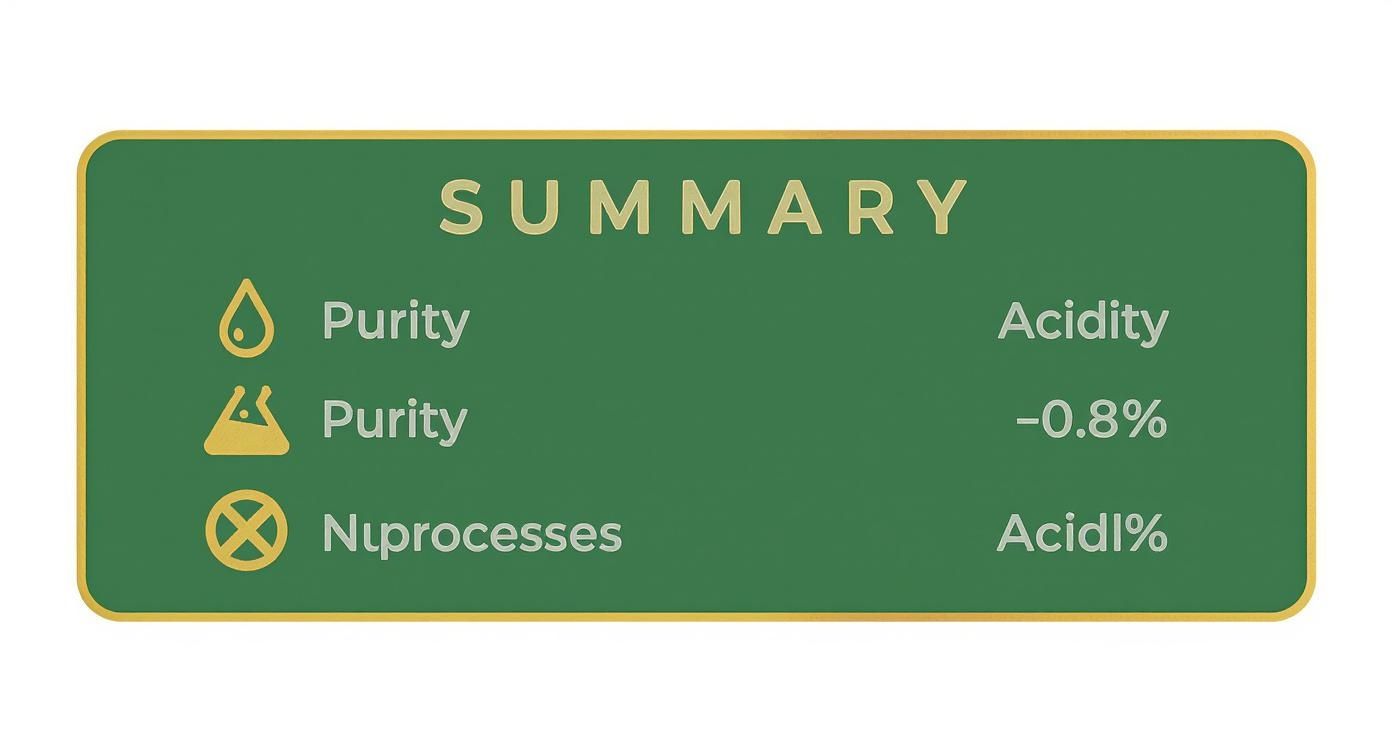
It’s this combination of natural purity, gentle processing, and low acidity that forms the bedrock of true EVOO quality.
The Longevity Test: Oxidation
The second crucial test measures the Peroxide Value. If acidity tells you about freshness at the start, the peroxide value predicts how long that freshness will last. It’s a measure of oxidation—the very process that makes any oil go rancid.
Oxidation is triggered by the oil’s three mortal enemies: light, heat, and air. A low peroxide value is hard proof that the oil has been expertly shielded from these elements throughout its entire journey. This number is a promise of shelf life and lasting flavor. The official limit for EVOO is 20 milliequivalents per kilogram, but you'll find that premium oils are typically much, much lower.
To make these numbers crystal clear, here’s a quick breakdown of the chemical standards an oil must meet.
EVOO Chemical Standards At A Glance
| Chemical Marker | What It Measures | Required EVOO Standard |
|---|---|---|
| Free Fatty Acidity (FFA) | The breakdown of fats due to damaged or old olives. A marker of initial freshness. | Less than or equal to 0.8% |
| Peroxide Value | The extent of initial oxidation. Predicts shelf life and resistance to rancidity. | Less than or equal to 20 meq O2/kg |
These two tests are the foundation, ensuring the oil is both fresh and stable from the day it's bottled.
These two chemical tests are non-negotiable. An oil might come from the most beautiful grove in the world, but if it fails either the acidity or peroxide test, it can never legally be labeled "extra virgin."
These scientific standards aren't just arbitrary rules. They are the bedrock of quality that separates authentic EVOO from everything else on the shelf. They translate directly into the vibrant, complex taste you experience in your kitchen and the lasting quality you expect. To dive deeper into the rigorous standards involved, you can explore more about what goes into extra virgin olive oil certification and what it really takes for a producer to pass.
The Art of Tasting: Judging Olive Oil Like a Pro
The lab reports tell only half the story. The other, arguably more important half, is told on the palate.
Before any olive oil can be crowned "extra virgin," it must pass one final, crucial test: a sensory panel of professionally trained tasters. Think of them as the guardians of quality, the secret police of flavor, ensuring the oil is bursting with character and—most importantly—is completely free of defects.
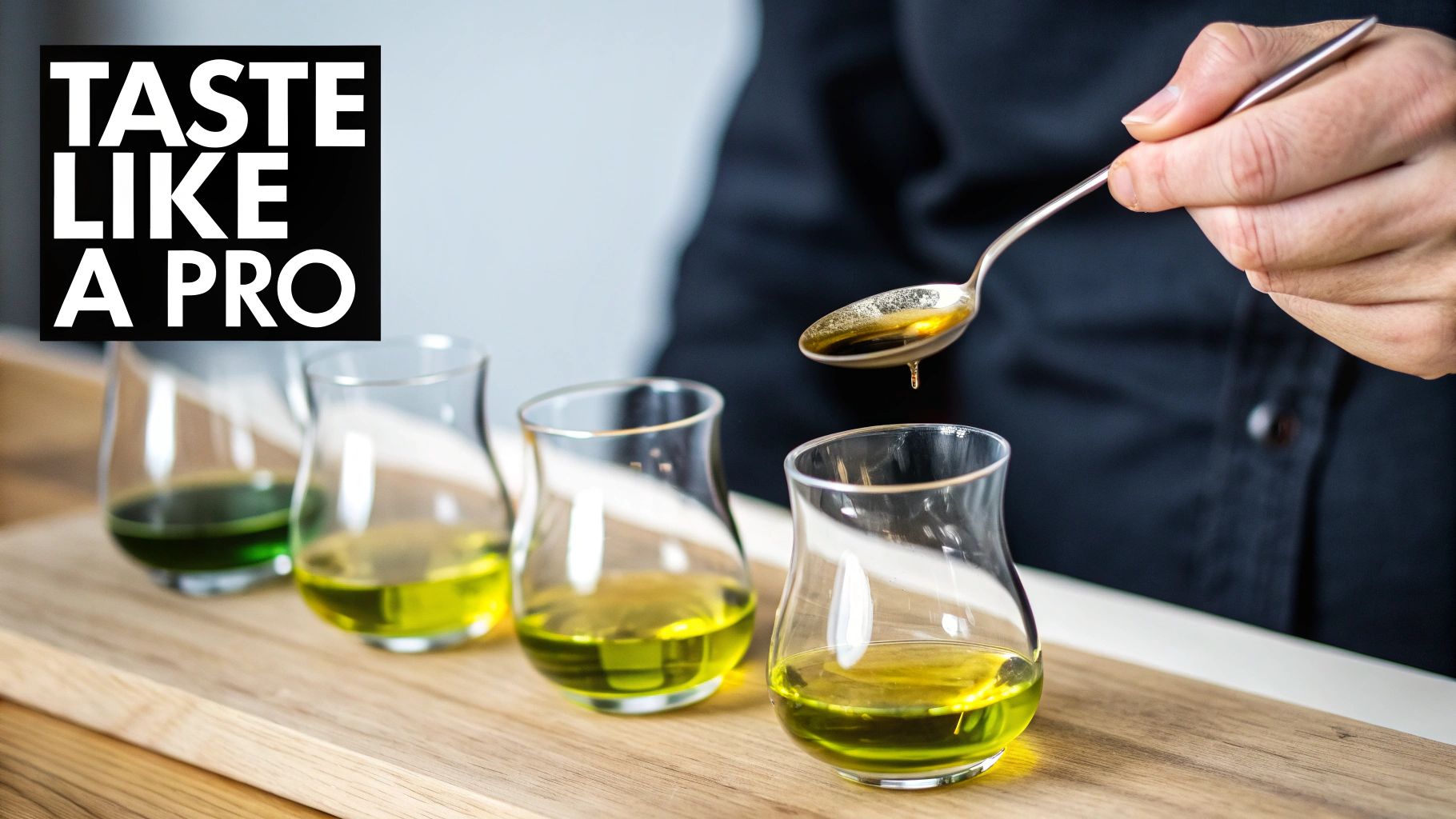
This is where you can become an expert in your own kitchen. The real extra virgin oil meaning is as much about sensation as it is about science. Once you understand the language of taste, you can judge an oil by its soul, not just its label.
Spotting the Flaws First
The first job of a taster is to play detective. You're hunting for any off-flavors that would instantly disqualify an oil from the extra virgin category. These defects are the tell-tale signs of a flawed process—poor handling of the olives, delays in milling, or improper storage.
You don’t need a fancy lab to spot them, just your nose and mouth. Here are the most common culprits:
- Rancid: This is the most frequent defect by far. It's that stale, waxy, or crayon-like flavor of decay. It’s what happens when oil is exposed to too much light, air, or heat over time.
- Fusty: This flaw gives off a swampy, muddy, or even olive-tapenade-gone-bad taste. It's the unfortunate result of olives being piled up and fermenting for too long before they're pressed, essentially rotting from the inside.
- Musty: An earthy, moldy flavor that tells you the olives themselves were moldy before they ever made it to the mill.
- Winey-Vinegary: A sharp, sour taste that signals aerobic fermentation has occurred, much like when wine turns to vinegar.
If a taster detects even a hint of any of these defects, the oil automatically fails. It simply cannot be called extra virgin.
Celebrating the Hallmarks of Greatness
Once an oil is confirmed to be free of flaws, the real fun begins. True extra virgin olive oil is defined by three positive attributes—a kind of holy trinity of flavor that signals impeccable quality and freshness.
Great olive oil is a balance of three key sensations: fruitiness, bitterness, and pungency. The presence and harmony of these characteristics are the true signs of a well-crafted, healthy oil.
These aren't just subjective preferences; they are direct indicators of the oil's quality, the specific olive variety used, and the presence of healthy antioxidant compounds called polyphenols.
- Fruitiness: This is the aroma of fresh olives, perceived through both the nose and mouth. It can range from delicate and buttery (think ripe almonds) to robust and green, with notes of fresh-cut grass, green tomato, or artichoke.
- Bitterness: This is a sign of freshness and powerful antioxidants! Don't shy away from bitterness on your tongue; it’s a prized trait found in other healthy foods like dark chocolate and arugula, and it indicates a high polyphenol count.
- Pungency: This is that peppery tickle or cough you feel in the back of your throat. It’s caused by a potent anti-inflammatory compound called oleocanthal and is a dead giveaway of a fresh, high-quality oil.
To truly experience these notes, professionals use a specific "slurp" technique to aerate the oil in their mouth. You can master this yourself by following our step-by-step guide on how to taste olive oil and unlock a whole new world of flavor. This simple practice will give you the confidence to trust your own palate over any marketing claim on a bottle.
From Grove to Bottle: The Journey of True EVOO
While the lab tests and sensory panels act as the final gatekeepers, the real character of an extra virgin olive oil is forged long before it ever reaches them. The chasm between an extraordinary oil and a merely average one is carved out in the olive grove and at the mill, where tradition, timing, and temperature are absolutely everything.
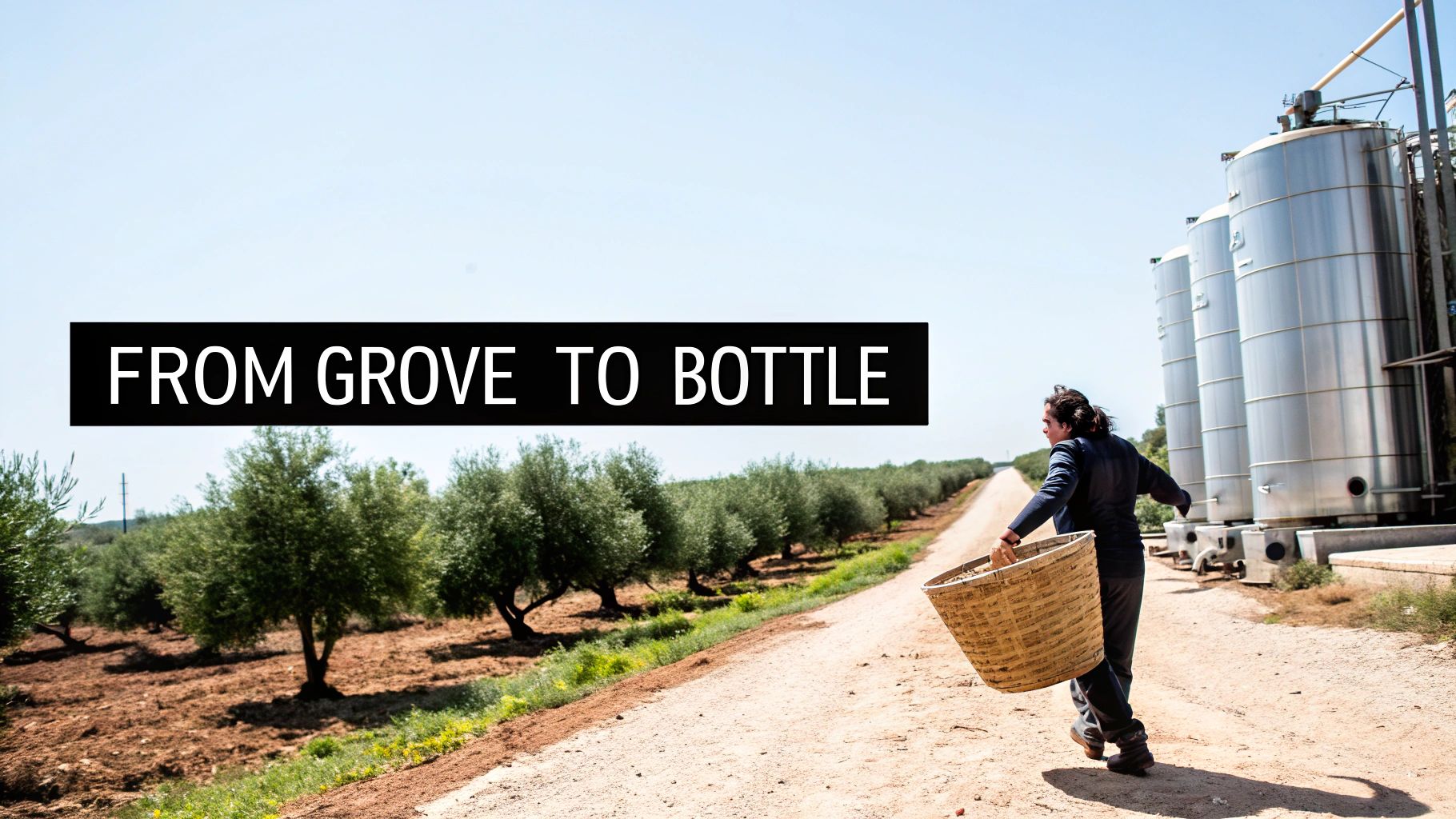
It all begins with the harvest. For the world's best oils, olives are often painstakingly hand-picked. This gentle handling prevents the bruising that can kick-start oxidation and send acidity levels soaring. Think of it more like gathering delicate berries than large-scale industrial farming.
As soon as an olive leaves its branch, the clock starts ticking. The fruit is rushed from the grove to the mill in a genuine race against time, because every passing hour nibbles away at its potential quality.
The Critical Pressing Window
The most committed producers will press their olives within mere hours of harvest—often less than 12 hours. This fanatical sense of urgency is non-negotiable. It's the only way to lock in the freshest flavors and stop the olive's natural fats from breaking down, which is the secret to keeping acidity incredibly low.
In contrast, lower-grade oils might come from olives left to sit for days, slowly fermenting in bags or piles and developing the very "fusty" or "musty" defects we talked about earlier.
Once at the mill, the real magic begins. The olives are washed and then crushed into a thick paste. This paste is then slowly churned in a process called malaxation, which encourages the tiny oil droplets to coalesce. Throughout this entire sequence, one factor reigns supreme: temperature.
True extra virgin olive oil is the direct result of a meticulous, unbroken chain of quality. It begins with healthy, carefully harvested fruit and ends with a swift, gentle extraction that honors the olive's natural integrity. Any shortcut in this process immediately compromises the final product.
The Secret of "Cold Extraction"
You’ve probably seen the terms "cold-pressed" or "cold extraction" on a bottle. This isn't just marketing fluff; it's a critical promise. It signifies that the oil was made without applying excessive heat, with the legal standard mandating that the olive paste remains below 27°C (80.6°F) from start to finish.
Why does this matter so much?
- Flavor Preservation: Heat is the enemy of nuance. It vaporizes the delicate aromatic compounds that give a great EVOO its vibrant, complex notes of fruit, herbs, and grass.
- Health Protection: High temperatures also destroy the oil's most precious cargo: its polyphenols. These powerful antioxidants are what give the oil its signature peppery kick and bitter finish, and they're also behind many of its celebrated health benefits.
This stands in stark contrast to industrial producers of cheap, refined oils, who often use high heat and chemical solvents to wring every last drop from the olive paste. While efficient, this method obliterates flavor and nutrients, yielding a bland product that has to be deodorized just to be edible. The patient, careful craft of cold extraction is what separates a true artisan product from a simple commodity. It's the art behind the science.
Decoding The Label And Spotting The Impostors
Walking down the olive oil aisle can feel like navigating a minefield of confusing claims and clever marketing. With a little insider knowledge, however, you can learn to see past the noise and spot the real deal. The secret isn't in the fancy bottle design or the poetic descriptions; it’s hidden in the fine print.
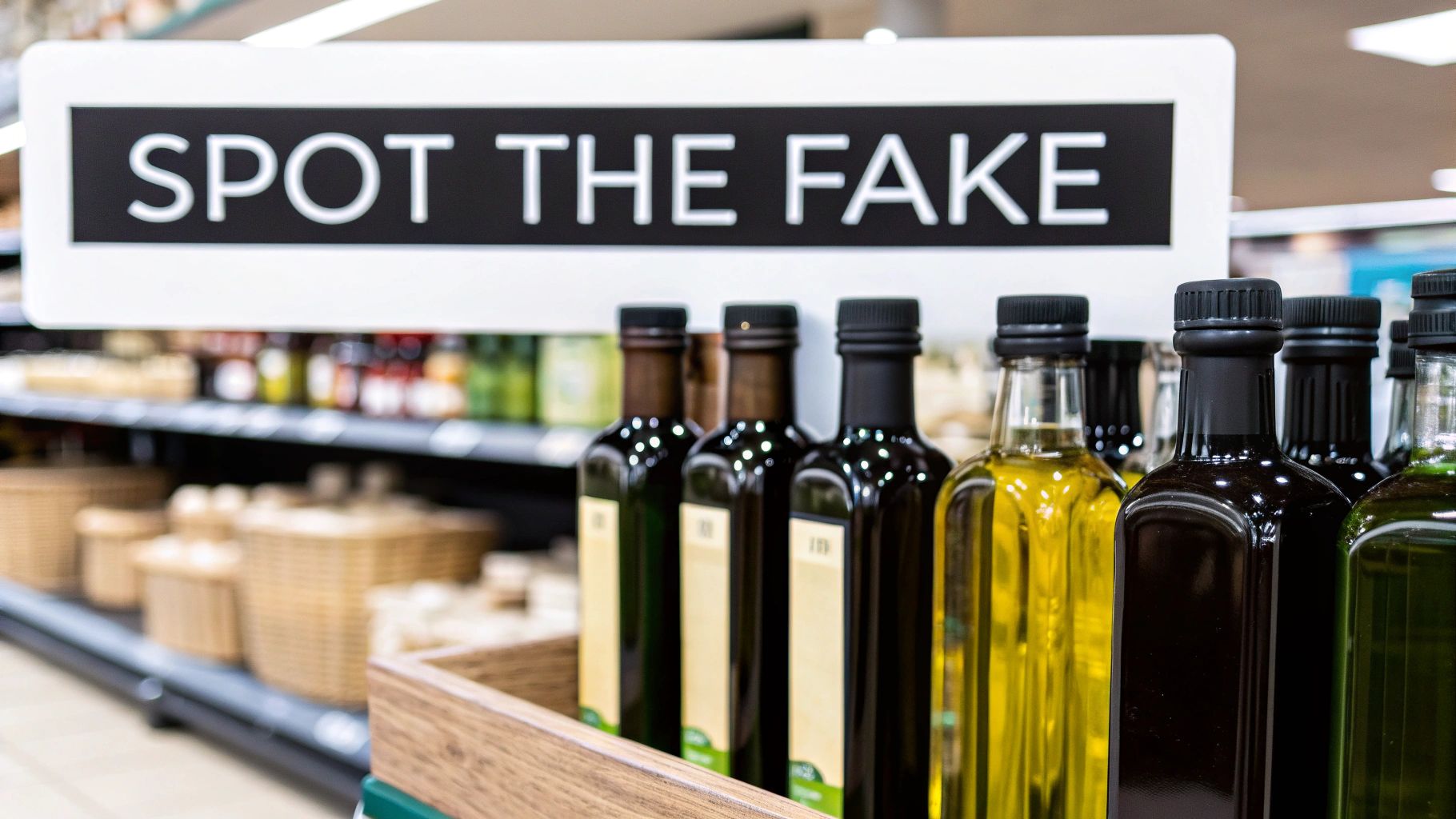
You’ll see a "best by" or "use by" date on most bottles, which is usually two years after it was bottled. Honestly? You can pretty much ignore it. An oil's true character comes from its freshness, and the only reliable clue you have for that is the harvest date. Look for a specific month and year—it tells you exactly when the olives were picked and is the single most important piece of information on any label.
The Power of Place and Pedigree
Beyond the harvest date, certain seals offer a powerful guarantee of a bottle’s pedigree. These aren't just stickers; they are legally binding certifications that tie the oil to a specific place and a traditional production method.
Look for these key indicators of authenticity:
- PDO (Protected Designation of Origin): This is the highest honor. It certifies that the olives were grown, harvested, and pressed entirely within a specific geographical area, ensuring a unique taste profile you can't find anywhere else.
- PGI (Protected Geographical Indication): This seal guarantees that at least one part of the production process happened in a specific region, linking the oil to that place's well-earned reputation.
These seals are your best defense against oils with vague origins like "Product of the Mediterranean," which often just means a blend of oils from multiple countries. For a deeper dive into what these mean, check out our guide on olive oil labeling.
Confronting Widespread Fraud
It’s an unfortunate truth, but fraud is rampant in the olive oil industry. The "extra virgin" label is so valuable that a huge portion of what's on store shelves simply isn't what it claims to be. These impostors are often lower-grade oils that have been chemically refined and deodorized, then mixed with a bit of real EVOO to fake the color and flavor.
The global demand for genuine EVOO is immense, creating a powerful incentive for fraudulent practices. Investing a few extra moments to check the label protects you from paying a premium for a counterfeit product.
This high demand shows up in the global trade numbers. For instance, in 2025, extra virgin olive oil made up about 70.7% of the European Union’s extra-EU olive oil exports, a clear sign of the sustained international desire for top-tier quality.
So how do you spot the fakes? Be wary of impossibly low prices—quality costs money, and there are no shortcuts. Steer clear of oils in clear glass bottles, since light is a primary enemy of freshness. And finally, trust the producers who proudly display their harvest date, specific region, and olive varietals. Transparency is always the hallmark of an honest oil.
Protecting Your Investment: Storing and Using Your EVOO
So, you've brought home a bottle of the good stuff. Congratulations! Now comes the crucial part: protecting that vibrant, fleeting character you paid for. A great olive oil is a living thing, and its quality is constantly under attack from three mortal enemies: light, heat, and air.
Think of these elements as the sworn adversaries of freshness. Direct sunlight or even harsh fluorescent kitchen lights will rapidly degrade the oil. Heat from a nearby stove or a warm pantry accelerates oxidation, turning those beautiful, lively flavors stale and flat. And every single time you open the bottle, air gets in and starts its slow, relentless work of breaking the oil down.
This is exactly why that convenient spot on the counter right next to your stove is the absolute worst place to keep your EVOO. The best home for your liquid gold is a cool, dark cupboard, sealed up tight and away from the daily chaos of the kitchen. Think of it as preserving your investment. For a deeper dive, check out these best practices for proper olive oil storage to get the most out of every drop.
Shattering the Cooking Myth
Let’s tackle one of the most persistent myths out there: you can’t cook with extra virgin olive oil. This is just plain wrong. The fear is all about the smoke point—the temperature where an oil starts to break down and, well, smoke. While a low-quality, old, or poorly made oil can have a low smoke point, fresh, high-quality EVOO is a different beast entirely.
A top-tier extra virgin olive oil has a smoke point that usually falls somewhere between 190°C and 215°C (375°F and 420°F). This range makes it perfectly safe and wonderfully suited for most home cooking, including sautéing, roasting, and even pan-frying.
It really just comes down to using the right tool for the job.
Unlocking Its Culinary Potential
Learning to pair your oil can take a dish from good to unforgettable. The easiest way to start is by matching the intensity of the oil to the intensity of the food.
- Delicate Oils: Those smooth, buttery, and mild oils are perfect for finishing delicate dishes. Think drizzling over baked fish, dressing a light spring salad, or even using it in baking.
- Robust Oils: Save your bold, peppery, and grassy oils for food that can stand up to them. They're incredible on grilled steaks, drizzled over hearty bean soup, or used to dress bitter greens like radicchio or kale.
To see just how much quality EVOO can bring to the table, try exploring some delicious Mediterranean diet foods and recipes rich in healthy fats like olive oil. It’s the best way to ensure you’re unlocking every ounce of flavor from your bottle.
Common Questions and Myths About Extra Virgin Olive Oil
Even when you know the rules, a few nagging questions always seem to pop up when you're standing in the olive oil aisle. Let's clear the air and tackle some of the most persistent myths and curiosities, so you can feel completely confident in every bottle you choose.
Think of this as your final checklist, the kind of practical knowledge that turns confusion into certainty.
Does Color Indicate Quality?
Let's get this one out of the way immediately: absolutely not. This is probably the single biggest misconception about olive oil. The color can range from a vibrant, almost electric green to a soft, buttery gold, and it tells you nothing about the oil's quality.
So, what does it tell you? The color is simply a reflection of the chlorophyll and carotenoid levels in the olives at the time of pressing. Olives picked early in the harvest are packed with chlorophyll and produce that famous green oil. Olives left to ripen longer on the tree create a more golden hue. That's it.
In fact, professional tasters use special cobalt blue glasses specifically to hide the oil's color. This prevents them from being biased by its appearance, forcing them to rely only on what matters: aroma and taste.
Key Takeaway: Judge an oil by how it smells and tastes, never by its color. A beautiful green hue can easily mask a rancid flavor, while a pale gold oil might be bursting with fresh, complex notes.
What If My Olive Oil Looks Cloudy?
Don't panic! Cloudiness isn't a flaw. In many cases, it’s actually a sign of a very fresh, minimally processed oil. That hazy appearance comes from tiny, harmless particles of olive flesh and water that haven't been filtered out.
This is what we call unfiltered olive oil. Some producers deliberately skip the filtering step to preserve every last bit of the original flavor and texture. This style of oil, especially when it's brand new (olio nuovo), is celebrated for its intense, rustic taste. Just be aware that those little particles can cause the oil to spoil a bit faster.
- Unfiltered Oil: Contains natural sediment, giving it a bolder, more peppery flavor. It’s a real treat, but it's best to use it up within a few months.
- Filtered Oil: The sediment is removed, resulting in a crystal-clear oil. This makes it more stable with a longer shelf life, all without losing its extra virgin status.
Ultimately, choosing between filtered and unfiltered is just a matter of personal taste. It’s about style and texture, not good versus bad.
At Learn Olive Oil, we believe that understanding the story behind the bottle is the key to truly appreciating what’s inside. We're here to guide you on that journey.
Discover the world of premium olive oil with us at https://learnoliveoil.com.

 Learn Olive Oil
Leave a comment