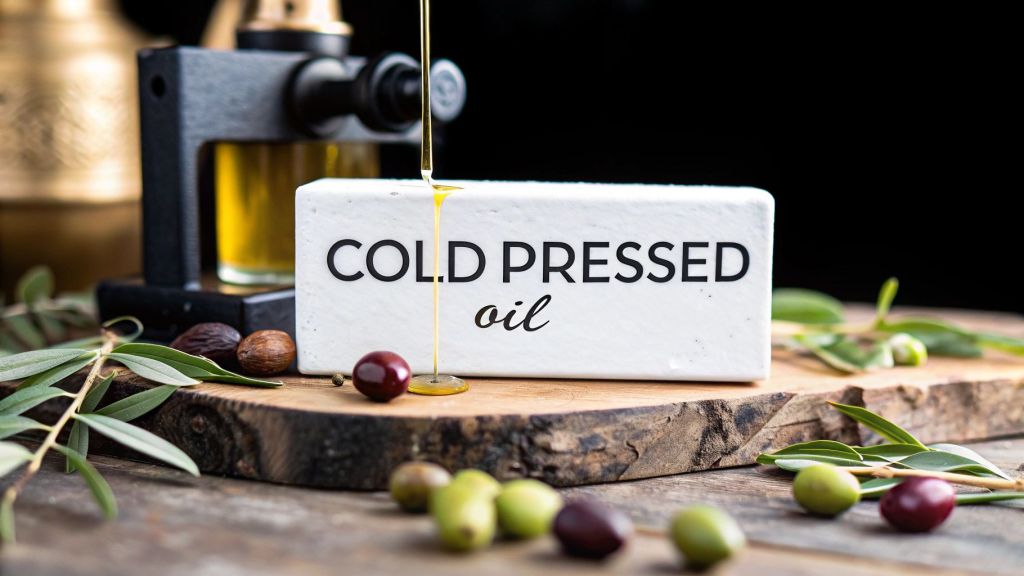
Before you even twist the cap, the words on an olive oil bottle begin to tell a story. Among the most crucial is ‘cold pressed’—a term that whispers of true craftsmanship and a fierce commitment to quality. This isn't just marketing fluff; it's a solemn promise. It tells you the oil inside was made with minimal processing, where temperature was obsessively controlled to shield the delicate flavors and potent antioxidants that make a truly great olive oil.
What "Cold Pressed" on an Olive Oil Label Really Means
Think of cold pressed as a producer’s pledge to capture the very soul of the olive. It is a method designed to preserve the absolute natural integrity of the fruit, preventing the villain—heat—from degrading its most valuable qualities on its journey from the grove to your kitchen.
Instead of a high-heat, industrial process that prizes quantity above all else, cold pressing is a quiet rebellion fought for quality. It’s a delicate dance of tradition and technique aimed at one simple, profound goal: to bottle the purest, most flavorful, and healthiest expression of the olive.
The Standard of Excellence
Why does this matter so deeply? Heat is the enemy of both flavor and nutrition in olive oil. When temperatures climb too high during extraction, the oil begins to break down. The vibrant, peppery notes start to vanish, and the powerful antioxidants, known as polyphenols, rapidly degrade.
The cold pressing method ensures the olive paste is never heated above a strict threshold—officially, 27°C (80.6°F). Keeping things cool preserves:
- Robust Flavor Profiles: Protecting the subtle fruity, grassy, and spicy notes that are the signature of premium oils.
- Maximum Health Benefits: Retaining the highest possible levels of vitamins and anti-inflammatory polyphenols.
- Natural Aroma: Ensuring the oil smells as fresh and alive as the day the olives were plucked from the tree.
In essence, choosing a cold-pressed oil means you are getting a product as close to its natural state as possible. The process guarantees that what you taste is the authentic flavor of the olive, untarnished by excessive heat or chemical shortcuts.
This careful, low-temperature approach is the bedrock for producing authentic extra virgin olive oil. While you might also see terms like "first cold pressed," it's the "cold" part that truly matters for quality. To understand this specific term better, you can learn more about what is first cold pressed olive oil and how it relates to modern standards. Ultimately, this method is the gold standard for anyone who values genuine taste and uncompromising health benefits.
The Journey from Olive Grove to Golden Oil
Imagine walking through a sun-drenched olive grove. That fresh, green, almost peppery scent? The entire point of cold-pressing is to capture that exact essence in a bottle. It’s a purely mechanical journey from fruit to oil, one where temperature is king.
It all starts the moment the freshly picked olives arrive at the mill. They’re quickly crushed, whole, into a thick, uniform paste. Think of it less as a violent smashing and more as a gentle persuasion, a process designed to break open the fruit’s cells and release their precious oil.
This olive paste then moves into a critical stage called malaxation, where it’s slowly and continuously stirred. This isn't just for show; the gentle mixing encourages all the tiny oil droplets to find each other and coalesce, making them much easier to separate later on.
The real magic, though, is in what doesn’t happen here. No external heat is ever added. Not to speed things up, not to squeeze out a few extra drops of oil. Nothing.
Preserving Purity Through Temperature Control
Throughout this entire journey, from the initial crush to the final separation, the temperature of the olive paste is obsessively monitored. To earn the title cold-pressed, it must remain below a strict threshold of 27°C (80.6°F).
Why the fuss over a few degrees? Heat is the enemy of great olive oil. Keeping the temperature low prevents oxidation and protects the delicate, volatile compounds that give the oil its incredible flavor and aroma, not to mention its powerful health benefits.
Once the paste is perfectly mixed, the oil is finally separated from the olive solids and water. Most modern producers use a decanter centrifuge, a brilliant piece of equipment that spins the paste at high speed, using physics to gently pull the lighter oil away. This whole mechanical dance—from start to finish—avoids any chemical solvents or high temperatures, ensuring the oil is as pure as the fruit it came from.
If you're curious to see the machinery and all the stages in more detail, this guide on how olive oil is made is a fantastic resource.
Ultimately, every step is intentionally gentle and low-impact. It’s all about preserving the olive's natural integrity. This commitment to quality and authenticity is more than just a trend; it’s a movement.
How to Decode Olive Oil Labels
Stepping into the olive oil aisle can feel like an ambush. You’re hit with a barrage of impressive-sounding terms: ‘cold pressed,’ ‘cold extraction,’ ‘first press.’ The labels promise quality, but the language often creates more confusion than clarity, leaving you to wonder what you’re actually paying for.
Don't be fooled by clever marketing. Much of what you see is either redundant or a romantic nod to a bygone era. These terms aren't interchangeable, and understanding the subtle differences is the first step toward becoming a truly savvy buyer.
The real story lies in the method. You’ll see both "cold pressed" and "cold extraction" on labels, and while they sound different, they share the same fundamental goal: keeping the temperature low. The distinction is purely technical.
Cold Pressed vs. Cold Extraction
Cold pressed is the old-world term. It conjures images of traditional hydraulic presses literally squeezing oil from olive paste between woven mats. It’s a beautiful, rustic idea, but it’s a method rarely used by commercial producers today because it's slow and inefficient.
Cold extraction, on the other hand, is the modern standard. This method uses a centrifuge to spin the olive paste at high speeds, neatly separating the oil from the water and solids. It's cleaner, more efficient, and offers far better control over the entire process—all while keeping the temperature below that critical 27°C (80.6°F) threshold.
So, which one is better? Honestly, neither. Both terms simply mean that no external heat was used, which is the cornerstone of high-quality extra virgin olive oil. Today, "cold extraction" is the more accurate description for how most premium oil is made, but "cold pressed" is often used to communicate that same commitment to quality.
The Myth of the First Press
And what about "first press" or "first cold press"? This is where marketing truly takes over. The term harkens back to a time when olive paste was pressed multiple times. The first round yielded the highest quality oil, while later pressings—often with hot water added—would extract more, lower-grade oil.
But with today’s efficient centrifuge technology, that entire practice is obsolete. All true extra virgin olive oil comes from a single, initial extraction. There is no second press.
When you see "first cold press" on a label, it’s mostly for effect. While it technically describes the process (it is the first and only extraction, and it is cold), the "first" part is redundant. Every single bottle of genuine extra virgin olive oil is, by definition, from the first extraction.
To help you cut through the noise, here’s a quick breakdown of what these common terms actually mean for the oil in the bottle.
Olive Oil Terminology Showdown
| Term | Process Explained | Impact on Quality | Common Usage |
|---|---|---|---|
| Cold Pressed | Traditional method using a hydraulic press to squeeze oil from olive paste. | Indicates low-temperature processing, which preserves flavor and nutrients. | A legacy term, often used for marketing to evoke tradition and quality. |
| Cold Extraction | Modern method using a centrifuge to separate oil from olive paste. | The modern standard for quality; signifies processing below 27°C (80.6°F). | The more technically accurate term for most high-quality EVOO made today. |
| First Press | Refers to oil from the very first pressing of the olives. | High quality, but the term is now redundant. All EVOO is from the first extraction. | A marketing term. It sounds premium, but adds no extra quality assurance. |
| Extra Virgin | A certified grade based on chemical analysis and sensory testing. | The highest grade. It must be free of defects and have low acidity. | A regulated term that is a much stronger indicator of quality than "first press." |
Ultimately, the key is to look past the romantic language. For a complete picture of what to look for, you can find a deeper exploration of modern olive oil labeling on learnoliveoil.com. The most important takeaway is to focus on the "cold" part of the equation, as that is the true indicator of quality preservation.
Why Temperature Is the Secret Ingredient in Your Olive Oil
The difference between a truly extraordinary olive oil and one that’s just… okay? It often comes down to just a few degrees. In the world of premium olive oil, ‘cold’ isn’t just a buzzword; it’s the secret ingredient that separates the best from the rest.
Think of heat as a thief in the night, silently robbing the oil of its most precious qualities.
Once the olive paste warms up past that critical 27°C (80.6°F) threshold, a whole chain reaction of degradation kicks off. The delicate chemical compounds that give a great oil its vibrant character are incredibly sensitive. Excess heat is their number one enemy.
The Tradeoff Between Quantity and Quality
Here's the thing: producers could crank up the heat to squeeze more oil out of each olive. For industrial-scale operations focused on volume, it's a tempting shortcut. But it’s a classic trap—a clear sacrifice of quality for the sake of quantity.
This is where the promise of cold pressed meaning really shines. Producers who stick to this method are making a conscious choice. They’re intentionally accepting less oil from each batch to ensure the oil they do get is of the absolute highest standard. They’re putting the natural goodness of the fruit ahead of maximizing their output.
This philosophy has, unsurprisingly, gained a huge following among health-conscious food lovers. Cold pressing is all about extracting oils at low temperatures to lock in the nutrients, flavors, and aromas that high-heat methods destroy.
Heat doesn't just mute the flavor; it actively destroys the very molecules that make olive oil healthy. It’s like overcooking a delicate vegetable until it’s mushy and devoid of its vitamins.
What Heat Destroys
So, what exactly is lost when things get too hot? The damage happens on several fronts, hitting the oil's flavor, aroma, and nutritional profile hard.
- Polyphenols: These are the powerful antioxidants behind olive oil’s famous anti-inflammatory benefits and that signature peppery kick. Heat degrades them fast, stripping the oil of its healthiest components.
- Aromas: Those fresh, grassy, or fruity notes you love? They come from volatile compounds that are the first to evaporate with heat, leaving you with a bland, flat-tasting oil.
- Vitamins: Key fat-soluble vitamins, especially Vitamin E, are also sensitive to high temperatures and are significantly diminished in a heat-treated oil.
This obsession with temperature control doesn’t stop at the mill; it extends right through the supply chain. If you're curious about how temperature control impacts ingredient quality on a larger scale, you might find these cold chain management principles interesting.
It even matters in your own kitchen. To learn more, check out our guide on the olive oil smoke point to see how heat changes the game during cooking.
The Connection Between Flavor and Health Benefits
https://www.youtube.com/embed/zM4rwhRgHeE
This is where the magic really happens—where all that talk about temperature control shows up in the taste of the oil and the good it does for your body. The entire reason for keeping things cool during extraction comes down to this: a truly cold-pressed extra virgin olive oil delivers a powerful one-two punch of incredible flavor and serious health benefits.
The secret is all about protecting the delicate compounds that heat would otherwise destroy. When you choose a cold-pressed oil, you're getting a product loaded with polyphenols. Think of them as the oil's personal bodyguards—powerful antioxidants that don't just protect the oil from going bad, but also help protect your body from cellular damage.
These are the very compounds responsible for olive oil's legendary health claims. They’re credited with everything from supporting heart health to fighting inflammation. Heat is their mortal enemy, so the cold-press method is what ensures they survive the journey from the olive grove all the way into your bottle.
How to Taste Olive Oil Like an Expert
Tasting a high-quality olive oil is a full sensory experience. It’s so much more than just another cooking fat; it's a direct reflection of the fruit, the soil, and the care that went into making it. To really understand the cold pressed meaning, you have to know what you're tasting for.
-
Look for Fresh, Fruity Notes: Pour a little bit into a small glass and warm it with your hands for a moment. Give it a good sniff. A great oil should smell alive and vibrant, with aromas of fresh-cut grass, green apple, or even tomato leaf.
-
Embrace the Bitterness: Now, take a sip. That pleasant bitterness you might feel on the sides of your tongue is a fantastic sign. It's a signature of those healthy polyphenols, proving the oil is packed with antioxidants.
-
Feel the Peppery Kick: Finally, swallow. A peppery or spicy sensation that catches you at the back of your throat is the hallmark of oleocanthal, a unique polyphenol known for its potent anti-inflammatory properties. That kick is a clear signal of a fresh, high-quality oil.
If your oil tastes flat, greasy, or waxy, that’s a red flag. It likely means it’s old, has gone rancid, or was damaged by heat during production. The vibrant trifecta of fruitiness, bitterness, and pepperiness is exactly what you're looking for.
While olive oil is the most famous example, this quality-first approach is used for other oils, too. Looking at the segmentation of cold-pressed oils, olive oil leads the pack, holding the largest market share at 45%. It's followed by coconut oil at 30% and avocado oil at 25%. You can dig into more data on the cold-pressed oil market to see just how much this trend is growing. It's clear that people everywhere are choosing products that deliver on both flavor and health—a promise that all starts with keeping things cool.
How to Buy and Store Authentic Cold Pressed Oil
Alright, you now understand the story behind the "cold pressed" label. It’s time to put that knowledge to work and bring home a bottle that actually delivers on its promise of incredible flavor and health benefits. Your job doesn't end at the checkout, though. How you choose your oil—and what you do with it back home—is just as crucial as how it was made.
Think of a beautiful, fresh cold pressed olive oil as a living product. Its biggest enemies are light, heat, and oxygen. Your mission, should you choose to accept it, is to protect it from these foes the second you take it off the shelf.
Smart Shopping for Superior Oil
The olive oil aisle can be overwhelming, but you're now equipped to see past the flashy front labels. The real clues to quality are almost always on the back. For a complete deep-dive, check out our guide on how to buy olive oil—it's a lifesaver.
For now, here’s what to zero in on:
-
Look for a Harvest Date: This is your number one priority. An olive oil is at its absolute best within 18 months of this date. A "best by" date alone isn't enough; it doesn't tell you how old the oil truly is.
-
Choose Dark Glass or Tins: Clear bottles might look pretty, but they're a huge red flag. They let in damaging light that degrades the oil, stripping it of its complex flavors and healthy polyphenols before you even open it.
-
Seek Out Quality Seals: Keep an eye out for certifications like PDO (Protected Designation of Origin) or PGI (Protected Geographical Indication). These aren't just fancy acronyms; they are strong indicators of authenticity and strict regional quality standards.
The Golden Rules of Storage
Once you get that prized bottle home, it's up to you to preserve its character. Proper storage is simple, yet it's where so many people go wrong. That convenient spot right next to your stove? It's the absolute worst place for your oil.
The constant blast of heat will accelerate its decline, turning a vibrant, peppery oil into something flat and disappointing. You have to treat it with the same respect the producer did.
The solution is easy: find a cool, dark home for it, like a pantry or a cupboard, far away from the stove or a sunny window. And always, always screw the cap on tight after you pour. Keeping oxygen out is just as important as keeping light and heat away. This simple care is what keeps the "cold pressed" promise alive to the very last drop.
This whole process is a small-scale version of what professionals call cold chain management, a concept that underscores just how vital temperature control is for preserving the quality of fresh foods.
Got Questions About Cold Pressed Oil? We've Got Answers.
Even after getting the hang of what cold pressed means, a few questions tend to linger. Let’s clear those up right now, so you can walk down the olive oil aisle with complete confidence. Think of this as the final piece of the puzzle to becoming a truly savvy shopper.
The idea is to get you past the marketing jargon and into what really makes a bottle of olive oil fantastic. This way, you'll not only buy better but also appreciate the incredible skill that goes into making it.
Is All Extra Virgin Olive Oil Cold Pressed?
For all practical purposes, yes. To earn the coveted ‘extra virgin’ designation in most major regions, the oil has to be extracted mechanically, without heat messing things up. The global standard actually caps the temperature at a very specific 27°C (80.6°F). So, any legitimate extra virgin olive oil is inherently a product of cold extraction.
When you see "cold pressed" splashed across the front of the bottle, it's really a marketing move. Producers are using it to signal to you, the consumer, that they’ve met this crucial quality benchmark and have done everything possible to protect the oil’s natural goodness.
Does "Cold Pressed" Really Mean It's Healthier?
It absolutely does. The entire point of the cold pressing process is to keep the oil’s nutritional powerhouse intact. Heat is public enemy number one for the delicate compounds that give olive oil its health halo.
High temperatures degrade polyphenols and other antioxidants—the very things that fight inflammation and protect our bodies.
A cold-pressed oil holds onto a much higher concentration of these beneficial compounds. You're not just tasting a superior flavor; you're getting a product that delivers its full health-boosting punch. It's like the difference between a crisp, just-picked apple and one that's been baked into a pie.
So, How Can I Spot a Genuinely High-Quality Oil?
Look past the front label and search for a harvest date. Freshness is everything. A top-tier oil should taste vibrant and alive, not heavy or greasy. You're looking for distinct notes—maybe it's fruity, maybe it has a pleasant bitterness, or perhaps it finishes with a peppery kick in the back of your throat.
If the oil tastes flat, waxy, or just plain boring, it’s a telltale sign that it's either old, poorly made, or was damaged by heat. Another great clue is a quality seal like PDO or PGI, which guarantees the oil's origin and production methods.
Can I Actually Cook With Cold Pressed EVOO?
Yes! This is one of the most persistent myths out there. The idea that you can't cook with extra virgin olive oil is simply not true. A good quality EVOO has a smoke point somewhere between 190–215°C (375–420°F), making it perfectly safe for everyday cooking methods like sautéing and roasting.
That said, to really appreciate its most nuanced flavors and get the most from its health benefits, its true genius is revealed when used as a finishing oil. Drizzle it over a finished dish, whisk it into a vinaigrette, or simply use it for dipping bread to enjoy it in its purest form.
At Learn Olive Oil, we believe that understanding the journey from grove to bottle transforms how you taste and use this incredible ingredient. Elevate your culinary experience by exploring our expert guides. Discover the World of Premium Olive Oil.
 Learn Olive Oil
Leave a comment