That bottle of olive oil sitting in your kitchen? It holds more secrets than you might think. What really separates one from another comes down to two simple truths: how the oil is coaxed from the olive, and the final, undeniable quality you can taste. At the very top sits Extra Virgin Olive Oil, a pure marvel pressed from fresh olives without a single chemical shortcut. At the other end, you’ll find refined oils—oils so flawed they must be stripped down and rebuilt, altering their flavor and nutritional soul in the process.
The Hidden World Inside Your Olive Oil Bottle
Most of us grab a bottle from the grocery store shelf without giving it a second thought. But the chasm between a magnificent extra virgin olive oil and a basic refined cooking fat is wider than the Grand Canyon. One is a vibrant, health-boosting elixir—a true culinary treasure. The other? A neutral, forgettable commodity.
This guide is here to finally pull back the curtain on this liquid gold. It’s your roadmap to navigating the grocery aisle with the confidence of an expert, breaking down the essential categories so you can finally see what separates the masterpieces from the mundane.
Understanding the Core Distinctions
The journey from a sun-drenched olive to the oil in your pantry is the single greatest factor that dictates its destiny. At its heart, premium olive oil is nothing more than fresh fruit juice. And like any pure juice, the less it’s tampered with, the more glorious it is. You can learn more about the simple yet elegant composition of this pantry staple in our guide on what is olive oil made of.
This is where the great divide occurs:
- Unrefined Oils: These are oils extracted using only mechanical force—think of a powerful press or a spinning centrifuge—without resorting to high heat or chemical solvents. Extra virgin and virgin olive oils are the proud members of this exclusive club.
- Refined Oils: These oils begin their life as lower-quality pressings, so flawed they must be subjected to heat, chemicals, and intense filtration to scrub away offensive flavors and odors.
Here is the secret in a single sentence: The best oils are made, while lesser oils are manufactured. Unrefined oils are an honest expression of the olive's true character. Refined oils are engineered for neutrality and a higher smoke point.
To get started, here is a quick overview of the main olive oil types. It's a handy snapshot of their defining characteristics.
Olive Oil Categories at a Glance
This table provides a simple summary of the main olive oil types, their production methods, and what they're best used for in the kitchen.
| Olive Oil Type | Production Method | Acidity Level | Best For |
|---|---|---|---|
| Extra Virgin | Mechanical (Cold-Pressed) | Less than 0.8% | Finishing, dressings, dipping, sautéing |
| Virgin | Mechanical (Cold-Pressed) | Less than 2.0% | General cooking, sautéing |
| Refined Olive Oil | Chemical/Heat Refining | Less than 0.3% | High-heat cooking, frying, baking |
| Olive Pomace Oil | Solvent Extraction | Varies (blended) | Industrial frying, high-heat uses |
Think of this as your field guide. As we dive deeper, you’ll discover how these fundamental differences in creation lead to vastly different experiences in flavor, health, and what they can do for your cooking.
Decoding the Olive Oil Quality Grades
Not all olive oils are created equal. Far from it. The industry relies on a strict grading system—a hierarchy built not on marketing hype, but on cold, hard chemistry and the finely tuned palates of sensory experts. Mastering these grades is the single most important step in separating a genuine, flavorful fruit juice from a bland, industrial fat.
This system isn't just clever branding; it’s a set of international laws that distinguish the champions from the contenders. At the top, you have oils celebrated for their purity and profound health benefits. At the bottom, you find grades so flawed they’re destined for heavy industrial processing before they’re ever allowed near a kitchen.
The Pinnacle: Extra Virgin Olive Oil
Extra Virgin Olive Oil (EVOO) is the highest grade attainable, the absolute cream of the crop. Imagine it as the freshly squeezed, unblemished soul of the olive, captured in a bottle. To earn this coveted title, an oil must clear two formidable hurdles.
First, its chemistry must be impeccable. The most critical measure is its free fatty acidity (FFA), which must register below an astonishingly low 0.8%. A low FFA is the chemical signature of perfectly healthy olives, rushed to the mill moments after being picked, halting any decay in its tracks.
Second, it must be perfect to the senses. A certified panel of tasters must find zero defects in its flavor or aroma, while also identifying the distinct, desirable notes of fruitiness. It is, quite simply, the purest expression of the olive.
The Runner-Up: Virgin Olive Oil
Just one step down from the throne, you'll find Virgin Olive Oil. Like its "extra" sibling, it is produced only by mechanical force—no chemical meddling allowed. It remains a pure, unrefined oil.
The crucial difference lies in tiny imperfections. Virgin olive oil is permitted a higher free fatty acidity, up to 2.0%, and it may exhibit minor sensory flaws. These could be subtle "fusty" or "musty" notes that, while not ruinous, prevent it from achieving that flawless "extra" status.
This grade reveals a critical truth in the differences in olive oils: a tiny chemical flaw or a faint sensory whisper is all it takes to separate the absolute best from the merely good. It’s still a natural product, but it lacks the pristine, vibrant quality of a true EVOO.
The World of Refined Oils
What happens when an oil is plagued by too many defects, either in its chemistry or its taste? It cannot legally be sold for consumption as it is. That’s where the harsh, industrial process of refining enters the picture.
Refined Olive Oil starts its life as a virgin oil that simply didn't pass the exam. It is then subjected to a brutal series of processes using heat, chemicals, and filtration to strip away the high acidity and foul flavors.
- Process: The oil is treated with agents that neutralize and deodorize its offensive character.
- Result: You are left with a flavorless, odorless, and nearly colorless oil with a very low acidity (below 0.3%).
- Nutritional Impact: But here’s the tragedy: this aggressive processing also obliterates most of the beneficial polyphenols and antioxidants that make EVOO a nutritional powerhouse.
This is why a bottle simply labeled "Olive Oil" or "Pure Olive Oil" is almost always a blend. It’s mostly refined oil, with just enough virgin or extra virgin olive oil added back in to give it a whisper of flavor. To learn more, you can explore the difference between pure and extra virgin olive oil in our detailed guide.
The Bottom Rung: Lampante Oil
At the very bottom of the quality ladder sits Lampante Olive Oil. The name itself is a dead giveaway, coming from the Italian word for "lamp," because this oil was historically used for burning in lamps.
With acidity soaring over 2.0% and overwhelming sensory defects, it is completely unfit for human consumption due to its repulsive taste and smell. But it doesn't go to waste. Lampante oil is the raw material sent to industrial refineries, where it's stripped down and reborn as the base for refined olive oil.
How Terroir and Climate Shape Flavor
Have you ever wondered why an olive oil from a sun-scorched Spanish grove tastes worlds apart from one harvested in the rolling Tuscan hills? The secret is a concept winemakers have revered for centuries: terroir. It's the unique alchemy of soil, geography, and climate that imprints an olive with its very soul.
This isn't just romantic marketing jargon; it’s agricultural truth. Terroir dictates everything from an oil’s peppery intensity to its grassy, fruity aromas. It is the reason oils made from the very same olive variety can be so fascinatingly, wonderfully different when grown in different places.
Think of it this way: a Pinot Noir grape from Burgundy tastes nothing like one from California. In exactly the same way, an Arbequina olive from the rocky soils of Catalonia will yield an oil completely distinct from one grown in a fertile valley. This powerful "sense of place" is what separates a generic cooking oil from a profound culinary experience.
The Influence of Climate and Soil
The environment where an olive tree lives leaves an indelible fingerprint on the final oil. The tree is a storyteller, and the oil is its tale—a story of struggle, of rainfall, of scorching sun, and of the very earth it drew its life from.
A tree that endures a dry, stressful season fights for survival by producing more polyphenols. These are the very compounds that give robust olive oils their signature peppery kick and bitter finish. This struggle, paradoxically, concentrates the flavors, resulting in a bold, pungent oil.
Conversely, a season with gentle, timely rains allows the olives to plump up with less effort. The resulting oil is often more delicate, buttery, and smooth. The soil plays its part, too. Mineral-rich volcanic soil can impart a distinct character that limestone or clay soils simply cannot match.
You are not just tasting an olive; you are tasting a specific hillside, a particular summer, and a unique microclimate. The oil in your bottle is a liquid snapshot of a time and a place.
Weather’s Dramatic Impact on Production
Beyond just shaping flavor, weather patterns wield immense power over the entire global olive oil market. A single, ill-timed frost or a prolonged drought can decimate a region's harvest, sending shockwaves through the supply chain that affect quality, availability, and price.
These climate variables are becoming more extreme, making the industry incredibly dynamic. For instance, in the 2025/26 season, global olive oil production is forecast to drop by about 10% due to punishing weather. Spain is expected to see a 3% decrease, while Italy is forecast for a 30% increase thanks to timely summer rainfall. These regional swings directly impact not only the quantity of oil produced but also its flavor, aroma, and nutritional profile.
Connecting Origin to Your Palate
Understanding terroir transforms how you shop for and appreciate olive oil. You can finally move beyond generic labels and start connecting specific regions with the flavor profiles you truly love.
- Tuscan Oils (Italy): Famous for their classic "pizzicante"—a spicy finish—with assertive notes of green grass and artichoke. The cooler climate and hilly terrain are to thank for this bold profile.
- Andalusian Oils (Spain): From a hotter, drier climate, these oils—particularly from Picual olives—can be robust and intensely fruity, with powerful hints of tomato leaf and fig.
- Kalamata Oils (Greece): Oils from the legendary Koroneiki olive are typically delicate and aromatic, with a softer, more herbaceous character and a gentle bitterness.
This knowledge empowers you to choose an oil not just as an ingredient, but as a deliberate flavor component that tells the story of its homeland. For a deeper dive into one of these iconic regions, check out our guide on what makes imported Italian olive oil so special. Appreciating these nuances is the key to unlocking the vast and delicious world of olive oil.
Where in the World Does Your Olive Oil Come From?
The bottle of olive oil in your pantry is more than a kitchen staple; it's a product of a specific place, shaped by local traditions, regulations, and the sheer scale of its production. When we investigate what makes one olive oil different from another, geography and government oversight are just as crucial as the olive variety or pressing method. The global olive oil stage is dominated by a few key players, but their philosophies on quality can be miles apart.
Understanding this landscape isn't just for food snobs—it's for anyone who wants to be certain they're getting the genuine article. A label might tell you where an oil was bottled, but that is rarely the whole story. The secret to smart shopping lies in knowing which countries focus on massive volume and which are the steadfast guardians of authenticity.
The Titans of Production
When you look at sheer volume, one country stands head and shoulders above all others: Spain. It’s an undisputed production powerhouse, and its scale is difficult to comprehend until you see the numbers.
Spain's dominance is truly staggering. For the 2024/25 season, its estimated output was 1,419,128 tons—that’s roughly 40% of the world's entire supply. To put that in perspective, Italy, Europe's second-largest producer, managed about 288,900 tons. This means Spain produced nearly five times more olive oil than Italy, a gap that has a seismic impact on global supply, price, and what ends up on your shelf. You can explore more production figures and discover more insights about the olive oil market on CertifiedOrigins.com.
Interestingly, while Italy is famous for its prestigious brands, it is actually a net importer of olive oil. It often brings in oils from Spain, Greece, and Tunisia to blend and bottle under its own world-renowned labels to meet global demand. This isn't necessarily a sinister practice, but it adds a layer of complexity for anyone seeking a true single-origin product.
- Spain: The world's largest producer, offering everything from mass-market oils to exceptional single-varietal EVOOs.
- Italy: Renowned for its bold, peppery oils, especially from Tuscany, but also a major blender and importer.
- Greece: The third-largest producer, with an ancient history and a sharp focus on the prized Koroneiki olive.
- Tunisia: A major North African producer known for its smooth, mild oils, which are often exported in bulk to be bottled elsewhere.
Why Government Oversight is Crucial
This is where the real story of quality begins. Production numbers tell one part of the story, but government oversight tells the other. The rules that govern an oil's journey from grove to bottle are what protect you from fraud, mislabeling, and low-grade oils being passed off as premium.
Countries within the European Union operate under a strict, unified legal framework. This system mandates rigorous traceability, chemical testing, and sensory analysis before an oil can earn the "Extra Virgin" label. Even more importantly, it provides powerful tools to protect a region's unique identity.
The most reliable promise of quality isn't just a brand name; it's a legally protected geographical seal. These certifications are a government's guarantee that the oil in the bottle is a true and authentic product of its claimed origin.
These seals aren't just fancy stickers on a label; they are legally binding marks of authenticity that you can trust.
Understanding Protected Designations
The EU uses specific seals to guarantee an oil’s origin and production methods, giving you a level of assurance that’s hard to find otherwise. Learning to spot them is your best defense against fakes.
| Designation | What It Guarantees | Why It Matters |
|---|---|---|
| PDO (Protected Designation of Origin) | The entire process—from growing and harvesting to pressing and bottling—happens in a specific geographical area using traditional methods. | This is the highest seal of authenticity. It guarantees the oil's character is inextricably linked to its specific region. |
| PGI (Protected Geographical Indication) | At least one stage of production (growing, pressing, or bottling) happens in the designated region. | This seal still links the oil to a specific place but allows for more flexibility in the production chain than a PDO. |
When you see a PDO seal on a bottle of Kalamata olive oil from Greece or a Chianti Classico from Italy, you have a government-backed guarantee of its origin. On the other hand, regions with less rigorous oversight can sometimes become sources for oils that are mislabeled or blended without disclosure. Recognizing these differences is key, and our guide on extra virgin olive oil certification can help you become an expert at spotting these important marks of quality.
Choosing the Right Oil For Every Dish
Using the wrong olive oil can sabotage a meal. Imagine drizzling a bold, peppery Extra Virgin Olive Oil over delicate scallops—you'd completely assassinate their subtle sweetness. On the other hand, a neutral refined oil adds nothing but grease to a salad that’s crying out for a vibrant, grassy dressing.
The true secret to elevating your cooking isn't just choosing a good oil, but choosing the right oil for the job. This is where you graduate from seeing olive oil as mere cooking fat and start wielding it as a key flavor ingredient. The unique character of each oil—from delicate and buttery to robust and pungent—is a powerful tool in your kitchen arsenal.
The following visual guide offers a simple way to think about your next purchase, whether your priority is finding the highest quality or getting the best value.
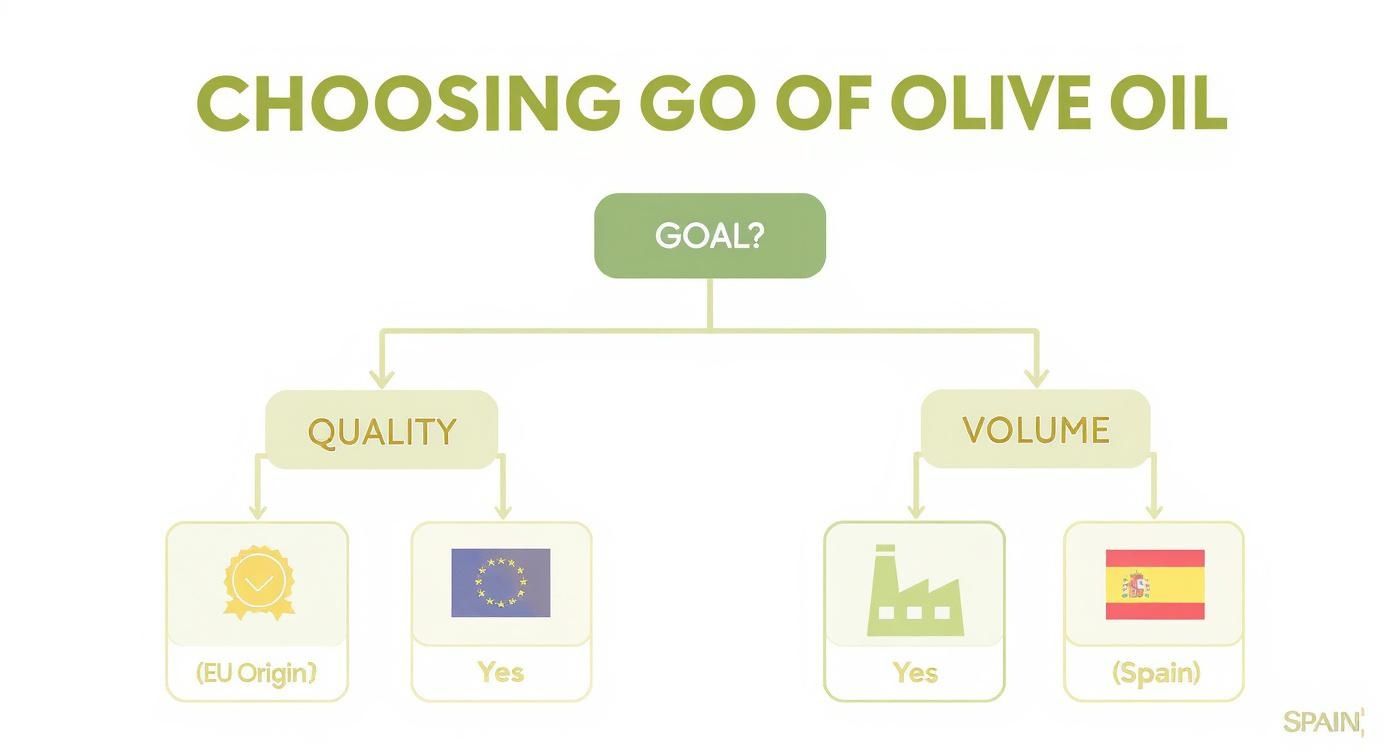
As the flowchart shows, a shopper prioritizing guaranteed quality might look for European origin seals, like PDO or PGI. Someone more focused on volume and value could turn to a production powerhouse like Spain for great everyday options.
Pairing Flavor Profiles With Cooking Methods
Let's get practical. We can group Extra Virgin Olive Oils into three main flavor categories, and each one has an ideal role to play in your kitchen. Getting this right is the key to making every dish sing.
One of the biggest myths I hear is that you can't cook with high-quality EVOO because of a low smoke point. The truth is, a good EVOO has a smoke point between 380°F and 410°F, which is more than enough for everyday cooking like sautéing and even roasting.
The real question isn't if you can cook with EVOO, but which EVOO you should cook with. A delicate oil might lose its nuanced flavors over high heat, while a robust one will stand up to it beautifully.
Perfect Pairings Culinary Use-Case Guide
Think of this table as your ultimate cheat sheet for matching the right oil with the right dish. It's all about creating harmony between the oil's character and your ingredients.
| Flavor Profile (e.g., Delicate/Fruity, Medium/Grassy, Robust/Peppery) | Best Cooking Method | Ideal Food Pairings | Example Olive Oil Origin |
|---|---|---|---|
| Delicate & Fruity | Drizzling, finishing, light baking, gentle sautéing | Mild fish, fresh mozzarella, salads with light vinaigrettes, baking cakes | Liguria (Italy), Provence (France) |
| Medium & Grassy | Sautéing, roasting, dressings, grilling vegetables | Grilled chicken, roasted vegetables, pasta sauces, hearty salads, pesto | Tuscany (Italy), Catalonia (Spain) |
| Robust & Peppery | Grilling, searing, finishing hearty dishes | Red meat, bean soups, bruschetta, bitter greens like arugula, drizzling on steak | Andalusia (Spain), Puglia (Italy) |
This simple framework helps you stop guessing and start pairing with absolute confidence, ensuring the oil enhances, rather than overpowers, your food.
Putting It All Into Practice
Start thinking of your olive oils like spices. You wouldn't use cayenne pepper where a pinch of parsley is needed, would you? The same logic applies here.
- Finishing a hearty bean soup? You need an oil that won't get lost. A robust and peppery EVOO adds that spicy, pungent kick that cuts right through the richness.
- Baking a lemon olive oil cake? The goal is subtlety. A delicate and fruity oil will add incredible moisture and a whisper of fruitiness that complements the citrus perfectly.
- Sautéing garlic and onions? This is a job for your everyday workhorse: a versatile medium and grassy EVOO. It has enough character to add flavor but is balanced enough not to dominate the dish.
Mastering these pairings really unlocks the full potential of your olive oil. For a wider view, you might also be interested in a broader perspective on finding the best oil for cooking. This approach will transform your kitchen, turning simple meals into something truly special.
How to Read Labels and Ensure Authenticity
Walking down the olive oil aisle can feel like trying to crack a secret code. Bottles are plastered with tempting words like "cold-pressed," "first press," and "light," not to mention a dizzying array of official-looking seals. It’s time to cut through the noise and reveal what actually matters.
Here’s the truth: many of the most common phrases on a label are pure marketing fluff. Take "first press," for example. That term is a relic from the age of old-fashioned hydraulic presses. Today, virtually all extra virgin olive oil comes from a single, continuous extraction, making the term meaningless. And "light"? That has absolutely nothing to do with calories. It simply means the oil has been refined to have a lighter color and flavor.
Once you learn what to ignore, you can focus on the real signals of a quality oil.
Decoding the Dates and Origin
If you look at only one thing on a bottle of EVOO, make it the date. Specifically, you must look for the harvest date or press date. This tells you precisely when the olives were picked and milled, which is the single best indicator of freshness. An oil is at its absolute peak for about 12-18 months after that date.
Do not be fooled by a "best by" date alone. That date is usually set two years from bottling, not harvesting. An oil could sit in a giant storage tank for a year before it's even bottled, so that "best by" date can be dangerously misleading.
The country of origin is just as critical. A vague label like "Product of Italy" might only mean the oil was bottled there, using olives from Spain, Greece, or Tunisia. Why does this matter? Because quality and traceability standards are not the same everywhere. A 2022 survey found that over 68% of consumers in Spain and Italy consider traceability a top priority. For a deeper dive into how different countries view quality, you can explore the full findings on consumer preferences.
Seals of Authenticity Versus Red Flags
Beyond dates, certain seals act as a government-backed guarantee of quality and origin. They are your best defense against a fraudulent product.
- PDO (Protected Designation of Origin): This is the gold standard. It guarantees the oil was grown, harvested, pressed, and bottled all within one specific geographical area.
- PGI (Protected Geographical Indication): This seal is also an excellent sign, ensuring that at least one key step of production happened in the designated region, tying the oil to its roots.
When you see a PDO or PGI seal, you’re not just trusting a brand; you're trusting a legally enforced system designed to protect authenticity. It’s the closest you can get to a foolproof promise of quality.
On the other hand, some signs should make you instantly suspicious. Be wary of any olive oil sold in a clear plastic bottle—light and air are its mortal enemies. A rock-bottom price for "extra virgin olive oil" is also a massive red flag. If you’re worried about ending up with a fake, check out our guide on how to spot fake olive oil for more expert tips. Armed with this knowledge, you can finally shop with confidence and bring home an authentic oil that tastes the way it was meant to.
Olive Oil FAQs: Your Questions Answered
Even after getting to grips with the different types of olive oil, a few questions always seem to surface. Let's tackle some of the most common ones so you can feel totally confident next time you're shopping or cooking.
Is It Really Okay to Cook With Extra Virgin Olive Oil?
Yes, absolutely. This is one of the biggest and most stubborn myths in the food world. A good quality EVOO has a smoke point somewhere between 380°F and 410°F, which is more than high enough for most home cooking, including sautéing and roasting.
The real consideration isn't safety—it's flavor. An intensely fragrant, delicate oil will lose some of its beautiful character over high heat. For that reason, you might want to reach for a more robust EVOO or even a standard Virgin Olive Oil for cooking, saving your finest bottle for finishing.
What Does "Cold-Pressed" Actually Mean on a Label?
"Cold-pressed" simply means the oil was extracted from the olives using only mechanical force—no external heat was added during the process. This gentle extraction is essential for preserving the oil’s complex flavors, aromas, and all those healthy antioxidants.
In reality, every single Extra Virgin and Virgin olive oil is "cold-pressed" by definition. So while the term is a good sign of quality, it’s really just describing the standard, required process for any top-tier, unrefined oil.
What’s the Best Way to Store My Olive Oil?
To keep your olive oil fresh and protect it from turning rancid, you must shield it from its three greatest enemies: heat, light, and air.
- Keep it in a cool, dark place like a pantry or cupboard, and absolutely away from the stove.
- Always choose oil sold in a dark glass bottle or a tin. This is your first line of defense against damage from light.
- And finally, always screw the cap on tight right after you use it. Oxygen is not its friend.
Here at Learn Olive Oil, we're firm believers that understanding these details can genuinely transform your cooking. We share expert insights to help you navigate the world of high-quality olive oil, from the grove all the way to your table. Discover the World of Premium Olive Oil and take your appreciation for this liquid gold to the next level.

 Learn Olive Oil
Leave a comment