Think about the last time you drizzled olive oil over a fresh salad or a piece of crusty bread. That vibrant, peppery kick that makes the flavors pop? That’s the magic of a truly great olive oil, the kind promised by the label first cold pressed extra virgin olive oil.
But what if the bottle in your pantry is an impostor? What if that liquid you trust to be pure, healthy, and delicious is nothing more than a cheap fraud masquerading as the real thing?
The Liquid Gold That Might Be Lying to You
Let’s be brutally honest. The olive oil aisle is a battlefield of confusion. You're confronted by a wall of green and gold bottles, each one whispering sweet nothings about rustic Italian farms and ancient traditions. In this treacherous landscape, a high price tag offers you no guarantee of quality. It’s a sad truth, but many of those beautiful bottles are filled with little more than disappointment.
This guide is your secret weapon. Your roadmap through the maze. We are about to decode why those four words—first, cold, pressed, extra virgin—are your shield against the fakes and your key to unlocking an oil brimming with explosive flavor and life-giving health benefits. They aren't just marketing fluff; they are a sacred promise—a standard of purity and quality cherished for millennia.
Why This Label Matters
Learning to read an olive oil label is the most powerful skill you can acquire to defend yourself against a massive, hidden problem in the food world. The market is drowning in oils that are cut with cheap substitutes, brutalized with heat and chemicals, or just brazenly mislabeled. This guide will empower you to see the truth.
I will hand you the tools to:
- Instantly spot the difference between an authentic, high-quality oil and the fakes that litter the grocery store shelves.
- Understand precisely what you are paying for, and why it makes a world of difference for your food, your health, and your family.
- Transform yourself into a savvy shopper who can confidently select a bottle that delivers on every single promise it makes.
This is your first step toward never being fooled by an olive oil label again. You’ll learn to spot the clues that separate a genuine, health-boosting oil from one that's just taking up space in your pantry.
Tragically, millions of people are using subpar olive oil and have no idea what they’re missing. The problem is immense. While our focus here is olive oil, this skill of discerning quality applies across many traditional foods. For instance, the world of animal fats has its own rich history; you might find it fascinating to discover the surprising uses of tallow in cooking and daily life.
It all begins with knowledge. Let's pull back the curtain and expose the truth behind the label.
What 'First Cold Pressed' Really Means
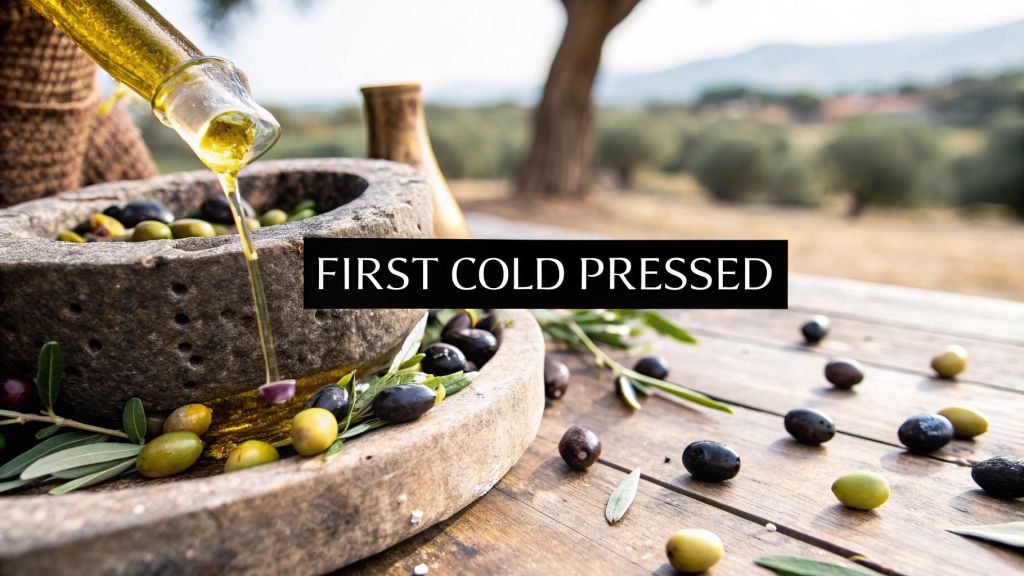
That phrase on the bottle, "first cold pressed," isn't just a charming piece of marketing poetry. It’s a direct link to a pure, time-honored tradition of crafting olive oil. To truly grasp its meaning, you must transport yourself out of the sterile grocery aisle and into an ancient stone mill, where the air is thick with the peppery, green perfume of freshly crushed olives.
Imagine you're making orange juice by hand. The very first squeeze of the fruit yields the nectar of the gods—the sweetest, most fragrant, most vibrant juice. If you were to wring out the pulp a second or third time, you’d get something watery and bitter. The "first press" of olives works on the very same principle. It is that initial, gentle crush that coaxes out the most exquisite oil, an oil overflowing with flavor and nutrients.
The 'Cold' Part: Guardian of Quality
Now, let's talk about the "cold" in "cold pressed." This may be the single most critical part of the entire process. It is the unwavering guardian of the oil's quality. You must understand this: Heat is the mortal enemy of the delicate flavors and fragile antioxidants in olive oil. In the world of industrial production, heat is a weapon used to extract every last drop of oil from the olive. It boosts profits, but it utterly annihilates quality.
For an oil to legally claim the title "cold pressed," the entire extraction process—from the moment the olives are crushed into a paste to the final spin in the centrifuge—must remain below a strict temperature threshold: 27°C (or 80.6°F). This gentle, low-heat method is a shield, protecting the precious polyphenols and other compounds that give a true first cold pressed extra virgin olive oil its signature peppery kick and its legendary health benefits.
Think of it like cooking a delicate piece of fish. A gentle poach preserves its flavor and flaky texture. Blasting it with high heat might cook it faster, but you'll be left with something dry, bland, and stripped of everything that made it special.
This meticulous, temperature-controlled extraction is the polar opposite of modern shortcuts that sacrifice character for volume. It preserves the very soul of the olive, delivering an oil that tastes truly alive.
A Method Rooted in History
This isn't some trendy new technique; it's a legacy. The concept of a "first cold press" has roots stretching back thousands of years to ancient Greece and Rome, where olives were crushed between massive stones. The oil was gently coaxed out without any added heat, a method that stood as the gold standard for centuries until modern machinery changed the game.
The journey from a living olive to liquid gold is a fascinating one, and knowing it will transform how you shop. For a complete look at the process, explore our guide on what is cold-pressed olive oil. This traditional path ensures the oil in your bottle is as close to nature as possible.
When you see "first cold pressed" on a label, it’s more than just words. It’s a solemn promise. It tells you the oil was made with patience and a profound respect for tradition, placing purity far ahead of profit. It’s your guarantee that the producer cared enough to protect the oil's soul, from the moment the olive left the branch to the second the bottle was sealed.
The True Meaning of Extra Virgin Quality
https://www.youtube.com/embed/WDxAcnhh7JE
If “first cold pressed” tells the story of the oil’s journey from olive grove to mill, then “extra virgin” is the final, undeniable stamp of perfection. This is not a fuzzy marketing term; it is the highest grade an olive oil can possibly achieve. Think of it as a dual guarantee of chemical purity and sensory flawlessness.
To truly understand what makes an oil "extra virgin," you must look at it from two different perspectives: through the cold, analytical eye of a lab scientist, and through the discerning palate of a trained taster. A true extra virgin olive oil must pass both trials with flying colors. It is this unforgiving, two-part standard that separates the world's finest oils from all the rest.
One part is hard data. The other is a flawless sensory experience. Let's break it down.
The Olive's Health Report: Chemical Standards
First, the chemistry. The single most crucial chemical marker for extra virgin olive oil is its free fatty acidity (FFA). To earn that coveted "extra virgin" crown, the oil's acidity must be astonishingly low—the international legal standard is below 0.8%.
But don't let the word "acidity" mislead you; this has nothing to do with a sour, lemon-like taste. A better way to think of it is as a report card for the olives at the very moment they were crushed. A low FFA score is proof that the olives were healthy, undamaged, and rushed from the tree to the mill immediately after being picked.
A high acidity level is a blaring red flag. It screams of problems—bruised fruit, long delays between harvest and press, or just plain sloppy handling. It's the difference between a crisp, perfect apple picked straight from the tree and one that’s been lying on the ground for a week, bruised and rotting.
This chemical benchmark is the first hurdle any oil must clear to even be considered for the top tier.
This simple diagram shows how each careful step in the process builds upon the last to create a superior product.
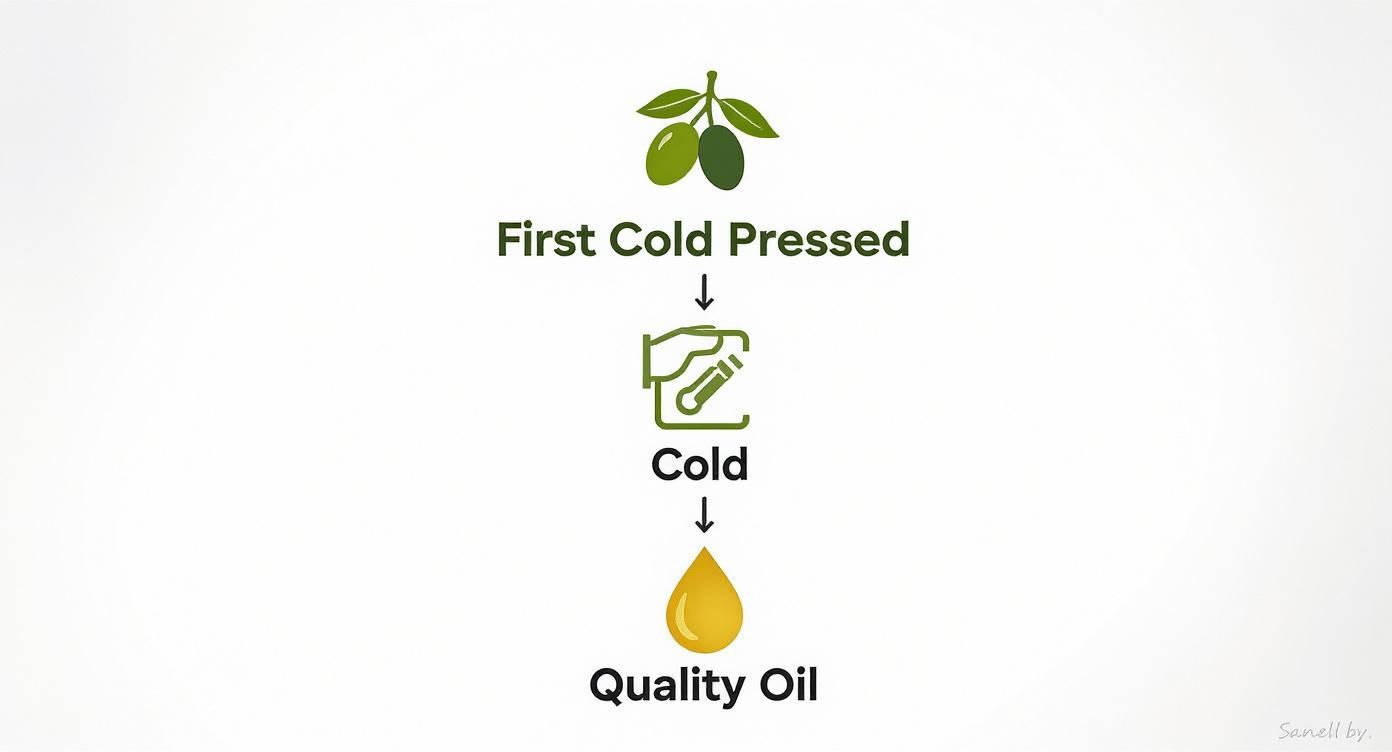
As you can see, you cannot end up with magnificent oil unless you begin with perfect olives and follow the right methods.
Passing the Taste Test: Sensory Standards
Nailing the lab test is only half the battle. Next, the oil must face a panel of trained sensory experts who conduct a blind tasting. Their mission is simple: to hunt for any defects. To be graded as extra virgin, an oil must have zero taste or smell defects. Period.
What exactly is a defect? It’s any "off" flavor that tells a story of something gone wrong. These flaws have specific names and recognizable traits:
- Fusty: This is the ghost of olives that were piled up and stored for too long before milling, causing them to ferment. It smells like a forgotten, damp gym bag.
- Rancid: The most common defect, a result of the oil being exposed to oxygen, light, or heat. It tastes and smells like stale nuts, old window putty, or even crayons.
- Musty: This earthy, humid scent comes from moldy olives—a clear signal that inferior fruit was used.
An oil can have a perfect acidity level, but if a taster detects even the slightest hint of a fusty or rancid note, it is immediately cast out from the extra virgin category. You can explore the official standards and learn more about the meaning of extra virgin olive oil in more detail.
This is what makes the first cold pressed extra virgin olive oil label so incredibly powerful. It's a promise that the oil you're buying is as pristine in its chemistry as it is perfect on your palate.
To put it all together, here’s a quick look at the key quality markers that separate true Extra Virgin Olive Oil from lower grades.
Extra Virgin Olive Oil Quality Markers
| Quality Marker | Extra Virgin Standard | Why It Matters to You |
|---|---|---|
| Free Fatty Acidity (FFA) | Must be below 0.8% | This measures fruit quality. Low acidity means fresh, healthy olives were used. |
| Sensory Defects | Must have ZERO defects | This guarantees the oil tastes and smells fresh and clean, not rancid, musty, or fusty. |
| Positive Attributes | Must have fruity notes | The oil should have a noticeable, pleasant aroma and taste of fresh olives (green or ripe). |
| Peroxide Value (PV) | ≤ 20 meq O2/kg | This indicates the initial level of oxidation. A low number means the oil is fresh and was handled properly. |
| Polyphenols | No official minimum | These are powerful antioxidants that give EVOO its health benefits and peppery, pungent flavor. Higher is better! |
Ultimately, these strict standards ensure you're getting an oil that is not only delicious but also packed with the health benefits that make olive oil famous.
How to Trust Your Senses to Find the Best Oil
A label can tell you a story, but your own palate reveals the truth. When it comes to olive oil quality, the most reliable lie detector isn't a fancy seal or an elegant bottle—it's your own senses.
Learning to taste olive oil like a professional is the single best skill you can develop to tell authentic liquid gold from the imposters on the shelf. It’s a lot easier than you might think. You don't need years of training, just a bit of guidance and the confidence to trust what your nose and mouth are telling you.
The Professional 'Slurp' Method
To really unlock an oil’s true character, you have to aerate it. This is a technique used by expert tasters all over the world to release the aromatic compounds that define its flavor. It might feel a little strange at first, but it’s the secret to experiencing the oil’s full complexity.
Here’s how you do it:
- Warm the Oil: Pour about a tablespoon into a small glass. Cup the glass in one hand and cover the top with your other, gently swirling the oil for a minute or so. Your body heat will warm it just enough to help the aromas blossom.
- Smell Deeply: Now, lift your hand and bring the glass to your nose for a deep sniff. What do you smell? Is it fresh-cut grass? Green banana? Maybe ripe tomato? These are all fantastic signs.
- Sip and Slurp: Take a small sip. With the oil still on your tongue, purse your lips and draw in a sharp burst of air through your teeth. This "slurp" sprays the oil across your entire palate, letting you perceive its full range of flavors.
This quick process dramatically amplifies the whole tasting experience. Once you get the hang of it, you’re ready to start identifying the three positive attributes every great first cold pressed extra virgin olive oil must have.
The Three Hallmarks of Quality
When you taste a superb olive oil, you’re not just looking for something that tastes "good." You're searching for three specific, positive characteristics: fruitiness, bitterness, and pungency. These aren't just tasting notes; they are the undeniable signatures of fresh, healthy olives and meticulous production.
- Fruitiness: This is the aroma and taste of fresh, vibrant olives. It can range from delicate and floral to robust and grassy. You might pick up on notes of green almond, artichoke, fresh herbs, or even tropical fruit. If there's no fruitiness, that’s a major red flag.
- Bitterness: This is a clear signal of freshness. A distinct bitter sensation on the sides of your tongue means the oil was made from green, unripe olives, which are loaded with healthy antioxidants. Don't mistake bitterness for a flaw—it's a badge of honor.
- Pungency: This is that peppery tickle or cough-inducing feeling in the back of your throat. It's the calling card of oleocanthal, a powerful anti-inflammatory polyphenol. The stronger the pepper, the more of these healthy compounds the oil contains.
A truly exceptional oil creates a symphony of these three elements. It should be fruity on the nose, pleasantly bitter on the tongue, and finish with a peppery kick that confirms its freshness and polyphenol content.
Unfortunately, many of us have been conditioned by years of tasting bland, defective oils to think that bitterness and pungency are bad things. The opposite is true. These sensations are the loudest, clearest proof you have that an oil is fresh, authentic, and packed with the compounds that deliver its famous health benefits.
Learning to recognize and appreciate them is the key. For a more detailed walkthrough, you can find a complete guide on how to taste olive oil and train your palate.
A Buyer's Guide to Spotting Authentic Olive Oil
Walking down the olive oil aisle can feel like navigating a minefield. Elegant labels and rustic imagery often hide mediocre, or even fraudulent, oil. But here’s the good news: you don't need to be a professional taster to make a great choice. You just need to learn how to read the bottle like a detective searching for clues.
Think of this as your field guide for cutting through the marketing fluff. Armed with a bit of know-how, you can easily spot the signs of a true first cold pressed extra virgin olive oil and sidestep the imposters.
The Most Important Date on the Bottle
First things first: completely ignore the "Best By" date. It's often set arbitrarily—usually two years from bottling—and tells you almost nothing about the oil's actual freshness. Unlike a fine wine, olive oil does not get better with age. It's a fresh fruit juice, and its clock starts ticking the moment it's made.
Instead, scan the label for the harvest date. This is the single most important clue you'll find. It tells you exactly when the olives were picked and pressed, giving you a crystal-clear picture of the oil's age. Your goal is to find the most recent harvest available, ideally from the last year.
An oil without a harvest date is an oil with something to hide. It’s a silent admission that the producer doesn’t want you to know just how old the contents really are.
This simple check instantly separates the producers who are proud of their product from those who rely on vague timelines to move old stock. An oil from a recent harvest is far more likely to deliver that vibrant flavor and the powerful health benefits you're paying for.
Scrutinizing the Label for Clues
Beyond the harvest date, a few other details on the label can reveal an oil's true character. You’re essentially building a case for authenticity, one clue at a time. The more specific the information, the more confident you can be in what you're buying.
The global demand for olive oil has created a complex, and sometimes tricky, market. The United States imports huge amounts every year, and consumer demand for the good stuff is booming. Major producers like Spain account for a massive chunk of the world's supply, but harvests can fluctuate wildly, which impacts global prices and, unfortunately, creates incentives for mislabeling. If you're curious about these market forces, you can explore more insights on the global olive oil market.
To protect yourself, keep an eye out for these positive signs:
- Specific Origin: Look for a specific estate, mill, or region, like "Grown and Milled in Tuscany, Italy" or "Produced in Koroneiki, Greece." This kind of detail shows traceability and pride.
- Olive Varietal: Just like grapes for wine, olives come in different varieties (Arbequina, Koroneiki, Picual, etc.). A producer who lists the specific olive used is confident in their oil’s unique flavor profile.
- Protective Packaging: Light is one of olive oil's worst enemies. Always, always choose oil packaged in dark glass bottles or opaque tins that shield it from damaging light.
On the flip side, you need to learn to spot the red flags that scream "low quality" or "deception."
Red Flags to Avoid at All Costs
If you see any of these on a bottle, just put it back on the shelf. These are common tricks used to hide the truth about what’s really inside.
- Vague Origin Claims: Phrases like "Product of the Mediterranean," "Packed in Italy," or "Imported from Italy" are practically meaningless. This usually means oils from various countries were blended and simply bottled there.
- Clear Glass Bottles: Any producer who genuinely cares about their oil would never put it in clear glass. It’s an immediate signal that they don’t care about protecting it from degradation.
- Suspiciously Low Prices: While a high price doesn’t automatically guarantee quality, a rock-bottom price almost certainly guarantees the opposite. Making real extra virgin olive oil is an expensive, labor-intensive process, and the price will reflect that.
Protecting Your Oil for Maximum Flavor
So, you did it. You navigated the supermarket aisle, decoded the labels, and brought home a fantastic bottle of first cold pressed extra virgin olive oil. But getting it home is only half the battle. Now, you have to protect it.
This liquid gold has three sworn enemies, constantly working to strip it of its incredible flavor and health benefits. Those culprits are light, heat, and oxygen. Keeping your oil safe from this trio is the key to making sure the last drop is just as vibrant as the first.
The Worst Places to Store Your Olive Oil
Let's start with where not to keep your oil. The most common spot is also the absolute worst: on the counter, right next to the stove. It might be convenient, but you're blasting it with a one-two punch of heat and light every time you cook. It's a fast track to a dull, tasteless oil.
Another well-intentioned mistake is storing it in the refrigerator. While that solves the light and heat problem, the cold temperatures cause the natural waxes to solidify. Your oil will turn cloudy and sludgy. Constantly warming it up and chilling it down messes with the delicate flavor compounds we've been talking about.
Think of your olive oil like a fine wine or fresh-squeezed juice. You wouldn't leave a great bottle of wine on a sunny windowsill, would you? Give your oil that same respect.
Proper storage isn't complicated, but it is absolutely essential. To get into the nitty-gritty, check out our detailed guide on proper olive oil storage techniques.
Simple Rules for Preserving Freshness
Luckily, protecting your investment is easy. Just follow these golden rules to keep that beautiful, peppery flavor locked in the bottle for as long as possible.
- Find a Cool, Dark Place: Your oil’s happy place is a kitchen cupboard or pantry, safely away from the stove and direct sunlight. The ideal temperature is around 57°F (14°C), but any stable, cool room temperature will do just fine.
- Keep it Sealed Tight: Oxygen is a real flavor-killer. Every time you open the bottle, air rushes in and oxidation kicks into gear. Get in the habit of screwing the cap on tightly right after you pour.
- Buy the Right Size Bottle: A giant tin might seem like a good deal, but unless you're a heavy user, you’re just giving oxygen more time to do its dirty work. It's much better to buy a bottle you can finish within a month or two of opening it.
At the end of the day, remember that first cold pressed extra virgin olive oil is a fresh product meant to be enjoyed. It’s at its peak right now. Don't hide your best oil away for a "special occasion"—make today's meal special by using it.
Your Top Olive Oil Questions, Answered
Let's be honest, the world of olive oil can feel a little confusing. With all the different labels and terms, it's easy to feel lost in the grocery aisle. You’ve got questions, and that's a good thing. Let's clear up some of the most common ones so you can shop like a pro.
Is 'First Cold Pressed' Better Than Just 'Cold Pressed'?
This is a great question that gets to the heart of how olive oil is made today. The short answer is: in the modern world, they mean the same thing.
Years ago, olives were crushed using hydraulic presses, and it was possible to do a second, lower-quality press. But that technology is mostly a thing of the past. Today, top-quality oil is extracted using a centrifuge, a machine that spins the olive paste to separate the oil. This is a single, continuous process, so it's always a "first press."
The keyword you really need to focus on is "cold". That's your guarantee that the temperature never went above 27°C (80.6°F) during extraction. Keeping things cool is what protects the oil’s incredible flavors and health-boosting antioxidants. So, while "first cold pressed" is a nod to tradition, "cold pressed" or "cold extracted" is the term that truly matters.
Can I Cook With First Cold Pressed Extra Virgin Olive Oil?
Yes, you absolutely can! This might be the single biggest myth we need to bust about olive oil. The idea that it's only good for finishing a dish is just plain wrong.
A good quality first cold pressed extra virgin olive oil has a smoke point somewhere between 375-410°F (190-210°C). That’s much higher than you probably think and well above the heat needed for most home cooking.
Think about it: when you sauté vegetables on the stove, you’re usually cooking around 350°F. High-quality EVOO can easily handle that.
In fact, because it’s packed with stable monounsaturated fats and antioxidants, it holds up to heat better than many other oils. Cooking with it not only makes your food taste amazing but helps preserve its nutritional goodness. So go ahead—sauté, roast, and even do some light frying with it.
Does the Color of Olive Oil Indicate Its Quality?
Here’s another common trip-up. The color of an olive oil tells you absolutely nothing about its quality. Zero. An oil can be fantastic whether it's bright green or pale gold.
The color simply comes down to a couple of things:
- Olive Variety: Just like grapes for wine, different types of olives produce different colored oils.
- Harvest Time: Olives picked early in the season are greener and full of chlorophyll, which makes for a green-hued oil. Olives picked later, when they’re more ripe, tend to create a more golden oil.
Professional tasters actually use special cobalt-blue glasses to judge oil. Why? To completely hide the color so it can't sway their opinion. They rely on their nose and palate to find the real markers of quality—the aromas and flavors—not the color.
Why Is Authentic Extra Virgin Olive Oil So Expensive?
When you see that higher price tag on a bottle of real first cold pressed extra virgin olive oil, you're seeing the cost of uncompromising quality. It's easy to make cheap oil by cutting corners. It takes immense dedication and hard work to make an exceptional one.
The price reflects a whole chain of careful, labor-intensive steps. It starts in the grove, where olives are often picked by hand at the perfect moment of ripeness. From there, it's a race against the clock to get them to the mill within just a few hours to prevent any bruising or oxidation.
The "cold" extraction method itself produces far less oil than industrial methods that use heat or chemicals to wring out every last drop. Finally, to earn that "extra virgin" label, the oil has to pass a battery of chemical tests and, crucially, a blind taste test by a certified panel. You're not just paying for olive oil; you're investing in a craft that prioritizes purity, flavor, and health above all else.
At Learn Olive Oil, we're passionate about demystifying this liquid gold. Our goal is to give you the expert insights and tasting skills you need to choose incredible olive oils with total confidence. Discover a world of flavor and elevate your cooking by exploring our guides at https://learnoliveoil.com.
 Learn Olive Oil
Leave a comment