Here’s a simple truth that may shock you: most olive oil is perfectly safe for your everyday home cooking. That old, tired rumor that you can't cook with extra virgin olive oil? It’s one of the most stubborn—and damaging—myths in the culinary world. A quality EVOO actually has a smoke point between 350°F and 410°F, more than enough for almost any dish you’ll ever make on your stovetop.
The Kitchen Myth Costing You Health And Flavor
You’ve heard it before. That quiet whisper from a well-meaning relative, or a confident decree from a TV chef: "Never, ever heat your extra virgin olive oil." For decades, this warning has been treated as gospel, an unbreakable law of the kitchen passed down without a single question.
But what if I told you that this golden rule is not only dead wrong but is actively sabotaging your health and robbing your food of incredible flavor? This single piece of misinformation has pushed millions of home cooks toward cheap, highly refined seed oils, all under the false flag of safety and higher smoke points.
It's Time To Ditch Outdated Advice
The fear of heating EVOO stems from a massive misunderstanding of how cooking oils actually behave under fire. An oil's smoke point is just one piece of a much larger, more important puzzle. What matters far more is its oxidative stability—in simple terms, how well it resists breaking down and forming harmful compounds when the heat is on.
And this is where a good olive oil doesn't just compete; it dominates. Thanks to its high concentration of stable monounsaturated fats and a powerful army of antioxidants known as polyphenols, it has a built-in defense system against heat damage.
The smoke point of extra virgin olive oil typically falls between 350°F to 410°F (175°C to 210°C), depending on its quality and freshness. Since most stovetop cooking happens right around 350°F, this range is more than sufficient for everyday meals. You can find more details about how olive oil performs under heat by exploring the research at aboutoliveoil.org.
So, why does the myth live on? Because we’ve been trained to focus on one simple number while ignoring the crucial science of fat chemistry. By letting go of this outdated dogma, you can finally unlock the full potential of olive oil, bringing its spectacular flavor and health benefits to far more than a final drizzle on a salad. Let's see how.
Why Smoke Point Isn't the Whole Story
For years, we've been fed a simple, seductive lie about cooking fats: smoke point is everything. It's been sold as the ultimate benchmark, the one number that dictates an oil's worth. But here’s the unvarnished truth: judging a cooking oil by its smoke point alone is like judging a car by its top speed. It’s a flashy number that tells you nothing about performance, safety, and reliability in the real world.
Think of smoke point not as a strict limit, but as a distress signal. It’s the temperature where you can see an oil surrendering to the heat. It’s a useful indicator, yes, but it reveals nothing about the invisible breakdown happening on a molecular level long before that first wisp of smoke appears.
The Real Hero: Oxidative Stability
The true hero in this story is oxidative stability. This is, without a doubt, the most important factor in how an oil stands up to heat. If smoke point is the moment an oil visibly breaks, oxidative stability is its power to resist breaking in the first place.
Imagine a fortress under siege. The smoke point is the plume of smoke you see rising from the battlements—a clear sign the defense has already been breached. Oxidative stability, on the other hand, is the strength of the fortress walls and the skill of the soldiers inside, repelling the enemy long before any smoke ever appears.
And this is where olive oil’s hidden superpower is revealed.
Olive oil’s fortress is built with two key defenses: a high concentration of sturdy monounsaturated fats (the strong walls) and a powerful army of polyphenol antioxidants (the elite soldiers). This combination creates an incredibly tough defense against the damage caused by heat.
Why Olive Oil’s Structure Is What Really Counts
A refined seed oil may boast a high smoke point on its label, but its defenses are paper-thin. It lacks that army of antioxidants and is often filled with fragile, unstable polyunsaturated fats. The moment you apply heat, it begins to degrade and form harmful compounds, well before you'd ever see a sign of smoke. You can dive deeper into this relationship in our detailed guide on the olive oil smoke point.
A high-quality extra virgin olive oil, however, remains remarkably stable at typical cooking temperatures. Its natural antioxidants are constantly at work, neutralizing the damaging free radicals that heat creates. This protects the oil’s integrity and, ultimately, the flavor and healthfulness of your food. It’s this fundamental difference that reveals why the obsession with smoke point has led so many good cooks astray for so long.
Choosing the Right Olive Oil for the Job
Any great chef knows you don’t use a paring knife to butcher a chicken. The same logic applies to your cooking oils. True kitchen mastery isn’t just about temperature control; it’s about choosing the right tool—or in this case, the right olive oil—for the job at hand.
Let's move beyond the science and into the practical decisions you make at the stove every day.
Think of your olive oils like different grades of sandpaper. You wouldn't use a coarse grit for a fine polish, and you wouldn't use a fine grit to strip old paint. Each has a specific purpose where it shines. The same is true for the bottles in your pantry.
The Right Oil for High-Heat Tasks
When you're bringing the heat—searing a steak, crisping chicken skin, or roasting vegetables until they're perfectly caramelized—you need an oil that won't back down. This is the time to reach for Refined or Light Olive Oil, often labeled simply as 'Olive Oil'.
These oils are filtered to remove impurities, a process that also mellows their flavor and raises their smoke point to a formidable 425-465°F (220-240°C). They provide the stable, monounsaturated fats of olive oil without the delicate flavor compounds of EVOO, which can burn off at extreme temperatures. Consider them your heavy-duty workhorses.
The Powerhouse for Everyday Cooking
Here is where one of the greatest myths in food is shattered. A high-quality Extra Virgin Olive Oil (EVOO) is not just a finishing oil. With a smoke point reaching up to 410°F and a payload of protective antioxidants, it is an absolute powerhouse for the vast majority of your daily cooking.
From sautéing garlic as the foundation of a sauce to pan-frying a delicate piece of fish, a great EVOO is more than up to the task.
This simple chart helps visualize how to think about your choices. It's less about a single temperature number and more about the oil's overall stability.
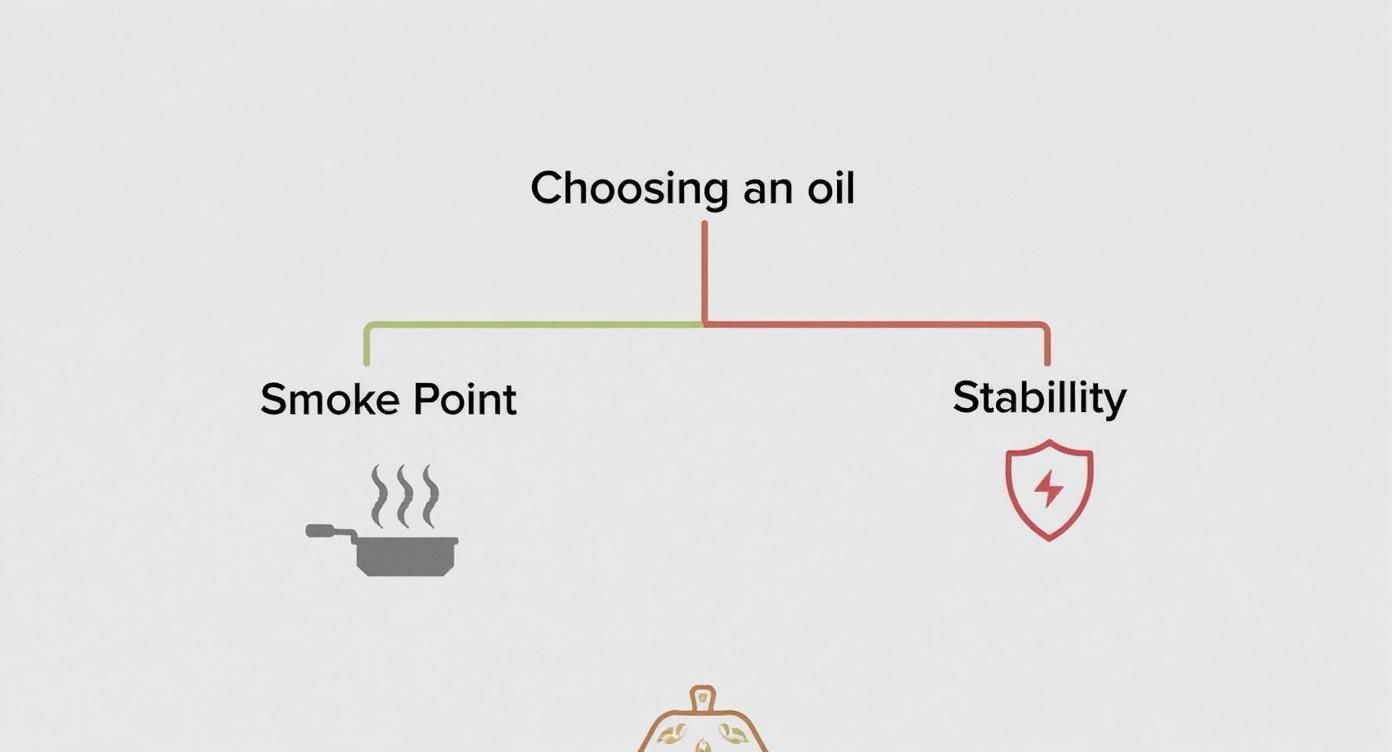
The real lesson here is that an oil's internal defense shield—its oxidative stability—is far more important than the exact temperature it begins to smoke.
Most home frying occurs between 350-375°F. A genuine extra virgin olive oil with a smoke point of 410°F handles that with room to spare, giving you a generous buffer for nearly any stovetop method. This isn't just theory; you can dig into the detailed research showing how EVOO's stability makes it a fantastic and safe choice for cooking.
The secret lies in a simple exchange. When you cook with EVOO, you're not just adding a fat; you're infusing your food with flavor. The oil's peppery, fruity notes become an integral ingredient, elevating the final dish in a way a neutral, refined oil simply cannot.
This is precisely why choosing the best extra virgin olive oil for cooking can transform your food. The rich flavor it imparts while sautéing or roasting is a feature, not a flaw. You're trading a little smoke point headroom for a massive upgrade in both taste and health.
So, for anything short of deep-frying or searing at volcanic temperatures, a quality EVOO isn't just an option—it’s often the best one you can possibly make.
The Hard Science That Proves Olive Oil's Stability
For years, the marketing machines behind cheap vegetable and seed oils have told a compelling story. They claimed their products, with their sky-high smoke points, were the only intelligent choice for high-heat cooking. It was a slick pitch that pushed traditional fats like olive oil to the back of the pantry in millions of homes.
But it's time to let the actual evidence speak for itself.
This isn’t about marketing spin or grandmother's wisdom. This is about the cold, hard data from a landmark study that completely demolishes that conventional thinking. Let’s see what happens when you stop listening to the ads and start looking at the science.
What Really Happens When You Heat Cooking Oils
In a groundbreaking Australian study, scientists put ten popular cooking oils through a brutal test. They cranked up the heat, meticulously measuring how each one degraded and, more importantly, which ones produced the most harmful byproducts. The results were not just interesting—they were a bombshell.
One oil consistently outperformed all the others, including those famous for their high smoke points. It stood firm against the heat, generating the fewest toxic compounds and proving to be the most stable fat in the entire lineup.
That oil was extra virgin olive oil.
The Australian study discovered that extra virgin olive oil was the safest and most stable oil when heated. It produced significantly fewer harmful polar compounds compared to popular high-smoke point oils like canola, which created more than 2.5 times the toxic byproducts under the same heating conditions.
This single finding shatters the myth that a high smoke point equals a safer oil. The reality is far more nuanced. While refined seed oils may not smoke as quickly, they can begin breaking down into harmful components much faster, creating a toxic mess in your pan long before you see the first wisp of smoke.
So, what is EVOO's secret? It's fortified with a natural defense system. Its high monounsaturated fat content provides a solid, stable foundation. But the real heroes are its polyphenols—potent antioxidants that act like microscopic bodyguards, shielding the oil from heat-induced damage. You can learn more about the role these compounds play by exploring our guide on olive oil polyphenol content.
The science is undeniable: olive oil’s unique chemical structure makes it the safer, healthier choice. This isn’t an opinion—it's the hard proof that its stability is superior right where it counts: in your pan.
Putting Olive Oil to Work in Your Kitchen
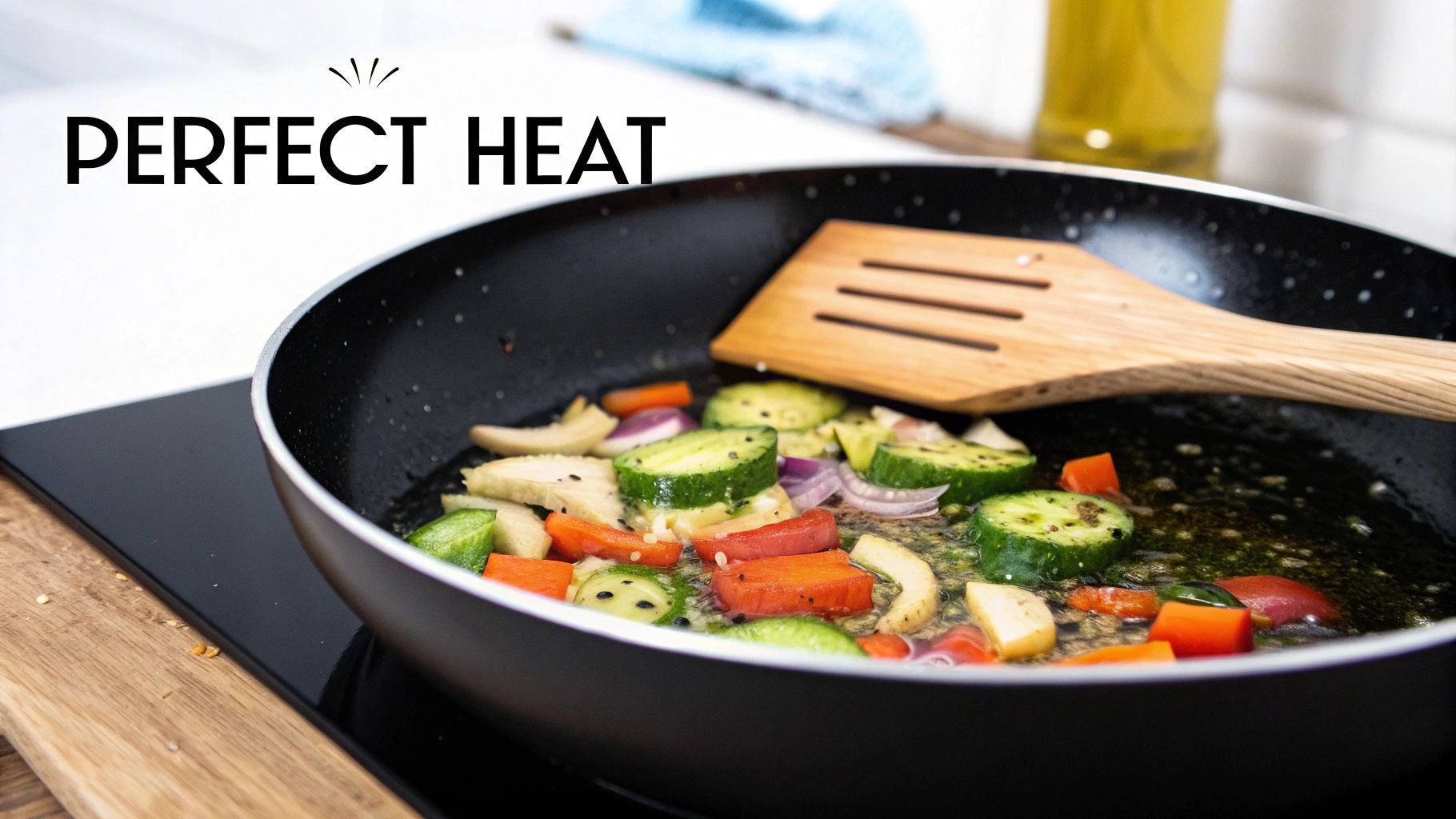
Knowing the science is one thing. True confidence is born at the stove. This is where we translate the data into the sizzle in the pan—the skills you can actually see, smell, and taste.
Forget fussing with a thermometer. Experienced cooks learn to read the oil itself, a skill you can master in minutes. The single most important visual cue to watch for is the shimmer.
Pour your olive oil into a preheating pan and simply watch. As the temperature climbs, the oil will thin out and begin to ripple across the surface, like a heat haze on a summer road. That subtle shimmer is the magic moment. It signals the oil is perfectly hot for cooking, typically in the ideal 325-375°F window, yet safely below its smoke point.
It’s a calm, ready signal—a world away from the frantic wisps of smoke that scream "danger!" Understanding the benefits of precise temperature control on cooking equipment can make hitting this sweet spot even easier, ensuring your oil stays stable and your food cooks perfectly.
From Knowledge to Technique
Turning this insight into delicious results only requires a few simple, powerful habits. These aren't rigid rules, but smart practices that protect the oil's quality and guarantee better food, every single time.
It begins with the bottle you buy. Always choose a high-quality olive oil and look for the harvest date. An oil from the most recent harvest will be loaded with the highest concentration of those protective polyphenols, your oil’s natural defense against heat. Freshness isn’t a luxury; it’s your first line of defense.
How you store it matters just as much. Keep your olive oil in a cool, dark place—think pantry, not windowsill.
Heat and light are the twin enemies of olive oil. They accelerate oxidation, destroying the very compounds that make the oil stable and healthy. A dark pantry is your oil's best friend.
Common Missteps to Avoid
Even with the finest olive oil, a few common mistakes can fill your kitchen with smoke and lead to soggy, disappointing food. The good news? They're easy to fix.
- Don't Add Oil to a Cold Pan: This is the big one. Always heat your pan first, then add the oil. This simple habit drastically cuts down the time the oil spends on the heat, preserving its flavor and integrity.
- Avoid Overcrowding the Pan: Dumping too much food in at once causes the pan's temperature to plummet. Your food will steam instead of sear, and the oil will struggle to recover, increasing the risk of breakdown.
- Pat Your Food Dry: Water is the enemy of a good sear. Excess moisture causes hot oil to splatter and cools the pan, preventing that beautiful, golden-brown crust.
By focusing on these visual cues and simple habits, you'll move from knowing the facts to feeling like an intuitive cook. You'll be ready to confidently use one of nature's greatest fats for almost any dish. For more tips on everyday cooking, check out our guide to using olive oil for sautéing.
The Real Reason This Olive Oil Myth Endures
If the science is so overwhelmingly clear, why does this myth still have such a stranglehold on our kitchens? The answer has nothing to do with food science and everything to do with marketing history. This piece of culinary dogma wasn't discovered; it was manufactured.
For decades, the corporations behind vegetable and seed oils waged a brilliant marketing war. Their strategy was brutally effective: find one simple, easy-to-understand metric and hammer it home relentlessly. That metric was the smoke point. It’s a clean number, perfect for a label, and it created a simple—but deeply flawed—narrative that higher is always better.
Simplicity Sold Better Than Science
This one-dimensional sales pitch completely overshadowed the far more important concept of oxidative stability. Explaining how an oil's antioxidants and monounsaturated fats form a protective shield against heat just doesn't fit on a bottle. A big number is simply easier to sell.
And so, the myth that olive oil can't handle heat took root in kitchens everywhere, shaping how generations of home cooks thought about oil. The real science, which proves that oxidative stability is a much better predictor of an oil’s performance, got lost in the noise. You can dive deeper into the modern science of cooking oil stability in this comprehensive article from the Olive Oil Times.
The endurance of this myth is a classic case of a simple lie outrunning a complex truth. An easily marketed number became kitchen dogma, sidelining one of nature's most stable and beneficial fats.
Once you see the myth's origin, you can feel confident trusting the evidence instead. The facts are clear: olive oil is incredibly stable, its health benefits survive the heat beautifully, and its versatility is unmatched. It's time to let go of the old dogma and embrace this liquid gold in all your cooking.
Just make sure you're using the real thing. Our guide on how to spot fake olive oil can help you tell the difference.
Your Olive Oil Questions, Answered
Alright, we've torn down the myths and looked at the science, but what does this mean when you're standing at the stove, pan in hand? Let's tackle the real-world questions I hear every day.
So, Can I Actually Deep-Fry with Olive Oil?
Yes, you absolutely can! The key is picking the right tool for the job. While you could use extra virgin olive oil, its beautiful, bold flavor might overpower the very food you're frying.
For deep-frying, your best bet is a Refined or Light Olive Oil. These have a much higher smoke point—up around 465°F / 240°C—and a neutral taste that lets your food be the star of the show.
How Many Times Can I Reuse Frying Oil?
If you're shallow-frying with a high-quality olive oil, you can typically get two or three uses from it. The trick is proper care. Once it's cool, strain it through cheesecloth to remove any food particles that could burn next time. Then, store it in a dark, sealed container.
But trust your senses. If the oil smells off, looks dark and murky, or gets foamy when you heat it, its time is up. Toss it and start fresh.
Does Cooking on High Heat Destroy All the Health Benefits?
This is a big one, and the answer is far better than you might think. It's true that some of the delicate polyphenols—those powerful antioxidants—will degrade under high heat. But here's the crucial part.
Extra virgin olive oil starts with such an enormous reserve of these healthy compounds that even after cooking, it often retains more antioxidant power than other refined oils had to begin with.
So while there's some loss, you're still left with a huge net gain.
Is Smoke Point the Only Thing I Should Care About?
Absolutely not. If you've learned one thing today, I hope it's this. For years, smoke point was the only number anyone talked about, but it's a deeply flawed metric. The real measure of an oil's performance is its overall stability.
Modern research shows that a far better indicator is an oil's oxidative stability, total unsaturated fat content, and UV coefficients. These factors paint a much clearer picture of how an oil holds up under heat, and it's where olive oil truly shines. If you want to dive deeper into the science, you can learn more about these critical stability findings and see why old assumptions are being turned on their head.
Here at Learn Olive Oil, we're passionate about helping you understand the real story behind this incredible ingredient. Knowing the truth empowers you to cook with more confidence, flavor, and health in mind.
Ready to explore the world of premium olive oil? Come visit us and elevate your cooking at https://learnoliveoil.com.

 Learn Olive Oil
Leave a comment