At the heart of it, the difference between pure and extra virgin olive oil is astonishingly simple. One is a culinary masterpiece, the other a practical workhorse. Extra Virgin Olive Oil is, in essence, the pure, unadulterated juice of fresh-picked olives. Pure Olive Oil, despite its virtuous name, is a carefully engineered product, refined and blended for utility.
One floods your senses with flavor and is celebrated for its remarkable health benefits. The other is designed for the searing heat of a frying pan and a taste that never steals the show. The choice you make between them will transform not just your cooking, but perhaps even your health.
Unpacking The Labels: What “Pure” and “Extra Virgin” Really Mean
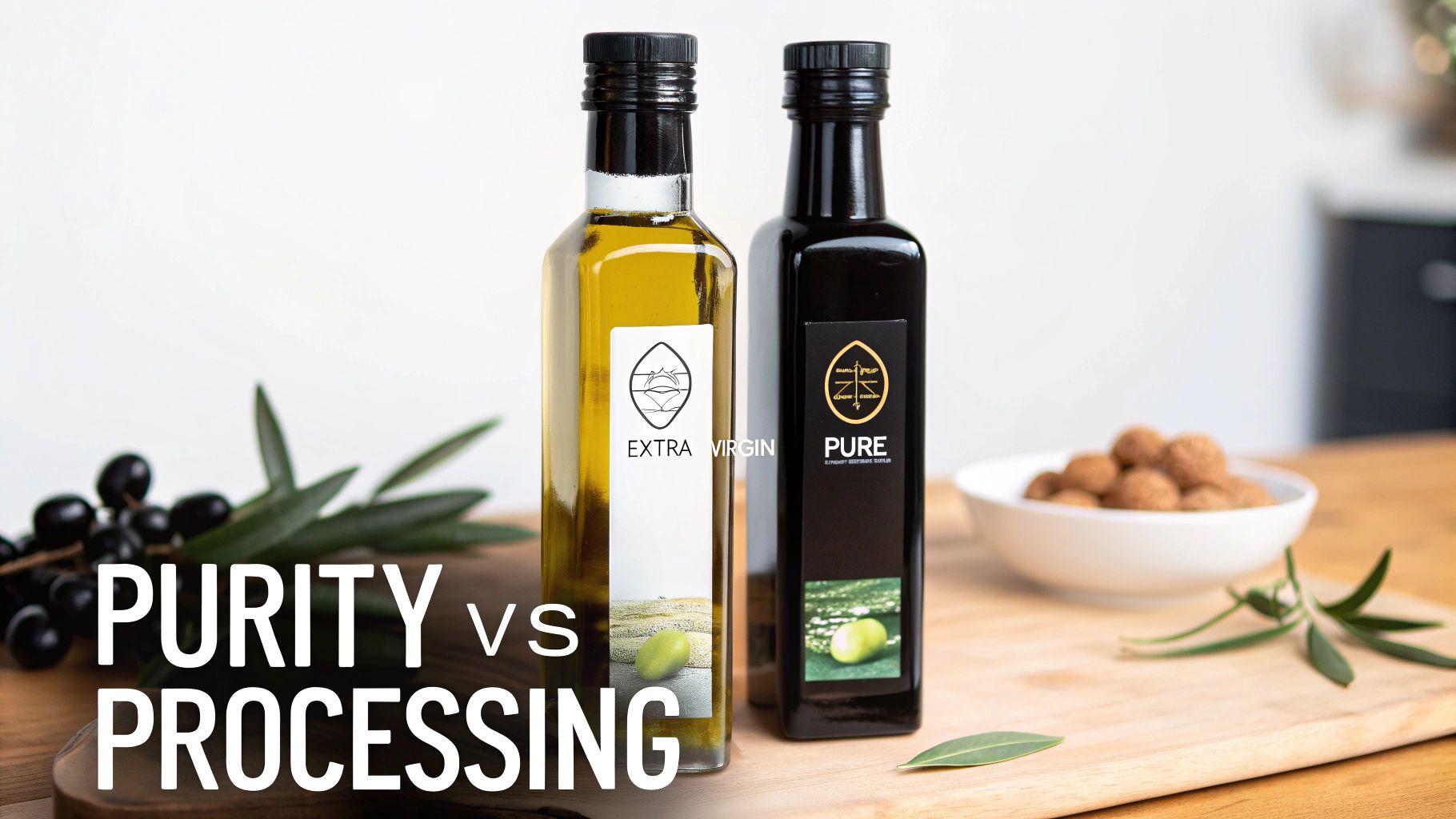
Standing in the grocery aisle, you’re faced with a wall of choices. The labels seem simple, but the stories behind these two oils are worlds apart. Imagine Extra Virgin Olive Oil (EVOO) as the most honest, authentic expression of the olive. It’s extracted using only immense pressure—no chemicals, no scorching heat. This is the secret to how it fiercely guards its unique character and nutritional might.
Now, let’s talk about "pure." That name is one of the great triumphs of marketing. "Pure" olive oil is, in fact, a blend—a mere whisper of virgin olive oil mixed with a vast amount of highly refined olive oil. This is the single most important distinction. How they are made dictates everything that follows: their flavor, their health benefits, and even their price. To pull back the curtain further, explore our guide on what is pure olive oil and discover its true place in your kitchen.
Key Differences At a Glance
Here is a simple blueprint of the most critical distinctions between these two common oils.
| Attribute | Extra Virgin Olive Oil (EVOO) | Pure Olive Oil |
|---|---|---|
| Production | Cold-pressed, mechanical means only | Blend of refined and virgin oils |
| Flavor Profile | Robust, fruity, peppery | Mild, neutral, very light flavor |
| Acidity Level | Very low (under 0.8%) | Higher (up to 1.5%) |
| Best For | Finishing, dressings, dipping, low-heat | Frying, roasting, baking, high-heat |
Mastering these differences is the first step. It empowers you to choose the right oil for the right job, ensuring your culinary creations are never less than perfect.
How Olive Oil Is Really Made
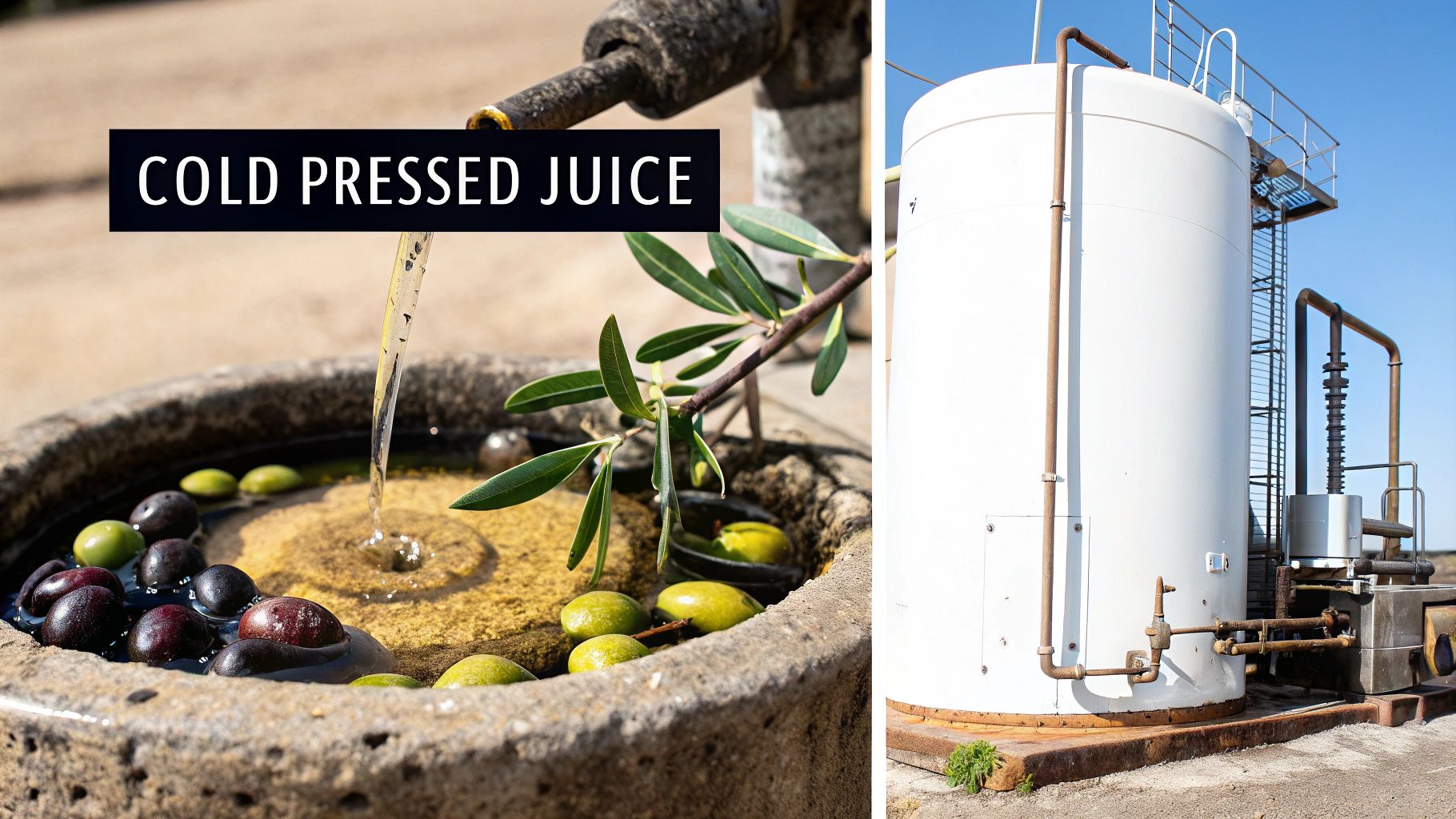
To truly grasp what separates these two oils, you must follow them on their journey. From a sun-drenched grove to the bottle on your counter, their paths diverge dramatically. This is the hidden truth behind the vast difference between pure and extra virgin olive oil.
Think of extra virgin olive oil as a simple, profound truth: it is fresh-pressed fruit juice. Olives are harvested, then crushed under immense force to squeeze out the golden liquid. This age-old method, often called the "first cold press," is purely mechanical. No chemical solvents. No destructive high heat.
This gentle handling is everything. It is designed to preserve the delicate flavors, the vibrant aromas, and the potent antioxidants—capturing the very soul of the olive.
The Industrial Path of Pure Olive Oil
The story of "pure" olive oil is a different beast entirely. Its journey is one of industrial might, starting with oils that failed to meet the exacting standards of extra virgin.
To salvage these lesser oils, they are sent to a refinery. Here, they are subjected to high heat and chemical solvents that strip away every imperfection. This harsh process neutralizes any off-flavors, but at a terrible cost: it obliterates the oil's natural character, its color, and nearly all of its nutritional firepower. What’s left is a bland, lifeless liquid.
To breathe some life back into it, producers add a small measure of virgin olive oil. It bestows a hint of flavor and a touch of color, but it’s a pale imitation of the real thing. For a more detailed look, see our complete guide on how olive oil is made.
The distinction is simple yet profound: one is a fruit juice, carefully pressed to preserve its integrity. The other is a refined product, engineered for neutrality and stripped of its natural soul.
This fundamental difference in production is the source of every other distinction—from how they taste and what they do for your health, to how you should wield them in your own kitchen.
A Masterclass in Flavor And Aroma
Have you ever wondered why one olive oil explodes with grassy, peppery notes while another is as quiet as a whisper? It’s no accident. The true difference between pure and extra virgin olive oil becomes undeniable the moment it touches your tongue.
A genuine Extra Virgin Olive Oil is an experience. It tells the story of its homeland, with complex notes of fruit, fresh-cut grass, and a signature pungent finish. That peppery kick you feel at the back of your throat is not a flaw—it is the hallmark of greatness.
That sensation is caused by oleocanthal, a potent antioxidant that screams freshness and quality. Far from being a defect, this peppery bite is what connoisseurs prize as proof of purity and health-giving power. It means you are tasting the oil as nature intended.
The Engineered Neutrality of Pure Olive Oil
Pure Olive Oil, by stark contrast, is built for neutrality. The harsh refining process mutes its natural song, stripping away the very compounds that give EVOO its soul. It is designed to be a quiet, functional fat for cooking, not the star of the show.
The flavor profile isn't just about enjoyment; it's a direct indicator of the oil's quality and antioxidant content. A bold taste often signals a healthier oil.
This deliberate blandness is its strength in certain situations. It won't fight with other flavors in your dish, making it a dependable choice for high-heat cooking like frying or in baking where you don't want the oil's personality to shine through.
Think of it this way: EVOO is the artist, adding character and depth. Pure olive oil is the reliable workhorse, getting the job done without a fuss. To truly appreciate these differences, it helps to learn how to taste olive oil like an expert.
The Real Impact on Your Health
When you look beyond the bottle and consider what you are putting into your body, the choice between pure and extra virgin olive oil becomes blindingly clear. This isn't just about selecting a cooking fat. It's about choosing between a basic ingredient and what many consider a genuine superfood.
The decisive health difference comes down to one thing: what is preserved—and what is destroyed—during production.
What's Inside the Bottle Matters
Extra Virgin Olive Oil is, without question, the nutritional champion. Because it’s unrefined and cold-pressed, it retains a powerful arsenal of polyphenols and antioxidants. These are the very compounds renowned for their potent anti-inflammatory and disease-fighting abilities, making EVOO the cornerstone of heart-healthy diets like the Mediterranean.
Pure olive oil, on the other hand, is a mere shadow of its extra virgin cousin. While it remains a source of healthy monounsaturated fats, the refining process strips away the vast majority of those precious micronutrients. You get the fat, but you lose the antioxidant magic.
The health benefits aren't just a happy accident; they are a direct result of the oil's purity. A peppery, vibrant EVOO is literally telling you it's packed with the good stuff.
This difference in quality drives global demand. Top producers like Spain and Italy contribute to the roughly 2.65 million metric tons of olive oil produced each year. In cultures where quality is paramount, like Greece where the average person consumes about 9.3 kg per year, extra virgin is the only choice that matters.
Ultimately, by choosing EVOO, you're picking an oil that does more than just cook your food—it actively contributes to your well-being. To get a closer look at the specific compounds that make it so powerful, you can explore these detailed extra virgin olive oil nutrition facts and see for yourself why it's the superior pick for your health.
Making the Right Choice in the Kitchen
So, which bottle should you grab, and when? Set aside the technical talk of acidity and cold-pressing for a moment. When you're standing before a sizzling pan, the practical differences between pure and extra virgin olive oil are what truly count.
Think of Extra Virgin Olive Oil as your finishing flourish. It possesses a bold, complex personality that you must not destroy with high heat. Its lower smoke point means it isn't made for searing, but it’s perfect for letting its character sing.
Drizzle EVOO generously over finished pasta, a bowl of soup, or a fresh salad. It is the only choice for a vibrant vinaigrette or a dip for crusty bread. It also works beautifully for a gentle sauté, where its fruity, peppery notes can infuse directly into your ingredients.
The Reliable Workhorse for High Heat
Pure Olive Oil, however, is your kitchen's tireless utility player. Its greatest assets are a neutral flavor and a higher smoke point, making it the undisputed winner for high-heat cooking. The refining process that silences its flavor also makes it more stable when the temperature soars.
This is the oil you reach for when you're frying chicken, roasting potatoes to a perfect golden crisp, or searing a steak. Its mildness also makes it a secret weapon in baking, where it won't clash with the flavor of a cake or muffins. When your goal is simply to cook something well, without adding a strong olive taste, pure olive oil is the right tool for the job.
If you wish to dig deeper into stocking your pantry, our guide on how to choose olive oil is an invaluable resource.
For a perfect, bright vinaigrette, you must use EVOO. For a perfect, golden-brown sear, Pure Olive Oil is your trusted partner. Understanding this simple rule will instantly elevate your cooking.
This clear distinction in use has shaped a massive global industry. The demand for premium EVOO, especially in culinary circles, has helped push the global olive oil market to a value of around USD 19.4 billion. With its deep roots in Mediterranean cooking, Europe accounts for nearly 50% of that market.
This simple decision tree can help you pick the right oil based on your health and cooking needs.

As you can see, EVOO is the undeniable champion for health benefits like heart support and anti-inflammatory properties. Pure olive oil, meanwhile, serves a more functional role for everyday high-heat cooking.
Which Olive Oil Should You Use?
To make it even simpler, here’s a quick guide matching the right oil to the right job.
| Cooking Method / Use Case | Recommended Oil | Why It Works Best |
|---|---|---|
| Salad Dressings & Vinaigrettes | Extra Virgin Olive Oil | Its robust, fruity flavor is the star of the show. |
| Dipping & Finishing | Extra Virgin Olive Oil | Drizzling it raw preserves its complex taste and health benefits. |
| Sautéing & Pan-Frying | Pure Olive Oil | Its higher smoke point handles medium-to-high heat without burning. |
| Roasting & Baking | Pure Olive Oil | Provides moisture and crispness with a neutral flavor that won't interfere. |
| Deep-Frying | Pure Olive Oil | Offers a high smoke point and a cost-effective option for using larger volumes. |
Ultimately, having both types in your pantry gives you the versatility to handle any recipe that comes your way.
Got Olive Oil Questions? We've Got Answers
Even after you understand the fundamental difference between pure and extra virgin olive oil, you might still have a few nagging questions. Let's solve the most common puzzles so you can shop and cook with absolute confidence.
Can you really fry with extra virgin olive oil? Yes, but with a crucial caveat: mind the heat. EVOO is brilliant for a gentle sauté, but its smoke point is lower than its refined cousins. For the intense heat of deep-frying, a neutral, budget-friendly "pure" olive oil is the smarter, safer bet.
And what about that beautiful green color? Many believe a deep green hue is the ultimate sign of quality. The truth? Not necessarily. The color is determined by the olive variety and its ripeness at harvest; it doesn’t define the oil's quality. A stunning golden oil can be just as complex and delicious as a vibrant green one. Let your palate be the judge, not your eyes.
Can I Substitute One for the Other?
In a pinch, you can sometimes use pure olive oil where EVOO is called for, especially in cooked dishes where its flavor is not the main event. But here is the one rule you must never break: do not substitute pure olive oil for EVOO in any raw application, like a vinaigrette or a finishing drizzle.
To do so would be like using a crayon when the recipe demands a fine-tipped pen. You would rob the dish of the incredible aroma, the nuanced flavor, and that signature peppery finish that makes a great EVOO truly magnificent.
Think of them as two different tools in your culinary kit. EVOO is your flavor powerhouse for dressings, dips, and finishing, while pure olive oil is your dependable workhorse for everyday, high-heat cooking.
The smartest strategy is to have both in your pantry. That way, you are always armed with the right oil for the right job, ready to make every single meal that much better.
Ready to explore the world of high-quality olive oil with confidence? At Learn Olive Oil, we provide expert guides, tasting notes, and recommendations to help you find the perfect bottle for any occasion. Discover the World of Premium Olive Oil today
 Learn Olive Oil
Leave a comment