When you see the words extra virgin olive oil on a bottle, you're not just looking at a label. You're looking at a promise. A promise of purity, of flavor, of an unbroken link to the ancient groves where it was born.
This isn't just another cooking oil. It is the purest expression of the olive—nothing more than the fresh, unadulterated juice, captured by mechanical force alone. No chemicals. No excessive heat. Just the golden liquid released from the fruit.
The Guarantee Behind the Label
"Extra Virgin" isn't a marketing slogan. It’s a legally enforced standard, a grade that signifies the absolute pinnacle of quality.
Imagine the difference between a glass of orange juice squeezed from a fresh-picked orange, and a sugary, watery drink from a carton. That’s the chasm that separates true extra virgin from the rest. The "extra virgin" title has to be earned through a series of grueling tests.
This grade guarantees the oil has aced two exams: one in a laboratory and one before a panel of trained human tasters. To pass, an oil must have a free acidity below a mere 0.8% and be completely, utterly free of any taste defects. You can discover the full story behind the name in our guide on why it's called extra virgin olive oil.
The term "extra virgin" is a seal of authenticity. It is your assurance that the bottle contains nothing but pure, cold-pressed olive juice, judged perfect in aroma and flavor.
This unwavering standard is the very reason EVOO is celebrated for its breathtaking flavors and health-giving properties. It’s what sets this liquid gold apart from every other oil on the shelf.
Quick Guide to EVOO Quality
To help you understand what makes Extra Virgin Olive Oil special, here’s a quick breakdown of its core attributes.
| Attribute | What It Means for EVOO | Why It Matters to You |
|---|---|---|
| Production Method | Made using only mechanical means (cold-pressed) with no heat or chemicals. | This is the only way to protect the natural flavors, antioxidants, and healthy fats. |
| Acidity Level | Must be below 0.8%. | This is the chemical proof of healthy, undamaged olives and swift, careful handling. |
| Sensory Test | Judged by a tasting panel to be free of any flavor or aroma defects. | Guarantees a fresh, vibrant, and pleasant taste—never rancid, musty, or dull. |
These criteria are inseparable. Together, they ensure that every bottle labeled "Extra Virgin" delivers the authentic taste and nutritional power you expect.
From Olive Grove to Golden Oil
The true meaning of "extra virgin" isn't forged in a factory. It begins in the soil. Picture a perfect, plump olive, harvested at the precise moment of ripeness. Getting that fragile fruit from the branch to the press is a race against time—a craft built on speed and precision.
This is where quality is won or lost. Olives must arrive at the mill within hours of leaving the tree. Once there, they are crushed and pressed in a single, continuous process. You've probably seen the term "first cold press" on a label. This isn't marketing fluff; it's the heart of the entire method. To get a better feel for this, you can learn more about how olive oil is made and see all the steps.
The Importance of Cold Pressing
Keeping the temperature down during extraction is non-negotiable. Heat is the mortal enemy of flavor and quality. If temperatures rise above a strict threshold—typically around 27°C (80.6°F)—the olive paste begins to cook, destroying the very compounds that make an oil "extra virgin."
This gentle, heat-free approach is the only way to lock in the oil's delicate floral notes, its fresh grassy aromas, and its payload of powerful antioxidants. The whole journey begins long before the press, with the cultivation of the olives themselves. To truly appreciate this agricultural side, imagine yourself exploring the sun-drenched olive groves in Cyprus.
This infographic breaks down the three core pillars that define how real EVOO is made.
As you can see, it all comes down to starting with pure olive juice, using absolutely no heat, and maintaining incredibly low acidity. These steps are completely inseparable. This strict, cold-press technique is the secret behind the exceptionally low acidity and flawless taste that earns an oil its crown. It's a standard of purity that refined, heat-treated oils simply can't touch.
The Science and Senses of Purity
So, how can you be sure an oil is truly "extra virgin"? It’s not just a fancy label slapped on a bottle. That promise is backed by a demanding, two-part trial where cold, hard science meets the refined human palate. One cannot pass without the other.
First, the oil is put under the microscope in a lab. Here, technicians run a full chemical analysis, checking its molecular fingerprint for key quality markers. The most famous of these is Free Fatty Acidity (FFA). Think of FFA as a report card for the olives and a stopwatch for the milling process. A lower number means healthier fruit was pressed with lightning speed after harvest.
To earn the extra virgin title, an oil's FFA must clock in below 0.8%, but the true champions of the olive world often boast levels far lower than that.
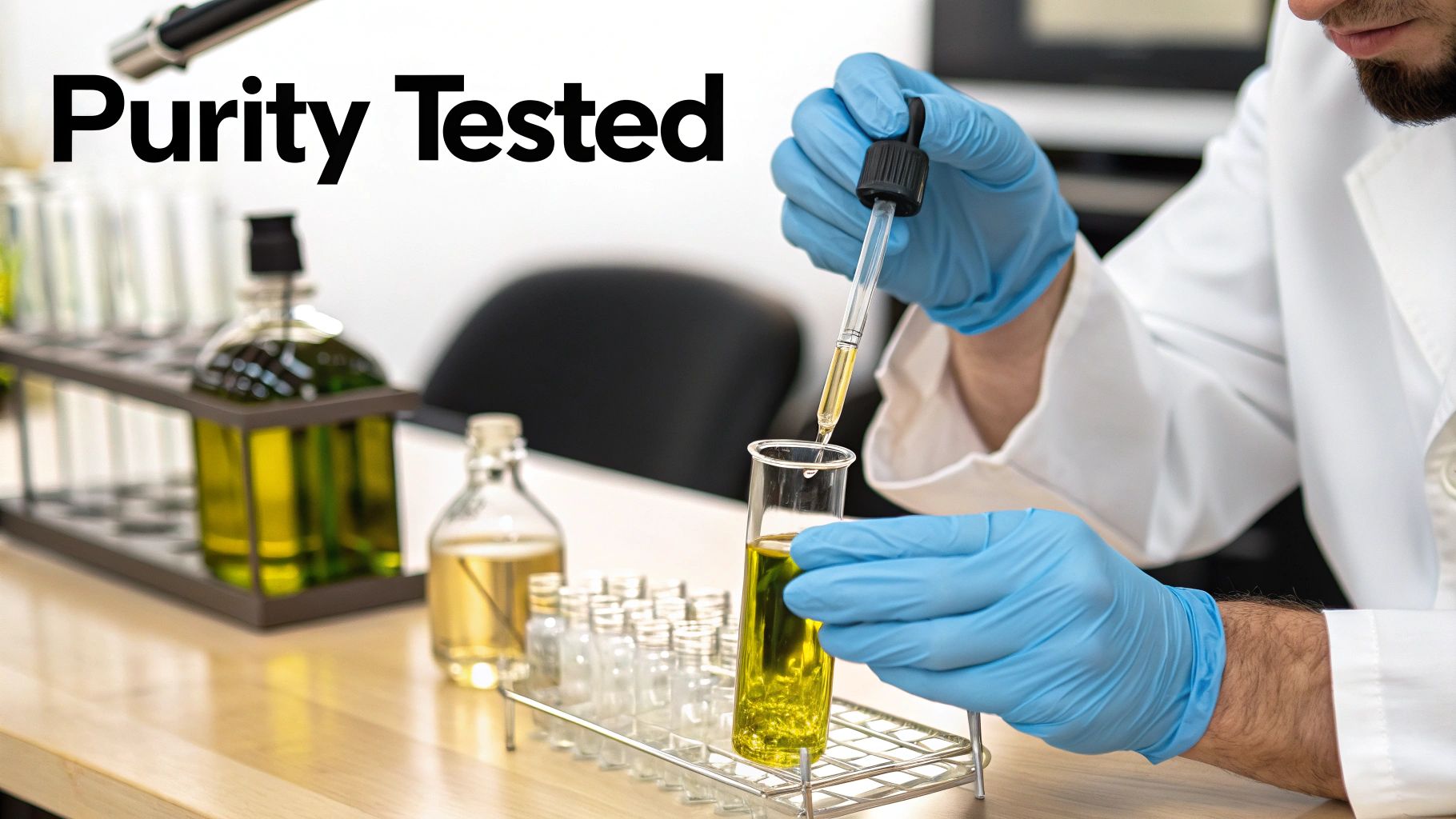
This level of scrutiny makes sense when you see the numbers. Global demand for the real deal is massive. In Spain, the world's leading producer, a recent campaign saw sales of around 1.135 million tons—that’s roughly 80% of their total production, which gives you a sense of the scale we're talking about.
The Ultimate Taste Test
Once an oil clears the lab tests, it faces its final, and arguably toughest, challenge: a panel of human experts. A certified group of sensory analysts performs what’s called an organoleptic assessment. This is not your average bread-dipping session; it's a highly disciplined and objective evaluation.
To ensure impartiality, the tasters use special blue glasses. This clever trick masks the oil's color—which can vary wildly and has zero bearing on quality—preventing any unconscious bias from clouding their judgment.
Their mission is simple: find the good and weed out the bad. To pass, an oil must have noticeable fruity notes and be completely, utterly free of defects. Even one tiny flaw, and it's disqualified.
They are hunting for three positive attributes, the holy trinity of a great EVOO:
- Fruitiness: Does it smell and taste fresh, like green or ripe olives?
- Bitterness: A pleasant, sharp sensation on the tongue, often the signature of early-harvest, antioxidant-rich olives.
- Pungency: That peppery kick you feel in the back of your throat. It's the calling card of a fresh, high-quality oil.
This sensory judgment is the final seal of approval. It’s a fascinating skill, and you can even learn how to taste olive oil like the pros do. In the end, it’s this powerful combination of lab data and expert human senses that guarantees the oil in your kitchen is the real deal.
How to Read an Olive Oil Label
Have you ever stood in the grocery aisle, paralyzed by a wall of olive oil bottles? They all seem to have beautiful labels with rolling hills and charming Italian farmhouses. But here’s a little secret: most of what you see on the front is just marketing. To find a truly great extra virgin olive oil, you need to play detective.
The good news is that all the critical clues are right there on the bottle, usually on the back label. So, ignore the fancy script on the front for a moment. Flip that bottle around. Your first mission is to find the single most important piece of information that speaks volumes about the oil's quality.
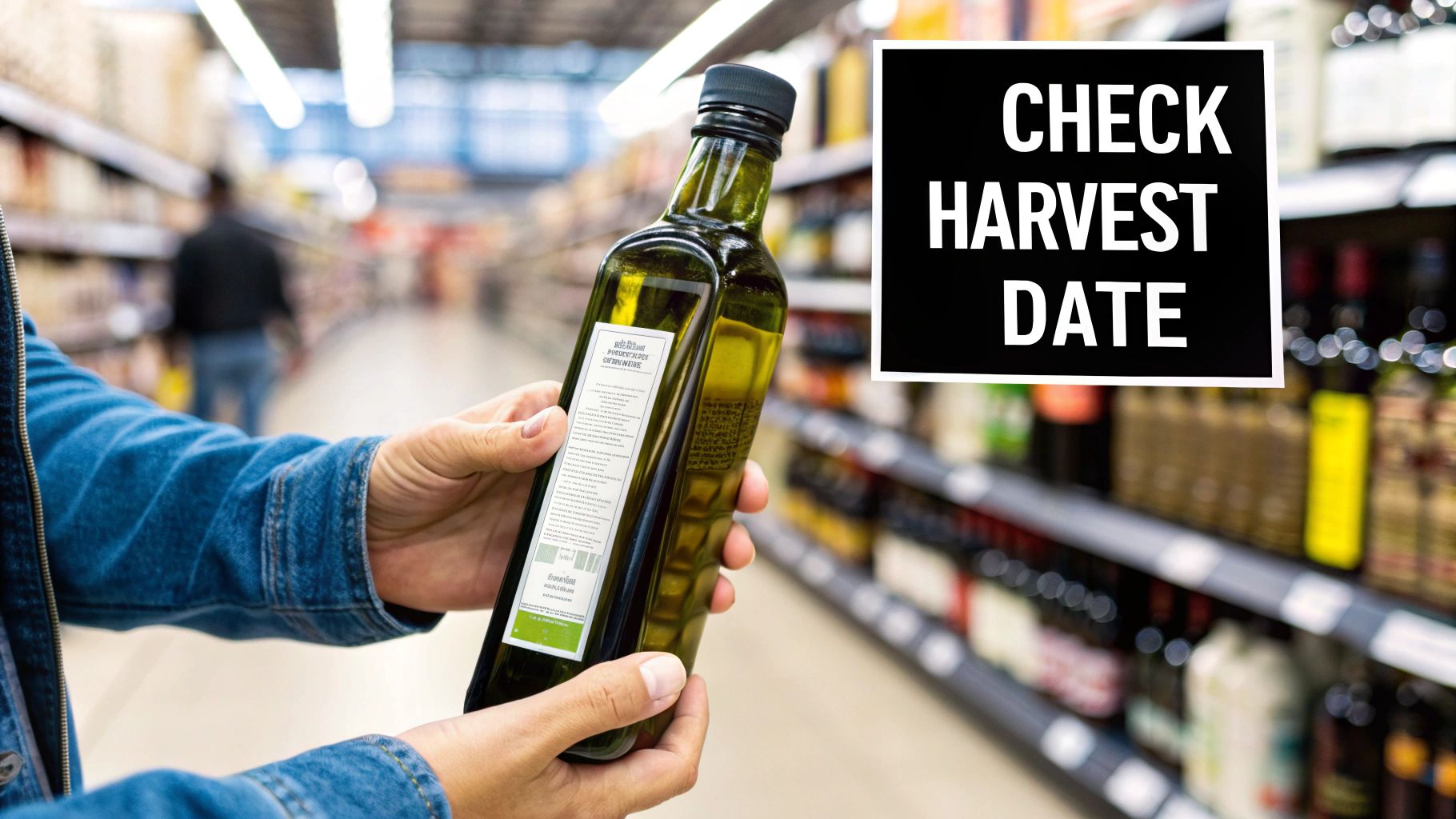
What is this magic detail? It’s not a gold seal or a flowery description of its taste. It’s the harvest date.
Look for the Harvest Date First
Think of olive oil as fresh-pressed fruit juice, because that's exactly what it is. And just like any juice, it's best when it's fresh. It does not get better with age.
Many bottles have a "Best By" date, but that can be deceiving. That date is often set for two years after bottling, not two years after the olives were picked. The harvest date, on the other hand, tells you the whole story—it's the birth certificate of your olive oil.
Always search for the most recent harvest you can find. This date is your best indicator of freshness, which translates directly to better flavor and more health benefits. If a bottle doesn't have a harvest date, put it back. It’s a gamble you don’t need to take.
A "Best By" date is a guess about the future. A harvest date is a fact about the past. That difference is everything when it comes to quality.
Decoding Seals and Red Flags
Once you've found the harvest date, a few other details can help you zero in on the perfect bottle. Some official seals are a good sign, while certain common marketing terms are actually red flags.
Look for These Quality Seals:
- PDO (Protected Designation of Origin): This is a big deal. It guarantees the olives were grown and pressed in a very specific geographic area using time-honored local methods. It’s a direct link from the bottle back to its terroir.
- PGI (Protected Geographical Indication): This is also a great sign. It’s similar to PDO but means at least one phase of the production happened in that specific region.
Avoid These Marketing Traps:
- "Pure Olive Oil": Sounds wholesome, right? It's not. "Pure" is an official grade for an oil that is mostly refined olive oil blended with a tiny bit of virgin oil to give it some flavor.
- "Light" or "Extra Light": This has nothing to do with calories or health. It simply means the oil has a lighter color and a neutral flavor because it has been highly refined. You lose all the bold taste and powerful antioxidants of a true EVOO.
Learning these simple cues will completely change how you shop for olive oil. For a deeper dive, check out our complete guide to understanding olive oil labeling. Armed with this knowledge, you can walk down that aisle and pick your next bottle with total confidence.
The Global Quest For Authentic EVOO
The world’s appetite for extra virgin olive oil is surging. From home cooks experimenting with dressings to chefs drizzling it over pasta, everyone wants that fresh, grassy kick.
In one recent month, EU exports to extra-EU countries reached 74,914 tons, marking a 36.1% leap compared to the same period last year. Even more striking, 74.6% of those shipments met the strict criteria to be labeled extra virgin olive oil. For more detail, check the International Olive Council’s data on EU export volumes.
- United States: tops the list, driven by health-focused consumers
- Australia: new palates embracing its peppery edge
- Canada: artisan kitchens fueling consistent growth
- China and Brazil: expanding tastes for Mediterranean cuisine
Impact On Quality Standards
That hot demand has a downside: temptation for fraud. Discounted labels and blended fakes can slip onto shelves, threatening every honest producer’s reputation.
“Every authentic EVOO bottle is a triumph against counterfeit oils,” says one industry insider.
To fight back, regulators and growers have built a multi-layered defense:
- Harvest date verification
- Chemical and sensory testing
- Blockchain-enabled supply chains
Cultural Connection
Beyond numbers, this global craze ties us to centuries-old Mediterranean rituals. Imagine the sun-warmed groves of Italy or Greece bottled up, ready for your kitchen. That heritage even influences Mediterranean style home decor, blending food and lifestyle in every olive-green accent.
You can also learn more about olive oil authenticity to ensure the next bottle on your shelf lives up to the promise.
In the end, each genuine drop of EVOO is more than a condiment—it’s a story of tradition, trust, and taste that stands out in a crowded marketplace.
Common Questions About Extra Virgin Olive Oil
Let's clear the air. There's a ton of misinformation out there about extra virgin olive oil, and it can create a lot of confusion in the kitchen. We're here to tackle the most common myths with straightforward, no-nonsense answers so you can use your oil with complete confidence.
One of the most stubborn myths? That you shouldn't cook with it. This couldn't be further from the truth.
Can You Actually Cook With EVOO?
Yes, you absolutely should. The idea that EVOO is only good for drizzling over salads is a myth that needs to disappear for good. A high-quality extra virgin olive oil has a smoke point somewhere between 375°F and 410°F, which is more than enough for everyday cooking like sautéing, roasting, and even light frying.
It’s also far more stable under heat than many people realize, holding up better than a lot of refined seed oils. Cooking with it doesn't just add incredible flavor to your food—it also helps transfer its powerful antioxidants to whatever you're making.
What Separates Extra Virgin From Regular Olive Oil?
It all comes down to two simple things: how it's made and how pure it is. Extra virgin olive oil is the real deal—the pure, unrefined juice from the first cold pressing of olives. To earn the name, it must be completely free of any taste defects. Think of it as a raw, natural product in its finest form.
On the other hand, what's often labeled as "Regular" or "Pure" olive oil is a heavily processed blend. It's mostly made up of refined oil that has been treated with heat and chemicals to strip away any flaws. A tiny bit of virgin oil is then added back in for a hint of flavor.
Does the Color of Olive Oil Mean Anything?
Not really, no. The color of olive oil tells you very little about its quality. A deep green hue might come from early-harvest olives, giving the oil a peppery, robust taste. A golden-yellow oil likely comes from riper olives, which results in a milder, more buttery flavor.
Both can be fantastic extra virgin olive oils. The color is simply a reflection of the olive variety and when it was harvested. This is exactly why professional tasters use special cobalt blue glasses—it completely hides the color, so it can't influence their judgment.
The most important qualities of an olive oil are its aroma and taste, not its color. A fresh, fruity scent and a clean flavor are the true signs of a superior oil.
How Should I Store My Olive Oil?
Proper storage is everything if you want to preserve that fresh-from-the-mill taste. You have to protect it from its three greatest enemies: heat, light, and air.
Always keep your EVOO in a cool, dark place, like a cupboard—and never next to the stove where the temperature is always changing. Make sure you seal the cap tightly after every single use to keep oxygen out. The best containers are dark glass bottles or opaque tins, as they provide the best defense against damaging light. Once you've opened a bottle, it’s best enjoyed within a few months to experience its peak flavor and aroma.
At Learn Olive Oil, we believe that understanding what's in your bottle makes every meal better. We provide expert insights to help you choose, taste, and cook with the world's best olive oils. Discover the World of Premium Olive Oil and turn your appreciation into expertise.

 Learn Olive Oil
Leave a comment