I’m going to let you in on a little secret.
The best extra virgin olive oil isn't the one with the fanciest Italian label or the steepest price tag. The truth is, most of what you see on supermarket shelves is a pale imitation of the real thing.
True liquid gold—the kind that floods your senses with flavor and floods your body with health—is defined by a powerful trifecta of qualities: explosive freshness, vanishingly low acidity, and a sky-high polyphenol count. It's revealed by a vibrant, peppery taste and a recent harvest date, not marketing hype.
The Unfiltered Truth About Finding Liquid Gold
Imagine the difference between a sun-ripened tomato picked fresh from the vine—juicy, fragrant, and bursting with life—and a bland, mealy imposter from a thousand miles away. That's the same chasm in quality that separates a genuine extra virgin olive oil from the countless pretenders lining the grocery store aisle.
Most people see the "extra virgin" label and assume it's a seal of absolute approval. But here’s the unfiltered truth: that label is just the starting line. It’s where the race for quality begins, not where it ends.
This guide is your roadmap. With it, you'll cut through the marketing fog and arm yourself with the knowledge to go from a confused consumer to a confident buyer who can spot the genuine article every single time.
Beyond the Brand Name
Forget fixating on a famous family name. The hunt for the best extra virgin olive oil is about what’s inside the bottle. You must think of it like fresh-squeezed juice; it's a raw, living agricultural product, and its vitality begins to fade the second it's made.
This means the true signs of quality are universal, regardless of the brand on the label:
- A recent harvest date: This is your non-negotiable proof of freshness, telling you precisely when the olives were picked and pressed.
- A peppery finish: Feel that little tickle or cough at the back of your throat? That's not a flaw. It's the unmistakable signature of powerful, health-boosting antioxidants called polyphenols.
- Protection from light: World-class producers always use dark glass bottles or tins. Why? Because light is one of olive oil's greatest enemies, turning liquid gold into a rancid mess.
The most expensive bottle is rarely the best, and the most familiar brands are often the least impressive. Your own palate and a bit of inside knowledge are the only tools you truly need.
Before we dive deeper, here's a quick reference table that breaks down the essential markers of a truly exceptional extra virgin olive oil.
Quick Guide to Identifying Top-Tier EVOO
| Quality Indicator | What It Means for You | Why It's Non-Negotiable |
|---|---|---|
| Harvest Date | Maximum freshness and flavor. | Oil degrades over time; freshness is everything. |
| Peppery Finish | High in healthy antioxidants (polyphenols). | This is the source of EVOO's main health benefits. |
| Dark Bottle/Tin | The oil is protected from light damage. | Light exposure creates rancidity and kills nutrients. |
This table is your starting point. Commit these three pillars to memory as you shop, and you'll already be miles ahead of the average consumer.
Making an Informed Choice
Staring down the olive oil aisle can be a dizzying experience, filled with confusing terms and misleading claims. Sadly, many bottles on the shelf are old, have been stored improperly, or are downright fraudulent. Learning how to tell if olive oil is real is the first and most critical step to avoid wasting your money and finally get the amazing flavor and health benefits you deserve.
Get ready to discover why the country listed on the front of the bottle is far less important than the hard evidence of freshness and purity you'll learn to look for.
Decoding the Label to Uncover True Quality
Think of the label on that olive oil bottle as a treasure map. It's your single best defense against a sea of mediocre, lifeless oils masquerading as the real deal. With a little insider knowledge, you can read the clues and find the liquid gold.
Most shoppers see the words "Extra Virgin" and stop there, assuming it’s a guarantee of excellence. That’s a monumental mistake. "Extra Virgin" is merely the price of admission—it gets an oil into the game, but it doesn't automatically make it a champion. To find a truly great olive oil, you have to become a label detective.
The absolute most important clue to look for is the harvest date. It's non-negotiable. This date tells you exactly when the olives were picked and crushed, giving you an undeniable picture of the oil’s freshness.
The Crucial Difference Between Harvest and Best-By Dates
Don't be fooled by a "best by" or "bottling" date. These are often set arbitrarily, sometimes two years or more after the oil was actually made. A bottling date simply tells you when old, tired oil was poured into a new bottle. It's a classic bit of marketing misdirection.
A harvest date is a producer’s promise of freshness. A “best by” date is often a marketing department’s hope. Always choose the promise over the hope.
A genuine, high-quality EVOO is at its peak within 18 months of its harvest. Look for a specific season and year, like "Autumn 2023." This one detail separates vibrant, life-giving oils from stale, forgettable ones. A producer who is proud of their fresh product will display the harvest date prominently. If it's missing or buried in the fine print? That's a massive red flag.
Beyond the Date Stamp
Once you've found a recent harvest date, you can dig a little deeper. A few other clues on the label can paint a much fuller picture of the oil's journey from the grove to your kitchen, helping you spot a meticulously crafted product versus a mass-produced commodity.
Here’s what to look for next:
- Country of Origin: Specificity is your ally. A label saying "Product of Italy" is far less reliable than one naming a specific estate or region, like "Tuscany, Italy." Vague sourcing usually means it’s a blend of olives from all over, some of which are likely of lower quality.
- Estate Grown: This tells you the olives were grown, harvested, and milled all on the same property. That level of control is a huge sign of quality because it drastically shortens the time between picking and pressing—a critical factor for creating low-acidity, high-flavor oil.
- Certifications: Official seals like PDO (Protected Designation of Origin) or PGI (Protected Geographical Indication) are legally binding guarantees. They ensure the oil was made in a specific region using traditional methods, holding it to a much higher standard than generic EVOO.
Imagine you're holding two bottles. One says, "Extra Virgin Olive Oil, Product of the Mediterranean." The other reads, "Single Estate EVOO, Harvested November 2023, Tuscany, Italy, PDO Certified." The second label tells a story of place, time, and accountability. The first one tells you almost nothing.
Learning these details is crucial. For an even more detailed breakdown, you can learn more about the intricacies of olive oil labeling and what regulations require. This knowledge turns you from a regular shopper into a savvy expert who can pick out a fantastic bottle with confidence every time.
The Science of Superior Flavor and Health
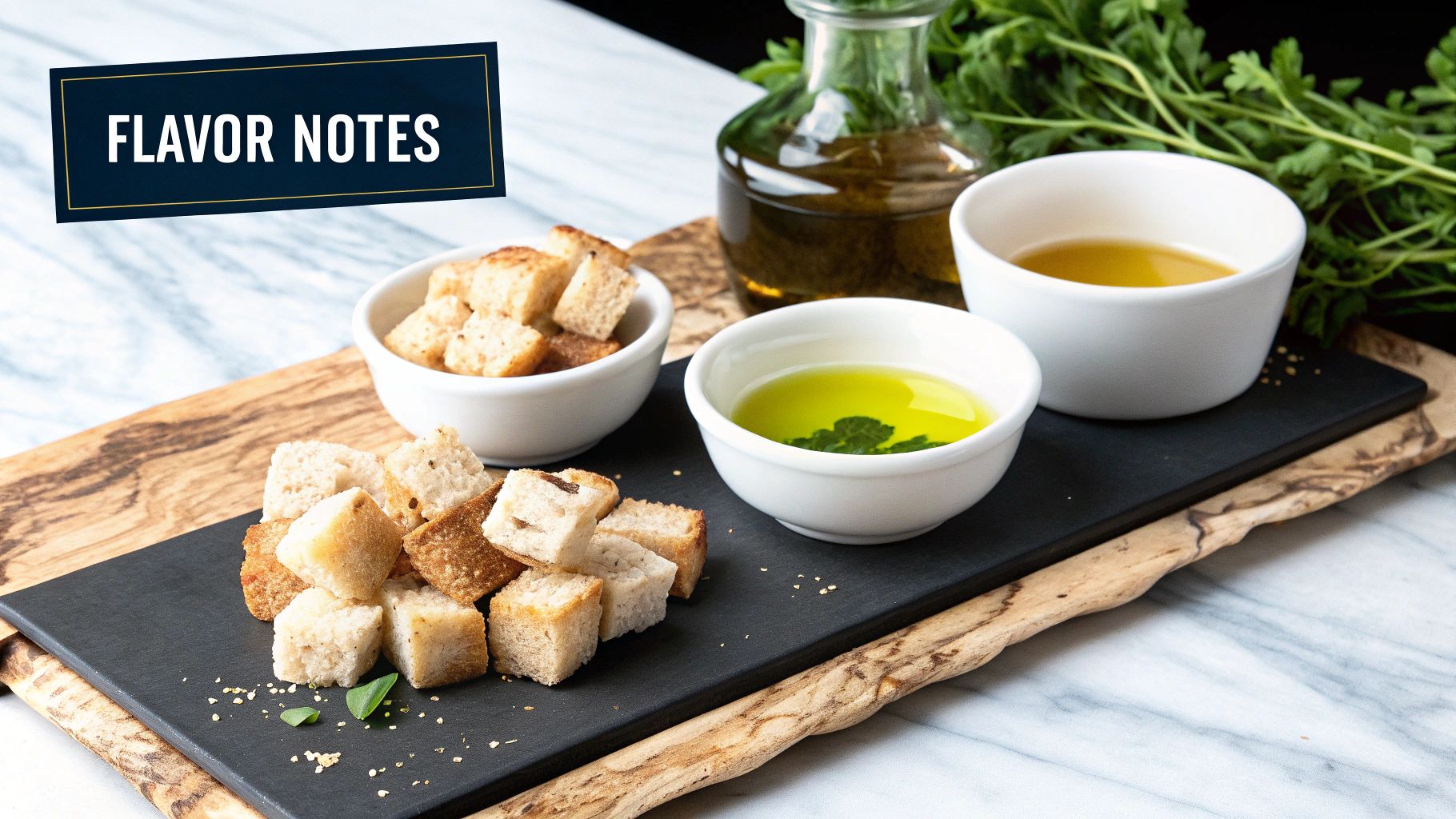
We've cracked the code on the label, but what really separates a good extra virgin olive oil from a truly exceptional one? To discover that, we have to look past the bottle and into its very chemical makeup.
Don't worry, you don't need a lab coat for this. It all comes down to two key markers that directly control both flavor and health benefits: acidity and polyphenols. Think of them as the building blocks of quality. Once you understand them, you'll never look at olive oil the same way again.
Understanding Acidity The Right Way
Let’s banish one common misconception right now. Free fatty acidity has absolutely nothing to do with a sour or acidic taste. It’s purely a chemical measure of breakdown—a freshness gauge at a microscopic level.
Imagine a perfect, crisp apple just plucked from a tree. Now, picture that same apple after it's been bruised and left on the counter for a few days. The bruising is a sign of cell breakdown. The very same thing happens with olives.
When olives get damaged—whether they're bruised during harvest, left sitting in piles for too long, or processed poorly—their fats begin to break down, releasing free fatty acids. A higher acidity level simply means more breakdown has occurred, pointing to damaged fruit or a sloppy, slow production process.
World-class extra virgin olive oil is born from an obsession with speed and gentle handling. The mission is to get healthy, unbruised olives from the tree to the mill in just a few hours to preserve their absolute integrity.
To earn the "extra virgin" title, an oil must have a free acidity of 0.8% or less. But the true artisans, the producers behind the world's best oils, aim for much, much lower. It’s common to see award-winning oils with acidity levels below 0.3%, a clear signal of meticulous farming and masterful milling.
The Power of Polyphenols
Now for the exciting part. If low acidity is the mark of a well-made oil, then a high polyphenol count is the mark of a powerful one.
Polyphenols are a class of potent antioxidants, and they are the superstars behind olive oil's legendary health benefits. These are the very compounds that give a great EVOO its distinct personality—the fruity notes, the bitterness, and that peppery finish.
Ever tasted an oil that gives you a sharp, peppery kick in the back of your throat, maybe even making you cough? That’s not a flaw. That's a feature!
That peppery sensation is the signature of oleocanthal, a specific polyphenol with stunning anti-inflammatory properties. It’s the ultimate signal that you're tasting an oil loaded with health-boosting compounds. Learning to love that pungency is a rite of passage for every true olive oil enthusiast. You can get a closer look at these compounds by exploring our guide to olive oil polyphenol content.
The global olive oil market is massive. The European Union alone exports around 75,000 tons every month. Within that huge number, roughly 74.6% is classified as extra virgin, which shows just how vital this quality standard is for producers and consumers alike.
When you choose an EVOO with low acidity and a high polyphenol count, you're not just buying a cooking oil. You're securing a fresh, vibrant, and powerful functional food that truly delivers on both flavor and wellness.
How to Taste Olive Oil Like a True Connoisseur
Do you think tasting olive oil is just for experts wandering through groves in Tuscany? Think again. It’s a skill anyone can master right in their own kitchen, and your palate is the ultimate tool you have for spotting a truly great oil. Forget just dipping bread; we're about to unveil the professional method that reveals an oil’s true soul.
This is the moment of truth. After you’ve decoded the labels and understood the science, the real test comes down to taste.
Waking Up the Aromas
First, let's unlock those aromas. Pour about a tablespoon of oil into a small, clean glass—a wine glass is perfect, but even a shot glass will do. Cup the glass in one hand to warm it slightly, and place your other hand over the top to trap the aromas inside.
Now, gently swirl the oil for about a minute. The warmth from your hand is the secret here. It coaxes the oil to release its volatile aromatic compounds, which are the very essence of its character.
What Your Nose Knows
Lift the glass to your nose, remove your hand, and take a good, deep inhale. What do you smell? There are no wrong answers, only your own impressions. Does it smell like a freshly cut lawn? Perhaps you pick up notes of green almond, fresh artichoke, or even a hint of banana. These lively, fresh scents are your first clue that you’re dealing with a high-quality oil.
This isn't just for show. You're training your brain to associate certain fragrances with quality. If you really want to dive deep and refine your technique, there's a lot of great info on how to taste olive oil that can build your confidence.
This chart gives you a glimpse into how different olive-growing regions stack up when it comes to the relationship between polyphenol levels and acidity.
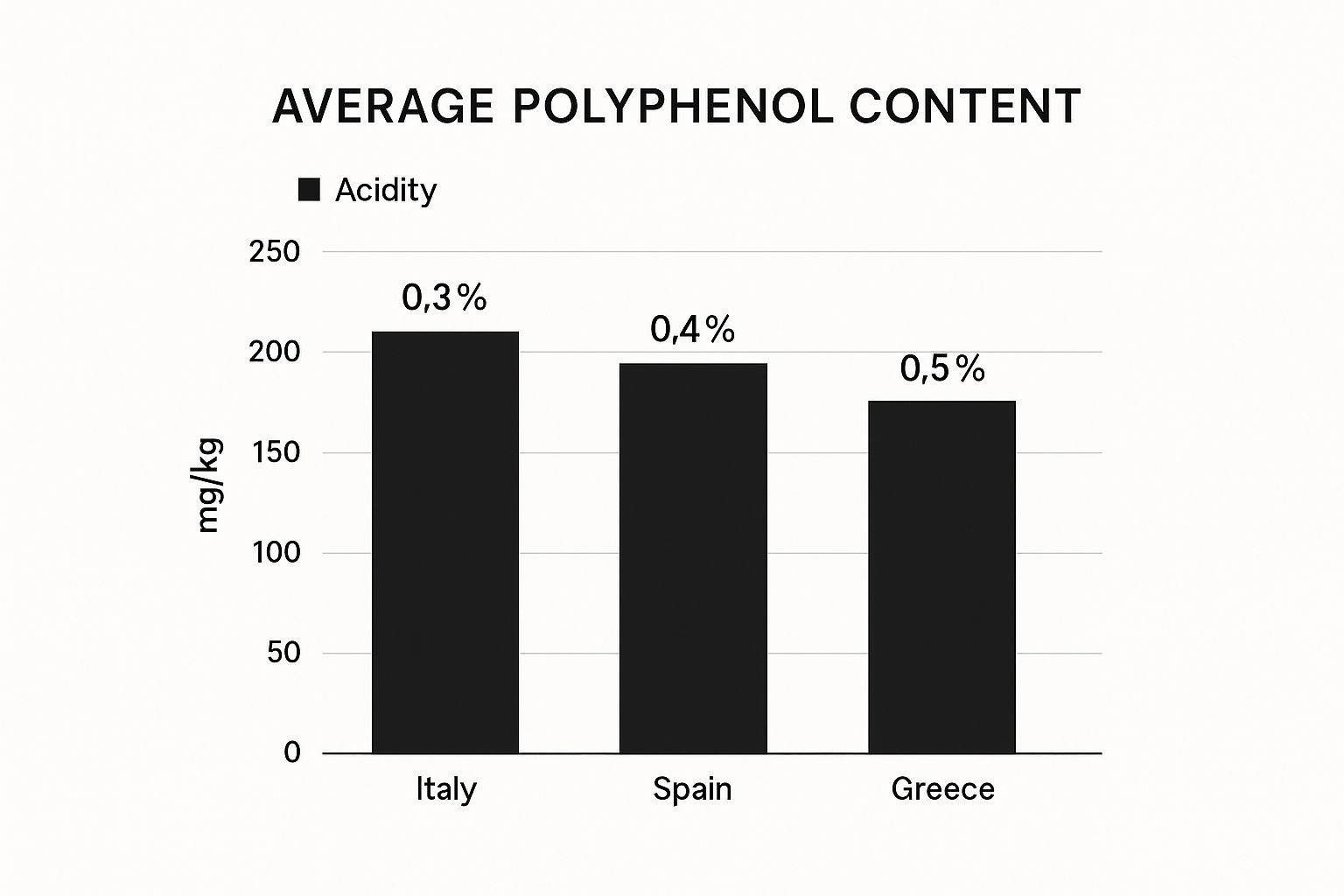
As you can see, some regions consistently produce oils with higher polyphenol counts, which directly translates to that more intense, peppery flavor we're looking for.
The Sip, Slurp, and Sensation
Now for the thrilling part: the slurp. In Italian, it's called strippaggio. Take a small sip, but don't swallow just yet. Keep your teeth lightly together and suck in a bit of air, pulling it across the oil in your mouth. It might feel a little odd at first, but this simple action vaporizes the oil, spreading it across your entire palate and sending its aromas straight up to your olfactory senses for a full-flavor explosion.
This is where you'll be able to pinpoint the three hallmark attributes of a fantastic EVOO:
- Fruitiness: This is what you perceive both in your nose and on your tongue. It’s the sum of all those fresh, plant-like aromas—think grassy, nutty, or even buttery notes.
- Bitterness: A distinctly positive trait you'll taste on your tongue, especially towards the back. A pleasant bitterness is a tell-tale sign that the oil was made from fresh, healthy olives packed with those powerful polyphenols.
- Pungency: That peppery kick you feel in the back of your throat. It might even make you cough, and that's a good thing! This sensation comes from oleocanthal, a potent anti-inflammatory compound. Don't be afraid of the cough—it's the signature of an exceptional oil.
Of course, you also need to learn to spot the defects. The most common enemy is rancidity. A rancid oil smells and tastes stale, like old walnuts or wax crayons. Other flaws include a musty or fusty flavor, which happens when olives begin to ferment before they're pressed.
Once you’ve tasted a truly vibrant, fresh olive oil, these defects will become impossible to ignore. Your own senses are, without a doubt, the most reliable guide you have.
The Health-Boosting Power of Real EVOO
So, why are so many people so passionate about extra virgin olive oil? The answer is simple: a genuine, high-quality EVOO is so much more than just another cooking fat. It's a powerhouse of beneficial compounds that can genuinely enhance your well-being, which is exactly why it's the cornerstone of the celebrated Mediterranean diet.
The secret to its incredible health profile is found in its chemical makeup. Unlike heavily processed seed oils, real EVOO is packed with heart-friendly monounsaturated fats—mostly oleic acid. This is the "good fat" you hear about, the one credited with supporting cardiovascular health and keeping cholesterol levels in check.
But that's just the beginning of the story. The real magic lies in its potent antioxidants, specifically the polyphenols we talked about earlier. Remember that peppery kick you feel at the back of your throat? That's the calling card of oleocanthal, a unique polyphenol that boasts impressive anti-inflammatory properties.
It's More Than Just a Fat
Here’s a powerful way to think about it: all those quality markers you've just learned to look for—the freshness, the pungency, the bitterness—are direct clues to the oil's health-giving potential. A lively, flavorful oil is telling you it's rich in polyphenols and ready to go to work for your body. A flat, stale oil? It's not offering much beyond empty calories.
A truly great extra virgin olive oil works harder for you. The more vibrant its flavor, the more powerfully it supports your long-term health.
It's no surprise that people around the world are catching on. As awareness grows, the demand for authentic EVOO has skyrocketed. The global olive oil market was recently valued at around USD 19.4 billion and is expected to climb to over USD 30.6 billion by 2032.
A Delicious Daily Habit for Wellness
Weaving a premium EVOO into your daily meals is one of the easiest and most enjoyable things you can do for your health. This isn't about drenching your food; it's about making a conscious switch to an oil that gives back. For a deep dive, you can explore the full range of extra virgin olive oil benefits in our dedicated guide.
Beyond its healthy fats, a top-tier EVOO is loaded with antioxidants. To take your wellness journey even further, you can pair it with other powerful ingredients when you discover other anti-inflammatory foods that work in harmony with a great olive oil.
The takeaway is simple. The best extra virgin olive oil for your palate is also the best one for your health. When you choose an oil with a recent harvest date and a bold, peppery finish, you're not just cooking—you're actively nourishing your body with every single meal.
Exploring the World's Premier Olive Oil Regions
When it comes to olive oil, geography is everything. The unique combination of soil, climate, and olive variety—a concept the French call terroir—is what gives an oil its distinct personality. Think of it like fine wine; a great extra virgin olive oil tells you a story about the place it came from.
Getting to know these regional fingerprints helps you predict an oil’s character before you even crack open the bottle. It transforms a shot-in-the-dark purchase into a well-informed, and ultimately delicious, decision.
The Old World Titans
For thousands of years, the Mediterranean has been the heartland of olive oil production. The "big three"—Italy, Spain, and Greece—have set the standard, each producing oils with their own celebrated profiles.
-
Italy: Head to Tuscany, and you’ll find oils that are unapologetically bold. They’re intensely grassy and peppery, often with a distinct artichoke note. These are powerhouse finishing oils, perfect for drizzling over a thick steak or a rustic bean soup.
-
Spain: Andalusia is the workhorse of the olive oil world, known for producing golden, buttery oils that are generally smoother and milder. The Spanish Arbequina olive, for instance, yields delicate, fruity oils with hints of almond and apple, making them incredibly versatile in the kitchen.
-
Greece: The island of Crete is famous for its complex and aromatic oils. Made mostly from the local Koroneiki olive, Greek oils tend to be robust and herbaceous with that classic peppery kick on the finish.
These regions have spent generations perfecting their craft, building an ironclad reputation for quality that consumers trust. That trust is a huge reason the extra virgin olive oil market was valued at a whopping USD 9.5 billion in 2023. With projections showing it could hit USD 14.41 billion by 2032, it's clear the world's appetite for high-quality oil is growing. You can read more about the growth of the olive oil market to see how consumer tastes are evolving.
The New World Challengers
While the Mediterranean has history on its side, the New World is bringing a fresh, exciting energy to the olive oil scene. Producers in places like California, Chile, and Australia are snapping up international awards by focusing relentlessly on freshness and innovative milling techniques.
New World producers aren't bound by centuries of tradition. This freedom allows for innovation, and their focus on rapid, high-tech production often results in exceptionally vibrant and flawlessly fresh oils.
They might be planting classic European olive varieties, but they're creating oils with a distinct local accent. A Californian Arbequina, for example, might be brighter and grassier than its Spanish counterpart. An Australian Coratina could be even more intensely pungent than one from Italy. These regions are proving, year after year, that world-class olive oil is no longer an Old World monopoly.
By exploring these different terroirs, you open up a whole universe of flavor. You’ll find the perfect oil for any dish, whether it’s a delicate Spanish Hojiblanca for flaky fish or a robust Tuscan Frantoio for char-grilled vegetables.
Common Questions About Extra Virgin Olive Oil
Even with all the facts, a few old myths about extra virgin olive oil just won't quit. It’s time we finally put them to rest. Clearing up these persistent misconceptions is the final step toward using your liquid gold with total confidence, ensuring you get all the flavor and health benefits you paid for.
Let's clear the air and tackle the three biggest questions that still trip people up. Getting these answers straight will change how you cook, shop, and think about this incredible food.
Can You Cook with Extra Virgin Olive Oil?
Yes, absolutely. This is hands-down the biggest—and most damaging—myth out there. The notion that you can't heat EVOO is just plain wrong.
A high-quality extra virgin olive oil has a smoke point somewhere between 375°F and 410°F (190-210°C). That range is more than high enough for most home cooking, from a gentle sauté to roasting vegetables in the oven. The secret lies in the oil's freshness and quality. A fresh, well-made oil is packed with polyphenols, and these powerful antioxidants make it more stable, protecting it from breaking down under heat.
So not only is it safe, but cooking with EVOO also weaves incredible flavor and a dose of healthy compounds right into your food. Ditch the bland, neutral oils; this is your chance to add a new layer of delicious complexity to every meal.
Does the Color of Olive Oil Indicate Its Quality?
Nope, not at all. This is a classic trap that catches even savvy shoppers. An oil's color—which can be anything from a vibrant, almost electric green to a soft, pale gold—tells you about the olive variety and how ripe it was when picked. It says absolutely nothing about quality.
That deep green color? It often comes from chlorophyll in olives harvested early in the season. A more golden hue might mean the fruit was left to ripen a bit longer. Neither one is inherently better than the other.
Trust your nose and your palate, not your eyes. Aroma is the true language of quality. A fresh, fruity, or grassy scent tells you everything you need to know about what's in the bottle.
In fact, professional olive oil tasters use special blue-tinted glasses for this very reason—to stop color from swaying their judgment. It’s a great reminder to focus on what really matters: how it smells and tastes.
What Is the Best Way to Store Olive Oil?
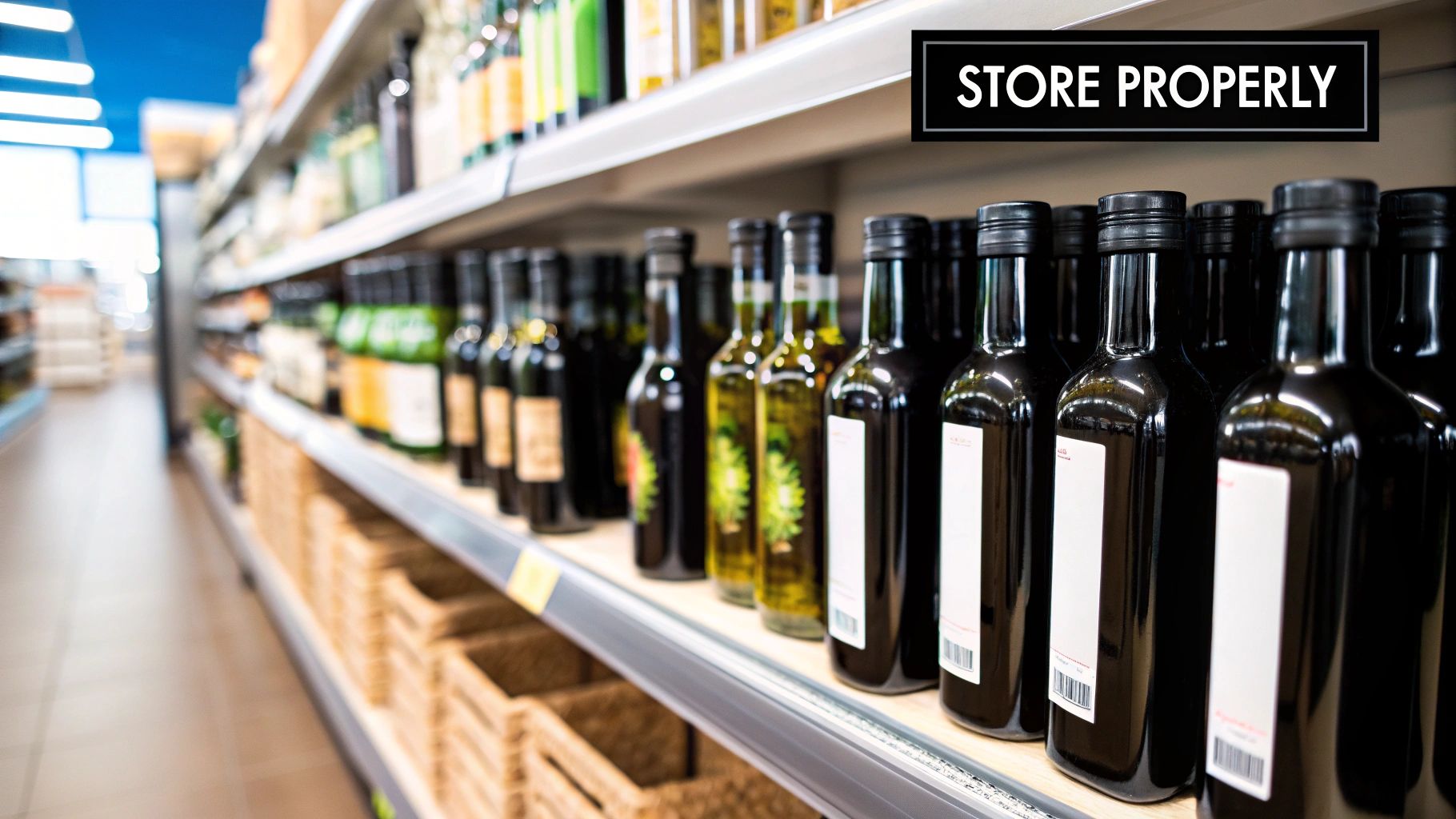
Your beautiful bottle of EVOO has three mortal enemies: oxygen, light, and heat. Protecting it from these elements is non-negotiable if you want to preserve its fresh flavor and potent health benefits.
Proper storage is simple but absolutely critical:
- Keep it in the dark. Store your oil in a cool, dark place like a pantry or kitchen cupboard. Never, ever leave it sitting next to the stove or on a sunny windowsill.
- Keep it sealed. Oxygen is the enemy of freshness. Make sure you twist the cap on tight after every pour to keep air from getting in and causing the oil to go stale.
- Keep it in the right container. Dark glass bottles or opaque tins are your best friends here, as they shield the oil from damaging light. If you buy a large tin, consider pouring a smaller amount into a dark bottle for daily use.
When you store it right, a high-quality oil will keep its peak character for 18-24 months from its harvest date. Treat it with a little care, and it will reward you with exceptional flavor every single time.
At Learn Olive Oil, we believe that understanding these details transforms your relationship with food. We are dedicated to helping you discover the world's best olive oils with confidence.
Explore our guides and start your journey at https://learnoliveoil.com today.
 Learn Olive Oil
Leave a comment