Walk down the olive oil aisle and you'll face a wall of confusion. A sea of bottles, all screaming labels like Extra Virgin, Virgin, and Refined. But these aren't just clever marketing ploys; they are official classifications, secrets whispered from the olive grove, telling you exactly how that oil was born and what it was born to do.
Imagine this: the less an olive is tormented and processed, the more of its raw, vibrant soul ends up in the bottle. Learning to read these labels is your first step from being a paralyzed shopper to a confident, masterful cook.
From Olive Grove to Your Kitchen
Deep down, the secret that separates all the different types of olive oil is one shockingly simple thing: how much they've been processed. This single, critical factor dictates everything—flavor, color, health benefits, and even its true purpose in your kitchen.
It's a straight line. On one end, you find the pure, unadulterated oils, liquid gold bursting with life. On the other, the highly processed, ghostly neutral ones. The true measure of quality and grade is the oil's free acidity level—a brutally honest indicator of the olive's health the moment it was crushed.
This diagram exposes the truth, showing how the main grades stack up based on quality and acidity.
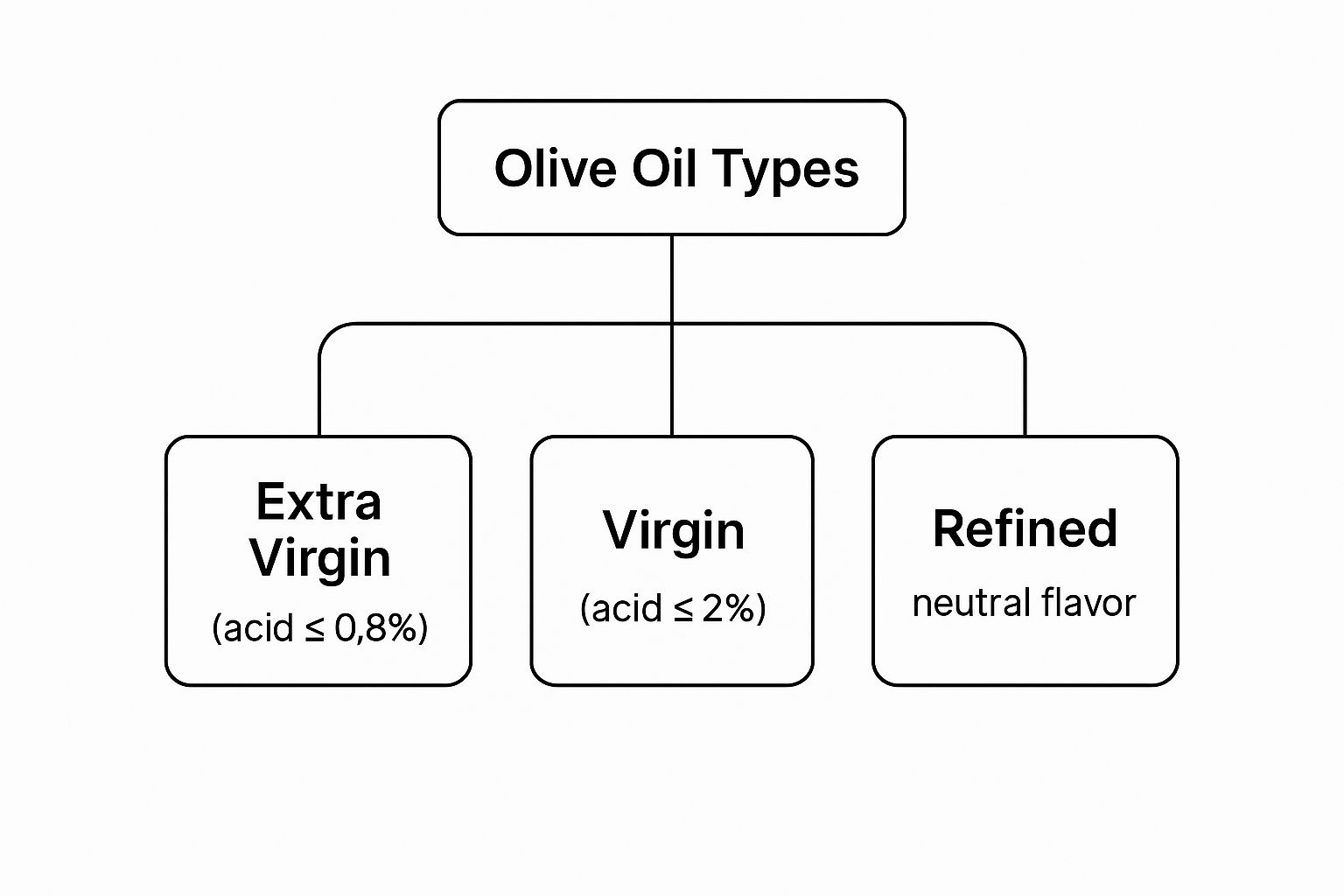
As you can see, the champions of quality, like Extra Virgin, boast the lowest acidity. It is the direct, undeniable proof of a careful, minimalist approach.
The Major Olive Oil Grades
While you’ll see dozens of different labels, the global olive oil market is really a three-horse race: extra-virgin, virgin, and refined. And here's a shocker: refined olive oil actually seized the largest market share by revenue in 2022, a staggering 31.1%.
Despite this, Extra Virgin Olive Oil (EVOO) remains the undisputed gold standard. Its ridiculously low acidity (never more than 0.8%) and superior, complex flavor make it the holy grail for anyone who truly loves food. You can dive deeper into the fascinating olive oil market trends to see how these titans clash in global consumption.
Here’s the inside story on the big three:
- Extra Virgin Olive Oil (EVOO): This is the purest of the pure. Extracted using only mechanical force—no heat or chemicals dare touch it. The result? The lowest acidity, the boldest flavor, and the highest payload of health-boosting compounds.
- Virgin Olive Oil: Also unrefined and extracted without chemicals, but it comes from olives that weren't quite perfect. This gives it a higher acidity (up to 2.0%) and a milder, though still pleasant, flavor. It's a small step down from EVOO but remains a quality, honest oil.
- Refined Olive Oil: This oil begins life as a lower-grade virgin oil, one with defects in taste or smell. It is then "refined"—a process of heating and filtering—to erase those flaws, leaving behind a neutral-tasting, light-colored oil with a much higher smoke point.
The grade of an olive oil is a direct confession of its journey from the tree to the bottle. The less it's been tampered with, the more of the olive's true, wild character you get to taste.
To make this crystal clear, let's lay out the key players in a simple table.
Quick Guide to Olive Oil Types
This table rips away the marketing jargon and reveals the essential differences between the olive oil grades you'll find on the shelf.
| Olive Oil Type | Processing Method | Flavor Profile | Best For |
|---|---|---|---|
| Extra Virgin | Cold-pressed, unrefined, no chemicals or heat | Fruity, peppery, grassy, complex | Salad dressings, dipping, finishing dishes |
| Virgin | Mechanically pressed, unrefined | Good olive flavor, but milder than EVOO | General cooking, sautéing, marinades |
| Refined | Chemically and/or heat-treated to remove flaws | Neutral, light, and almost flavorless | High-heat cooking, frying, baking |
| Olive Oil | A blend of refined and virgin olive oils | Mild olive flavor, very versatile | All-purpose cooking and sautéing |
Now that you have this foundational knowledge, you're ready to look closer. In the next sections, we'll expose the secrets of each category, so you'll know exactly which bottle to reach for and why.
Extra Virgin: The Gold Standard of Olive Oil
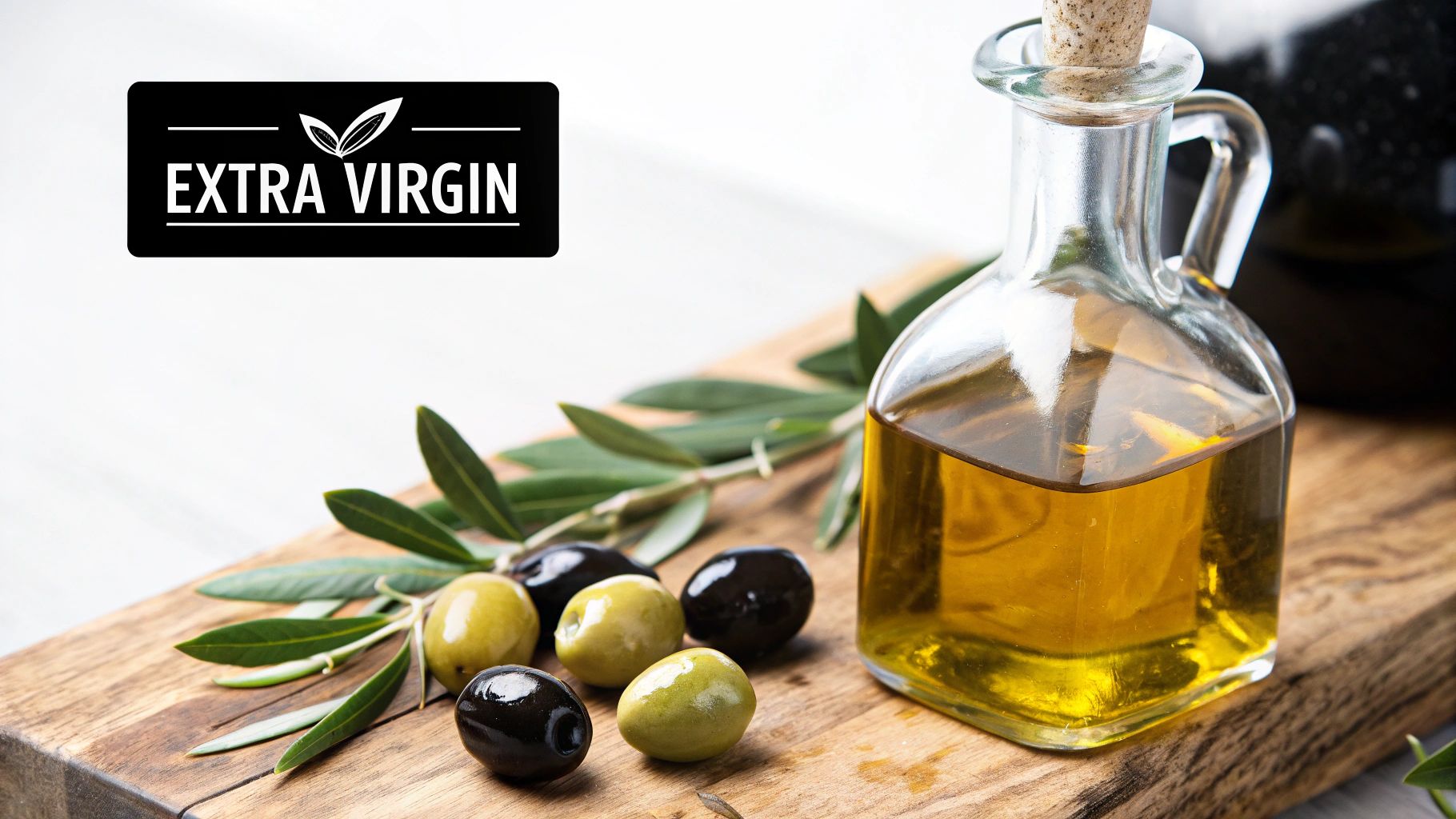
When you hear "olive oil," what picture flashes in your mind? For most, it’s a bottle of Extra Virgin. It summons images of sun-scorched Italian groves and fresh pasta glistening under a final, glorious drizzle. But Extra Virgin Olive Oil, or EVOO, is not just another cooking fat; it is the pure, unadulterated, living juice of fresh olives.
Think of it like this: EVOO is to olive oil what fresh-squeezed orange juice is to concentrate. One is vibrant, complex, and alive with flavor; the other is a pale ghost of the real thing. EVOO is the genuine article, capturing the very soul of the fruit it came from.
This top-tier status isn't some marketing gimmick. It is earned through a painstaking process and defined by ruthlessly strict chemical and sensory standards that place it in a universe of its own.
The Art of Pure Extraction
The magic of EVOO is born at the mill. You’ve surely seen the term “first cold press” on a label. This isn't just a romantic phrase—it's a sacred promise of purity that defines the entire category.
It means the olives, plucked at their absolute peak, are crushed and pressed only once. More importantly, this is done without any high heat or chemical solvents. The process is entirely mechanical, using immense pressure to gently persuade the oil from the olive paste.
This gentle persuasion is everything. It preserves the delicate, volatile compounds that gift EVOO its astonishing flavor and potent health benefits. Sure, adding heat would squeeze out more oil, but it would murder the very essence of what makes it "extra."
The Chemistry of Quality
After pressing, an oil must pass a gauntlet of chemical tests to earn the "extra virgin" crown. The single most important test is its free fatty acidity level, which tells a brutally honest story about the quality of the olives and the care with which they were handled.
To be legally branded Extra Virgin, an olive oil must have a free acidity of less than 0.8%. This impossibly low number is proof that healthy, unbruised olives were pressed almost immediately after being plucked from the tree.
If the acidity climbs higher, it’s a red flag. It screams that the olives were bruised, overripe, or sat around for too long, allowing oxidation and decay to begin their destructive work. This one chemical marker is often the sharpest dividing line between a good oil and a truly great one. In fact, most deep dives into the different types of olive oil begin with this fundamental test.
A Symphony of Flavors and Aromas
While the lab provides the proof, your palate delivers the pleasure. A real EVOO is a full-sensory assault, with a complex army of aromas and tastes as nuanced as any fine wine.
Forget a simple, greasy taste. A high-quality EVOO should shock you with:
- Fruity Notes: These can explode with the bright, green notes of underripe olives and fresh-cut grass, or soothe with the softer, buttery tones of mature fruit.
- Bitterness: A pleasant bitterness on the tongue isn't a flaw! It's the hallmark of freshness and a clear sign that the oil is loaded with healthy polyphenols.
- Pungency: This is that peppery, spicy kick you feel at the back of your throat. It's another tell-tale sign of a high-quality, antioxidant-rich oil.
Just like wine, EVOO has terroir. The soil, the climate, and the specific olive variety (or cultivar) all leave their unique fingerprint on the final product. An Arbequina olive from Spain will forge a very different oil than a Coratina from Italy. This is what makes exploring different EVOOs a lifelong journey of discovery.
Beyond Extra Virgin: Meet the Rest of the Family
So, if Extra Virgin Olive Oil is the undisputed star of the show, what happens to the oils that are good, but just miss that top-tier cut? They are not thrown away; they simply step into a different, but equally vital, role. This is where you meet the hardworking supporting cast: Virgin and Refined olive oils.
Think of it like grading apples at an orchard. The flawless, crisp apple is sold whole. But the one with a small bruise? It's still a fantastic apple, perfect for making a delicious pie. Virgin olive oil is that pie apple—still pure and unrefined, just with a slightly different personality than its perfect sibling.
From there, we enter the world of culinary science with refined olive oil. Here, innovation steps in, taking flawed oils and transforming them into incredibly consistent and reliable workhorses for kitchens everywhere. These are not "lesser" oils; they are simply different tools for different jobs.
Virgin Olive Oil: The All-Purpose Workhorse
Virgin olive oil is made using the exact same process as extra virgin. The olives are crushed and pressed by machine, without any heat or chemicals. It is, by every definition, a pure, natural fruit juice. The only real difference is what the lab tests and tasting panels reveal at the end.
So, what stops it from earning the "extra" title? It all comes down to two key factors: a slightly higher acidity and a less intense flavor.
- Acidity Level: To be labeled Virgin, an oil must have a free acidity of up to 2.0%. This is well above EVOO’s strict 0.8% limit and often reveals the olives were a bit riper or had some minor bruising before pressing.
- Flavor Profile: It must still taste and smell like good olives. However, it might have very slight sensory flaws or lack the bold, peppery punch and complex bitterness you'd find in a premium extra virgin.
This profile makes virgin olive oil a fantastic, versatile oil for your daily cooking. Its pleasant flavor won’t overpower your dishes, making it a brilliant choice for sautéing, roasting, and general-purpose cooking where you want a hint of that real olive taste without the intensity.
Refined Olive Oil: The Neutral Hero
What about oils with more obvious flaws in flavor, aroma, or acidity? Instead of being wasted, they begin a journey of purification to become Refined Olive Oil. This is a specific industrial process designed to create a perfectly neutral, stable, and consistent cooking oil.
The refining process is a multi-step system that systematically erases any and all undesirable qualities from the oil.
The goal of refining isn’t to add anything; it’s about taking imperfections away. The process strips out the oil’s color, aroma, and flavor, leaving behind a pure fat that's incredibly useful for high-heat cooking.
The main stages of refining usually include:
- Neutralization: An alkaline solution is used to strip out the high levels of free fatty acids, beating the acidity down to almost nothing.
- Bleaching: The oil is passed through natural activated clays, which absorb the pigments and turn the oil a very light, pale yellow.
- Deodorization: High-temperature steam is used to boil away any volatile compounds that would create unpleasant smells or tastes.
The result is an oil with a very high smoke point (often up to 465°F / 240°C), a completely neutral taste, and a much longer shelf life. This makes it the champion for deep-frying, searing, and baking—any time you need an oil that can handle intense heat without smoking or adding its own flavor to the food.
The Rise of Blended Olive Oils
Since refined olive oil is virtually tasteless and odorless on its own, producers will often blend it with a small amount of virgin or extra virgin olive oil. This simple act adds back a touch of color and a subtle hint of that classic olive flavor.
This blend is what you'll typically find on the shelf labeled simply as "Olive Oil" or "Pure Olive Oil." It strikes a clever balance, offering a high smoke point for cooking versatility with a mild, pleasant taste. If you're intrigued by these blends, you can explore our detailed guide on what is pure olive oil and how it fits into your kitchen.
Diving into Light and Pomace Olive Oils
Now we venture into the more industrial, and often misunderstood, side of the olive oil world. This is where you find the bottles labeled "Light" and "Olive Pomace Oil," two of the most processed members of the olive oil family.
These oils were born from a drive for total efficiency, a promise that absolutely nothing from the olive goes to waste. But to understand when—or if—you should use them, you must first understand how they are made. Let's pull back the curtain on what's really happening.
This section is all about revealing the truth. By the time we're done, you'll know exactly what you're seeing on the shelf and can make a truly informed choice.
What "Light" Olive Oil Really Means
First, let's kill a myth that refuses to die. "Light" olive oil does not have fewer calories. This piece of marketing genius has confused millions for decades. The name has zero to do with health; all olive oils have the same fat and calorie count, around 120 per tablespoon.
So, what does "light" actually mean? It’s all about the oil’s incredibly pale color and its whisper-quiet, almost non-existent flavor.
This doesn't happen by accident. Light olive oil is the product of intense refining. It starts life as a lower-grade oil that is then neutralized, bleached, and deodorized—just like other refined oils, but often taken a step further to scrub out every last trace of olive character.
Think of light olive oil as a ghost. It has the basic structure of olive oil, but its soul—the aroma, color, and taste—has been completely exorcised. It's as neutral as it gets.
While it lacks the health perks of its unrefined cousins, its super-high smoke point and neutral profile make it a potential stand-in for other vegetable oils. It works best in baking or high-heat frying where you demand that the oil do its job without leaving any flavor behind.
Olive Pomace Oil: The Final Extraction
After olives are pressed for the good stuff—extra virgin and virgin oils—what's left is a thick, damp paste called pomace. This mash of olive flesh, skin, and pit fragments still holds a little oil hostage, maybe around 5-8%. Freeing it isn't as simple as just pressing again; it requires a much more industrial approach.
This is where olive pomace oil comes from. It’s a product born from pure resourcefulness, a way to guarantee not a single drop of potential oil is ever wasted.
The process involves washing the pomace with chemical solvents (usually hexane), which dissolve the remaining oil and pull it out. The solvent is then boiled off, and the resulting crude pomace oil endures the same full refining process as other low-grade oils. What you're left with is a completely bland, neutral oil.
To make it sellable, producers will usually blend this refined pomace oil with a small amount of virgin olive oil to give it a little color and a ghost of olive flavor.
Quality and When to Use Them
Pomace oil has certainly had its share of controversy, mostly due to the chemical solvents used and the risk of contaminants if production isn't carefully controlled. That said, regulations in most countries are quite strict, ensuring the final product is safe and that solvent residues are at negligible, harmless levels.
Here’s a quick breakdown of how these two highly processed oils stack up:
| Feature | Light Olive Oil | Olive Pomace Oil |
|---|---|---|
| Source | Virgin oils with defects | Leftover pulp (pomace) |
| Extraction | Mechanical pressing, then refined | Solvent extraction, then refined |
| Flavor Profile | Extremely neutral, almost tasteless | Very mild, slightly nutty |
| Best Use | Baking, high-heat frying | Industrial frying, some home frying |
| Perception | A highly refined cooking oil | The most economical, lowest grade |
At the end of the day, both light and pomace oils are engineered for high-heat cooking where you demand zero flavor interference. They’re budget-friendly options for deep-frying or for use in commercial food production. Just remember, they are a world away from the antioxidant-rich, flavorful extra virgin olive oil that’s celebrated for both its taste and health benefits. Knowing the difference between these different olive oil types ensures you're picking the right tool for the job, not just falling for a clever label.
How Geography Shapes Your Olive Oil
Every bottle of great olive oil is a liquid postcard from its homeland. Just as the soil and sun define a fine wine, the unique combination of climate, olive variety, and centuries of tradition gives each oil its distinct accent and personality. This isn't just about different olive oil types; it's about the very soul of a place, captured in a bottle.
Let’s take a trip through the sun-drenched groves of the Mediterranean to see just how profoundly geography shapes every drop. The story of olive oil is really the story of the land itself.
Spain: The Bold and Golden Giant
When you think of olive oil, Italy might come to mind first, but Spain is the undisputed king of production. The country's hot, arid climate is perfect for producing oils that are robust, fruity, and often brilliantly golden. Spanish oils, particularly from the iconic Picual olive, are famous for their bold, peppery finish.
This assertiveness makes Spanish olive oil a fantastic choice when you need an oil that won't get lost in a dish. Think of it as the lead singer in a band—confident, powerful, and ready to take center stage. For this reason, many chefs turn to it for specific culinary tasks, and you can explore more about this in our guide to using olive oil for cooking.
Spain's dominance in the global market is staggering. In 2022, global production hit about 2.74 million tonnes, with Spain alone contributing 24% of that total. The heart of this production is the Andalucía region, where the province of Jaén is responsible for a jaw-dropping 70% of all Spanish olive oil. You can discover more insights about global olive oil production on Wikipedia.
Italy: The Diverse and Artisanal Artist
Italian olive oil is a beautiful mosaic of regional styles. From the delicate, almond-like oils of Liguria in the north to the intensely grassy and bitter oils of Sicily in the south, there is no single "Italian" flavor. This diversity is Italy's greatest strength, driven by hundreds of local olive cultivars and a deep-rooted passion for artisanal craft.
An oil from Tuscany might taste of green tomato leaf and artichoke, while one from Puglia could be rich with notes of ripe fruit and spice. This is what makes exploring Italian oils so exciting; each bottle is a new discovery, a reflection of a specific microclimate and a family's heritage.
An Italian olive oil doesn't just speak of Italy; it whispers the secrets of its specific valley, grove, and miller. It's a testament to the idea that in food, as in life, the small details make all the difference.
Greece: The Ancient and Delicate Soul
Greece is home to some of the world's oldest olive groves, with trees that have been bearing fruit for thousands of years. This ancient heritage is reflected in their oils, which are often delicate, herbaceous, and exceptionally smooth. The famed Koroneiki olive yields a golden-green oil that is prized for its gentle fruitiness and mild, buttery finish.
Greek olive oil is typically less aggressive than its Spanish or Italian counterparts. It's the perfect finishing oil for fresh salads, grilled fish, or a simple plate of feta and tomatoes, where its subtle elegance can shine without overpowering the other ingredients. It’s a taste of history, pure and simple.
Choosing and Using the Right Oil for Every Dish
Knowing the difference between olive oils is one thing, but the real fun begins when you learn which bottle to grab for what you're making. This is where all that knowledge pays off, turning good meals into fantastic ones.
Think of your olive oil collection like a chef's knife set. You have your go-to all-rounder, your delicate slicer, and your heavy-duty cleaver. You wouldn't use the wrong knife for the job, and the same logic applies here. Matching the oil to the task is a simple secret that elevates your cooking from home-style to professional.
The Great Smoke Point Debate
Let's clear the air on one of the most persistent myths out there: you can, and absolutely should, cook with Extra Virgin Olive Oil. The old idea that its smoke point is too low for anything beyond a finishing drizzle is just plain wrong.
A good quality EVOO has a smoke point that sits comfortably between 375-410°F (190-210°C). That's well within the range for most daily cooking, from sautéing vegetables to pan-searing chicken. In fact, its high antioxidant content actually makes it more stable under heat than many other common oils.
The myth that you can't cook with EVOO is costing you flavor. While a refined oil is more economical for high-heat frying, using a good quality EVOO for daily cooking adds a layer of taste and health benefits you're otherwise missing out on.
Of course, for something like deep-frying, a refined or light olive oil is the smarter, more economical choice. With a much higher smoke point—often up to 465°F (240°C)—and a neutral flavor, they are built for those high-temperature jobs. You can find a deeper dive into these differences in olive oil types here: https://learnoliveoil.com/differences-in-olive-oil-types.
A Framework For Flavor Pairing
Heat is only half the story; flavor is where the art comes in. A bold, peppery EVOO from Tuscany might be incredible on a grilled steak, but it would completely overpower a delicate piece of fish.
Here’s a simple way to think about it:
- Robust & Peppery Oils: Let these bold EVOOs shine as a key ingredient. Think drizzling over a hearty bean soup, grilled meats, or bitter greens like radicchio.
- Delicate & Fruity Oils: Use these gentle EVOOs when you want to complement, not dominate. They are perfect for vinaigrettes, baking cakes, or finishing steamed veggies.
- Neutral & Refined Oils: These are your workhorses. When you just need fat without a distinct olive flavor—for frying, searing, or certain baked goods—this is the bottle to reach for.
To see this in action, just look at how traditional Cypriot foods expertly match specific local oils to regional dishes, creating a perfect harmony of flavor.
Olive Oil Culinary Pairing Chart
To make things even easier, here's a quick-reference chart to guide you in the kitchen. It’s a simple cheat sheet for matching the right oil to your cooking method.
| Cooking Method | Recommended Olive Oil Type | Why It Works |
|---|---|---|
| Drizzling & Finishing | Extra Virgin Olive Oil (EVOO) | Its complex, fresh flavors are best appreciated raw, adding a final burst of taste and aroma. |
| Sautéing & Pan-Searing | Good Quality EVOO or Virgin | The smoke point is perfect for medium-high heat, and it adds a wonderful depth of flavor. |
| Roasting & Baking | EVOO (mild) or Light Olive Oil | A mild EVOO can add fruity notes to roasted veg, while light olive oil is neutral for cakes. |
| Deep-Frying | Refined or Light Olive Oil | The high smoke point and neutral flavor won't burn or interfere with the food's taste. |
| Vinaigrettes & Dips | Extra Virgin Olive Oil (EVOO) | The oil is the star here, so use your best! The fruitiness and pepperiness create a flavorful base. |
Ultimately, this chart is a starting point. The best way to learn is to taste and experiment to find the pairings you love most.
Protecting Your Liquid Gold
Finally, a quick but crucial tip on storage. Olive oil has three enemies: heat, light, and air. If you expose your oil to any of them, you'll rapidly degrade its flavor and health benefits. It's a waste of a great product.
Always store your olive oil in a cool, dark place, like a cupboard away from the stove. Never keep it on the counter next to a sunny window. And make sure you seal the cap tightly after each use. These simple steps will ensure the last drop tastes just as fresh and vibrant as the first.
Your Olive Oil Questions Answered
As you begin exploring the different types of olive oil, a few questions always bubble to the surface. The olive oil aisle is a confusing place, littered with marketing traps and old myths designed to keep you from finding the perfect bottle. It's time to cut through that noise.
This is your personal cheat sheet. I want to arm you with the confidence to choose, store, and use olive oil like you've been doing it your entire life. So, let’s destroy the biggest questions I hear all the time.
Does Light Olive Oil Have Fewer Calories?
No. It absolutely does not. This is probably the single most common lie out there, and it’s a brilliant piece of marketing deception. The word "Light" has nothing to do with calories or fat; it refers only to the oil's pale color and incredibly mild flavor.
Every single type of olive oil—from the boldest EVOO to the most refined "Light" oil—carries the same caloric weight: about 120 calories per tablespoon. Light olive oil is just heavily refined to strip out any real olive taste, making it a neutral choice for baking or high-heat cooking where you don't want the flavor to crash the party.
Can You Cook with Extra Virgin Olive Oil?
Yes, you can and you should! The myth that you can't heat EVOO is one of the most stubborn, and it robs people of adding incredible flavor to their everyday meals. It’s time to put this lie to rest for good.
A high-quality extra virgin olive oil has a smoke point somewhere between 375-410°F (190-210°C). That's more than enough for most home cooking, including sautéing, roasting, and even pan-frying. In fact, because it’s so rich in antioxidants, EVOO is actually more stable under heat than many other common cooking oils.
While you might reach for a less expensive, refined oil for something like deep-frying, using EVOO for your daily cooking is not only perfectly safe—it infuses your food with complex flavors and health benefits that other oils simply cannot deliver.
What Does First Cold Press Actually Mean?
When you see this phrase on a bottle, see it for what it is: a stamp of quality. It is a sacred promise that the oil was made with the most careful, traditional methods, designed to preserve everything that makes olive oil magnificent.
Let's break it down:
- First Press: This tells you the olives were crushed only once. There was no second or third pressing to squeeze out every last drop of oil—a practice that always produces inferior quality.
- Cold Press: This is the key. It means no heat was added to force more oil out of the olives. The entire process was kept below a strict 80.6°F (27°C). This gentle handling protects the delicate flavors, beautiful aromas, and all the healthy compounds in the oil.
Knowing the truth behind what is first cold-pressed olive oil helps you understand why it’s the gold standard. It’s not just a fancy term; it’s a real commitment to quality.
At Learn Olive Oil, we believe that understanding the story behind your food makes every meal better. We provide expert insights to help you choose, taste, and cook with the world's best olive oils. Discover the perfect bottle for your kitchen at https://learnoliveoil.com.
 Learn Olive Oil
Leave a comment