When you stand before a hot stove, the choice between a bottle of golden olive oil and a stick of creamy butter is more than a simple culinary decision. It's a fork in the road. One path leads to one flavor profile and set of health outcomes; the other, to an entirely different destination for your meal and your body.
Olive oil is the darling of modern health, praised for its heart-friendly fats and resilience under fire. Yet, who can deny the siren song of butter as it browns and foams, lending an irreplaceable richness to sauces and pastries? The truth is, the right choice is never a blind guess. It's a calculated decision based on what you're cooking, the heat you're using, and the health you're building.
The Ultimate Kitchen Showdown
Every chef, from the Michelin-starred to the weekend home cook, wages this internal battle daily. Do I reach for the peppery, vibrant olive oil, or does this moment call for the comforting richness of butter? This choice sets the entire stage for the flavor, the texture, and even the nutritional story of your dish. Forget the simplistic "good fat vs. bad fat" rhetoric you've heard a thousand times. We are going much, much deeper.
The fact is, these two kitchen titans are from different worlds entirely. One is born from a fruit, the other from an animal. Their very chemical souls are unalike, which dictates how they dance with heat. This is precisely why a direct, honest comparison is not just useful—it's essential for anyone who takes their food seriously.
Key Differences at a Glance
Before we dissect the finer points, let's establish the battlefield. Understanding what truly separates these fats is the secret to predicting their behavior in the pan and their impact on your palate.
| Attribute | Olive Oil | Butter |
|---|---|---|
| Source | Plant-Based (Pressed Olives) | Animal-Based (Churned Cream) |
| Primary Fat Type | Monounsaturated Fat | Saturated Fat |
| Common Forms | Extra Virgin, Virgin, Refined | Salted, Unsalted, Clarified |
| Flavor Profile | Varies: Peppery, Fruity, Grassy | Creamy, Rich, Nutty |
| Health Focus | Heart-Healthy Polyphenols | Contains Milk Solids & Fat |
This table provides a snapshot, but the real story, the one that will transform your cooking, is hidden in the details. My promise to you is this: by the end of this guide, you will possess the confidence to select the perfect fat for any culinary task, every single time. When you grasp their distinct personalities, you can fuse your cooking technique with your health priorities, turning a mundane choice into a masterstroke. The olive oil vs. butter showdown isn't about crowning a single winner—it's about building an arsenal and knowing which weapon to draw for every delicious challenge.
Understanding The Fundamental Differences
To truly master the use of olive oil versus butter, you must journey back to their origins. Olive oil is, in essence, a fruit juice—pressed directly from plump olives. It is a plant-based fat, celebrated for its staggering levels of monounsaturated fats—the very fats your heart craves—and a powerful battalion of antioxidant polyphenols. Extra virgin olive oil (EVOO) is the pinnacle, the least processed, and the most explosive in flavor.
Butter, its dairy-born rival, is another creature altogether. An animal fat forged from churned cream, it delivers a potent blend of saturated fat, milk solids, and butterfat. These are not minor distinctions; they are the fundamental reasons each behaves so uniquely. From how they greet a searing hot pan to the soul they bring to a dish, it all comes back to their creation story.
From Plant Versus Animal
The great chasm between them is their source. Olive oil is a liquid at room temperature, a clear signal that it’s brimming with unsaturated fats. Butter, solid and stoic, telegraphs its higher saturated fat content. This simple visual cue is your first clue to their profound chemical differences and how they'll perform under pressure.
This origin story is the heart of the entire olive oil vs. butter saga. Those milk solids in butter? They are the secret to its magnificent browning power, but they are also its Achilles' heel, causing it to burn at lower temperatures. Olive oil, free from these delicate solids, can stand a much fiercer flame.
The choice isn't just about taste; it's a strategic decision rooted in chemistry. One is a fruit extract engineered for stability, while the other is a dairy concentrate born for rich, transformative browning.
A growing wave of nutritional wisdom has sparked a revolution in kitchens worldwide. Global olive oil consumption has surged past three million tons annually, propelled by people actively seeking healthier, more intelligent choices. Spain, producing an astonishing 43% of the world's supply, exports its "liquid gold" to satisfy this insatiable demand.
The universe of olive oil is surprisingly vast, a fact that deeply influences both its flavor and its proper use in your kitchen. You can explore the different types of olive oil in our detailed guide.
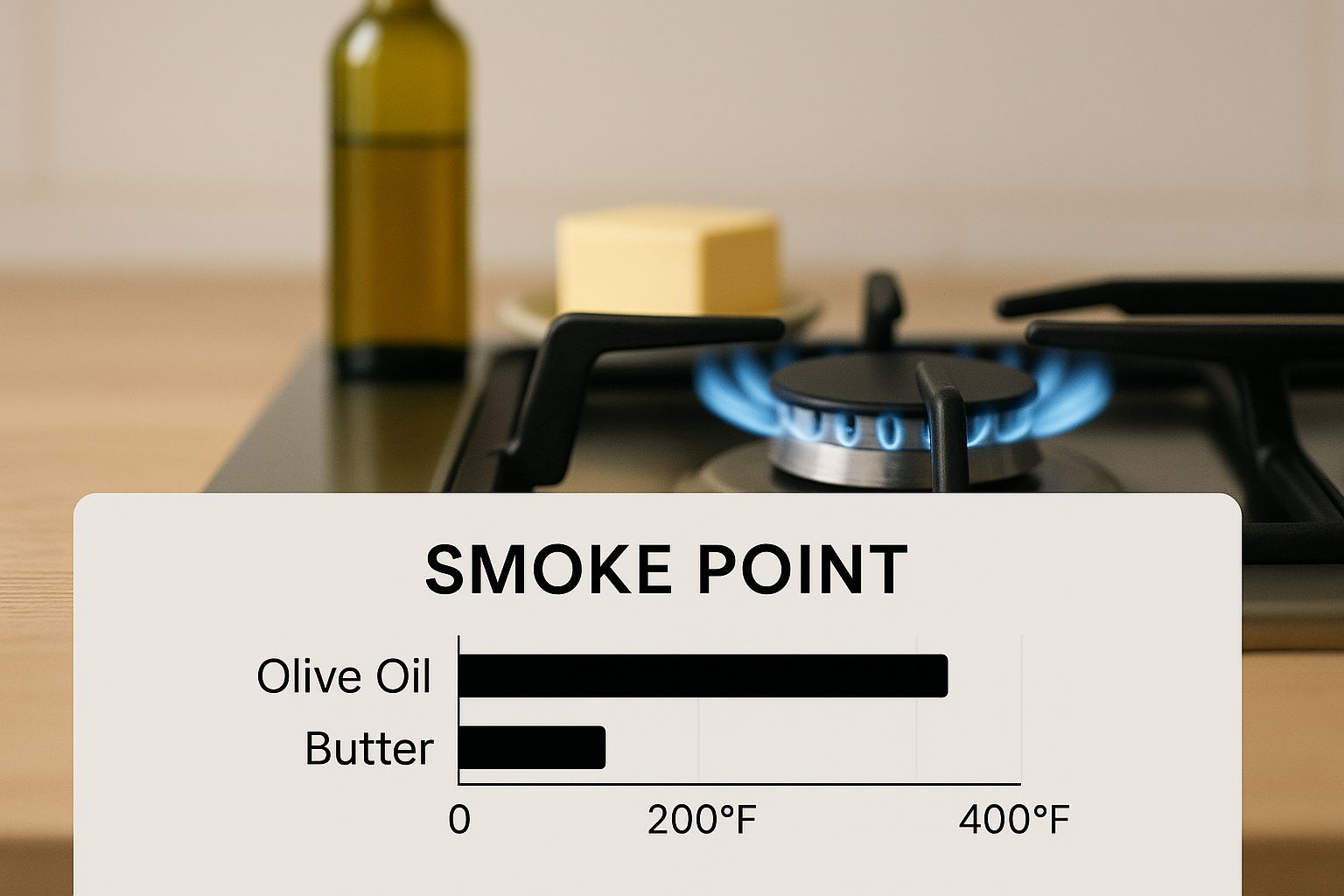
As you can see, butter’s smoke point is dramatically lower than most olive oils. This single fact makes olive oil the more versatile and reliable warrior for higher-heat cooking, from a lightning-fast sauté to searing a prized cut of steak.
To make these core differences impossible to ignore, here is a direct comparison.
At-a-Glance Comparison Olive Oil vs Butter
| Attribute | Extra Virgin Olive Oil | Unsalted Butter |
|---|---|---|
| Source | Plant-based (Pressed Olives) | Dairy-based (Churned Cream) |
| Primary Fat Type | Monounsaturated | Saturated |
| State at Room Temp | Liquid | Solid |
| Key Components | Oleic Acid, Polyphenols | Butterfat, Milk Solids, Water |
| Flavor Profile | Grassy, Peppery, Fruity | Creamy, Rich, Nutty |
| Best For | Finishing, Vinaigrettes, Sautéing | Baking, Browning, Rich Sauces |
This table cuts to the chase, but the real alchemy occurs when you translate these properties into the food on your plate.
Flavor And Culinary Role
Forget science for a moment and let's talk about pure pleasure. A truly great EVOO can bestow a grassy, peppery, or fruity blessing upon a dish, elevating it from merely good to unforgettable. It is not simply a medium for cooking; it is an ingredient with a voice of its own.
Butter, in contrast, offers a creamy, nutty richness that is simply inimitable. It browns to perfection, adding profound depth to sauces and providing the tender, flaky architecture that is non-negotiable in great baking. Learning to speak their distinct flavor languages is how you transcend a recipe and begin to truly create.
The Health Verdict: A Deep Dive into Nutrition
When we weigh olive oil against butter, the conversation inevitably moves from the stove to the science lab. The nutritional evidence isn't just persuasive—it's a landslide. To truly understand why, you must look beyond the lazy "good fat, bad fat" labels and see how these fats actually behave inside your body.
The story begins at the molecular level. Olive oil is the undisputed king of monounsaturated fats, particularly oleic acid. This is the fat that forms the very bedrock of the heart-protective Mediterranean diet, celebrated for its power to help lower "bad" LDL cholesterol while preserving "good" HDL cholesterol.
Butter is a different beast. Its decadent, creamy character comes from a high concentration of saturated fat. Now, saturated fat isn't a villain in moderation, but diets heavy with it are undeniably linked to higher LDL cholesterol—a primary risk factor for heart disease. This is the great nutritional fault line between them.
The Power of Polyphenols
But the story doesn't end with fat types. Extra virgin olive oil wields a secret weapon that butter completely lacks: polyphenols. These are potent antioxidant compounds that act as your body's personal defense force against oxidative stress and inflammation.
Chronic inflammation is the silent, smoldering fire behind many modern diseases, from heart conditions to arthritis. The polyphenols in a high-quality EVOO, like oleocanthal, function as natural anti-inflammatories, offering a protective shield that grows stronger with every meal. While butter contains some fat-soluble vitamins like A and D, it is utterly devoid of this antioxidant firepower. For a closer look at its makeup, you can explore these detailed https://learnoliveoil.com/olive-oil-nutrition-facts.
The choice you make in your pan echoes in your arteries. One fat helps extinguish inflammation and safeguard your cardiovascular system, while the other can add fuel to the very fires many of us are desperately trying to put out.
Weighing the Cardiovascular Impact
The long-term health consequences of choosing one fat over the other are not trivial. Decades of scientific research have drawn a bright, clear line between our dietary patterns and our health destinies.
Studies have revealed a chilling correlation: a higher intake of butter is associated with an increased risk of all-cause mortality. One landmark study found that individuals with higher butter consumption faced a 15% greater risk of premature death.
In stunning contrast, the same study demonstrated that consuming more plant-based oils, including olive oil, was linked to a 16% reduction in total mortality risk. The data sends an undeniable message: a simple daily act, like switching from butter to olive oil for cooking, could dramatically lower your risk of premature death.
This isn't about achieving perfection. It's about direction. Every meal is an opportunity to steer your health toward a better future, and the cumulative power of choosing olive oil over butter is one of the most profound investments you can make in your long-term well-being.
The Broader Picture of Dietary Fats
Of course, the universe of fats is more intricate than a simple duel between olive oil and butter. The delicate balance of all fats in your diet, including omega-3s and omega-6s, plays a crucial role in managing inflammation and securing your overall health.
To grasp the complete picture of how these fats interact, including a fascinating discussion on healthy vs unhealthy omega-6 oils and cholesterol, it's worth digging deeper. This provides the vital context for understanding the interplay of fats within your body.
When you lay out all the evidence, the verdict is inescapable. For daily cooking and lifelong health, olive oil offers a cascade of benefits that butter simply cannot touch. From its heart-defending monounsaturated fats to its inflammation-quenching polyphenols, it is the superior choice for the health-conscious kitchen.
Kitchen Performance Under Pressure
Beyond the nutrition panel and the doctor's advice, the ultimate test of any cooking fat is how it performs when the heat is on. This is where theory meets the searing reality of a hot pan, and the practical chasm between olive oil and butter becomes blindingly clear. Their reaction to fire dictates everything from the perfect crust on a steak to the ethereal, flaky layers of a croissant.
The single most critical factor is the smoke point—that precise temperature where a fat stops shimmering and starts smoking. A smoking pan is a sign of surrender. The fat is breaking down, unleashing bitter, acrid flavors that will assassinate your dish. This is not a minor detail; it is the line between a culinary triumph and a kitchen catastrophe.
The Science of the Sizzle
Butter's fatal flaw under high heat is its milk solids. These tiny fragments of protein and sugar are what make browned butter taste like a gift from the gods, but they are also incredibly delicate. Because of them, regular butter begins to smoke at a shockingly low 302°F (150°C). This makes it a high-wire act for searing or stir-frying.
Olive oil, by contrast, was born for the heat. Devoid of those fragile milk solids, its smoke point is far higher. A good quality extra virgin olive oil can often withstand temperatures up to 410°F (210°C). This gives you a much broader, more forgiving runway to cook, granting you superior control and flexibility.
Think of the smoke point as your culinary safety net. Butter's low threshold forces you to walk a tightrope, while olive oil provides the stable ground needed to execute a wider array of techniques without fear of a scorching failure.
To truly master this concept, you can learn more about the olive oil smoking point in our comprehensive article. Understanding this is fundamental to elevating your craft.
Flavor Beyond the Flame
Performance isn't merely about heat tolerance; it's about the chemistry of flavor. This is where the Maillard reaction enters the stage, and it's butter's moment in the spotlight. This is the magical browning process that occurs between amino acids and sugars under heat, creating the deep, savory, complex flavors that trigger our most primal cravings.
The milk solids in butter are the perfect catalyst for this reaction. When you baste a steak with foaming butter, you're not just adding fat—you're initiating a glorious chain reaction that builds a rich, nutty, deeply browned crust that olive oil simply cannot replicate. It is the secret weapon behind classic pan sauces and the very soul of countless baked goods.
But olive oil brings its own distinct personality to the celebration. A high-quality extra virgin olive oil is not a neutral bystander; it's a finishing flourish. Its peppery, grassy, or fruity notes can awaken a finished dish, adding a layer of fresh complexity that butter’s creamy richness might otherwise smother.
Practical Application: When to Choose What
True culinary mastery is born from knowing which tool to use for which job. It’s not about choosing a favorite; it's about deeply understanding their unique strengths.
-
For High-Heat Searing: Olive oil is the undisputed champion. Its higher smoke point allows you to achieve a beautiful, hard sear on meat or vegetables without filling your kitchen with smoke.
-
For Browning and Pan Sauces: Here, butter is king. Those browning milk solids create the fond—the delicious browned bits left in the pan—which is the sacred foundation for a rich, complex sauce.
-
For Baking: In this realm, butter's solid state is non-negotiable. It creates the critical air pockets needed for flaky croissants and the tender crumb in a perfect cake. Its flavor is the bedrock of most traditional pastries.
-
For Finishing and Flavor: For the final anointment, a drizzle of premium EVOO over soup, pasta, or simple crusty bread adds a burst of vibrant flavor that heat would obliterate. In this role, it is an ingredient, not just a fat.
Ultimately, knowing how each fat behaves under fire transforms cooking from a game of chance into an act of confident creation. There is no single winner. The goal is to build a versatile arsenal and know exactly which weapon to grab to achieve perfection, every single time.
Your Culinary Playbook: When to Use Each Fat
Theory is one thing; the sizzle in the pan is another. Let's move beyond the science and into a practical, actionable playbook for your kitchen. Knowing why one fat is better is smart, but knowing precisely when to reach for each is what separates the novice from the master.
This choice is not a mere matter of taste; it’s a strategic maneuver. This exact shift in thinking is transforming kitchens across the globe, with a powerful trend away from butter and toward olive oil, especially in North America and Europe. The United States alone devoured 381,000 tonnes in the 2022-23 period, placing it in the same league as traditional powerhouses like Italy and Spain. Even nations like Germany and Poland are joining the movement, driven by an awakening to health and an increasingly sophisticated palate. You can explore these consumption trends and see how different countries rank on World Population Review.
This guide is your blueprint, broken down by cooking method, designed to ensure success every time you command the stove.
For Searing and High-Heat Sautéing
When you need to get a pan screaming hot for that flawless sear on a steak or a lightning-fast stir-fry, olive oil is your undisputed champion. Its higher smoke point is its decisive advantage.
Butter’s milk solids, so wonderful for flavor, will surrender to the heat, burning and turning acrid long before you achieve that coveted dark crust. Olive oil provides a stable, clean medium, allowing you to cook at scorching temperatures without smoking out your kitchen or poisoning your food with a burnt taste.
- Best Choice: Regular olive oil or light olive oil.
- Why it Works: Their neutral flavors and high smoke points are engineered for intense heat.
- Example: Searing scallops until golden or flash-sautéing bell peppers and onions for fajitas.
For Baking and Pastry
In the delicate world of baking, butter reigns supreme. Its magic lies in its solid state and its ability to create pockets of steam as it melts.
When you incorporate cold butter into dough for croissants or pie crusts, you're creating thousands of microscopic layers. In the oven's heat, the water within the butter erupts into steam, forcing those layers apart. This is the very physics that creates the light, flaky texture that liquid oil can never hope to achieve.
Butter isn't just an ingredient in baking; it's the architect. It builds the flaky, tender, and rich foundation that defines classic pastries and desserts.
For Sauces and Browning
If you're building a classic pan sauce from scratch or aiming for that perfect golden-brown skin on chicken thighs, butter is the only tool for the job. The secret is the Maillard reaction, which is supercharged by butter's milk solids.
As butter melts and foams, those solids toast and caramelize, creating an unparalleled depth of nutty, rich flavor. The browned bits they leave behind in the pan, known as the fond, are the very soul of a great sauce. While a sauce made with olive oil is possible, it will lack that signature creamy body and complex, browned flavor. If you wish to learn more, explore our guide on how to properly cook with olive oil.
The Best of Both Worlds: A Professional Technique
Sometimes, the most intelligent move in the olive oil vs. butter debate is to refuse to choose. Professional chefs frequently combine them to harness the power of both.
By starting with olive oil and finishing with a knob of butter, you achieve a brilliant synthesis:
- Heat Stability: The olive oil raises the mixture's overall smoke point, acting as a bodyguard for the delicate butter solids and preventing them from burning.
- Flavor and Browning: You still get all the magnificent browning power, rich flavor, and creamy texture from the butter.
This is the ultimate technique for pan-searing a steak, allowing you to baste the meat with the foaming, nutty mixture in the final moments of cooking. It’s also phenomenal for sautéing mushrooms or caramelizing onions, bestowing a beautiful color and profound flavor without the risk of scorching.
For Finishing Drizzles and Dressings
When a dish is complete and you seek that final, crowning touch of flavor, a high-quality extra virgin olive oil is the only choice. Its delicate, complex aromas are volatile and destroyed by heat, so its true power is unleashed when used raw.
A final drizzle of a peppery, grassy olive oil over a finished soup, a bowl of pasta, or a simple plate of ripe tomatoes elevates the entire experience. Here, it is not a fat; it is a condiment. Butter, with its heavy, opaque profile, would simply weigh the dish down.
A Few Common Questions About Cooking Fats
Even after you've mastered the fundamentals, nagging questions can arise in the heat of a culinary moment. The great olive oil vs. butter debate is filled with nuances that can make or break your dish. Let’s tackle some of the most pressing questions with direct, actionable answers to arm you with confidence.
Think of this as the practical wisdom that bridges the gap between knowing the theory and flawlessly executing the technique.
Can I Substitute Olive Oil for Butter in Baking?
This is the million-dollar question, especially for those looking to bake with a healthier conscience. The short answer is: yes, absolutely. But you cannot simply perform a one-for-one swap and expect identical results.
Butter is roughly 80% fat and 20% water and milk solids; olive oil is 100% fat. To compensate, a reliable rule is to use about three-quarters of the amount of olive oil. If a recipe demands 1 cup of butter, use ¾ cup of olive oil.
The true difference-maker is texture. When you cream solid butter with sugar, you're whipping in tiny air pockets that gift cakes their tender crumb and pastries their light, flaky layers. As a liquid, olive oil creates a denser, moister result. This is wonderful for muffins, quick breads, and certain types of cakes, but it simply won't work for recipes that depend on that creaming process for their structure.
How Should I Store My Olive Oil and Butter?
Proper storage is not a fussy detail—it is absolutely essential for preserving the flavor and health benefits of your fats. Both olive oil and butter have three mortal enemies: heat, light, and air. Exposure will turn them rancid, destroying their taste and negating their nutritional value.
-
Olive Oil: Always store olive oil in a cool, dark place. A pantry or cupboard far from the stove is ideal. Never store it on a sunny windowsill or next to your cooktop. Dark glass bottles or tins are your best allies, as they block light. Once opened, try to use it within a few months for peak freshness.
-
Butter: Butter belongs in the refrigerator. Keep it wrapped in its original packaging or in a covered butter dish to shield it from air and prevent it from absorbing strange odors from other foods. It will last for months in the fridge, or it can be frozen for up to a year if you buy in bulk.
Is It Cheaper to Cook with Olive Oil or Butter?
Cost is a real-world factor for every cook. On the surface, a standard bottle of olive oil and a pound of butter might appear to be in the same price bracket, but that's a deceptive comparison. The true cost difference emerges when you venture into premium territory.
A top-shelf, cold-pressed extra virgin olive oil can certainly carry a higher price tag than even the most esteemed European-style butter. For daily cooking, however, a quality regular olive oil is often the more economical choice, especially when you consider how much further a bottle stretches compared to a few sticks of butter. The savviest strategy is to maintain an arsenal: an affordable olive oil for sautéing, a premium EVOO for finishing, and your favorite butter for baking and specific sauces.
Think of your cooking fats as a toolkit. You wouldn't use a sledgehammer for a finishing nail. By the same token, you don't need a $40 bottle of EVOO for frying—a solid, everyday oil will do the job perfectly and save you money.
What’s the Best Way to Use Olive Oil in a Non-Stick Pan?
Using olive oil in a non-stick pan is a brilliant move, but I beg you, stay away from aerosol cooking sprays. Many contain emulsifiers and propellants that accumulate on the non-stick surface, creating a gummy residue that is nearly impossible to remove and will ultimately destroy your pan.
Instead, pour a small amount of olive oil into a cold pan. Use a paper towel to wipe it across the surface, creating a micro-thin, even layer. Then, heat the pan to your desired temperature. This simple technique protects your expensive cookware and gives you far greater control over the amount of oil you're actually using. For recipes that don't require high heat, like creating a simple vinaigrette, you can find superb options in our guide to the best olive oil for salad dressing.
At Learn Olive Oil, we believe that understanding your ingredients is the secret to creating extraordinary food. We are dedicated to providing the expert insights and clear guidance you need to choose, taste, and cook with the world's finest olive oils. Discover the World of Premium Olive Oil and transform every meal into a masterpiece.
 Learn Olive Oil
Leave a comment