Ever stood paralyzed in the olive oil aisle? You’re not alone. Staring at that wall of bottles—Extra Virgin, Virgin, Pure, Light—can feel like trying to decipher an ancient, secret code.
But what if I told you that code is surprisingly simple to crack? What if the real difference between a ten-dollar bottle and a fifty-dollar bottle comes down to just two things: the soul of the olive itself, and the secrets of how its precious oil was coaxed from it?
The Secret Language of Olive Oil
Let’s be honest. We’ve all been there, frozen by indecision. The labels seem designed to baffle, but once you learn their language, everything clicks. Think of it like coffee. You have your dark, thundering espresso, your smooth, comforting drip brew, and your no-fuss instant coffee. Each is born from a different process, and each has a job it does best.
It's precisely the same with olive oil. The journey—from a sun-drenched olive hanging on a gnarled branch to the gleaming bottle in your kitchen—defines everything. It dictates the flavor, the health-giving properties, and, yes, the price. This chart reveals, at a glance, how the different grades stack up.
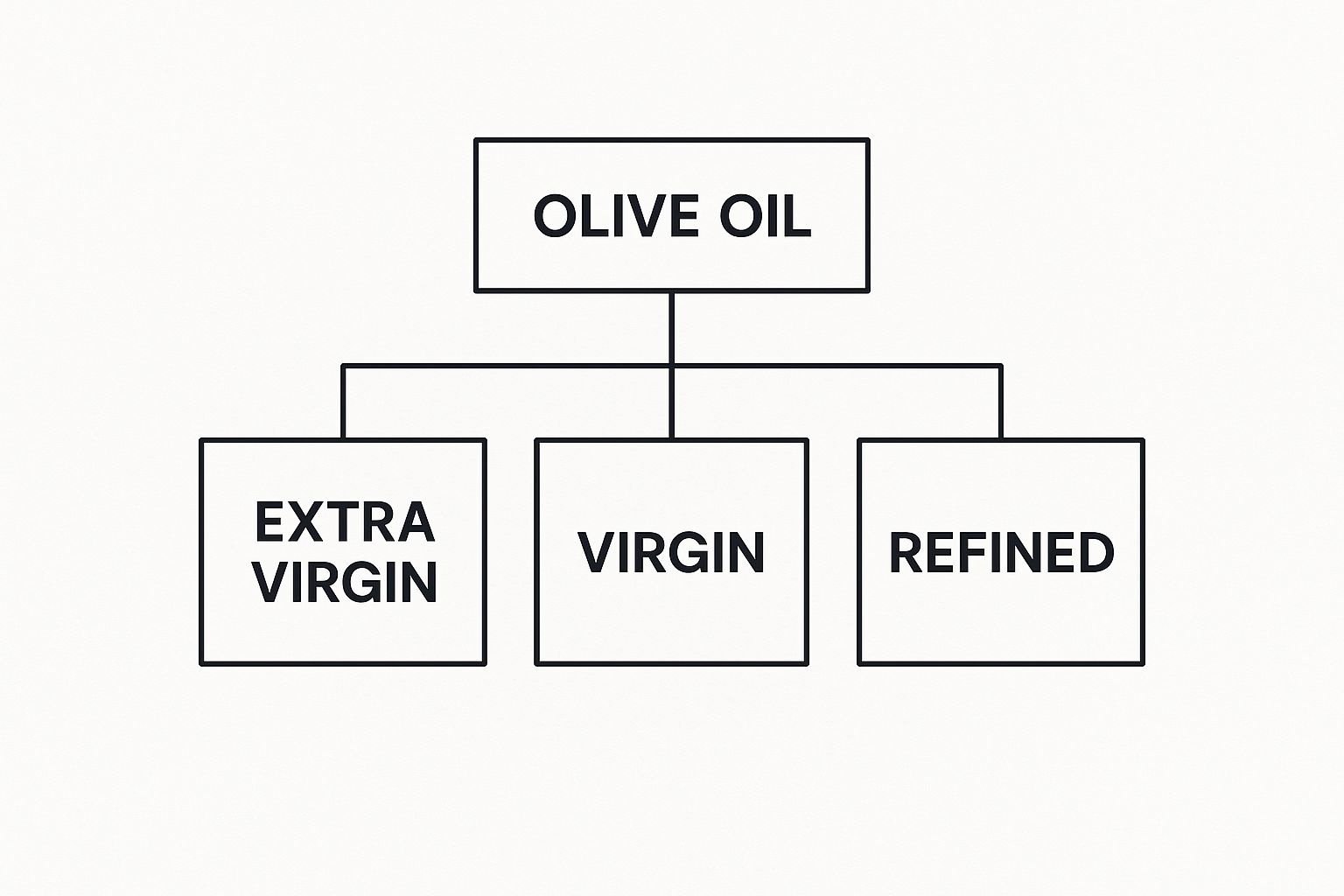
As you can see, the world of olive oil is a hierarchy. Extra Virgin reigns supreme at the very top, with Virgin just below, followed by the various Refined oils. Understanding this simple pyramid is your first step to becoming the kind of shopper who never guesses—the one who knows exactly which oil to reach for, whether dressing a delicate salad or searing a thick steak.
Understanding the Core Differences
At its heart, the classification of olive oil is a story of purity. The less that is done to the oil, the more magnificent it is.
- Extraction Method: The finest oils are simply pressed from the fruit—no chemicals, no destructive heat. Lower-grade oils, on the other hand, are often salvaged with solvents and an intense refining process to become usable.
- Acidity Level: This is a crucial chemical fingerprint. The level of free fatty acids reveals the health of the olives and how meticulously the oil was crafted. Lower is always better.
- Flavor Profile: The taste tells the whole story. It can whisper of pepper and grass or be as mild as butter—a direct reflection of how that oil was born.
This grading system isn't just marketing fluff; it's a promise, ensuring the label on the bottle actually means something. To dive deeper, uncovering the rules of olive oil labeling is a fascinating next step. And broadening your knowledge by understanding healthy versus unhealthy dietary oils can provide powerful context for making truly superior choices in your kitchen.
1. Extra Virgin Olive Oil: The Gold Standard
This is the aristocrat of the olive oil world. When you hear chefs and food lovers speak of olive oil with that certain reverence, they’re almost always talking about Extra Virgin Olive Oil, or EVOO. It’s not just a fancy name; it’s a legally binding promise of quality, purity, and an unforgettable taste experience.

Here's the best way to think about it: EVOO is to olives what fresh-squeezed juice is to an orange. It is the purest, most unadulterated expression of the fruit, extracted from perfect, unblemished olives within mere hours of being plucked from the tree.
The process is purely mechanical—no chemicals, no excessive heat—which is why you often see the term “first cold press.” This gentle handling is the secret to preserving the oil’s fragile flavors, its intoxicating aromas, and—most importantly—its potent, life-enriching health benefits.
The Science of Purity
To earn the coveted “extra virgin” title, an oil must survive a battery of stringent chemical trials. The most critical of these is its free fatty acidity level. While the chemistry is complex, the takeaway is simple: a lower acidity signals healthier olives and more masterful handling from the grove to your bottle.
To be classified as extra virgin, an olive oil must have a free acidity level below 0.8%. This isn't a mere suggestion; it's a strict international standard that separates the absolute best from everything else.
This meticulous standard is a core part of the meaning of extra virgin olive oil and guarantees you're getting the highest grade possible. Olive oil is classified based on how it's made and its final quality, with EVOO representing the peak of the pyramid. It comes purely from the first cold pressing of olives without any chemical funny business, a stark contrast to lower-grade refined oils.
A Symphony of Flavors
Unlike processed oils with their flat, forgettable taste, EVOO is absolutely alive with flavor. The taste profile can be astonishingly complex, shifting dramatically based on the olive variety, the soil it grew in, and even the week of its harvest.
A truly great EVOO isn't just "oily." It can be:
- Fruity: Whispering notes of green apple, fresh almond, or even tropical fruit.
- Grassy: Evoking the scent of a freshly mown lawn or wild artichokes.
- Peppery: That sharp, spicy kick you feel in the back of your throat? That’s the signature of healthy polyphenols at work!
- Bitter: A sophisticated bitterness, much like you'd find in exceptional dark chocolate or fine coffee.
This very complexity is why EVOO is prized as a finishing oil. Drizzling it over a dish just before serving is less about cooking and more about adding a final, powerful chord of flavor. It can transform a simple slice of grilled bread, a fresh tomato salad, or a bowl of soup from merely good to unforgettable.
In this sense, it’s not just an ingredient; it’s a condiment in its own right.
Decoding Virgin and Refined Olive Oils
If Extra Virgin Olive Oil (EVOO) is the star of your pantry, it’s time to get acquainted with its dependable cousins—Virgin and Refined olive oils. Learning their secrets does more than just stretch your budget; it empowers you to choose the right oil for every job with absolute confidence.
Think of Virgin Olive Oil as EVOO’s almost-perfect sibling. It’s pressed in the same way—mechanically, with no heat or chemicals—but it’s made from olives that didn’t quite make the A-list. As a result, you’ll notice subtle flavor quirks and a slightly higher acidity, typically between 0.8% and 2.0%, giving it a more rustic charm.
The Great Fixer-Upper: Refined Olive Oil
Then there’s Refined Olive Oil, the unsung hero that keeps countless kitchens humming. It begins its life as crude oil that didn’t qualify as virgin. But instead of being discarded, it’s put through a purification process that removes strong flavors, unwanted aromas, and impurities. The result? A perfectly consistent oil with a very high smoke point—often 400°F (204°C)—ready to tackle any high-heat cooking challenge.
Refined olive oil is your secret weapon when you need a neutral, stable fat that won’t overpower your dish.
You might see labels like “Light” or “Pure,” which refer to color and taste—not calories. Often, a splash of virgin or EVOO is blended back in to lend just a hint of character.
Before we dive into when to use each one, let’s lay them out side-by-side:
EVOO vs. Refined Olive Oil: A Head-to-Head Comparison
Here’s a quick snapshot of how Extra Virgin and Refined olive oils stack up:
| Feature | Extra Virgin Olive Oil (EVOO) | Refined Olive Oil |
|---|---|---|
| Production | Cold-pressed, no heat or chemicals | Refined from substandard virgin oil |
| Flavor Profile | Fruity, peppery, complex | Mild, neutral |
| Smoke Point | Around 375°F (191°C) | Up to 400°F (204°C) |
| Health Benefits | High in polyphenols and antioxidants | Fewer antioxidants but still a healthy fat |
| Best Uses | Dressings, dips, finishing touches | Frying, baking, everyday cooking |
In short, EVOO is your finishing touch; refined oil is your kitchen workhorse.
Choosing The Right Oil For The Job
Once you grasp these differences, choosing the right bottle becomes second nature. Here’s when to reach for Virgin or Refined:
- High-Heat Sautéing and Frying: They stand up to heat without smoking or turning bitter.
- Baking: They provide moisture without a peppery kick, letting your cakes and breads shine.
- General Cooking: They are a reliable, neutral fat for your everyday culinary needs.
Knowing what makes olive oil virgin versus refined isn’t just trivia—it’s practical kitchen wisdom. Use it, and you’ll save your premium EVOO for those moments when its full, glorious flavor can truly sing.
So, What About Olive Pomace Oil?
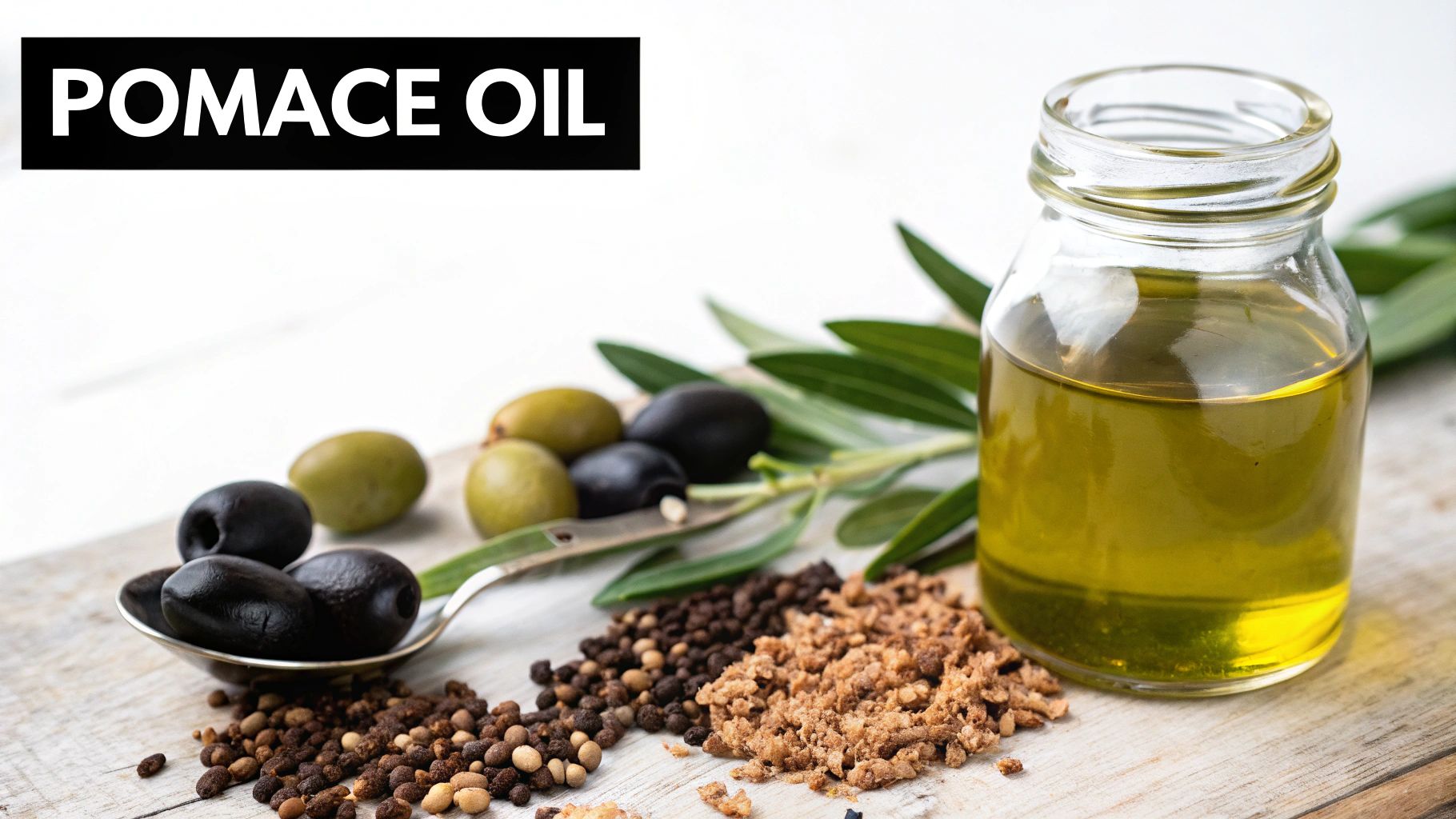
We've covered the oils born from the first press, but what about what’s left behind? After olives are crushed for extra virgin and virgin oil, a dense, damp mash of pits, skins, and pulp remains. This leftover material is called olive pomace, and it still holds a tiny secret: a final, stubborn trace of oil.
Getting that last drop out is a completely different game. Forget gentle pressing. Extracting pomace oil requires solvents and high heat to wrestle out the last of the fat. The resulting crude oil is then aggressively refined to make it edible.
What you are left with is an oil that is, technically, from olives, but it’s a world away from its virgin cousins. The intense processing strips it of everything that makes olive oil special: the nuanced flavor, the fresh aroma, and the powerful antioxidants.
Finding a Place for Pomace Oil
If it’s so heavily processed, what good is it? Pomace oil’s value is brutally simple: a sky-high smoke point and a rock-bottom price. The refining process obliterates all the delicate compounds that would normally burn, giving it the ability to withstand extreme heat—often over 450°F (232°C).
This makes it a workhorse in certain high-volume commercial kitchens. It's not an oil you'd ever want to drizzle on a salad or use as a finishing touch. Instead, it’s for situations where you simply need a cheap, stable fat that won’t break down under intense heat.
Think of pomace oil as the utility player of the olive oil family. It’s not the star quarterback like EVOO; it’s the one called in for tough, functional jobs where finesse doesn't matter, only heat resistance does.
Should You Use Pomace Oil?
For most of us cooking at home, the answer is a resounding no. It’s perfectly safe, but you can get the same or better performance from other common cooking oils that don’t rely on solvent extraction. Its true home is in industrial-sized deep fryers and large-scale food manufacturing, where ruthless cost-cutting is the top priority.
Knowing your olive oils is about picking the right tool for the job. While pomace oil has its niche, the journey from leftover pulp to refined liquid puts it in a category of its own. It’s an oil born from pure efficiency, not from a passion for flavor or a focus on health.
A Journey Through Olive Oil's Global Heartlands
To truly understand the different kinds of olive oil, you have to transport yourself to the sun-soaked landscapes where the olive tree isn't just a plant—it’s a way of life. Every bottle of great olive oil is a liquid postcard, a taste of a specific place, shaped by the soil, the climate, and the hands that have tended the same groves for centuries. And the undisputed heart of this world is the Mediterranean.
Our journey begins in Spain, the undisputed giant of the olive oil world. This isn't just farming; it's a massive global enterprise. In 2022, world production stood at around 2.74 million tonnes, and Spain utterly dominated that market, producing an incredible 665,709 tonnes. That's roughly 24% of the entire planet's supply.
Look closer, and you'll find that one region, Andalusia, is the engine room. Its Jaén province is responsible for a mind-boggling 75% of all Spanish olive oil. Spanish oils, especially those from the famous Picual olive, tend to be bold and assertive. Think robust, peppery flavors with a pleasantly bitter kick—the kind of oil that stands up and makes itself known.
The Artisans of Italy
Next, we journey from Spain's industrial might to Italy's artisanal soul. Italy is the second-largest producer at 331,038 tonnes, but its reputation is built not on volume, but on staggering variety and fierce regional pride. Each corner of the country offers a unique flavor profile.
- Tuscany: Here you'll discover those classic grassy, artichoke-like flavors with that signature peppery finish.
- Sicily: Oils from this island often lean fruitier, with hints of tomato leaf and sweet almond.
- Puglia: Down in the heel of Italy’s boot, the oils are intense and robust, a perfect match for rustic, hearty meals.
Italian producers are masters of terroir—the belief that an oil must taste of the place it came from. They have built a legacy on creating oils that tell a story.
An Italian olive oil isn't just from Italy; it's from a specific village, a particular grove, and a unique family tradition. This hyper-local focus is what gives Italian oils their prestigious status and incredible range.
The Ancient Roots of Greece
Our final stop is Greece, a place where the olive tree is woven into the very fabric of history and myth. Greek olive oil, particularly from Crete and the Peloponnese, is legendary.
Oils here are often made from the Koroneiki olive, prized for its delicate, fruity, and herbaceous character. They are typically smoother and less aggressive than their Spanish cousins, making them wonderfully versatile in the kitchen.
The story of olive oil is inseparable from the geography of these Mediterranean nations. From the powerful Picual of Spain to the grassy blends of Tuscany and the ancient Koroneiki of Greece, you begin to see that the land itself is the most important ingredient in every bottle. To dive deeper into this rich history, you can explore the fascinating details of olive oil origins and gain a whole new appreciation for what's in your pantry.
How to Choose and Store Your Olive Oil
You've learned the difference between EVOO and refined oil. But now comes the moment of truth: you're standing before that wall of bottles in the store. How do you pick a winner?
Bringing home a truly great bottle of olive oil—and keeping it that way—requires you to think like a detective. You must learn to see past the pretty pictures and treat your oil like the fresh, perishable product it is.
Because the front of the label is selling you a story. The back is where you find the truth.
Reading the Label Like an Expert
When you pick up a bottle, flip it over and search for the real clues. Here’s what matters most:
- Harvest Date: This is your golden ticket. Unlike wine, olive oil is at its peak right after it's made. Hunt for oil from the most recent harvest, ideally pressed within the last 12-18 months.
- Country of Origin: Specificity is your friend. "Tuscany, Italy" tells you infinitely more about quality and sourcing than a vague "Product of the Mediterranean."
- Quality Seals: Certifications like PDO (Protected Designation of Origin) or PGI (Protected Geographical Indication) are a huge plus. These seals are your guarantee that the oil came from a specific place and was made according to strict, non-negotiable standards.
Focusing on these details helps you cut through the marketing noise and choose a bottle based on what's actually inside.
Olive oil has three mortal enemies: light, heat, and air. Exposing your oil to any of them is the fastest way to turn that liquid gold into a rancid, flavorless disappointment.
Proper storage isn’t just a helpful tip; it’s an absolute command.
That beautiful, clear glass bottle might look lovely on your sun-drenched windowsill, but it's a death sentence for the oil inside. Always buy oil sold in dark, opaque glass or a tin to shield it from light.
Once you get it home, find a cool, dark place for it. A pantry or a cupboard far from the stove is perfect. Heat is a killer, rapidly accelerating the oxidation that murders those delicate flavors you paid for.
And finally, always—always—seal the bottle tightly after you pour. Keeping air out is crucial. Obey these simple rules, and every drop will stay as fresh and vibrant as the day it was pressed. To master the art of preservation, you can find more great tips on proper olive oil storage.
Got Questions About Olive Oil? We've Got Answers.
Stepping into the world of olive oil can feel a little intimidating. With so many different types of olive oil on the shelf, it's natural to have questions. Let's finally put some of the most common myths to rest, whether you're standing in the grocery aisle or over your stove.
Can you actually cook with Extra Virgin Olive Oil? The answer is an emphatic yes. It’s one of the most persistent myths that EVOO is only for drizzling. While its incredible flavor is wasted in a deep fryer, a good quality EVOO has a smoke point around 375°F (191°C), which is more than high enough for everyday sautéing and pan-frying.
Which Olive Oil Is the Healthiest?
When it comes to health benefits, Extra Virgin Olive Oil is in a league of its own. There is no contest.
Because it's extracted without heat or chemicals, it retains the highest levels of natural antioxidants called polyphenols. These are the powerful compounds responsible for fighting inflammation and protecting your cells from damage.
Refined oils are still a source of healthy monounsaturated fat, but the intense processing they endure strips away most of those precious, health-boosting compounds.
Pro Tip: For the biggest health punch, always reach for a fresh, high-quality EVOO. That peppery tickle you feel at the back of your throat? That’s not a flaw—it's the tell-tale sign of powerful polyphenols hard at work.
What Does "Light" Olive Oil Actually Mean?
This is a clever marketing trick that trips up millions. The term "light" olive oil has absolutely nothing to do with calories, fat, or being a "diet" product. It refers only to the flavor and color.
"Light" simply means the oil has a very neutral taste and a pale, golden hue. It’s a refined oil, which gives it a high smoke point and a flavor profile that won’t interfere with your other ingredients. Think of it as a workhorse oil for baking or high-heat cooking where you don't want the oil's personality to steal the show.
At Learn Olive Oil, we’re passionate about revealing how a deeper understanding of olive oil can elevate your cooking from good to great. Our guides are built to give you the confidence to choose, taste, and use premium oils like an expert. Find your next favorite bottle with our help at https://learnoliveoil.com.
 Learn Olive Oil
Leave a comment