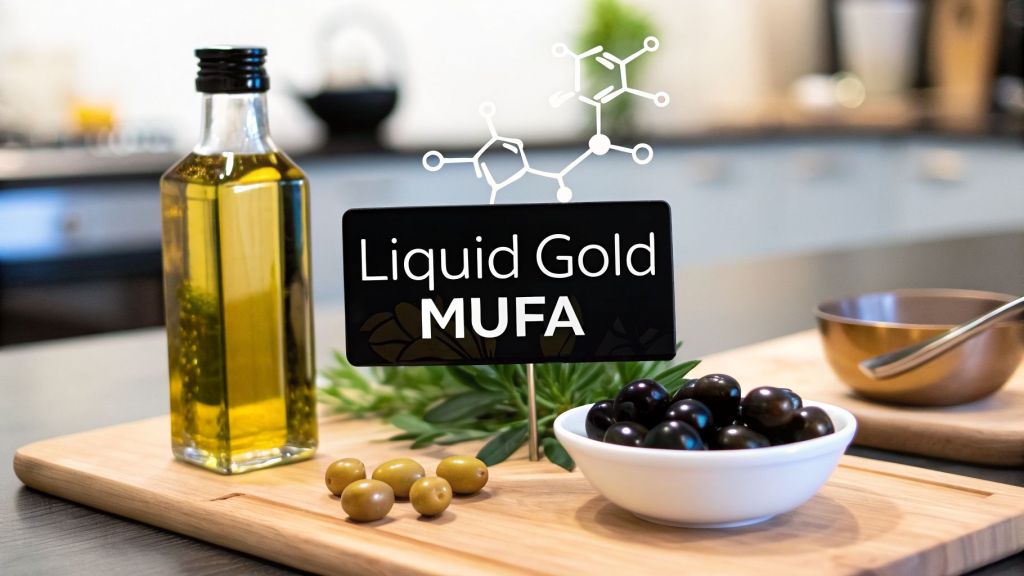
Have you ever wondered why olive oil, for centuries, has been celebrated as a cornerstone of health? It’s not just a matter of tradition. The real magic—the secret revealed by modern science—is hidden in its chemistry. Specifically, its high concentration of olive oil monounsaturated fat—the very foundation of the famed Mediterranean diet.
The Secret Ingredient Behind Olive Oil's Power
What separates olive oil from the crowded field of cooking fats? It all comes down to its molecular structure. While many foods contain fat, the type of fat is what truly counts. And here, olive oil stands nearly alone. It is absolutely packed with a specific monounsaturated fat called oleic acid, often making up over 70% of its entire composition.
Let's think about dietary fats in a practical way. Saturated fats are like rigid, tightly-packed chains. They're stable, but in excess, they can create a kind of stiffness in our biological systems. Polyunsaturated fats, on the other hand, are like loose, flimsy chains, making them unstable and easily damaged by heat and oxygen.
Monounsaturated fats strike the perfect balance.
They are the strong, yet flexible, players in our cellular world. This structure provides stability without being rigid, allowing your body's systems to function with remarkable fluidity and efficiency. It’s the key to their power.
This unique combination of strength and flexibility is what sets the olive oil monounsaturated fat apart. It helps build healthy, fluid cell membranes and supports a huge range of bodily functions without the downsides linked to other fat types.
Oleic Acid: The Unsung Hero
The star of the show in every bottle of olive oil is oleic acid. This isn't just another fatty acid; it's a well-researched powerhouse known for its impressive stability and health-promoting qualities. Oleic acid is remarkably resilient, making it a reliable and clean-burning source of energy for your body.
Here’s why its dominance is so critical:
- Structural Integrity: It plays a key role in building strong, fluid cell walls, which is essential for everything from nutrient transport to cell-to-cell communication.
- Chemical Stability: With just one double bond in its chemical structure, oleic acid is far less prone to oxidation (damage from free radicals) than delicate polyunsaturated fats. This matters both in the bottle and in your body.
- Health Synergy: Oleic acid doesn't work alone. It acts in concert with olive oil's other potent compounds, like antioxidants and polyphenols, to deliver a full spectrum of benefits.
This isn’t just about cutting out "bad" fats; it's about actively choosing a "smarter" one. When you understand the central role of oleic acid, you see that olive oil monounsaturated fat is more than just an ingredient—it's a strategic choice for long-term health. To see a full breakdown of the numbers, check out the complete fat content of olive oil in our detailed guide. Next, we’ll explore how these powerful fats measure up against others in your diet.
How Olive Oil's Good Fats Outperform Others
To truly appreciate the power of olive oil’s monounsaturated fats, it helps to see how they stack up against the competition. In the world of dietary fats, it's not just about being "good"—it’s about performance. Let's put the everyday fats in your kitchen to the test.
Think of it this way: some fats, like the saturated kind in butter and coconut oil, are rigid and inflexible. Others, like the polyunsaturated fats in many seed oils, can be delicate and unstable.
The monounsaturated fats (MUFAs) from high-quality olive oil, on the other hand, strike a brilliant balance. They are both stable and flexible, a unique combination that makes them incredibly effective at supporting your body.
Fat Profile Showdown: Olive Oil vs. Common Kitchen Fats
Not all fats are created equal. Their chemical structure dictates everything—from how they behave in a hot pan to how they function inside our bodies.
Saturated fats are packed tightly together, which is why they're solid at room temperature (think of a stick of butter). When we consume them in excess, this rigidity can translate to less flexible cell membranes.
By contrast, olive oil's monounsaturated fat has a special "kink" in its molecular chain. This single bend keeps the fat molecules from packing together, making olive oil a liquid at room temperature. This simple visual shows you exactly what I mean.

This isn’t just a cosmetic difference. That unique structure is the very reason MUFAs deliver their health benefits so effectively.
A Tale of Two Cholesterols
One of the most impressive jobs olive oil’s monounsaturated fat performs is managing cholesterol. For years, we’ve heard about "bad" LDL and "good" HDL cholesterol. Olive oil doesn't just pick a side—it works on both.
Solid research has shown that swapping saturated fats for MUFAs helps lower LDL cholesterol. That’s the type that can cause trouble when it oxidizes and builds up as plaque in your arteries.
But that's only half the story.
Olive oil's MUFAs pull off a rare trick: they help lower the harmful LDL cholesterol while leaving protective HDL cholesterol levels untouched, or even giving them a boost. HDL is the "scavenger" cholesterol that cleans up the excess from your arteries.
Very few other fats can perform this delicate and vital maneuver, which truly puts olive oil in a league of its own. For a head-to-head analysis, our guide on olive oil vs coconut oil breaks it down even further.
The Winner by the Numbers
When you lay out the fat profiles of common kitchen staples side-by-side, the picture becomes crystal clear. The sheer amount of monounsaturated fat in olive oil is impressive.
Here’s a quick comparison.
| Fat/Oil | Monounsaturated Fat (%) | Polyunsaturated Fat (%) | Saturated Fat (%) |
|---|---|---|---|
| Extra Virgin Olive Oil | ~73% | ~11% | ~14% |
| Butter | ~21% | ~3% | ~63% |
| Coconut Oil | ~6% | ~2% | ~87% |
| Canola Oil | ~63% | ~28% | ~7% |
| Sunflower Oil | ~20% | ~66% | ~10% |
As you can see, while some other oils have MUFAs, none match the high concentration found in olive oil, especially without a large amount of more fragile polyunsaturated fats. The numbers don't lie.
Choosing olive oil isn’t just a matter of taste; it's a strategic choice for getting the most stable, health-supportive fat into your meals.
The Heart Health Benefits of Monounsaturated Fats
So, we've covered the "what," but the "why" is where the story gets really compelling. What is it about olive oil monounsaturated fat that makes it such a powerhouse for heart health? This isn't some new discovery; the clues have been hiding in plain sight for decades, nestled in the sun-drenched hills of the Mediterranean.
It all started to click back in the 1950s. Researchers studying different populations noticed something incredible in places like Crete: people who ate a diet swimming in olive oil had exceptionally low rates of heart disease. This observation became a cornerstone of the landmark Seven Countries Study, which later found that populations with high olive oil intake had 37% lower rates of coronary heart disease.
We've come a long way since then. Modern clinical trials have confirmed that making the switch to extra virgin olive oil can lower "bad" LDL cholesterol by up to 10%, all while delivering a potent dose of protective polyphenols.
Calming Chronic Inflammation
Imagine a low-grade fire constantly smoldering inside your arteries. This is chronic inflammation—a silent process that, over years, contributes to serious damage and many modern illnesses, especially heart disease.
The primary monounsaturated fat in olive oil, oleic acid, is a fantastic anti-inflammatory agent. It works on a cellular level to dial down the inflammatory signals that lead to arterial damage and the buildup of plaque. A diet rich in olive oil monounsaturated fat essentially helps keep that internal fire in check, fostering a healthier environment for your entire cardiovascular system.
"A daily ritual of incorporating extra virgin olive oil isn't just a culinary choice; it's a preventative health strategy. It actively works to protect your circulatory system from the ground up."
This is the very definition of proactive health. Instead of waiting for a problem, you’re creating a biological foundation where issues are far less likely to develop. You can also learn more about olive oil for blood pressure in our dedicated guide.
Protecting Your Arteries
One of the biggest threats to your heart is atherosclerosis—the hardening and narrowing of your arteries. It all begins when LDL cholesterol, the "bad" kind, becomes oxidized. Once it oxidizes, it gets sticky and begins to cling to your artery walls, forming the dangerous plaque that chokes off blood flow.
This is where olive oil truly shines. Its monounsaturated fats, working alongside powerful antioxidants like polyphenols, form a protective shield around those LDL particles.
By preventing oxidation in the first place, they stop plaque formation before it can even start. This helps keep your LDL cholesterol from turning "toxic," allowing it to circulate harmlessly instead of building up into a dangerous blockage. Olive oil is particularly good at improving your overall cholesterol profile, and you can deepen your knowledge by understanding the nuances of cholesterol and its impact on your heart health.
Improving Blood Vessel Function
Healthy blood vessels aren't rigid pipes. They are flexible, dynamic tissues that need to expand and contract to manage blood flow and maintain healthy pressure. Unfortunately, they can become stiff and dysfunctional over time.
Monounsaturated fats have been shown to directly improve the function of the endothelium—the delicate, single-cell-thick lining of your blood vessels.
A healthy endothelium means great things for your body:
- Better Blood Flow: When your vessel lining is smooth and healthy, blood flows freely, carrying oxygen and nutrients where they need to go.
- Lower Blood Pressure: Flexible arteries can better accommodate the force of blood flow, which helps promote healthier blood pressure levels.
- Reduced Clotting Risk: A healthy endothelial lining is non-stick, making it much less likely to trigger the formation of dangerous blood clots.
Ultimately, a diet centered on olive oil monounsaturated fat doesn't just target one risk factor. It supports the entire cardiovascular system in a holistic, synergistic way—an approach to well-being that has been proven over generations and validated by modern science.
Choosing an Olive Oil for Maximum Health Impact

Okay, you’re sold on the power of olive oil monounsaturated fat. But walking down the oil aisle can feel overwhelming. With so many choices, how do you know which bottle actually delivers the health benefits you’re after?
The secret is realizing that not all olive oils are created equal. The single most important thing to look for is the grade. While every bottle of olive oil is loaded with monounsaturated fats, the way it's processed determines whether it keeps its other vital compounds—the antioxidants and polyphenols that work hand-in-hand with those healthy fats.
Think of it this way: extra virgin olive oil is like fresh-squeezed orange juice. It's the pure, unadulterated stuff, bursting with all the natural goodness of the fruit. In contrast, refined oils are more like juice from concentrate. Heat and chemical processing have stripped away most of the original flavor, aroma, and nutrients.
Decoding the Labels
To find the good stuff, you need to learn the language on the label. These aren't just marketing terms; they're legal classifications that tell you exactly how an oil was made and what to expect from it.
Extra Virgin Olive Oil (EVOO): This is the top of the line. It's produced only by mechanical methods—simply crushing fresh olives without heat or chemicals. To earn the EVOO label, an oil must pass strict chemical tests for freshness (low acidity) and a sensory panel to confirm it has a perfect, fruity taste. This is your best bet for maximizing your intake of olive oil monounsaturated fat and beneficial polyphenols.
Virgin Olive Oil: This oil is also made without chemicals, but it doesn't quite meet the high standards of EVOO. It might have some minor flavor flaws or slightly higher acidity. It's still a decent product, but it's a step down in overall quality and antioxidant punch.
Olive Oil (or Pure/Light Olive Oil): Here’s where it gets complicated. These products are blends, usually containing just a tiny splash of virgin olive oil mixed with a lot of highly refined oil. The refining process uses heat and solvents on oils that failed to make the virgin grade, removing nearly all the flavor, color, and—most importantly—those precious polyphenols.
Don't be fooled by the word "Light" on a label. This is a clever marketing trick. It only refers to a lighter flavor and color, not fewer calories or less fat. While the fat composition is the same, the antioxidants that make it so healthy are mostly gone.
What to Look for on the Bottle
Beyond the grade, a few other clues on the bottle can point you toward a truly superior product. A producer who is proud of their oil will want to give you this information.
Harvest Date: This is your most powerful tool for finding a fresh, high-quality oil. Olive oil is essentially a fruit juice, and it degrades with time. Look for a specific harvest date (e.g., "Harvested: November 2025") and grab the most recent one you can find. A "best by" date isn't nearly as helpful, as it's often set for two years after bottling and doesn't truly reflect freshness.
Country of Origin: Specificity is key. A label saying "Product of Italy" is good, but one that names the specific estate or region is even better. Certifications like PDO (Protected Designation of Origin) go a step further, guaranteeing the olives were grown, pressed, and bottled in that one particular place.
Packaging: Light is one of olive oil’s worst enemies. Always choose oils sold in dark glass bottles, tins, or ceramic containers. These protect the oil from light damage, which can degrade the healthy fats and destroy the antioxidants.
When you're ready to buy, checking out products like this Smooth Organic Extra Virgin Olive Oil can show you what a high-quality label looks like in the wild.
For a deeper dive, check out our guide on how to find an extra virgin olive oil with the highest polyphenols. Choosing wisely in the store is the final, crucial step to harnessing the true health power of olive oil monounsaturated fat.
Cooking with Olive Oil to Unlock Its Benefits

Alright, you’ve grasped the science behind olive oil monounsaturated fat. But the real magic happens when you bring that knowledge out of your head and into your kitchen. Making this liquid gold a part of your daily routine isn't about mastering complex recipes. It’s about making simple, flavorful swaps that make your food better—and you healthier.
First things first, let's bust a myth that just won't die: the idea that you can't cook with extra virgin olive oil. I hear this all the time, and it has probably stopped more people from enjoying EVOO's benefits than anything else. The fear is that heat will make it smoke, break down, and lose all its goodness. This is a huge misunderstanding.
A good-quality extra virgin olive oil has a smoke point somewhere between 375°F and 410°F (190-210°C). That range is more than high enough for the vast majority of home cooking, including sautéing, roasting, and even some light frying.
The stability of EVOO under heat isn't just about its smoke point. It's the powerful combination of stable olive oil monounsaturated fat and protective antioxidants that makes it a surprisingly resilient cooking partner. These compounds shield the oil from breaking down.
So please, use your good oil. The real secret isn't avoiding heat altogether; it's about matching the right oil to the right task.
Pairing Flavors for Maximum Impact
This is where it gets really fun. Not all extra virgin olive oils are created equal, and they certainly don't taste the same. Think of it like wine—you wouldn't use the same bottle for every occasion, and the same goes for olive oil. You can group them into three general flavor profiles:
- Delicate & Buttery: These oils are incredibly smooth and mellow, often with hints of almond or ripe, sweet fruit. They're perfect for baking when you want a moist cake without an assertive flavor, or for drizzling over a flaky white fish.
- Fruity & Balanced: Consider this your go-to, everyday workhorse. It has that classic green, grassy aroma and a wonderfully balanced fruitiness. This oil shines in vinaigrettes, makes roasted vegetables sing, and works beautifully as a base for marinades.
- Robust & Peppery: These oils pack a punch. They are bold and leave a distinct, peppery finish in the back of your throat. That little "kick" is actually a good thing—it’s a telltale sign of a high polyphenol content. Use these powerful oils to finish a hearty stew, drizzle over a grilled steak, or pair with bitter greens like arugula.
When you start matching the oil’s intensity to your dish, you’re no longer just adding fat. You’re adding a whole new layer of flavor and complexity that can take a simple meal from good to great.
Effortless Swaps to Get Started
Bringing high-MUFA olive oil into your diet should feel easy, not like a chore. Here are a few dead-simple swaps you can make right now to start enjoying the benefits:
- Roast Your Vegetables: Forget steaming. Toss your broccoli, carrots, and asparagus in a generous coating of olive oil, salt, and pepper. Roasting at 400°F (200°C) brings out their natural sweetness and gives them an incredible crispy-tender texture.
- Ditch the Butter: Use a drizzle of olive oil instead of melted butter when tossing pasta or potatoes. For baking, you can often substitute olive oil for butter using a 3:4 ratio (so, ¾ cup of oil for every 1 cup of butter).
- Make Your Own Dressing: Why buy store-bought dressings loaded with sugar and cheap oils? In just a minute, you can whisk together 3 parts extra virgin olive oil with 1 part vinegar (balsamic is great), a dollop of Dijon mustard, salt, and pepper. It’s a game-changer.
For even more techniques and recipes, check out our complete guide on how to cook with olive oil. The ultimate win in the kitchen is when the healthiest choice is also the most delicious one.
Your Questions on Olive Oil Fats Answered
When it comes to olive oil, a few questions pop up again and again. It's smart to be curious, especially with all the information out there. Let's clear the air and tackle some of the most common topics so you can feel confident about what you're buying and eating.
Does All Olive Oil Have the Same Amount of Monounsaturated Fat?
For the most part, yes. The fat profile of any olive oil is dominated by monounsaturated fats, specifically oleic acid. While the exact percentage can vary a little based on the type of olive, where it was grown, and when it was harvested, MUFAs are always the main event.
The real difference between "extra virgin" and "light" olive oil isn't the fat content—it's the processing. Refined oils are made using heat and chemicals that strip away the polyphenols. These are the antioxidants that work hand-in-hand with the healthy fats to give you the full range of health benefits. If you want the biggest impact, always reach for Extra Virgin Olive Oil.
Can I Lose Weight by Eating More Olive Oil?
Simply adding a lot of olive oil to your diet won't make you lose weight on its own—it is a calorie-rich food, after all. But that's not really how it helps.
The high concentration of olive oil monounsaturated fat is fantastic for promoting satiety, that feeling of being full and satisfied after a meal. This can curb your appetite and make you less likely to reach for unhealthy snacks. When you use it to replace other fats like butter or margarine, especially within a balanced approach like the Mediterranean diet, it becomes a powerful tool for managing a healthy weight and improving your metabolism.
How Do I Know if My Olive Oil Is High Quality?
This is the million-dollar question. To find a genuinely great bottle, you have to play detective with the label. Here are the three most important clues to look for:
- A Harvest Date: Freshness is everything. Look for a specific date (e.g., "Harvest: November 2025") and always pick the most recent one you can find.
- Protective Packaging: Quality olive oil's biggest enemy is light. A good producer knows this and will use dark glass bottles, tins, or even ceramic containers to protect the oil inside.
- A Quality Seal: Look for official certifications. Seals like a PDO (Protected Designation of Origin) or a regional one (like the California Olive Oil Council seal) are your guarantee of authenticity and quality standards.
The ultimate test of a great extra virgin olive oil is its taste. You should notice a fresh, almost grassy aroma and a distinct peppery or slightly bitter sensation in the back of your throat. That little "kick" is the tell-tale sign of powerful, healthy polyphenols doing their job.
Is It Safe to Cook with Extra Virgin Olive Oil at High Heat?
Yes, it absolutely is. This is probably one of the biggest and most stubborn myths about olive oil. A high-quality extra virgin olive oil has a smoke point between 375-410°F (190-210°C).
That temperature range is more than high enough for nearly all home cooking, from sautéing and roasting to pan-frying. What makes it so stable? The combination of its stable monounsaturated fats and the protective layer of antioxidants, which prevent the oil from breaking down under heat. So not only is it safe, it's a smarter, healthier choice for your everyday cooking.
Here at Learn Olive Oil, we believe that knowing the "why" behind your food choices makes every meal better. We're here to give you the expert insights needed to choose, taste, and cook with the world's best olive oils. To start your journey toward becoming an olive oil expert, explore our guides.
 Learn Olive Oil
Leave a comment