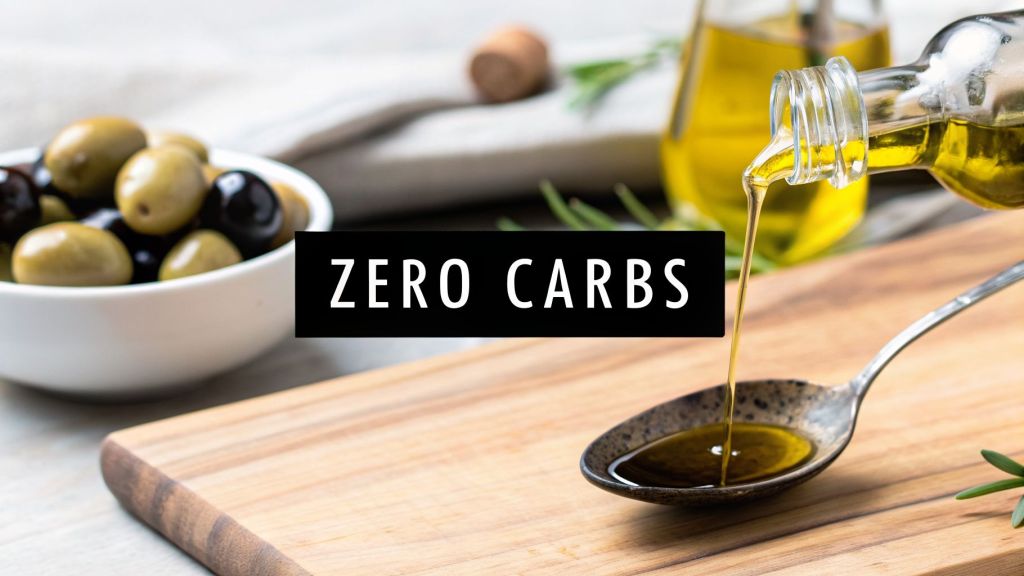
If you've ever found yourself asking, "how many carbs are in olive oil?", you’re in for some refreshingly good news. The answer is a simple, resounding zero.
How Many Carbs Are In Olive Oil?
That's right. Whether you're splashing out for a robust extra virgin olive oil or using a lighter, more refined one, pure olive oil contains zero carbohydrates. No sugars. No fiber. Nothing. It is pure, unadulterated fat—and that is precisely why it has become the cornerstone for countless people following low-carb and ketogenic lifestyles.
But hold on. How can a product derived from a fruit contain no carbohydrates?
It all comes down to a simple, brilliant act of separation. When olives are pressed, the oil is mechanically squeezed and separated from the fruit's pulp, skin, and water. Those solids are where the trace amounts of carbohydrates are locked away. What we are left with is the pure, liquid fat—often called "liquid gold."
This carb-free profile is a cornerstone of why olive oil is celebrated in the Mediterranean diet. In fact, compelling research shows that making extra virgin olive oil a regular part of your diet can offer significant heart-health benefits without impacting your blood sugar, as highlighted in this study from the National Institutes of Health.
Since tracking carbs is a non-issue, the one thing you must remain mindful of is the calorie count. Let's look at the numbers.
Nutritional Snapshot of Extra Virgin Olive Oil
Here’s a quick breakdown of the macronutrient content in common serving sizes of olive oil.
| Serving Size | Carbohydrates (g) | Total Fat (g) | Calories (approx.) |
|---|---|---|---|
| 1 Teaspoon | 0 | 4.5 | 40 |
| 1 Tablespoon | 0 | 14 | 120 |
| 1/2 Cup | 0 | 112 | 960 |
| 1 Cup | 0 | 224 | 1920 |
As you can clearly see, the carbohydrate count always remains at 0, no matter how much you use. The fat and calories, however, climb quickly with the portion size.
For a deeper dive into the healthy fats, vitamins, and antioxidants that make up the rest of its profile, you can explore our complete guide to olive oil nutrition facts.
How a Fruit Becomes a Pure, Zero-Carb Fat
It seems a little counterintuitive, doesn't it? Olives are fruits, and fruits contain carbs. So how does olive oil end up with zero carbohydrates? The answer isn't some complex chemical process; it’s all about simple, powerful, mechanical extraction.
Think of it this way: when you make fresh-squeezed orange juice, you’re separating the liquid juice from the fibrous pulp and peel. The process for making olive oil is similar, but instead of chasing sugary juice, the goal is to isolate the pure, liquid fat from everything else in the olive.
This diagram gives a great high-level look at how the valuable oil is separated from the rest of the fruit.

As you can see, the machinery itself acts as a natural filter, ensuring only pure oil makes it through to the final bottle.
The Science of Separation
Freshly harvested olives are a mix of oil, water, and solid matter. The entire goal of production is to get the oil out, completely on its own.
It all comes down to the press. The immense pressure applied during milling and pressing literally squeezes the oil from the olive's fruit cells. Everything left behind—the water, skin, seeds, and fibrous pulp—is where the fruit's tiny amount of natural carbohydrates is trapped.
This physical separation is incredibly efficient. It isolates the fatty acids (the good stuff, like oleic acid) from all the water-soluble parts of the olive, which includes any trace sugars or starches. By its very nature, this process guarantees the final product is 100% pure fat.
This is why you can be absolutely confident that a bottle of true extra virgin olive oil contains 0g of carbohydrates. The production method itself is designed to remove them.
If you’re curious to see the fascinating journey from orchard to bottle in more detail, you can dive deeper into how olive oil is made and the different techniques used.
Ultimately, understanding this physical separation is key. It's not a chemical refinement; it’s a simple act of taking the fat and leaving the rest behind. This is what makes olive oil such a clean, pure source of energy for any diet.
Why Olive Oil Is a Keto Diet Superstar
If you’re following a low-carb or ketogenic lifestyle, you know the drill: the constant hunt for foods that are both satisfying and compliant. Olive oil doesn't just fit into that category—it's practically a headliner. Before we get into exactly why, it helps to understand the real difference between keto and low carb diets to see where it shines brightest.
Its incredible value goes way beyond its zero-carb count. At its core, a ketogenic diet forces your body to switch its primary fuel source from carbs to fat. To get into that fat-burning state, called ketosis, you need to eat a lot of fat. Olive oil offers this in its purest form.
Think of olive oil as a direct line to your daily macros. Every tablespoon gives you about 14 grams of pure, high-quality fat with zero carbohydrate interference. This makes it an unbelievably efficient way to hit your fat targets and help your body stay in ketosis.
Because it's pure fat, it has no impact on your blood sugar. You can learn more about how it sidesteps blood sugar spikes in our guide on the glycemic index of olive oil.
The Secret Weapon Against Blandness
Let's be honest: diet fatigue is a real problem, often caused by eating the same bland meals over and over. This is where olive oil truly becomes your best friend, turning a restrictive diet into a genuine culinary experience. Its rich, savory flavor completely changes the game.
A quick drizzle can transform boring staples into something you actually look forward to eating:
- Roasted Vegetables: Toss broccoli or asparagus in olive oil to get that crispy, crave-worthy texture.
- Lean Proteins: A splash adds moisture and a gourmet touch to simple grilled chicken or fish.
- Simple Salads: Creates a delicious, nutrient-packed dressing with just a bit of lemon and salt.
By adding this kind of flavor and richness, olive oil makes your low-carb meals more enjoyable, which is key to sticking with it for the long haul. It's the perfect tool for creating dishes that feel indulgent, not like a sacrifice.
It’s Not Just About the Zero Carbs

Knowing olive oil is carb-free is a great start, but that’s only half the story. The real health benefits don't come from what's missing, but from what's packed inside every single drop. This is what separates it from other simple cooking fats and turns it into a true health-booster.
The oil is primarily made of oleic acid, a type of monounsaturated fat famous for its heart-healthy properties. But the real powerhouse compounds are the ones you can actually taste.
The Power of That Peppery Kick: Polyphenols
Have you ever tried a high-quality extra virgin olive oil and felt a distinct, peppery sensation at the back of your throat? That's not a sign of a bad oil—quite the opposite. That "kick" is the taste of polyphenols.
Think of polyphenols as the oil's built-in bodyguards. They're powerful antioxidants that protect the olive from environmental stress, and when you consume the oil, they get to work protecting you. They fight off oxidative stress caused by free radicals, which contributes to aging and chronic illness. This is why a genuine, high-quality olive oil is so much more than just empty calories.
Its power lies in its composition. While it contains 0g of carbs per 100g, extra virgin olive oil (EVOO) is rich in monounsaturated fats and can have polyphenol levels four times higher than refined versions.
This unique combination of healthy fats and antioxidants is tied to some pretty impressive results. For example, studies suggest that people who consume more olive oil have a 20-30% lower risk of developing type 2 diabetes. In one trial, participants who had just over three tablespoons of EVOO daily saw better improvements in their good cholesterol markers compared to those using corn oil, all without adding a single carb. You can see the full study on these beneficial olive oil effects.
Clearly, the benefits go far beyond just being a zero-carb ingredient. To learn more about what this liquid gold can do for you, take a look at our complete guide to olive oil health benefits.
How to Choose an Authentic Zero-Carb Olive Oil

Walking down the oil aisle can feel overwhelming. You’re faced with dozens of bottles, all with beautiful labels and tempting descriptions. But if you want a truly pure, healthy, and zero-carb product, you must ignore the marketing on the front and focus on a few key words on the back.
Your best bet, every single time, is to look for two simple words.
The gold standard is always Extra Virgin Olive Oil (EVOO). This isn't just a fancy name; it's a specific designation meaning the oil was extracted using only mechanical methods, without chemicals or intense heat. The result is pure, unadulterated fat.
Because EVOO is made this way, all the fruit pulp, water, and natural sugars from the olive are left behind. That’s why it’s guaranteed to be carb-free. Seeing terms like "cold-pressed" or "unrefined" are extra confirmation you’re getting the real deal.
Red Flags to Watch For
The market is flooded with lower-quality products disguised as premium oil. Knowing how to read nutrition labels and spotting misleading marketing buzzwords is your best defense.
Keep an eye out for these common imposters:
- "Light" Olive Oil: This has nothing to do with calories or carbs. It simply means the oil has a lighter color and flavor because it's been heavily refined, stripping away its natural taste and most of its health benefits.
- "Pure" Olive Oil: Ironically, this usually means the opposite of pure. It's typically a blend of chemically refined olive oil with just a tiny amount of virgin oil added back in for flavor.
- Vague "Oil Blends": If the label says "packed in Italy" but not "produced in Italy," be suspicious. It could be oil from anywhere. Even worse are bottles that list other vegetable oils in the ingredients, which means you're not getting 100% olive oil.
Getting this right matters. To learn more about identifying these tricky bottles, our guide on how to spot fake olive oil is a great resource. Choosing a genuine EVOO ensures you get the authentic, zero-carb powerhouse you're paying for.
Answering Your Top Olive Oil Questions
Even after you know for sure that olive oil is carb-free, a few more specific questions usually follow. I get these all the time, so let's clear them up right now so you can use this amazing ingredient with total confidence.
Do Flavored or Infused Olive Oils Contain Carbs?
This is a great question, and the answer isn't a simple yes or no. Generally, they don't have any meaningful amount of carbs. When you infuse pure olive oil with something like garlic cloves, fresh herbs, or lemon peel, a tiny, almost immeasurable trace of carbs might transfer over.
For any decent-quality infused oil, this amount is so small—we're talking fractions of a gram—that it's nutritionally insignificant. It won't throw you out of ketosis or mess with your low-carb goals. But you do need to be a savvy shopper.
The real trap is in products that add ingredients after the infusion. If a so-called "flavored oil" is mixed with added sugars, balsamic glaze, or other sweet syrups, then the carb count can definitely jump. The nutrition label is your best friend here. For a 100% zero-carb guarantee, your safest bet is always pure EVOO or an infused oil where you've personally checked the label.
How Does Olive Oil Compare to Butter or Coconut Oil?
When it comes to carbs, there’s no contest because they’re all in the same boat. Just like olive oil, both butter and coconut oil contain zero carbohydrates. They are all pure fats.
The important difference isn't about carbs, but about the type of fat each one brings to the table.
- Olive Oil: The star here is heart-healthy monounsaturated fat, plus those amazing antioxidant compounds called polyphenols.
- Coconut Oil: This one is mostly saturated fat, but it's famous for its Medium-Chain Triglycerides (MCTs), a favorite in the keto world because of how the body metabolizes them for quick energy.
- Butter: Also high in saturated fat, butter is prized for the rich, creamy flavor it adds to food.
So, your choice isn't about avoiding carbs. It’s about picking the right fat for your health goals, your personal dietary philosophy, and of course, the taste you're going for in your dish.
This all points to a core nutritional concept. Fat is the most energy-dense macronutrient we have, packing 9 calories per gram. For comparison, carbohydrates and protein only provide 4 calories per gram.
Because olive oil is 100% fat, it's also naturally calorie-dense, coming in at around 120 calories per tablespoon. That's not a bad thing; it’s a sign of its purity. It means a small amount delivers a huge payload of flavor and health benefits without any fillers.
At Learn Olive Oil, we believe that truly appreciating olive oil starts with understanding it. We're here to give you the expert insights you need to choose, taste, and cook with confidence. Explore our guides at https://learnoliveoil.com to find your next favorite bottle.
 Learn Olive Oil
Leave a comment