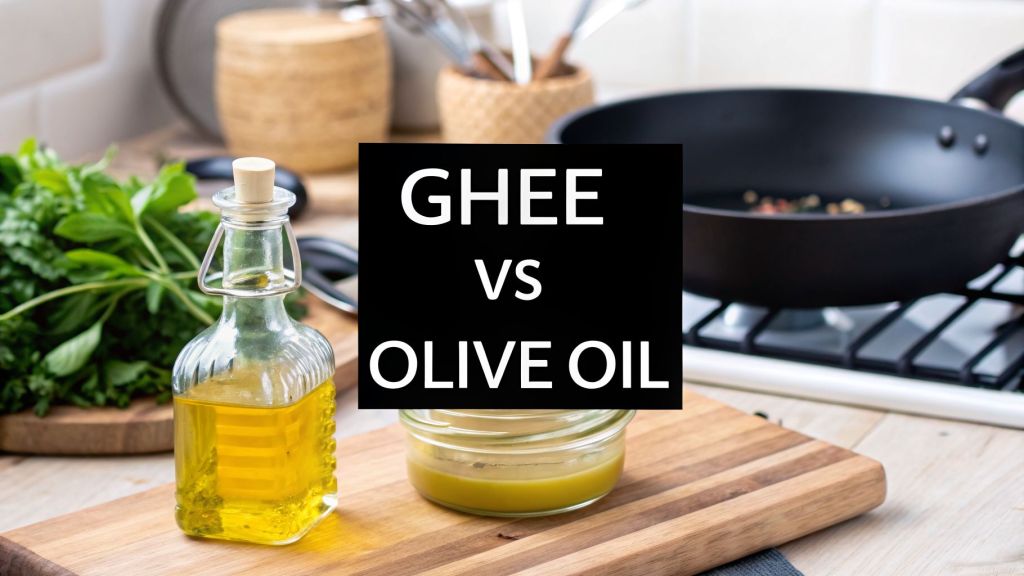
In the world of cooking fats, two titans vie for the top spot in your pantry. One is ghee, the golden, nutty essence of butter, revered in ancient traditions for its searing heat and rich flavor. The other is olive oil, the liquid gold of the Mediterranean, celebrated by modern science for its heart-healthy virtues and vibrant taste. This isn’t just a simple choice between two bottles on a shelf. It’s a decision that defines the soul of your dish.
The Great Fat Debate: Ghee or Olive Oil?
Imagine, for a moment, you’re poised to create a masterpiece in your kitchen. Before you stands a jar of luminous, fragrant ghee and a bottle of deep green, extra virgin olive oil. Each is a legend in its own right, a cornerstone of entire culinary worlds. Yet, they could not be more different. This is not a battle to crown a single winner, but a story of two distinct characters, each waiting for the right role on your plate.
Ghee, the clarified heart of butter, has been a sacred staple in Indian cuisine and Ayurvedic medicine for millennia. Its power lies in its purity; with the milk solids and water removed, it can withstand blistering heat, making it the undisputed champion of the sear and the fry. Olive oil, on the other hand, is the lifeblood of the Mediterranean. It is beloved not just for its astounding flavor but for a mountain of scientific evidence backing its health benefits. It comes alive when used with a gentle hand—drizzled, whisked, or lightly sautéed—where its complex notes can sing. To find the perfect partner for your meal, you might explore the different types of olive oil for cooking.
If you follow the habits of health-conscious cooks, a powerful trend emerges. The world has fallen in love with olive oil. In the U.S. alone, consumption has exploded from a mere 28,000 metric tons in the early 1970s to a staggering 400,000 metric tons today. This is no accident. It’s a conscious shift toward the heart-protecting monounsaturated fats that have made olive oil a household name.

A Quick Comparison
To cut to the chase, let’s lay bare their fundamental differences. The ghee vs. olive oil debate isn’t about finding a universal "best," but about mastering your tools. It’s knowing which key unlocks which door.
| Feature | Ghee | Extra Virgin Olive Oil |
|---|---|---|
| Primary Use | High-heat cooking, searing, roasting | Finishing, dressings, gentle sautéing |
| Flavor Profile | Nutty, buttery, slightly sweet | Varies: peppery, grassy, fruity, buttery |
| Main Fat Type | Saturated Fat | Monounsaturated Fat |
| Origin | Clarified Butter (Dairy) | Pressed Olives (Plant-based) |
The secret of the world's best chefs isn’t choosing a winner. It's knowing precisely when to call upon ghee for its profound, buttery depth and when to let the fresh, intricate notes of olive oil elevate a dish to greatness. A truly masterful kitchen needs both.
A Head-to-Head Nutritional Showdown
At first glance, ghee and olive oil seem like twins—both are pure fats, ready to sizzle in your pan. But look closer, and you'll discover they are built from entirely different blueprints. What’s inside each spoonful has a radically different impact on your body and your long-term health.
The most crucial distinction lies in their very structure. Ghee, born from butter, is a fortress of saturated fat, which constitutes about 62% of its composition. In breathtaking contrast, extra virgin olive oil is the undisputed king of monounsaturated fats, with these heart-friendly fats composing up to 73% of its volume.
The Great Fat Divide
This is the fork in the road where health-conscious cooks make their choice. While the debate over saturated fat has complexities, decades of research have led to a clear consensus: high intake is associated with higher levels of LDL (the "bad") cholesterol.
On the flip side, the monounsaturated fats in olive oil, led by the superstar oleic acid, are praised across the medical community for their profound benefits to heart health. One of the simplest yet most powerful recommendations for supporting cardiovascular wellness is to replace saturated fats with a source like olive oil.
To truly grasp the difference, let the numbers speak for themselves.
Nutritional Snapshot: Ghee vs. Extra Virgin Olive Oil (Per Tablespoon)
This table reveals the hidden story behind each fat, showing just how different they are beneath the surface.
| Nutrient | Ghee (Approximate) | Extra Virgin Olive Oil (Approximate) |
|---|---|---|
| Calories | 120 | 120 |
| Total Fat | 14g | 14g |
| Saturated Fat | 9g | 2g |
| Monounsaturated Fat | 4g | 10g |
| Polyunsaturated Fat | <1g | 1.5g |
| Vitamin A | ~8% DV | 0% |
| Vitamin E | ~2% DV | ~10% DV |
| Vitamin K | ~1% DV | ~7% DV |
As you can see, though calories are identical, the kind of fat you're consuming is worlds apart.
Vitamins and Antioxidants
Beyond fats, each contender brings a unique set of micronutrients to the fight. Extra virgin olive oil is famous for its arsenal of polyphenols, powerful antioxidants that are your body’s frontline defense against inflammation and oxidative stress. That assertive, peppery sensation you feel at the back of your throat from a world-class EVOO? That's the taste of health—the calling card of its potent polyphenols.
Ghee offers a different treasure. As a dairy derivative, it contains fat-soluble vitamins absent in olive oil, including:
- Vitamin A: Essential for vision and a robust immune system.
- Vitamin E: A powerful antioxidant that guards your cells.
- Vitamin D: Crucial for bone health.
- Vitamin K: Vital for blood clotting and bone metabolism.
Because these vitamins require fat for absorption, ghee serves as a superb delivery system. However, it entirely lacks the powerhouse polyphenols that have made olive oil a legend in the world of wellness. For a deeper look, this guide to olive oil nutrition facts is an excellent resource.
So, the "ghee vs olive oil" dilemma boils down to a strategic choice: do you want the fat-soluble vitamins (A, D, K) from ghee, or the heart-protecting monounsaturated fats and inflammation-fighting polyphenols from extra virgin olive oil?
The Smoke Point Myth and Mastering Heat

If you’ve ever set foot in a serious kitchen, you’ve heard the gospel of the smoke point. The old wisdom was brutally simple: higher is better. On paper, this makes ghee the heavyweight champion, with a smoke point often cited at a searing 485°F (252°C).
But here is a truth that can change the way you cook forever: that single number is dangerously misleading. A fat’s smoke point is not a fixed law of nature. It’s a variable, shifting with the quality, age, and purity of the specific fat you use. In the showdown between ghee and olive oil, this single detail changes everything.
The true measure of a cooking fat’s mettle isn’t just the temperature at which it begins to smoke, but its steadfast resistance to oxidative degradation. This is where a high-quality extra virgin olive oil reveals its hidden genius. While its smoke point is technically lower—typically between 350°F and 410°F (177°C to 210°C)—it comes armed with a natural battalion of protectors.
A fat’s real worth under fire is its ability to resist breaking down into harmful compounds. The powerful polyphenols and stable monounsaturated fats in extra virgin olive oil give it a secret weapon: remarkable resilience that often surpasses refined oils with higher smoke points.
When to Use Each Fat for Optimal Heat
The question isn’t which fat can take more punishment, but which is the right weapon for the task. Ghee is your go-to when you demand a magnificent, golden-brown sear. Its near-total lack of moisture and milk solids makes it a titan for pan-searing a steak or crisping roasted potatoes to perfection. That high smoke point gives you a wide margin of error when the heat is on.
- Choose Ghee For: Searing steaks, frying chicken, or high-heat roasting where you crave that unmistakable rich, buttery flavor.
- Choose Olive Oil For: Your everyday sauté, pan-searing delicate fish, and roasting vegetables up to around 400°F. A great EVOO will not only handle the heat but will also infuse your dish with incredible flavor and antioxidants.
The Polyphenol Shield of Olive Oil
Thankfully, the culinary world has evolved. We're finally moving beyond the smoke point obsession to look at a fat’s total chemical stability. A great extra virgin olive oil is brimming with polyphenols—potent natural antioxidants that act as a shield, protecting the oil from breaking down under heat. This means that even as it approaches its smoke point, a good EVOO often remains more stable than many highly refined oils. You can explore the science in our guide to the olive oil smoking point.
The world’s best extra virgin olive oils, like those from premier producers in Spain, boast an incredibly low free fatty acidity (well below 0.8%), making them even more robust. These protective antioxidant compounds are entirely absent in ghee. As the world awakens to the quality of great olive oil, it's no surprise that world consumption is rising.
Crafting Flavor With Culinary Pairings
Ultimately, the choice between ghee and olive oil is not a technical calculation; it is an artistic one. It’s a decision that will paint the final character of your dish. As every great chef knows, fat is the vehicle for flavor, and these two fats tell profoundly different stories.

Ghee possesses a flavor that feels both ancient and deeply luxurious. The moment it melts in a pan, it releases a nutty, toasty perfume that simple butter can only dream of. This is not a mere cooking medium; it is a foundational flavor, adding layers of caramelized richness from the very start.
This deep, comforting character makes ghee a natural partner for hearty, earthy foods. It can transform a simple pot of lentils into a dish of soul-stirring satisfaction or give roasted root vegetables a decadent, golden crust. It sings in harmony with warm spices like turmeric, cumin, and coriander.
The Bold Language of Ghee
Think of ghee as a warm, enriching embrace. Its flavor is assertive yet round, enhancing everything it touches without overwhelming it. It is the secret weapon for making humble ingredients taste like a feast.
- Indian Cuisine: For true authenticity, ghee is king. It’s indispensable for the rich base of a dal makhani, the fragrant depth of a biryani, or the perfect crispness of a samosa.
- Roasting Vegetables: Toss potatoes, carrots, or cauliflower in melted ghee before roasting. You’ll be rewarded with a crisp, golden-brown armor and a tender, deeply flavorful heart.
- Finishing Grains: A single spoonful stirred into hot basmati rice or quinoa adds a nutty richness that instantly elevates the entire meal.
The Diverse Dialects of Olive Oil
Olive oil, in contrast, is not one flavor—it is an entire language. Its taste ranges from gentle and buttery to fiercely grassy with a sharp, peppery finish. A robust Tuscan oil is a completely different tool than a delicate Spanish Arbequina.
This chameleon-like versatility is olive oil’s greatest strength. A peppery, powerful oil can act as a finishing spice, slicing through the richness of grilled steak or adding a pungent counterpoint to a creamy bean soup. A milder, fruit-forward oil can gently cradle the flavor of delicate fish or fresh greens. To master this art, it helps to learn how to taste olive oil like a professional.
The art of pairing lies in matching intensity. A bold, peppery olive oil is the perfect foil for strong flavors like garlic and red meat. A delicate, buttery oil is the ideal companion for subtle ingredients like fresh mozzarella or spring vegetables.
Think of olive oil as a final, deliberate brushstroke. It can brighten, it can add a pungent kick, or it can lend a smooth, grassy undertone. That final drizzle is rarely for show; it's a calculated move to add a new dimension of complexity. Knowing when to reach for which fat is what separates good cooking from true artistry.
The Health Showdown: What Science Says
When you stand in the cooking oil aisle, you’re making a decision that echoes far beyond tonight’s dinner. You're making a choice for your long-term health. But with a storm of conflicting claims, what does the cold, hard science actually reveal about ghee versus olive oil? Let’s cut through the noise.
The entire conversation begins and ends with the type of fat each one is made of. Olive oil’s claim to fame is its astonishingly high concentration of monounsaturated fats (MUFAs), which have been rigorously studied for decades for their profound, positive impact on heart health.
Heart Health and the Fat Factor
You’ve heard of the legendary health benefits of the Mediterranean diet. Extra virgin olive oil is its beating heart. The secret is oleic acid, the dominant MUFA in olive oil. Study after study has forged an unbreakable link between diets rich in these fats—especially when they replace saturated fats—and superior cardiovascular outcomes.
This is where the two fats diverge dramatically. Ghee, for all its culinary magic, is a bastion of saturated fat. Olive oil, in stark contrast, is loaded with the very type of fat that health organizations across the globe champion for cholesterol management.
Here is the most critical lesson from modern nutrition science: The type of fat you consume is far more important than the total amount. The simple act of swapping saturated fats for monounsaturated ones is one of the most powerful moves you can make for your heart.
The Science Behind the Switch
The numbers tell an undeniable story. A top-tier extra virgin olive oil is typically 71-83% monounsaturated fat. Ghee's profile is the mirror opposite, dominated by saturated fat. This isn't a minor detail—it dictates how your body processes them. Research has shown that replacing saturated fats with MUFA-rich oils like olive oil can help lower LDL ("bad") cholesterol by as much as 10%.
For anyone dedicated to their well-being, this data makes the choice for daily, heart-focused cooking abundantly clear. It’s the primary reason olive oil consumption has surged in health-conscious nations, a trend confirmed by data on global olive oil consumption on WorldPopulationReview.com.
Beyond Fat: The Power of Polyphenols
But the story doesn’t end with fat. Olive oil comes armed with polyphenols, potent antioxidant compounds that are virtually nonexistent in ghee. These micronutrients are your body’s elite forces against chronic inflammation and oxidative stress, two of the primary drivers of modern disease. If you’re curious about the full scope of these benefits, explore the many proven health benefits of olive oil in our comprehensive guide.
Ghee does have its own unique compound, butyric acid, which is highly regarded in Ayurvedic tradition for supporting gut health. While this short-chain fatty acid is beneficial, the overwhelming scientific consensus for total-body wellness—especially for your heart and long-term health—lands decisively in favor of olive oil.
Your Practical Decision-Making Guide
Nutritional theory is one thing, but the real test is in the heat of the kitchen. This is where the ghee versus olive oil debate truly matters. Let's set aside the charts and forge a simple, practical framework for choosing the right fat, for the right job, every single time. The goal is always maximum flavor and flawless performance.
This decision tree offers a quick visual path, focusing on your primary goal, whether it’s heart support, fighting inflammation, or boosting vitamin intake.

As you can see, the path is clear. If your number one priority is supporting your heart and reducing inflammation, olive oil is the most direct and powerful route. But if you’re aiming to enrich your diet with fat-soluble vitamins, ghee makes a compelling case.
A Situational Guide for Your Kitchen
The idea of a single "best" cooking fat is a fantasy. A great cook knows it’s all about deploying the right tool for the task. Here’s your playbook for common kitchen scenarios, explaining not just which fat to grab, but why it’s the undisputed champion for that moment.
For Searing a Steak
- The Winner: Ghee
- The Reason: To achieve that perfect, deep-brown crust—the legendary Maillard reaction—you need ferocious, direct heat. Ghee's high smoke point and pure fat composition mean it can withstand extreme temperatures without smoking or scorching, delivering a clean, buttery flavor that magnifies the richness of the meat.
For Drizzling Over Soup
- The Winner: Extra Virgin Olive Oil
- The Reason: Think of this as a final flourish, not a cooking medium. A stream of high-quality, peppery EVOO adds a fresh, aromatic brightness that slices through the creaminess of a soup. Its polyphenols deliver a pleasant, pungent kick that ghee simply cannot replicate.
Your choice of fat isn't just a medium; it's an ingredient. Ghee is for building deep, foundational flavor with heat. A premium olive oil is for adding that final, aromatic exclamation point.
For Roasting Vegetables
- It Depends: This is a choice between two magnificent but different outcomes.
- Choose Ghee for: A sweet, nutty, and deeply caramelized finish. It performs miracles on root vegetables like potatoes and carrots, giving them a gorgeous golden crust and a truly decadent flavor.
- Choose Olive Oil for: A lighter, more herbal character. It’s perfect for more delicate vegetables like asparagus, zucchini, or bell peppers. Plus, its antioxidants hold up beautifully in the oven, providing excellent stability up to around 400°F.
For Baking a Cake
- The Winner: A mild Olive Oil
- The Reason: Believe it or not, a light-flavored olive oil can replace butter or other fats in many cake recipes, producing an incredibly moist and tender crumb. It's also a simple way to introduce heart-healthy monounsaturated fats. As a rule of thumb, use about 3/4 cup of olive oil for every 1 cup of melted ghee or butter the recipe specifies.
Frequently Asked Questions
When it comes to ghee vs. olive oil, a few key questions always surface. Let's provide clear, direct answers so you can use both of these culinary powerhouses with confidence.
Can I Substitute Olive Oil for Ghee in Baking?
Yes, but understand that you are fundamentally changing the outcome. Using a mild-flavored olive oil can gift cakes and muffins with a wonderfully light, tender texture. As a starting point, try using 3/4 cup of olive oil for every 1 cup of ghee or butter in the recipe.
However, this swap will fail in recipes that depend on solid fat for structure, like flaky pie crusts or croissants. Ghee, which is solid at room temperature, creates the tiny pockets of air needed for that glorious flakiness. Liquid olive oil simply cannot perform this structural magic.
Is Ghee a Better Choice for Dairy Intolerance Than Olive Oil?
For someone with lactose intolerance or a mild casein sensitivity, ghee is a significant improvement over butter. The clarification process removes nearly all of the milk solids that cause digestive distress.
That said, for someone with a true, severe dairy allergy, there is no margin for error. Trace amounts of dairy proteins can remain in ghee. In this case, plant-based extra virgin olive oil is the only 100% guaranteed safe option, as it is completely and naturally free of all dairy.
Which Is More Cost-Effective: Ghee or Quality Olive Oil?
This depends entirely on which shelf you’re reaching for. Comparing standard, mass-market ghee and olive oil, prices are often neck-and-neck. The real gap appears at the premium level. A jar of high-quality, grass-fed ghee may well be more affordable per ounce than a bottle of artisanal, single-estate extra virgin olive oil.
A savvy approach is to match the oil to its purpose. Many discerning home cooks invest in a top-shelf EVOO for its unparalleled flavor and health benefits, reserving it for finishing, dressings, and gentle cooking where its brilliance can be fully appreciated. This strategy lets you enjoy the best of both worlds without breaking the bank.
Ready to discover the incredible world of premium olive oil? At Learn Olive Oil, we provide expert guides to help you choose, taste, and cook with the best olive oils from around the globe. Start your journey here.
 Learn Olive Oil
Leave a comment