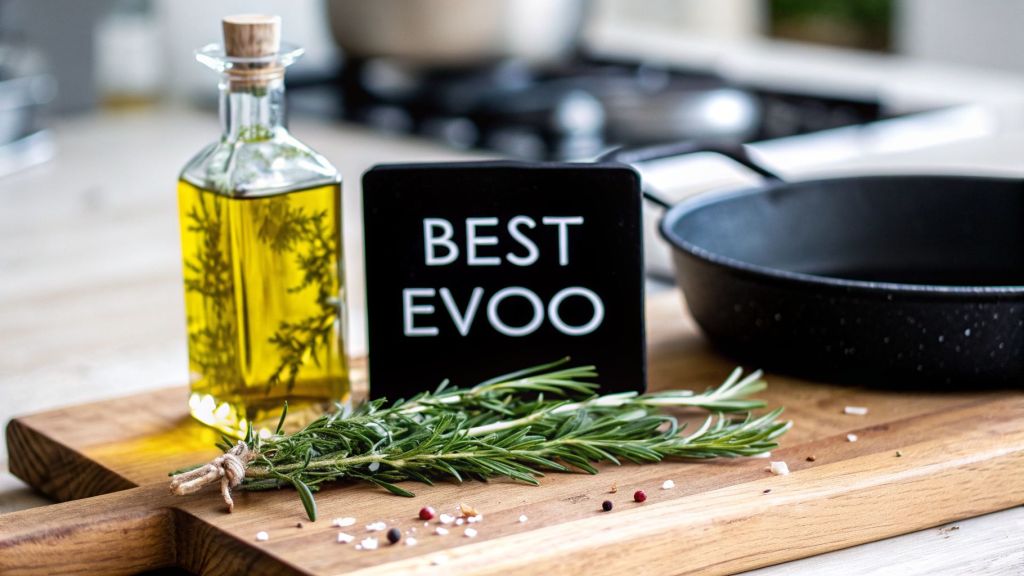
The truth is, the best EVOO for cooking isn’t a single, magical bottle. It's an idea. And the idea is this: match the right oil to the right job. A bold, peppery oil that’s perfect for searing a steak would utterly overwhelm a delicate piece of fish. Your search for the perfect oil ends not when you find one bottle, but when you begin building a small, versatile collection—just like a chef.
Your Search for the Best EVOO for Cooking Ends Here

Have you ever stood in the olive oil aisle, paralyzed by the wall of green glass before you? You are not alone. The labels whisper promises of tradition while the prices range from suspiciously cheap to shockingly dear. It's a confusing, often frustrating experience.
But what if you could walk down that aisle with the quiet confidence of a chef? What if you had a knowledgeable friend to cut through the marketing noise and reveal the simple truths that unlock spectacular flavor? This guide is that friend.
The Real Secret of the Pros
Let me tell you a secret the world's best chefs and seasoned home cooks live by: the very idea of a single "best" olive oil is a myth. The question they ask is not, "What's the best EVOO?" It is, "What am I cooking with it today?"
This tiny shift in thinking is the key. It changes you from a passive buyer, hoping for the best, into an active cook making a strategic choice. This is how you unlock the door to a more flavorful kitchen.
This journey isn't about chasing the most expensive bottle. It's about arming you with the knowledge to make smarter choices—choices that will elevate your cooking from routine to remarkable. And people are catching on; the global extra virgin olive oil market is projected to reach an astonishing USD 34.17 billion by 2034, driven by home cooks just like you. This number reveals a powerful truth: great EVOO is no longer a luxury, but a cornerstone of the modern kitchen.
Turning Confusion into Confidence
Our promise is to replace your confusion with confidence. We will demystify everything from flavor profiles and freshness dates to the misunderstood science of heat stability. By the time you're done, you will stop guessing and start cooking with thrilling new intent.
You will have a profound new understanding of this liquid gold. Should you wish to journey even deeper, our complete guide on how to buy olive oil awaits.
Let us begin. Your adventure into a world of incredible flavor starts now.
Finally Busting the Great Smoke Point Myth
For years, a single, stubborn piece of misinformation has robbed home cooks of their most flavorful ingredient. You’ve heard the warning, passed around like a dark kitchen secret: "Don't cook with extra virgin olive oil—its smoke point is too low!"
It’s a lie. A lie repeated so often it has taken on the feel of truth. Let’s expose it, once and for all.
This misguided advice has likely stolen more flavor and health benefits from your food than you can imagine. The idea that a single temperature defines an oil’s fitness for cooking is a gross oversimplification—a marketing ghost story that has haunted kitchens for decades. It’s time to turn on the lights.
The truth is, the best EVOO for cooking is not some fragile flower. It’s a heavyweight champion disguised as a lightweight.
Stability Is the Real Measure of Strength
What is smoke point? Merely the temperature where an oil begins to break down and smoke. But that number, in isolation, tells you almost nothing about how an oil will perform in your pan. The far more critical factor is oxidative stability.
Think of it this way: smoke point is how quickly someone gets startled. Stability is how they handle sustained pressure. A highly refined seed oil may have a high smoke point—it doesn’t “startle” easily—but it can degrade and form harmful compounds much faster under heat because it lacks inner strength.
True, high-quality extra virgin olive oil is saturated with powerful antioxidants (polyphenols) and composed of stable monounsaturated fats. These are nature’s bodyguards. They shield the oil from heat damage, making it remarkably stable and safe for nearly all home cooking.
This natural fortification is what separates a superior cooking oil from the pretenders. While refined oils are stripped of these protective compounds, real EVOO retains them, giving it the backbone to stand up to the heat of your kitchen.
Putting EVOO to the Test
What does this mean for you, standing at your stove? Freedom. It means that beautiful bottle of EVOO on your counter is not just for salads.
- Sautéing and Pan-Frying: Most sautéing happens around 350°F (177°C), well within the safe zone for good EVOO. Its stability ensures it won’t break down while it infuses your food with incredible flavor.
- Roasting Vegetables: We roast between 375°F to 425°F (190-218°C). The antioxidants in the oil not only protect it from the heat but transfer to your food, boosting its nutritional power.
- Shallow-Frying: Yes, even shallow-frying. Mediterranean cooks have done it for centuries, and for good reason. It works beautifully.
Scientific studies have confirmed it time and again: when heated, high-quality EVOO is one of the most stable cooking oils available, consistently outperforming many seed oils marketed for their high smoke points. To see the data for yourself, this breakdown of cooking oil smoke points offers a great visual comparison.
The verdict is in. The myth is busted. Grab a quality extra virgin olive oil and cook with the confidence you deserve.
Matching the Oil to Your Mission
Imagine your pantry is a casting director’s office. You wouldn't cast a soft-spoken character actor for a bombastic action role. The same logic applies to choosing an extra virgin olive oil. The art is not in finding one "best" oil; it’s in casting the right flavor profile for the part.
This is where you graduate from simply buying "olive oil" to cooking with strategy and instinct. It’s where you learn to trust your own palate and master a few simple principles that will make you a far better cook.
When you match the oil to the dish, both the food and the fat are allowed to shine. This principle is a cornerstone of culinary traditions built on flavor and well-being, like the many delicious recipes centered on healthy fats like olive oil.
The Flavor Spectrum of EVOO
Extra virgin olive oil is not one thing; it is a beautiful spectrum of intensity. Let's forget the jargon and think of it in three simple acts: delicate, medium, and robust.
-
Delicate (or Mild): These are the smooth, buttery, mellow oils. They whisper. With a gentle fruitiness and almost no bitterness or peppery finish, they are the perfect supporting actor, never stealing the scene.
-
Medium: Here lies perfect balance. You'll find distinct fruity notes, a pleasant bitterness, and a peppery tickle in the back of your throat. These are your versatile players, getting along with nearly every ingredient you introduce them to.
-
Robust: These are the big, bold personalities. Expect intense fruitiness, a pronounced bitterness (like good dark chocolate), and a strong, peppery kick that might even make you cough. That kick is the calling card of a high polyphenol count—a very, very good thing.
This chart reveals how an oil's quality—directly linked to its flavor and antioxidant levels—impacts its stability under heat.

The secret it reveals: high-quality, antioxidant-rich EVOO—which happen to be the more flavorful and robust oils—are naturally more stable and better suited for cooking.
Putting Flavor Pairing into Practice
Once you feel these profiles, pairing becomes second nature. Your goal is either harmony, where flavors blend seamlessly, or a delicious contrast that makes the entire dish sing.
A delicate oil is your secret weapon for baking, whisking into homemade mayonnaise, or finishing mild foods like flaky white fish. It adds richness without ever getting in the way.
Your medium-bodied oil is the kitchen workhorse. It is fantastic for sautéing vegetables, building a bright vinaigrette, or roasting a chicken. Its flavor is confident enough to be noticed but polite enough not to dominate. We explore these all-around uses in our guide to olive oil types for cooking.
Reserve your robust oils for dishes that can stand up to them. Drizzle it over a sizzling steak, a hearty bean soup, or bitter greens. The oil’s peppery notes will slice through the richness and elevate every single bite.
How to Read an Olive Oil Bottle Like an Expert
Think of an olive oil label as having two sides: the front is marketing, the back is truth. The front shows you beautiful Tuscan hills. The back, however, tells the real story, separating the truly great cooking oils from the imposters.
Learning to decipher this fine print is the single most powerful tool you have to ensure the oil you bring home is fresh, authentic, and worth your money.
Freshness Is Everything: Look for the Harvest Date
If you learn only one thing from this guide, let it be this: ignore the “Best By” date. This date is often set two years (or more!) after bottling and tells you nothing about when the olives were picked. Olive oil is a fresh fruit juice; it begins to age the moment it’s made.
The one date that truly matters is the Harvest Date. This is your North Star. It tells you exactly when the olives were picked and pressed. Always hunt for the most recent harvest you can find, ideally within the last year. An oil harvested in late 2023 will be leagues better than one from 2022, even with identical "Best By" dates.
A clear, recent Harvest Date is the single greatest sign of a producer’s commitment to quality. It is a signal of confidence. It means they have nothing to hide.
If a bottle lacks a harvest date, you are flying blind. Put it back. It's a risk you don’t need to take.
Decoding Key Terms and Certifications
Once you’ve found a fresh oil, a few other clues on the label can reveal its quality. These aren't just buzzwords; they represent real standards that impact flavor and health.
- Cold-Pressed or Cold-Extracted: This is your guarantee that no high heat was used during extraction, a process that can destroy delicate flavors and beneficial antioxidants. Seeing this on the label is a reassuring sign of quality.
- Country of Origin: Look for specificity. A single country, or better yet, a specific region like Tuscany, Italy, or Andalusia, Spain, is what you want. Vague terms like “Product of Mediterranean Countries” are a red flag for a blend of oils of varying quality from unknown sources.
- Seals of Authenticity (PDO/PGI): A seal like the European Union’s Protected Designation of Origin (PDO) is a rock-solid guarantee. It is a legal certification that the oil was grown, processed, and prepared in a specific region using traditional, time-honored methods.
These details matter. Consumers are demanding authenticity, which is why extra virgin olive oil now commands a massive 52.8% of the European market share, and its global market hit USD 1,568.05 million in 2024. This growth is fueled by regulations like PDO that give people confidence they value pure and authentic olive oil.
Arm yourself with this knowledge, and you will never see the olive oil aisle the same way again. To become even more discerning, learn how to interpret every detail on an olive oil label. You will soon spot the genuine articles from the imposters in seconds.
How to Protect Your Liquid Gold at Home

Bringing a beautiful bottle of extra virgin olive oil home is just the start. The work of preserving its vibrant flavor begins the moment it crosses your threshold. How you store it makes all the difference between an oil that elevates every dish and one that becomes a sad, rancid shadow of its former self.
Think of your oil as a fresh-squeezed juice, not a shelf-stable commodity. It is a living ingredient. To keep it at its peak, you must protect it from its three mortal enemies: light, heat, and air.
Defending Your Oil from Its Three Enemies
The good news is, protecting your oil is simple. It just requires mindfulness and breaking a few common kitchen habits.
-
Light is a killer. Direct sunlight or even bright kitchen lights trigger photo-oxidation, a process that rapidly destroys quality and taste. This is why you must never buy EVOO in a clear glass bottle. A quality producer knows this and will use dark green glass or an opaque tin. Your job is to keep it in a dark cabinet or pantry.
-
Heat accelerates decay. Storing your olive oil next to the stove is the most common mistake in the kitchen. That convenient spot is a death sentence for flavor. Constant heat—the same goes for spots near a dishwasher or sunny windowsill—speeds up oxidation. Its ideal home is a cool, dark place.
-
Air causes rancidity. Oxygen is the final enemy. Every time you open the bottle, air rushes in and begins to degrade the oil. Get into the habit of sealing the cap tightly the moment you're done pouring. Never leave it open on the counter while you cook.
The rule is simple: cool, dark, and sealed. Treat your olive oil with the same care you would a fine wine, and it will reward you with exceptional flavor down to the very last drop.
Mastering these steps is the key to getting your money's worth. For an even deeper dive, our guide to perfecting your olive oil storage has you covered. By protecting your investment, you ensure the best EVOO for cooking stays that way from the first pour to the last.
Getting Down to Brass Tacks: Your EVOO Cooking Questions
Alright, we’ve covered the big ideas. But experience tells me that even when you understand why EVOO is great for cooking, a few practical questions always remain. It’s one thing to know the theory; it’s another to stand at the stove. Let's tackle the most common questions head-on so you can cook with total confidence.
So, Can I Really Fry with Extra Virgin Olive Oil?
An enthusiastic yes. This is the most stubborn myth, so let's put it to rest. A quality EVOO is incredibly stable under heat, far more than you’ve been led to believe. Its secret weapon is a one-two punch: a high concentration of stable monounsaturated fats and a payload of protective antioxidants.
These natural compounds are bodyguards, protecting the oil from breaking down. This makes EVOO a fantastic, and frankly more flavorful, choice for pan-frying and even shallow-frying. The key is to do what you'd do with any oil: use a fresh bottle and watch your temperature. As long as you stay below its smoke point (around 375–410°F or 190–210°C for good EVOO), you're golden. People in the Mediterranean have been doing this for millennia—they knew something.
Does Heating Destroy All the Health Benefits?
Not even close. While very high, prolonged heat can diminish some of the most delicate polyphenols, the core of what makes EVOO healthy—its stable monounsaturated fat—remains perfectly intact.
But here’s something even better: research shows those powerful antioxidants don't just protect the oil; they migrate into the food you're cooking. When you sauté vegetables in EVOO, you're not just cooking them; you are infusing them with extra nutrients. You get far more nutritional value than you ever would from a highly refined, empty-calorie seed oil.
The real takeaway is this: cooking with EVOO doesn’t erase its goodness. In many ways, it shares that goodness with your entire meal, making it better in both flavor and nutrition.
What's the Real Difference Between a "Finishing" and a "Cooking" Oil?
I think of it like wine. You might have an affordable, reliable bottle for a weeknight dinner, and a special, more complex bottle you save to savor.
- A "finishing" oil is your special bottle. It’s usually a more expensive, robust EVOO with powerful aromas and a peppery kick. You use it raw to let that character shine—drizzled over a finished steak, a bowl of soup, or fresh tomatoes. You're paying for its vibrant, raw personality.
- A "cooking" EVOO is your trusty weeknight bottle. It can still be a great quality oil, but perhaps with a milder flavor profile and a more accessible price, making it perfect for sautéing, roasting, or whisking into a vinaigrette.
But these aren't strict rules. Gently poaching a beautiful piece of fish in a pricier, robust oil can be a game-changer, infusing the dish with incredible depth. The best EVOO for cooking is often just the one that gets you excited to get in the kitchen and play.
At Learn Olive Oil, we believe that true understanding of your ingredients is the first step toward incredible food. We're here to help you explore the nuances of authentic, high-quality olive oil. To continue your journey and become a more confident, flavorful cook, explore our other guides.
 Learn Olive Oil
Leave a comment