You’ve been there. Staring at the giant two-liter jug of Kirkland Signature Extra Virgin Olive Oil in the middle of a bustling Costco. You glance at the price tag, and a single, nagging question burns in your mind: How can something this good be this cheap?
It’s a suspicion born from years of being told “you get what you pay for.” But in this rare case, I’m here to tell you that your skepticism, while understandable, is misplaced. The answer is a resounding yes. This olive oil is the genuine article. And that impossibly low price isn’t a red flag. It’s the cornerstone of one of the most brilliant plays in modern retail.
Why Costco's Olive Oil Is a Shopper's Secret Weapon

That flicker of disbelief you feel when you see the price? That’s precisely the emotion Costco is banking on. Their olive oil isn't just another product on the shelf. It is a foundational pillar of their business, a secret weapon meticulously engineered to win your unwavering trust and loyalty. Retail insiders call this the "halo effect."
Think of the olive oil as their Trojan horse of value. Costco is willing to accept a paper-thin profit—and sometimes, no profit at all—on this single item. They know that if you make a special trip for the astonishing deal on olive oil, you won’t just leave with that one bottle. Before you know it, your cart is also laden with fresh ciabatta, a wedge of imported Parmesan, a bag of organic spinach, and a fine Chianti to complete the perfect meal.
The Proof Is in the Price Tag
This isn't some dusty business school theory; it’s a strategy we see them deploy in real-time. Consider what happened in 2025: Costco sent shockwaves through the market by slashing the price of its coveted Kirkland Signature Organic Extra Virgin Olive Oil from $24.99 down to an incredible $18.39 in a single quarter. That’s a staggering 26.4% price drop.
Such moves are never random. They are the "halo effect" in full force—using an essential, high-demand product to cast a golden glow of value over the entire store.
Costco’s objective isn’t to make a fortune on olive oil. Their objective is to make you a customer for life, one who sees them as the undisputed champion of value. The olive oil is the irrefutable proof.
This business model is what sets them apart. While lesser brands are forced to compromise on quality to compete on price, Costco leverages its colossal buying power to source superior oil and pass the savings directly to you. It’s a major reason it consistently appears on lists of the best inexpensive olive oil on the market.
So, as we delve into the secrets behind where this oil comes from, how it tastes, and what its label truly reveals, remember this: that incredible price isn’t a warning. It’s a green light, inviting you to seize one of the best deals in the entire grocery universe.
How to Read a Kirkland Olive Oil Label Like an Expert

Imagine an olive oil label as its resume. It holds the key to its entire history, but only if you know how to read between the lines. When you pick up a bottle of Kirkland olive oil, you are holding its autobiography—a story that stretches from a sun-drenched grove to your kitchen shelf. Let's translate it together.
Your first mission is to locate the three most important words: "Extra Virgin Olive Oil." This isn't marketing fluff; it’s a legally binding grade. It is a sworn promise that the oil was extracted using only mechanical means—no harsh chemicals, no high heat—a critical process for preserving its delicate flavors and life-giving health benefits.
Decoding Dates and Certifications
Now, for the insider’s secret that separates the novice from the pro: ignore the "Best By" date. The single most crucial piece of information on any bottle of high-quality olive oil is the harvest date. Think of olive oil not as a fine wine that improves with age, but as fresh-squeezed fruit juice. It is at its absolute peak within 18 months of the day the olives were plucked from the tree. The harvest date is the oil’s birth certificate, revealing its true freshness.
Next, hunt for official seals. These are your independent guarantors of quality and origin, and you'll often find several on Costco's labels.
- USDA Organic: This seal is your steadfast assurance that the olives were cultivated and the oil was produced without synthetic pesticides or fertilizers. For anyone who prioritizes clean eating, this seal is non-negotiable.
- PDO (Protected Designation of Origin): This is a premier certification from the European Union. When you see this on a Kirkland bottle, like their "Terra di Bari Bitonto," it is an ironclad guarantee that everything—from the growing and harvesting of the olives to the pressing and bottling of the oil—occurred in that specific, named region of Italy. It is a promise of authentic local character.
An olive oil label is a promise. Seals like PDO and USDA Organic are the independent witnesses ensuring that promise is kept, telling you exactly where your food comes from and how it was made.
The Power of Knowing the Source
This level of transparency is a cornerstone of the trust the Kirkland Signature brand has built. By providing crystal-clear origin information, Costco gives you a direct line of sight from a sun-drenched Italian grove right to your shopping cart. It’s this profound trust that has allowed Kirkland to build a fortress-like reputation for delivering serious quality without the punishing price tag.
The strategy is undeniably effective. The brand's relentless focus on quality, purity, and traceability fueled its meteoric rise from $75 billion to a jaw-dropping $90 billion in sales in a single year. That kind of explosive growth demonstrates just how deeply consumers value knowing what’s in their food.
Learning to decode these details empowers you to choose a superb bottle, every single time. To go even deeper, explore our comprehensive guide on how to read any olive oil label like a pro, which uncovers even more secrets you might find.
The Authentic Taste Test: What Kirkland Olive Oil Reveals
To truly understand an olive oil, you must approach it not as a simple pantry staple, but as you would a fine wine. And no, you don't need a sommelier's gifted palate. All it takes is a spark of curiosity to finally hear what the oil is trying to tell you. Here, we venture beyond the price tag on a bottle of Costco olive oil and discover its true soul.
The first rule: put down the bread. To genuinely taste the oil, you must taste it alone. Professionals use a specific ritual for this, but it’s remarkably simple to replicate at home. Once you try it, I promise you will never look at olive oil the same way again.
The Professional's Tasting Method
Pour about a tablespoon of oil into a small glass; a wine glass or even a shot glass will do nicely. Cup the glass in your hands, allowing your body heat to gently warm the oil. This awakens its fragile aromatic compounds, releasing its full bouquet.
Swirl it gently. Bring the glass to your nose and inhale deeply. What secrets does it reveal? The scent of a freshly mown lawn? Green banana? The faintest hint of tomato vine?
Now, for the most vital step—the slurp. Take a small sip of oil while simultaneously sucking in a bit of air. It may feel strange (and sound a little noisy!), but this single action atomizes the oil across your entire palate, allowing you to experience its full spectrum of flavors. For a masterclass, see our complete guide on how to taste olive oil like an expert.
You are searching for three key sensations. The presence and harmony of these attributes are what separate a world-class extra virgin olive oil from a merely average one.
- Fruitiness: This is the pure aroma and flavor of fresh, healthy olives. It can range from delicate and buttery (like ripe banana) to robust and green (like artichoke or fresh-cut grass).
- Bitterness: That subtle bitter note you detect on the sides of your tongue is not a flaw—it’s a badge of honor! It signals that the oil was made from green, unripe olives and is bursting with healthy antioxidants.
- Pungency: This is the peppery kick or sting you feel at the back of your throat. It might even make you cough. That sensation comes from oleocanthal, a powerful natural anti-inflammatory compound. A good cough is a very good thing!
What the Kirkland Profile Reveals
So, what does this ritual tell us about Kirkland's olive oil? While the profile can vary slightly with each harvest, a tasting of their celebrated Kirkland Signature Organic Extra Virgin Olive Oil P.D.O. from Terra di Bari Bitonto is truly illuminating.
This oil presents itself as a beautifully balanced medium-intensity oil. On the nose, it is buttery and slightly sweet, with distinct notes of ripe banana and a green whisper of artichoke. When you taste it, that initial softness gives way to a pleasant, creeping bitterness.
But the finish is where the story culminates. A robust, peppery pungency grabs you in the back of the throat and lingers—the classic calling card of high-quality Coratina olives, which are legendary for their sky-high polyphenol content. It’s a revelatory experience for a novice taster: you get the inviting fruity notes up front, followed by that signature throat-burn that screams "this is a healthy, well-made oil!" This impressive quality is a major force behind the brand's success, a topic explored in this deep dive into Costco's sales on chowhound.com.
This balanced character makes the oil astonishingly versatile. It’s gentle enough to drizzle over delicate fish but has enough of that peppery backbone to stand up to a hearty stew or a rich pasta sauce, making it a true workhorse in any kitchen.
The Secret Behind Costco's Unbeatable Olive Oil Value
Have you ever stood in that Costco aisle, staring at the price of their Kirkland Signature olive oil, and thought, "This makes no sense"? Especially as your grocery bill everywhere else seems to be on a one-way trip to the moon. It’s not magic. It’s not a pricing mistake. It is the result of a masterfully executed retail strategy that most competitors can only envy.
The secret isn’t one thing. It's a powerful trifecta: colossal buying power, shrewd global sourcing, and a business model that prizes sheer volume over high margins.
This combination gives Costco an almost unfair advantage. While other stores buy olive oil by the case, Costco negotiates for entire shipping containers. In some instances, they commit to buying a producer's entire harvest for the season. This monumental scale gives them a level of negotiating power that smaller retailers can only dream of.
It’s the difference between a neighborhood bakery buying a 50-pound bag of flour and a commercial plant buying it by the trainload. The plant pays a fraction of the price per pound. Costco applies that same ruthless logic to sourcing high-quality olive oil from the world's most revered groves.
This chart reveals what we seek in a quality Extra Virgin Olive Oil—the harmonious balance between fruitiness, bitterness, and pungency. These are the definitive hallmarks of fresh, healthy olives and a meticulously crafted oil.

Each of these attributes tells a part of the oil's story, from its quality and freshness to its profound health benefits.
Navigating a Volatile Global Market
Costco’s sheer size also serves as a powerful shield against the turbulence of the global olive oil market—the very chaos that sends prices at other stores soaring. We witnessed this firsthand during the recent supply chain crises.
Even as catastrophic weather hammered harvests in Spain and Italy through 2025, triggering global supply shocks, Costco’s shelves remained dependably stocked. More importantly, their prices held steady. A stunning example was their August 2025 two-pack deal for $16.99, a 23% markdown from the usual $21.99. That’s a world away from the $18-24 you’d pay for a single bottle of comparable quality at a specialty store like Whole Foods. As detailed in this analysis of Costco's market strategy, this isn't luck; it's by design.
This is the very heart of Costco's covenant with its members. They flex their immense scale not just to secure a lower price, but to create a fortress against market volatility. It’s how they make exceptional food accessible to everyone.
When you break it down to simple math, the savings become impossible to dispute. A straightforward price-per-ounce comparison lays bare the staggering value you receive. Kirkland consistently delivers certified, single-origin oil for far less than what competitors charge for their basic, often generic, blends.
Price Per Ounce Showdown: Kirkland vs. Competitors in 2026
Let's put some hard numbers to this. The table below illustrates what you can expect to pay for EVOO across different retailers in 2026. The chasm in value becomes undeniable when you compare the cost per ounce.
| Retailer/Brand | Typical Bottle Size (oz) | Average Price | Price Per Ounce |
|---|---|---|---|
| Specialty Importer | 16.9 oz | $24.99 | $1.48 |
| Whole Foods 365 | 33.8 oz | $21.99 | $0.65 |
| California Olive Ranch | 25.4 oz | $17.99 | $0.71 |
| Kirkland Signature | 67.6 oz (2L) | $22.99 | $0.34 |
As you can see, the savings aren't just a few pennies. Choosing Kirkland over a specialty brand can slash your cost by more than 75%.
This is not a mere discount; it is a paradigm shift. For a family that uses olive oil daily, that difference could easily translate into hundreds of dollars in savings over a year—all without sacrificing a single drop of quality. This is the pricing wizardry that ensures nearly every Costco olive oil review reaches the same inescapable conclusion: the value is, quite simply, unbeatable.
Bringing Health and Flavor Into Your Kitchen
A bottle of real extra virgin olive oil is infinitely more than just another cooking fat. It is one of the sacred pillars of the famously healthy Mediterranean diet, and for very good reason. Its profound benefits can be distilled down to two key components that make it a powerhouse for your body.
First, you have the monounsaturated fats. These are the "good fats" celebrated for their role in supporting healthy cholesterol levels. It's the primary reason a diet rich in high-quality olive oil is so intimately linked with superior heart health.
But the true secret weapon? The polyphenols. These are potent antioxidants that work tirelessly behind the scenes to combat inflammation and oxidative stress. In a beautiful twist of nature, the very compounds that give a great olive oil its signature peppery finish are the same ones working to protect your health.
A Pantry Essential for a Reason
This isn’t just ancient wisdom; it has become a stark modern reality. The global health crisis of 2020 fundamentally reshaped how people approached their pantries. Suddenly, having a kitchen stocked with reliable, health-fortifying staples wasn't just a convenience—it was a necessity.
Costco’s own olive oil buyer, Lucas Stanuch, reported a massive surge in sales during that period, as consumers actively sought out quality they could depend on. The brand's unwavering commitment to traceability and high standards had already built a deep reservoir of trust—a trust that paid off immensely when people began scrutinizing what went into their bodies.
In a world awash with confusing health fads, extra virgin olive oil remains a simple, delicious, and powerful way to invest in your well-being. Its benefits aren't a fleeting trend; they are a time-tested truth.
Getting the Most From Every Drop
While the health benefits are compelling, that’s only half the story. The true joy of using a great olive oil lies in its power to elevate your cooking from merely good to truly unforgettable. But to unlock this magic, you must use the right oil for the right job. You can delve into the science in our complete guide to olive oil health benefits.
Think of it as a culinary art form—marrying the oil's unique character to your dish.
- For Finishing: A robust, peppery oil like the Kirkland P.D.O. was born for this role. A generous drizzle over a finished steak, a hearty soup, or a simple plate of pasta adds a bold, pungent exclamation point that completes the dish.
- For Dressings: The vibrant, fresh flavor is perfect for creating dynamic vinaigrettes. Simply whisk it with lemon juice, salt, and perhaps a touch of mustard for a dressing that breathes life into any salad.
- For Everyday Cooking: For tasks like baking or gentle sautéing, you might prefer a milder, more buttery olive oil. It adds sublime moisture to an olive oil cake without overpowering it and is ideal for cooking delicate fish or vegetables.
To truly discover what your Kirkland olive oil can do, begin experimenting with it in your kitchen. Try it in some of these easy Mediterranean recipes to feel its versatility. Whether it forms the base of a marinade or provides the final flourish on a roasted dish, understanding its personality is the key to making every single drop count.
Protect Your Investment and Preserve Your Olive Oil

Congratulations. You’ve just brought home one of the shrewdest purchases in the entire grocery world. Now, the real work begins: protecting it. The fastest way to transform a brilliant extra virgin olive oil into a flavorless, rancid disappointment is to fall victim to a few common storage sins.
It helps to think of your beautiful Kirkland oil as a bottle of fresh-squeezed juice, not a jar of pickles. Its vibrant, peppery character is precious and, sadly, perishable.
The greatness of your oil is under constant assault from three mortal enemies: light, heat, and air. These are the sworn nemeses of good olive oil, working around the clock to strip away its flavor, demolish its health benefits, and turn it rancid.
The Three Golden Rules of Preservation
You know that bottle of oil sitting conveniently next to your stove? As a food professional, that sight sends a shiver down my spine. The relentless heat from the burners and the ambient light from your kitchen are a death sentence for your oil, dramatically accelerating its decay.
This is precisely why any honest Costco olive oil review must acknowledge the dark green bottle Kirkland uses. That isn't a stylistic choice; it’s a critical first line of defense against the ravages of light.
Your olive oil is a living product. Treat it with the same care you would give to fresh produce, and it will reward you with extraordinary flavor and health down to the very last drop.
To truly safeguard your oil and understand how long cooking oil lasts and how to store it safely, you must win the war against its primary foes. Here is your battle plan:
-
Defeat the Heat: Find a cool, dark home for your main bottle, such as a pantry or cupboard—anywhere far from the stove, oven, or a sun-drenched windowsill. The ideal storage temperature is around 57°F (14°C).
-
Block the Light: Always keep the oil in its original dark bottle or transfer it to another opaque container. Light is a potent catalyst for oxidation, the chemical reaction that creates those foul, stale flavors.
-
Limit the Air: Oxygen is the final assassin. The moment you break the seal, air begins to degrade the oil. This is where buying a large jug from Costco requires a professional move: decant a small amount into an opaque cruet or dispenser for daily use. Keep the large bottle sealed tightly and tucked away to minimize its exposure to air.
For a deeper dive, our guide on proper olive oil storage contains even more expert strategies. Follow these simple rules, and you will guarantee the last drizzle from your bottle is as magnificent as the first.
Common Questions About Costco Olive Oil Answered
Even with a mountain of glowing reviews, I understand. You might still be eyeing that giant two-liter jug with a healthy dose of skepticism. It’s smart to ask questions, especially when a deal seems this good. Let's tackle the most common questions I hear, so you can make your purchase with absolute confidence.
Is Kirkland Signature Olive Oil Really Extra Virgin?
Yes. Unquestionably. This isn't just a hollow claim on a label; it has been proven, time and time again. Over the years, numerous independent labs have subjected Kirkland's Organic Extra Virgin Olive Oil to rigorous testing. It consistently meets—and often surpasses—the strict chemical and sensory standards required for the "extra virgin" classification.
Costco’s strategy of forging direct partnerships with reputable producers and maintaining an iron grip on its supply chain is the secret to this consistency. They aren’t just slapping their label on any random oil; they have engineered a system that guarantees quality from the olive grove all the way to your shelf.
The "extra virgin" label is a promise of purity and quality. Kirkland's oil has repeatedly proven it lives up to that promise, making it a reliable choice for any kitchen.
Can You Cook With Costco's Extra Virgin Olive Oil?
You bet, and you absolutely should! A persistent myth claims you shouldn't cook with extra virgin olive oil, but it ranks among the greatest falsehoods in the culinary world.
A high-quality EVOO like Kirkland's has a smoke point between 375–400°F (190–204°C). That range is more than sufficient for almost every task in a home kitchen, from sautéing vegetables and pan-searing chicken to roasting and even light frying. While its bright, fresh flavor is spectacular for drizzling, you should never hesitate to use it as your everyday cooking workhorse.
How Long Does The Big Bottle Last Once Opened?
Once you break that seal, the countdown begins. To experience the oil's peak flavor and reap its full health benefits, you should aim to use it within 3 to 4 months. Oxygen is the great enemy of fine olive oil.
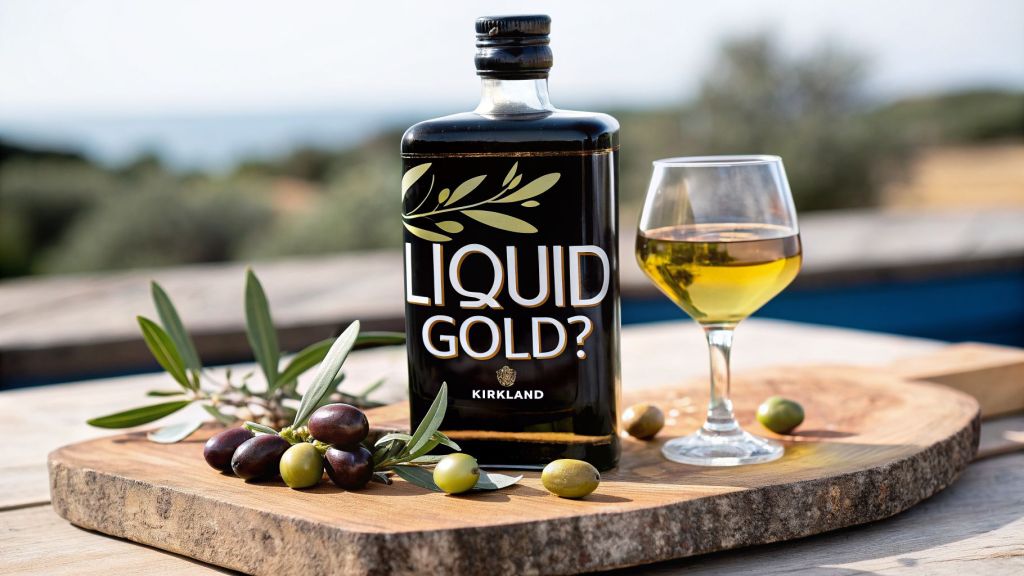
The secret is proper storage: always in a cool, dark place like a pantry, and never next to the stove. If you know you won't get through the large bottle that quickly, here’s a pro tip: pour a smaller amount into a decanter for daily use, and keep the main bottle sealed up tight. This simple act starves the oil of oxygen and keeps your "liquid gold" tasting magnificent for longer.
At Learn Olive Oil, we believe that understanding what's in your bottle is the first step toward a more flavorful and healthy kitchen. Discover more expert insights and elevate your appreciation for this liquid gold at https://learnoliveoil.com.
 Learn Olive Oil
Leave a comment